




Abstract
Abstract
Removal of some heavy metals during thermal treatment of a model solid waste under different ambient gases (carbon monoxide [CO], nitrogen [N2], and air) was studied. Compared with the removal under N2 and air, removal of cadmium was significantly enhanced by CO at temperatures of 700°C and 800°C. Nickel removal was highest at 700°C, whereas removal of lead and zinc was highest at 800°C, also under CO. The enhancement trend correlated with the evaporation temperatures of the zero-valent forms of the metals. These show the potential of thermal treatment with a reducing CO gas in removing some heavy metals from solid wastes.
Introduction
Thermal treatment to remove heavy metals from solid waste capitalizes on the increased metal volatility at high temperatures. But to minimize energy requirement, preconversion of the metal to more volatile species, such as chloride salts, is generally considered. Up until now, most studies on thermal treatment of heavy metal contaminated solids such as fly ash and municipal wastes utilize chloride addition to improve metal removal (Jakob et al., 1996; Nishii et al., 2007; Nowak et al., 2012; Yu et al., 2012; Kubonova et al., 2013). During purification of metallic ores, carbon monoxide (CO) has been used as a reducing agent to generate zero-valent species with lower vaporization temperatures (Halvorson and Peters, 1969; Upadhya, 1986). This facilitates their removal and subsequent recovery as pure metals. In this communication, the feasibility of employing this technique for maximum removal of certain heavy metals during thermal treatment of a model solid waste was evaluated. This study is the first to consider CO-assisted metal reduction at high temperature to address the heavy metal contamination of solid wastes. As a short communication, the experimental scope is limited to the comparison of metal removals at different ambient gas conditions including CO, nitrogen (N2), and air.
Materials and Methods
Preparation of model solid waste with kaolin
For model solid waste preparation, kaolin was used as a matrix to simulate metal-contaminated sediment, soil (Sawada et al., 2003), or fly ash. Heavy metal cations are assumed to bind with the kaolin surface by forming monodentate surface complexes with silanol and aluminol groups (Hiza and Apak, 2006). Approximately 50 g of kaolin was dispersed in a pH 6 aqueous solution containing a mixture of various metals including copper, Cu(II); lead, Pb(II); zinc, Zn(II); cadmium, Cd(II); iron, Fe(II); nickel, Ni(II); and chromium Cr(III) and allowed to stand for 1 day (Sawada et al., 2003). The employed metal concentrations allowed for a maximum theoretical incorporation of ∼500 μg/g kaolin. After overnight standing, the mixture was filtered and the spiked kaolin was dried inside a draft chamber for 3 days. Table 1 gives the concentration of the different heavy metals in the spiked sample.
Heavy Metal Content of Spiked Kaolin
Reported values are averaged of duplicate analysis runs.
Cd, cadmium; Cr, chromium; Cu, copper; Fe, iron; Ni, nickel; Pb, lead; Zn, zinc.
Furnace design
The heating reactor (Asian Laboratory Services, Tsukuba, Japan) consists of five major components: chamber, cold trap, water trap, gas adsorbent, and activated carbon (Fig. 1). The chamber is made up of quartz tube of 8,000 mL capacity. The rectangular quartz sample holder of 900 mL capacity is placed inside the chamber. An air compressor and gas tanks for N2 and CO are connected to the chamber to create the desired ambient gas during thermal treatment.
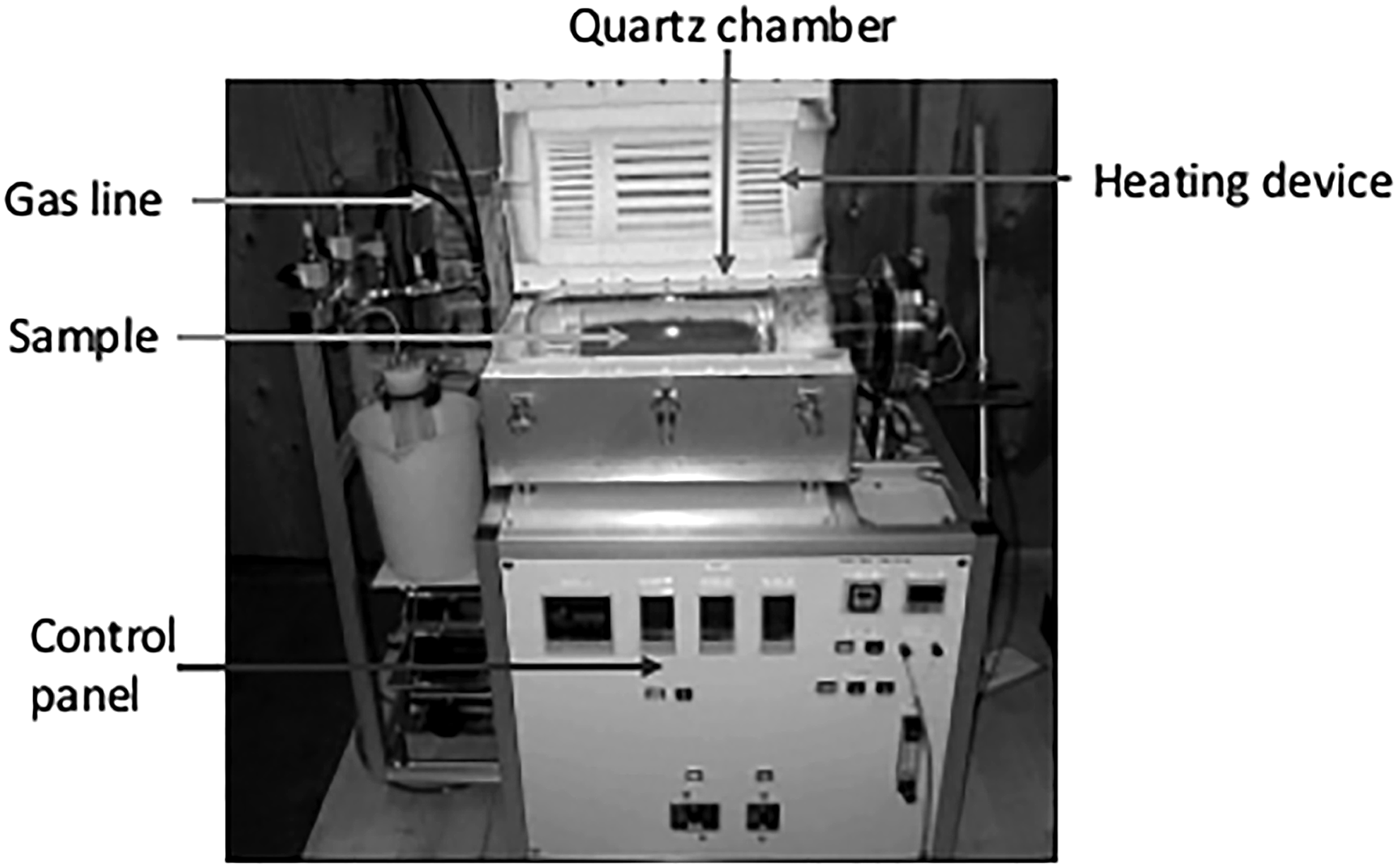
Design of furnace for thermal treatment.
Thermal treatment
A measured amount of metal-spiked kaolin was heated at 700°C and 800°C for 1.5 h (Nowak et al., 2012), under different gases (pure N2, pure CO, or air) in the glass furnace. CO and N2 gases were delivered through gas tanks. The gas flow rate was maintained at 1 L/min. The metal content of samples was determined before and after treatment.
Analytical methods
Heavy metal analysis
Heavy metal concentrations in the initial and treated residues were analyzed by Inductively Coupled Plasma Spectrometer (Nippon Jarrel-Ash) after acid digestion. The digestion procedure was performed according to American Public Health Association standard (Eaton et al., 1995). Analysis runs were duplicated and average values are reported.
Results and Discussion
Thermal treatment showed a significant removal of some heavy metals from the model kaolin sample. Greater decrease was achieved at the higher temperature of 800°C (Fig. 2). However, a more interesting effect was observed on the contribution of ambient gas on metal removal. At both analyzed temperatures, much higher removals were observed with CO.

Removal of different heavy metals from spiked kaolin by thermal treatment at different temperatures and under different gases. Reported values are averages of duplicate analysis runs. Cd, cadmium; CO, carbon monoxide; Cr, chromium; Cu, copper; Fe, iron; N2, nitrogen; Ni, nickel; Pb, lead; Zn, zinc.
Among the different heavy metals, Cd exhibited the highest removal under CO, reaching 97% and close to 100% at 700°C and 800°C, respectively. For both N2 and air, similar rates of Cd removal were observed, amounting to ∼40% and 55% at 700°C and 800°C, respectively. Such removal rates are significantly lower than those observed under CO flow. For Zn, removals under CO were 48% and 91% at 700°C and 800°C, respectively, corresponding to an almost 100% enhancement relative to N2 and air data. For Pb, removals were 22% and 79% with CO at 700°C and 800°C, respectively. Although only a slight enhancement relative to the other gases was attained at 700°C, a considerable increase of >200% was achieved at 800°C for Pb with CO. For Ni, metal removal under CO (74% and 62% at 700°C and 800°C, respectively) was at least 30% higher than in the presence of air and N2. Finally, for Fe and Cu, no significant enhancement in their removal with CO was observed. These results showed a general improvement of metal removal with CO. This was striking for Cd, Zn, Pb, and Ni. In past studies, a similar trend in fly ash samples has been reported and the effect was also pronounced for both Cd and Zn (Yoshiie et al., 2002).
The boiling point of metals varies according to their speciation. For metal oxide, this occurs at generally high temperatures >2,000°C. This may account for the lower metal removals in the presence of O2. This tendency has also been reported during the incineration of solid wastes (Yu et al., 2012). Metal chlorides in contrast have lower boiling points ranging from 700°C to 1,300°C (Kox and Van der Vlist, 1981). As mentioned earlier, researchers have exploited this difference by converting metal oxides to chlorides to improve their volatilization from solid wastes. In this connection, zero-valent metal species of some metals also have low vaporization temperatures. Foremost are Cd, Zn, and Pb with boiling points of 767°C, 907°C, and 1,750°C, respectively. The respective values for Cu, Ni, Cr, and Fe are much higher at 2,560°C, 2,910°C, 2,672°C, and 2,870°C, respectively (Yang et al., 1994). In this study, we have focused on the formation of zero-valent metal species through their reduction with CO to improve their vaporization. The reduction reaction equation is as follows:
The acquisition of zero-valency under CO was apparent from the mentioned metal removal tendency. Although detailed data on the fate and speciation of metals during treatment are not available in this study, the intriguing removal trend of Cd > Zn > Pb is highly correlated with their relative boiling points to indirectly support such conversion. The complete removal of Cd at 800°C, which is already more than its boiling point, provides strong evidence about its vaporization as Cd0. The highly enhanced yet incomplete removal of Zn and Pb confirmed that 800°C is still below the respective boiling points of their zero-valent species. Further tests are recommended to confirm the required temperatures for completely removing these metals in the presence of CO. Finally for Ni, the vaporization temperature of its zero-valent form is prohibitively high (2,910°C) to account for its improved removal with CO. Its higher removal enhancement relative to Fe, which has a comparable boiling point, is also quite anomalous. For these data, we can only postulate the propensity of any generated Ni0 to react with CO to yield a highly volatile carbonyl complex (Halvorson and Peters, 1969). Ni-carbonyl gas formation through the Mond process is an important technique for recovering Ni from its ores (Kazantsis, 1972; Shi, 1994).
Conclusion
Thermal treatment studies showed that CO significantly enhanced the removal of heavy metals such as Cd, Zn, Pb, and Ni from a model solid waste sample. Their reduction to zero-valent species with lower boiling points could account for the observed enhancements in removals in the presence of CO gas. Although this study only employed a model-spiked kaolin that represents a metal-contaminated soil, sediment, or fly ash samples, this approach may also find application in other metal-contaminated solid wastes as well. However, more detailed evaluations on the effects of higher temperatures and lower CO gas concentration on metal removals are necessary. Future studies to evaluate the fate of heavy metals during treatment are also important to assess the recovery aspect.
Footnotes
Author Disclosure Statement
The authors declare no conflict of interest.
Funding Information
No funding was received for this article.