




Abstract
Abstract
Sediment in the region of transitional waters (riverine-lacustrine) of the Lake Guaíba has physical and chemical diversity influenced by its tributaries and the water dynamic. The aim of this study was to characterize sediment characteristics of bottom sediments in this region of transitional waters and evaluate the relationship of these characteristics with pollution. Surface bottom sediments (0–5 cm), as composite samples (with three subsamples), were collected at six sites in the Lake Guaíba transitional waters (during June 2016) with a drag bucket sampler. These samples were dried and sieved (2 mm) and pH, bulk density, particle density, particle size, electrical conductivity, total organic carbon, total Kjeldahl nitrogen, bioavailable phosphorus, metals, and X-ray diffraction determined on sieved samples. Particle size of the bottom sediment decreased along the course from Jacuí's Delta to Lake Guaíba. Particle size had a strong influence on sorption potential of elements and compounds, increasing the values of carbon, nitrogen, phosphorus, and metals. Results indicate that particle size has a major influence on concentrations of metals in bottom sediments. Although these results indicate only a minor metal enrichment, they raise the possibility of punctual pollution in Lake Guaíba surpassing the natural quality. Concentrations of metals (especially zinc, copper, chromium, nickel, and lead) are largely controlled by particle size in the Lake Guaíba transitional waters and particle size differences are the result of depositional processes within the lake.
Introduction
High population densities in the metropolitan areas and the associated industrial and agricultural activities impact local water resources that often serve as a source of water to the same population. Metals are natural elements found in the soil and mineral matrix; however, they can be accumulated in the environment through anthropic pollution. Chemicals entering water bodies bind to suspended particles and are deposited in bottom sediments where they accumulate in concentrations many times greater than natural concentrations (Sharley et al., 2016; Zhou et al., 2017). These sediments formed by deposition of organic and inorganic particles that originate in metropolitan areas play an important role in aquatic ecosystems, affecting biogeochemical cycles, nutrients redistribution, and maintenance of environmental quality (Liu et al., 2016; Sharley et al., 2016).
Lake Guaíba is an urban shallow open lake located in the metropolitan region of Porto Alegre, the capital of Rio Grande do Sul State (RS), Southern Brazil (Fig. 1). It has served as the main water source for the capital since its foundation in the 18th century. Currently, the water of the Lake Guaíba has multiple uses such as water supply, wastewater dilution, recreation, fishing, and navigation. Lake Guaíba has an area (A) of 496 km2, volume (V) of 1.44 km3, mean depth (V/A) of 3 m, average discharge (Q) of 1,193 m3/s, water residence time (V/Q) of 14 days, and short-term average sedimentation rate (14C and 210Pb) of 6 mm/year (Laybauer, 2002). The lake is fed by the tributary rivers “Jacuí” (almost 85% of the water), “dos Sinos,” “Caí,” and “Gravataí.” Those rivers meet at the Jacuí's Delta, forming a transitional environment (from riverine to lacustrine), and this water flows through the Lake until reaching Patos Lagoon. The lake acts as a reservoir that receives significant water and sediment load and cannot be seen merely as an extension of its branch of rivers (Laybauer, 2002). The Lake Guaíba has many pollution sources that flow from the metropolitan region (industries and sewage), major through the Jacuí's Delta (de Andrade et al., 2018; de Andrade et al., 2019).

Map location of sediment samples on Lake Guaíba transitional waters. Darkest area in state map represents lake drainage basin.
The sediment in the region of transitional waters (riverine-lacustrine) of the Lake Guaíba has physical and chemical diversity influenced by its tributaries and the water dynamic. The aim of this study was to characterize the sediment characteristics of bottom sediments in this region of transitional waters and evaluate the relationship of these characteristics with the pollution. Specifically, we determined the extent to which metal concentrations of bottom sediments were controlled by distance from tributaries versus sediment characteristics within the lake.
Materials and Methods
Surface bottom sediment (0–5 cm), as composite samples (with three subsamples), were collected at six sites in the Lake Guaíba transitional waters (during June 2016) with a drag bucket sampler. Sampling locations (Fig. 1) were geolocated (Garmin GPSMAP®78s and GPS TrackMaker®v13) and Side Scan Sonar images (Humminbird Side Imaging®) were registered (Table 1; Fig. 3). The average bottom water temperature during sampling was 14.5°C.
Physical and Chemical Values in Bottom Sediment at Lake Guaíba Transitional Waters
Means followed by the same letter are not statistically different from each other by Tukey's test at 95% confidence. LOD: As – 2.0; Mo – 0.2; Se – 4.0 μg/g.
Cumulative distance between points.
Bathymetry.
pH CaCl2 (1:2.5).
EC (1:5).
Al, aluminum; As, arsenic; Ba, barium; Ca, calcium; Co, cobalt; Ds, bulk density; Dss, particle density; EC, electrical conductivity; Fe, iron; K, potassium; LOD, limit of detection; Mg, magnesium; Mn, manganese; Mo, molybdenum; Na, sodium; ND, not detected; P, phosphorus; Pt, platinum; Pt, total porosity; Se, selenium; TKN, total Kjeldahl nitrogen; TOC, total organic carbon; V, vanadium.
Sediment samples were returned to the laboratory, dried (45°C), and sieved (2 mm; with no presence of gravels). Sieved samples were analyzed for pH in calcium chloride (ratio 1:2.5, v/v), bulk density (Ds), particle density (Dss), particle size (pipette method), electrical conductivity (1:5, v/v), total organic carbon (TOC; Walkley–Black), total Kjeldahl nitrogen, and bioavailable phosphorus (P; Melich-1). Element concentrations (iron [Fe], aluminum [Al], calcium [Ca], magnesium [Mg], potassium [K], manganese [Mn], sodium [Na], barium [Ba], vanadium [V], zinc [Zn], copper [Cu], chromium [Cr], cobalt [Co], nickel [Ni], lead [Pb], arsenic [As], cadmium [Cd], molybdenum [Mo], and selenium [Se]) were assessed by acid digestion (HNO3–H2O2–HCl) according to the method EPA-3050B (USEPA, 1996) and the quantification was performed in ICP-OES (PerkinElmer® Optima™ 8300) using internal control standards (PSJ, PSJ-1, PSJ-2, and PM) of LAS-UFRGS to verify the quality. All analyses were performed in laboratory quadruplicate.
X-ray diffraction (XRD) analyses were made on powder blades (Bruker®D2-phaser) over CuKα radiation [λ = 1.54Å], steps 0.020°, and range 4 to 70 °2θ. Halite (H) was used as an internal indicator at 0.282 nm to characterize the Lake Guaíba sample set. The identification of minerals was performed according to Brindley and Brown (1980).
The geoaccumulation index (Igeo) is an indicator used as an empirical relationship of the degree of metal pollution (Muller, 1969). The index was determined following the equation: Igeo = log2 (Cn/1.5 × Bn); where Cn is the measured value of the metal in the sediment sample, Bn is the geochemical background level of element, and 1.5 is the background matrix correction factor to lithogenic effects (Chaharlang et al., 2016; Liu et al., 2016). The background (Bn) values were obtained from Laybauer (2002): Zn – 110; Cu – 27; Cr – 21; Ni – 32; Pb – 27 μg/g (HCl–HNO3–HF). The standardization by aluminum (metals/Al) was used to compensate the variations in metals concentrations due to different particle sizes; the Al is the metal most presented in the earth's crust.
Results were submitted to analysis of variance (ANOVA) and, when significant differences were indicated, means were compared by Tukey's test with a 95% confidence interval (p < 0.05). Relationships among sediment characteristics and physical attributes of the lake were evaluated by Pearson's correlation. All graphics and statistical analyses were developed at software Statistica® v13.
Results and Discussion
As a river enters a lacustrine water body, the water velocity decreases and sediments settle out forming a delta. As the hydrological character transitions from riverine to lacustrine, coarser materials (such as sand) tend to settle first, followed by lighter materials, such as silt and clay (Lucas et al., 2015). Thus, a spatial gradient of particle size distribution was expected in the lake. The particle size of the bottom sediment varied along the 12 km section that was evaluated (Table 1). Particle size decreased from G1 to G6, along the course from Jacuí's Delta to Lake Guaíba (Figs. 1 and 2). Coarse sand (φ 0–2) content decreased from 68 to <1% along the water flow line, while silt (φ 5–8) content increased from 3% to 46%. Fine sand (φ 3–4) accumulated in intermediate sections (71% at G3). Clay (φ > 9) occurred in higher concentrations in the lower half section, ranging from 4% to 10% (Fig. 2). The silt/clay ratio of the bottom sediment into the Lake Guaíba transitional waters was very similar (p < 0.05) among sections G1, G2, G3, and G4, with greater values at G5 and G6 (Fig. 2).
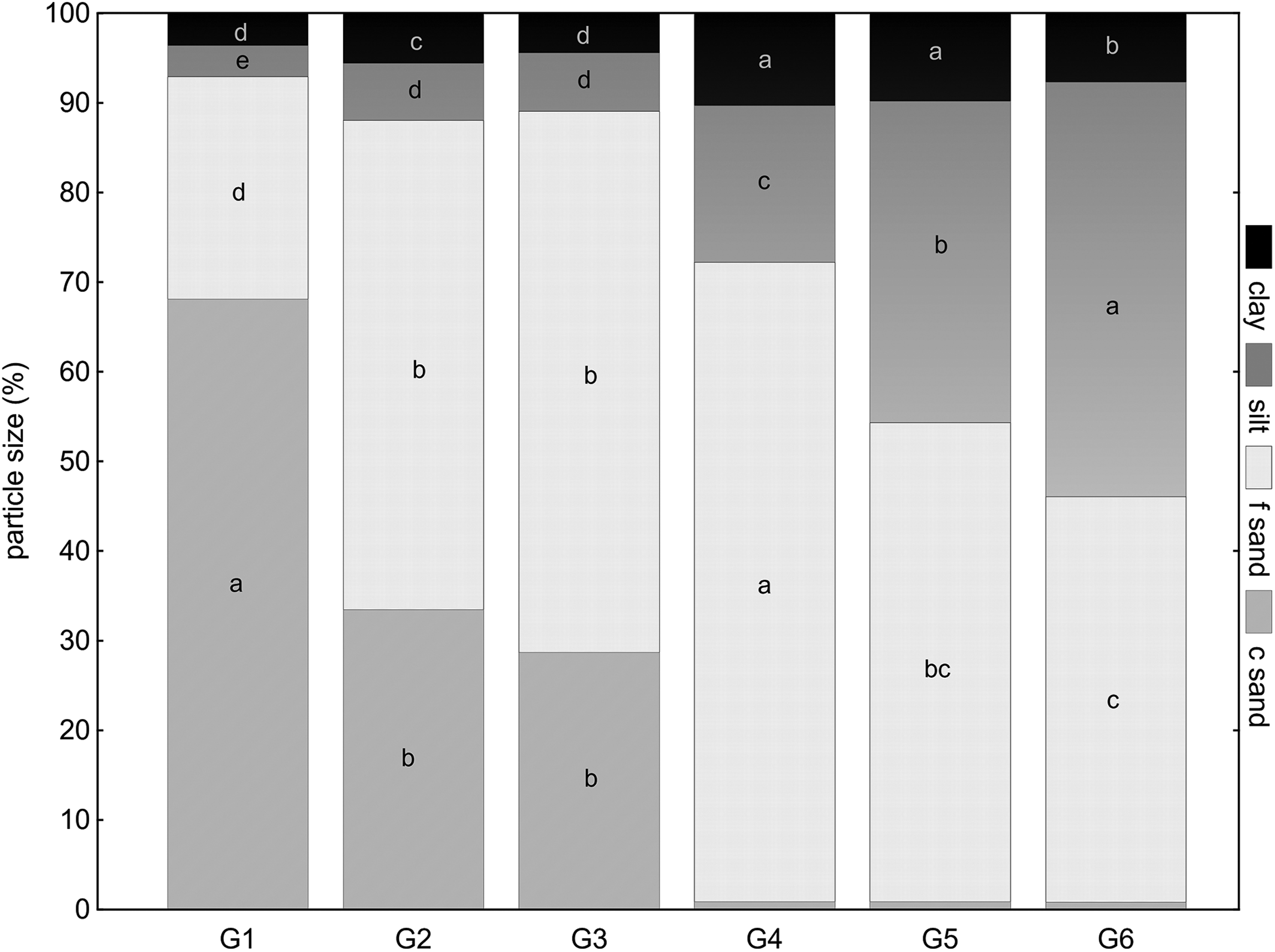
Particle size (clay, silt, fine sand, and coarse sand) in bottom sediment at Lake Guaíba transitional waters. Means followed by the same letter are not statistically different (comparing the sites) from each other by Tukey's test at 95% confidence.
Bedform is related to the sediment particle size, water depth, and flow velocity (Wang et al., 2016; Staudt et al., 2017). Coarse sediments deposited by flowing water entering a calm water body produce characteristic ripples in the bottom, as shown in the section G1 and, to a lesser extent, in the section G2. These ripples are absent in other sections (Fig. 3). This pattern was consistent with reductions in sand content and increased fine particle (silt and clay) within the sections (Fig. 2) as well as the reduced water depth at G3 (Table 1). The occurrence of fine particles in sections G4 to G6 indicate more stable conditions (Staudt et al., 2017). According to Laybauer (2002), there is a relationship between Lake Guaíba bathymetry and sediment particle size (finer particles in deeper parts); however, it is less significant in the transitional waters given the different hydrodynamics in the region.

Side Scan Sonar images at sediment sampling sections on Lake Guaíba.
Clay fraction contents were relatively low in all evaluated sites (Fig. 2), as most of the suspended clays entering the Lake Guaíba are exported downstream to the Patos Lagoon as suggested by Laybauer (2002). This is supported by results from the XRD that indicated that quartz was the predominant mineral. All XRD samples also had peaks at 0.389 and 0.377 nm for potassium feldspar, with more intense reflections of calcium feldspars in the sites G2 and G3. Sampling sites G5 and G6 showed low-intensity reflections relative to minerals of the mica group at 0.90 nm (Fig. 4). The presence of kaolinite, the most common clay mineral in this region (identified at 0.717 nm), was observed only at sample site G2.

X-ray diffraction in bottom sediment of Lake Guaíba transitional waters. Micas (0.90 nm); Kt – Kaolinite (0.649 nm); Ft – potassium and calcium Feldspars (0.404–0.402 nm and 0.321–0.299 nm); H – Halite (0.282 nm); Qz – Quartz (0.334 nm).
Particle size has a strong influence on sorption potential of elements and compounds. Smaller grains (as clay and silt) have greater surface areas (adsorbing sites) and, consequently, concentration of pollutants tends to be greater in finer textured sediments (He et al., 2012; Sangster et al., 2015; Tansel and Rafiuddin, 2016). These smaller particles also have a greater tendency to be resuspended and move with the water column. Therefore, compounds associated with these particles are more likely to travel greater distances (Sangster et al., 2015).
Carbon concentrations are also affected by the particle size (Liu et al., 2016). TOC increased 600%, from 1.91 (G1) to 11.89 mg/g (G6), and had a strong correlation with clay plus silt contents (R2 = 0.94; p < 0.01), as well as the distance from Jacuí's Delta (r = 0.92; p < 0.01) (Table 2). The C/N ratio ranged from 8.8 (G2) to 13.2 (G5) in Lake Guaíba transitional waters (Table 1). The C/N ratio is an indicator of organic matter sources and fate, as well as reflecting changes in nutrient status (Lucas et al., 2015); however, the C/N does not have any strong correlation with other parameters (Tables 1– 3). Phosphorus (P) concentrations, and most of the metals, also rose with clay plus silt contents, increasing with the distance from Jacuí's Delta (Tables 1 and 3).
Pearson's Correlation Coefficients (r) on Bottom Sediment of Lake Guaíba Transitional Waters
n = 24. Fine and coarse sand.
Significant at 0.05 level.
Significant at 0.01 level.
Pt, total porosity.
Concentrations of Zinc, Copper, Chromium, Nickel, Lead, and Cadmium on Bottom Sediment of Guaíba Transitional Waters, Reference Values and Standardized Values by Aluminum
Means followed by the same letter are not statistically different from each other by Tukey's test at 95% confidence.
BG values to Lake Guaíba bottom bulk sediment (Laybauer, 2002).
GV to dredged sediments: CONAMA Resolution No. 454 (Brazil, 2012), Level 1. Standardized values (metals/Al) multiplied by 1,000. LOD: Zn – 2; Cu – 0.6; Cr – 0.4; Ni – 0.4; Pb – 2; Cd – 0.2 μg/g.
BG, background; Cd, cadmium; Cr, chromium; Cu, copper; GV, guiding values; Ni, nickel; Pb, lead; RV, reference values; Zn, zinc.
Relative concentrations of metals (at mean magnitude) were ordered: Fe > Al > Ca > Mg > K > Mn > Na > Ba > V > Zn > Cu > Cr > Co > Ni > Pb (without detection to As, Cd, Mo, and Se). Concentrations of Zn, Cu, Cr, Ni, and Pb increased substantially (500–700%) from the G1 to G6 sections following the general pattern of increased clay plus silt in sediments (Table 3). Other major elements such as the alkaline earth metals (Ca and Mg) also showed a strong positive correlation with the increase of the distance and fine-sized particles, probably due to the higher cation exchange capacity of fine particles. Both Cu and Ni concentrations exceeded the proposed Brazilian guiding values (level 1) for sediments (Federal Official Gazette of Brazil, 2012) at the G5 and G6 sections; however, the concentration of Ni in the background in Lake Guaíba is higher than the guiding value. Both Cu and Cr were also greater than background levels at sections G4 to G6. Generally, no differences occurred between the G5 and G6 sections and only a few differences between G2 and G3 sections were observed, being similar to the patterns observed for sand. Although most metals and other elements evaluated showed a high positive correlation between them, this correlation may be spurious, and this effect may not be due to direct interactions between the metals and other elements. The most likely explanation for this observation seems to be the direct relationship that all metals have with increasing fine particle concentration in the sediment.
Our results (Table 3) differ from results of previous studies of Lake Guaíba sediments (Laybauer, 2002; Fontoura and Leite, 2014). This variation appears to be largely a consequence of the differences in the particle sizes examined. When results with similar particle sizes are compared, the concentrations are similar. For example, Fontoura and Leite (2014) reported concentrations of Cu and Cr that were lower than the mean concentrations we observed, but this author worked with samples from areas of the lake dominated by sand-sized particles (>95%), which we showed to have lower concentrations in Lake Guaíba. Laybauer (2002) analyzed samples with more fine particles (almost 50% silt plus clay). In Laybauer's study, samples with a large percentage of sand (20–40%) had similar concentrations of some heavy metals to those in fine fractions (<63 μm), probably due to organic coatings and/or Fe and Mn oxi-hydroxides on the surface of the sandy grains. This distinction is significant as Brazilian regulatory statues are written for bulk sediment samples and these samples should represent the particle distribution within the lake.
The lowest metal/Al ratios occurred at sample point G1 for Zn, Cu, and Ni, and differences among sample locations was statistically significant for these metals. No statistically significant differences among sample locations occurred for Pb/Al, and minor to Cr/Al ratios (Table 3). The Igeo, which standardizes metal accumulation against background concentrations, indicates some increase of Cu and Cr in sediments. Together, these results indicate a major influence of particle size on the concentrations of metals in the bottom sediment. Although the Igeo compensates the natural concentrations, showing values of Cu and Cr surpassing a bit the “natural quality” (Fig. 5), these results present a minor (or absent) metal enrichment (Chaharlang et al., 2016; Liu et al., 2016); however, it raises the possibility of punctual pollution in Lake Guaíba.
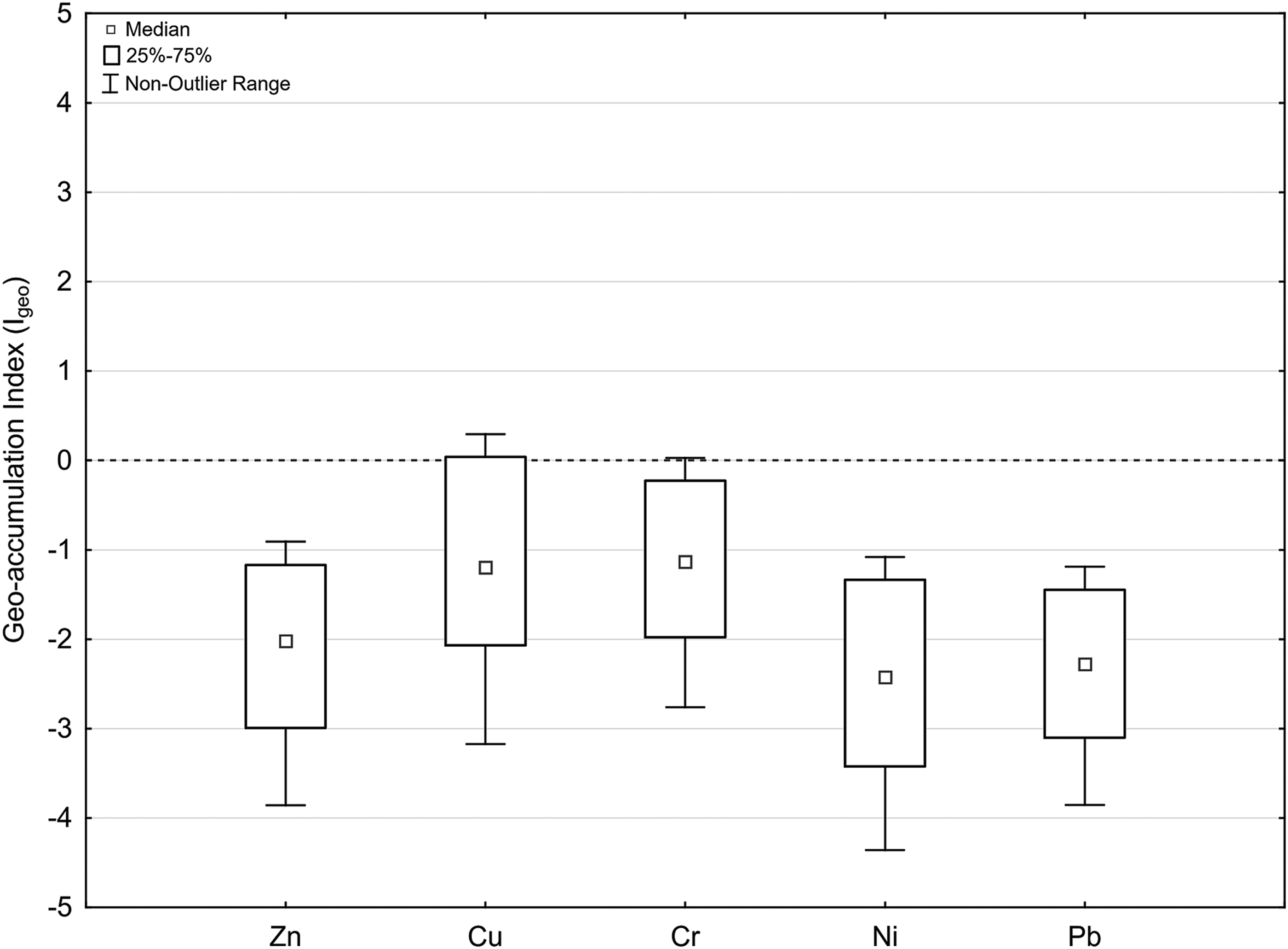
Geoaccumulation index boxplots of metals zinc, copper, chromium, nickel, and lead in bottom sediment of Lake Guaíba transitional waters.
Conclusions
Lake Guaíba transitional waters had a strong correlation between particle size deposited and the distance from the entering tributaries (Jacuí's Delta). Both distance from entering tributaries as well as the particle size and carbon are highly correlated with metal concentrations. The concentrations of metals (especially Zn, Cu, Cr, Ni, and Pb) are largely controlled by sediment particle size. Silt and TOC presented higher correlation with the metals than clay; but this may occur by the exportation of clay to the south part of the lake and to the Patos Lagoon.
Footnotes
Author Disclosure Statement
The authors declare that they have no conflict of interest.
Funding Information
This work has a financial support by the Brazilian National Counsel of Technological and Scientific Development (CNPq; 165407/2014-0) and operational support from the Coastal and Oceanic Geological Studies Center, Universidade Federal do Rio Grande do Sul.