




Abstract
The large quantity of manure generated from concentrated animal feeding operations (CAFOs) must be properly handled. Black soldier fly (BSF), Hermetia illucens L. (Diptera: Stratiomyidae), has been widely used in treating such manure. However, while it can convert 90% of animal manure matter, the remaining waste must be further handled. In addition, powdered BSF larva feces continue to be problematic, as the reuse of such waste is inconvenient. To handle this waste, white-spotted flower chafer (WSFC), Postosia brevitarsis Lewis, is introduced to deal with BSF larva-eaten manure and poultry manure residue, thus forming a triad microcirculation. A farm engaged in this practice shows that for 16 U of duck manure treated by BSF larvae, 4 U of BSF larvae can be generated. Then, the remains are treated by WSFC larvae, and 1 U of WSFC larvae and 10 U of WSFC feces products can be obtained. The constant operation of a microcirculation farm must be both ecologically and economically sustainable. In this sense, the rearing of the appropriate insect species, the available technical capacity, and the economic feasibility of facilities and apparatus equipment should be the focus for this insect-based bio-resource approach.
Introduction
The remarkable growth of concentrated animal feeding operations (CAFOs) in China has substantially improved the standard of living, but also produces large quantities of bio-waste in the form of animal manure, urine, and other materials. Such bio-waste is a serious source of environmental pollution and contributes to negative impacts on ecological and public health. To effectively manage environmental effects of bio-waste from CAFOs, government agencies in China have issued and implemented strict environmental regulation and standards, such as those outlined in the document Regulation on the Prevention and Control of Pollution from Large-scale Breeding of Livestock and Poultry that began to be enforced on January 1, 2014. Under these regulations, CAFOs are required to collect, store, and treat manure and urine, as well as treat and discharge wastewater in accordance with national environmental standards to avoid environmental pollution. Two national environmental protection standards for the livestock and poultry breeding industry in China are: Discharge standard of pollutants for livestock and poultry breeding (GB18596-2001) and Technical standard of preventing pollution for livestock and poultry breeding (HJ/T81-2001). According to GB18596-2001, the discharge standard requires that odor be maintained within a national emission limit of 70. There are two control criteria for solid manure: a ≥95% death rate of roundworm ova and ≤1000/kg fecal coliforms. The concentration limits for the main water pollutants in waste water discharge are listed in Table 1.
Concentration Limit of Main Water Pollutants in Waste Water Discharge
Data source: Discharge standard of pollutants for livestock and poultry breeding (GB18596-2001).
The implementation of such regulations and their enforcement has intensified since 2016, when the central government of China set target levels and used longitudinal accountability for target responsibility. In addition, the central committee of the CPC environmental protection supervision committee was founded and provided environmental supervision to various sites to ensure that targets were achieved. These environmental protection efforts resulted in the closure of large numbers of livestock and poultry breeding farms due to uncontrolled manure landfills, as well as indiscriminate waste water disposal, or ineffective treatment of bio-waste. These closures inevitably impacted the development of CAFOs, not only in terms of economic benefits to the farms but also the supply of meat and eggs for the Chinese population. Thus, methods for development of coordinated environmental and economic activities of CAFOs are needed to allow development of sustainable livestock and poultry breeding approaches.
In 2018, the National Development and Reform Commission and the Ministry of Agriculture, China formulated the document: The county level promotion work plan for resource utilization of livestock and poultry excrement (2018–2020), which proposed nine methods that included three aspects. Earthworms, fly maggots, and black soldier fly (BSF, Hermetia illucens L. Diptera: Stratiomyidae) to process livestock and poultry excrement are recommended as one of the nine methods. The other eight methods are: returning cropland, composting, use of liquid dung, energy utilization, fermentation, padding, fuel, and standard discharge.
The earthworm, fly larvae, and BSF are pro-environmental insects. Among these three pro-environmental insects, BSF larvae (BSFL) processing is emerging as a promising bio-waste treatment technology for sustainable waste management systems (Gold et al., 2018). BSFL are also ecologically sustainable for management of animal manure in terms of reducing manure mass and eliminating odor, as well as controlling the numbers of roundworm ova and fecal coliforms. If manure from livestock or poultry is collected manually, as is done on most small farms in Northern China, the application can fully meet the environmental standards and, thus, does not require environmental supervision.
The rationale for use of BSFL to ensure environmental feasibility of CAFOs is as follows. First, volatile fatty acids in manure and fecal odor are positively correlated, and BSFL are effective in removing acetic acid, propionic acid (short-chain fatty acids), and most long-chain fatty acids, including butyric acid and pentanoic acid. In particular, BSFL can process skatole, which is present in high concentrations in manure, and is the most difficult to remove. Second, BSFL volatilize odors by metabolizing odor-promoting compounds and increasing numbers of beneficial bacteria (e.g., rumen genus Lactobacillus) and inhibit growth of bacteria such as Clostridium and Micro sp in Actinomycetes that produce foul odors (Jin, 2013).Third, as BSFL consume and digest microorganisms, they modify the microflora of manure that in turn reduces or even eliminates harmful or undesirable species (e.g., the domestic fly) (Sherman et al., 2000).
One study showed that number of pathogenic Escherichia coli O157:H7 and Salmonella enterica decreased by 2,000 fold in chicken manure treated with BSFL compared to untreated manure (Erickson et al., 2004). Another study supported this result in which incubation of 15-day-old BSFL and E. coli ER 2566-pQBI63 with autoclaved dairy manure in a growth chamber reduced the E. coli population to undetectable levels (Liu et al., 2008). BSFL were also reported to reduce the emissions of Volatile Organic Compounds (VOCs) from animal waste by around 90% (Beskin et al., 2018). In addition to inhibiting growth of pathogenic organisms and reducing levels of VOCs, BSFL are economical for bio-waste disposal due to their low cost, short treatment time, and high efficiency (Diener et al., 2009; Zhou et al., 2013; Lalander et al., 2014; Nakamura et al., 2016). Based on these beneficial qualities, interest in use of BSFL for handling CAFO manure has been increasing (Zurek et al., 2000; Cˇicˇková et al., 2015).
Use of BSF can also contribute to economic sustainability of farms by converting residual nutrients in manure into biomass, which is a valuable reusable resource that can serve as animal food or bio-fuels (Newton et al., 2005). Yang et al. conducted a study showing that BSFL reared on fresh pig manure are rich in protein (40.6%), crude fat (33.7%), amino acids, and fatty acids and, thus, is a valuable nutrition source. More importantly, BSFL can convert livestock or poultry manure into organic fertilizer comprising larva feces that have a composition of 71.88% organic matter, 2.32% nitrogen, 5.19% phosphorus (P2O5), and 1.25% potassium (K2O) at pH 7.3. These values are consistent with those for standard organic fertilizers (Wang et al., 2016).
The use of BSFL to digest manure began in the 1980s (Sheppard, 1983). In 1994, Sheppard et al. built the first manure management system that used BSFL to treat the manure of laying hens in Mexico. This system reduced hen manure accumulation by at least 50%. Since then, similar and even more sophisticated systems have been established in the United States, countries in the EU, and China. Meanwhile, considerable research has been conducted that seeks to understand the mechanisms of BSFL processing of manure and how the scope of this application can be expanded.
In 2006, the Guangdong Institute of Entomology introduced BSFL bio-resource technology into China (An and Lv, 2007), and use of the practice has grown throughout China based on work done by Shandong Agricultural University, Huazhong Agricultural University, and other academic institutions and enterprises. In addition to promoting the utilization of such technology, several groups are working to address challenges associated with BSF breeding such as producing pro-environmental insect eggs or larvae consistently throughout the year and adapting insect cultures to different types of animal production (Newton et al., 2005).
There is one significant limitation to use of BSFL to digest manures produced on CAFOs, namely how to manage the residual manure, around 10% by mass, that is not processed by BSFL (Liu, 2019). This limitation raises the question of whether other pro-environmental insects can be used to process residual manure to achieve nearly nonwaste status. Moreover, through BSFL activity the CAFO manure that is processed (∼90%) is converted to BSFL feces that exist in a powdered form. Despite the rich nutrient content of these feces, difficulties associated with their packing and transport have limited the commercialization of this material and give rise to the question of whether a method can be developed that will allow efficient transfer of BSFL feces so that they can be commercialized.
Another pro-environmental insect species, white-spotted flower chafer larvae (WSFCL; Postosia brevitarsis Lewis), used together with BSFL in a microcirculation triad has the potential to address both of these challenges by consuming residual manure and processing BSFL feces into a more convenient form.
This study examined the potential of this industrialized microcirculation farm model and compared it to other approaches to explore the feasibility of this approach for treating manure from CAFOs.
Materials and Methods
Experiments on the triad microcirculation farm model were conducted at the Shandong Agricultural University, which hosts systems for livestock and poultry breeding, pig (swine), chicken, and duck husbandry, as well as the BSFL system and WSFC system.
Among the three systems, the livestock and poultry system breeding activities are traditional systems. The BSF system, which has been officially recommended by the National Development and Reform Commission and the Ministry of Agriculture, China, is one method for treating the manure. This system is technologically mature and in popular use. The National Technical Requirements for Disposal of Perishable Waste by Black Soldier Fly formulated in China in 2019, together with local technical standards, such as the Guangdong Province Technical Specification for Disposal of Kitchen Waste (2018) are key parts of the triad model. This study focuses on the scientific development and incorporation of manure treatment involving both WSFCL and BSFL.
In a field study conducted in Shandong Province, China, Su et al. (1985) identified WSFC from Potosia famelica and Potosia aerata (Potosia brevitarsis Lewis). WSFC has also been listed in the Ben Cao Gang Mu (Compendium of Materia Medica) as a traditional Chinese medicine. Adult WSFC contains chitin, and Wang et al. (2001) developed a method for chitin extraction from the WSFC strain Portaetia brevitarsis. Since the 1990s, WSFC has developed as an environmentally beneficial insect, and research has been conducted at Shandong Agricultural University to enable production of WSFC eggs, larvae, pupae, and adults on a year-round basis. Now, three to four generations of WSFC can be raised in 1 year under artificial conditions, which lay the foundation for use of WSFC for the effective treatment of organic waste (Liu, 2019).
As part of a study of WSFC for disposal and resource utilization of waste straw, dry samples of WSFC 3-instar larvae were shown to have 49.90%, 15.42%, and 38.90% protein, fat, and amino acids; 17 types of amino acids were present in the larvae. A particular advantage is that after the waste transformation, WSFC larva dung contained high amounts of organic matter, nitrogen, P2O5, and K2O (34.10%, 1.42%, 1.31%, and 1.33%, respectively (on a dry basis), and thus is suitable for use as commercial fertilizer. Furthermore, the granular shape of the dung facilitated packaging. The transformation power of WSFC was demonstrated by the 1 kg increase in WSFCL biomass in a 18.75 kg waste draw (Liu and Zhang, 2015).
In 2016, Xu et al. developed a method to use WSFC combined with BSF to completely transform livestock and poultry manure into usable resources (Patent number: CN201610409937.3). Shandong Agricultural University developed a similar technique to treat livestock and poultry manure. The box-based three-dimensional breeding pattern of the larvae is well matched to manure treatment in animal husbandry and allows relay processing of BSF-treated manure.
In 2017, Shandong Agricultural University began applying the triad model that combines BSF and WSFC for manure treatment in the animal husbandry industry and offered technical support for two formal partners (Hualong farm and Yuanhu farm), as well as for dozens of small farmers engaged in raising pigs, chickens, and ducks in Shandong Province. The Hualong duck breeding farm in Linyi City currently raises 20,000 ducks and has integrated systems for breeding of ducks, as well as BSF and WSFC, since November 2018.
The Yuanhu Pig farm in Jinan City has around 3,000 pigs and has used the triad circulation model since April 2019. The smaller farms are gradually adopting the triad model. In this study, data from these farms were collected through observation, field surveys, and market research in breeding proving grounds of the Shandong Agricultural University, the partner breeding farms, and the surrounding markets.
Results
The triad microcirculation farm comprised three parts: the livestock and poultry breeding system and one system each for raising BSF and WSFC.
Part 1: The livestock and poultry breeding system
In a typical livestock or poultry breeding system manure is collected by two methods: manual collection and flush (Fig. 1). For manual collection, farm workers use spades and shovels to collect the sludge from the ground of the enclosure and load it onto a cart for transport to a culture pond used to feed BSFL at the two/three-instar stage. For farms that collect manure through flush, the manure is first dewatered and then placed in storage basins. In this study, the Hualong farm collected manure manually, whereas the Yuanhu farm collected manure through flushing. Other small farms that have adopted the triad model also collect manure manually.
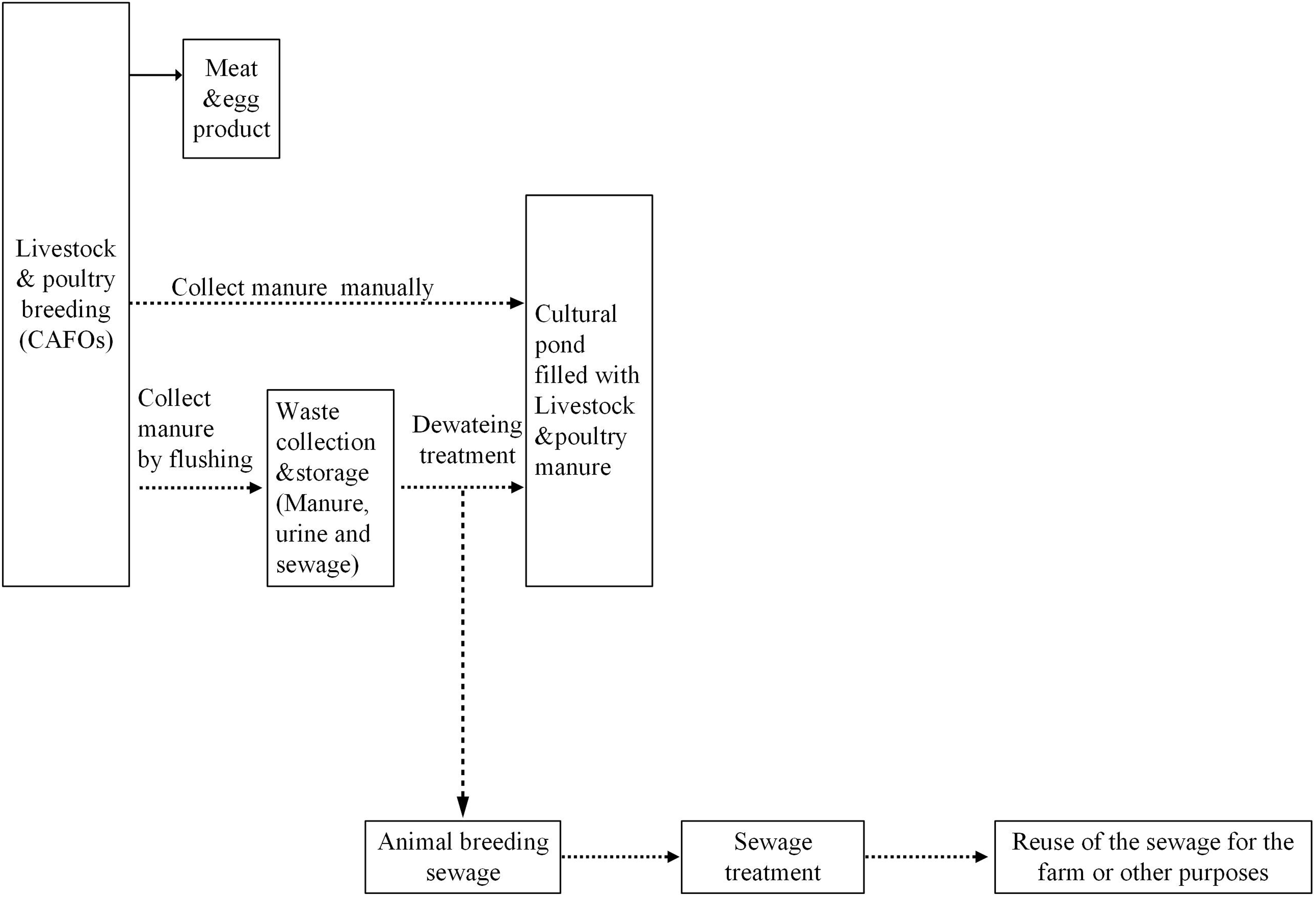
The livestock and poultry breeding system.
Part 2: The BSF breeding system
In the BSF breeding system combined with the duck breeding system, adult BSFs are reared in a greenhouse with mesh screening (Fig. 2). After the adult BSFs lay eggs, the eggs are retrieved and newly hatched larvae are cultured in an air-conditioned room equipped with an artificial climate chest to precisely control the temperature and humidity for egg hatching and cultivation of one-instar larvae. Upon reaching the two- or three-instar stage, the larvae are moved to a culture basin located in a greenhouse with temperature and humidity control that facilitates larvae growth. The larvae culture basin is the junction between the two breeding systems. The culture basin is filled with duck manure that is collected fresh on a daily basis. The BSFL consume the duck manure and progress to last-instar larvae (pro-pupae) over a period of 10–15 days, after which the last-instar larvae are collected. Most last-instar BSF larvae are used as commodities and around 1% pupate and reach adulthood for use in the next breeding cycle.
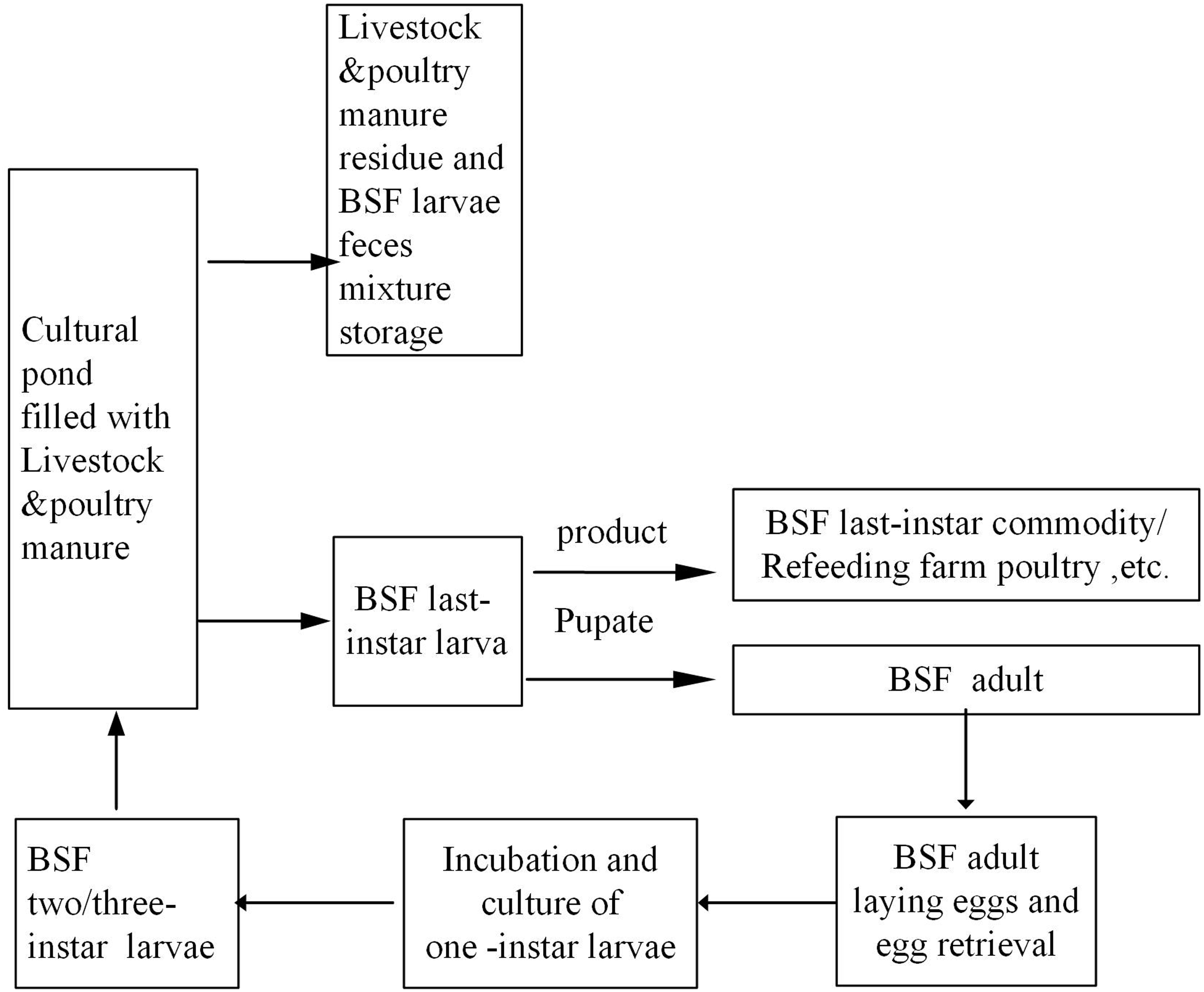
The BSF breeding system. BSF, black soldier fly.
Due to advances in knowledge and technology, the BSF breeding system can now operate year round. The Hualong farm has been continuously running the BSF breeding system for 1 year. During this period, monthly statistics showed that an average of 4 U (weight) of last-instar BSFL can be collected from 16 U of duck manure per day. After separation of last-instar BSFL, there is a 12 U mixture comprising a blend of BSFL droppings and feces (90%) with duck manure residue that the BSFL did not consume (10%). These results are consistent with experimental results obtained at Shandong Agricultural University. Through the BSFL conversion process, the weight of the mixed manure residue is generally decreased by more than 1/4 (volume reduction of nearly 1/2), and the fetid odor is greatly reduced, which brings significant ecological benefits. Similar outcomes were seen for the Yuanhu farm, as well as for surrounding small farms, and no significant differences were observed among chicken, pig, and duck farms.
In terms of economic performance, the market price of last-instar BSFL is ¥7/kg, and the estimated total earnings from BSFL activities for the Hualong farm may reach ¥170,000 ($24,000/year). Thus, this system is profitable and economically sustainable. Some chicken farms feed fresh BSFL to their chickens directly. Eggs from chickens fed BSFL sell on average for ¥1 for each, equal to ¥15/kg, which is double the price of chickens given conventional feed. In general, use of BSFL in poultry feed is economically feasible and profitable.
Although the BSF breeding system brings considerable ecological and economic benefits to duck breeding, some aspects are performing less well. The volume of residual manure that is not consumed by BSFL, while significantly reduced from the original amount, is nonetheless significant and occupies valuable land and storage areas on the farm. Moreover, the organic matter of this mixture does meet criteria for an organic fertilizer, but commercialization is difficult due to the powdered nature of BSFL droppings that cannot be easily packaged or transported. As such, residual manure after BSFL transformation has less commercial value.
Part 3: The WSFC breeding system
Due to the remaining limitations of the BSFL system, a third breeding system, the WSFC breeding system, has been introduced. Under natural conditions, WSFC grown in Shandong Province, China typically produces one generation per year. The active life cycle of one generation lasts from April to October when the final adult WSFC lays eggs and dies. Their eggs hatch into larvae and hibernate in the ground until the next active life cycle, which usually begins in April of the following year. When the outdoor daytime temperature rises to 18°C, the WSFCL emerge from hibernation, grow, and pupate to reach adulthood.
In artificial rearing of WSFC, the WSFC adults first lay eggs, which are retrieved in a greenhouse with mesh screening. The eggs hatch into larvae that grow for ∼54 days. Under such conditions, one-instar larvae last 7 days, and two-instar larvae and three-instar larvae that live for 15 and 30 days, respectively, can be used for further digestion and treatment with the residual mixture of the duck breeding and BSF system. Because WSFC adults constantly lay eggs throughout their lifetime, from June to October, two-instar and three-instar larvae are available during these months. At other times, when the outdoor temperature drops below 18°C, the larvae go into hibernation and typically no larvae are available between November and May of the following year. As such, within 1 year another WSFC generation must be used. To overcome these barriers when the outdoor temperature drops to below 18°C, artificial intervention such as a greenhouse breeding system equipped with apparatus to adjust the temperature and humidity can be used to produce an additional generation of WSFC within a single year. Such 1-year-round WSFC breeding systems are now available for farms to adopt for use in triad microcirculation systems.
In the flow between WSFC and BSF breeding systems, newly hatched WSFCL are cultured in individual breeding boxes in a temperature- and humidity-controlled room (Fig. 3). When the WSFC eggs hatch and become two-instar larvae, each breeding box is divided into two boxes. At this time, the WSFCL can be fed with the BSFL feces mixture to begin the manure and feces conversion process. In this phase, the feces mixture serves as a connecting link to the earlier breeding system. The collected mixture from the BSF system is stored in a central room and dispersed into separate WSFC breeding boxes. The WSFCL are typically fed once every 3–5 days, depending on the feeding situation.

The WSFC breeding system. WSFC, white-spotted flower chafe.
As the larvae consume the feces mixture, they progress to the last-instar larvae (pro-pupa) stage. After ∼30–45 days, the contents of the breeding boxes are separated by manual sieving, and last-instar larvae are collected. Among the collected last-instar WSFCL, 2% will pupate and become adults for the next breeding cycle, whereas the remaining larvae (98%) will be used as commodities. In this stage, 1 U of last-instar WSFCL can be harvested from the remaining feces mixture, and 10 U WSFCL of dung are obtained, while 1 U weight (water component) is removed.
The ecological benefit of integrating the WSFC breeding system, BSF breeding system, and CAFOs is that the nutrition and organic matter from the duck manure residue, which cannot be converted by BSFL, can be converted through digestion by WSFCL, thus decreasing and eliminating the potential pollution from the manure that remains after BSFL transformation. Moreover, integration with WSFC alters the BSFL feces composition from a powder to a granular form, which is more convenient for use as organic fertilizer for crops (Lal, 2004; Tan et al., 2005). Use of the triad microcirculation farm model can help offset use of raw materials such as phosphate rock to generate chemical fertilizer, as well as the substantial energy consumption involved in producing nitrogenous fertilizer (e.g., the Haber–Bosch process) (Cordell et al., 2009).
In the WSFC breeding system the last-instar WSFCL and their dung can generate revenue. Given the 70% weight reduction between fresh and dried WSFCL, 18 kg of dried last-instar WSFC can be generated daily. The unit price is ¥30/kg larvae, such that up to ¥540 income can be generated every day. The local market price for WSFCL dung is ¥1/kg, which yields another ¥600 per day for the farm. Although the investment in construction of WSFC breeding facilities is somewhat high, the WSFC operation was nonetheless profitable for the Hualong farm. For the Hualong farm in particular, the triad microcirculation model generates guaranteed estimated total earnings of ¥100,000 ($14,000)/year, thus making duck breeding even more ecologically and economically sustainable.
The triad microcirculation farm approach
Figure 4 illustrates the overall triad microcirculation farm approach. In this example, 16 U of duck manure produced 4 U of last-instar BSF larvae products, 1 U of last-instar WSFCL products, and 10 U of WSFCL fecal products, while 1 U of manure was transformed during the entire process.
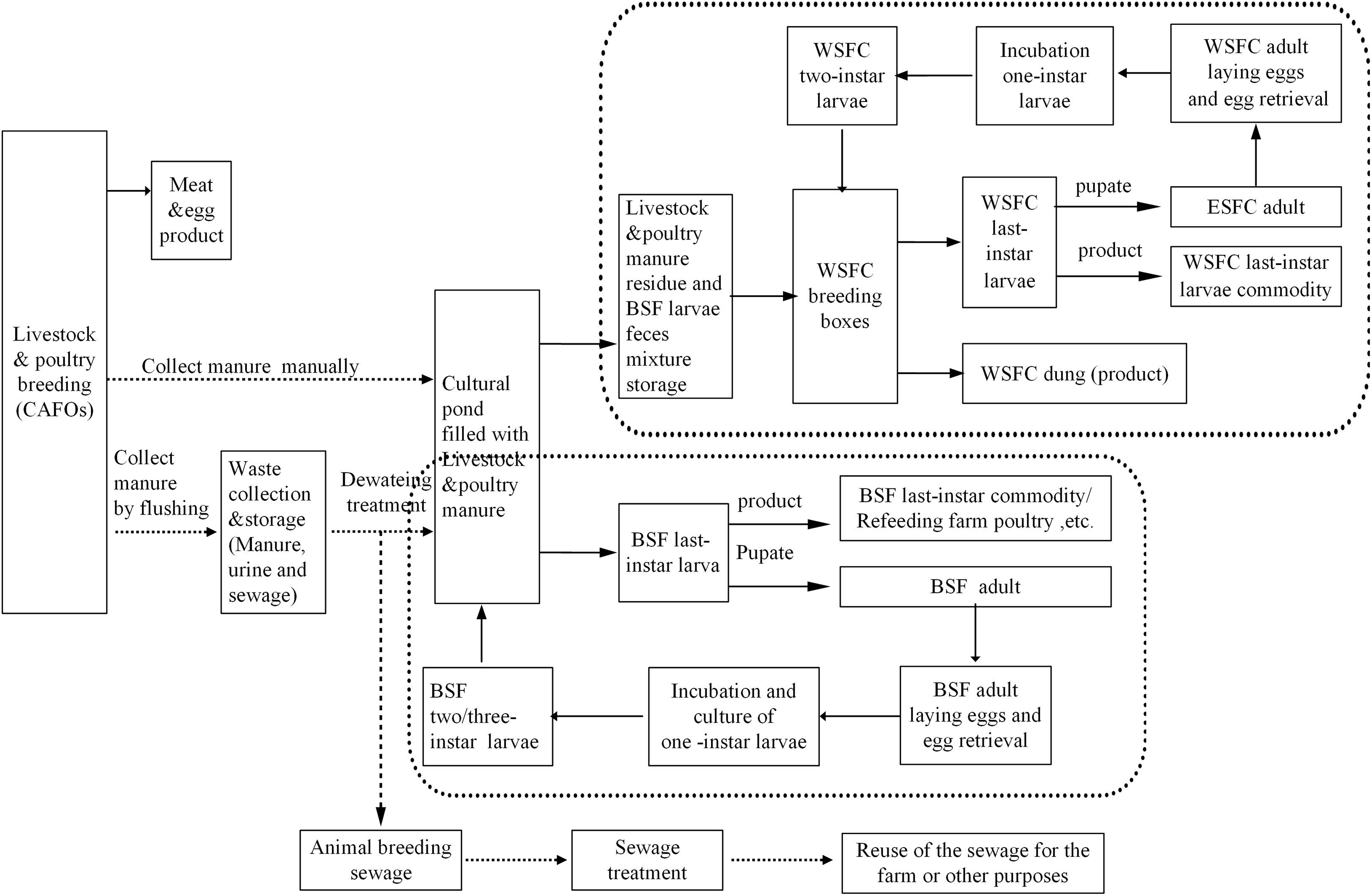
The triad microcirculation farm approach.
Discussion
Due to negative environmental impacts, the livestock and poultry breeding industry has struggled to survive and farms have been unable to pass environmental inspections. Many breeding farms have been closed due to the excessive emissions caused by animal manure. Odors from animal breeding farms affect not only the farms themselves but also nearby communities. Livestock waste also presents a public health issue. In the summer months, residents of communities neighboring these farms are plagued by domestic flies and mosquitoes, as well as by volatile emissions. In the winter, accumulated manure affects the appearance of communities and, more importantly, causes groundwater pollution in the form of heavy metals and harmful microorganisms.
Many methods have been applied to process animal manure, including manure extrusion dehydration, concentrated composting, biogas treatment, and insects that utilize bio-resources. These methods address waste treatment and disposal, energy recovery, resource recycling, and reuse.
The simplest approach for processing manure is used across the world and involves returning solid waste to the land to enhance soil fertility and formation, thus enhancing primary production by allowing storage of organic matter and providing structural materials (Trimmer et al., 2019) that contribute to favorable soil conditions for agricultural activities. The use of manure is particularly beneficial for restoration and re-vegetation of degraded croplands (Zanuzzi et al., 2009). However, resource transfer from animal waste is often inefficient and ineffective.
A more sustainable manure management approach involves direct generation of energy from the waste (Verstraete et al., 2009; Trimmer et al., 2017; Orner & Mihelcic, 2018) to produce biogas through anaerobic digestion of manure. However, these methods are largely uneconomical due to the substantial investments needed in terms of finance, equipment and equipment maintenance, and raw materials. In addition, the processing cycle of these methods is often long, and the results are often unsatisfactory. Meanwhile, biogas production from manure typically involves secondary pollution and collateral pollution, and the gas yield can be poor and unreliable. The potential for energy recovery from organic matter tends to be lower than that for nutrient reuse. In accordance with the order of waste management hierarchies, using resource recovery systems to transfer “waste” to nutrients (Rockstr et al., 2009), thus cycling organic matter from manure using insects, is a promising approach (Chai et al., 2012).
Conclusions
This work presents a feasible approach for treating manure from CAFOs. A “2+N” microcirculation farm model, in which “2” refers to BSFL and WSPCL and “N” refers to any type of livestock and/or poultry, can be used to address animal manure problems more sustainably. The method described here is a nonwaste livestock/poultry breeding model that represents an advance in the utilization of pro-environmental insects to treat manure from CAFOs. On the one hand, the triad microcirculation model produces another insect commodity, last-instar WSFCL, which have high economic value. On the other hand, this method involving WSFCL successfully transforms both BSFL feces and residual duck feces and in doing so transforms the powdered waste from BSFL into granular dung that is more amenable to packaging and transport.
This study did not involve technological experiments but instead focused on the introduction of an innovative practice for the sustainable development of livestock and/or poultry farming. Critical for the effective and efficient utilization of insects to process manure from CAFOs is the rearing of feasible insect species, the available technical capacity, and facility design. This study is limited in that the triad model was applied to small farms and one moderately-sized farm (i.e., the Yuanhu farm) but not to large-scale farms. As such, additional research is needed to determine the suitability of the triad model for large-scale farms and CAFOs and to determine whether this approach has any negative environmental impacts.
Footnotes
Acknowledgments
The authors thank Shandong Agricultural University for providing data and granting permission to visit their experimental facilities. The authors also thank Ms. Ying Li and Mr. Yuanhu, as well as the farmers of the Hualong duck breeding and Yuanhu Pig farm, for granting permission to visit their farms and for providing data.
Author Disclosure Statement
No competing financial interests exist.
Funding Information
This study was supported by the Chinese National Funding of Social Sciences (16BKS070) and Shandong Provincial Social Science Foundation (19CWMJ15).