




Abstract
The stacked bioelectrochemical systems (BESs), composed of microbial electrolysis cells (MECs) driven by microbial fuel cells (MFCs), provide an alternative approach for the recovery and separation of mixed W(VI) and Mo(VI) without input of external energy. Herein, the stacked BESs, assembled with three parallel MFCs (2#, carbon rod cathode) connected to an MEC (1#, stainless steel mesh cathode) in series were advanced to be operated, where mixed W(VI) and Mo(VI) were continuously flowed either in parallel (influent to each individual cathodes, individual feeding) or serial (sequentially through the cathodes of the 2# to the 1# units, sequential feeding) modes. Individual feeding outperformed sequential feeding at an hydraulic retention time (HRT) of 4 h and under air exposure conditions, achieving deposition of 29.1 ± 0.8% to 33.8 ± 0.5% (W) and 65.2 ± 0.4% to 71.8 ± 0.8% (Mo) in the 1# units with separation factors of 4.3–5.9, higher than those in the 2# units (W: 13.4 ± 0.6% to 14.9 ± 0.3%; Mo: 31.7 ± 0.4% to 39.6 ± 0.3%; separation factor: 2.8–3.9). Anaerobic conditions or a shorter HRT of 2 h disfavored system performance. Electrochemical impedance spectroscopy data, scanning electronic microscopy observation, and X-ray photoelectron spectroscopy analysis supported the optimum system performance. The elucidation of such effects deepens our understanding of these operational parameters for optimization of the metallurgical self-driven BESs for W and Mo deposition and separation, which could ultimately lead to industrial application.
Graphical abstract
Introduction
Bioelectrochemical systems (BESs), including microbial fuel cells (MFCs) or/and microbial electrolysis cells (MECs), and composed of anodic and cathodic electrodes, have been shown to oxidatively degrade organics and even recalcitrant substances on the anode electrode (Garcia-Becerra and Ortiz, 2018; Li et al., 2018; Hua et al., 2019). In parallel, the reductive cathode electrodes of BESs can deposit many heavy metals from aqueous solutions, providing an environmentally benign approach for heavy metal recovery in the cathode with simultaneous organic degradation in the anode (Wang and Ren, 2014; Dominguez-Benetton et al., 2018). The stacking of BESs, composed of multiple MFC and/or MEC units, can efficiently deposit and separate many mixed metals on the cathode, including Cu(II), Co(II), and Li(I), and W(VI) and Mo(VI) based on their different redox potentials as well as the various circuital currents and cathode potentials created by the purposely diverse connections of multiple MFC and/or MEC units in serial and/or parallel connections (Huang et al., 2014, 2017, 2018; Wu et al., 2015; Zhang et al., 2015). The stacked BESs are regarded to be promising for hydrogen production because of their higher performance than increasing the size of an individual unit through reduced mass transfer losses during upscaling (Sun et al., 2008). However, in terms of metal deposition and separation, the stacked BESs are usually operated in fed-batch mode under anaerobic conditions (Huang et al., 2014, 2017; Wu et al., 2015; Dominguez-Benetton et al., 2018; Li et al., 2019), limiting its applicable treatment for practical heavy metal-wastewaters with required continuous flow feeding under atmospheric air exposure conditions. Despite the continuous flow operation in BESs for organic wastewater treatment with simultaneous energy production in the absence of heavy metals, the increased oxygen intrusion in continuous operation lowered performance of single-chamber BESs (Cusick et al., 2014; Lanas et al., 2014; He et al., 2016). For the metallurgical single MFCs or MECs, the dissolved oxygen competed with metal ions for cathodic electrons and thus negatively affected recovery of single metals such as Co(II), Cu(II), or Cd(II) (Ter Heijne et al., 2010; Huang et al., 2015; Wang et al., 2016; Song et al., 2019). Conversely, the presence of dissolved oxygen in the catholyte of the fed-batch operated single MFCs or MECs favored the in situ-produced H2O2 for efficient deposition of some metals such as Cr(VI) (Wang et al., 2017b). For the continuously operated stacked BESs for deposition and separation of mixed heavy metals, operation under air exposure or anaerobic conditions is scarcely reported and thus necessarily explored to forward the metallurgical BES technology for more practical application.
Flow mode might affect the performance of stacked BESs for recovery and separation of mixed heavy metals. Individual feeding with influent flowed in parallel to each individual cathode units, shared the same high concentrations of substrates (e.g., organics or heavy metals) in each of the flows to the units, which has been thus known to favor for either more electricity or hydrogen generation from continuously operated single BESs in the absence of heavy metals (He et al., 2016) or more removal of single heavy metals in stacked BESs (Zhang et al., 2015). In parallel, the sequential feeding, termed as the effluents of the first units of the stacked BESs fed into the subsequent units in serial connection (Lanas et al., 2014), might be suitable for recovery of more heavy metals from the final effluents owing to the successive organics oxidative reactions in the same feeding influent at a long hydraulic retention time (HRT) (Lanas et al., 2014). Compared with the attention on electrically stacked BESs in serial or parallel connections for metal recovery (Huang et al., 2014, 2017, 2018; Li et al., 2019), the impact of such different modes of flow feeding on the metallurgical stacked BESs has been scarcely reported.
In this study, we evaluate continuous-operated stacked BESs with individual or sequential flow modes in the presence or the absence of dissolved oxygen to assess deposition and separation of mixed W(VI) and Mo(VI). These two species are always concomitantly present in the ore dressing wastewater and the leaching liquors of many spent catalysts in key industries, such as the automotive industry (Lasheen et al., 2015; Huang et al., 2017, 2018, 2019). Individual rather than sequential feedings under air exposure conditions achieved efficient W and Mo deposition and separation. Deeper insight into these aspects will enhance the performance of the stacked BESs for efficient W and Mo deposition and separation as discussed subsequently.
Materials and Methods
Assembly of stacked BESs
Identical dual chambers (14 mL operating volume each) of one MEC unit (1#) and three parallel connected MFC units (2#) of the stacked BESs were used in all experiments, with the chambers separated by a cation exchange membrane (CMI-7000 Membranes International, Glen Rock, NJ), as previously described (Huang et al., 2017). This stacked BES was optimized on the basis of nine operational BES configurations comprising a minimum of two and a maximum of six BES units under anaerobic fed-batch run conditions (Huang et al., 2017). In brief, porous graphite felts (1.0 × 1.0 × 1.0 cm; San Ye Co., Beijing, China) were used as the anodes of both 1# and 2# units, whereas carbon rod and stainless steel mesh (Chijiu Duratight Carbon Co., Qingdao, China) with equal geometric areas (2.0 × 2.0 cm) were used as the cathodes of 2# and 1#, respectively, owing to their well-matching for efficient metal deposition in the stacked BESs (Wu et al., 2015; Huang et al., 2018). Before installation, these electrode materials were treated as previously described (Wang et al., 2015). A glass tube (Ø 8 mm) was used to create a headspace of 12 mL in the cathode of the 1# unit for hydrogen collection. The stacked BESs were continuously operated at room temperature (25 ± 3°C). Three duplicate BESs were used in all the experiments. A reference electrode (Ag/AgCl, 195 mV vs. standard hydrogen electrode [SHE]) was installed in the cathodes of the 1# and the 2# units to determine the electrode potential, with all potentials reported versus SHE. All electrode potentials were collected using data acquisition (PISO-813; Hongge Co., Taiwan). Applied voltage, derived from the electricity output from the 2# units (MFCs) applied to the 1# units (MECs) with requirement of an electrical input, was automatically recorded. The reactors were wrapped with aluminum foil to exclude light effects and possible side reactions in the cathodes. Because of the insignificant differences in the three paralleling connected units in 2#, data from 2# were reported as average values for the sake of clarity (Huang et al., 2017).
Inoculation and operation
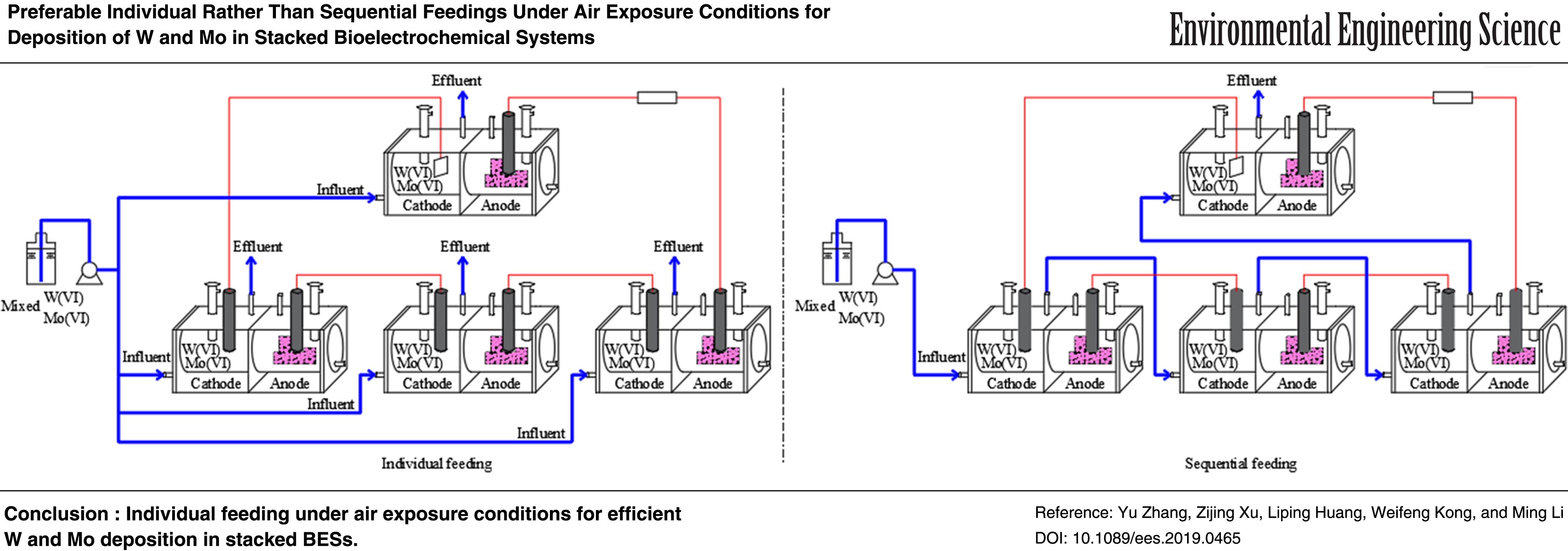
Anodic inoculation, acclimation, and solution refreshment was exactly the same as previously described using acetate (1.0 g/L) as substrate (Huang et al., 2017, 2018). Mixed W(VI) and Mo(VI) aqueous solutions composed of Na2WO4·2H2O and Na2MoO4·2H2O (Kaida Chemical Co. Ltd., Tianjin, China) with each at 1.0 mM were used as the original catholyte (pH: 2.0; solution conductivity: 3.5 mS/cm) throughout the experiments based on the previous optimization (Huang et al., 2018). Pumps (BT100-2J; Lange, China) were used to either equally feed each of the 1# and the 2# units of the stacked BESs with the same influent (individual feeding), or first pump the influent into the three serially connected cathode of the 2# units, and then sequentially flow to the cathodes of the 1# units, as clearly shown in blue lines in Fig. 1. The influent was continuously sparged at least 15 min by either air to create an initial dissolved oxygen of 8.2 ± 0.3 mg/L (here referred in brief as air exposure conditions) or pure N2 (here referred in brief as anaerobic conditions) before being fed into the reactors (Jiang et al., 2014; Wang et al., 2017a). HRTs of 4 or 2 h under anaerobic or air exposure conditions were tested for optimal system performance.
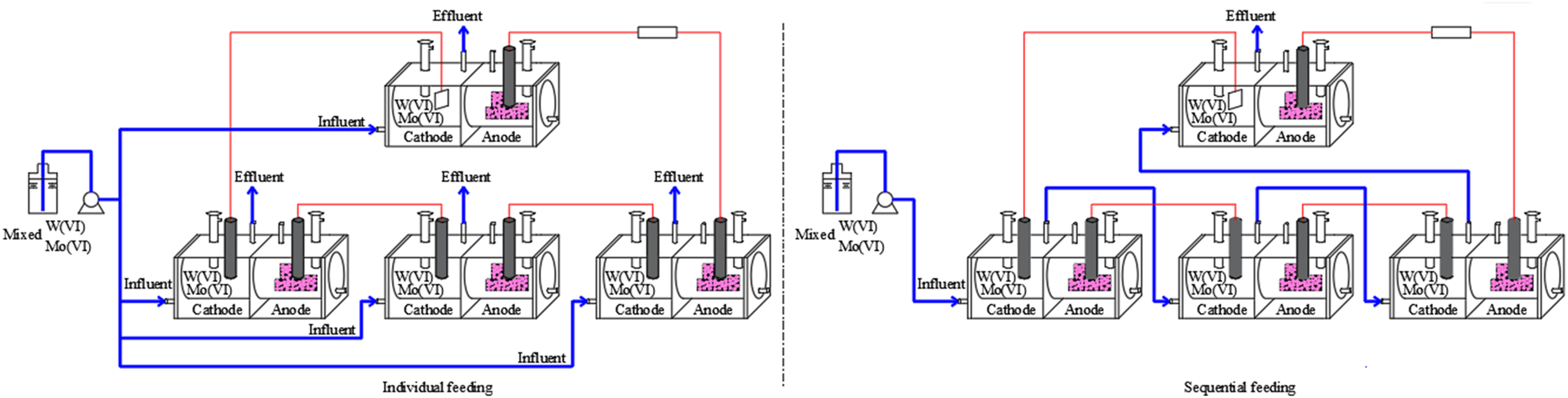
Schematic representation of the stacked BESs. BES, bioelectrochemical system.
Measurements and analyses
Concentrations of W(VI) and Mo(VI) in the influents and effluents of each units were analyzed according to the previous description (Huang et al., 2017). Metal recovery (%) was based on the net changes of W(VI) and Mo(VI) in the 1# or the 2# units divided by their initials in the original influent. Hydrogen (m3/[m3·d]) in the headspace of the cathode of the 1# unit was analyzed using a gas chromatograph (GC7900; Tianmei, Shanghai, China). pHs in the effluents of each units were determined using a pH probe and meter (PHS-3C; Leici, Shanghai, China).
A scanning electronic microscopy (Nova NanoSEM450; FEI Company) equipped with an energy dispersive X-ray spectroscopy (EDS) (X-MAX 20/50 mm2; Oxford Instruments, United Kingdom) and X-ray was used to characterize the cathodes of the stacked BESs. Accordingly, the valences of the products on the cathodes of the 1# and 2# units were confirmed using X-ray photoelectron spectroscopy (XPS) (Kratos AXIS Ultra DLD).
Polarization curves were obtained using “multiple cycles,” whereas electrochemical impedance spectroscopy (EIS) were conducted using a potentiostat (VSP; BioLogic) as previously described (Logan, 2012; Wu et al., 2015).
Calculation
The separation factor ɛ was calculated from Equation (1).
where W(VI)in and Mo(VI)in, and W(VI)ef and Mo(VI)ef are the concentrations of W(VI) and Mo(VI) in the influent and the effluent of each units of these stacked BESs, respectively.
One-way analysis of variance in SPSS 19.0 was used to analyze the statistical differences among the data at significance levels of p < 0.05.
Results and Discussion
System performance under individual feeding and anaerobic conditions
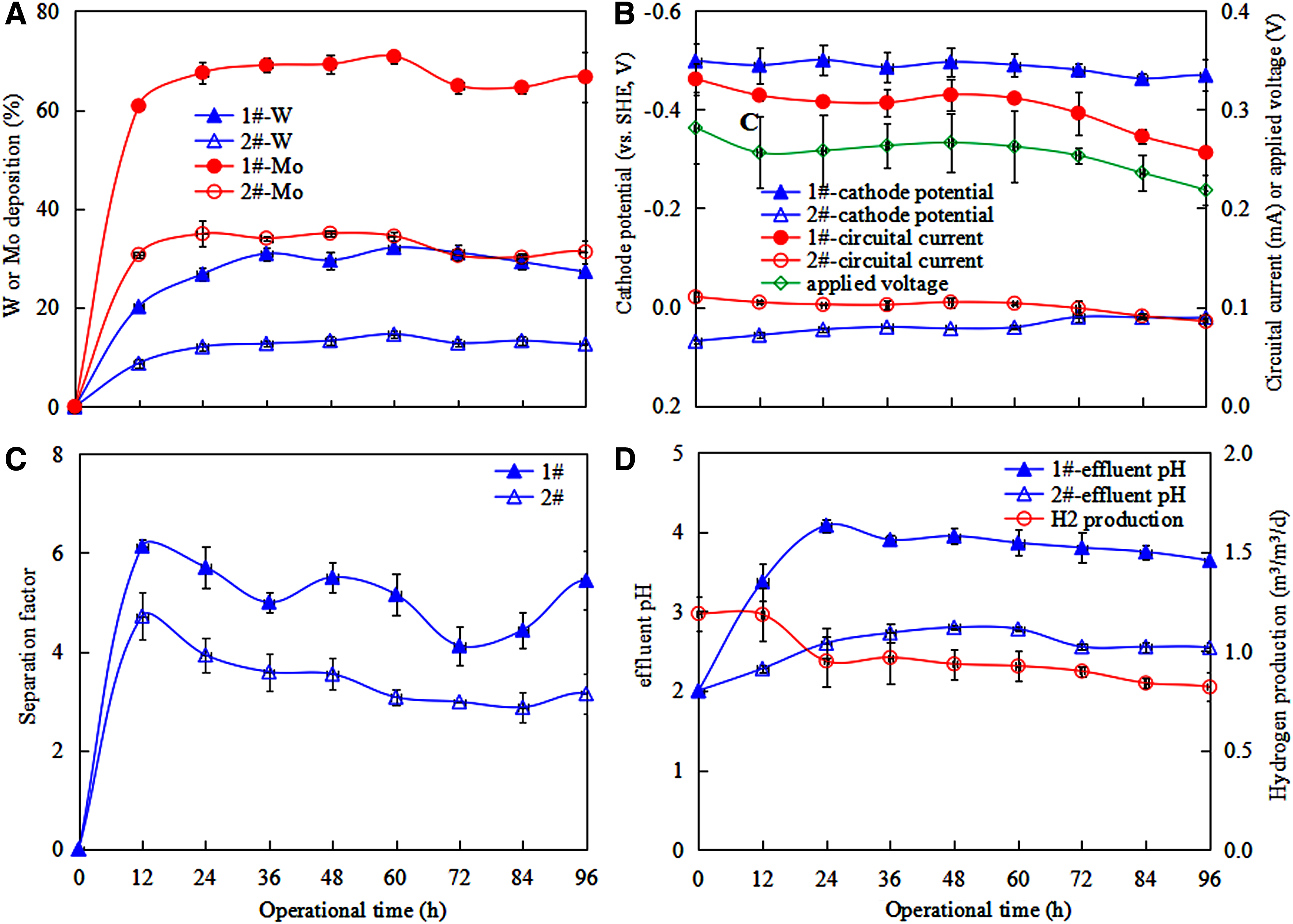
The 1# units (W: 27.3 ± 0.5% to 32.2 ± 0.2%; Mo: 64.6 ± 1.1% to 70.8 ± 1.3%) stably outperformed the 2# units (W: 12.8 ± 0.6% to 14.7 ± 0.8%; Mo: 30.2 ± 0.3% to 35.1 ± 0.5%) during the entire operational period (Fig. 2A), consistent with the more negative cathode potentials (−0.50 to −0.47 V) and the higher circuital currents (0.26–0.31 mA) in the 1# units than those in the 2# units (cathode potentials: 0.02–0.05 V; circuital currents: 0.09–0.10 mA) (Fig. 2B). Accordingly, the voltage applied to the 1# units as MECs from the 2# units as MFCs ranged from 0.22 to 0.26 V (Fig. 2B) and thus produced hydrogen of 0.82–0.95 m3/(m3·d) (Fig. 2D). Because of the concentrations of W(VI) and Mo(VI) always being the same in the influent, the more efficient W (27.3 ± 0.5% to 32.2 ± 0.2%) and Mo (64.6 ± 1.1% to 70.8 ± 1.3%) deposition with higher differences between each other in the 1# units than those in the 2# units (W: 12.8 ± 0.6% to 14.7 ± 0.8%; Mo: 30.2 ± 0.3% to 35.1 ± 0.5%) (Fig. 2A), understandably more largely differentiated the residual W(VI) and Mo(VI) in the 1# effluents. As a consequence, higher separation factors (4.1–5.7) (Fig. 2C) and more increase in effluent pHs (3.6–4.1) (Fig. 2D) were observed in the 1# effluent. These results were comparative with the previously stacked BESs at fed-batch operation and under the same anaerobic conditions (Huang et al., 2017, 2018), implying the negligible differences between fed-batch and continuous operations for W and Mo deposition and separation in these systems.
W and Mo deposition
Polarization curves showed a higher open circuit potential (1.35 V) in the stacked BESs than those in the 1# units (0.68 V) and the 2# units (0.77 V) (Fig. 3A), implying the more efficiency of the stacked BESs than the individual units. More power production in the 2# (66 ± 3 mW/m2, 300 mA/m2) than the 1# units (20 ± 1 mW/m2, 76 mA/m2) was explained by the three parallel connected MFCs in the former, compared with the 1 U in the latter. These results were appreciably higher than those previously reported (2#: 38 mW/m2, 200 mA/m2; 1#: 10 mW/m2, 70 mA/m2) in the same stacked BESs with fed-batch operation (Huang et al., 2017), implying the improved electrochemical performance under this continuous operation. This power production of 20 ± 1 mW/m2 in the 1# units was much lower than those in many other MFCs (Pant et al., 2016; Hiegemann et al., 2019), ascribed to the multiple different parameters including reactor architecture and working volume, anodic fuel/substrate, cathodic electron acceptor, solution conductivity and pH, size and material of anode and cathode electrodes, and so forth (Logan, 2012). Taken together with the negligible differences between fed-batch and continuous operations for W and Mo deposition, the continuous flow mode might have avoided large changes in pH values, and thus exhibit higher electrochemical performance. This result was similar to other reports on power generation in MFCs or MECs in the absence of heavy metals (Jacobson et al., 2015; Zhang et al., 2015; Kim and Logan, 2019).
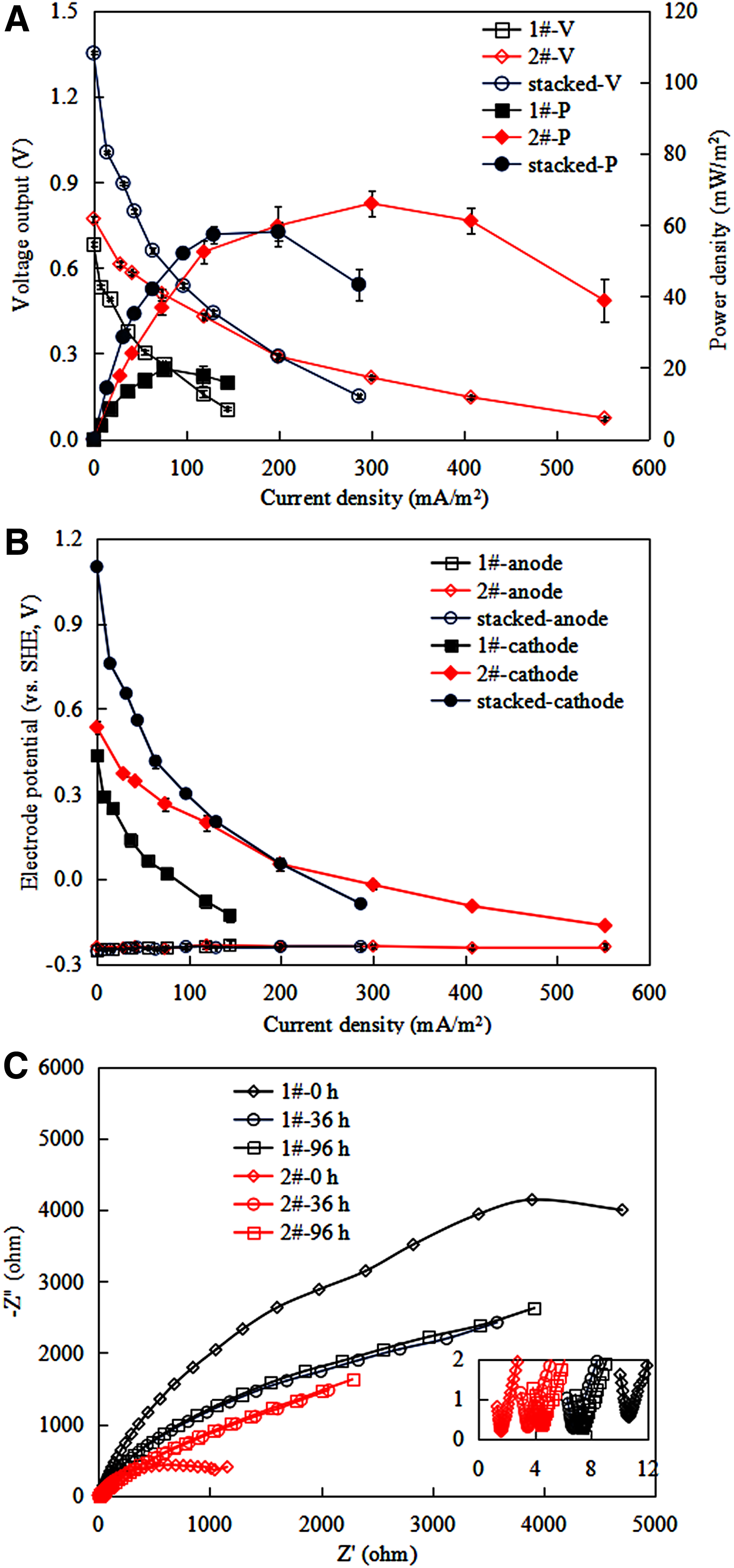
Polarization and power density curves
Cathode performance mainly caused reduced voltage, as the cathode potentials became negative at higher current densities, whereas the anode potentials remained almost constant over the current density range (Fig. 3B), consistent with the previous same systems in fed-batch operation (Huang et al., 2017, 2018) and many other metallurgical BESs using single or mixed heavy metals of Cu(II), Cr(VI), or Co(II) as electron acceptors in the catholyte (Huang et al., 2014, 2015; Wang et al., 2015, 2017b).
EIS was used to analyze the variation of the cathodes of the 1# and the 2# units at different operation intervals (Fig. 3C), by fitting spectra to an equivalent circuit (Supplementary Fig. S1). Diffusion resistance (Rd) considerably dominated over charge transfer resistance (Rct) and ohmic resistance (Rs) in both the 1# and the 2# units, where appreciable decrease in the Rd was observed on the stainless steel mesh cathodes of the 1# units with W and Mo deposition over time, converse to those in the 2# units using CR as a cathode (Fig. 3C and Supplementary Table S1). This result illustrated the role of W and Mo deposits in lessening the internal resistances of the SSM cathodes of the 1# units, compared with its increase for the CR cathodes of the 2# units. This result would be further explained by the various amounts of W and Mo deposits and their different morphologies on the cathodes of the 1# and the 2# units in subsequent Electrode Morphology and Product Analysis section.
System performance under individual or sequential feedings and air exposure conditions
Individual feeding outperformed sequential feeding for W and Mo deposition in the 1# and the 2# units under the same influent with complete air exposure, achieving 29.1 ± 0.8% to 33.8 ± 0.5% (W) and 65.2 ± 0.4% to 71.8 ± 0.8% (Mo) in the 1# units and 13.4 ± 0.6% to 14.9 ± 0.3% (W) and 31.7 ± 0.4% to 39.6 ± 0.3% (Mo) in the 2# units (Fig. 4A, B) with higher separation factors (1#: 4.3–5.9; 2#: 2.8–3.9) (Supplementary Fig. S2A) and less differences in pHs of effluents from the 1# and 2# units (Supplementary Fig. S2B). For each unit of the stacked BESs, the influent under individual rather than sequential feeding conditions understandably had more dissolved oxygen, one reaction substrate for in situ produced H2O2 for subsequent W and Mo deposition through the predominate pathways of peroxo-tungstate and peroxo-polymolybdate (Wang et al., 2017a), explaining the more efficiency of individual rather than sequential feedings for W and Mo deposition. These W and Mo depositions were invariably higher than those under anaerobic conditions (p < 0.05) (Fig. 2A), confirming the improved W and Mo deposition by air exposure. In the controls in the absence of W(VI) and Mo(VI) in the influent, species of H2O2 was detected under air exposure conditions, reaching 4.9 ± 0.3 mg/L, compared with the absence of any H2O2 under anaerobic conditions. This result confirmed the preferable utilization of in situ produced H2O2 under air exposure conditions for W and Mo deposition through the predominate pathways of peroxo-tungstate and peroxo-polymolybdate (Wang et al., 2017a). This preferable air exposure for W and Mo deposition was inconsistent with the reported anaerobic conditions favorable for recovery of Cu(II) or Cd(II) (Ter Heijne et al., 2010; Wang et al., 2016; Song et al., 2019), where reduction of dissolved oxygen directly competed with Cu(II) for cathodic electrons and thus negatively affected their recovery in the BESs.

Comparison of W deposition
The species of Mo(VI) has a redox potential of 1.26 V, higher than 1.14 V for oxygen and 0.36 V for W(VI) under the same experimental conditions. This implied the more possibility of Mo(VI) reduction than the others of oxygen and W(VI) under the same cathode environment and the more likely occurrence of competition between oxygen and W(VI) for cathodic electrons. As a consequence, less W(VI) (1#: 29.1 ± 0.8% to 33.8 ± 0.5%; 2#: 13.4 ± 0.6% to 14.9 ± 0.3%) was always reduced than Mo(VI) (1#: 65.2 ± 0.4% to 71.8 ± 0.8%; 2#: 31.7 ± 0.4% to 39.6 ± 0.3%) in the same catholyte, consistent with those previously reported in single MFCs in fed-batch operation (Wang et al., 2017a).
Although circuital currents in both the 1# and the 2# units with the sequential feeding were lower than those with the individual feeding, the sequential feeding exhibited more negative cathode potentials (1#, acted as MECs) and more positive cathode potentials (2#, acted as MFCs) (Fig. 4C), both of which decisively favored the evolution of hydrogen in the 1# units (Sun et al., 2008; Dominguez-Benetton et al., 2018) (Fig. 4D). The production of more hydrogen with the sequential feeding had reasonably consumed more cathodic electrons (Zhang et al., 2015), which thus negatively resulted in the competitive electrons consumed for less W and Mo deposition (Fig. 4A, B). In addition, the earlier exhaustion of dissolved oxygen along with the various units of the stacked BESs under the sequential rather than the individual feedings, may also favor the evolution of hydrogen in the former based on the well-known Henry's law. Collectively, these results demonstrated the favorable individual feeding for W and Mo deposition, and the preferable sequential feeding for hydrogen evolution in the stacked BESs.
Under the same air exposure conditions, power production in the 2# units under individual feeding conditions (77 ± 2 mW/m2, 468 mA/m2) (Supplementary Fig. S3A) was lower than that with sequential feeding (103 ± 4 mW/m2, 383 mA/m2) (Supplementary Fig. S3B), both of which were higher than that under anaerobic conditions with individual feeding (66 ± 3 mW/m2, 300 mA/m2) (Fig. 3A). Accordingly, cathode potentials under individual feeding conditions (Supplementary Fig. S3C), decreased more significantly than that with sequential feeding (Supplementary Fig. S3D) over the same range of current density, implying that individual rather than sequential feedings controlled more the cathodic reactions, similar to the reports on many other heavy metals in the catholyte of single BESs (Wang and Ren, 2014; Wu et al., 2016).
Analysis of the internal resistance of the 1# and 2# units over time using EIS showed that individual feeding under air exposure conditions had less internal resistance (Supplementary Fig. S4A and Supplementary Table S2) than that under anaerobic conditions (Fig. 3C and Supplementary Table S1). This was consistent with the W and Mo deposition through the predominate pathways of peroxo-tungstate and peroxo-polymolybdate with less overpotential loss (Wang et al., 2017a). In addition, sequential (Supplementary Fig. S4B and Supplementary Table S2) rather than individual (Supplementary Fig. S4A and Supplementary Table S2) feedings exhibited less dominant Rd over Rct and Rs, all of which similarly decreased in the 1# units over time, converse to the increase in the 2# units. This was reflected by the various amounts of W and Mo deposits, and the different morphologies of particles on the different units, subsequently described in Electrode Morphology and Product Analysis section.
Impact of HRTs
An HRT of 2 h exhibited deposition of W (16.6 ± 0.6% to 19.3 ± 0.5%) and Mo (38.0 ± 0.4% to 41.8 ± 0.8%) in the 1# units, apparently higher than those in the 2# units (W: 7.1 ± 0.3% to 8.6 ± 0.6%; Mo: 17.6 ± 0.4% to 23.1 ± 0.5%) with same individual feeding (Fig. 5A). Both of them were invariably lower than those at 4 h (p < 0.05) (Fig. 4A, B), signaling the insufficient operational 2 h for proceeding deposition of W and Mo in the stacked BESs. Cathode potential, circuital current, applied voltage, and thus the hydrogen production (Fig. 5B, C) were similar to those at 4 h (Fig. 4C, D and Supplementary Fig. S2), implying negligible effects by this HRT. Accordingly, lower separation factors with similarity between each other (1#: 2.8–3.5; 2#: 2.5–3.8) (Fig. 5C) than those at 4 h (1#: 4.3–5.9; 2#: 2.8–3.9) (Supplementary Fig. S2A) along with associated effluent pHs (1#: 2.8–3.4; 2#: 2.4–2.7) (Fig. 5C) were reasonably observed.
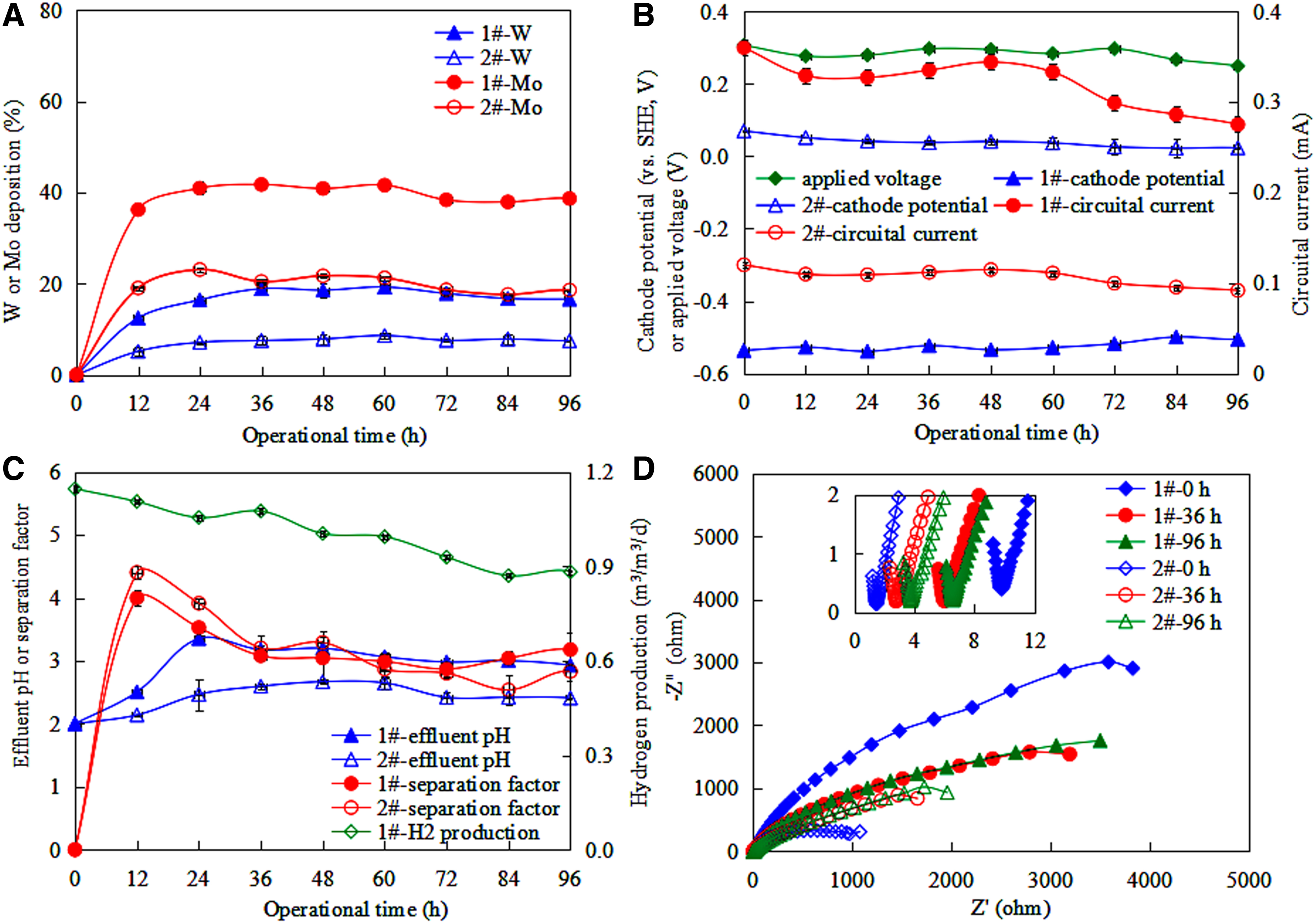
W and Mo deposition
EIS analysis confirmed the increased internal resistance in the 2# units and the decreased internal resistance in the 1# units over operational time (Fig. 5D and Supplementary Table S2), which were invariably lower than those at 4 h (Supplementary Fig. S4 and Supplementary Table S2). These less internal resistance at 2 h than 4 h were also reflected by the improved power production [2#: 88 mW/m2, 500 mA/m2 (Supplementary Fig. S5) vs. 77 ± 2 mW/m2, 468 mA/m2 (Supplementary Fig. S3A); 1#: 28 mW/m2, 200 mA/m2 (Supplementary Fig. S5) vs. 24 mW/m2, 131 mA/m2 (Supplementary Fig. S3A)]. Collectively and in terms of W and Mo deposition, these results confirmed the favorable 4 h rather than 2 h for system performance.
Electrode morphology and product analysis
Products with big size agglomerates were always observed in the 2# units (Fig. 6A, E, I, and M), compared with the uniform layers of deposits in the 1# units (Fig. 6B, F, J, and N), regardless of the individual (Fig. 6A, B, E, F, I, and J) or sequential (Fig. 6M, N) feedings, under anaerobic (Fig. 6A, B) or air exposure (Fig. 6E, F, I, J, M, and N) conditions, and at 4 h (Fig. 6A, B, E, F, M, and N) or 2 h (Fig. 6I, J). The uniform deposits in the 1# units (Fig. 6B, F, J, and N) were consistent with the kinetic data (Figs. 2A, 4A, B, and 5A), where the 1# units always harbored more W and Mo than the 2# units, and thus achieved sufficient W and Mo deposits for this even distribution. Conversely, the always less efficient 2# units (Figs. 2A, 4A, B, and 5A) and thus the insufficient W and Mo deposition caused the formation of discontinuous agglomerates or “islands” (Fig. 6A, E, I, and M). The even distribution of W and Mo deposits in the 1# explained its decreased internal resistances, compared with the increase in the 2# with discontinuous W and Mo agglomerates, as given in Figs. 3C, 5D and Supplementary Fig. S4, and Supplementary Table S2. The morphology of doped metal particles has been reportedly correlated with the internal resistance of the substrate, where even distribution of metals/metal oxides particles generally decreased internal resistance and uneven discontinuous “islands” were associated with the increase in the internal resistance (Brylewski et al., 2013).
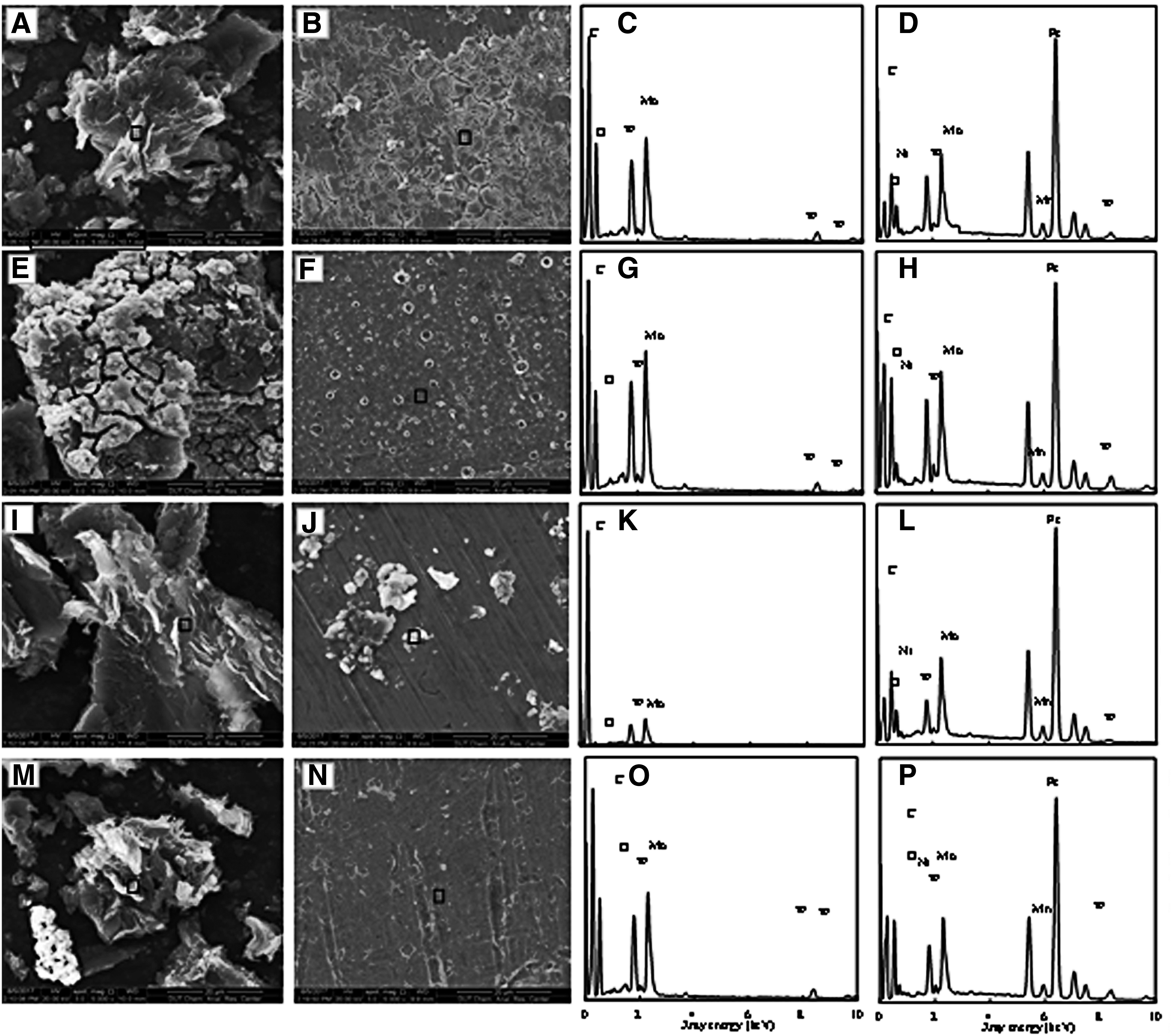
SEM
EDS analysis of the deposits in the 1# units reported higher Mo than W signals (Fig. 6C, G), both of which were higher than those in the 2# units (Fig. 6D, H) under the same anaerobic (Fig. 6C, D; Supplementary Table S3) or air exposure (Fig. 6G, H) conditions. Individual feeding, HRT of 4 h, and air exposure conditions instead of sequential feeding, HRT of 2 h and anaerobic conditions favored for Mo and W deposition in both the 1# and the 2# units (Supplementary Table S3). These results were consistent with the results in Figs. 2, 4 and 5.
XPS images demonstrated the presence of peaks at 35.9 and 38.1 eV for W (Fig. 7A, C, E, G, I, K, M, and O), assigned to W(VI) at W(4f7/2) and W(4f5/2) levels, respectively. For the same individual feeding, air exposure conditions and HRT of 4 h (Fig. 7G) achieved stronger peaks than those under anaerobic conditions (Fig. 7C) or a shorter 2 h (Fig. 7K) in the same 1# units, which was invariably higher than those in the 2# units (Fig. 7A, E, I, and M). In parallel, the sequential feeding exhibited lower peaks (Fig. 7M, O) than those with individual feeding (Fig. 7A, C). These results were well in agreement with those in Figs. 2, 4, and 5.

X-ray photoelectron spectra of the cathodes of the 2#
Accordingly, peaks associated with Mo(IV) (231.2 eV; 233.8 eV) and Mo(V) (234.8 eV; 231.8 eV) were simultaneously observed with Mo(VI) (231.0 eV; 234.0 eV) in the 1# units (Fig. 7D), which were higher than those in the 2# units (Fig. 7B) at a same 4 h and under the same anaerobic and individual feeding conditions, consistent with the results in Fig. 2. With the same individual feeding, the air exposure always favored for the reduction of Mo(VI) with an exceptional formation of less Mo(IV) at Mo(3d5/2) (Fig. 7H, F). Accordingly, a shorter 2 h (Fig. 7L, J) with the same individual feeding, or alternatively sequential feeding under anaerobic conditions and at a same 4 h (Fig. 7N, P), always decreased the reduction of Mo(VI) to Mo(V) and Mo(IV), with more formation of Mo(V) than Mo(IV). Collectively, these results reflected the occurrence of diverse Mo(VI) reduction reactions correlated with the multiple parameters including the mode of flow, the anaerobic or air exposure conditions, the HRT and the reductive environment of the different units in the stacked BESs, in agreement with the summary for other metals (Dominguez-Benetton et al., 2018).
In summary, the results presented in this study through mode of flow, air exposure/anaerobic conditions, and HRTs, and multiple characterization methods, demonstrate the preferable individual rather than sequential feedings at 4 h under air exposure conditions for W and Mo deposition and separation in the stacked self-driven BESs without any external energy input. The comparative similar W and Mo deposition to those at fed-batch operation (Huang et al., 2017, 2018), confirmed the negligible differences between fed-batch and continuous operations for W and Mo deposition and separation in these systems. For the practical operation of pilot stacked BESs, air exposure is more applicable owing to not only the improved W and Mo deposition and increased separation of W and Mo, but also the eliminating operational cost of sustaining anaerobic conditions.
Different from the incomplete removal of organics in the BESs with further required secondary polishing step (Kim et al., 2013; He et al., 2016), species of W(VI) and Mo(VI) with each <9.0 mg/L have been proven to be completely removed in continuously operated single-chamber MECs or stacked BESs with fed-batch operation, with the metals in the effluent below the national discharge limits (Huang et al., 2019). Thus, concentrations of W(VI) and Mo(VI) with each <9.0 mg/L and under air exposure conditions could be reasonably completely removed using the stacked BESs with continuous operation, outstanding the multiple advantages of this metallurgical system for complete metal recovery.
W and Mo deposits on the cathodes can decease the activity of the electrodes over time, requiring the periodical removal of the deposits from the electrodes. However, the binary W and Mo deposits have been recently proven to be in situ utilized for either mineralization of recalcitrant metronidazole and azo dye methyl orange or synthesis of acetate in the cathodes of BESs under simulated sunlight conditions (Wang et al., 2019a, 2019b; Cai et al., 2020), broadening the applicable scope of the stacked BESs deposited with W and Mo, and possibly other metals.
In terms of economical consideration and on the basis of the operating costs alone, the net value of W and Mo products recovered from the system [7.22$/m3 mixed W (VI) and Mo(VI)] appreciably offsets the cost from pumping transport (0.25$/m3) without requirement of other external energy, demonstrating the economical feasibility of this self-driven technology over conventional chemical or electrochemical processes with much more consumption of reducing agents or external electrical energy (11,580 kWh/ton) (Lasheen et al., 2015).
With regard to the practical application of the stacked BESs for W and Mo recovery, the dual-chamber BESs have merits over the single-chamber systems, because these avoid the toxicity of W and Mo to the anodic exoelectrogens while permitting the simultaneous treatment of two different wastewaters (Wang and Ren, 2014; Dominguez-Benetton et al., 2018). Considering the steadily decreasing materials, particularly the costs of the ion-exchange membrane (Dominguez-Benetton et al., 2018; Liang et al., 2018) and large MFCs (e.g., 85 and 255 L) for more power production or efficient treatment of real municipal wastewater under practical conditions (Hiegemann et al., 2019; Rossi et al., 2019), pilot and full scale of the dual-chamber stacked BESs for practical W and Mo wastewater treatment, needs to be further explored. Evaluation of the long-term operation and stability of the system over feeds with fluctuating characteristics of practical wastewaters should be particularly stressed. Further investigations in these directions are warranted.
Conclusions
Deposition and separation of aqueous W(VI) and Mo(VI) using the stacked self-driven BESs is attractive because of their concomitant occurrence in mine drainage wastewaters and the drawbacks of conventional energy consumed and/or second contaminated treatment technologies. Previous studies have primarily examined the fed-batch operation of different stacked BESs under anaerobic conditions at various ratios of W and Mo for their deposition and separation. In this study we have demonstrated the preferable individual rather than sequential feedings under air exposure conditions and at an HRT of 4 h for efficient deposition and separation of mixed W and Mo in the continuously operated stacked BESs composed of one MEC (1#) serially connected with three parallel connected MFCs (2#). The W and Mo deposits over the SSM cathodes of the 1# units decreased the charge transfer resistance, compared with the increase on the CR cathodes of the 2# units. This study gives a comprehensive appreciation of the effects of modes of flow, dissolved oxygen conditions and HRT on the 1# and 2# units of the stacked self-driven BESs, which further affected the efficiency of W and Mo deposition and separation. However, further studies should shed more light on the scale-up stacked BESs for deposition and separation of mixed W and Mo from practical wastewaters.
Footnotes

References
Supplementary Material
Please find the following supplemental material available below.
For Open Access articles published under a Creative Commons License, all supplemental material carries the same license as the article it is associated with.
For non-Open Access articles published, all supplemental material carries a non-exclusive license, and permission requests for re-use of supplemental material or any part of supplemental material shall be sent directly to the copyright owner as specified in the copyright notice associated with the article.
