




Abstract
Novel adsorbents [Zr–Fe-, Mn–Fe-, and Mn–Zr–Fe-modified natural zeolites (MNZs)] were prepared by a green synthetic method and used for aqueous phosphorus removal. The MNZs were characterized by scanning electron microscopy, Brunauer–Emmett–Teller (BET), X-ray powder diffraction, X-ray photoelectron spectroscopy, Fourier-transform infrared spectrometer, and magnetic property. The results showed that the BET-specific surface areas of the synthesized novel adsorbents (92.599–279.660 m2/g) were much higher compared with natural zeolites (17.494 m2/g). Strong magnetism was observed for the synthesized novel adsorbents. At 35 mg/L phosphorus and 308 K, the equilibrium adsorption amounts of Mn–Fe-, Zr–Fe-, and Mn–Zr–Fe-modified zeolites were 11.8, 8.8, and 20.9 mg/g, respectively, which were 3.7, 2.8, and 6.5 times that of natural zeolites (3.2 mg/g). The pseudo-second-order kinetics model (R2 > 0.98) and Langmuir model (R2 > 0.96) were more suitable to describe the adsorption process. The intraparticle diffusion rates of the modified zeolites were in the order of Mn–Zr–Fe-, Mn–Fe-, and Zr–Fe-modified zeolites, respectively. Adsorption of phosphorus onto the modified zeolites was an endothermic process (ΔH0 > 97 kJ/mol). Acidic conditions contributed to the adsorption of phosphorus. The adsorption capacity of the synthesized novel adsorbents decreased with increasing coexisting ionic strength, and Cl− and HCO3− had the minimum and maximum impact on the adsorption of phosphorus, respectively. The ligand exchange and electrostatic attraction played key roles in the adsorption of phosphorus onto the modified zeolites. Excellent regeneration ability for the modified zeolites was observed. The synthesized novel adsorbents have great potential applications in removing phosphorus from eutrophic water.
Introduction
Eutrophication is the phenomenon of increased biomass in water, which is caused by excess nutrients such as nitrogen and phosphorus (Nguyen et al., 2015), where phosphorus is the restrictive factor of water eutrophication (Zhang et al., 2013). When the total phosphorus concentration is above 0.02 mg/L, and the inorganic nitrogen concentration is above 0.3 mg/L in natural water, then the state of the water body is eutrophication (Dupas et al., 2015). The main sources of phosphorus in water include municipal wastewater and industrial wastewater (Ji et al., 2014). Furthermore, water eutrophication has become a serious environmental problem, hence, it is crucial to enhance the removal of phosphorus from water (Liu et al., 2013).
Over the past decades, various techniques and methods have been reported for phosphorus removal from water, such as chemical precipitation, biological removal methods, and adsorption by suitable adsorbents (Huang et al., 2016a, 2016b, 2016c; Nguyen et al., 2015; Szentpetery et al., 2008; Wang et al., 2015; Wilaiwan et al., 2010; Wilsenach et al., 2007). From a nutritional recovery perspective, removal and recovery of pollutants from wastewater is advantageous to decomposing methods (Delaney et al., 2010; Guo et al., 2017a; Ji et al., 2014; Liu et al., 2013; Wilaiwan et al., 2010; Zhu et al., 2014).
Adsorption is an attractive method for phosphorus removal and recovery due to less occupied areas, easy to operate, low operation cost, and high efficiency at low phosphorus concentration (Wilaiwan et al., 2010). Various adsorption materials have been developed for phosphorus removal, including zeolites, lanthanum-modified materials, aluminum hydroxide, iron oxide, and peat (Guan et al., 2009; Liu et al., 2016; Shang, 2007; Wu et al., 2011; Xiong and Mahmood, 2010; Yang et al., 2007, 2011).
Natural zeolites are widely used in the field of environmental pollution control owing to their unique structure and low cost (Mudasir et al., 2016). Furthermore, they have porous channels and can adsorb small molecules, such as phosphorus, ammonia, nitrogen, and metal ions in water (Alshameri et al., 2014). Reports have shown that natural zeolite adsorption can serve as an alternative for phosphorus recovery from fermentation liquid with a recovery rate of 98.28% (Wan et al., 2017).
However, the adsorption capacity of natural zeolites is poor for aqueous pollutants, with their maximum adsorption capacity for aqueous phosphorus being 2.92 mg/g (Delgadillo-Velasco et al., 2018). Therefore, the natural zeolites need to be modified for improving its adsorption capacity.
The aluminum-modified zeolite has the highest adsorption capacity of 8.9 mg/g for phosphorus (Mucci et al., 2018). Modifications can reduce internal impurity minerals of natural zeolites, promoting an increase in the specific surface area and adsorption ability toward target pollutants (Hor et al., 2016; Liu et al., 2014). A kind of low-cost synthetic zeolites obtained from fly ash and modified with lanthanum has been reported for aqueous phosphorus removal (Goscianska et al., 2018). Simultaneously, removal of ammonia and phosphorus from aqueous solutions was conducted by green synthesized iron oxide nanoparticles dispersed onto zeolite by eucalyptus leaf extracts (Xu et al., 2020). Zirconium-modified zeolites were effective for the removal of phosphorus in water (Yang et al., 2014).
Zirconium oxide and manganese oxide are widely used in the field of phosphorus adsorption, owing to their high specific surface area and strong selective phosphorus adsorption (Yang et al., 2014). However, they do exhibit other advantages, including heat resistance, higher mechanical strength, and enhanced chemical stability (Cui et al., 2012; Su et al., 2013). According to reports, the noncrystalline zirconium oxide adsorbents have a strong selective adsorption capability for phosphorus in wastewater (Chitrakar et al., 2006). Encapsulating hydrated manganese oxide inside a strongly basic anion exchanger improved the adsorption capacity of phosphorus under alkaline conditions (Pan et al., 2014).
Although zirconium oxide and manganese oxide have strong adsorption ability for aqueous phosphorus, from an economical perspective, they are not suitable for engineering applications due to high cost. Therefore, it is of great importance to incorporate these oxides into a low-cost carrier. Furthermore, adsorbents are often difficult to separate from water, where many researchers have synthesized magnetic adsorbents by incorporating iron to enhance the separation of adsorbents (Yan et al., 2015; Zhu et al., 2010).
In our previous work, Mg−Al-, Zn−Al- and Mg−Fe-layered double hydroxides were synthesized and used for phosphorus adsorption. The maximum adsorption amount of phosphorus was 74.8, 80.8, and 67.8 mg/g for Mg−Al, Zn−Al, and Mg−Fe magnetic layered double hydroxide, respectively, which is considerably higher than that of the natural zeolites (Sheng et al., 2019). This may be due to the bimetallic system facilitating the adsorption of phosphorus. Hence, based on the above analysis and hypothesis, Zr–Fe-, Mn–Fe-, and Mn–Zr–Fe-modified natural zeolites (MNZs) were synthesized through a green synthetic method and employed for the removal of aqueous phosphorus in the present work. The adsorption behavior and mechanism of synthesized Mn–Zr–Fe MNZs toward phosphorus were compared with synthesized Zr–Fe and Mn–Fe MNZs.
The MNZs were characterized by scanning electron microscopy (SEM), Brunauer–Emmett–Teller (BET), X-ray powder diffraction (XRD), X-ray photoelectron spectroscopy (XPS), Fourier-transform infrared spectrometer (FTIR), and magnetic property. The adsorption mechanism of phosphorus and the effect of adsorption time, modified zeolite dosage, pH, and coexisting ions on the adsorption of phosphorus onto the modified zeolites were studied; at the same time, the regeneration performance, adsorption isotherm, and adsorption kinetics of the modified zeolites were also examined.
Materials and Methods
Synthesis of MNZs
All reagents were of analytical grade and used as received without any further purification. The magnetic natural zeolites were synthesized as follows: natural zeolites were added to 500 mL HCl (0.5 mol/L) and stirred for 1 h, then soaked for 24 h, washed with deionized water to neutral pH, and then dried. FeCl3·6H2O (12.16 g) and FeSO4·7H2O (12.51 g) were dissolved in 200 mL deionized water. Under vigorous magnetic stirring, natural zeolites (6 g) treated with HCl were added to the mixture of FeSO4·7H2O and FeCl3·6H2O, and simultaneously 2 mol/L NaOH solution was added to maintain a pH of 10. Then the suspension was stirred for 1 h, aged at room temperature, and washed to neutral pH with deionized water, generating the desired magnetic zeolites.
Zr–Fe MNZs were prepared as follows: ZrOCl2·8H2O (4.83 g) was dissolved in 200 mL magnetic zeolite slurry, and simultaneously NaOH solution (2 mol/L) was added to maintain a pH of 10. Then the formed suspension was continuously stirred for 1 h, aged at room temperature for 4 h, washed to neutral with deionized water, and then the suspension was filtered and dried at 100°C.
Mn–Fe MNZs were prepared as follows: KMnO4 (2.37 g) was dissolved in 200 mL magnetic zeolite slurry, and simultaneously NaOH solution (2 mol/L) was added to maintain a pH of 7.5. The formed suspension was continuously stirred for 1 h, aged at room temperature for 4 h, washed to neutral pH with deionized water, and the suspension was filtered and dried at 100°C.
Mn–Zr–Fe MNZs were prepared as follows: ZrOCl2·8H2O (4.83 g) and KMnO4 (2.37 g) were dissolved in 200 mL magnetic zeolite slurry, and simultaneously NaOH solution (2 mol/L) was added to maintain a pH of 8. The formed suspension was continuously stirred for 1 h, aged at room temperature for 4 h, washed to neutral with deionized water, and the suspension was filtered and dried at 100°C.
Adsorbents characterization
The MNZs were characterized by SEM, BET, XRD, XPS, FTIR, and magnetic property. The cross-sections of modified zeolites were performed on a SEM (SU8020, Japan). Morphology analysis of the MNZs was performed on a physical adsorption instrument (ASAP2020, USA). XRD analysis was carried out on an X-ray diffractometer (D/MAX2500VL/PC, Japan). The elemental species were analyzed using XPS (ESCALAB250Xi; Thermo, USA). FTIR analysis was carried out on a Fourier infrared spectrometer (Nicolet 6700, USA). Magnetic property was performed on an electron paramagnetic resonance spectrometer (JES-FA200, Japan).
Adsorption experiments
Adsorption kinetics experiment
All conical flasks containing 0.2 g MNZs and 200 mL KH2PO4 solution were placed in a thermostat oscillator at 298 K. At set intervals, ∼2 mL suspension was withdrawn and centrifuged; the concentrations of phosphorus were determined by Ultraviolet–visible spectrophotometry (UV-754; Shanghai Jinghua Science and Technology Instruments Co. Ltd., China) using the ammonium molybdate spectrophotometry at 700 nm. The detailed steps for phosphorus concentration determination are listed in our previous work (Sheng et al., 2019).
Adsorption isotherm
Adsorption isotherm experiments were performed in conical flasks containing 50 mL KH2PO4 solution and 0.07 g MNZs at different temperatures (288, 298, and 308 K). Samples were withdrawn after 24 h and centrifuged to determine the concentrations of phosphorus.
Effect of modified zeolite dosage
Different amounts of Mn–Fe, Zr–Fe, and Mn–Zr–Fe MNZs were added to conical flasks containing phosphorus solution. All solutions were placed on a thermostat oscillator at 298 K for 24 h.
Effect of pH
The pH values of solutions, containing 5 mg/L of phosphorus and 0.5 g/L of MNZs, were adjusted with HCl or NaOH solutions to the desired pH values. Reaction time and temperature of the solutions were 24 h and 298 K, respectively.
Effect of coexisting anions
The effects of Cl−, NO3−, SO42−, and HCO3− on the adsorption of phosphorus onto MNZs were investigated. Four kinds of anion concentrations (0.01, 0.1, 0.5, and 1.0 mol/L) were tested. The initial phosphorus concentration and MNZ dosage were 5 mg/L and 0.5 g/L, respectively.
Desorption and reusability
The MNZs were saturated with phosphorus for 24 h, and then added to different concentrations of NaOH solutions (0.01, 0.1, 0.5, and 1.0 mol/L) for another 24 h. The residual phosphorus concentrations were determined by calculating the desorption percentage.
Results and Discussion
Characterization of MNZs
Natural zeolites are mixed minerals, which are mainly composed of clinoptilolite and quartz (Alejandro et al., 2014). As shown in Fig. 1, natural zeolites have strong diffraction peaks at 2 theta values of 21.1°, 26.7°, 39.7°, 50.3°, and 59.9°, which are consistent with JCPDS data (No. 46-1045) of synthetic quartz. The characteristic diffraction peaks of Fe3O4 at 2 theta values of 30.1°, 35.5°, 43.2°, 57.1°, and 62.7° are observed in the XRD spectra of the three MNZs, which indicates that they have magnetic separation property.

X-ray powder diffraction spectra of natural and modified zeolites.
The XRD spectra of Mn–Fe-modified zeolites show diffraction peaks of MnO2 at 2 theta values of 23.5°, 37.1°, 42.5°, and 66.8°, indicating that hydrous manganese oxides were successfully loaded onto the natural zeolites (Lǚ et al., 2013; Salam, 2015). In the case of XRD spectra of Zr–Fe-modified zeolites, diffraction peaks of ZrO2 at 2 theta values of 30.4°, 50.8°, and 60.4° were detected, suggesting that hydrous zirconium oxides were successfully loaded onto the natural zeolites (Long et al., 2011). In addition, diffraction peaks related to hydrous manganese oxides and hydrous zirconium oxides are observed in the XRD spectra of Mn–Zr–Fe-modified zeolites.
Supplementary Figure S1 shows the surface morphology of MNZs, which display a similar irregular and rough shape. The N2 adsorption–desorption isotherm of MNZs and natural zeolites are shown in Supplementary Fig. S2. When the relative pressure (P/P0) was at about 0.4, capillary condensation of MNZs occurred and isotherm increased rapidly, the adsorption and desorption isotherms were not a coincidence, indicating the generation of adsorption hysteresis. N2 adsorption and stripping isothermal displayed characteristics of typical IUPAC (IV) adsorption isotherm, indicating that MNZs were mesoporous due to inconsistency of the hysteresis loop between adsorption and stripping isotherm cures (Guo et al., 2017b).
In addition, there was an obvious capillary condensation phenomenon in the relative pressure (P/P0) between 0.4 and 1.0, which also showed that MNZs belonged to mesoporous materials (Zhu et al., 2010). Mesoporous materials had high specific surface area, and the gap size of mesoporous materials was 2–50 nm (Rouquerol et al., 1994), which was identical with the calculated diameter in Supplementary Table S1. Hysteresis loop belonged to H3 when P/P0 was between 0.4 and 1.0, which also suggested that the adsorbent had mesoporous channel (Zhu et al., 2010). Specific surface areas of the adsorbents calculated by different methods are shown in Supplementary Table S1. It was clear that, compared with the natural zeolites, a significant improvement was observed for MNZ-specific surface areas.
The magnetic hysteresis diagram of MNZs is shown in Supplementary Fig. S3, presenting a typical S type, remnant magnetization tended to 0, indicating that they have excellent soft magnetic properties (Yan et al., 2015). Furthermore, MNZs exhibit super paramagnetic characteristics, which shows that the particle size of the modified zeolites is <13 nm (Li et al., 2006). Additionally, the particle size of the MNZs is consistent with the results listed in Supplementary Table S1.
Natural zeolites and MNZs were characterized by FTIR, and the results are shown in Supplementary Fig. S4. The MNZs had a broad and strong characteristic peak within the range of 3100–3600 cm−1, corresponding to the stretching vibration of −OH (Apte et al., 2007). The weaker absorption peak at ∼1630 cm−1 represents the bending vibration of −OH (Huang et al., 2016a; Liu et al., 2016). In addition, MNZs have small amounts of absorption peak in the range of 600–1600 cm−1, representing carbonate ions (Yang et al., 2014). The small amounts of weak peaks in the range of 455–469 cm−1 are due to the stretching vibration of hydration metal oxide (Apte et al., 2007).
Adsorption kinetics
Adsorption kinetics is one of the most important factors in evaluating the adsorption efficiency. The adsorption capacity of phosphorus onto MNZs is shown in Fig. 2a. It is clear that the adsorption of phosphorus exhibits a rapid initial adsorption within 10 h of contact time. After this time a relatively slow adsorption of phosphorus is observed, which is similar to other studies (Carina et al., 2007; Zhao and Robert, 2001). The adsorption equilibrium achieved within about 12 h shows that the maximum adsorption amounts of Zr–Fe-, Mn–Fe- and Mn–Zr–Fe-modified zeolites are 7.97, 9.34, and 12.93 mg/g, respectively.

Time profiles
The fast initial adsorption is attributed to surface adsorption at the beginning, where MNZs has enough surface adsorption sites to adsorb phosphorus. At the same time, there is a high concentration difference between the solution and surface of the MNZs; hence the adsorption rate is fast (Guo et al., 2017b). After 10 h of contact time, the concentration of phosphorus decreases, and surface adsorption gradually saturates, and phosphorus needs to infiltrate the pore through the surface of the MNZs, therefore, the adsorption rate of this stage is slow (Ali et al., 2016).
The data of phosphorus adsorption onto MNZs were fitted with pseudo-first-order and pseudo-second-order kinetics model (Dehghani et al., 2015; Fan et al., 2016). The obtained kinetics model parameters are given in Table 1. As shown, the kinetics data of the MNZs are better fitted by the pseudo-second-order kinetics model, which indicates that pseudo-second-order kinetics model is more suitable for describing the adsorption of phosphorus onto the modified zeolites. The pseudo-second-order model is based on the assumption that the rate-limiting step may be chemical sorption or chemisorption involving valency forces through sharing or exchange of electrons between adsorbent and adsorbate (Ho and McKay, 1999, 2000). Furthermore, this also indicates that the adsorption process includes chemisorption and chemical bonding between adsorbent active sites and phosphorus (Guo et al., 2017b).
Parameters of Kinetics Models for Adsorption of Phosphorus onto the Modified Zeolites
Adsorption of phosphorus by green synthesized iron oxide nanoparticles dispersed onto zeolite by eucalyptus leaf extracts also follows a pseudo-second-order kinetic reaction (Xu et al., 2020). According to the literature, the pseudo-second-order kinetics is the most frequently used model to describe the adsorption of phosphorus onto the modified zeolites, such as zirconium-modified zeolite, hydrated aluminum oxide-modified zeolite, and La (III)-modified Y zeolite (Guaya et al., 2015; Yang et al., 2015; Zhang and Tian, 2015).
However, the pseudo-first-order kinetics model and pseudo-second-order kinetics model cannot explain the diffusion mechanism during the adsorption process clearly (Guo et al., 2017b). Reports have shown that the intraparticle diffusion model can describe the diffusion mechanism and the different stages of diffusion during adsorption effectively [Eq. (1)] (Sun and Yang, 2003; Weber and Morris, 1963):
where qt is the adsorption quantity at t time (mg/g), kid is the diffusion rate constant at different stages (mg/g min1/2), I is the parameter that is associated with the thickness of the interface layer.
The fitted results of intraparticle diffusion model are shown in Fig. 2b and Table 2, which indicate that the adsorption process started at a faster rate, and then gradually slowed down, eventually reaching the adsorption equilibrium. The fitted curve in Fig. 2b shows that the adsorption of phosphorus onto MNZs is affected by the intraparticle diffusion; the fitting line did not pass through the origin of the coordinates, suggesting that intraparticle diffusion is not the only factor controlling the adsorption process (Mohanty et al., 2005). Furthermore, according to the calculated k1d and k2d, the intraparticle diffusion rate of the modified zeolites is in the order of Mn–Zr–Fe-modified zeolites > Mn–Fe-modified zeolite > Zr–Fe-modified zeolites.
Parameters of Intraparticle Diffusion Model
Adsorption isotherm
The adsorption isotherm of phosphorus onto MNZs is depicted in Fig. 3, where the adsorption capacity increases significantly with the phosphorus equilibrium concentration. In addition, the adsorption capacity shows a dramatic increase for temperatures between 288 and 308 K.

Adsorption isotherm of phosphorus onto the Mn–Fe-modified zeolites
The isotherm data of the modified zeolites were fitted by the Langmuir model, Freundlich model, and Dubinin–Radushkevich model, respectively. The models are shown in Eqs. (2)–(5) (Ali et al., 2016; Dabrowski, 2001; Xie et al., 2014):
where qe is the equilibrium adsorption capacity of phosphorus onto the adsorbent (mg/g), Ce is the equilibrium concentration of phosphorus (mg/L), qm is the maximum adsorption capacity (mg/g), KL is the constant related to the binding strength of phosphorus (L/mg), KF is the constant for different adsorbents, n is the constant related with adsorption energy distribution, β is adsorption free energy (mol2/kJ2), ɛ is Polanyi adsorption potential, R is the ideal gas constant [8.314 J/(mol·K)], and T is adsorption temperature (K).
The calculated parameters and correlation coefficient (R2) for the three models are listed in Table 3, in which the correlation coefficients of the Langmuir model are higher than those of the other two adsorption isotherm models. This suggests that the Langmuir model is better for describing the adsorption behavior of phosphorus onto MNZs. Therefore, the adsorption of phosphorus onto MNZs is monomolecular layer adsorption, and the adsorbed phosphorus molecules did not interact with each other. Also, the energy distribution of the surface adsorption sites of MNZs is homogeneous (Delaney et al., 2010; Zhu et al., 2016).
Parameters of Isotherm Models for Phosphorus Adsorption onto the Modified Zeolites
According to qm data of the Langmuir model in Table 3, the saturated adsorption capacity of the three kinds of MNZs increases with increasing temperature, indicating that the adsorption of phosphorus by the modified zeolites is endothermic (Pan et al., 2014). Adsorption of aqueous phosphorus by lanthanum-modified synthetic zeolites obtained from fly ash is also endothermic and well fitted using the Langmuir isotherm model (Goscianska et al., 2018).
Reports have shown similar results, in which the phosphorus uptake isotherms by hydrated aluminum oxide-modified zeolite, zirconium-modified zeolite, La (III)-modified Y zeolite, and hexadecyltrimethylammonium bromide-modified zeolite were well described by Langmuir model (Guaya et al., 2015; Yang et al., 2015; Zhang and Tian, 2015), while phosphorus sorption by Fe-zeolite was well described by the Freundlich isotherms model (Moharami and Jalali, 2015). Phosphorus adsorption by Lanthanum/aluminum-modified zeolite matched with both Langmuir and Freundlich isotherms (Meng et al., 2013).
At 35 mg/L phosphorus and 308 K, the equilibrium adsorption amounts of Mn–Fe-, Zr–Fe- and Mn–Zr–Fe-modified zeolites are 11.8, 8.8, and 20.9 mg/g, respectively (Table 3). It was reported that the maximum adsorption capacity of phosphorus was 0.14 mg/g for natural zeolite (Oliveira et al., 2015). Modification could improve the adsorption capacity of zeolites. The maximum adsorption capacity of 10.2 mg/g phosphorus at pH 7 and 25°C was obtained for zirconium-modified zeolite (Yang et al., 2015). Hydrated aluminum oxide MNZs had a maximum adsorption capacity of 7.0 mg/g for aqueous phosphorus (Guaya et al., 2015). Phosphorus adsorption capacity by Fe-zeolite (1.58 mg/g) was improved by 427% compared with unmodified zeolite (0.37 mg/g) (Moharami and Jalali, 2015). The adsorption amount of lanthanum/aluminum-modified zeolite was 2.867 mg/g at the initial phosphorus concentration of 40 mg/L (Meng et al., 2013).
Thermodynamic study
Thermodynamic parameters for the adsorption of phosphorus onto MNZs were calculated using the following Eqs. (6)–(8) (Zhu et al., 2016):
where Kd is the adsorption coefficient (L/g), qe is the equilibrium adsorption capacity of phosphorus onto the adsorbent (mg/g), Ce is the equilibrium concentration of phosphorus in solution (mg/L), ΔS0 is the entropy change of adsorption [kJ/(mol K)], ΔH0 is the heat of adsorption (kJ/mol), R is the ideal gas constant [8.314 J/(mol K)], T is the reaction temperature (K), and ΔG0 is the free energy change of adsorption (kJ/mol).
The calculated thermodynamic parameters are shown in Table 4, where the calculated values of ΔG0 are negative, in the range of −20 and 0 kJ/mol, suggesting that the adsorption of phosphorus onto MNZs is spontaneous physisorption (Carina et al., 2007; Yang et al., 2011). Furthermore, ΔG0 values decrease with increasing temperature indicating that the adsorption spontaneity increases at higher temperatures. The calculated ΔS0 values are positive, illustrating an increase in the freedom of adsorption system (Lǚ et al., 2013). The positive value for ΔH0 arises from that adsorption of phosphorus onto the modified zeolites being an endothermic process (Xie et al., 2014).
Thermodynamic Parameters for the Adsorption of Phosphorus onto the Modified Zeolites
Factors affecting the adsorption of phosphorus
The effect of adsorbent dosage on the removal of phosphorus is depicted in Fig. 4a, which shows that the removal rate of phosphorus increases with increasing adsorbent dosage. When the adsorbent dosage increases to 0.5 g/L, the removal rate of phosphorus can reach 90% for Mn–Fe and Mn–Zr–Fe MNZs, and in the case of Zr–Fe-modified zeolites is below 90%, which shows that the adsorption capacity of Mn–Fe and Mn–Zr–Fe MNZs is superior to that of Zr–Fe MNZs under this condition. In addition, when the adsorbent dosage increases to 1.0 and 2.5 g/L, the removal rates are almost the same. Therefore, 1.0 g/L of adsorbent dosage is the optimal adsorbent dosage considering the adsorption capacity and economy, in which the removal rate of phosphorus can reach 95% under this condition.
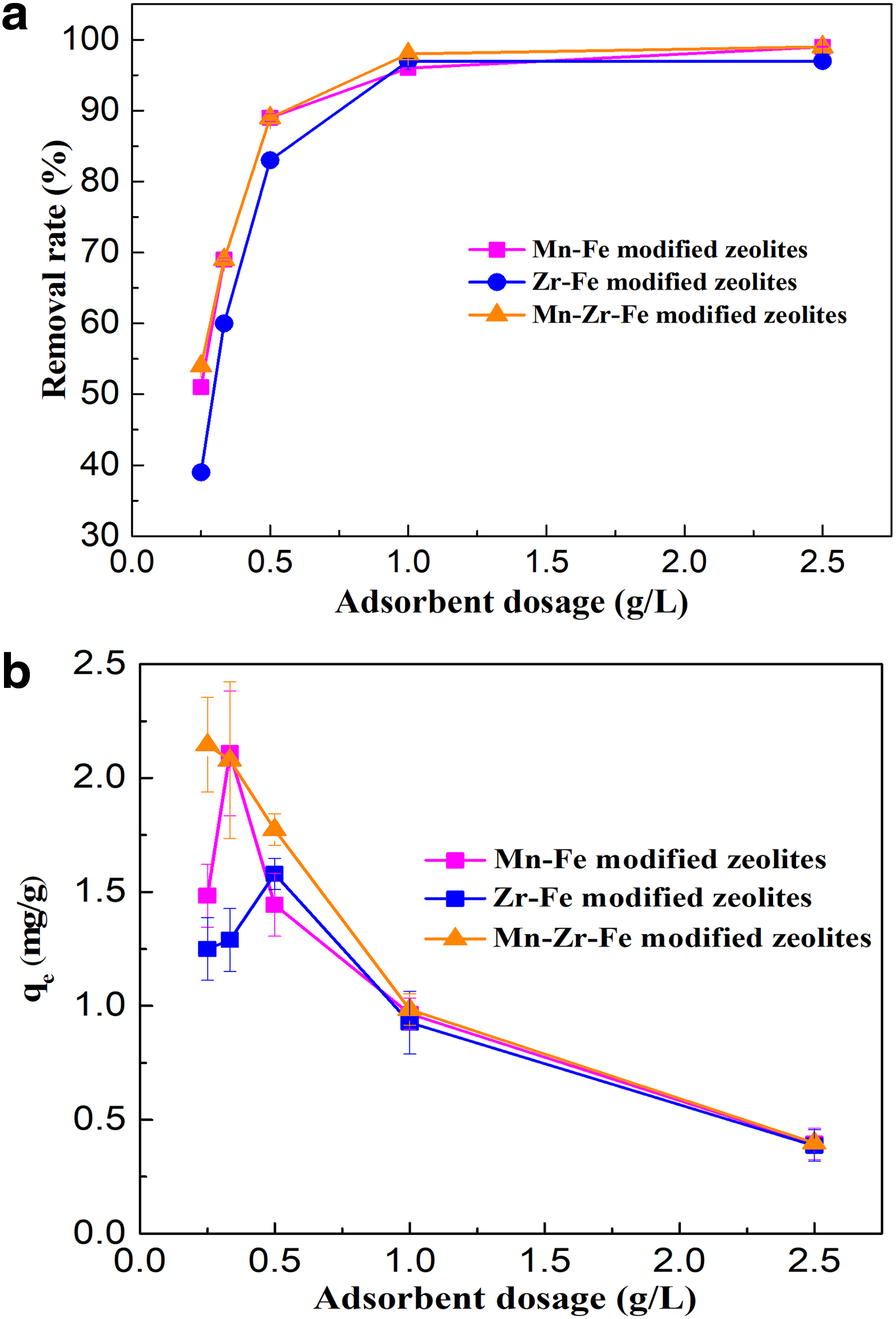
Effect of adsorbent dosage on the removal rate of phosphorus
Upon increasing the dosage of MNZs, the equilibrium adsorption amount of phosphorus increases first and then decreases (Fig. 4b). Under normal circumstances, an increase in adsorbent dosage promotes reduction of the effective total surface area, and then reduces the equilibrium adsorption capacity of the adsorbents (Zhu et al., 2016).
There are many coexisting anions (Cl−, NO3−, SO42−, and HCO3−) in natural water, which have certain competition effect on the adsorption of phosphorus. As shown in Fig. 5, Cl− has the weakest effect on the adsorption of phosphorus, whereas the other coexisting ions inhibiting effect is in the order of HCO3− > SO42− > NO3−. When the concentration of the coexisting anions is higher, the saturated adsorption capacity of the modified zeolites is smaller (Ji et al., 2014). The inhibition of adsorption of phosphorus is due to the competition for the adsorption sites on the surface of adsorbent between coexisting anions and phosphorus anion (Yang et al., 2014).
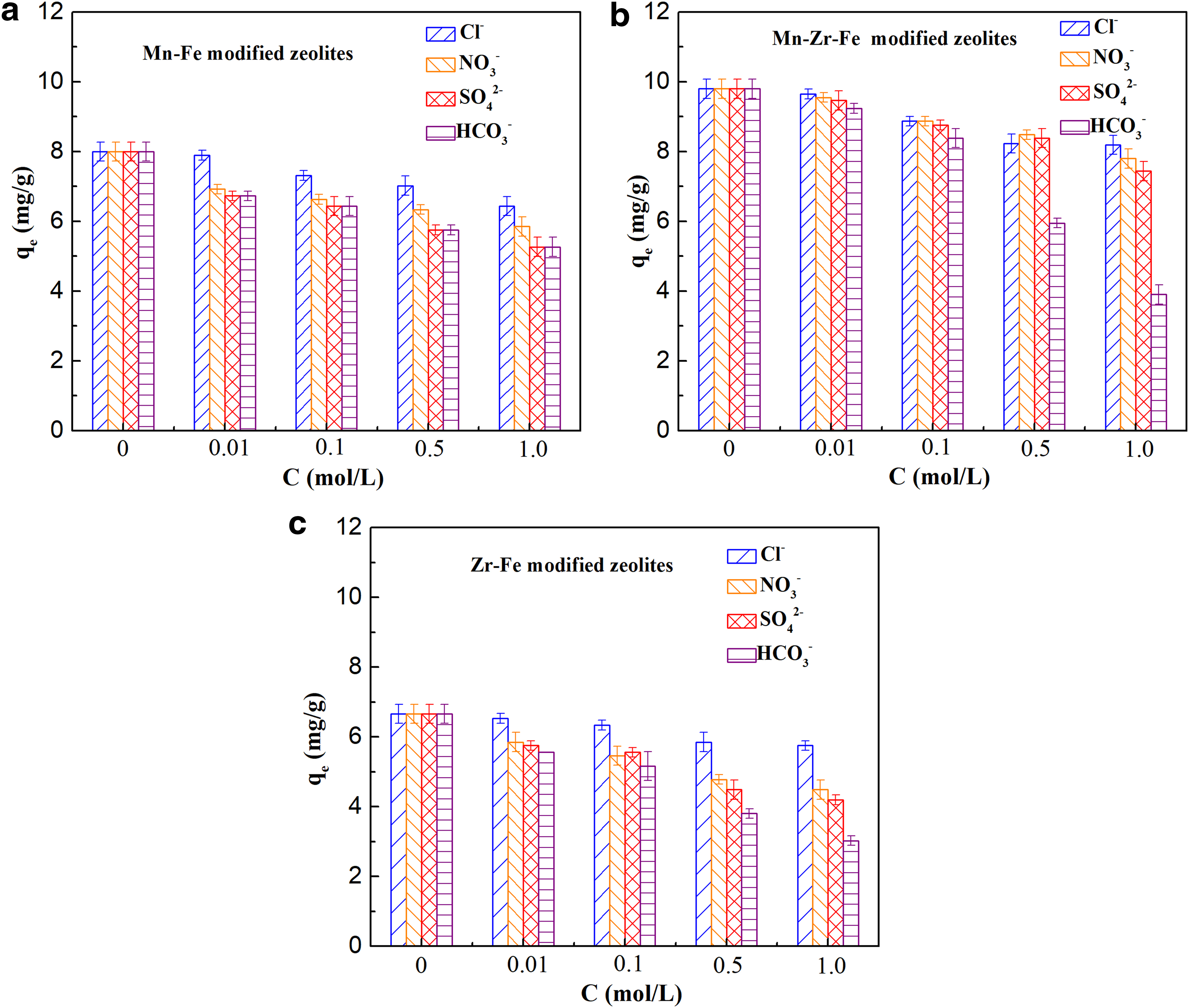
Effect of coexisting anions on the adsorption amount of phosphorus for the Mn–Fe-modified zeolites
The modified zeolites were negatively charged after adsorbing coexisting anions, which could produce electrostatic repulsion with the phosphorus anion. Furthermore, at higher concentrations of coexisting anions the electrostatic repulsion is stronger. In addition, the introduction of HCO3− to water leads to changes in the pH value. At higher HCO3− concentration, the pH value of solution increases. Previous published analytic results showed that acidic conditions contributed to the adsorption of phosphorus, in addition, HCO3− acts as an oxygen acid radical similar to phosphorus's tetrahedral structure. Hence, HCO3− has the largest capacity for adsorption sites competition (Xie et al., 2014).
Additionally, the existence of competing ions did not affect the phosphorus adsorption by hydrated aluminum oxide-modified zeolite (Guaya et al., 2015). At different pH values, changes in the ionic strength had little effect on the adsorption of aqueous phosphorus for Fe zeolite (Moharami and Jalali, 2015). This might be due to the fact that high concentrations of competing ions are used in the present article.
Adsorption mechanism of phosphorus
To gain further insights into the adsorption mechanisms of phosphorus onto the MNZs, a series of complementary analyses were performed. The effect of pH value on the adsorption capacity of phosphorus onto MNZs is depicted in Supplementary Fig. S5. The results show that pH influences the adsorption of phosphorus significantly. Overall, the adsorption capacity of phosphorus decreases with increasing pH values. Furthermore, acidic condition benefits the adsorption of phosphorus onto MNZs. Adsorption capacity slowly reduces from pH 2.0 to 4.0 and decreases dramatically from pH 4.0 to 11.0.
When pH values of solution are in the range of 2.0–11.0, the distribution of phosphorus in aqueous solutions consists mainly of H2PO4− and HPO42− (Supplementary Fig. S6). The concentration of H2PO4− decreases with increasing HPO42− content and pH values, and H2PO4− is more easily adsorbed on MNZs than HPO42− through a ligand exchange mechanism (Xie et al., 2014; Yang et al., 2014).
Furthermore, the determined isoelectric points (pHpzc) of Zr–Fe, Mn–Fe, and Mn–Zr–Fe MNZs are 4.1, 5.9, and 4.3, respectively (Supplementary Fig. S7). When pH value of solution is lower than the pHpzc, the surface of the modified zeolites is positively charged. Lower pH value benefits protonation, at the same time, the surface of the modified zeolites is positively charged, which contributes to the attraction with phosphorus anion. However, when the pH value of solution is higher than pHpzc, the surface of the modified zeolites is negatively charged, which is not conducive to adsorb phosphorus due to the electrostatic repellent effect with the phosphorus anion (Pan et al., 2014).
Therefore, the adsorption capacity of phosphorus onto modified zeolites at the pH < pHpzc is much higher than that of pH > pHpzc, indicating that the electron attraction between the negative phosphate ions and modified zeolites also contributes to the adsorption of phosphorus when pH < pHpzc.
XPS spectra of natural zeolites and MNZs are shown in Supplementary Fig. S8. XPS spectra show that natural zeolites contain C, O, and Si, which is consistent with XRD spectra of natural zeolites. Three new peaks corresponding to Mn2p, Zr3d, and Fe2p compared with natural zeolites appear, which suggests that manganese, zirconium, and iron elements are loaded onto natural zeolites. The high-resolution XPS spectra of O1s for MNZs and phosphorus-adsorbed natural zeolites are shown in Fig. 6.
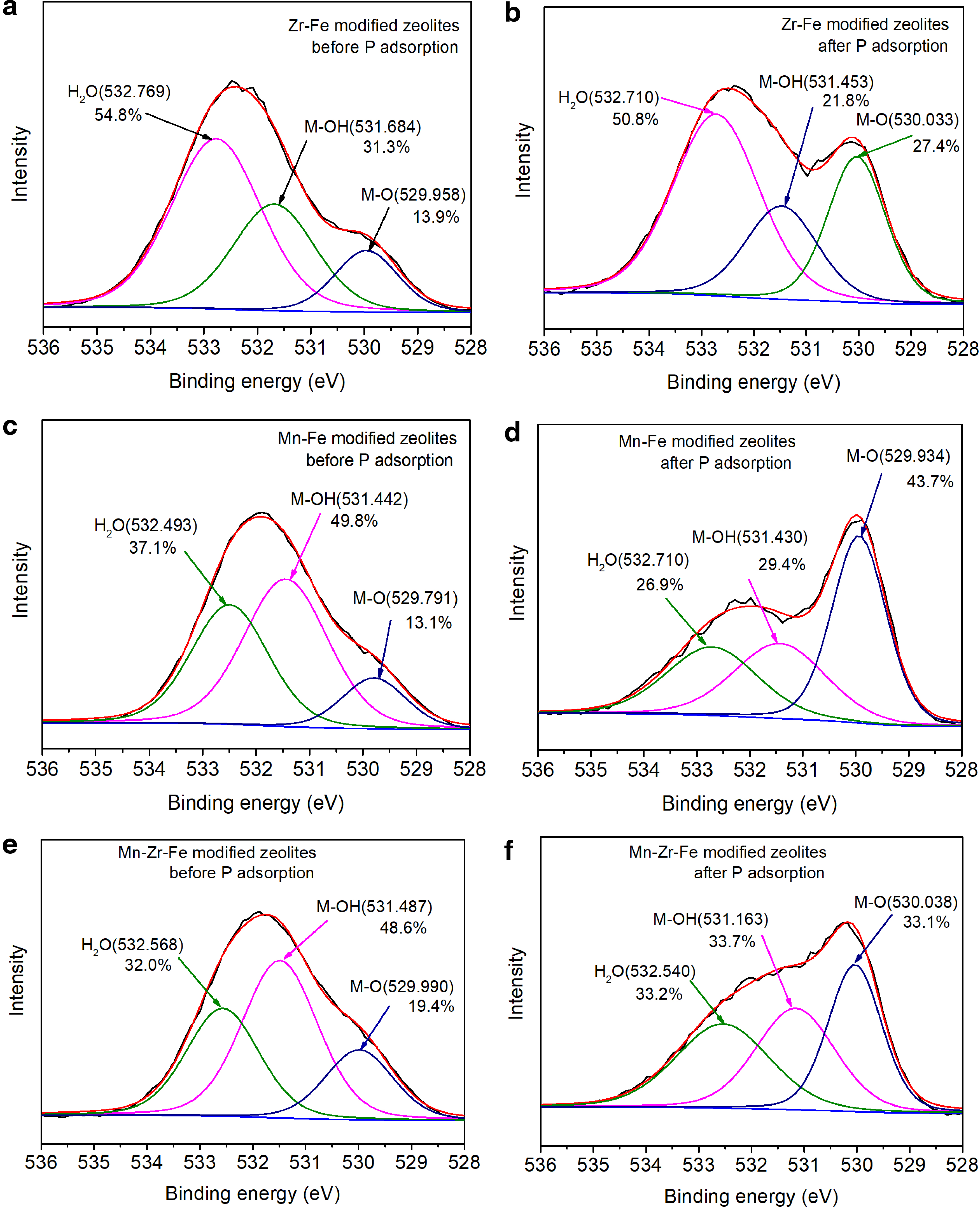
X-ray photoelectron spectroscopy spectra of O1s for the Zr–Fe-modified zeolites
As shown in Fig. 6, the O1s spectra can be separated into three overlapping peaks corresponding to M–O (oxygen bonded to metal), M–OH (hydroxyl bonded to metal), and adsorbed water (H2O) (Pepper et al., 2018). A large amount of −OH groups (31.3%) exist on Zr–Fe MNZs surface, and the percentages of −OH groups decline from 31.3% to 21.8% after the adsorption of phosphorus on Zr–Fe MNZs. Similarly, the percentages of −OH groups decline from 49.8% and 48.6% to 29.4% and 33.7%, after the adsorption of phosphorus onto Mn–Fe MNZs and Mn–Zr–Fe MNZs, respectively.
The decrease in the percentages of −OH groups could be due to the ligand exchange between −OH groups on the adsorbents and aqueous phosphorus during the adsorption process, which further confirms that these groups on the surface of phosphorus play a key role in the phosphorus adsorption (Shi et al., 2019). The stoichiometric ratio of surface hydroxyl between the original adsorbent and phosphorus-loaded adsorbent is 0.5 for a monodentate complex and 2 for a bidentate complex (He et al., 2016).
In the present study, the ratio of the proportion of surface hydroxyl in the adsorbent to that of phosphorus-adsorbed adsorbent is 1.4, 1.7, and 1.4 (ranging between 0.5 and 2) for Zr–Fe MNZs, Mn–Fe MNZs, and Mn–Zr–Fe MNZs respectively, which suggests that monodentate, bidentate mononuclear, and bidentate binuclear innercomplex might be formed when phosphorus is adsorbed on the surface of the modified zeolites (Yu and Paul Chen, 2015).
Therefore, the adsorption of phosphorus onto MNZs is controlled by ligand exchange through the generation of inner-sphere surface complexes and electrostatic attraction between the negative phosphorus ions and positive surface of the MNZs.
Desorption and reusability
NaOH solutions (0.01, 0.1, 0.5, and 1.0 mol/L) were used for desorption of phosphorus. Figure 7a shows that the desorption rate of phosphorus increases with increasing concentration of NaOH. When the concentration of NaOH increases from 0.5 to 1.0 mol/L, desorption rate of phosphorus for Mn–Fe and Mn–Zr–Fe MNZs remains unchanged, therefore, when the concentration of NaOH is 0.5 mol/L, desorption rate of phosphorus achieves optimal value. In addition, when the concentration of NaOH increases from 0.1 to 1.0 mol/L, desorption rate of phosphorus for Zr–Fe MNZs remains unchanged, hence, when the concentration of NaOH is 0.1 mol/L, the desorption rate of phosphorus is the optimal for Zr–Fe MNZs.
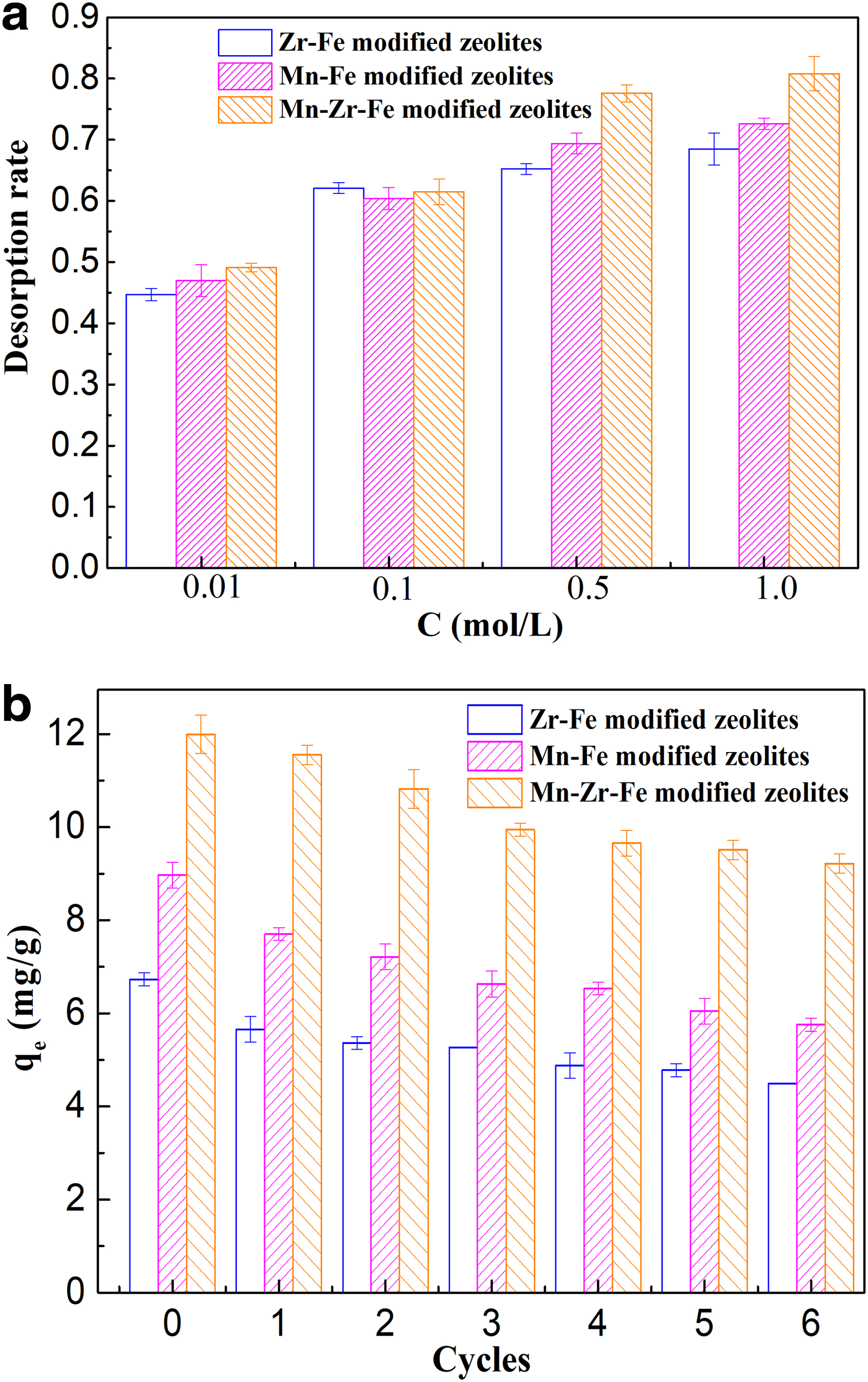
Effect of NaOH concentration on the desorption of phosphorus
Recycling and regeneration of adsorbents are important economic indicators when investigating adsorbents. As shown in Fig. 7b, the observed saturated adsorption capacity of the modified zeolites was shown at different adsorption–desorption cycles. Saturated adsorption capacity of Zr–Fe, Mn–Fe and Mn–Zr–Fe MNZs for phosphorus adsorption is 6.7, 9.0, and 12.0 mg/g at the first cycle, respectively. After six adsorption–desorption cycles, saturated adsorption capacity is 4.5, 5.8, and 9.2 mg/g, respectively. Therefore, the modified zeolites have good regenerative capacity.
Conclusions
According to our analysis, the specific surface areas of natural zeolites increased observably after modification. Adsorption kinetics of phosphorus onto MNZs was more in accordance with the pseudo-second-order kinetics model. The adsorption of phosphorus onto MNZs was affected by intraparticle diffusion. Langmuir model was more suitable to describe the adsorption behavior of phosphorus onto MNZs. Thermodynamic studies showed that the adsorption of phosphorus onto MNZs was a spontaneous process.
Higher temperatures contributed to the spontaneity of phosphorus adsorption, and the adsorption of phosphorus was an endothermic process. The unit adsorption quantity of the modified zeolites was higher at lower adsorbent dosage. Optimum range of pH conditions for phosphorus removal by MNZs was found to be acidic (pH = 2.0–6.0). Adsorption quantity of MNZs decreased with increasing coexisting anion concentration. The minimum and maximum influence of coexisting ions on the adsorption was inflicted by Cl− and HCO3−, respectively. Ligand exchange between phosphorus and hydroxide groups loaded on MNZs and electrostatic attraction were the main adsorption mechanisms. MNZs had good performance of adsorption and regeneration.
Footnotes
Author Disclosure Statement
No competing financial interests exist.
Funding Information
This work was supported by the National Water Pollution Control and Treatment Science and Technology Major Project (Grant No. 2017ZX07603-004), the National Natural Science Foundation of China (Grant Nos. 51208163 and 21876040), and the Fundamental Research Funds for the Central Universities (Grant No. PA2019GDQT0010).

References
Supplementary Material
Please find the following supplemental material available below.
For Open Access articles published under a Creative Commons License, all supplemental material carries the same license as the article it is associated with.
For non-Open Access articles published, all supplemental material carries a non-exclusive license, and permission requests for re-use of supplemental material or any part of supplemental material shall be sent directly to the copyright owner as specified in the copyright notice associated with the article.
