




Abstract
A novel calcium carbonate (CaCO3)/expanded graphite (EG) catalyst was fabricated, characterized, and used in a catalytic ozonation process to increase degradation and mineralization of ethylenediaminetetraacetic acid (EDTA) aqueous solutions. Various techniques were used to analyze the crystalline structure, morphology, and elemental composition of the novel CaCO3/EG catalyst, including X-ray diffraction, scanning electron microscopy, and energy dispersive spectrometry. Mercury intrusion porosimetry was used to measure specific surface area, pore diameter, and pore volume of the CaCO3/EG catalyst. Essential influencing factors such as CaCO3/EG composite dosage and initial pH were also surveyed for different systems. Catalytic ozonation by CaCO3/EG was notably increased by the removal of total organic carbon (TOC) of EDTA. After 60 min, 80% TOC removal efficiency from simulated wastewater having an initial TOC concentration of 600 mg/L and initial pH of 4.9 was achieved using 1.0 g/L CaCO3/EG. This efficiency was higher than that seen for other systems, including O3 alone (40%), EG/O3 (39%), CaCO3/O3 (28%), and EG (4%). A small decrease in the CaCO3/EG-catalyzed TOC removal rate was observed after three runs, but nonetheless the efficiency was >80% after 120 min. Assays with tert-butanol confirmed that CaCO3/EG-mediated catalytic ozonation was dependent on a free radical pathway. The results support that CaCO3/EG material could serve as an important reusable resource for catalytic oxidation reactions during treatment of wastewater containing EDTA.
Introduction
As a common industrial agent, ethylenediaminetetraacetic acid (EDTA) is used extensively in electroplating, food, cosmetics, pharmaceutical, and other industries (Parizot et al., 2019). Although itself EDTA is nontoxic itself, it does act as a complexing agent such that improper treatment of wastewater containing EDTA can enhance the mobility and stability of heavy metals in an aquatic environment (Guan et al., 2018). EDTA is also the most common component of wastewater from electroplating (Wang et al., 2018) and is an effective decontaminating agent in the nuclear industry due to its ability to form strong chelating compounds with various radioactive substances (Papynov et al., 2017). EDTA typically cannot be removed from wastewater using traditional biochemical methods since it does not readily biodegrade (Liu et al., 2017). Advanced oxidation process (AOPs) is a promising technology for the removal of several organic pollutants that promotes the effective degradation of chelating agents in wastewater (Kulik et al., 2007; Sun et al., 2009). EDTA can be effectively removed by various AOPs through the production of highly reactive hydroxyl radicals (•OH) promoted by various processes, including photocatalytic oxidation (Rekab et al., 2015), catalytic Fenton-like processes (Sashkina et al., 2016; Zhang et al., 2019), hydrothermal oxidation (Avramenko et al., 2008), UV/H2O2 (Seo et al., 2019), electrochemical oxidation (Kabdaşlı et al., 2009; Durante et al., 2011), and ozonolysis (Englehardt et al., 2007). However, the low utilization efficiency, high consumption, and lack of high activity and stability of desirable catalytic materials have limited the application of these methods (Oturan and Aaron, 2014).
Heterogeneous catalytic ozonation is a promising and attractive technology for the removal of organic compounds (Mehrjouei et al., 2015; Yaghmaeian et al., 2017) since ozone can produce •OH in water that in turn promotes EDTA oxidation (Nawrocki and Kasprzyk-Hordern, 2010; Zhang et al., 2018). Hence, as ozone oxidation proceeds, wastewater is purified through the direct reaction of EDTA with •OH formed during the decomposition of O3 (Huang et al., 2016; Chen et al., 2019). However, the efficiency by which ozone decomposes to yield •OH is relatively poor due to the low oxidative potential of this reaction. As such, proper and effective catalysts are needed to increase the efficiency of EDTA degradation.
Both homogeneous and heterogeneous particles as catalysts have been recently reported as key components of advanced oxidation methods for catalytic ozonation processes (Miklos et al., 2018; Wei et al., 2019). Due to their unique features such as high surface area, ease of recycling, and low preparation and regeneration costs (Amutha et al., 2014), several metal oxides, including Fe2O3, MnO2, Ce2O3, ZnO, CoO, Al2O3, MgO, and CaO (Mageshwari et al., 2013; Wang et al., 2013; Huang et al., 2016; Yaghmaeian et al., 2017; Izadifard et al., 2018), have been widely used in catalytic ozonation systems. Several studies described the preparation of CaCO3 as a catalyst for heterogeneous oxidation of ozone to sulfur dioxide in the gas phase (Li et al., 2006; Dash et al., 2018).
Carrier materials have a high potential for enhancing catalytic activity, stability, and mineralization rate (Nawrocki and Kasprzyk-Hordern, 2010). Several carbon materials, including graphene, graphite oxide, and carbon nanotubes, have been reported to be potential substrates of metal oxides for catalytic oxidation (Duan et al., 2018). However, these carbonaceous materials are difficult to produce on an industrial scale due to their complex preparation process. Expanded graphite (EG) is a type of modified graphite that has a certain degree of separation between most of its carbon layers (Chung, 2016). EG is characterized by a worm-like or accordion-like morphology and large numbers of network-like pores in its structure (Yu et al., 2014). In particular, EG could be a promising catalytic carrier material for catalytic oxidation based on its low toxicity and cost, as well as its ease of large-scale production.
Despite its promise, few studies have focused on the potential of CaCO3/EG composites as heterogeneous catalysts for the oxidation of EDTA. The primary focus of this work was to prepare CaCO3/EG particles using a simple chemical impregnation approach to produce an efficient heterogeneous catalyst for the degradation of EDTA. The properties of CaCO3/EG samples were characterized via X-ray diffraction (XRD), scanning electron microscopy (SEM), energy dispersive spectrometry (EDS), and mercury intrusion porosimetry (MIP). Three main parameters, catalytic system, catalyst dosage, and pH were selected to evaluate the removal efficiency of EDTA total organic carbon (TOC) in aqueous solution. The stability and reusability of the CaCO3/EG system were evaluated in terms of the catalytic activity during EDTA degradation, and possible reaction mechanisms associated with EDTA degradation were examined. This study also aims to provide technical support for the treatment of organic wastewater containing EDTA using a system involving CaCO3/EG.
Materials and Methods
Materials
Natural flake graphite (NG, particle diameter = 80 meshes) was supplied by Qingdao Tianheda Graphite Co., Ltd. (China). Perchloric acid (HClO4) and potassium permanganate (KMnO4) were acquired from Tianjin Kemiou Chemical Reagent Co., Ltd. Calcium nitrate hexahydrate [Ca(NO3)2 · 6H2O], ammonium nitrate (NH4NO3), hydrochloric acid (HCl), calcium carbonate (CaCO3), sodium hydroxide (NaOH), absolute ethanol, tert-butanol (TBA), and EDTA disodium were from Tianjin Kaitong Chemical Reagent Co., Ltd.. All reagents were of analytical grade.
Experimental methods
Preparation of EG
EG was fabricated via direct chemical interaction of NG according to our previously described method (He et al., 2017). EG could be obtained from NG via chemical oxidation methods, in which KMnO4 is the oxidizing agent and NH4NO3 and HClO4 are intercalation agents. The expanded volume of EG was 380 mL/g.
Preparation of CaCO3/EG composite
CaCO3/EG composite was prepared via an impregnation method using absolute ethanol, Ca(NO3)2 and EG at a mass ratio of Ca(NO3)2 to EG of 2.3:1. The entire reaction process was carried out in a glass reactor. Ca(NO3)2 (11.8 g) was completely dissolved in 50 mL absolute ethanol by ultrasonic treatment before 5 g of EG was added. The mixtures were incubated at room temperature for 12 h with magnetic stirring. The fully impregnated EG was then removed and thoroughly washed with deionized water, suction filtered, and dried at 60°C for 8 h. The samples were further calcined in a muffle furnace at 550°C for 5 h and then slowly cooled to room temperature to complete fabrication of the CaCO3/EG composite.
Experimental procedures
All catalytic degradation experiments were conducted at room temperature in a glass reactor (1.0 L, 90 mm inside diameter and 25 mm high) containing 300 mL EDTA solution that was constantly stirred. A solution containing 600 mg/L EDTA served as simulated wastewater. Ozone was produced using an ozone generator (Qinhuangdao GuoZhong Environmental Engineering Co., Ltd., China) with a pure oxygen source. The ozone (O3) entered the reaction column at a flow rate of 2.0 L/min and a concentration of 58.2 g/m3 through an inlet at the bottom of the column and was passed over a porous sand core plate. A 15% KI solution was used to prevent secondary contamination from the remaining ozone exiting the reactor. Na2S2O3 (0.1 M) was used to quench the remaining aqueous O3 in the reaction solution. Catalytic ozonation experiments were replicated and the standard error of the mean was determined. The pH value of the aqueous EDTA solution was adjusted using NaOH and HCl. Upon initiation of the reaction (0 min) and later time points (15, 30, 45, 90, 105, and 120 min), 10 mL samples of the solution were collected and filtered into a glass bottle through a 0.22 μm filter membrane. The mineralization rate was evaluated based on the change in the TOC before and after the reaction. Key factors such as reaction system, catalyst dosage, and initial pH were examined and optimized under a constant ozone concentration. To evaluate the stability and reusability of the catalyst, samples were collected after each reaction and used for the next reaction under the defined conditions. TBA (0.05 M) was used to examine the effect of the presence of radical scavengers. All results were obtained by repeating the experiment at least three times.
Analytical methods
The concentration of ozone in the liquid phase was determined using Standard Methods (1985) with a UV-vis spectrophotometer (WFZ-26A; China) and the indigo colorimetric method (Bader and Hoigné, 1981). TOC in solution was measured using a TOC-VCPH analyzer (Shimazu, Japan). Each sample was analyzed in triplicate. The pH value of the aqueous EDTA solution was measured using a pH meter (PHS-4A; China). The morphology and elementary compositions of the CaCO3/EG composites were investigated by SEM (S4800; Hitachi, Japan) and EDS with an accelerating voltage of 20 keV to observe the surface morphology and elementary compositions. The crystalline phase of the prepared CaCO3/EG was characterized by XRD analysis with a Rigaku (Japan) D/max 2500 PC XRD with Cu Kα radiation (λ = 0.15418 nm) of 40 kV and 40 mA. The scanning rate was 5°/min from 10° to 80°. The characteristics of the material pore structure, including pore volume, specific surface area, and pore diameter, were all acquired by MIP using an AutoPore IV 9510 Porosimeter (Micromeritics Instrument Corporation, Norcross, GA).
Results and Discussion
Characterization of the catalyst
XRD analysis of the CaCO3/EG composite prepared using an impregnation method showed a strong characteristic peak from 2θ = 20°–50° that corresponded to the standard card of CaCO3, indicating that the composite was successfully prepared (JCPDS No. 05-0586; Fig. 1). The CaCO3 crystal obtained was calcite (Wang et al., 2006), which also indicates that the active component calcium (Ca) in the obtained catalyst is CaCO3. The calcination temperature (550°C) did not exceed the decomposition temperature of CaCO3 (900°C), consistent with the main component being CaCO3. At the same time, the catalyst had one significant, sharp peak (2θ = 29°) that is characteristic of high crystallinity and good crystal form.
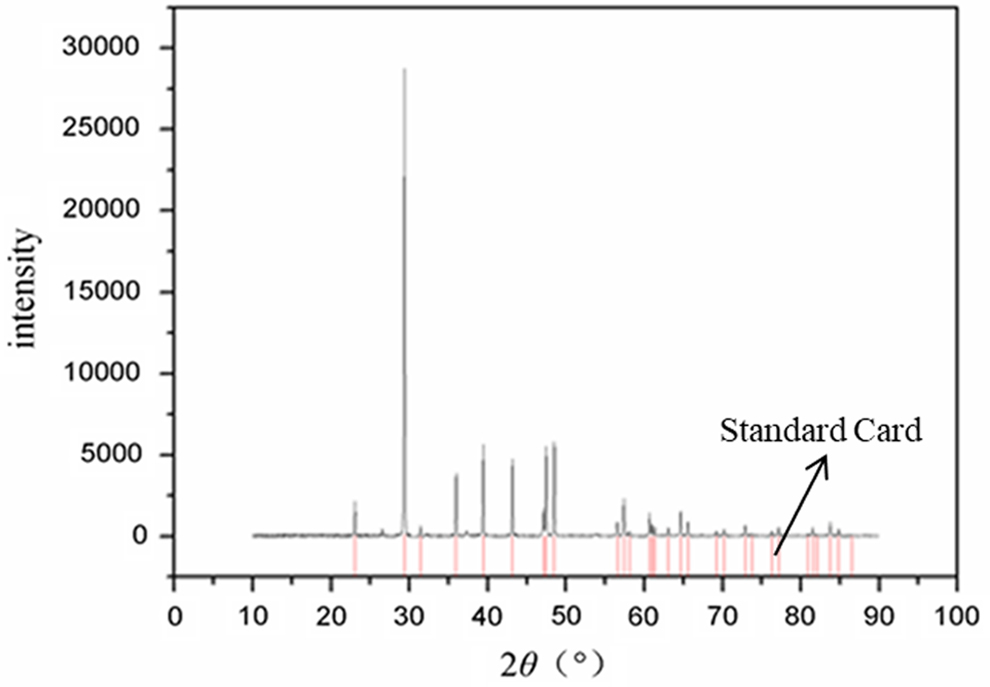
X-ray diffraction pattern of CaCO3/EG composite. CaCO3, calcium carbonate; EG, expanded graphite.
In SEM analysis, the morphology of EG at 1,000 × magnification exhibited a worm-like structure (Fig. 2a). The surface of EG has a mesh-like structure and a developed pore structure composed mainly of large pores and mesopores. Notably, the pore structure has sufficient space for the catalyst load, indicating that EG can be an ideal carrier. At 2,000-fold magnification in SEM, small white particles could be seen loaded onto the surface or interstitial spaces of EG (Fig. 2b), indicating that uniform distribution of CaCO3 as an active component could be successfully obtained in the CaCO3/EG compound via the simple impregnation method. Due to the porous structure of EG, CaCO3 particles can have an optimal distribution on the surface of EG and prevent particle aggregation.
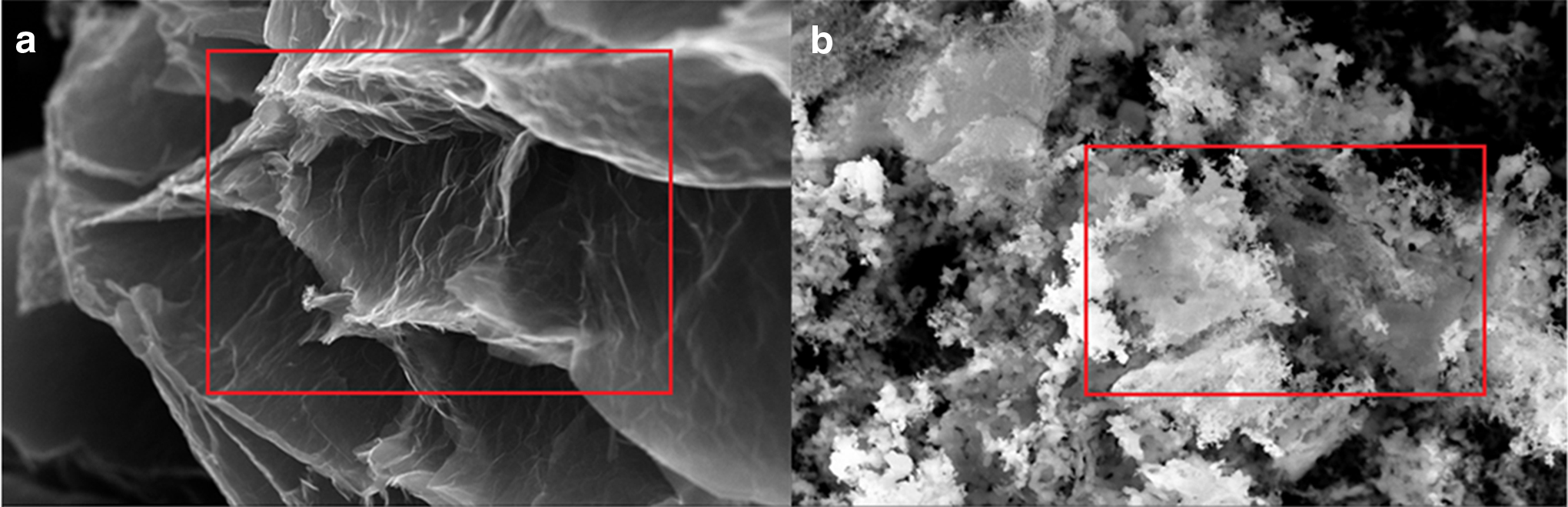
Scanning electron microscopy images of catalysts:
EDS analysis was performed to analyze the elemental composition of CaCO3/EG composite (Fig. 3). EDS mapping of EG showed clear peaks corresponding to chlorine (Cl), carbon (C), and manganese (Mn) elements (Fig. 3a). The appearance of Cl and Mn elements can be ascribed to the chemical oxidation mechanism. In addition, Cl, C, Mn, and Ca elements were also visible in EDS measurement of the CaCO3/EG composite (Fig. 3b). These results indicate that Ca2+ was transformed into crystallized CaCO3, which is consistent with the XRD analysis.
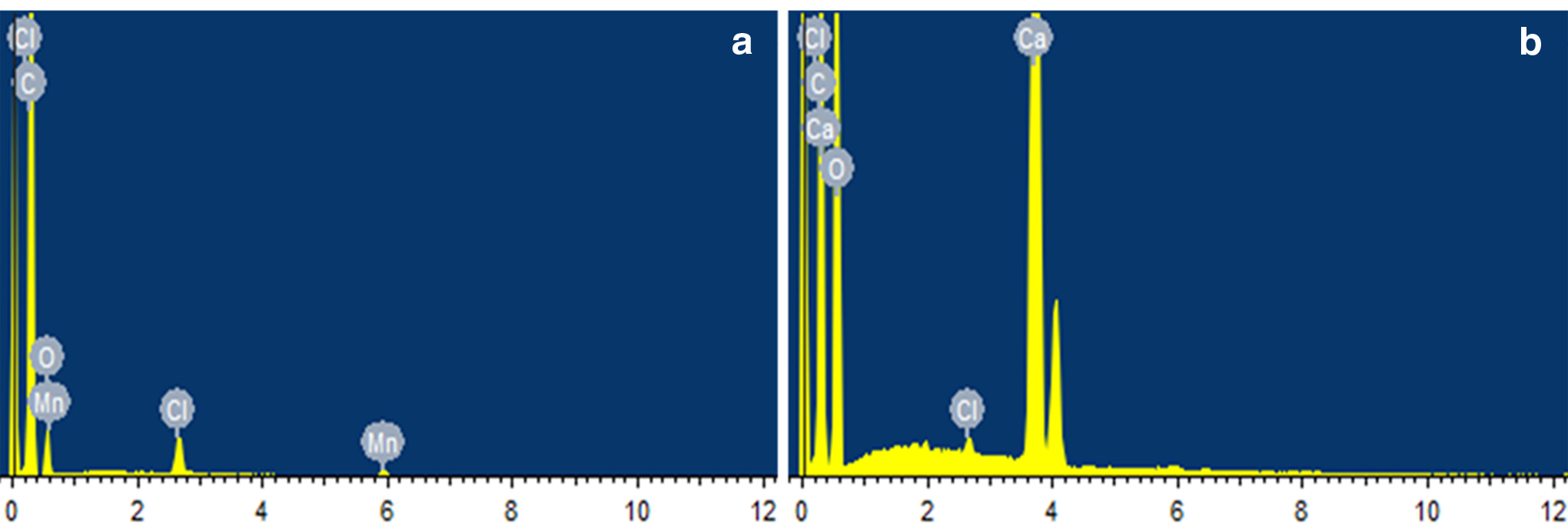
Energy dispersive spectrometry spectra of
The specific surface area and porosity of EG and the CaCO3/EG composite were investigated by MIP (Table 1). EG had a higher specific surface area (420 m2/g) relative to the CaCO3/EG composite (307 m2/g) due to the attachment of the CaCO3 active component to the EG surface. The pore diameter and volume of EG was also larger than that of the CaCO3/EG composite 22.135 μm versus 19.086 μm and 37.5576 cm3/g versus 25.4754 cm3/g, respectively.
Mercury Intrusion Porosimetry Analysis of Expanded Graphite and Calcium Carbonate/Expanded Graphite
CaCO3, calcium carbonate; EG, expanded graphite.
EDTA degradation experiments
Catalytic evaluation of EDTA degradation in different systems
The removal efficiency of TOC was compared for (i) O3 alone, (ii) EG–O3, (iii) CaCO3/EG–O3, (iv) CaCO3–O3, and (v) EG alone. The TOC removal efficiency of the CaCO3/EG–O3 system after 60 min was the highest at >80% compared to the other systems (O3 alone, 40%; EG–O3, 39%; CaCO3–O3, 28%; and EG, 4%; Fig. 4). EDTA is not substantially adsorbed onto the EG carrier as evidenced by the TOC removal rate that ranged between 2% and 5%. This result indicates that the loose porous structure of EG does not adsorb substantial amounts of EDTA. O3 alone and EG–O3 had similar effects on EDTA with removal of about 40% TOC after 60 min, also indicating that the EG carrier has only a certain adsorption effect. Meanwhile, the TOC removal rate of the CaCO3/EG catalytic system was 92% after 120 min, which was substantially higher than that of the CaCO3–O3 system (59%). These results indicate that (i) the unique structure of EG could provide a favorable attachment space for dispersing CaCO3 particles; (ii) the CaCO3/EG composite has more active sites for EDTA degradation than CaCO3 alone, which can be attributed to the surface area provided by EG (Dash et al., 2018); and (iii) the CaCO3 particles in the CaCO3/EG composite could interact with the EG substrate to lower the energy barrier on the EG surface to enhance the catalytic activity (Fang et al., 2018). Together these results show that CaCO3/EG materials could be a promising catalyst of EDTA degradation.
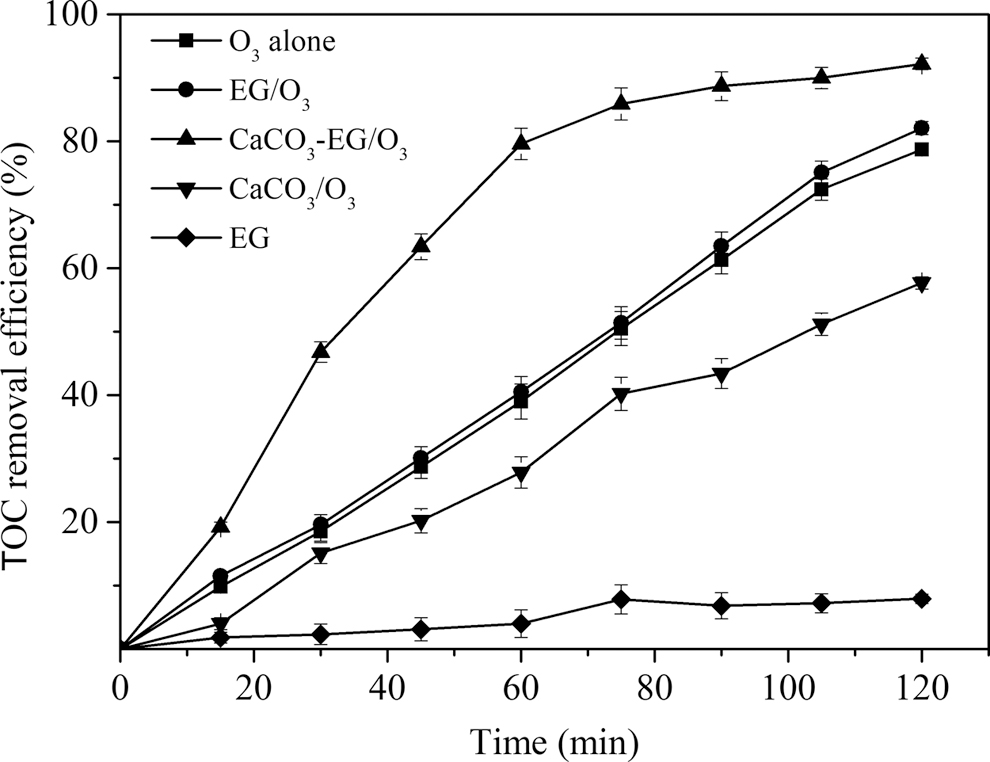
Removal efficiency of TOC in different systems, (Experiment conditions: CEDTA = 600 mg/L; CO3 = 12 mg/L; initial pH = 4.9; T = 293 ± 1 K; Ccatalyst = 1.0 g/L). TOC, total organic carbon; EDTA, ethylenediaminetetraacetic acid.
Effect of catalysts dosage on EDTA degradation
Catalyst dosage is a key factor in catalytic ozonation systems. An investigation of CaCO3/EG dosage on the removal rate of TOC in the catalytic ozonation system showed that an increase in catalyst dosage enhanced EDTA degradation (Fig. 5). When the catalyst dosage was 0.5 g/L, only 45.1% of TOC removal was achieved within 60 min, compared to ∼80% removed at a catalyst dosage of 1 g/L. This outcome could be directly attributable to increased contact between the CaCO3/EG catalyst and EDTA. Increased catalyst dosage of the CaCO3/EG composite provides more active sites for oxidation reactions that in turn produce more hydroxyl radicals, thus accounting for the increased TOC removal rate. However, no obvious improvement in TOC removal was seen for CaCO3/EG concentrations >1 g/L, suggesting that the optimum CaCO3/EG dosage for EDTA degradation was 1 g/L. This concentration was used for subsequent experiments.

Effect of catalyst dosage on TOC removal during EDTA ozonation (experiment conditions: CEDTA = 600 mg/L; CO3 = 12 mg/L; initial pH = 4.9; T = 293 ± 1 K; Ccatalyst = 1.0 g/L).
Effect of initial pH on CaCO3/EG-mediated EDTA degradation
The pH of the aqueous EDTA solution is an important factor that influences the catalytic ozone oxidation of organic compounds because it affects ozone decomposition and the functional groups on the catalyst surface. When the initial pH of the test solution in the CaCO3/EG–O3 system was 4.9, the TOC removal was highest at around 80% at 60 min (Fig. 6). When the initial pH was shifted from 4.9 to 3.0 or 11.0, the TOC removal rate decreased. This outcome could be associated with the dissociation of CaCO3 particles from the EG support promoted by acidic conditions (pH = 3.0) in the reaction process, which resulted in the lowest TOC removal rate of 35% (pH = 11.0). This result could also be related to pH-dependent effects on the state of EDTA. This finding is consistent with that of a study by Gilbert and Hoffmann-Glewe (1990), which showed that the degradation rate of EDTA decreased with increasing pH. In acidic solutions, in which the pH is less than the pKa of EDTA (6.2), EDTA exhibits essentially the same molecular state and as the solution pH decreases, the molecular state of EDTA increases. Furthermore, the increased rate of degradation can be attributed to an increase in the ozone oxidation potential in acidic medium. Higher pH also does not favor degradation of TOC in the CaCO3/EG system. The ratio of free radical scavengers (e.g., CO32−, HCO3−) may increase at high pH, resulting in decreased amounts of •OH (Wang et al., 2010). Moreover, Muroyama et al. (2011) showed that pH values in a solution can be maintained for about 6 h in the presence of 0.1 g CaCO3 in the aqueous phase. When the initial pH values were 3.0, 4.9, 7.0, and 11, the corresponding final pH values after the reaction were 7.2, 7.4, 7.7, and 7.8, respectively. Together, optimal pH (pH 4.9) and ionic strength are more conducive to effective catalytic oxidation.
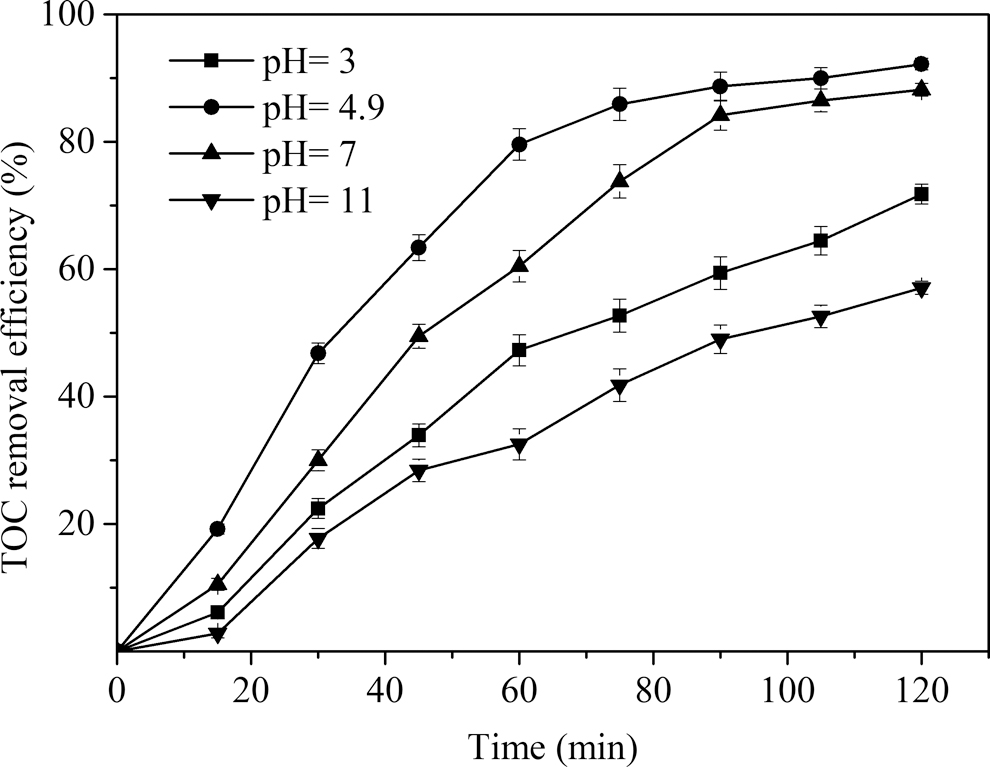
Effect of initial pH on TOC removal during EDTA ozonation (experiment conditions: CEDTA = 600 mg/L; CO3 = 12 mg/L; T = 293 ± 1 K; Ccatalyst = 1.0 g/L).
Stability and reusability of CaCO3/EG
The reusability of a catalyst is one of the most important criteria for feasibility of large scale industrial applications. At the end of each cycle, the used catalyst was filtered, collected, and washed gently with distilled water and dried in an oven at 60°C for 2 h before use in the next cycle at the same dose. Compared with newly prepared catalysts, the catalytic activity decreased gradually for previously used catalysts, and the TOC removal rates across three cycles dropped from >92% to 80% in a 120 min oxidation reaction (Fig. 7). Meanwhile, compared with alone O3, an 80% TOC removal rate can be obtained after the third run, indicating that the CaCO3/EG composite has suitable performance in terms of reusability. The loss of activity with repeated use could be ascribed to the poisoning of active catalytic sites through the adsorption of intermediates and decreases in the catalyst-specific area. The decay of active catalytic sites is also associated with the loss of CaCO3 particles from the composite. Based on the above analysis and the experimental results, CaCO3/EG particles have relatively stable catalytic activity.

TOC removal rates after repeat uses of CaCO3/EG composite catalyst (experiment conditions: CEDTA = 600 mg/L; CO3 = 12 mg/L; initial pH = 4.9; T = 293 ± 1 K; Ccatalyst = 1.0 g/L).
Catalytic mechanism of EDTA degradation
As a strong radical scavenger, TBA can effectively react with •OH [k = 6 × 10⁸/(M · s)] in solution (Liu et al., 2018). Previous studies indicated that hydroxyl radicals not only trigger the free radical chain reaction but also play a dominant role in oxidation of aqueous contaminants (Nawrocki and Kasprzyk-Hordern, 2010). In this study, TBA was used to evaluate whether •OH can interfere in the global pathway of ozonation catalyzed by CaCO3/EG. In the presence of 0.05 M of TBA, TOC degradation was markedly inhibited in both the CaCO3/EG–O3 and O3 alone systems (Fig. 8). This result confirmed that the •OH radical was involved in the catalytic mechanism of the CaCO3/EG–O3 system. Only 35% of TOC was achieved in the presence of TBA in the O3 alone systems, indicating that the self-decomposition of ozone can form •OH, and EDTA could be removed by O3 alone.
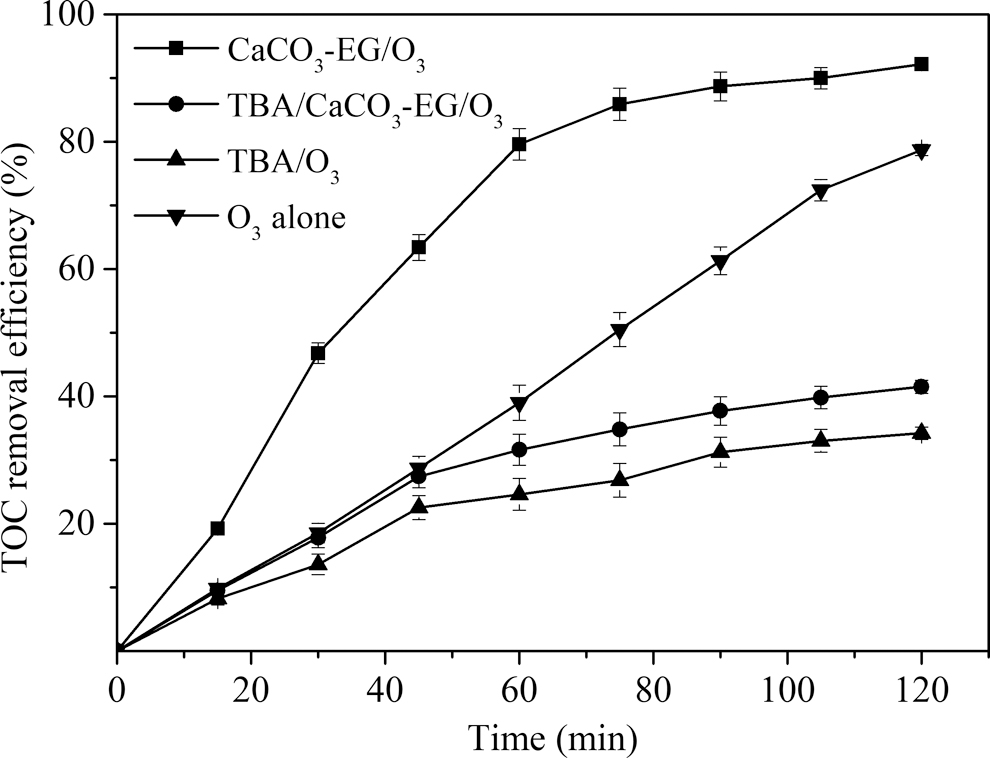
Effect of TBA on TOC removal efficiency during EDTA ozonation (experiment conditions: CEDTA = 600 mg/L; CO3 = 12 mg/L; initial pH = 4.9; T = 293 ± 1 K; Ccatalyst = 1.0 g/L). TBA, tert-butanol.
The specific surface area of the catalyst is an essential parameter of catalytic activity (Ma et al., 2013). A larger specific surface area can provide more active sites to promote catalysis on the surface (Chen et al., 2015). Li et al. (2012) assessed CaCO3 as a catalyst for heterogeneous oxidation of sulfur dioxide by ozone in the gas phase. They proposed a catalytic mechanism that involved adsorption of SO2 on the CaCO3 surface followed by O3 oxidation at active sites on the solid surface. Following the results shown in Table 1, it is reasonable to deduce that the catalytic activity of the CaCO3/EG catalyst is determined by the number of active sites. Appropriate amounts of CaCO3 can provide more active sites that result in higher activity for degradation of EDTA.
Conclusions
In this study, the CaCO3 particles were successfully loaded onto EG with an impregnation method and the resulting CaCO3/EG catalytic ozonation system compound was shown to be an effective heterogeneous catalyst for EDTA degradation in the presence of ozone. Initial pH, catalyst dosage and the catalytic system composition all influenced the catalytic ozonation process. The CaCO3/EG composite at 1 g/L with an ozone dosage of 12 mg/L achieved >80% TOC degradation efficiency in 60 min at initial pH 4.9. Meanwhile, after three reaction run times, a final TOC removal of around 80% was achieved, indicating that the catalyst had good stability and reusability. Radical scavengers were used to demonstrate the existence of ·OH in the reaction and that EDTA oxidation mediated by the CaCO3/EG composite may proceed via radicals and O3 molecules.
Footnotes
Author Disclosure Statement
No competing financial interests exist.
Funding Information
This work was supported by National Natural Science Foundation of China (51608468).