




Abstract
Herein, we developed a dual-functional filter for one-step decontamination of highly toxic antimony (Sb) (III). The filter consists of carbon nanotubes (CNTs) and nanoscale zerovalent iron (nZVI) particles, both are indispensable. Rapid transformation of highly toxic Sb(III) to less toxic Sb(V) can be achieved without additional energy requirements due to the oxidative capability of the nZVI nanoparticles. Compared to conventional batch system, the proposed flow-through filter demonstrated obviously enhanced Sb(III) removal kinetics and sorption capacity due to convection-based mass transport. Moreover, the limited filter pore size, more exposed sorption sites, as well as a throughflow design also synergistically contribute to the improved Sb(III) removal performance. The nZVI-CNT hybrid filter could work effectively across a wide range of pH. The working mechanism of the nZVI-CNT hybrid filter for Sb(III) oxidation and adsorption was verified by various advanced characterizations and tests. Exhausted nZVI-CNT filters can be regenerated by chemical washing with sodium hydroxide solution. The Sb(III)-spiked tap water experiment was carried out to further verify the stability and practicability of the nZVI-CNT filter system, generated ∼2100 bed volumes of effluent before the removal efficiency of Sb(III) <90%. This study gives new insights for the detoxification and sorption of highly toxic Sb(III) and other similar heavy metal ions through a continuous-flow system.
Introduction
Currently, environmental pollution caused by emerging contaminant antimony (Sb) has attracted global attention (Sandhu et al., 2013; He et al., 2015; Yan et al., 2017; Ma et al., 2019). Large quantities of Sb are released into environment from either natural or anthropogenic activities such as soil runoff, rock weathering, electroplating, and flame retardant (Luo et al., 2015; Mao et al., 2019). Elevated total Sb concentration ranging from 100 and 7,000 μg/L was reported in the surface and well waters close to mining area and smelting area (Guo et al., 2009). In natural aquatic environment, the most abundant Sb species are inorganic Sb(III) and Sb(V) (Cai et al., 2015; Leechart et al., 2016), and Sb(III) is 10 times more toxic than Sb(V) (Liu et al., 2019a). Sb may induce severe adverse effects, including carcinogenicity, genotoxicity, immunotoxicity, and reproductive toxicity (Zhu et al., 2011). Sb has been listed as priority pollutant in several countries and the World Health Organization has regulated their corresponding maximum concentration level in drinking water as 5 μg/L (Makris et al., 2013).
Given the high toxicity of Sb(III), it is highly desirable to not only remove these compounds but also minimize their toxicity simultaneously. Till now, various strategies have been developed to remove Sb(III) from water bodies, including adsorption (Diquattro et al., 2018; Yang et al., 2018), chemical precipitation (Guo et al., 2018), ion exchange (Luo et al., 2015), and others. Among these, adsorption has been widely adopted due to its simplicity, high efficiency, and cost-effectiveness (Saleh et al., 2017; Lin and Wu, 2018; Moghaddam et al., 2019).
Several nanoscale adsorbents with large surface area and Sb specificity have been rationally designed [such as iron oxides (Yu et al., 2017), manganese oxide (Fu et al., 2018; Shi et al., 2018; Wang et al., 2019), titanium dioxide (Yang et al., 2018; Liu et al., 2019b), clay minerals (Dousova et al., 2018), and carbonaceous materials (Saleh et al., 2017)]. Of these, nanoscale zerovalent iron (nZVI) provides an affordable option (Mishra et al., 2016). Previous studies have proven that nZVI is capable of generating various reactive oxygen species, which may be further utilized for the oxidation of highly toxic Sb(III) (Mishra et al., 2016; Zou et al., 2016; Fan et al., 2018). Unfortunately, the oxidation process from Sb(III) to less toxic Sb(V) was largely limited by the poor mass transport kinetics in conventional batch systems (Guo et al., 2014).
It is also noteworthy that conventional adsorption processes using powdered sorbents usually require extended time (e.g., dozens of hours or even few days) to reach absorption equilibrium (Guo et al., 2014; He et al., 2015). Besides, conventional powdered or granular adsorbent would limit their large-scale applications due to additional efforts for postseparation. These nanosorbents can also be coated onto macroscopic support, encapsulated into polymeric materials, or blended into membranes (Qi et al., 2017; Sari et al., 2017; Li et al., 2018). However, these designs usually sacrifice their sorption performance due to inevitable blocking of active sites.
Herein, we propose a dual-functional filter to address the above-mentioned limitations. The filter consists of preformed carbon nanotubes (CNTs) and further functionalized with nZVI particles. These nZVI particles not only possess high Sb specificity but also enable the conversion of highly toxic Sb(III) to less toxic Sb(V) by their surface oxidative coating layer. Since the nZVI particles were coated onto a preformed carboxylate CNT filter, the potential release of nZVI from the filter surface can be minimized due to the chemical bond between ferric ions and carboxylate functional groups. Moreover, their surface active sites are exposed and readily available for Sb sorption. Improved Sb(III) sorption and sequestration kinetics can be envisaged due to combined characteristics of flow-through design, small pore size, and easily accessible active sites. Various advanced characterization techniques were employed to demonstrate the efficacy of the nZVI-CNT hybrid filter. The effect of few key operational parameters on Sb removal performance was also investigated. Finally, Sb(III)-spiked tap water was used to evaluate the application potential of the as-prepared filter. The outcomes of this study can facilitate mechanistic insights into Sb(III)/nZVI and provide a low-cost and promising nanotechnology for effective Sb(III) decontamination from water bodies.
Experimental
Chemicals and materials
Multiwalled CNTs (<d> = 10–20 nm) were purchased from TimesNano Co., Ltd. Hydrophilic polytetrafluoroethylene (PTFE) filters (<d> = 47 mm, dpore = 5 μm) were obtained from Millipore (Omnipore JWMP, Ireland). Iron trichloride hexahydrate (FeCl3·6H2O; ≥99%), n-methyl-2-pyrrolidinone (≥99.5%), nitric acid (HNO3; 36–38%), ethanol (≥96%), hydrochloric acid (36–38%), and sodium hydroxide (NaOH; ≥96%) were provided by Sinopharm Chemical Reagent Co., Ltd. C8H4K2O12Sb2·3H2O and sodium borohydride (NaBH4; ≥98%) were purchased from Sigma-Aldrich. Suwannee River natural organic matter (SR-NOM) was provided by the International Humic Substances Society (St. Paul, MN). All reagents were of analytical grade and used without further purification. All aqueous solution was prepared with ultrapure water produced from Direct 8 Milli-Q purification system unless noted.
Synthesis of nZVI-CNT filters
The carboxylate CNT (CNT-COO–) powders were prepared by adding 0.5 mg/mL CNT into concentrated HNO3 in a round-bottom flask with vigorous stirring and heated at 70°C for 12 h. After reaction, the mixture was cooled down to room temperature, loaded onto a PTFE membrane, and then washed with copious deionized water until a neutral pH was obtained. Next, 20 mg CNT-COO– powder was uniformly dispersed in 30 mL of 0.1 M FeCl3-ethanol solution by ultra-sonication for 30 min. The dispersion solution was then loaded onto a PTFE filter by vacuum filtration to form CNT-COOFe3+ filter. Finally, the nZVI-coated CNT hybrid filter can be synthesized by slowly dripping 5 mL of 0.05 M NaBH4 solution onto the as-obtained CNT-COOFe3+ filter.
Characterizations
The morphology of the hybrid filters was examined by a JEM-2100F transmission electron microscope (TEM, Japan). X-ray photoelectron spectroscopy (XPS) was performed on a Thermo Fisher Scientific Escalab 250Xi under high vacuum. All binding energies were calibrated and referenced to the C1s peak at 284.8 eV. Crystal phases of the filters were characterized by a Rigaku D/max-2550 PC X-ray diffraction diffractometer (Japan). The Brunauere-Emmette-Teller surface area of the filters was characterized at 77 K using a Quantachrome Autosorb iQ-c analyzer (Quantachrome). Thermogravimetric analysis of the filter samples was carried out using a Mettler Toledo thermogravimetric analyzer (TGA, Switzerland) from 30°C to 800°C at a heating rate of 10°C/min in oxygen atmosphere.
Sb(III) sorption experiments
Three sorption modes (batch, recirculated filtration, and single-pass filtration) were comparatively investigated (Supplementary Fig. S1). For the batch mode, an nZVI-CNT filter was transferred into a flask containing 100 mL of 900 μg/L Sb(III) solution. Then the flask was sealed and placed on a shaker (THZ-C, Peiying, China) at 150 rpm for 8 h at room temperature. For recirculated filtration mode, 100 mL of 900 μg/L Sb(III) solution was pumped through an nZVI-CNT filter at 3.0 mL/min, placed in a Whatman polycarbonate filtration casing, and then returned. The impact of flow rate (1.5, 3, or 6 mL/min), competitive anions (1–10 mM of carbonate, chloride, phosphate, sulfate, and silicate), and solution pH (3–9) on Sb(III) removal kinetics was systematically studied using this mode. For single-pass filtration, the solution passed through the nZVI-CNT filter at a rate of 1.5 mL/min and the effluent was no longer returned. Aliquots were sampled at prearranged time.
The concentrations of total-Sb (Sbtotal) and Sb(III) were determined by a Thermo Scientific iCAP-Q inductively coupled plasma mass spectrometer (Waltham, MA) and AF-610E atomic fluorescence spectrometer (Beijing, China), respectively. Details are available in the Supplementary Data. Two milliliters of the as-obtained sample was spiked with 40 μL of HNO3 solution and stored in refrigerator before analysis. The amounts of absorbed Sb in the nZVI-CNT filter were calculated based on the difference of initial Sb and effluent Sb. Regeneration of exhausted filters was evaluated by passing through the filter with 100 mL of 5 mM NaOH solution at a flow rate of 1.5 mL/min in recirculated filtration mode. After 3 h of filtration, the regenerated filter was rinsed with water before a new cycle. Two hundred μg/L of Sb(III)-spiked tap water experiment was further challenge the filtration system to evaluate the efficacy of the proposed technology in the single-pass mode. All experiments were repeated at least thrice to ensure reproducibility.
Results and Discussion
Characterizations of nZVI-CNT filters
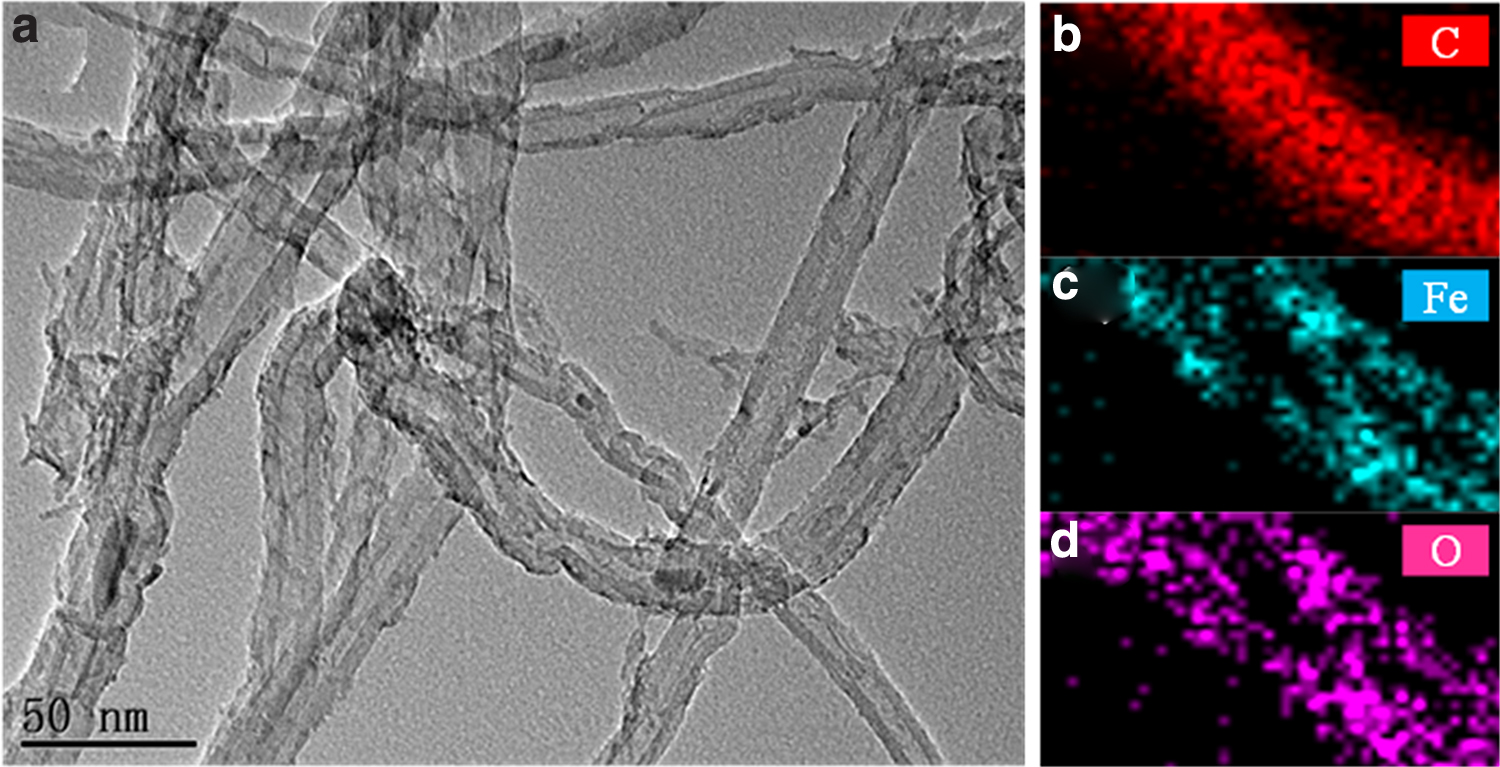
TEM characterization of an nZVI-CNT filter was displayed in Fig. 1a. A rough tube surface can be observed and a thin layer of fine particles (<5 nm) coated on the CNT sidewalls can be observed as well. No crystal structures can be identified, indicating an amorphous phase of the nZVI-CNT filter (Supplementary Fig. S2). Energy dispersive spectrometer elemental mapping suggested that the elemental distribution of Fe was well consistent with that of C (Fig. 1c–e). TGA results indicated that an effective nZVI content was only determined to be 5.2 ± 0.2 mg within a typical nZVI-CNT filter (Supplementary Fig. S3). All these results suggest that we have successfully fabricated the nZVI-CNT filter using a simple manner.
Kinetics of Sb adsorption
Effect of flow rate
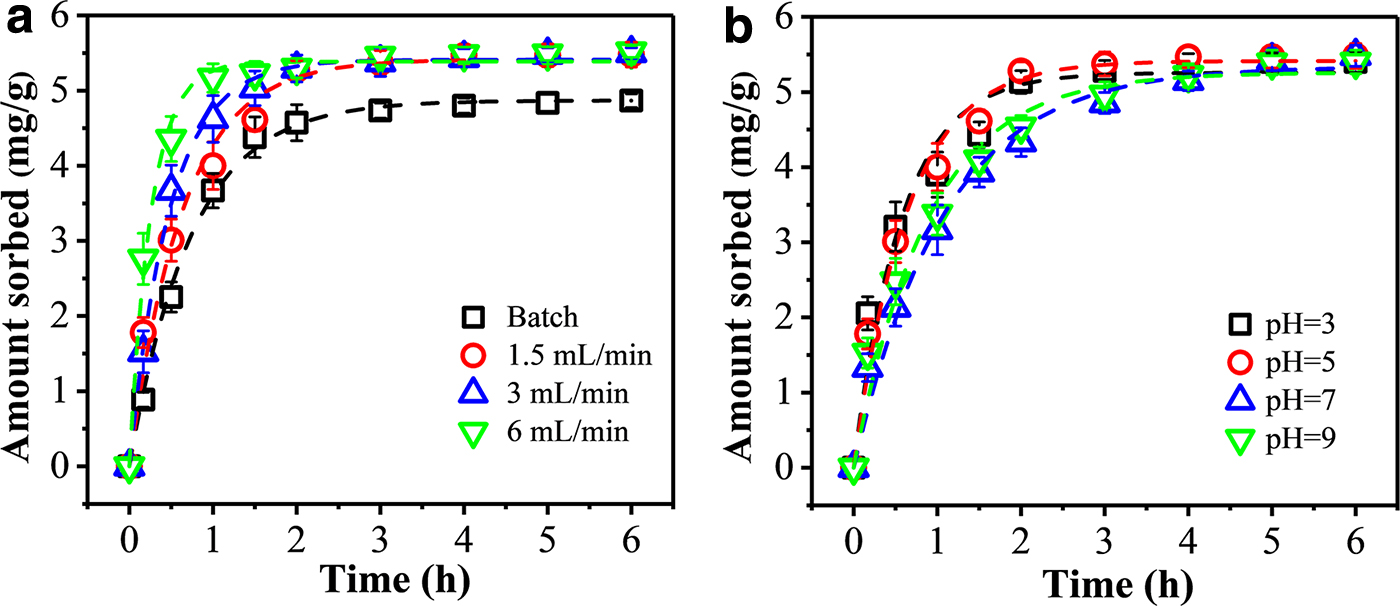
Flow rate is an important parameter impacting the mass transport of Sb(III) toward the active sites of nZVI-CNT filter. As displayed in Fig. 2a, compared with conventional batch system, a throughflow design demonstrated evidently enhanced Sb(III) sorption kinetics and capacity. All data fit the pseudo-first-order model well [see Eq. (1)].
where qt represents the amount adsorbed at time t (min), qe is the amount adsorbed at equilibrium, and k is the pseudo-first-order model adsorption rate constant (min−1). The Sb(III) sorption kinetics increased with flow rate from 0.026 h−1 at 1.5 mL/min to 0.064 h−1 at 6 mL/min. This indicated that the mass transport of Sb(III) compounds is the rate-limiting step. For the batch mode, and flow rate of 1.5, 3, and 6 mL/min, the removal efficiency was 81.1%, 89.7%, 90.1%, and 90.3% with k values of 0.022, 0.026, 0.035, and 0.064 h−1, respectively. This improvement for adsorption performance could be attributed to that convection-enhanced mass transport in the flow-through system. As comparison, only diffusion dominates the mass transport of Sb(III) compounds in conventional batch mode (Liu et al., 2020). Although CNT networks possess large specific surface area (147.4 m2/g) and abundant functional groups (Li et al., 2019), their contribution to Sb(III) sorption is rather negligible due to lack of affinity to Sb(III). This claim was reflected by the limited Sb(III) sorption efficiency (<3%) by a CNT-alone filter (Liu et al., 2019a). In contrast, these abundant functional groups (e.g., –COOH) provide ideal sites for iron ion anchoring, so that more nanoscale nZVI can be loaded onto the CNT sidewalls. Besides, the small pore size (<80 nm) of the nZVI-CNT network is another reason for enhanced adsorption performance by shortening the diffusive distance of Sb(III) to these accessible sorption sites (Supplementary Fig. S4).
Effect of initial solution pH
Solution pH is another key parameter affecting the surface charges of adsorbents. The Sb speciation is highly pH dependent and the interaction of the filter and Sb compounds is also significantly affected by the solution pH (Guo et al., 2014). The effect of pH on Sb(III) removal is shown in Fig. 2b. Results indicated that no significant difference on Sb(III) sorption kinetics and capacities was observed within a range of pH (3–9). The equilibration times were less than 6 h and their final average adsorption amount was 5.2 ± 0.3 mg/g at different pH conditions. It could be also observed that the best adsorption performance was obtained at a pH of 3–5 and it dropped slightly at alkaline conditions. This can be attributed to the existence of different Sb species at different pH conditions.
For Sb(III), Sb(OH)3 is the most common species that exists over a range of pH (3–10), and for Sb(V), Sb(OH)6− is the main form in aqueous solution (Yan et al., 2017). The point of zero charge (pHPZC) values of pristine nZVI was 7.8 as previously reported (Giasuddin et al., 2007). Thus, at pH of 3–5, the positively charged nZVI could electrostatically attract these negatively charged Sb(V). However, at pH 7–9, the filter surface became negatively charged (pH > pHZPC) and electrostatic repulsion dominates the reaction between nZVI and Sb(V), further deteriorating the Sb sorption performance.
Removal of Sb using nZVI-CNT filter
To further verify Sb oxidation and sorption, the nZVI-CNT filter before and after Sb sorption was studied by XPS technique. The superficial elemental ratio of a fresh nZVI-CNT filter was 79.4% C, 17.5% O, and 3.1% Fe, while for an Sb-loaded filter, the ratio changed to 65.8% C, 26.0% O, 6.4% Fe, and 1.8% Sb (Supplementary Fig. S5). The change of surface elements can be mainly due to the interception of Sb and corrosion of nZVI.
In addition, the Fe 2p spectrum can be deconvoluted into five characteristic peaks centered at 726.0, 724.6, 712.9, 710.9, and 706.2 eV, corresponding to FeOOH 2p1/2, Fe2O3 2p1/2, FeOOH 2p3/2, Fe2O3 2p3/2, and Fe0 (Xu et al., 2016), respectively (Fig. 3a). The spectrum of Sb 3d + O 1s can be deconvoluted into four peaks at binding energy of 540.2, 531.9, 531.1, and 530.1 eV, which belong to Sb 3d3/2 [i.e., Sb(V)], OH2O (i.e., chemisorbed oxygen species, like H2O), Sb 3d5/2 [i.e., Sb(V)], and Olatt (i.e., lattice oxygen), respectively (Fig. 3b) (Luo et al., 2015). This proved that Sb(V) is the dominant species on the filter surface; the conversion of Sb(III) to Sb(V) can be achieved due to the oxidative capability of the loaded nZVI particles under given conditions.

X-ray photoelectron spectroscopy spectra of Fe
The oxidative conversion of Sb(III) and sorption of Sb in aqueous solution was further determined by monitoring the changes of Sb species and concentration in the effluent as a function of time. As shown from Fig. 4, the concentration of Sbtotal decreased exponentially with time at pH 7. In the initial 1 h, >92.1% of Sb(III) conversion was achieved at the recirculation mode by the nZVI-CNT filter. The increase of Sb(V) concentration suggested that Sb(III) oxidation was faster than Sb(V) sorption. Meanwhile, the Sb(V) concentration increased rapidly to 232 μg/L and became the dominant species in aqueous solution after 1 h. At this time, the Sb(V) adsorption rate is much higher than the Sb(III) oxidation rate, so that the decreased trend of Sb(V) is consistent with that of Sbtotal. This is also consistent with the XPS results.
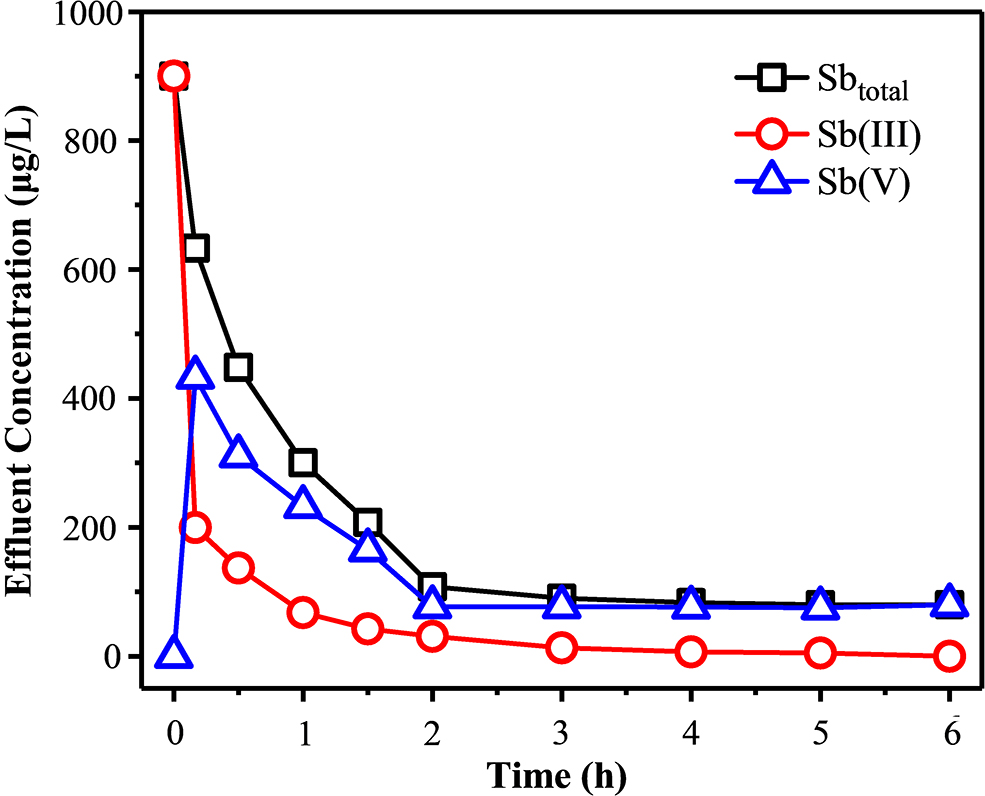
The concentration change of Sb species as a function of time at recirculated filtration mode. [Sb(III)]0 of 900 μg/L, initial pH of 7, flow rate of 1.5 mL/min.
Previous reports indicated that nZVI is capable of generating reactive species during nZVI corrosion (Luo et al., 2015). These reactive species may responsible for the Sb(III) conversion. Also, the oxidation of Sb(III) may be induced by Fenton-like reaction if H2O2 co-existed with nZVI within the system (Cheng et al., 2015). After Sb sorption, the disappearance of Fe0 characteristic peaks, which may be due to the coverage of iron sites by the sequestered Sb or the formation of iron oxides (i.e., corrosion) during Sb sequestration (Supplementary Fig. S6). In addition, the time for the conversion completely of Sb(III) is about 3 h and the removal efficiency of Sbtotal can reach 90.1% within the same period. Taking into account all of the above results and those described in Fig. 3d, it can be deduced that Sb(III) removal from the aqueous through a predominant pathway of “first oxidized to Sb(V) by nZVI, then is adsorbed by iron oxides.”
Adsorption isotherm was used to evaluate the Sb(III) sorption capacity by the nZVI-CNT filter at 25°C. To make the data comparative, the Sb(III) adsorption isotherm of nZVI-CNT filter was performed in recirculated filtration mode (Liu et al., 2014, 2019b), and further fitted with the Freundlich isotherm model [see Eq. (2)] (Supplementary Fig. S7).
where qe represents the amounts adsorbed by the nZVI-CNT filter at equilibrium, Ce means equilibrium concentration, and Kf and n are constants. The maximum adsorption capacity of Sb(III) on the nZVI-CNT filter reached 74.6 mg/g (Ce = 8808.1 μg/L). As the qe value has not reach a plateau, the actual maximal qe values could be even greater.
Effect of coexisting anions
The presence of co-existing anions significantly impacts the nZVI performance (Zhao et al., 2014). Herein, five kinds of common anions (e.g., carbonate, chloride, phosphate, sulfate, and silicate) were spiked into the Sb(III) solution before challenging the filter and the results are illustrated in Supplementary Fig. S8. Results demonstrated that the presence of carbonate, chloride, phosphate, and sulfate posed negligible inhibition effect on Sb(III) sorption regardless of concentration. However, silicate can be identified as a strong interfering substances at the concentration of 10 mM (e.g., removal efficiency of Sb(III) decreased from 90.1% to 74.2%). This is mainly due to the similar sorption mechanism of silicate with Fe, compared with that of Sb, by forming an inner-sphere complex, rather than being adsorbed by electrostatic interaction. This will inevitably occupy the surface adsorption sites of the nZVI-CNT filter, leading to a significant reduction in the removal performance of Sb(III). A similar silicate inhibition effect on Sb sorption has been reported (Miao et al., 2014).
Sb(III) can be almost completely oxidized to Sb(V) even in the presence of co-existing ions (Supplementary Fig. S9). This also indicates that the coexisting anions on the Sb(III) oxidation process was rather limited. It is of note that the concentration of co-existing anions selected in this study is much higher than that in the actual environmental matrices, so that their impact could be less when dealing with actual water samples. The effect of dissolved organic matter in water on Sb removal was also considered. Supplementary Figure S10 shows that the addition of dissolved NOM negatively affected the Sb removal, with the Sb(III) removal decreasing from 90.1% to 72.3%. This can be attributed to competition of filter active sites between organic matters and Sb.
Regeneration of the exhausted nZVI-CNT filter
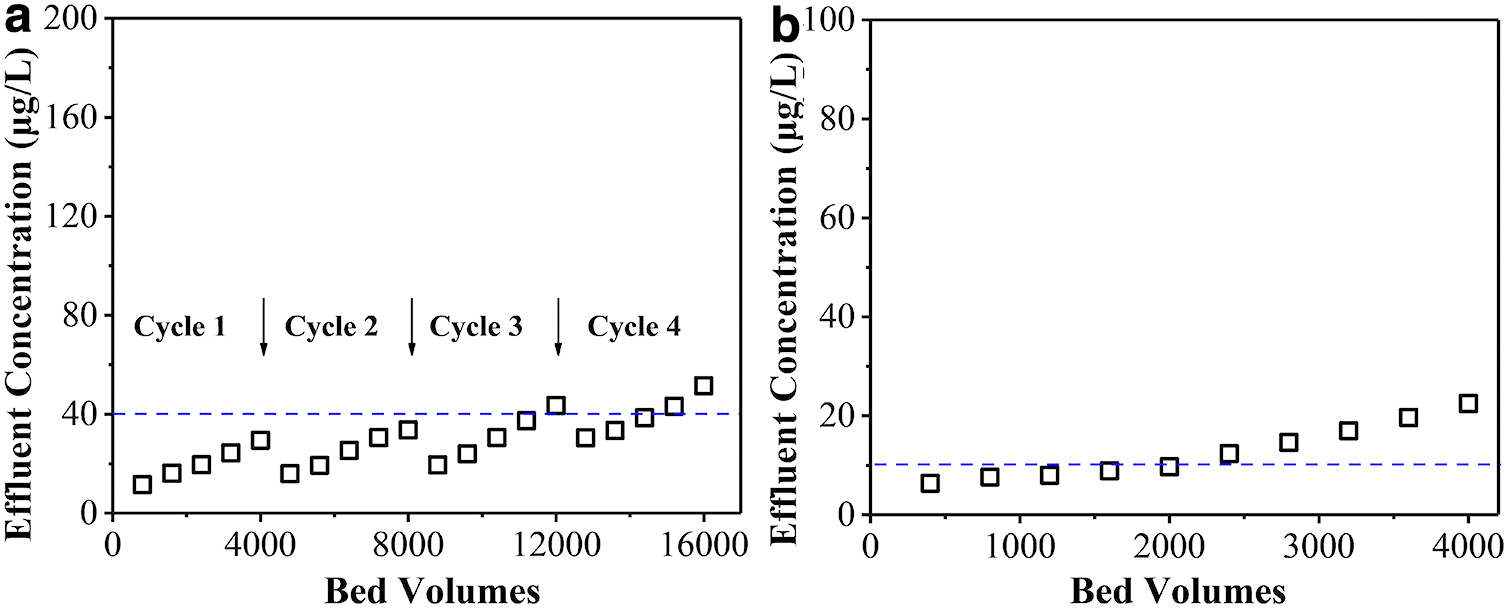
The exhausted nZVI-CNT filter was regenerated by passing through 100 mL of 5 mM NaOH solution at a flow rate of 1.5 mL/min. Then, to evaluate the performance of regenerated filter, 200 μg/L Sb(III) solution was pumped at 1.5 mL/min through the nZVI-CNT filter in the single-pass mode. As shown in the Fig. 5a, after four cycles, the removal efficiency of Sb(III) was still above 75%. The slight decline in the removal efficiency (<15%) may be due to the precipitation of some iron ions on the nZVI-CNT filter under alkaline conditions, further blocking adsorption site and decreasing flux in the throughflow system. This indicates that the nZVI-CNT filter had good chemical stability, and washing with NaOH was a simple and effective method for the regeneration of exhausted nZVI-CNT filters.
Removal performance of Sb(III)-spiked tap water
To further evaluate the practical application potential of the nZVI-CNT filter system, 200 μg/L of Sb(III)-spiked tap water was pumped through the nZVI-CNT filter in the single-pass mode at a flow rate of 1.5 mL/min. Tap water contains many common ions and organic substances, which may occur an influence on the Sb(III) removal performance. The chemical compositions of the tap water are listed in Supplementary Table S1. As exhibited from Fig. 5b, the nZVI-CNT filter produced ∼2100 BV of effluent before the removal efficiency of Sb(III) was less than 90%. These data are comparable or even better than a TiO2-CNT filter with 1600 BV for Sb(III) (Liu et al., 2019b). This is mainly due to the large specific surface area (∼125.1 m2/g) and abundant adsorption sites of the nZVI-CNT filter.
It is worth noting that the hydraulic retention time in the electroactive filter is <2 s with the flow rate of 1.5 mL/min, which is much lower than the typical reaction system (several minutes or hours) (He et al., 2015). In addition, the energy required for pumping was calculated to be 1.5 J, at a common backpressure of 15 kPa, a pumping efficiency of 75%, and a flow rate of 1.5 mL/min. Obviously, the nZVI-CNT filtration technology provides a promising solution to remove Sb(III) pollution and other similar heavy mental ions.
Conclusions
A novel dual-functional electrochemical filter was designed for simultaneous oxidation and sorption of Sb(III). The hybrid filters possess limited pore size and excellent chemical stability, and are regenerable. In the presence of nZVI, an in situ conversion of highly toxic Sb(III) to less toxic Sb(V) can be obtained. Various advanced characterization techniques confirmed the efficacy of the system. Overall, this study provides new insights for the oxidation and sorption of Sb(III) and other similar heavy metal ions by a continuous-flow system.
Footnotes
Author Disclosure Statement
No competing financial interests exist.
Funding Information
This work was supported by the Open Research Fund Program of Key Laboratory of Cleaner Production and Integrated Resource Utilization of China National Light Industry (No. CP-2019-ZD1), the Natural Science Foundation of Shanghai, China (No. 18ZR1401000), and the National Key Research and Development Program of China (No. 2019YFC0408304).

References
Supplementary Material
Please find the following supplemental material available below.
For Open Access articles published under a Creative Commons License, all supplemental material carries the same license as the article it is associated with.
For non-Open Access articles published, all supplemental material carries a non-exclusive license, and permission requests for re-use of supplemental material or any part of supplemental material shall be sent directly to the copyright owner as specified in the copyright notice associated with the article.
