




Abstract
In China, there are about a thousand million tons of waste serpentine tailings (WSTs) that cause serious environmental problems. So it is urgent to treat WSTs. In this work, the MgO in WSTs was extracted to synthetize a high value-added Mg(II)Al(III) layered double hydroxide (LDH) by an alkali fusion process, and the purified SiO2 can be obtained by the precipitation of Na2SiO3. The results indicated that the MgO extraction rate increased with the increase of Na2CO3 content and calcination temperature. The serpentine structure was destroyed and the MgO extraction rate increased rapidly to reach 91.4% when the temperature reached 750°C and the ratio of WSTs and Na2CO3 was 1:2. However, when the temperature was over 800°C, the serpentine completely transformed into forsterite with higher crystal strength, which was difficult to react with Na2CO3. The Mg-Al-LDH synthesis was carried out using a chemical precipitation method. It was not conducive to synthesis of Mg-Al-LDHs for using the rich magnesium solution that was obtained under low MgO extraction rate. The structure and surface morphology of the LDHs were characterized by an X-ray diffraction, FT-IR, and scanning electron microscopy (SEM). Finally, the Mg(II)Al(III)LDHs property of adsorbing Pb and P was investigated. The removal rate of Pb could reach about 99% and there was good adsorption capacity for P. This indicates that it is possible to synthetize high value-added Mg(II)Al(III) LDH by WSTs that could be recycled.
Introduction
With the development of industry, people's living standards are constantly improving, but people are also facing the problem of a worsening environment (Qi et al., 2020a). For example, industrial development produces a large number of wastes containing heavy metals (Qi et al., 2020b), convenient life produces a lot of plastic wastes (Xiu et al., 2020a, 2020b), and excessive exploitation of mineral resources produces a lot of tailings (Abo Atia and Spooren, 2019). If mankind wants to realize sustainable development, these wastes must be treated on “3R” principles, that is, reduce, reuse, and recycle. In this study, a tailing was recycled for a high value-added product.
Serpentine is a 1:1 layered hydrated magnesium silicate mineral with a regular pore structure (Cao et al., 2017). It can be written as Mg3Si2O5(OH)4, and formed mainly by minerals of the serpentine group: antigorite, chrysotile, and lizardite. Its main component is about 32–38% MgO and 35–40% SiO2 (Cao et al., 2017; Vieira et al., 2018). In China, there are abundant serpentine resources. It is well known that mining activities often generate large amounts of waste products. Among them, mining tailings are known to have high environmental effects because they can give rise to landsides and debris flow in the rainy season, damage farmland, and generate hazardous dust. With increasing global concern for atmospheric, water, and soil pollution, the safe disposal of various kinds of mining tailings is of critical importance (Schoenberger, 2016). Waste serpentine tailings (WSTs) are from crushed serpentine rocks, and their main components are the same as raw ore. It is estimated that there are a thousand million tons of WSTs in China (Zhu et al., 2013). Such huge stockpiles of WSTs cause serious environmental problems, such as generating hazardous dust including chrysotile (a kind of asbestos carcinogen). These dusts can be inhaled into the lungs to cause serious lung diseases such as asbestosis, mesothelioma, and lung cancer (Zhu et al., 2012). Therefore, the treatment of WSTs is urgent.
Initially, serpentine and WSTs were applied as flux materials, refractory material (Nemat et al., 2018), iron-making, and so on. But the added value of these products was too low to make the enterprise maintain production with good benefits. Later, according to the content and characteristics of serpentine components, it was calcined with apatite to prepare calcium and magnesium phosphate fertilizer (Błońska et al., 2016). However, with the emergence of a large number of low-cost chemical fertilizers on the market, the serpentine fertilizer is no longer popular. On account of high contents of MgO and SiO2, some complex hydrometallurgical processes were used to extract and prepare products of Mg and Si, such as light magnesium oxide and porous silica (Sierra et al., 2018). Nevertheless, it is difficult to avoid the secondary pollution of acid wastewater.
Layered double hydroxides (LDHs) are two-dimensional (2D) nanostructured materials, which is made of positively charged brucite-like layers and charge-balancing hydrated anions, located in the interlayer space; also termed as anionic clay or hydrotalcite. Their general chemical formula can be expressed as [M2+(1−X)M3+(X) (OH)2]X+(An−)X/n·mH2O, where M2+ and M3+ represent divalent (Mg2+, Zn2+, Mn2+, Ca2+, Fe2+, etc.), and trivalent metal cations (Fe3+, Al3+, Mn3+, etc.), respectively, An− (CO32−, NO3−, Cl−, and SO42−) is an interlayer anion, and X is a molar ratio of M3+ to total metal (Daud et al., 2019; Karami et al., 2019), while m is the number of water molecules between layers. LDHs are used as adsorbents (Mostafa and Bakr, 2018; Li et al., 2020), catalysts (Fan et al., 2014), fuel cells (Djellali et al., 2019), drug delivery applications (Li et al., 2014; Rojas et al., 2015), CO2 capturing (Pasquier et al., 2014; Gao et al., 2019), and in many other potential applications due to their replaceable intercalated anions, chemical multifunctionality, low cost, high stability, low toxicity, reusability, and facile synthesis (soliman et al., 2019).
In view of this, it may be a good recycling way to prepare high value-added Mg-Al-LDHs by extracting MgO from WSTs. The calcination or heat treatment method has been proved to be essential for non-fired raw materials such as some mine wastes (Moukannaa et al., 2019). Recently, alkaline fusion has been explored as a chemical activation method (Tchakouté et al., 2015). Alkali roasting with sodium carbonate was first developed in 1854 by Louis Le Châtelier for the recovery of alumina from bauxite ore (Borra et al., 2016). At present, many researchers have applied the alkali fusion technology on bauxite residue for the recovery of alumina. The process alters the mineralogical composition of the mines by increasing the amount of amorphous phase or formation of some Na-rich crystalline phases. Tchakoute Kouamo et al. (2013) reported that the alkaline fusion of volcanic ash resulted in the conversion of a significant amount of muscovite, anorthoclase, and diopside into soluble aluminosilicates, which enhanced the reactivity of the volcanic ash. In addition, some studies have shown that binary mixture such as NaOH/Na2CO3 flux could provide a liquid at lower fusion temperature than that for other (individual or binary) alkali and/or alkaline metal salts used elsewhere, so the energy consumption of this technology may probably be lower (Ismael et al., 2020). Therefore, the alkaline fusion process can be used to extract MgO from WSTs.
Co-precipitation is the simplest and most common method of preparing LDHs (Fan et al., 2014). In this method, inorganic aqueous solutions of M2+and M3+ containing the anion that is to be incorporated into the LDHs are used as precursors, of which Mg and Al are the most frequently used metal precursors (Hibino 2011; Zhu et al., 2016). As mentioned earlier, WSTs have very high MgO content (32–38%). If the WSTs and aluminum scrap materials are utilized to produce high value-added Mg-Al-LDHs, it will provide a novel approach to recycle WSTs.
In the article, WSTs and aluminum scrap materials were used as precursors of Mg and Al to synthesize Mg-Al-LDHs. Magnesium in the WSTs was extracted by an alkali fusion process. The effect of the ratio of WSTs and sodium carbonate (Na2CO3) and calcination temperature on extraction rate of magnesium and preparation of Mg-Al-LDHs was investigated. X-ray diffraction (XRD) was used to define the crystalline phase of Mg-Al-LDHs and the scanning electron microscope (SEM) was used to observed the microstructure and morphology of Mg-Al-LDHs. Then, the property of the Mg-Al-LDHs adsorbing Pb and P was experimented. The main purpose of the present work is to find a novel approach of recycling WSTs to obtain a high value-added product.
Experimental Details
Materials
WSTs used in these experiments were from Yiyang county serpentine ore in Jiangxi Province, China. The compositions were determined by an X-ray fluorescence (XRF-1800; Shimadzu Limited, Kyoto, Japan), and shown in Table 1. The aluminum scraps were obtained by a local solid-waste treatment factory. The other reagents were analytical grade products from Shanghai Sinopharm Chemical Reagent Co., Ltd. (China).
Chemical Composition of Waste Serpentine Tailings
Extraction of magnesium in the WSTs
WSTs were crushed with a jaw crusher and ground into powders of sizes below 100 μm using a planetary ball mill. The 10 g WST powders were mixed with sodium carbonate by a certain ratio (1.5:1,1.25:1, 1:1, 0.75:1, 0.5:1, 1:3.5, 1:4, and 1:5). The mixture was calcined for 1 h in a certain temperature (300°C, 500°C, 600°C, 700°C, 750°C, 800°C, and 850°C) in SX-8-10 muffle furnace. Then, the calcined product was put into the deionized water for ultrasonic for 1 hr, and filtered. The filtrate can be prepared white carbon black (SiO2). The filter residue was calcined to form MgO rich products in 500°C for 6 h. Finally, the MgO rich products were solved into 3 M HNO3 solution for preparation of Mg-Al-LDHs. The Mg2+ content was examined by a complexometric titration [HGT 3575-2006 (2006)].
Preparation of Mg-Al-LDHs
The Mg-Al-LDH synthesis was carried out using a chemical precipitation method. The aluminum scraps with Mg2+/Al3+ molar ratio of 2.0 were dissolved in the rich Mg(NO3)2 solution (preparation in the extraction of magnesium in the WSTs section) to produce solution A. About 13.6 g sodium hydroxide and 9.76 g sodium carbonate were dissolved in 500 mL deionized water to obtain the solution B. The pH of the solution A was raised and controlled in the range of 9–10 by dropwise addition of the solution B with stirring. Afterward, the resulting white suspension was matured for 24 h at 68°C, washed with deionized water till pH about 7, and dried into oven at 60°C for 24 h (Maziarz et al., 2019; Anjum et al., 2019).
Characterization
Powder XRD (Rigaku, Tokyo, Japan) patterns of Mg-Al-LDH samples were recorded on a D/max-γβ X-ray diffractometer with 50 mA and 40 kV, CuKR radiation was used to define the crystalline phase. The microstructure and morphology of Mg-Al-LDHs were observed using a scanning electron microscope energy-dispersive X-ray spectroscopy (SEM-EDS; JSM-6700F, JEOL Ltd. Japan) at an accelerating voltage of 20 kV, and FT-IR (IFS 55; Bruker Company, Fällanden, Zurich, Switzerland) with a KBr pellet method under the conditions of a resolution of 4 cm−1, scan time of 32 s, and scan range of 4,000–400 cm−1.
Adsorption of Pb and P by prepared Mg-Al-LDHs
Batch 100 mL solution was prepared using Pb(NO)3 (or NaH2PO4), which contained different concentrations of Pb2+ (or P) (50, 100, 150, 200, and 1,000 mg/L) respectively. About 0.05 g Mg-Al-LDHs was put into the 100 mL solution respectively. The adsorption experiments were carried out using a conical flask with cover at 70°C on a shaker with a shaking speed of 200 rpm for 6 h. The concentration of Pb2+ was analyzed with an inductively coupled plasma atomic emission spectrometer (ICP-AES; Prodigy). The concentration of phosphate was measured using the molybdenum method (GBT 11893-89 1989; Liu et al., 2016; Laipan et al., 2018). All of the experiments were conducted in duplication.
Results and Discussion
Extraction of magnesium in the WSTs is the key to preparation of Mg-Al-LDHs. Furthermore, the quantity of alkaline added and calcination temperature to the fused system were very important parameters. So the effects of the ratio of WST powders and Na2CO3, and calcination temperature on Mg-Al-LDHs product were discussed.
The effects of the ratio of WST powders and sodium carbonate on preparation of Mg-Al-LDHs
Figure 1a shows the relationship between the ratio of WSTs and Na2CO3 and MgO extraction rate. More alkaline amplifies the reactivity of the fused materials (Moukannaa et al., 2019). It can be observed that MgO extraction rate increases linearly with the increase of Na2CO3 content, and reaches 91.4% when the Na2CO3 content is twice that of WST powders (The ratio is 0.5:1), then, it almost no longer increases. Figure 1b shows XRD patterns of Mg-Al-LDHs prepared with the rich Mg(NO3)2 solution, which was from extraction of magnesium in the WSTs by the alkali fusion process under the different ratio of WSTs and Na2CO3. The three characteristics peaks of LDH from (003), (006), and (012) planes can be observed at 11.7, 23.4, and 34.9 reflections, which reveals evidence for the prepared Mg-Al-LDHs composed of well-defined crystallites when the ratio of WSTs and Na2CO3 is 0.5:1 (Tong et al., 2012). The interlamellar distances (d003, d006, and d012) of the prepared LDH sample is found to be 7.58 Å, 3.79 Å, and 2.57 Å. Relatively, the characteristics peaks of LDH have not been found when the ratio of WSTs and Na2CO3 is 1.5:1. It is believed that the crystal layer structure of LDH is difficult to form due to the low Mg2+ concentration in the rich Mg(NO3)2 solution.
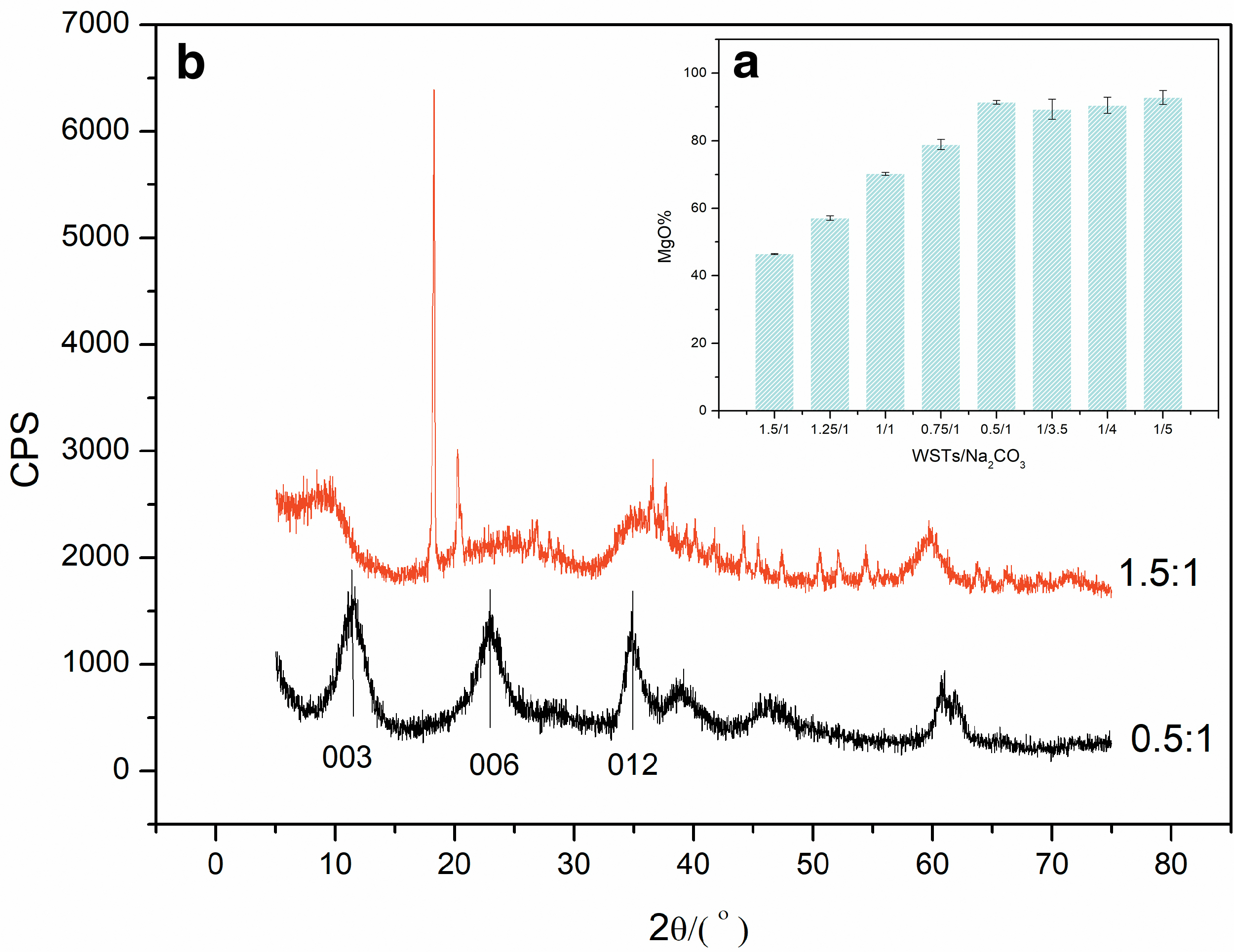
The effect of the ratio of WSTs and Na2CO3 on MgO extraction rate
The main component of the serpentine is about 32–38% MgO and 35–40% SiO2. The alkali fusion process can extract SiO2 from WSTs to enrich MgO, as shown in equation (1) and (2), (Priestnall, 2015; Ning et al., 2018). Tchadjié et al. (2016) also indicated that a new crystalline phase of sodium silicate Na2SiO3 was formed in the fused granite waste samples and that some crystalline phases namely biotite, almandine albite, and quartz have undergone partial decomposition. But MgO cannot be enriched completely if Na2CO3 content is not enough. The serpentine is a layered crystal structure, which is a silicate layer connected to a layer of [MgO2(OH)4] octahedral (Vieira et al., 2018). This composite layer is linked to the corresponding layers by weak bonds (Sajid and Basheer, 2016). The alkali fusion process destroys the layered structure by extracting SiO2 from WSTs, which releases MgO to form Mg(OH)2. Insufficient Na2CO3 content kept some magnesium in the WSTs, which made Mg2+ concentration in the rich Mg(NO3)2 solution low. In addition, some impurities such as iron in the WSTs were also enriched by the alkali fusion process, which affected the formation of LDH.
The effects of calcination temperature on preparation of Mg-Al-LDHs
Figure 2a shows the relationship between the calcination temperature and MgO extraction rate. It can be observed that MgO extraction rate increases with the increase of calcination temperature, and reaches 91.4% when the temperature reaches 750°C, then, decreases sharply to 16.3% with the temperature reaching 850°C. This is because serpentine only gradually loses adsorbed water and structural water at below 300°C and 600°C, respectively. Although the structural water, which exists in the octahedral flakes of the crystal structure unit layer in the form of hydroxyl groups, causes the serpentine structure to be loose and easier to react the structure of the serpentine is almost unchanged (Dlugogorski and Balucan, 2014). WSTs cannot react with Na2CO3 completely. When the calcination temperature reaches 600–750°C, dehydroxylation of the serpentine occurs and increases its amorphous phase content. The serpentine structure is destroyed and MgO extraction rate increases rapidly. However, higher fusion temperature could endorse the crystallization of mines and the formation of hardily-reactive phases (Luukkonen et al., 2018), which is not conducive to the reaction with Na2CO3 to extract MgO. When the temperature is over 800°C, the serpentine completely transforms into forsterite with higher crystal strength which leads to lower MgO extraction rate.
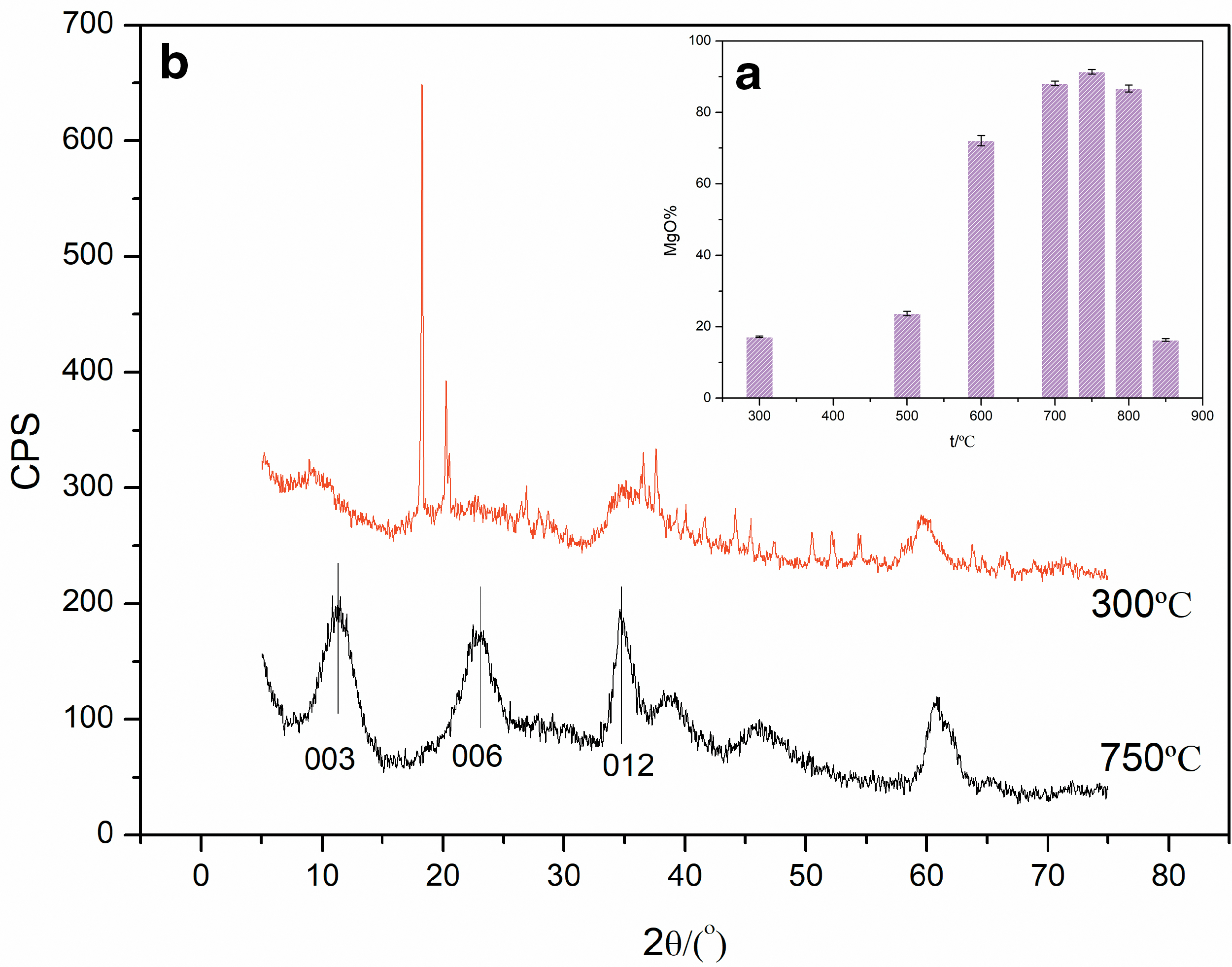
The effect of the calcination temperature on MgO extraction rate
Figure 2b shows XRD patterns of Mg-Al-LDHs prepared with the rich Mg(NO3)2 solution, which was from extraction of magnesium in the WSTs by alkali fusion process under the different calcination temperature. It can be seen that Mg-Al-LDHs is prepared and have good crystallites because of high MgO extraction rate when the temperature is 750°C. But the crystal layer structure of LDH is difficult to form at low calcination temperature.
The characterization of Mg-Al-LDHs
Figure 3 shows the FT-IR spectrum of prepared Mg-Al-LDHs. The broad and strong peak at 3,462 cm−1 is related to the stretching vibration of OH groups (Sakr et al., 2018). The weak peak at 1,647 cm−1 is attributed to bending vibration of the interlayer water. The narrow and strong absorption peak at 1,384 cm−1 originated from the antisymmetric stretching mode of the interlayer CO32− anions presented in the LDH structure (Gao et al., 2019). The week absorbance bands in the range of 1,000–400 cm−1 are ascribed to the stretching and bending vibrations of metal-oxygen bonds in the hydrotalcite (Ni et al., 2017).
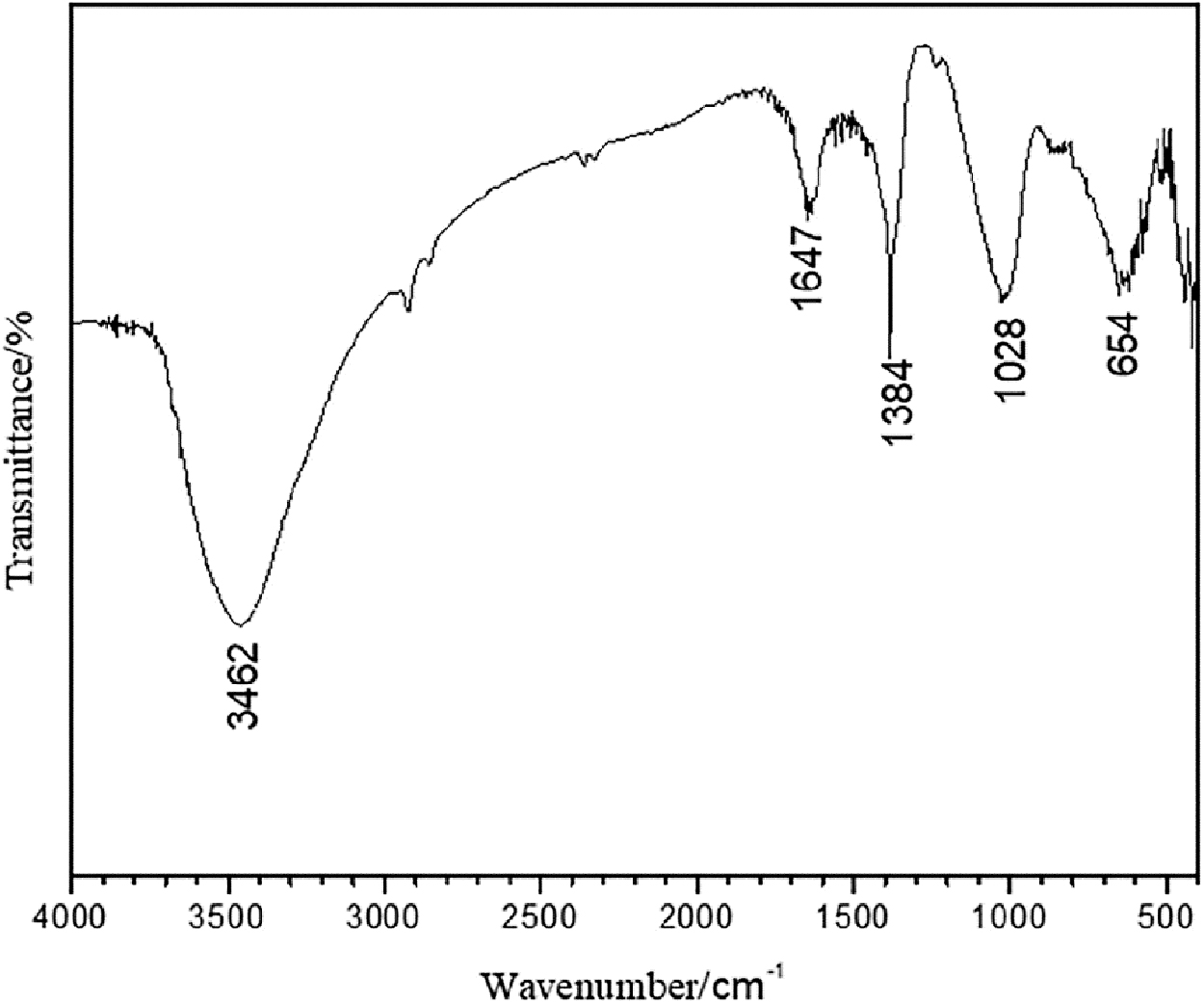
The FT-IR spectrum of Mg-Al-LDHs.
Figure 4 shows the SEM image of prepared Mg-Al-LDHs. It can be seen that a blade-like layered characteristic structure of Mg-Al-LDHs is identified. This morphology suggests the combination between metal hydroxide and the inner ions has been successfully bonded. The EDS mapping shows the distribution of elements, so the experimental magnesium/aluminum (Mg/Al) molar ratio can be calculated. The value is 2.6 which is a little larger than theoretical value (it is 2). To further confirm formation of prepared Mg-Al-LDHs, the contents of Mg and Al in LDH sample were determined by ICP. The result showed that Mg was 14.57 wt% and Al was 8.23 wt%, respectively. Their molar ratio was 2.0. Therefore, the obtained values are in agreement with the theoretical values of the synthesis by the determination of EDS and ICP. It is evidencing the uniform distribution of elements taking part in the formation of LDH (Da Silva et al., 2018; Anjum et al., 2019).

The SEM-EDS image of prepared Mg-Al-LDHs.
The property of Mg-Al-LDHs adsorbing Pb and P
Adsorption is an important property of LDH materials. In the study, the property of prepared Mg-Al-LDHs was measured by adsorbing Pb2+ cation and phosphate anion. Pb is an important element and is a divalent cation Pb2+ in heavy metal wastewater. P is the main element of eutrophication and is an anion of phosphate in water. Their simulated solutions were configured, and the effects of adsorption time and element ionic concentration of the solution on the element removal rate were investigated. As shown in Fig. 5a, removal rates of Pb and P both increase with the increase of adsorption time. However, adsorption rate of P is faster than that of Pb. After 30 min, the removal rate of P is basically in equilibrium, and that of Pb increases slowly and is not stable until 300 min. Interestingly, initial adsorption rate of Pb is faster than that of P. The removal rate of Pb reaches about 50% while that of P is only about 21% at 10 min. Moreover, the removal rate of Pb reaches about 99% while that of P is only about 88% at 6 hr. Figure 5b shows that the relationship between element ionic concentration of the solution and the element removal rate. It can be observed that removal rates of Pb and P both decrease with the increase of their concentration. But the removal rate of Pb decreases faster than that of P (Zhao et al., 2011; Yang et al., 2014). It indicates that the adsorption capacity of prepared Mg-Al-LDHs to Pb is smaller that of P.
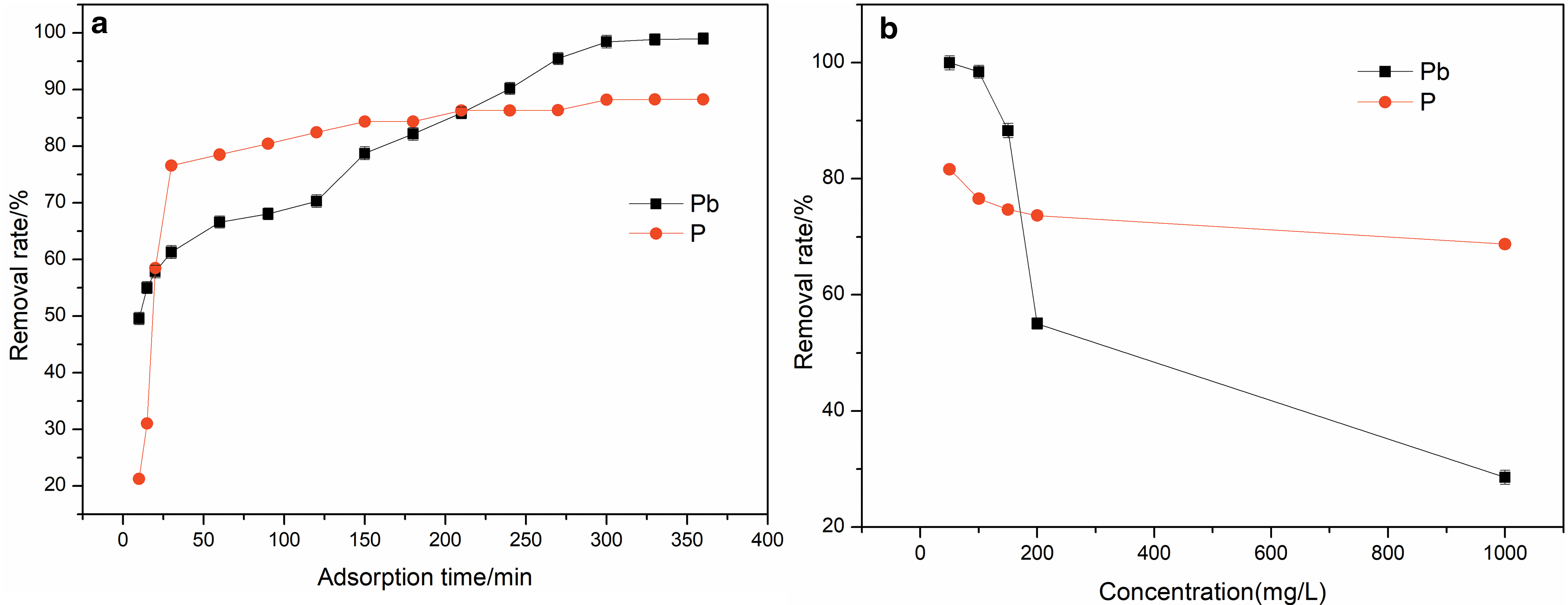
The effects of adsorption time
As can be seen from the experimental data in Fig. 5, Mg-Al-LDHs, which was prepared using WSTs, has good adsorption effect on Pb and P. It can be used to treat wastewater containing different elements according to different aims such as removal rate or adsorption capacity. The mechanism of Mg-Al-LDHs removing Pb and P will be researched further in the future.
Conclusions
In this study, WSTs were recycled to prepare high value-added Mg-Al-LDHs. First, the effects of the ratio of WSTs and sodium carbonate, and the calcination temperature on MgO extraction rate were investigated. The results showed that MgO extraction rate increased with the increase of Na2CO3 content and calcination temperature, and reached 91.4% when the Na2CO3 content was twice that of WST powders and calcination temperature was 750°C. The XRD patterns of LDH synthesized under these conditions showed well-defined crystallites, and there were three typical characteristics peaks of LDH. Second, prepared Mg-Al-LDHs was characterized. FT-IR could observe the antisymmetric stretching mode of the interlayer CO32− anions presented in the LDH structure, and SEM could see the typical structure of Mg(II)Al(III) brucite-like sheets with exchangeable capability in an interlayer space. Mg/Al molar ratio was 2.0 by the determination of EDS and ICP, which were in agreement with the theoretical values of the synthesis. These indicated Mg-Al-LDHs can be successfully prepared by WSTs. Finally, the prepared Mg-Al-LDHs were applied to adsorb Pb and P in water. The results showed that the removal rate of Pb can reach about 99% and adsorption capacity of prepared Mg-Al-LDHs for P is relatively high. The research provides a new idea and solution for the recycling of WSTs.
Footnotes
Author Disclosure Statement
No competing financial interests exist.
Funding Information
The authors are grateful for support of National Key R&D Program of China (2019YFC0408204), National Key R&D Program of China (2018YFC1903201), and National Key R&D Program of China (No.2018YFC0213605).