




Abstract
Effluent from wastewater treatment plants (WWTPs) is considered to be an important source of antibiotic resistance genes (ARGs) in the environment, which has become a global issue for human and animal health. However, the conventional treatment processes in WWTPs including the disinfection process cannot remove ARGs completely. This study estimated the removal efficiency of selected ARGs (sul1, sul2, tetO, and tetX) from WWTP effluent by electrocoagulation (EC). A reduction of 1.48–2.61 logs for selected ARGs was obtained by EC with the electrolysis time of 60 min under a current density of 20.0 mA/cm2 at neutral pH. Adsorption and enmeshment of the precipitated flocs generated electrochemically were proposed as the main mechanism for the removal of ARGs by EC. High current density and low pH (3.0–7.0) could promote the removal of ARGs. When pretreated with conventional ultraviolet (UV) disinfection, the reduction logs of ARGs were higher than the sum of that by single UV disinfection and EC process, ranging from 1.62 to 2.83 logs after 30 min of electrolysis. Moreover, it was found that the abundance of extracellular ARGs was increased after UV disinfection but reduced significantly after the subsequent EC treatment. The results showed that EC would be an effective method for the removal of both intracellular and extracellular ARGs from WWTPs effluent.
Introduction
Antibiotic-resistant bacteria (ARB) and antibiotic resistance genes (ARGs) are frequently detected in various environment matrices, such as water, sludge, soil, and sediment (Auguet et al., 2017; Qiao et al., 2018; Cheng et al., 2019). Pollution of ARB and ARGs due to the overuse of antibiotics has become a global issue for human and animal health. This resistance could reduce the efficacy of antibiotics for infectious diseases, which causes >23,000 deaths per year in the United States, ∼25,000 deaths per year in Europe, and even more in less-developed countries (WHO, 2014; Vikesland et al., 2017). It has been reported that ARGs might persist in the environment even after the selective pressure has been removed or the bacteria are dead (Tamminen et al., 2011; Dodd, 2012). Besides, this antibiotic resistance can be disseminated by sharing ARGs among microorganisms by a horizontal gene transfer (HGT) mechanism (Berendonk et al., 2015). Plasmids, integrons, and transposons are the mobile genetic elements often involved in the HGT processes (Su et al., 2015).
Both intracellular and extracellular ARGs readily adapt into new hosts (Pruden, 2014). Although the extracellular ARGs in environmental samples were often two to three orders of magnitude lower than intracellular ARGs (Guo et al., 2018; Sui et al., 2019), the persistence and transforming ability of extracellular ARGs could also play an important role in the propagation of ARGs (Dong et al., 2019). Studies have shown that wastewater treatment plants (WWTPs) might be the important reservoirs of ARGs and the effluent from WWTPs might be a significant source of ARGs released into the environment (Auguet et al., 2017). ARGs could be partially removed through the processes in WWTPs; but the selection of multiresistant bacteria species was increased simultaneously (Czekalski et al., 2012).
Disinfection processes such as chlorination, ultraviolet (UV) irradiation, and ozone oxidation in water and wastewater treatment have been proved to inactivate ARB effectively (Sharma et al., 2016). But they are not so effective for the removal of ARGs (Dodd, 2012). Although the cellular structures can be destroyed by the disinfection processes, ARGs may exist and the extracellular ARGs will be posing continuing risk (Czekalski et al., 2016). To decrease both ARB and ARGs effectively, a high dose of disinfectant is often required; for example, a dose of chlorine as high as 30 mg/L, a dose of UV irradiation >10 mJ/cm2, or a dose of 3 mg/L ozone (Oh et al., 2016; Zheng et al., 2017). Other technologies such as Fenton oxidation, titanium dioxide (TiO2) photocatalysis, and UV/hydrogen peroxide (H2O2) have shown higher removal efficiency for ARB and ARGs recently. Fenton process and UV/H2O2 could remove ARGs by 2.3–3.8 logs; while photocatalysis by TiO2 could reduce ARB by 4.5–5.8 logs and ARGs by 4.7–5.8 logs (Zhang et al., 2016; Guo et al., 2017). Nevertheless, the high cost and the usage of chemical reagent limit their application to municipal wastewater treatment.
Electrochemical disinfection has received special attention in the last few years, which was described as an emerging perspective for water treatment particularly aiming the reuse (Ghernaout, 2018). It is more eco-friendly and cost-effective compared with conventional disinfection methods (Ghernaout and Ghernaout, 2010). One technology for electrochemical disinfection is called electrocoagulation (EC). Coagulants are generated in situ by electrochemical oxidation of iron or aluminum anode in an undivided cell, which forms flocs and precipitate with the bacteria or contaminants (Ghernaout, 2013). EC has been investigated for swimming pool water treatment, removal of organic pollutants, and disinfection of WWTP effluents and real swine wastewater (Naji et al., 2018; Baran et al., 2018; Rahmani et al., 2019; Simas et al., 2019). However, the EC process has not been estimated for the removal of ARGs from WWTP effluent.
This study aims to assess the ability of EC to remove both intracellular and extracellular ARGs from municipal WWTP secondary effluent. Effect of conventional UV disinfection pretreatment was also investigated. As tetracycline and sulfonamide are two of the most widely used antibiotics in China and the corresponding resistance genes are frequently detected in the environment (Cheng et al., 2013), the four typical ARGs (sul1, sul2, tetO, and tetX) and 16S rRNA were selected as the target genes. The results could provide a potential alternative technology for effective removal of both intracellular and extracellular ARGs from municipal wastewater effluent.
Materials and Methods
Wastewater sampling
Water samples were obtained from the secondary clarifier effluent of a local WWTP using an oxidation ditch process for removal of organic matter and nutrients. The initial pH of water samples was 6.9–7.1. The original gene copies of the wastewater samples for sul1, sul2, tetO, tetX, and 16S rRNA were 1.86 × 10⁵, 7.24 × 10⁴, 3.18 × 10³, 2.21 × 10⁴, and 1.63 × 10⁸ copies/mL, respectively. To study the effect of initial pH on the removal efficiency of ARGs by EC, sulphuric acid (H2SO4) or sodium hydroxide was added to adjust the pH of water samples.
EC treatment
EC experiment was carried out in an undivided cylindrical glass cell containing 200 mL of the secondary effluent or the final effluent kept at 25°C. The anode and cathode were 10 cm2 Fe plate and stainless steel electrode separated 1 cm. The Fe surface was mechanically abraded using SiC paper and cleaned with 0.1 mol/L H2SO4 solution before use. The reaction solution was stirred by a magnetic bar. The current was provided by a DC power supply. After electrolysis for a certain time, the suspension was left for 2 h for sedimentation. A sample of 150 mL was taken from the above supernatant for DNA extraction. To investigate the effect of pretreatment by UV disinfection, the laboratory-scale UV254 disinfection was carried out before EC. Wastewater was put into 50 mL quartz glass tubes placed in a photochemical reactor (YM-GHX-V; Yuming Instrument Company, China) with a low-pressure mercury vapor 254 nm lamp (TUV-T54P-SE; Philips) at the center and stirred gently by a magnetic stir bar. The UV lamp was prewarmed for ∼15 min to ensure stable UV irradiation fluence. The UV irradiation fluence applied for disinfection was 20 mJ/cm2. Each experiment was performed in triplicate.
DNA extraction and real-time quantitative polymerase chain reaction
For total DNA (containing both intracellular and extracellular DNA) extraction, sodium acetate (NaAc, 3 mol/L) and absolute ethanol were added to each water sample (VNaAc/VEthanol/VWater = 1:22:10), which was stored at −20°C overnight before centrifugation at 10,000 × g for 10 min (Zhang et al., 2018). The precipitate was collected and air-dried before DNA extraction. To determine the abundance of extracellular ARGs, intracellular DNA was extracted. For intracellular DNA extraction, water samples were filtered through 0.22 μm membranes (Millipore, USA) for cell interception. The membranes were then stored at −20°C before DNA extraction. PowerSoil DNA Isolation Kit (MoBio Laboratories, USA) was used to extract the intracellular DNA from the filtered membranes and the total DNA from the precipitate. The concentration and purity of extracted DNA were determined by NanoDrop 1000 spectrophotometer (Thermo Scientific, USA). ARGs (sul1, sul2, tetO, and tetX) and 16S rRNA were quantified using SYBR Green I qPCR on a Real-Time PCR. Primers, annealing temperature, and amplification size are described in Table 1. All standard curves of real-time quantitative polymerase chain reaction (qPCR) were prepared from 10-fold serial dilutions of the plasmid-carrying target genes ranging from 108 to 102 gene copies per microliter (Guo et al., 2017). qPCR was conducted in 96-well plates. The final volume of mixture in each well was 20 μL, containing 10 μL of iTaq Universal SYBR Green Supermix (Bio-Rad, USA), 0.2 μM of each primer, 2 μL of template DNA, and 7.2 μL of ultrapure water. The qPCR amplification and quantification processes were carried out on a StepOnePlus real-time PCR system (Applied Biosystems, USA). The detailed protocol was as follows: 2 min at 95°C, followed by 40 cycles at 95°C for 5 s, 10 s at annealing temperature, 15 s at 72°C, and a final melt curve stage for specificity verification. Each reaction was run in triplicate. Melting curves were tested to ensure the qPCR results. R2 values were >0.990 for all calibration curves.
Primers Used in This Study
F, forward; R, reverse.
Statistical analysis
The difference between the abundance of total ARGs and intracellular ARGs was expressed as the abundance of extracellular ARGs. The removal of ARGs was calculated as log removal (log C/C0), where C0 was the initial abundance of ARGs in wastewater and C was the finial abundance of ARGs in wastewater after treatment. Pearson's correlation analysis was conducted with Statistical Package for the Social Sciences 16.0 for windows. One-way analysis of variance was applied to detect significant differences, and the statistical significance was accepted at p < 0.05.
Results and Discussions
Removal of ARGs by EC
The removal of selected ARGs from the secondary effluent by EC process was studied under different current densities. As shown in Fig. 1, the removal efficiency of all selected ARGs increased with the current applied. At initial pH 7, a reduction of 0.18–0.38 logs was obtained after EC treatment with the electrolysis time of 60 min under a current density of 5.0 mA/cm2. When the current density was increased to 20.0 mA/cm2, the removal efficiency of ARGs was increased by ∼1.30–2.23 logs, which reached 2.36 logs for sul1, 1.73 logs for sul2, 1.48 logs for tetO, and 2.61 logs for tetX. The influence of electrolysis time on the removal of ARGs at initial pH 7 under a current density of 20.0 mA/cm2 is shown in Fig. 2. Generally, the removal efficiencies of selected ARGs increased with the reaction time substantially, particularly within 60 min; then they increased slowly after 60 min. It is suggested that the selected ARGs in the secondary WWTP effluent could be removed efficiently by EC process under a current density of 20.0 mA/cm2 at neutral pH.

Influence of current density on the removal of ARGs by electrocoagulation. pH = 7.0; electrolysis time: 60 min. ARGS, antibiotic resistance genes.
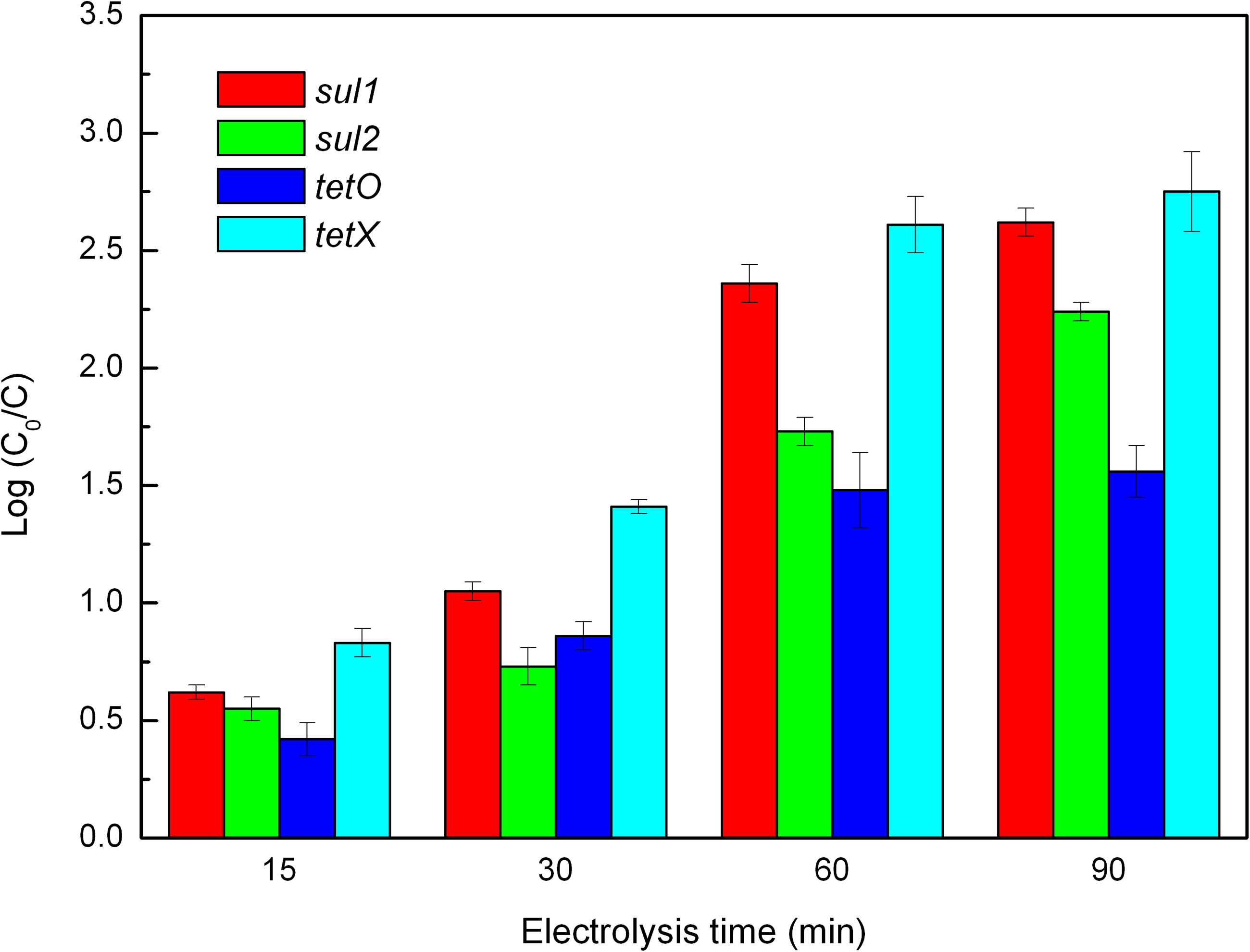
Influence of electrolysis time on the removal of ARGs by electrocoagulation. pH = 7.0; current density: 20 mA/cm2.
EC is the most commonly used method among various electrodisinfection technologies. In the EC process using iron as anode, Fe2+ is released at the anode and OH− is formed at the cathode. Fe2+ is further transformed into Fe(OH)2. When there is dissolved oxygen, Fe2+ is converted into Fe(III) and Fe(OH)3 is formed. These hydroxides neutralize charges and foster their aggregation or act as sweep flocs with large surface areas, which adsorb bacterial cells and dissolved pollutants (Ghernaout, 2013). Besides, when using iron electrode, the bacteria could be inactivated by reactive species produced upon Fe(II) oxidation by O2 (Delaire et al., 2016). Furthermore, the electric field may lead to the formation of permanent pores in the cell membrane or the loss of important cell components and destruction of chemical gradients, which also allow reactive species free access into the cell, resulting in the activation of bacteria (Drees et al., 2003). Among these mechanisms, the physical removal through enmeshment in precipitated flocs is the primary process during Fe-EC disinfection in actual wastewater or natural waters (Delaire et al., 2016).
To explore the potential mechanism for the removal of ARGs by EC, a correlation analysis was carried out between the removal efficiency of ARGs and that of 16S rRNA by EC with various electrolysis times under a constant current density of 20.0 mA/cm2 at neutral pH. 16S rRNA genes were identified as taxonomic markers of bacteria, which could reflect the abundance of background bacteria in the sample (Ju et al., 2014). As shown in Table 2, the removal efficiency of selected ARGs (sul1, sul2, tetO, and tetX) was all significantly correlated with that of 16S rRNA, indicating that the removal of ARGs during the EC process was mainly attributed to the decrease of microorganisms through adsorption and enmeshment of flocs. According to Faraday's law, the amount of generated Fe2+ ions at the anode increases as the current density applied. Thus more hydroxides flocs were formed, and higher removal efficiency of ARGs was achieved under a higher current density.
Correlation Analysis Result between the Removal of Antibiotic Resistance Genes and 16S rRNA
Correlation is significant at the 0.05 level (two tailed).
Influence of initial pH
To investigate the influence of initial pH on the removal of ARGs, pH values were set at 5.0, 7.0, and 9.0 under a constant current density of 20.0 mA/cm2 for 60 min in this study. As shown in Fig. 3, the maximum log reductions of sul1, tetO, and tetX were achieved at pH 5.0, which were 2.54 logs, 1.85 logs, and 2.78 logs, respectively; while the maximum removal efficiency of sul2 was achieved at pH 7.0. At initial pH 9.0, lowest log reductions of all selected ARGs were observed, which were in the range of 0.81–1.63 logs.
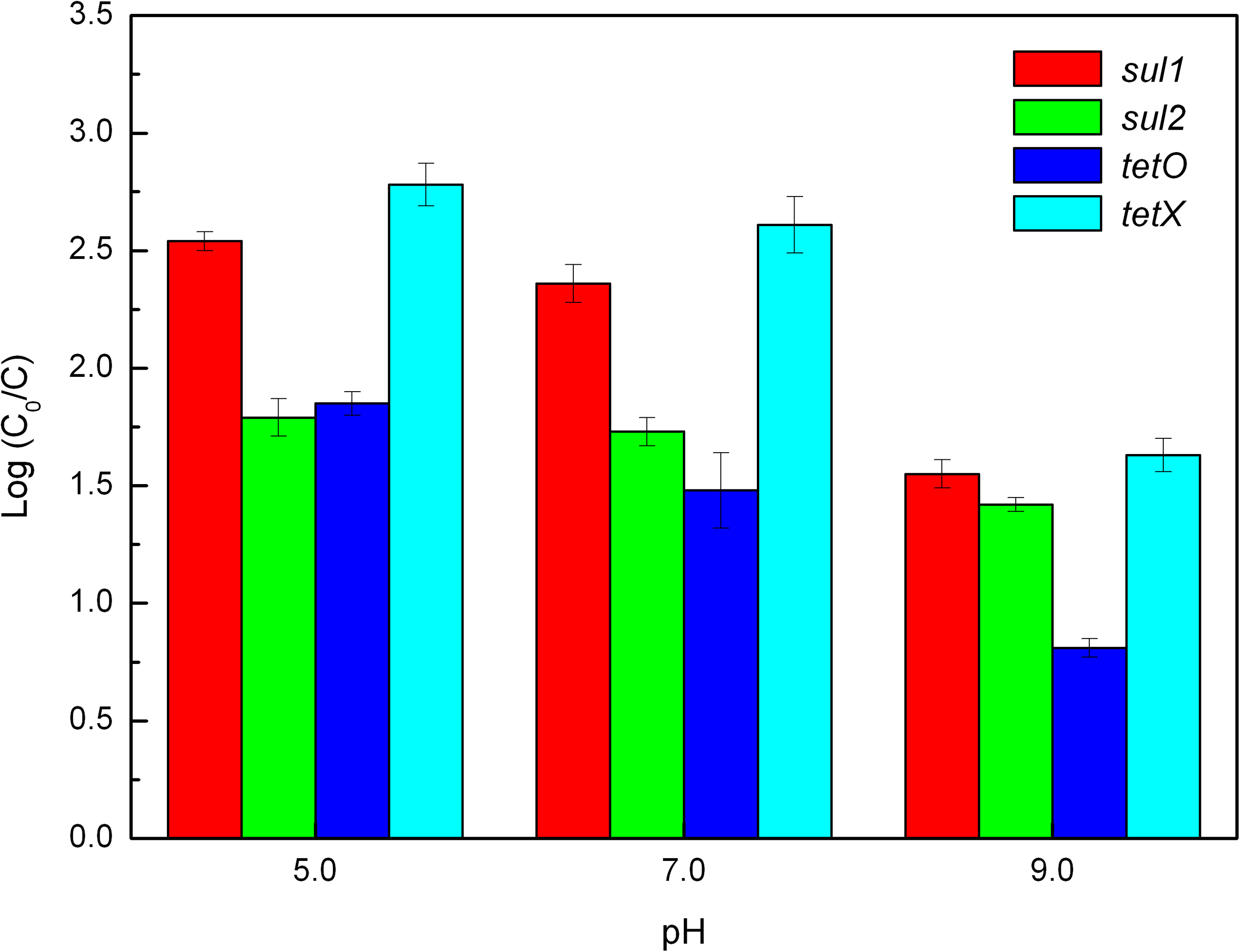
Influence of initial pH on the removal of ARGs by electrocoagulation. Current density: 20 mA/cm2; electrolysis time: 60 min.
The predominant species of iron hydroxides are mainly determined by the initial pH value. At pH 5.0, soluble polymeric hydroxy complexes, such as Fe(H2O)63+ and Fe(H2O)5(OH)2+, are predominant, which have positive charges (Gomes et al., 2007; Ndjomgoue-Yossa et al., 2015). These positive charges could bind with the bacterial cells and extracellular genes, which have negative charges, causing the precipitation of bacterial cells and extracellular genes (Nguyen et al., 2010; Wang et al., 2016). When pH was increased to 7.0, insoluble Fe(OH)2 or Fe(OH)3 was the predominant species, which was responsible for the removal of antibiotic resistance bacteria and ARGs (Gomes et al., 2007). The removal of ARGs was lower at pH 9.0, which might be due to the formation of soluble species such as Fe(OH)42− (Gomes et al., 2007). These species could not absorb bacteria cells or extracellular genes.
Effect of pretreatment by UV disinfection
The removal efficiencies of selected ARGs by single UV disinfection ranged from 0.18 to 0.50 logs, as shown in Fig. 4, implicating that the conventional UV disinfection in WWTP could not remove ARGs effectively and a large amount of ARGs would be released into the aquatic environment. The removal efficiencies of sul1 and sul2 were lower compared with those of tetO and tetX by UV disinfection, which might be because sulfamethoxazole-resistant bacteria had greater tolerance to UV irradiation than tetracycline-resistant bacteria (Zheng et al., 2017). UV irradiation is able to destroy ARGs as UV light between 240nm and 280 nm can penetrate the UV-transparent structures in the bacterial cell envelop and be absorbed by the nucleobases comprising DNA and RNA, which subsequently destruct the structures of DNA and RNA molecules (Mckinney and Pruden, 2012). According to our study, the capacity of conventional UV disinfection for removal of ARGs at a normal UV fluence of 20 mJ/cm2 was limited. However, pretreatment by UV disinfection significantly enhanced the removal of selected ARGs by EC and the reduction logs of ARGs by sequential UV/EC reached 1.62–2.83 logs, which were even higher than the sum of that by single UV disinfection and EC process (Fig. 4). The explanation might be that the pre-inactivation of antibiotic resistance bacteria by UV irradiation may cause the destruction of cell structure, which would reduce the cell stability and promote the subsequent flocculation. The removal of ARGs by sequential UV/EC with the electrolysis time of 60 min was also studied, which showed a reduction of 1.86–3.32 logs for the selected ARGs. However, from the aspect of energy cost, UV/EC process with the electrolysis time of 30 min seemed more efficient and practical for wastewater treatment.
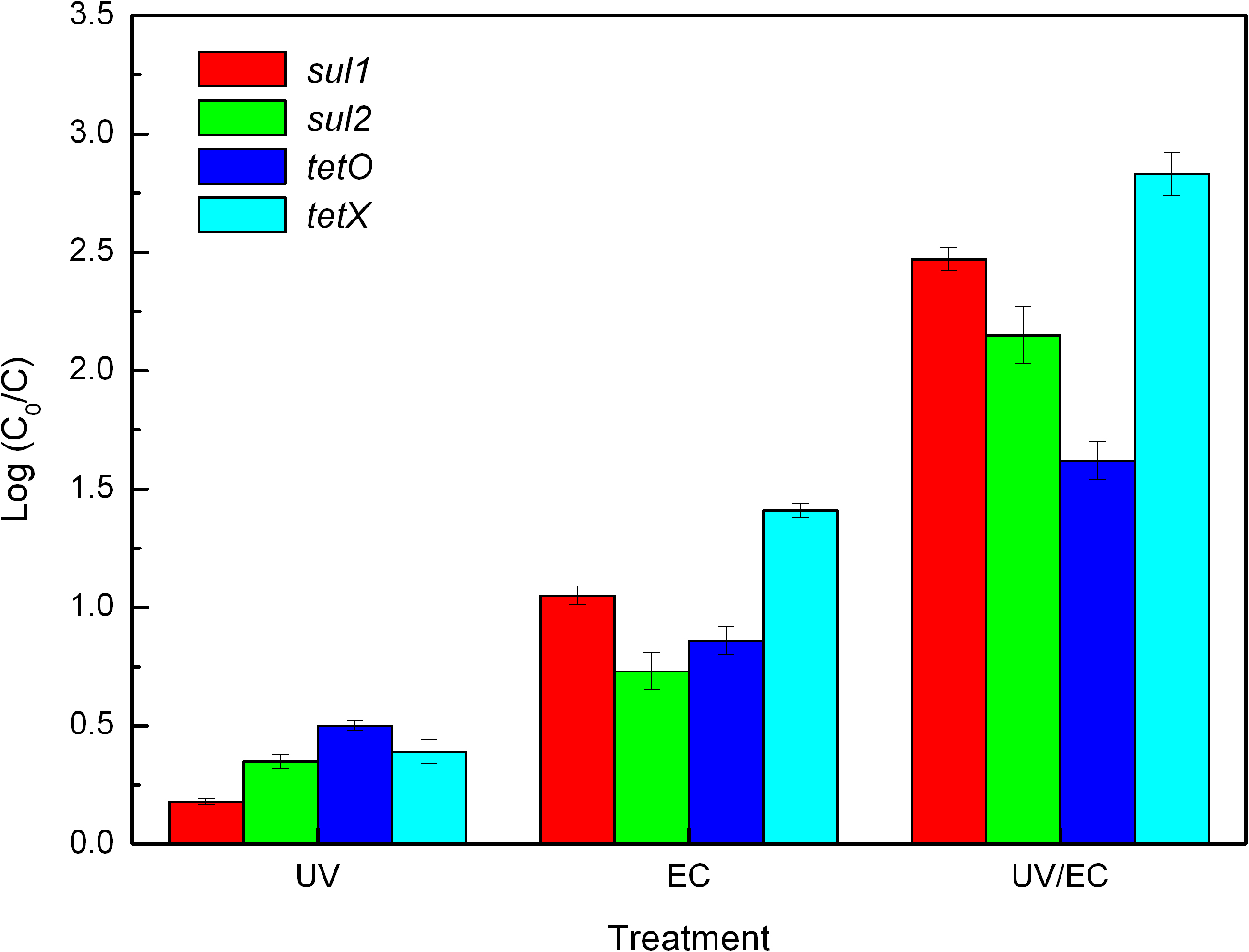
Comparison of UV disinfection (UV), single EC, and sequential UV/EC for the removal of selected ARGs. pH = 7.0; current density: 20 mA/cm2; electrolysis time: 30 min. EC, electrocoagulation; UV, ultraviolet.
The study by Zheng et al. (2017) showed that the removal efficiency of ARGs in secondary effluents of municipal WWTPs could reach 79.7–92.0% when the UV fluence was increased to 160 mJ/cm2; but a higher UV fluence might also promote the release of ARGs, leading to the persistence of ARGs in the form of free ARGs in water. In this study, an increase in the abundance of extracellular ARGs after UV disinfection was also observed, indicating that more extracellular ARGs would be discharged into the environment after single UV disinfection. The abundance of extracellular ARGs for sul1 and sul2 decreased by 0.08–0.36 logs after UV disinfection; but a slight increase (0.06–0.10 logs) was observed for both extracellular tetO and tetX, as shown in Fig. 5. However, all of the extracellular ARGs were removed efficiently by the subsequent EC process, with a total reduction ranging from 1.09 to 1.52 logs.

Changes in abundance of extracellular ARGs during sequential UV/EC process. pH = 7.0; current density: 20 mA/cm2; electrolysis time: 30 min.
Conclusions
The selected ARGs (sul1, sul2, tetO, and tetX) from the secondary effluent of WWTP could be removed efficiently by EC under a current density of 20.0 mA/cm2 at neutral pH. The primary mechanism for the removal of ARGs by EC was the adsorption and enmeshment of precipitated flocs. Increased current density could increase the reduction logs of ARGs. Acidic and neutral conditions were beneficial to the removal of ARGs by EC. Pretreatment by conventional UV disinfection could enhance the removal efficiency of ARGs by the subsequent EC process. Although the extracellular ARGs might be increased after the UV disinfection, they could be removed efficiently by the EC process. Results suggest that EC process, especially with pretreatment of UV disinfection, is a promising method for the removal of both intracellular and extracellular ARGs in municipal wastewater effluent.
Footnotes
Author Disclosure Statement
No competing financial interests exist.
Funding Information
This work was supported by the Jiangsu Provincial Key Laboratory of Environmental Science and Engineering (No. Zd1904) and Key Laboratory of Water Pollution Control and Environmental Safety of Zhejiang Province, China (No. 2018ZJSHKF04).