




Abstract
In this study, a bilevel programming model is proposed for a multiple decision-subject location-routing problem of hazardous waste (HW) under a fuzzy random environment to select the best HW disposal centers. In this proposed model, the objective of the upper level decision makers is to select the best location of HW disposal centers to minimize total costs and risk loss, while the goal of followers is to select an optimal HW disposal center to minimize transportation costs. However, the amount of HW generated is difficult to estimate, so we consider the amount of HW generated as a fuzzy random parameter in this article. Then, we developed a binary particle swarm optimization based on fuzzy random simulation (FRS) to address the proposed model, and a case study was applied to verify the effectiveness and feasibility of the proposed model and algorithm. Therefore, some interesting findings are obtained: (i) the results show that the bilevel programming model is suitable for such problems; (ii) the bilevel programming model proposed herein is flexible, and the parameters can be adjusted to meet different requirements; and (iii) the comparison between binary particle swarm optimization (PSO) based on FRS and classical PSO further illustrates the advantages of the proposed algorithm. Moreover, due to the flexibility of the proposed method, the proposed bilevel programming model in this article can be applied to other similar research problems.
Introduction
With the rapid development of urbanization in developing countries, hazardous waste (HW) generated by medical and chemical industries is increasing. However, inappropriate disposal methods bring great harm to the environment and people's health (Masoumi and Yengejeh, 2020). Therefore, how to select suitable HW disposal sites is receiving more and more attention. The location of HW disposal sites is a key part of the integrated waste disposal system, especially the location of toxic and medical waste disposal centers (Yu et al., 2020). With the improvement of people's awareness of the environment, location-routing problem of hazardous waste (LRPHW) has attracted more and more attention in the fields of science and practice.
In recent times, various mathematical models have been developed. Because the LRPHW has received close attention, many scholars (Aydemir-Karadag, 2018; Rabbani et al., 2018a, 2018b, 2019; Zhao and Huang, 2019) have conducted extensive research on it. Taghipour et al. (2014) used analytical hierarchy process to analyze the location of HW and find the best location for medical waste disposal through comparative analysis. Alumur and Kara (2007) proposed a new multiobjective location-routing model, which considered the total cost and total transportation risk minimization. In addition, Samanlioglu (2013) expanded on the research of Alumur and Kara (2007), and proposed a multiobjective location-routing model, which considered the total cost and total risk minimization, to study the optimal location. Zhao et al. (2016) applied a multiobjective programming model to identify waste sites and determine transportation routes for HW. Lei et al. (2015) developed an integer programming model to select the best sites. Yu and Wei (2016) considered two key factors in the model, namely system operating costs and risks, which are very important in HW disposal site selection. Ardjmand et al. (2016) established a two-objective stochastic model, which considered minimizing the total cost, and minimizing the risk of the transportation, location, and allocation of hazardous materials. Zhao and Ke (2017) used mathematical model to optimize the cost and environmental risks of HW transportation systems, and the results showed a significant improvement based on previous research. Ghezavati and Morakabatchian (2015) developed a multiobjective location-routing model, which considered minimizing the total costs of transportation and location allocation, and minimizing total transportation and site risks related to the population exposure along transportation routes and disposal centers. Rabbani et al. (2019) developed a multiobjective mathematical model, which solved three main problems, namely location, vehicle routing, and inventory control.
Regarding the LRPHW, Aydemir-Karadag (2018) presented a profit-oriented mixed integer mathematical model, which incorporated the energy recovery from waste and the application of the polluter pays principle, to solve the HW location-routing problem. HW management involves the site selection, collection, transportation, and disposal of waste. In addition, based on previous research, it can be found that the mathematical models for LRPHW mainly focus on minimizing costs and risks. In other words, the key to the location of HW disposal sites is to reduce environmental pollution, reduce costs and transport risks.
However, previous studies on LRPHW have focused only on deterministic models. Due to the uncertainty in the real environment (Li et al., 2019), some of the variables in LRPHW can be considered as fuzzy random variables. The amount of HW plays an important role in the LRPHW, and it is critical to estimate the quantity well, so it can be regarded as a fuzzy random variable. Therefore, to be more realistic, recent studies on uncertainty in LRPHW have received more and more attention. Wang et al. (2011) considered the randomness of customer needs in their study. Liu and Xu (2011), Wenab and Kakuzo (2008), and other scholars considered the customer's demand as a fuzzy variable for research, and Liu (2006) considered transportation costs as fuzzy variables. Zhang et al. (2020) optimized water resource allocation and soil salinity control under uncertain environment. Ma et al. (2020b) studied the problem of dual uncertainties in water resources allocation. Feng (2021) applied triangular fuzzy numbers to describe the amount of water available. Ma et al. (2020a) studied the impact of uncertain water supply on the results in the Amu Darya basin on the results. Ding et al. (2020) applied vertex-based analysis technique to reflect uncertain parameters in their research.
Indeed, fuzzy random theory has been considered in many research fields as in Xu et al. (2008, 2011); Chen et al. (2009); Yasuda et al. (2010); and Yano and Matsui (2013). Therefore, there is no doubt that uncertain parameters are involved in the location of HW disposal sites. Although many scholars have also studied randomness in other research fields, random factors are rarely considered in HW site selection. Moreover, most scholars construct multiobjective optimization models to select the best location, and rarely consider multilevel decision making of HW. Therefore, to the best of our knowledge, previous studies have rarely applied the bilevel programming model to select the best HW disposal site.
In particular, the purpose of this article is to answer the following questions:
Which method should be used to determine the best location of HW disposal sites? How to deal with uncertain parameters effectively? What effect does the uncertainty parameter have on the site selection result? How to balance the conflict between upper level decision makers and lower level followers?
In this article, we aim to establish a bilevel programming model to describe multilevel decision making and fuzzy randomness in HW, and reduce costs and risk losses. There are two decision subjects in the proposed model. Upper layer is the leader, who focuses on minimizing total costs and minimizing risk, and the lower level decision subject, namely the follower, is the disposal center who determines the best transportation route to achieve the lowest cost. Fuzzy random variables can be used for site selection problems to describe dual uncertain variables. The reason we use fuzzy random theory is explained in section “Fuzzy random environment.”
Key Problems Statement
In the HW management, since the location of the disposal center is an important factor that affects the HW planning (Wei et al., 2015; Chauhan and Singh, 2016), it is of great importance to determine the best location of HW. The basic process of waste integration processing is shown in Fig. 1. It can be seen from Fig. 1 that HW management involves multiple decision makers. Therefore, it is very interesting to study how to balance the conflicts of interest between these decision makers. In addition, it is difficult to make decisions that balance the conflict between environmental protection and economic benefits.
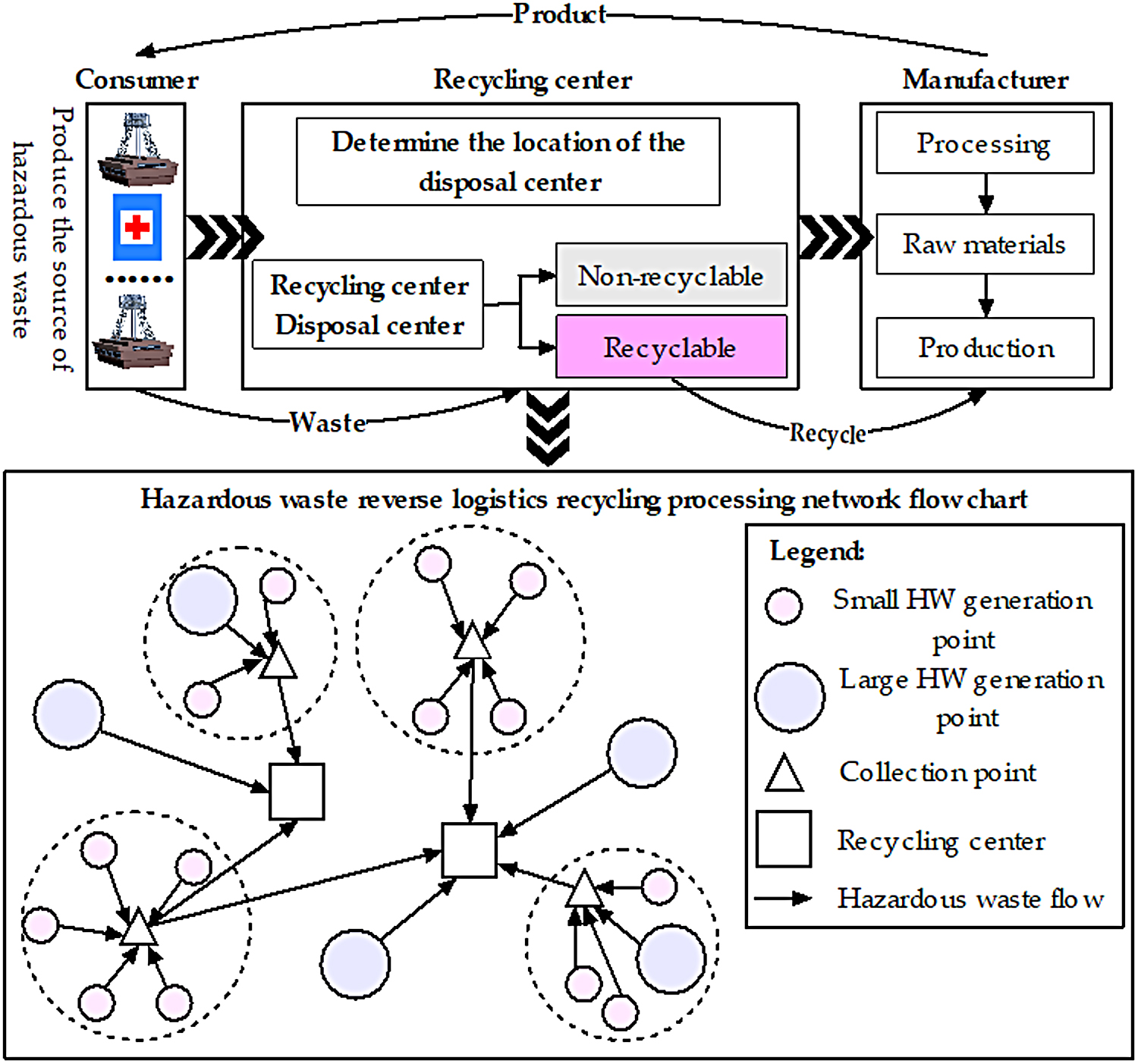
The basic process of waste integration processing. HW, hazardous waste.
The general diagram of the HW disposal process is shown in Fig. 1A. When the amount of HW generated at the point of generation is small, it does not make much sense to transport the amount of HW from generation points to the recycling centers. Therefore, there may be a collection point between generation point and the recycling center (Fig. 1B). Before establishing the mathematical model, we will elaborate the location problem of HW disposal centers.
Multiple decision subjects
In the HW disposal plan, it mainly involves government departments, enterprises with HW disposal qualifications, and HW generation agencies. The government department, which can be regarded as the upper level, is responsible for the planning and construction of the disposal center, entrusts enterprises with HW disposal qualifications to operate and strictly supervise and control them. Therefore, we can obtain the structure of bilevel relationship in the location of HW, as shown in Fig. 2.
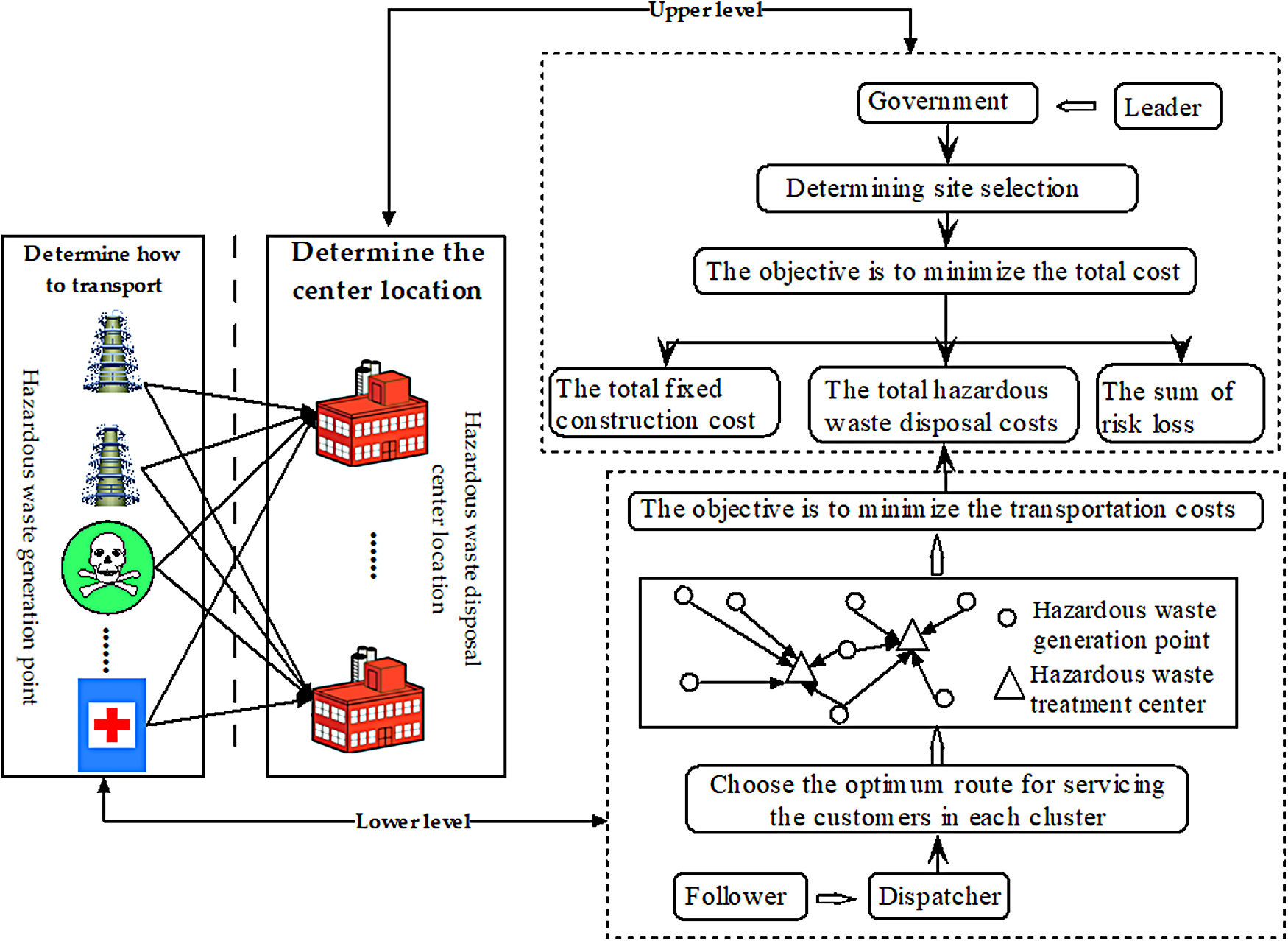
The structure of bilevel relationship in the location-routing problem of HW.
The objectives of the two decision-making bodies are different. The government's main concern is how to minimize the total investment cost, reduce the environmental pollution and the risks. Different disposal centers will bring different environmental pollution impacts, risk losses, and transportation costs. Therefore, the government should consider these factors to determine the best location of the disposal center. Once the government department has chosen the location of the disposal centers, each HW generation point can choose different disposal centers to handle HW. However, the objective of each HW generation point is to determine how to transport the HW. Therefore, to pursue their own minimum transportation cost, they ignore that the HW transportation may bring risks to the ecological environment and residents. Therefore, when the government departments are planning the location of the HW disposal center, they should take into account the measures that may be taken by institutions with HW disposal requirements after their decision.
In this article, it is evident that governments can influence how HW generation points choose disposal centers, but they cannot control lower level decisions. However, HW generation points make decisions based on the best decision-making methods of government departments. In summary, bilevel programming model has more advantages than single-level programming model. This article summarizes the following points: (i) two different and even conflict goals can be analyzed by the bilevel programming model in the decision-making process; (ii) bilevel programming models can better reflect the actual problem; and (iii) the relationship between government departments and HW generation points can be clearly reflected in the bilevel programming model.
Fuzzy random environment
The amount of HW generated by HW generation points is affected by a variety of complex factors, such as economic conditions, weather conditions, and population density (Ojoawo et al., 2013). The trend in the amount of HW generated by HW generation points is fluctuating because of the uncertainty in the assessment, the lack of information, and the dynamic environment. Therefore, to better describe the two simultaneous uncertainties, this article uses fuzzy random variables to characterize it. That is to say, the amount of HW generated by HW generation points includes both fuzzy and random factors. Thus, the LRPHW needs to be discussed in a fuzzy random environment, so that it can be closer to the actual situation, as shown in Fig. 3.
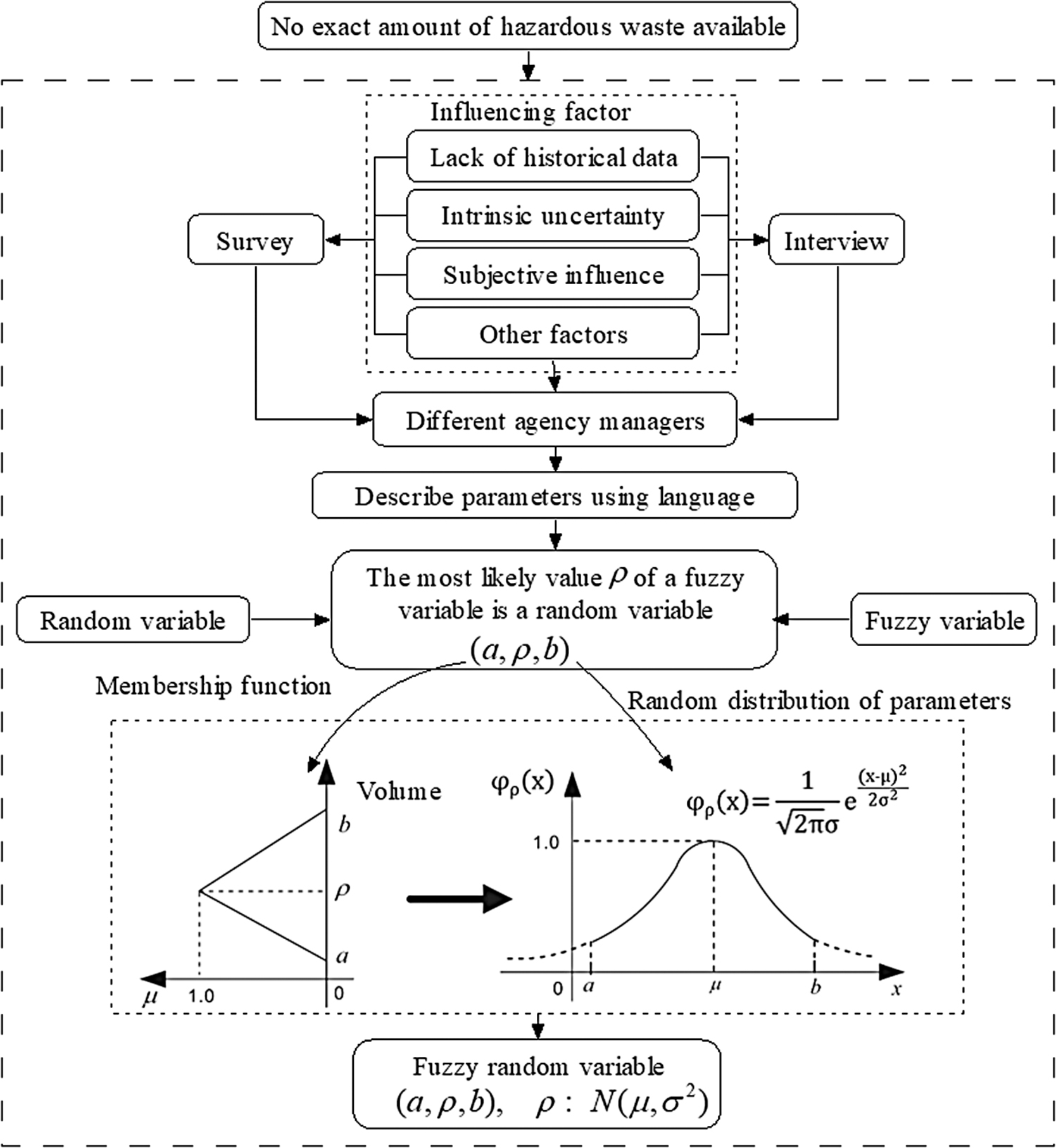
Analysis flow chart of HW generation as fuzzy random variables.
As far as we know, few studies consider the uncertainty in LRPHW. As shown in Fig. 3, the amount of HW is usually determined through interviews or surveys, and even described in vague language. In this article, random factors are also considered in the LRPHW: (i) if a HW generation point is in charge of more than one manager, it is random to select a respondent; and (ii) due to special circumstances such as environmental conditions, temperature conditions, population density, population size, and age of the population, respondents usually provide different data. In general, respondents' statements include random and vague factors. Therefore, fuzzy random environment should be considered in the LRPHW.
Modeling
Based on the description in section “Key problems statement,” this section aims to build a bilevel programming model to balance the conflict between the upper and lower.
Assumptions
Before establishing a bilevel programming model, we need to make the following assumptions:
HW generation points are abstractly equivalent to production. For medical waste, a community clinic or a large hospital can be seen as a production point.
Each production point will transport HW to a single disposal center rather than to multiple disposal centers.
Regardless of the type of waste, it is regarded as a kind of item that needs special disposal and is transported by a special car.
Notations
Index:
i: Index of generation points of HW, i = 1, 2, 3, L, n.
j: Index of potential locations for disposal centers, i = 1, 2, 3, L, m.
Certain parameters:
dij: Transportation distance from generation point i to disposal center j.
c: Unit transportation cost of HW.
cj: Cost of processing one unit of HW in disposal center j.
fj: Fixed cost of opening a disposal center at location j.
Rj: Population and environmental risk around the potential location j for disposal center.
μj: Probability of population and environmental risk around the potential location j for disposal center.
TB: Government's total budget for setting up the disposal centers.
Pj: Maximum capacity of disposal center j.
Uncertain parameter:
Decision variables:
xij: A binary variable, if the HW is transported from generation point i to disposal center j, xij = 1, otherwise, xij = 0.
yj: A binary variable. If a disposal center is established at location j, then yj = 1, otherwise, yj = 0.
Upper model
As a government planning department, it is necessary to choose to build disposal centers in different locations according to actual conditions. Due to different economic development levels, there will be some differences in unit processing costs. Therefore, government departments should consider disposal costs, fixed investment, environmental impact, etc. to select the best locations.
Objective function
In general, government departments try to minimize total costs and risks. Therefore, this article considers three kinds of costs. The first one is fixed investment, which includes construction costs, purchase and processing equipment costs, land use fees, and human resources costs, thus we can obtain that the total fixed construction cost is
Constraints
Cost budget constraint
When government departments plan the location of HW disposal centers, they need to formulate fixed investment budgets based on actual conditions. The total fixed investment of disposal centers cannot exceed the budget, thus we can obtain the following mathematical formulation:
Capacity constraint
The selected HW disposal centers should have the capacity to meet regional HW disposal. In other words, total disposal capacity should be greater than or equal to the amount of regional HW. Therefore, we can obtain the following mathematical formulation:
0–1 variable constraint
If a disposal center is established at location j, then yj = 1, otherwise, yj = 0.
Lower model
The lower level decision makers are the HW generation points. Generally speaking, they are not concerned about waste disposal costs. The disposal price of unit HW is regulated by the government, so the unit disposal cost is the same. However, the distance between the HW generation point and the disposal center determines the transportation cost. Therefore, the objective of lower level decision makers is to minimize total transportation costs.
Objective function
The objective of the lower level is to minimize the total transportation cost, so total transportation cost can be obtained by
Constraints
Meet processing constraint
Each HW generation point must select at least one disposal center to process HW. Therefore, the constraint is as follows:
Capacity constraint
Each disposal center has a processing capacity limit, and the total amount of HW cannot exceed its maximum processing capacity, so it has the following constraint:
Only selected disposal center can receive waste
If a disposal center j is not selected, the waste cannot be shipped there. Therefore, a constraint is needed to illustrate this logical relationship. Let M be a sufficiently large positive number, then we can obtain the following constraint:
0–1 variable constraint
If the HW is transported from the generation point i to the disposal center j, xij = 0, otherwise, xij = 0.
Global model
Based on the above analysis, the global model of fuzzy random bilevel LRPHW can be obtained.
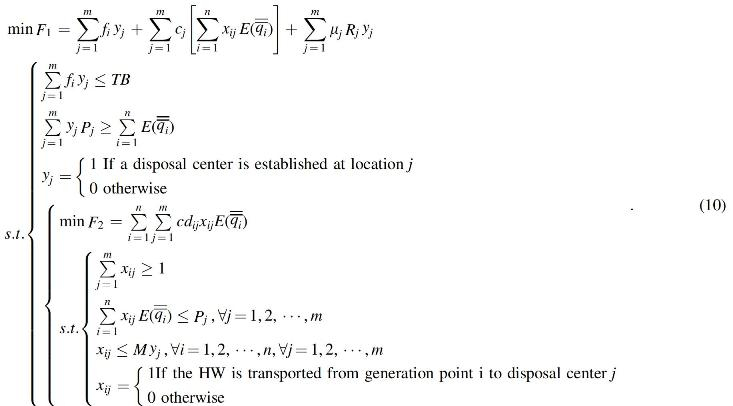
Model (10) is a bilevel programming model that solves the location problem of HW disposal center in a fuzzy random environment. The goal of upper level decision makers is to minimize the total costs and risks, while the objective of lower level decision makers is to minimize the total transportation costs. However, in practice, the upper level decision has a significant impact on the lower level transportation route, and the lower level transportation route selection also affects the upper level decision making. Therefore, upper level decision makers should consider constraints from the perspective of themselves and their followers.
Model Algorithm
The bilevel programming model proposed herein is an Non-deterministic Polynomial-hard problem, and it is quite difficult to find the optimal solution. In addition, the proposed model contains fuzzy random parameters, which makes it more difficult to solve.
Many methods have been developed to solve the bilevel programming model, such as the Karush–Kuhn–Tucker method, extreme point search method, descent method, and direct search method. In general, the Karush–Kuhn–Tucker method and extreme point search method are used to solve the bilevel linear programming problem, while descent method is mostly used to solve the bilevel nonlinear programming problem. In recent years, intelligent algorithms such as genetic algorithms and particle swarm optimization (PSO) have been developed rapidly and are widely used. Therefore, this article uses the PSO to solve the bilevel programming problem.
Fuzzy random variable processing
The fuzzy random variable
Solution algorithm
Model (10) is a nonlinear model with uncertain variables and discrete variables. Therefore, the traditional methods, such as the Karush–Kuhn–Tucker method and extreme point search method, cannot be used to solve the model. Because the decision variables are discrete, the binary PSO (BPSO) algorithm can be used to solve the proposed model in this article. The PSO algorithm, which is similar to the genetic algorithm, is a kind of evolutionary intelligent algorithm. PSO will generate a random set of solutions during initialization, and then find the optimal solution through updating and optimizing generation by generation. In addition, the fitness function can be used to evaluate the solution.
The decision-making variables in this study are 0–1, which are discrete binary variables. The discrete BPSO algorithm is essentially different from the original PSO. The BPSO's particles are binary coded, each binary bit uses Equation (11) to generate velocity, and the generated velocity value will be further converted into transformed probability; that is to say, the probability that each bit variable takes a value of 1 (Trelea, 2003):
where c1 and c2 represent the acceleration constant, respectively; Pp and
In addition, the parameter relationship of BPSO is different from that of PSO. Kennedy and Eberhart (2002) used the optimization simulation method to verify the robustness of the discrete binary algorithm, which made the algorithm popular. The velocity value of the BPSO particle is mapped to the interval [0, l], which represents the probability that the binary value is 1. In this article, we use the sigmtrid function to map, as shown in Equation (12):
where
Initialization: The parameters and variables are initialized as shown in Table 1.
Check constraint: To check whether the initialized particles meet the constraints, we use the following procedure to verify (Table 2).
BPSO-based FRS program: When a particle finds the local most position, the other particles will quickly approach it. The general steps of a BPSO-based FRS algorithm are provided as shown in Table 3.
Parameter and Variable Initialization Steps
Constraint Inspection Process Steps
The General Steps of a Binary Particle Swarm Optimization-Based Fuzzy Random Simulation Algorithm
The fitness of the upper objective function is defined as follows:
where
where
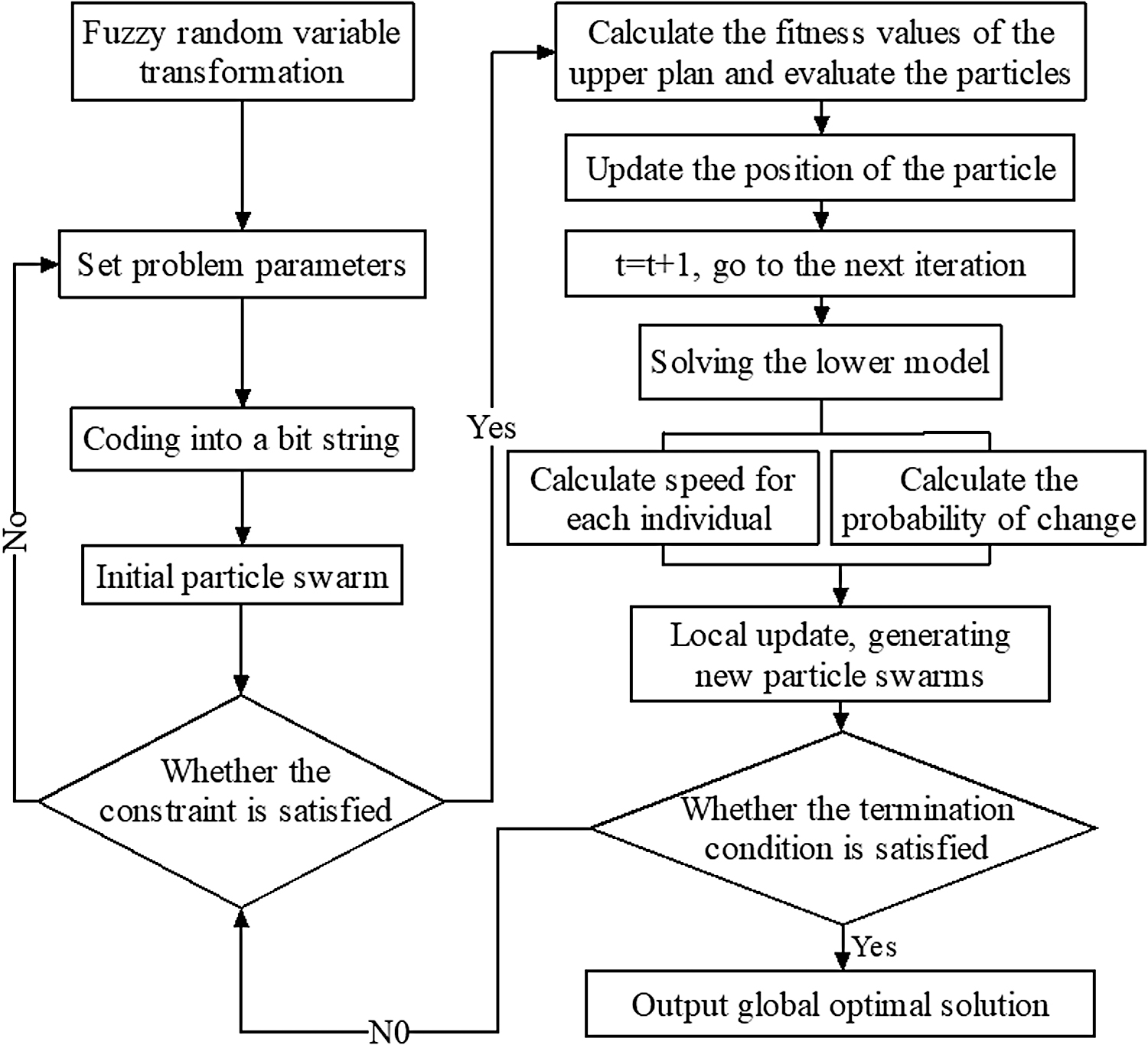
Bilevel binary particle swarm algorithm flow chart.
Case Study
This section aims to apply a case study to verify the effectiveness and practicability of the proposed model.
Case description
Case study comes from Bijie city in southwestern China. The city is divided into eight administrative districts, and the main HW is currently concentrated around the urban area. Therefore, for the convenience of research, it is impossible to take every HW generation point into account. Only these points that generate more HW, such as large hospitals and factories, can be considered as a HW generation point. In view of the actual situation, this article divides the urban area into 15 HW generation points, and there are five candidate disposal centers in the area. The geographic location of the HW generation points in Bijie city is as shown in Fig. 5.

The geographic location of the HW generation points in Bijie City.
Data collection
To better solve the location of disposal center problem, data collection was performed. Table 4 gives the data on five
Alternative Concentration Point and Construction Costs
Data source: planning research report provided by a hazardous waste disposal company.
Because of the geographic environment, population situation, economic development, etc., the HW disposal centers established have different environmental pollutions and risk losses to local residents. Estimate the environmental pollution and the risk loss of residents in five alternative locations, and the results are shown in Table 5.
Environmental Pollution and Loss Risk Values at Each Candidate Point
The distance is measured using Google Map, and the distance between each HW generation point and the five potential disposal centers is shown in Table 6.
Distance Between Hazardous Waste Generation Points and Potential Disposal Centers (Unit: km)
The amount of HW that needs to be processed is a fuzzy random variable, as shown in Table 7. In addition, HW generation points provide historical data, and we have processed the data. Moreover, the unit transportation cost is
Fuzzy Random Data of Hazardous Waste (Unit: 103 Ton)
Results and Discussion
Parameter settings are very important for solving two-level programming models (Trelea, 2003; Chen and Jin-Shou, 2005). The parameters in this article are set as follows: population size
The Results of Model Based on Binary Particle Swarm Optimization-Based Fuzzy Random Simulation
We use the Matlab software to draw the iterative situation in the process of the program. Figure 6 shows that the upper objective function value decreases as the number of iterations increases.
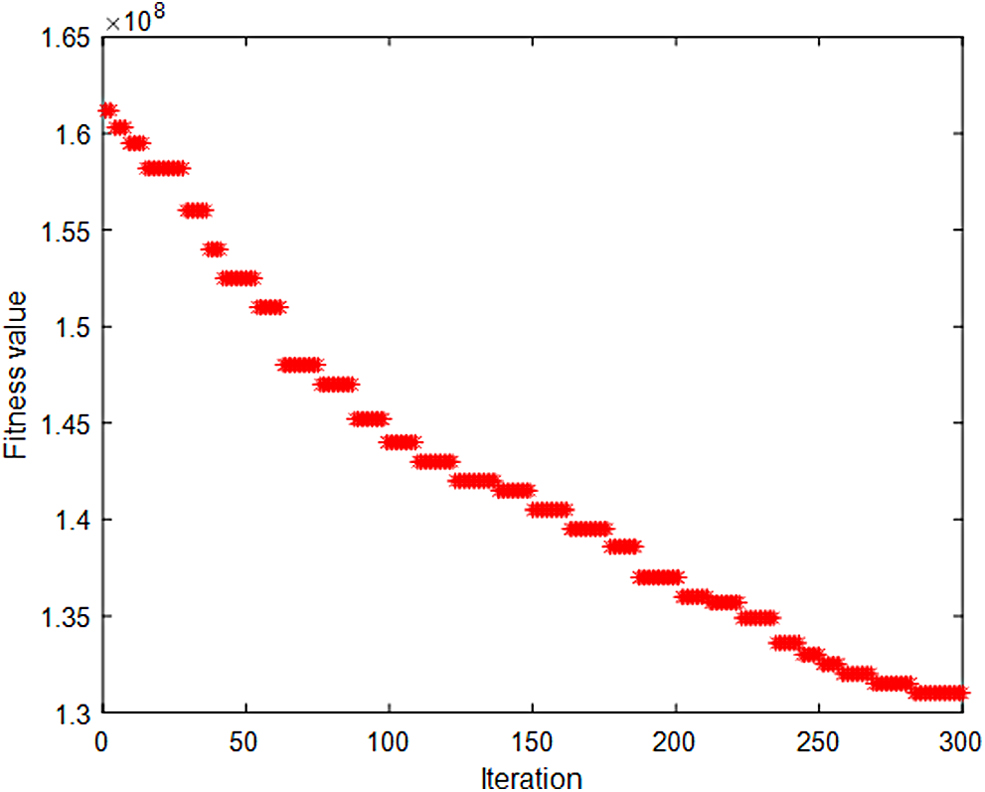
The change of the upper objective function value with the number of iterations.
In the case of the data given in the article, the final satisfactory solution shows that among the five disposal centers, selecting the disposal centers 1, 2, and 3 can meet the model requirements, and the upper level objective value is the smallest, which is 131,662,140. The transport assignments are as shown in Fig. 7. The lower objective function value is 10,731,360.
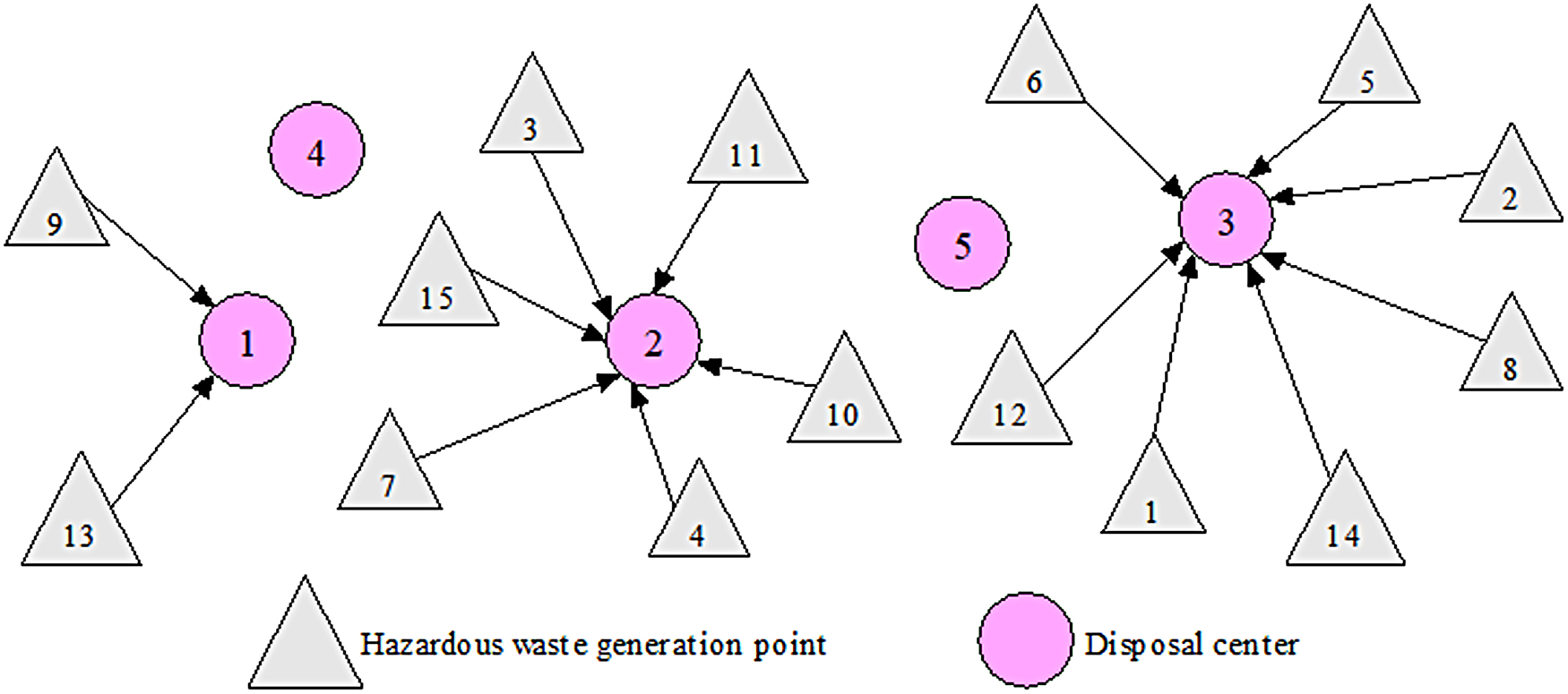
Final network diagram of HW generation points and disposal center.
Model comparison
The collection data is transformed into fuzzy random variables according to its characteristics. Fuzzy random variables are an extension of fuzzy variables, so this article uses fuzzy random models and fuzzy models to compare. For comparison purposes, random factors are ignored when processing data. This fuzzy data is put into the BPSO-based FRS, and the program run 20 times. In addition, we select the lower objective function value for comparison. The calculation result is shown in Table 9.
The Comparison Between Fuzzy Random Environment and Fuzzy Environment
Since the fuzzy data relax the constraint, the search range of the calculated fitness value is expanded. From the comparison of the model application, it can be seen that considering the fuzzy randomness of the data can make the model more accurate, bring more economic benefits. In the decision-making process, considering both the fuzziness and randomness of the data can not only provide more accurate data for decision makers but also help them make more controllable and feasible decisions. It can also be clearly seen from the comparison results that converting the data into fuzzy random is more in line with the actual situation, and also makes the model have better performance.
Algorithm evaluation
To show better the effectiveness of algorithm, we have made a brief comparison between BPSO-based FRS and classic PSO. The parameters of the basic version of the classic PSO algorithm, population size

The iterative process of application by the BPSO and the classic PSO. FRS, fuzzy random simulation; PSO, particle swarm optimization; BPSO, binary PSO.
The Comparison Between the Binary Particle Swarm Optimization-Based Fuzzy Random Simulation and the Classic Particle Swarm Optimization
PSO, particle swarm optimization; BPSO, binary particle swarm optimization.
It can be seen from Table 10 that BPSO-based FRS algorithm is better than the classical PSO algorithm. In addition, it can be seen from Fig. 8 that the optimal objective function values of the two algorithms decrease as the number of iterations increases. However, in terms of stability and convergence speed, the BPSO-based FRS algorithm is significantly better than the classical PSO algorithm, which verifies the effectiveness of the FRS-based BPSO algorithm used in this article.
Effectiveness analysis
The model proposed in this article is flexible, thus decision makers can change the parameters in the proposed LRPHW model to meet different practice demands. Different parameters value may have an impact on the results. Therefore, decision makers can adjust these parameters according to the current environment and economic development, so that the research results are in line with actual conditions. In addition, the proposed model herein is a general model, which can add objective functions or constraints according to the requirements of different decision makers. For example, in practice, the government may stipulate that HW disposal centers must be greater than or equal to the minimum HW disposal requirements before they can be built, so we have to add new constraints. In short, the model proposed herein is effective to select the best location of HW disposal sites, and is equally applicable to other developing countries dealing with similar problems.
Research contribution
The research results of this article show that the proposed model is effective in solving the location problem of HW disposal center. In addition, the comparative analysis shows that it is appropriate to consider HW as a fuzzy random variable. Therefore, based on the above analysis, the article's contributions are as follows:
First, most of the previous studies focused on the location of logistics centers, while there are few studies on the location of HW disposal sites. Therefore, in the context of a circular economy, this article is of great significance for the site selection of HW in theory and practice.
Second, the amount of HW is not considered as fuzzy random variable in the previous studies, which is unreasonable. So, this article considers the amount of HW as a fuzzy random variable, and the fuzzy random expected value method is used to convert the uncertain variable into a deterministic variable to make it more consistent with the actual situation.
Third, this article constructs a bilevel model for the site selection of HW, and applies a BPSO-based RFS algorithm to solve the proposed model. Thus, the application of bilevel programming in the location of HW under uncertain environment has been expanded.
Management implications
The location of HW disposal sites is a key issue in HW management. Research on HW management is of great significance in a circular economy. This article provides interesting insights for the site selection research and application of HW disposal sites. The results of this research will help the government and HW-related companies to build a systematic approach to select suitable HW disposal sites. Some management implications are as follows:
For upper level decision makers, the choice of a suitable objective function is crucial. Since the decisions of the upper level influence the decisions of the lower level decision makers, the upper level managers must consider the impact on the lower level decisions before making each decision. However, lower level decision makers will also optimize their own management decisions based on the decisions of upper level managers. The interesting thing is that both upper and lower decision makers will find a satisfactory decision solution.
Regarding the amount of HW generated, it is difficult to accurately predict. Therefore, this article regards the amount of HW generated as a fuzzy random variable. The results show that fuzzy random variables are more realistic than fuzzy variables. Moreover, in management practice, it is still an interesting topic to study how to deal with fuzzy random variables reasonably.
It is a complex problem to discuss the issue of LRPHW, especially in the context of sustainable development. Due to the changing environment, the best decisions currently made may not be applicable in the future. Therefore, to improve the ability of HW management, it is urgent to improve the proposed method in practice.
Conclusions
In this article, a multiple decision-subject location problem of HW disposal under a fuzzy random environment and its application to Bijie city have been discussed. For the location problem of HW disposal, a novel bilevel programming model was proposed, in which cost and risk loss is fully considered. To address this issue, the BPSO-based FRS algorithm was presented. Then, a case study was used to verify the validity of the model; it can be concluded that the proposed model and algorithm are feasible and effective in addressing such bilevel programming problems. Finally, the comparative analysis of BPSO-based FRS and conventional PSO is used to further illustrate the advantages of the algorithm. Thus, the advantages of the method proposed in this article can be summarized. (i) Compared with the single-level model, the bilevel programming model is advantageous in solving the location problem of HW disposal centers; and (ii) the model is flexible. Parameters can be adjusted to meet different requirements, and objective functions or constraints can be added to meet the needs of decision makers. Moreover, the following conclusions can be drawn:
First, the proposed model is proved to be feasible by considering the key problem of “multiple decision subjects” and “fuzzy random environment” simultaneously. The results of the case study related to the multiple decision-subject LRPHW of Bijie showed that incorporating these key problems into the model not only helps reduce the total cost of site selection and operation of the disposal center but also reduces the risk loss that may be caused by the transportation of HW.
Second, for the site selection obtained from the proposed model, Bijie's HW management system has been proven to be cost-effective within the scope of short-term planning. These solutions provide valuable information for governments and HW generation agencies, as well as novel mathematical methods for addressing the site selection of HW disposal centers.
Last but not the least, this article considers that the amount of HW generated as a fuzzy random variable is effective, which can be seen from the research results. The parameter
However, the method proposed herein still has limitations. First, the capacity of the HW disposal center considered in this article is fixed. However, in practice, if the amount of HW processed by the disposal center cannot reach or approach the maximum capacity, it may cause a waste of resources. Second, this article does not consider environmental issues. In the HW treatment process, different disposal centers may pollute the environment differently. Third, this article only considers a fuzzy random parameter, which may affect the research results. In management practice, many parameters can be considered as fuzzy random variables. In the future, an important thing is to develop the multiobjective bilevel programming model under a complex fuzzy and random environment in the real world. For example, multiobjective multistage bilevel programming model could explore the interrelationship between different target solutions. In addition, more uncertain variables should be taken into account, such as transportation costs and HW disposal costs. Therefore, regarding future research, as many realistic constraints as possible should be considered, and multiple uncertain variables should be appropriately added to make the research results more accurate.
Footnotes
Acknowledgments
The author is grateful for the valuable comments and suggestions from the respected editor and reviewers. Their valuable comments and suggestions have enhanced the strength and significance of this article.
Author Disclosure Statement
No competing financial interests exist.
Funding Information
This study did not receive any specific grant from funding agencies in the public, commercial, or not-for-profit sectors.