




Abstract
To immobilize Cd in soil and attenuate its uptake by vegetables, spent mushroom substrate (SMS), spent mushroom substrate biochar (SMSB), and SMS compost were employed as organic amendments to secure rape growth. Sequential chemical extractions showed that all three amendments efficiently reduced the exchangeable Cd (SE-Cd) fraction and carbonate Cd (WSA-Cd) fraction, and they increased the Fe-Mn oxides Cd (OX-Cd) and organic Cd (OM-Cd) fraction. Three amendments also markedly improved the physicochemical and biological properties of the soil, including soil pH, electrical conductivity, enzyme activity, and microbial biomass. In addition, three amendments significantly (p < 0.05) decreased Cd content, whereas they increased plant biomass and the physiological parameters of rape seedlings (peroxidase activity, proline, soluble protein, and sugar content). SMSB performed better than the other two amendments in reducing SE-Cd (by 53.61%) and WSA-Cd (by 45.74%) proportions and in decreasing Cd content (from 0.23 to 0.09 mg·kg−1·dry weight) in edible parts.
Introduction
Cadmium (Cd) has been classified as a carcinogenic element for human beings. Atmospheric deposition, mining, and excess fertilization could cause Cd accumulation in soils. Reports of the second national land survey issued by the Ministry of Environmental Protection of China show that more than 70% of agricultural land has been seriously polluted by Cd (Yuan et al., 2020).
And as a most mobile heavy metal, Cd can be readily absorbed by the roots and transported to the shoots, leading to Cd accumulation in the edible parts of plants and forming a primary source of dietary Cd intake (Zhao et al., 2006; Podazza et al., 2012; Hu et al., 2017). Excess Cd in soil may inhibit plant growth, deteriorate plant quality, cause Cd accumulation in plants, and, ultimately, endanger human health (Rizwan et al., 2016; Chonokhuu et al., 2019). It has been reported that 72% Cd in the daily diet of humans comes from vegetables (Baldantoni et al., 2016). Therefore, controlling soil heavy metal pollution and reducing its impact on agricultural products is of great significance for soil, thus remedying Cd-contaminated soil, improving soil quality, and ensuring the production of vegetables in China.
Organic amendments, such as biochar, straw, compost, sludge, and livestock manure, have been employed to remedy Cd-contaminated soil (Karami et al., 2011; Ahmad et al., 2015; Yang et al., 2019; Mori et al., 2016). The application of organic amendments in metal-contaminated soil not only reduces the Cd mobility and bioavailability but also improves the soil property and plant growth. Spent mushroom substrate (SMS) is a agricultural waste after the cultivation of edible mushrooms. China is one of the largest producers of edible mushroom, and it is responsible for about 75% of the global annual mushroom production (Lou et al., 2017). Thus, it has become an increasing concern to find sustainable solutions for its treatment.
In recent years, SMS has been widely used as a soil amendment, including increasing organic matter and available nutrients (Peregrina et al., 2012) and improving physicochemical properties of the soil (Medina et al., 2012). Besides, it could be used as a heavy metal adsorbent due to its relatively large surface area, well-developed microporous structure, and abundant functional groups (Medina et al., 2012). Biochar has been widely used for heavy metal immobilization due to its alkalinity and porosity (Zhu et al., 2017). Compost is another effective organic amendment that is widely applied in soil improvement due to its high contents of humic substances and beneficial microbes (Caporale et al., 2013).
However, there are insufficient studies on the use of SMS, biochar, and compost originating from SMS on the distribution of heavy metal fractions and their immobilization. Therefore, it is reasonable to hypothesize that the SMS, SMS-based biochar, and compost might be highly effective to immobilize Cd in the soil and to reduce the Cd uptake in vegetables.
To test our hypothesis, three organic amendments, SMS, spent mushroom substrate biochar (SMSB), and spent mushroom substrate compost (SMSC), were prepared and applied to investigate the efficiency of three amendments on soil Cd immobilization and capability in soil improvement. Rape, as one of the popular vegetables in China, was used to comparatively investigate the impact of three amendments on its growth, Cd uptake, and physiological index through a combination of physiology and toxicology testing. The study would be beneficial to provide new methods for the comprehensive utilization of SMS in Cd-contaminated soil remediation and the safety production of vegetables.
Materials and Methods
Materials
Soils were collected from 7-year-old greenhouses located in an experimental station of Northeast Agricultural University, China. Soils were air dried, homogenized, and passed through a 2-mm sieve before use. SMS, collected from the Xiangfang mushroom plant located in Harbin of China, was taken as the raw material for amendment preparation. The SMS amendment was obtained after being thoroughly rinsed with distilled water and air dried to constant weight. To produce SMSB, SMS was placed in a stainless steel incinerator at 500°C for 4 h (heating rate 10°C/min) under anaerobic conditions. SMSC was prepared by aerobic composting with SMS and cow dung at a ratio of 1:1 (w/w) for 60 days at the moisture content of 60–70%. All three amendments were ground and sieved through a 2-mm sieve, and they were stored in airtight containers before use. The physiochemical properties of the soils and amendments are presented in Tables 1 and 2.
Basic Physiochemical Properties of the Tested Soil
EC, electrical conductivity.
Basic Physiochemical Properties of Three Amendments
N.d., not detected; SMS, spent mushroom substrate; SMSB, spent mushroom substrate biochar; SMSC, spent mushroom substrate compost.
Experimental design
The pot experiment was conducted in a greenhouse located inside the experimental station of Northeast Agriculture University. There were four treatments for the soil: (1) Control (soil without amendment, designated as CK), (2) SMS (soil with 4% [w/w] SMS), (3) SMSB (soil with 4% [w/w] SMSB), and (4) SMSC (soil with 4% [w/w] SMSC). Soil and amendment were mixed evenly and incubated for 1 month; then, 2.0 kg of soil or soil with amendment was added into a polyethylene pot with three replicates for each treatment. Rape seeds were surface sterilized by 70% ethanol for 1 min and 0.01 g/mL of sodium hypochlorite for 5 min; then, they were rinsed thoroughly in sterile distilled water. Rape seedlings were thinned to four with a uniform size in each pot after 1 week. During the whole incubation period, deionized water was used for irrigation to keep the moisture content of the soil (70%). After maturity, the plants were collected and stored to determine the growth physiological index and the Cd content in edible parts. The soils were also collected to determine the Cd species, soil pH, enzyme activity, and other properties.
Soil physiochemical property analysis
The pH and electrical conductivity (EC) values of the soils were measured: deionized water ratio of 1:5 by using a pH meter (EL20; Mettler Toledo, China) and a conductivity meter (DDS-11A; Lei Ci, China) (Bao, 2000).
Sequential extraction procedure for Cd in soil
Tessier sequential extraction method was used to extract different fractions of Cd in soil (Tessier et al., 1979). The following five fractions were obtained: (1) water-soluble plus exchangeable fraction (SE), (2) bound to carbonate or weakly specifically adsorbed (WSA), (3) bound to Fe-Mn oxide fraction (OX), (4) bound to organic fraction (OM), and (5) residual fraction (RES). The obtained extracted solutions were used to analyze Cd concentration in the soil by Graphite Furnace Atomic Absorption Spectrometry (AAS) (AA-6800; Shimadzu-GL, Japan). A brief summary of the procedure is presented in Table 3.
Summary of the Tessier Sequential Extraction Procedure (Tessier et al., 1979)
Soil physiochemical property, enzyme activity, and microbial biomass determination
Urease activity was determined colorimetrically following the method recommended by Yang et al. (2007) and expressed as 1 mg NH4+-N g−1 (dried soil) 24 h−1. Sucrase activity was determined according to the method of Schinner and Von Mersi (1990) and expressed as 1 mg glucose/g (dried soil) 24 h−1. Catalase activity was estimated by the titration method and expressed as mL KMnO4/g (dried soil) 20 min−1 (Li et al., 2009). Microbial biomass carbon (MBC) and microbial biomass nitrogen (MBN) were calculated according to the difference of carbon or nitrogen contents between fumigated and nonfumigated soil (Huang et al., 2020).
Analysis of Cadmium content in edible parts of rape seedlings
The dried edible parts of rape seedlings (0.1 g DW) were subjected to hotblock (120°C) for digestion by using HNO3 and HCl (v/v, 3/1) (Fang et al., 2016). After digestion, ultrapure water was used to dilute the digests to a final volume of 10.0 mL and the concentration of Cd was analyzed by using Graphite Furnace AAS (AA-6800; Shimadzu-GL).
Rape growth and physiological index determination
Rape seedlings were harvested after 5 weeks and separated into aboveground and underground parts. Plant samples were washed with distilled water, and the root and stem lengths were measured separately. The dry weights were measured after the samples were placed at 105°C for 30 min; then, they were dried at 80°C overnight. The chlorophyll was extracted by ethanol, and its total content was measured according to the method of Xu et al. (2018). The peroxidase (POD) activity was determined as briefly described by Khan et al. (2014). Proline content was estimated according to the protocol of Bates et al. (1973). The levels of soluble sugar and protein were measured according to the methods of Jin et al. (2013).
Statistical analysis
One-way analysis of variance (ANOVA) was carried out by using SPSS 19.0. Statistical significance was calculated by Student's t-test, and a probability value p < 0.05 was considered significant. Multiple comparisons were made by using Duncan's test. The figures were drawn by using Origin 8.0 software.
Results
Changes of soil pH and EC with application of organic amendments
Application of three amendments effectively changed soil pH (Fig. 1a). The soil pH was 5.86 in CK, whereas it was increased by 0.52, 0.57, and 1.03 U in SMS, SMSC, and SMSB treatment, respectively. Obviously, biochar was most effective in elevating soil pH. Soil EC indicates the changes in soil-soluble salt content and soil ecosystem quality (Mahar et al., 2018). As shown in Fig. 1a, the EC of CK was 101 μS/cm, which is higher than that of most farmland soils due to its higher content of soluble salts. The addition of SMS, SMSB, and SMSC significantly (p < 0.05) decreased soil EC by 27.72%, 27.72%, and 8.91%, respectively, indicating that three amendments could alleviate the soil salinization in a greenhouse.
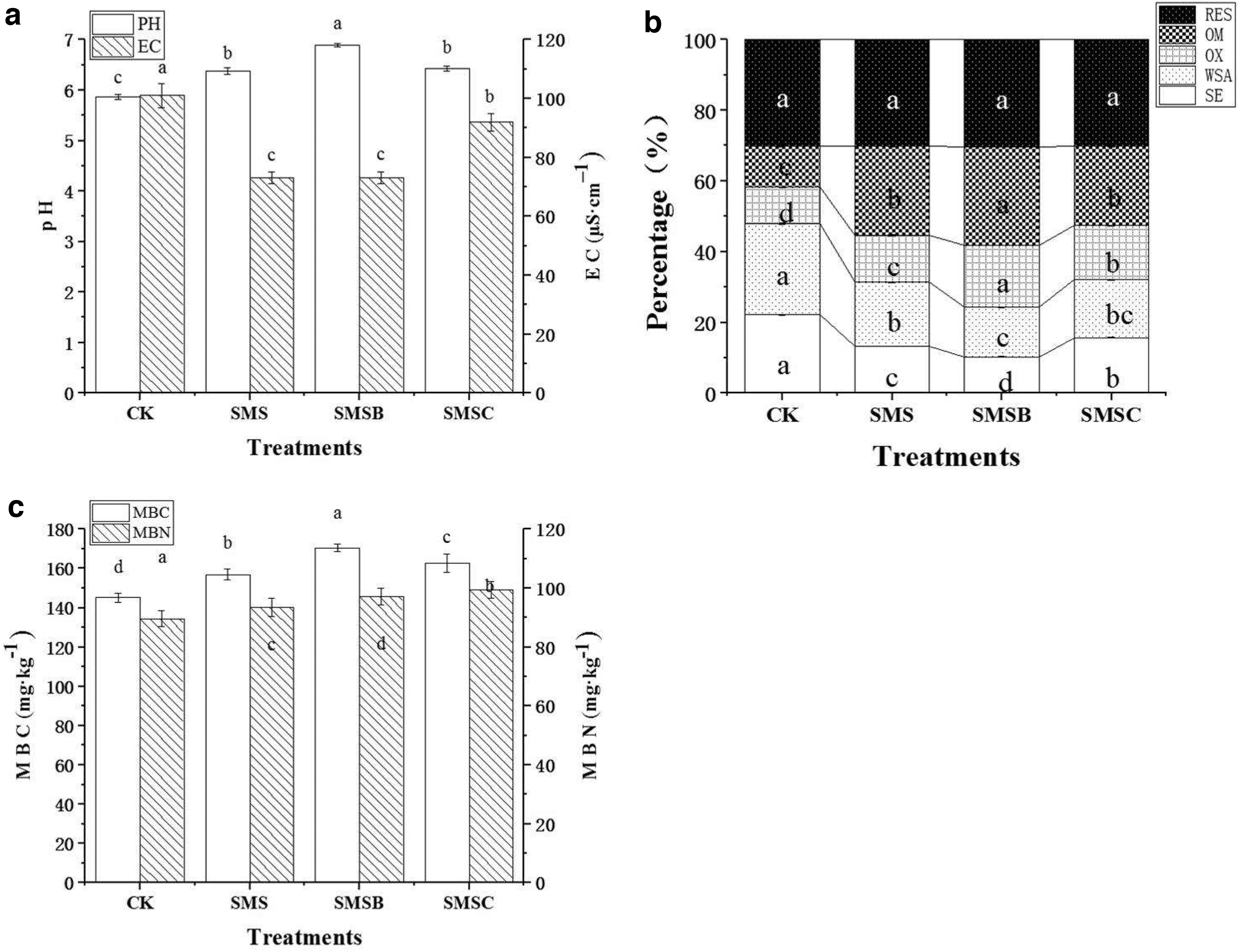
Changes in soil pH and EC changes
Changes of Cd fraction and proportion with application of organic amendments
The distribution of various Cd fractions in the soil was clearly altered by the addition of three amendments (Fig. 1b). The percentage of SE-Cd and WSA-Cd in CK was 22.18% and 25.73%, respectively. Compared with CK, the proportion of SE-Cd and WSA-Cd was declined to 10.29% and 13.96% with SMSB addition, respectively. Similarly, the application of SMS and SMSC also significantly reduced SE-Cd to 13.26% and 15.73% and WSA-Cd to 18.12% and 16.31%, respectively, as compared with CK. Meanwhile, the application of SMSB significantly (p < 0.05) increased the proportion of OX-Cd and OM-Cd by 70.13% and 141.03%, respectively, which was 41.32% and 24.48% higher than SMS, 21.63% and 46.89% higher than SMSC. RES-Cd ratio in all treatments was around 30%, whereas SE-Cd content showed a gradient variation in SMSB (10.29%), SMS (13.26%), and SMSC (15.73%) treatments.
Effect of organic amendments on soil enzyme activities and soil microbial biomass
As shown in Table 4, SMS, SMSB, and SMSC treatments enhanced soil urease activity. Compared with CK, urease activity was significantly increased by 77.78% in SMSB, 37.50% in SMS, and 33.33% in SMSC treatment (p < 0.05). Similarly, catalase activity was significantly increased in SMS, SMSB, and SMSC treatments (from 0.34 to 0.64, 0.52, and 0.68 mL KMnO4/g dried soil 20 min−1) as compared with CK, respectively. For sucrase activity, it was markedly increased from 7.38 to 9.98, 8.96, and 10.45 mg·glucose 24 h−1g−1 dry soil by the addition of SMS, SMSB, and SMSC, respectively. The levels of MBC and MBN in soil are given in Fig. 1c. The MBC of untreated soil was 145.20 mg/kg, whereas that of SMS, SMSB, and SMSC treatments was significantly promoted by 8.06%, 17.49%, and 12.12%, respectively. The effect of three organic amendments on MBN presented a similar trend as that of MBC.
Effect of Different Treatments on Soil Enzyme Activities
Treatments: control (CK), SMS, SMSB, and SMSC.
Error represents the standard deviation, and different letters indicate a significant difference at p < 0.05 level.
Effect of organic amendments on plant growth and chlorophyll content
In our study, the addition of three organic amendments showed a positive effect on the growth of rape seedlings (Fig. 2a). The fresh weights of rape seedlings in three amendments' groups were significantly higher than those in CK by 28.22%, 46.77%, and 60.48% in SMS, SMSB, and SMSC, respectively. In addition, the dry weight showed a positive response to the addition of organic amendments: SMSC had the best promotion on fresh and dry weight by 60.48% and 228.57%, respectively, compared with CK. Similarly, SMS, SMSB, and SMSC increased both stem length and root length compared with the control, among which SMSB improved root length most (around 5.72 cm relative to the untreated plants), whereas SMSC had the greatest impact on the stem length (Fig. 2b). The chlorophyll content of rape seedlings was illustrated in Fig. 2c, which indicated that the chlorophyll content was only positively affected by SMS and SMSC addition. In detail, SMS and SMSC led to an increase in the chlorophyll content from 0.67 to 0.73 and 0.85 mg·g−1·FW, respectively.
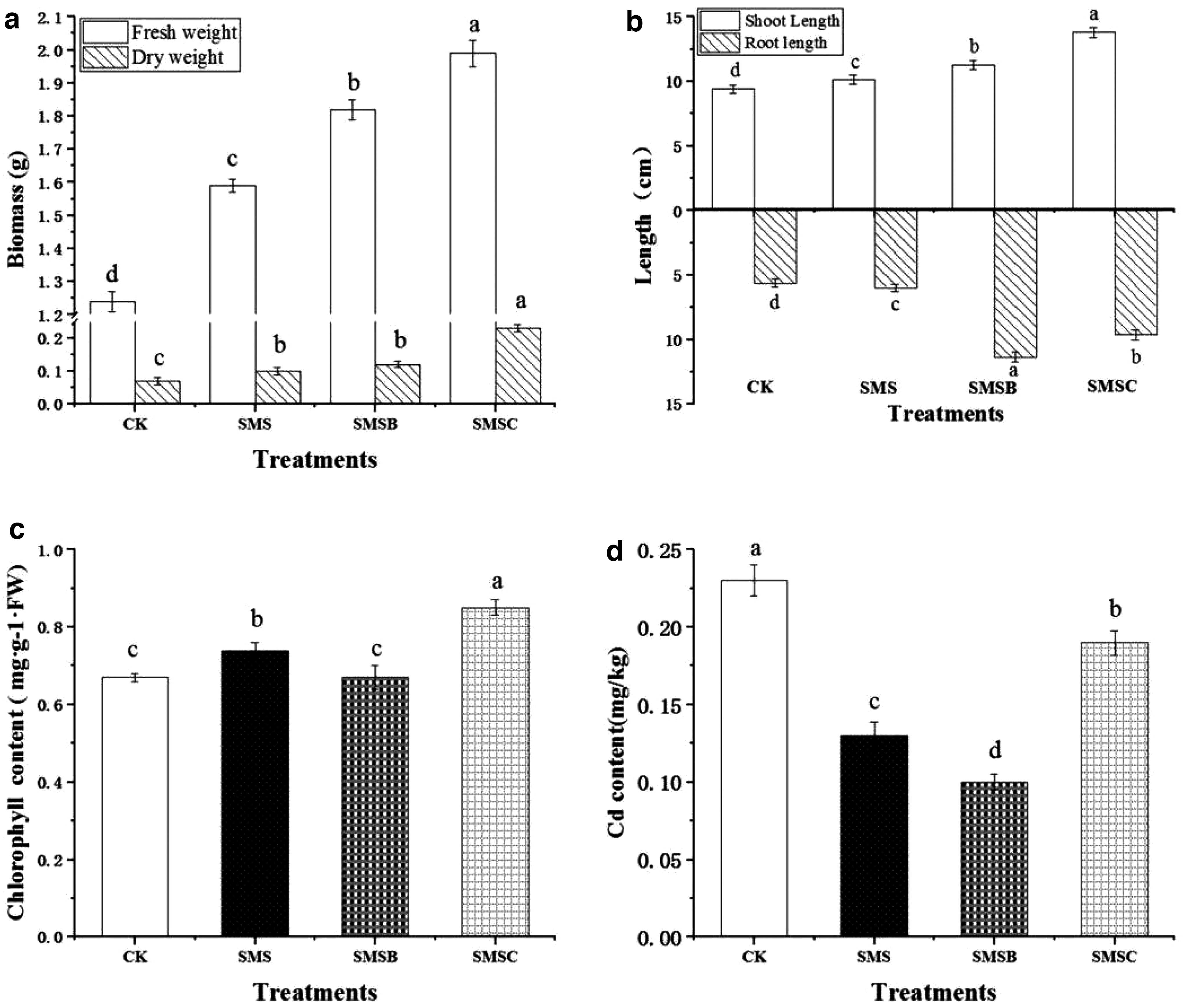
Effect of different amendments on fresh weight and dry weight
Effect of organic amendments on Cd content in rape seedlings
The Cd content in edible parts of rape seedlings in all treatments is listed in Fig. 2d. In CK, the Cd content in edible parts was 0.23 mg/kg, exceeding the maximum limit (0.2 mg/kg) of the National Food Quality Standard of the People's Republic of China (GB2762-2012). However, the Cd content was significantly reduced below the maximum limit value by SMS (0.13 mg/kg), SMSB (0.09 mg/kg), and SMSC (0.19 mg/kg), which was consistent with the results of the Cd fraction (Fig. 1c). In brief, the application of three organic amendments helped to achieve the safety production of rape grown in Cd-contaminated soil.
Effects of organic amendments on POD activity, proline, soluble protein, and soluble sugar content
As illustrated in Fig. 3a, POD activity of rape seedlings in CK was 128.52 U·g−1·FW, whereas it was increased by 74.26% with the addition of SMS, 51.13% with SMSB, and 49.58% with SMSC addition as compared with CK. Proline content showed a similar variation as POD activity corresponding to amendments' addition (Fig. 3b); SMS, SMSB, and SMSC increased proline content by 5.92%, 10.56%, and 12.67% compared with CK (33.63 mg·g−1·FW) (p < 0.05). Considerable increases of soluble protein and sugar in leaves were also observed in the presence of three amendments (Fig. 3c). The soluble protein content of plants in CK was 6.91 mg·g−1·FW, whereas that in SMSB and SMSC was to 9.97 and 8.26 mg·g−1·FW (p < 0.05), respectively. However, there was no significant difference observed between CK and SMS treatment. The application of three amendments had a positive effect on the soluble sugar as compared with control. The soluble sugar in rape seedling leaves increased most by SMSB (18.92%), followed by SMS (9.46%) and SMSC (13.51%), respectively, as compared with control.
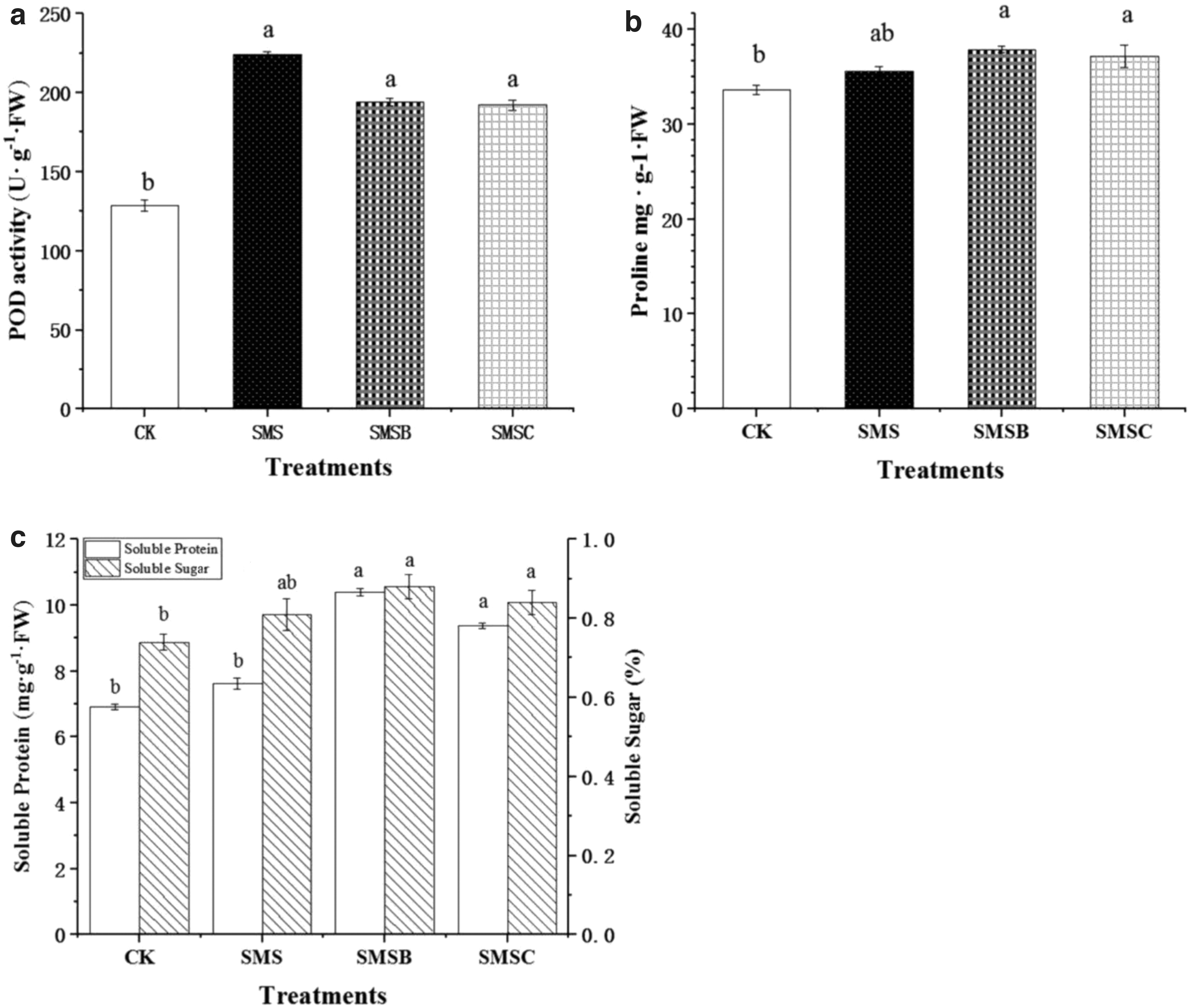
Effects of different amendments on POD activity
Discussion
Effect of organic amendments on Cd immobilization in soil and Cd uptake by plants
The application of organic amendments has emerged as an efficient method for heavy metal polluted soil in in situ remediation (Zeng et al., 2015; Jones et al., 2016; Saengwilai et al., 2019). Most organic amendments can mitigate soil heavy metals' bioavailability by increasing soil pH (Zhu et al., 2017). As adsorbents, SMS, SMSB, and SMSC could be reused at least thrice. And as soil amendments, they could be used once for 3 months (Wei et al., 2020). In the current study, all organic amendments exhibited a high capacity in elevating soil pH and SMSB performed best (1.02 U higher than CK), which is even higher than that reported by other researchers (Li et al., 2018). SMS contains high amounts of organic substances. Biochar originating from it has a large surface area and numerous microporous structures due to the decomposition of these components, which provide more active sites for metal adsorption (Wu et al., 2019). The ability of SMS in pH elevation is lower than that of SMSC and SMSB due to its lower pH and lower organic matter content (Table 2). He et al. (2019) found that soil pH was negatively correlated with SE-Cd (p < 0.05) in the greenhouse experiment. In our study, the efficiency of amendments in reducing the available Cd (SE-Cd) is similar to that in pH. As an alkaline material, SMSB can reduce Cd availability via precipitating Cd2+ as Cd(OH)2 or CdCO3. In addition, biochar has a large surface area, a microporous structure, active organic functional groups, and high mineral ash contents during pyrolysis, which is useful for the adsorption and precipitation of Cd (Lu et al., 2017; Zhu et al., 2017). Although SMS just increased pH for 0.52 U, it dramatically decreased SE-Cd ratio in the soil by increasing the proportion of OM-Cd in soils. Wang et al. (2014) observed that the Cd in the control soil existed in a more mobile form than that in the SMS-treated soils and Cd concentration in soybean plants was decreased after SMS amendment addition. Some studies have shown that the release of phosphates, carbonates, and other salts from organic matter may interact with metals, forming insoluble metal compounds and limiting metal solubility, which, ultimately, increase the proportion of inorganic Cd precipitates (Walker et al., 2003; Liu et al., 2009). For SMSC, it decreased the SE-Cd and WSA-Cd ratio by transferring them to the less available fraction (OX-Cd and OM-Cd) due to its high proportion of carboxyl, carbonyl, and phenols of humic substances (Caporale et al., 2013; Huang et al., 2016). Moreover, compost contains high content of P, which probably forms precipitation as metal phosphates (Liu et al., 2009; Huang et al., 2016). In our study, the Cd concentration in edible parts of rape seedlings in SMS, SMSB, and SMSC treatments was significantly lower than that in CK (p < 0.05; Fig. 2a); these changes resulted from three amendments' addition, which can be assigned to both Cd immobilization (as mentioned earlier and seen in Fig. 1b) and “dilution effect” due to the increase of plant biomass. Cd induced the inhibition of photosynthesis and respiration processes in the shoots and the inhibition of root development (Rizwan et al., 2012). Biochar application in Cd-contaminated soils could suppress its inhibitory effect (Sohi et al., 2010), which may be attributed to reduced metal toxicity through immobilization and supply of nutrients. Younis et al. (2016) found that Cd concentrations in the shoot of spinach (Spinacia oleracea) were decreased by about 53%, 36%, and 31% in the 25, 50, and 100 mg Cd treatments with biochar application, respectively, as compared with control. With 5% biochar addition, the Cd was reduced from 7.72 to 3.88 mg/kg in fenugreek and from 5.42 mg/kg in control to 3.45 mg/kg in spinach plants in Cd-treated soil (17 mg/kg Cd) (Younis et al., 2015). Besides, SMS still has high levels of organic matter, N, P, K, and other nutrients after mushroom harvesting, which will be attributed to promoting plant growth (Paula et al., 2017). Ribas et al. (2009) reported that SMS was an excellent supplement for promoting lettuce growth. The addition of SMSC enhanced the biomass yield of L. perenne through the provision of plant nutrients and the heavy metal toxicity reduction, thereby decreasing metal concentrations owing to the dilution effect (Jordan et al., 2008). Gadepalle et al. (2007) reported that compost amendment applied to heavy metal-contaminated soils resulted in improving plant growth and ultimately yielding and reducing heavy metal concentrations in plants.
Effect of organic amendments on soil enzyme activity and microbial biomass
Except the abiotic factors, biological factors, including microbial biomass and soil enzyme activity, also affect the Cd immobilization in soil (Houben et al., 2013; Wu et al., 2013). As compared with the control, SMSB treatments more significantly (p < 0.05) increased MBC and nitrogen than SMS. The benefits of amendments for the microbial biomass are usually associated with the following points: (1) immobilize Cd by decreasing SE-Cd and subsequently inducing microbial growth (Clemente and Bernal, 2006); (2) as a labile C source support microbial growth (Ameloot et al., 2013); and (3) provide a suitable habitat for microbes (Warnock et al., 2007). In the recent study of Pukalchik et al. (2017), higher microbial biomass was found compared with the control in the presence of biochar. Studies also showed that SMSC served as an additional carbon source to stimulate soil microbial activity and modified the physiochemical properties (Jordan et al., 2008). Besides, SMSC has a relatively higher nitrogen content than SMS and SMSB, which might explain that SMSC increased MBN better compared with others.
Heavy metals in soils indirectly affect soil enzyme activities by altering the microbial communities that synthesize enzymes (Jacek and Elsas, 2000). In this study, the significant shifts (Table 3) in soil enzyme activities (catalase, urease, and sucrase activity) were consistent with our hypothesis that three organic amendments could enhance the soil enzyme activities. Several studies found that there are significant correlations between fractions of Cd and soil enzyme activities. In detail, soil enzyme activities were correlated negatively with SE-Cd and WSA-Cd ratio, but positively with OX-Cd, OM-Cd, and RES-Cd ratio (Cui et al., 2013). In addition, soil enzyme activities were influenced by changes in soil pH values (Dick et al., 2000). In our study, SMSB increased soil enzyme activities the most compared with others. There are several possible mechanisms involved in enzyme activity improvement by biochar: (1) Biochar influences enzyme activity by changing the physiochemical properties of the soil (especially pH) and Cd fraction (Zimmerman and Ahn, 2010); (2) some small molecules released by biochar are speculated to act as allosteric regulators or inhibitors of specific enzymes (Bailey et al., 2011); (3) biochar has more minerals such as P, K, and Mg that may contribute to the increase of soil enzyme activities (He et al., 2019). For SMS and SMSC treatments, our results are in harmony with the report of Wei et al. (2020) that soil enzyme activity was increased due to beneficial microbes, stable intra- and extracellular enzymes from SMS and SMSC. SMS can also provide available nutrients, including low-molecular-weight organic acids, available N, P, K for soil microbes, which may significantly improve the soil enzyme activities (Yang et al., 2019; Zhao et al., 2019).
Effect of organic amendments on plant growth and biochemical activities
Organic amendments can help plants to alleviate antioxidative damage and maintain osmotic balance, thereby improving plant growth (Bashir et al., 2018). In this experiment, the total Cd content in the soil is five times higher than the standard level in the agricultural soil of China (0.3 mg/kg), and the Cd content in the edible part of rape seedlings is 1.2–2.5 times higher than those in organic amendments' treatments. All tested organic amendments had a significant effect (p < 0.05) on plant growth. The enhanced plant growth by amendments may be associated with their high nutrients, physiochemical properties (i.e., EC, CEC, pH, organic matter), and biological activity (i.e., soil enzyme activity, soil microbial biomass) (Coumar et al., 2016; Khan et al., 2017). Besides, organic amendments bind with Cd and reduce its availability by transporting less Cd to plants (Park et al., 2011; Coumar et al., 2016). After adding SMC, the plant's chlorophyll content was significantly increased (p < 0.05) (Table 4). It may result from the phyto-nutritive capacity of compost related to macro elements (N and P, in particular) in the soil (Dick and McCoy, 1993; Karami et al., 2011; Alam et al., 2020). POD activity and proline content in SMSC treatment were enhanced. And there was a significant (p < 0.05) increase in soluble sugar and protein content, which may be attributed to higher antioxidant activity and osmotic balance. The results are inconsistent with those of Zhang et al. (2020), as they reported that application of SMC amendment significantly (p < 0.05) increased soluble protein concentration, chlorophyll of leaves and improved the growth of P. fortunei seedlings exposed to manganese (Mn). SMSB significantly (p < 0.05) increased POD activity and proline content, soluble sugar and protein content compared with CK. As osmoprotectants and protectants, the proline and soluble sugar support the plants against metal stress (Kanu et al., 2019). The increased soluble protein content could improve the water retention ability of plant cells and protect the cell membrane from Cd toxicity (Younis et al., 2015; Younis et al., 2016). Park et al. (2011) found that incorporation of chicken manure biochar increased dry biomass of Brassica juncea shoot and root by 353% and 572%, respectively, as compared with the control. As for SMS, it can provide high levels of organic matter, N, P, K, and other nutrients and promote plant growth (Medina et al., 2009). In addition, SMS can promote the growth of Ricinus communis by activating the antioxidant defense system (Cheng et al., 2018).
Conclusions
In our study, three organic amendments not only improved soil properties, decreased metal mobility but also enhanced plant growth and physiological activity. They were effective in Cd immobilization by decreasing the SE-Cd and WSA-Cd ratio and increasing the OM-Cd and OX-Cd ratio in soil. Moreover, the amendments alleviated Cd stress and promoted the rape seedlings' growth by regulating the activities of antioxidant enzymes and adjusting the contents of proline and soluble sugar, etc. In conclusion, SMS is a valuable waste material that can be potentially used in the production of organic amendments. All three amendments originating from SMS can efficiently mitigate the impact of Cd contamination and achieve the safe production of rape, especially SMSB.
Footnotes
Author Disclosure Statement
No competing financial interests exist.
Funding Information
The authors are grateful for the support rendered by the National Key Research and Development Program of China (Grant number: 2017YFD0801104).