




Abstract
Phytoremediation with augmentation of oxalic acid could improve the removal efficiencies of toxic metals in saline soil. Metal concentrations and species in saline soil, extraction of metals by Suaeda salsa, and physiology of plant were all affected by the additive concentration of oxalic acid. The addition of oxalic acid increased the availability of heavy metals in soil and promoted the metal migration from soil to plant. Low dose of oxalic acid (0.5%) application promoted plant root length and biomass, and improved the translocation of cadmium and lead from roots to shoots, which increased from 13.8 to 14.3 cm, from 102.5 to 103.1 g/pot, from 10.74 to 12.82 for cadmium, and from 0.71 to 0.95 for lead, respectively. Whereas the higher addition (1.5%) of oxalic acid induced higher plant toxicity and increased the accumulation of heavy metal in root of S. salsa significantly (p < 0.05). The highest values of translocation factor were achieved under relative low dose (0.5% or 1.0%) of oxalic acid addition, which were 0.39, 12.82, and 0.95, respectively. While the highest values of bioconcentration factors for shoot and root (BCFshoot and BCFroot) occurred at 1.0% and 1.5% oxalic acid addition, respectively. S. salsa could be more suitable for phytostabilization for combined toxic metal pollution under the addition of high dose of oxalic acid.
Introduction
Heavy metal contamination and soil salinization-combined pollution is one of the major global environmental problems owing to the climate change, rapid development of industrial activities, and agricultural practices, which lead to hazardous health effects through food chain (Noriega et al., 2012; Singh, 2015). Phytoremediation presents tremendous potential in removing pollutants from environment and has been an alternative technique to traditional physical or chemical remediation technology because of it being low cost, less destructive, and environmental friendly (Liu et al., 2013; Sinegani et al., 2015).
However, most hyperaccumulators of toxic metals are glycophytes, which could not survive in saline soil (Wang et al., 2013; Liang et al., 2017). Therefore, halophytes, with higher tolerance to both salt and toxic metals, are potential plants for phytoremediation of heavy metal-contaminated saline soil (Taamalli et al., 2014). Suaeda salsa is a common annual succulent herbaceous halophyte, which has good saline-alkali resistance and heavy metal tolerance (Jin et al., 2016; Zhang et al., 2018a). It is reported that S. salsa was an ideal alternative halophyte for heavy metal (cadmium, lead, etc.)-contaminated saline soil, which could survive and reproduce in high salt environment with 15–20 g/kg salt content (Wu et al., 2013; Li et al., 2019).
To improve the removal efficiency of heavy metals from saline soil, chelant-induced phytoremediation was applied in the actual soil remediation, which could promote the migration of toxic metals owing to the complexation reactions between chelating agents and toxic metals in soil (Mai et al., 2019). The main chelating agents for enhanced phytoremediation include aminopolycarboxylic acid, such as ethylene diamine tetraacetic acid (EDTA), ethylenediamine disuccinic acid and nitrilotriacetic acid, and low-molecular-weight organic acids (such as oxalic acid, citric acid, and malic acid) (Song et al., 2016). EDTA was recognized as the most effective synthetic chelating agent and widely used to enhance phytoremediation, because it can enhance the metal mobilization in soil obviously (Zhang et al., 2010).
However, its low biodegradability and ineffectiveness to anionic metals limited the application in actual remediation (Wei et al., 2016). Low-molecular-weight organic acids are important components of plant root exudates, which could change the pH and content of organic matter of soil, increase the adsorption of heavy metals by acidification, precipitation, complexation, and redox reaction (Chai et al., 2013; Li et al., 2014; Babaeian et al., 2016). Meanwhile, the relatively stable heavy metals in the soil (such as exchangeable and organic binding states) would be activated by organic acids into heavy metal complexes with relatively strong migration, which would promote the accumulation of heavy metals in the soil by plants (Yan et al., 2017). Therefore, phytoremediation with the enhancement of low-molecular-weight organic acids has attracted widespread attention in recent years.
Previously, a number of studies have addressed removal efficiencies of toxic metals by enhanced phytoremediation with different agents (Zaier et al., 2014). A study showed that the addition of malic acid and oxalic acid could decrease the concentration of dissolved species of cadmium and zinc in soil, and promoted the accumulation of heavy metals by Brassica juncea (Arwidsson and Allard, 2010). Wang et al. (2012) found that oxalic acid (70 mg/L) could mitigate the decrease of biomass and length of the accumulating plant Leersia hexandra Swartz and enhance its chromium tolerance. Sedum aizoon and Suaeda heteroptera have extremely strong tolerance and accumulation to lead and cadmium enhanced by EDTA, and the highest removal efficiency of lead and cadmium were 38% and 42%, respectively (Chen et al., 2017).
It was reported that the accumulation and tolerance of toxic metals in halophytes (such as S. salsa and Spartina alterniflor) are related to their physiological mechanisms and there has been a significant difference in the accumulation of heavy metals in roots and shoots with the changes of metal concentrations, plant growing season, and seasonal change (Yang et al., 2015). The moderate salinity could also promote the growth of halophytes and the translocation of toxic metals from roots to shoots (Liang et al., 2017).
Generally, enhanced phytoremediation mainly focuses on the accumulation of toxic metals by glycophyte, few researches on accumulation of metals by halophytes with low-molecular-weight organic acids, especially the effect on the changes of soil toxic metal species, and physiology of plants under the combined influence of organic acid and halophytes. Therefore, the primary objectives of this article were: (1) to investigate the metal concentrations and species changes of arsenic, cadmium, and lead in saline soil by halophyte, S. salsa, with the enhancement of different doses of oxalic acid; (2) to study the extraction of metals by roots, stems, and leaves of S. salsa, and the effects on the translocation of S. salsa for metals under the addition of oxalic acid in saline soil; (3) to research the effects of oxalic acid addition on the physiology of S. salsa.
Experimental Section
Soil sampling and characterization
The study site is located in an abandoned metal smelting site in the eastern part of Binzhou City, Shandong province, China. Surface soil samples (0–20 cm) with moderate level of pollution (arsenic 85–143 mg/kg, cadmium 0.68–1.43 mg/kg, and lead 102–134 mg/kg, tested by a handheld XRF spectrometer [FAS 2100; Niton]) were collected. Samples were air dried, ground, and then homogenized and stored until analysis and subsequent experiments. The selected physicochemical characteristics and contamination of the sample are listed in Supplementary Table S1.
The samples were neutral sandy soil with the pH ranging from 7.36 to 8.02. The average values of cation exchange capacity (CEC) and total organic carbon (TOC) were 7.85 cmol/kg and 12.65 g/kg, respectively. The concentrations of the experimental soil were 102.7, 1.18, and 116.0 mg/kg for arsenic, cadmium, and lead, respectively, which were 3.4 and 3.9 times higher than soil environmental quality for arsenic and cadmium, respectively (Ministry of Environmental Protection [MEP], 2018). The moderately contaminated soil was adaptable to phytoremediation from the perspective of remediation.
Phytoremediation experiment
Enhanced phytoremediation experiments (from mid-April to Mid-June in 2019 before flowering, 60 days in all) were conducted to investigate the addition of different concentrations of oxalic acid (0%, 0.5%, 1.0%, and 1.5%) on growth of S. salsa and toxic metals uptake in greenhouse of Ludong University. S. salsa seeds were collected from the Yellow River Delta in December 2018.
The seeds were sterilized by immersion in 0.5% potassium permanganate and rinsed eight times with sterilized water before experiments (Li et al., 2016). Soil samples (3 kg) and 15 S. salsa seeds were put in each polyethylene pot for seed germination. The relative water content of soil samples was kept at 75%. The experiment was performed in a greenhouse at 25°C/18°C day/night temperatures and with a 13 h photoperiod. Four treatments were set up for soil with different concentration of one-time addition of 1 L oxalic acid: 0%, 0.5%, 1.0%, and 1.5% after the seeding longer than 10 cm. Plant and soil samples were harvested separately after 60 days treatment. All experiments were carried out in triplicates.
Soil analysis
Soil samples were air dried, ground, and sieved to remove >1 mm gravel. The soil pH (1:2.5 soil-water, w/w) was measured with a conventional pH meter. The CEC was analyzed by the ammonium acetate method (Lu, 2000). TOC was measured with a TOC analyzer (Elemetar, Germany). The soil salt content was measured by a Dezimalwaage after the drying residue method described by Bao (2000). Experiments were performed in triplicates.
Around 0.1000 g soil was poured into a polytetrafluoroethylene jar and digested with concentrated HNO3+HF+HClO4 (5:2:1, v/v) in an automatic digestion instrument (LabTech Digi Block ST36, Beijing, China). The digested solution was cooled, filtered, and diluted to 25 mL. Total heavy metal concentrations were determined in soil samples by inductively coupled plasma optical emission spectroscopy (ICP-OES; Agilent Tech) after acid digestion (MEP, 2018). A standard reference soil sample (GBW07401 [GSS-1]) was employed in the analysis to ensure accuracy and precision. The analysis was performed in triplicate.
The metal species were fractionated using an established sequential extraction scheme (Supplementary Table S2). A modified BCR procedure (exchangeable and acid soluble [F1], reducible [F2], oxidizable [F3] and residual [F4]) was performed to assess the cadmium and lead distribution of soil samples (Van Herreweghe et al., 2003). Extraction schemes based on phosphorus sequential extraction protocols were performed to assess the arsenic distribution since it resulted in better arsenic fractionation and recovery than the three-step BCR scheme; arsenic was classified into five fractions: exchangeable As (AE-As), Al-bound As (Al-As), Fe and organic bound As (Fe-As), Ca-bound As (Ca-As), and residual As (O-As) (Onken and Adriano, 1997).
Plant analysis
At the end of the 60-day experiment, fresh plants of S. salsa were harvested. The plant samples were gently washed with tap water and then rinsed with deionized water for three times, and the growth parameters, such as root length, were measured using a tape measure for biochemical changes. The cleaned plants were divided into roots, stems, and leaves. The roots, stems, and leaves were dried for constant weight at 80°C for 48 h and weighed (Gross et al., 1991).
Chlorophyll content of seeding (60 days) was conducted by the methods of spectrophotometric method (Wang et al., 2018). Fresh leaves were plucked from plants and covered with aluminum foil immediately and kept in polystyrene box with ice. Samples were extracted with 95% ethanol in water bath at 80°C and then the absorbance of the extract was measured at 662 and 649 nm using an UV/VIS spectrophotometer (T6; PERSEE, Beijing, China). The chlorophyll a and chlorophyll b contents were calculated as follows:
where, A is absorbance.
Plant malondialdehyde (MDA) content was determined using the method of Heath and Packer (1968). MDA reacted with thiobarbituric acid and its concentration was estimated by subtracting the nonspecific absorption at 600 nm from the absorption at 532 nm, using an absorbance coefficient of extinction 156.
Plant samples were dried in an oven at 70°C before being weighted and then were ground and digested. Around 0.2000 g plant was poured into a polytetrafluoroethylene jar and digested for 4 h with concentrated HNO3 (MOS reagent, 2 mL) at room temperature, then set into stainless steel sleeve and heated in the oven for 4 h at 165°C. The digested solution was cooled, filtered, and diluted to 10 mL. Total heavy metal concentrations were determined in plant samples by ICP-OES (Agilent Tech). The recovery rates for most metals in the standard plant samples (GBW07602 [GSV-1]) were 78–113%. Experiments were performed in duplicate.
Translocation factor
To evaluate the capability of the S. salsa plant to absorb and translocate toxic metals from the roots to the shoots, the following parameters were considered.
The translocation factor (TF) of plant for a certain metal was calculated as the ratio of metal concentration in shoots to that in roots (Anamika et al., 2009), which are expressed as follows:
Bioconcentration factor
The bioconcentration factors for the roots (BCFroot) and shoots (BCFshoot) were calculated as the ratio of metal content in root or shoot to that in soil (Sasmaz and Sasmaz, 2009), which are expressed as follows:
Statistical analysis
The experimental data were analyzed using a one-way ANOVA (SPSS 16.0). Duncan's multiple range test was used to determine the statistical significance (p < 0.05).
Results and Discussion
Metal concentrations and species changed by the addition of oxalic acid in soil
The concentrations of arsenic, cadmium, and lead in soil under different additions of oxalic acid after enhanced phytoremediation experiment are shown in Fig. 1A. The addition of oxalic acid had some influence on arsenic and lead concentrations in soil, especially at 1.0% addition, whereas minor effect for cadmium concentration. The addition of low-dose of oxalic acid (0% and 0.5%) had little effect on the concentrations of heavy metals in soil, although 0.5% dose addition of oxalic acid resulted in a small increase in the average concentrations of arsenic (increased by 2.7 mg/kg), lead (increased by 4.5 mg/kg), and even cadmium (increased by 0.04 mg/kg). The small increase in metal concentrations might be the error owing to the unhomogenized soil samples.
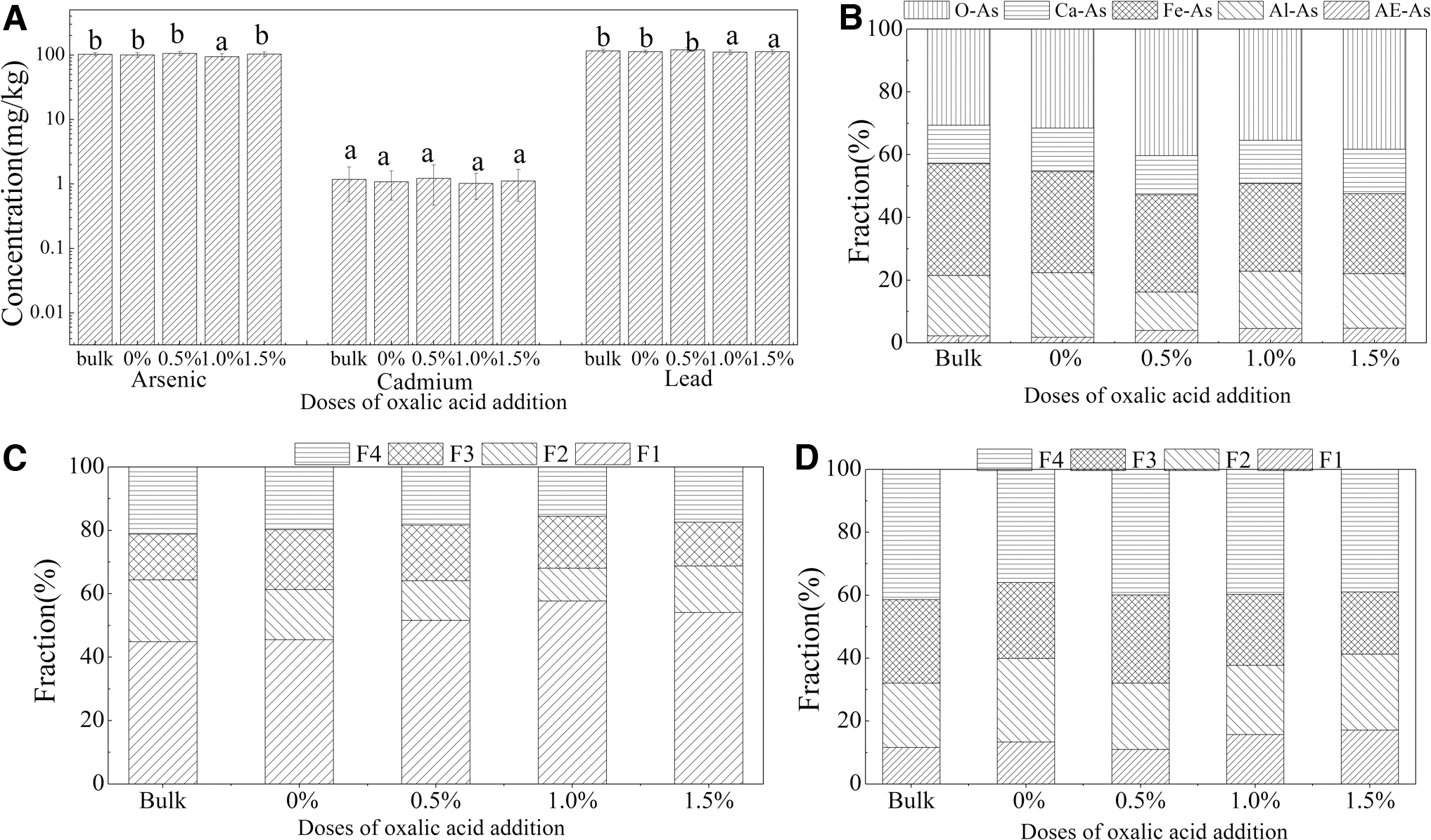
Effects of the addition of oxalic acid on metal concentrations and fractions in soil.
Higher addition of oxalic acid (1.5%) failed to contribute to significant enhancement of the target metal removal by enhanced phytoremediation (p < 0.05), which inhibited the plants' growth and affected the effect of phytoremediation probably (Babaeian et al., 2016). The uptake of metals by halophyte plants depends upon the metal mobility and availability in soil, which is determined by the soil physicochemical properties, such as pH, salinity, redox potential, etc. (Reboreda and Cacador, 2007).
The bioavailability and ecotoxicity of toxic metals depended on their speciation rather than their total concentration (Mulligan et al., 2001; Wei et al., 2016). Metal fractions in soil affected by enhanced phytoremediation are further investigated.
As shown in Fig. 1B, arsenic mainly occurred in O-As (30.6%), Fe-As (35.6%), and Al-As (19.3%), whereas a minimal amount of arsenic occurred in AE-As (2.2%), which indicated that the mobility of arsenic was limited. It showed that S. salsa had little effect on the speciation of arsenic without the addition of oxalic acid. AE-As was of minimal content in bulk soil, but the ratio of AE-As had a smaller increase (<5%) under the enhanced phytoremediation, which indicated that the addition of oxalic acid increased arsenic mobility in the soil (Wei et al., 2016).
There were minimal changes in ratio of Ca-As fractions under different experimental conditions, whereas the addition of oxalic acid reduced the ratio of Fe-As (minimum 25.5% under 1.5% oxalic acid addition) and Al-As fractions (minimum 12.3% under 0.5% oxalic acid addition) obviously. As a mild reducing agent and a strong chelating agent, oxalic acid can form strong complexes with ions (especially iron) released from the oxides in the soil, and then enhance the potential mobility of arsenic (Kim et al., 2016; Wei et al., 2016).
Unlike arsenic, cadmium was mostly in exchangeable fraction (45.0% approximately), indicating its relatively high mobility and potential bioavailability in soil. Similarly, S. salsa also had little effect on the fractions of cadmium without oxalic acid addition, the ratio of F1 fraction of cadmium increased markedly under the enhanced phytoremediation because of the increased mobility of cadmium by oxalic acid primarily (Wang et al., 2018; Bai et al., 2020). The highest ratio of F1 fraction with the value of 54.1% achieved by enhanced phytoremediation under 1.0% oxalic acid addition, the higher additive amount of organic acid (>1.0%) failed to increase the mobility of cadmium, which was related to the extraction ability of S. salsa under different additive concentrations (detailed in Fig. 2).
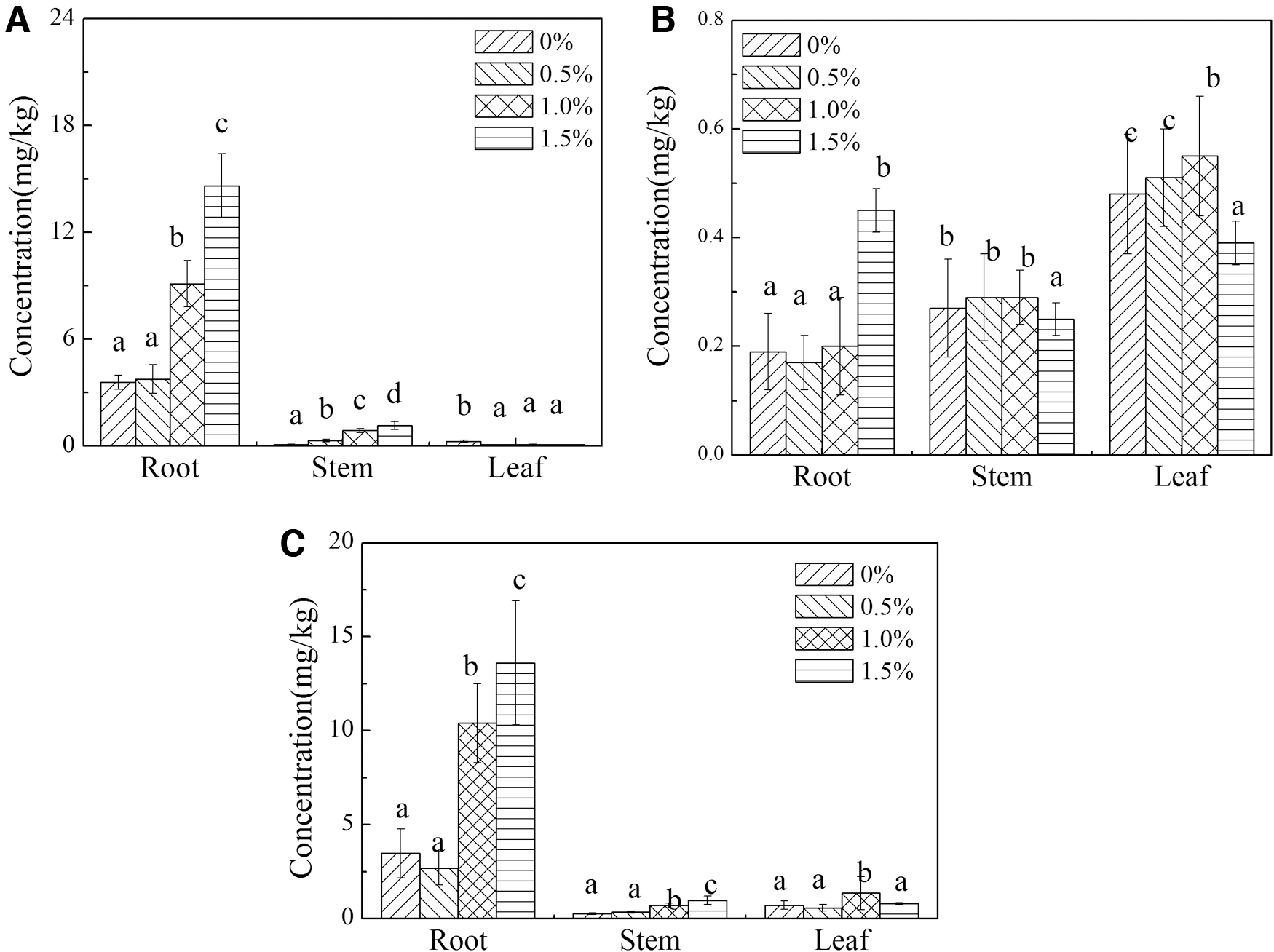
Concentrations of arsenic, cadmium, and lead in roots, stems, and leaves under the addition of different doses of oxalic acid in soil.
The fractions of lead were balanced compared with arsenic and cadmium. The oxalic acid addition had a slight effect on the lead fraction distribution, but the ratio of F3 fraction of lead decreased markedly (from 26.6% to 20.0%) at 1.5% addition of oxalic acid under the enhanced phytoremediation. The enhanced mobilization of lead in the soil/plant can be attributed to the formation of soluble lead-chloro (Pb-Cl) and other complexes (Lopez-Chuken et al., 2010; Wang et al., 2012).
Extraction of metals by roots, stems, and leaves of S. salsa under oxalic acid application
Concentrations of metals in different parts of S. salsa under different amounts of oxalic acid after the enhanced phytoremediation are shown in Fig. 2. It indicated that arsenic and lead were mainly accumulated in the roots and small quantities translocated to the stems and leaves in S. salsa, cadmium was the metal most concentrated in all plant tissues. The addition of the acid increases the accumulation of all target toxic metals in roots significantly, especially at 1.5% addition of oxalic acid (p < 0.05). The absorption of heavy metals is passive absorption mostly, so the accumulation of arsenic, cadmium, and lead is stuck in the roots of plants predominantly (Chen et al., 2017).
As the additive amount of oxalic acid increased, concentrations of toxic metals varied in roots, stems, and leaves of S. salsa. Arsenic concentration in belowground tissues was one or two orders of magnitude higher than that in stems and leaves under oxalic acid application. The concentration of arsenic in roots increased significantly (p < 0.05) under 1.0% and 1.5% additive oxalic acid. It achieved the highest concentration of 14.6 mg/kg under 1.5% oxalic acid added in roots, which was three times higher than that without the addition of oxalic acid.
Although the high content of oxalic acid could induce high concentration of arsenic in stems of S. salsa, the variation in the absorption of metals by stems is not significant (p > 0.05). Minute quantity of arsenic (0.25 mg/kg) accumulated in leaves of S. salsa, the oxalic acid addition further restrained the arsenic accumulation in leaves. It is probably because of the resistance reaction of nonessential element in halophyte (Mnasri et al., 2015). Meanwhile, the stable metal/chelate complex formed by heavy metals and oxalic acid limited the transformation of heavy metals from the roots to shoots (Yuan et al., 2011).
As shown in Fig. 2, low-dose oxalic acid addition (0.5%) had no effect on the accumulation of cadmium in roots of S. salsa. The concentration of cadmium in root was pretty high by enhanced phytoremediation under 1.5% addition of oxalic acid. Suaeda plants could decontaminate Cd2+ in saline soils, owing to its ability in accumulating large amounts of Cd2+ in its tissues, especially in the roots (Bankaji et al., 2015; Li et al., 2019). The cumulative tendency of cadmium in stems and leaves was similar, the concentration increased with increases in the addition of oxalic acid to the levels in the range of 0–1.0%, but decreased slightly in the stems and apparently in the leaves under the 1.5% addition of oxalic acid.
The variation trend of lead concentration in roots was similar as that of in the stems of S. salsa under different additions of oxalic acid, the lead accumulation in roots and stems increased significantly at 1.0% and 1.5% oxalic acid addition. Compared with cadmium, arsenic and lead were preferentially accumulated in belowground tissues of S. salsa, which could stabilize these metals in saline soil.
Effects of addition of oxalic acid in soil on the translocation of S. salsa for metals
Factors of TF, BCFshoot, and BCFroot were calculated to evaluate the ability of S. salsa to accumulate metal in the tissues from soil.
The value of TF >1 means S. salsa was able to extract amounts of toxic metals from root to shoots, and vice versa. As shown in Table 1, the TF of S. salsa for arsenic, cadmium, and lead increased under relative addition of low-dose oxalic acid (0.5%), and decreased under addition of high-dose oxalic acid (1.5%). The TF values of arsenic and lead were all <1 and of cadmium were all >1 under different enhanced phytoremediation experiment conditions, which indicated that S. salsa had good translocation ability to cadmium (Bankaji et al., 2015). The highest TF of cadmium was obtained under the addition of 0.5% oxalic acid, whereas the TF decreased to 4.0 from 10.7 under the addition of 1.5% oxalic acid. The mobility of cadmium increased at the addition of high-dose oxalic acid (1.5%), which promoted the absorption of cadmium in roots but not in shoots owing to no specific translocator and transport channel for nonessential element in S. salsa (Chen et al., 2017).
The Translocation Factor and Bioconcentration Factors for Shoot and Root (BCF shoot and BCF root ) of Suaeda salsa for Arsenic, Cadmium, and Lead Under Different Doses of Oxalic Acid Enhanced Phytoremediation
Mean values (n = 3) followed by the same letters do not differ significantly at p < 0.05 according to one-way ANOVA for dependent samples.
BCFshoot, bioconcentration factors for shoot; BCFroot, bioconcentration factors for root; TF, translocation factor.
The averages of BCFs (shoot and root) were in the following decreasing order mostly under different doses of oxalic acid: cadmium>arsenic>lead. Although all the TF values for cadmium were >1, cadmium concentration in roots was similar to that in shoots, so S. salsa could be more suitable for phytostabilization other than phytoextraction for combined heavy metal pollution (Li et al., 2019).
The BCF values of arsenic and lead for roots were higher than those for shoots, the ratio of BCFroot to BCFshoot varied between 5.7–13.3 for arsenic, and between 4.0–17.1 for lead, respectively, whereas the values of cadmium for shoots were 1.7–4.6 times higher than those for roots under different experimental conditions. By contrast, cadmium is more toxic, which inhibited the absorption of lead and arsenic by roots (Niu et al., 2017). It was easy for cadmium to be complexed with Cl− in saline soil polluted by heavy metals, which increased its bioavailability, whereas lead and arsenic tended to form insoluble substances with CO32−, PO43−, SO42−, and C2H42− (under the addition of oxalic acid), and the lower mobility restrained the migration of lead and arsenic from soil to plant (Chen et al., 2017).
The BCFroot values of three toxic metals increased with the increasing doses of oxalic acid application, which increased between 2.38–4.75 times compared with the control group at 1.5% oxalic acid addition. It indicated that the addition of organic acids promoted the accumulation of metals in roots (Bai et al., 2020). The changes of BCFshoot varied under different dose additions of oxalic acid due to the difference of toxic metal transport capacity (Li et al., 2016).
Although the values of BCFs were dissatisfactory for the 60-day enhanced phytoremediation experiment, the changes of TF and BCFs illustrated the pollution remediation potential for S. salsa.
Effects of the addition of oxalic acid on the physiology of S. salsa
The soil pH was not affected by low-dose oxalic acid treatment (0.5% and 1.0%) compared with controls, it decreased obviously under relative high-dose oxalic acid treatment (1.5%) (Table 2). A decrease in soil pH could accelerate the migration of heavy metals and reduce soil microorganism activity, which could increase risks of leakage and affect plant growth (Mai et al., 2019).
Effect of the addition of oxalic acid on soil pH and selected physiological index of plant
Mean values ± standard deviation (n = 3) followed by the same letters do not differ significantly at p < 0.05 according to one-way ANOVA for dependent samples.
MDA, malondialdehyde.
As shown in the Table 2, the highest values of root length and biomass were 14.3 cm, 103.1 g/pot under 0.5% oxalic acid-enhanced phytoremediation experiment, respectively. Obvious reduction of the root length and biomass were found under 1.5% oxalic acid-enhanced phytoremediation, which was consistent with the results of the translocation of S. salsa for metals. It indicted that the low-dose oxalic acid had a stimulatory effect on S. salsa growth and alleviated the toxic metal stress-induced phytotoxicity, and high-dose oxalic acid-induced toxic effect (Li et al., 2016; Bai et al., 2020). The low-dose oxalic acid induced the changes of metal speciation and soil properties, and promoted the growth of plant owing to the phenomenon of hormesis (Sharma et al., 2010).
Under the addition of high-dose oxalic acid, the increased accumulation of toxic metals in roots and shoots could slow down the S. salsa growth by inhibiting photosynthesis and transpiration, even reduce plant biomass by interfering with the absorption and redistribution of plant nutrients (Chen et al., 2017). The biomass is an important index of phytoremediation ability (Zhang et al., 2018b), the relative large biomass indicated that S. salsa had a certain degree of tolerance in toxic metals, and it has strong application potential and values for the remediation of toxic metal contaminated soil.
Apparently, S. salsa showed no symptoms of chlorosis by enhanced phytoremediation experiment. It showed a slight increase in chlorophyll under the addition of low-dose oxalic acid, as in Table 2. Similar to the changes of root length and biomass, the chlorophyll contents decreased under the addition of relatively high-dose oxalic acid. A decrease in chlorophyll is one of the common symptoms of heavy metal toxicity in plants (Sharma et al., 2010). It has been reported that Cd2+ treatment affects the light-harvesting chlorophyll-a/b (LHC)-containing pigment/protein complex formation negatively by the inhibition of LHC protein synthesis (Horvath et al., 1996). The chlorophyll reduction under enhanced phytoremediation treatment was induced by the increase of cadmium concentration in leaves owing to the interference of different chlorophyll biosynthesis stages probably (Sharma et al., 2010).
Instead, MDA values increased with the increasing doses of oxalic acid application, and the highest levels in MDA was found in the 1.5% oxalic acid treatment. Normally, the content of MDA in plants indicates the extent of the damage of plant cell membrane; the higher the content of MDA, the greater the toxicity to the plant (Wang et al., 2018). So, the low dose of oxalic acid (0.5%) promoted the growth of S. salsa and the accumulation of toxic metals, but the higher dose of oxalic acid (both for 1.0% and 1.5%, especially for the 1.5% oxalic acid addition) inhibited plant growth and limited the transportation of toxic metals from soil to plant, which was consistent with the results of toxic metal concentrations of shoots and roots.
Conclusions
Phytoremediation by S. salsa with the enhancement of oxalic acid has great potential in remediating saline soil contaminated by coexisting toxic metals (cadmium, lead, and arsenic).
The results demonstrate that target toxic metals accumulated in the roots of S. salsa preferentially (especially for arsenic and cadmium), and their concentrations in roots increased significantly (p < 0.05) with the application of the increasing doses of oxalic acid, whereas a minor change in the accumulation of toxic metals in shoots. The addition of relatively low doses of oxalic acid (0.5–1.0%) promoted the growth of S. salsa and improved the translocation in plants because of the stimulatory effect. High dose of oxalic acid (1.5%) increased the mobility of toxic metal in soil, began to accelerate the toxic effect on plants, and restrain the migration of toxic metals from roots to shoots, however, the highest absorption of toxic metals occurred by the addition of 1.5% of oxalic acid.
Consequently, the mechanisms of migration of coexisting toxic metals from saline soil to halophyte by enhanced phytoremediation are still not clear. The effect of enhanced phytoremediation by organic acid on physicochemical properties of saline soil and physiology of S. salsa needs further study. In addition, in view of the dissatisfactory results of TF and BCFs for a 60-day enhanced phytoremediation experiment, the long-term remediation experiment and other organic acid additive should be studied in the future.
Footnotes
Author Disclosure Statement
No competing financial interests exist.
Funding Information
This research was funded by Open Research Fund Program of Shandong Provincial Key Laboratory of Eco-Environmental Science for Yellow River Delta (Binzhou University), the National Natural Science Foundation of China (41977039), Young Taishan Scholars (tsqn201812097), and Yantai Key Research and Development Plan (2019XDHZ103).

References
Supplementary Material
Please find the following supplemental material available below.
For Open Access articles published under a Creative Commons License, all supplemental material carries the same license as the article it is associated with.
For non-Open Access articles published, all supplemental material carries a non-exclusive license, and permission requests for re-use of supplemental material or any part of supplemental material shall be sent directly to the copyright owner as specified in the copyright notice associated with the article.
