




Abstract
Oxygation (O) is a water-saving and energy-saving irrigation method that can also influence the absorption of cadmium (Cd) by rice, but the related mechanism is still unclear. In this study, the relationship between O method and Fe–Mn plaque formation was tested through pot experiments. The Fe–Mn plaque content and Cd concentration were measured during different rice growth periods, and the fitted models based on their correlation were established. The results show that, Fe–Mn plaque formation was the most significant factor affecting Cd accumulation in rice under O conditions. The content of rice root Fe–Mn plaque was higher after the application of O during the filling and maturity stages of rice growth, and Fe–Mn plaque inhibited Cd accumulation in the rice roots and grains and reduced the translocation factors (TFs) from the rice dithionite-citrate-bicarbonate extract (DCB) to the roots (TFDCB-R) and from the roots to the straw (TFStraw-G). O may influence the Fe–Mn plaque formation on the root surface to impede Cd absorption by rice. This research provides theoretical support for the Cd absorption under O conditions.
Introduction
Cadmium (Cd) contamination has become a global concern due to the widespread distribution and high toxicity of Cd, which constitutes a serious threat to human and animal health (Bari et al., 2019; Guo et al., 2019; Ye et al., 2020). Many diseases, such as lung cancer, bone diseases, and brain damage, have been reported to be connected with Cd (Pal and Maiti, 2019). In China, rapid industrialization with insufficient environmental protection over the last 30 years has led to severe issues such as cropland and water contamination (Ochoa et al., 2020). Approximately 65% of the available croplands are polluted by Cd (Wang et al., 2020; Xu et al., 2020). An increasing Cd content in the soil caused by rapid industrialization brings about an extreme yield reduction, and high Cd accumulation in rice threatens food safety. Cd translocates from rice roots to straw and finally accumulates in rice grains (Rehman et al., 2020). The Cd concentrations in much of the rice grown in Southeast China have exceeded the Chinese food safety standard (0.2 mg/kg) (GB2762-2017) (Tian et al., 2019), especially in some areas of Hunan Province (Farooq et al., 2020). Therefore, appropriate and effective methods for minimizing Cd levels in rice and strengthening an understanding of how rice plants take up this metal are of great significance for the reuse of polluted resources.
Water management measures have been implemented to guarantee food safety in many crops cultivated in slightly and moderately Cd-polluted soils (Zhang et al., 2018; Chiao et al., 2019), and flood irrigation decreases Cd concentrations in rice tissues grown in acidic soil (Wan et al., 2019). Oxygation (O) can significantly increase the accumulation of dry matter and rice yield by effectively transferring oxygen and aerate water to the roots in soil (Bhattarai and Midmore, 2009; Lei et al., 2016; Zhou et al., 2019), it can also influence the absorption of Cd by rice under conditions of severe soil drying (Li et al., 2019).
As an important factor affecting Cd absorption in rice, Fe plaque formed on the rice root surface plays an important role in inhibiting Cd accumulation and translocation in plants (Dong et al., 2016; Fu et al., 2018; Bao et al., 2019), However, some research has indicated that Fe plaque formation cannot effectively impede toxic metal absorption (Huang et al., 2017). These contradictory results may be connected with many factors, such as the rhizosphere oxygen, and soil properties (Li et al., 2017; Lin et al., 2017; Du et al., 2018; Kong et al., 2018; Soltan et al., 2018). The application of Fe/Mn oxides combined with flood irrigation may attenuate the Cd concentrations in rice (Qiao et al., 2018). O can be used to promote oxic soil conditions and decrease heavy metal mobility and uptake into rice plants under flooded conditions (Li et al., 2019). However, few studies have focused on the effect of Fe–Mn plaque formation on the Cd absorption and translocation capacity of rice cultivated by O. It is therefore important to understand the correlation between Fe–Mn plaque formation and O method, and the presence and importance of Fe–Mn plaques on heavy metal absorption under O conditions.
The objective of this research was to elucidate the formation mechanism of Fe–Mn plaque in rice cultivated by mechanical O, determine how Fe–Mn plaque regulates the Cd concentration and Cd redistribution, and discuss the possible mechanism underlying the influence of the O method on the Cd translocation capacity (Fig. 1).

Fe–Mn plaque formation mechanism and Cd absorption and translocation under O conditions. Cd, cadmium; O, oxygation.
Materials and Methods
Materials and reagents
Experimental soil
The sample soil used for the pot experiment was taken from a paddy rice field at Hunan Agricultural University (N 28°10′, E 113°04′, Changsha, China). The soil was ground to pass through a 3 mm sieve after air drying. The soil pH was 6.42. The total Fe, Mn, and Cd concentrations in the soil were 33.84, 0.44, and 0.60, respectively.
Nitrogenous fertilizer (base fertilizer:tillering fertilizer:grain fertilizer = 3:3:4) application was 2.29 g per pot during the whole period of rice cultivation. Base fertilizer was added at 0.69 g per pot for urea [CO(NH2)] addition at the early stage, and 0.69 g per pot and 0.91 g per pot were added at the tillering and filling stages, respectively. Potassium fertilizers were added at 0.78 g per pot in the form of potassium chloride (K2O) before transplanting and at the jointing stage.
Experimental rice seedlings
Rice seeds (hybrid rice: Liangyou 608) were provided by the Hunan Hybrid Rice Research Center. Before sowing, the seeds were soaked in 30% H2O2 for 15 min, rinsed with deionized water, and then sown on June 12, 2015, and placed into a seed bed for germination. Plants were transplanted after four leaf seedlings.
Experimental design
The water management model, based on our previous experiments, is shown in Table 1. Artificial soil without O was used as the conventional irrigation (CK) group. Soil with O was used as the O group. For the O treatment, air was displaced by an air pump, to input oxygen to the rhizosphere, and the flow rate was set at 35 L/min. A homemade aero-oxygen irrigation system (a spiral piping system) was embedded in the soil. The ventilation time was from 8 a.m. and 6 p.m. to maintain a theoretical oxygen concentration.
Design of the Potted Rice Experiment
“1–3 cm” denotes the water depth, and “70–100%” denotes a percentage of the field capacity.
CK, conventional irrigation; O, oxygation.
To easily separate rice roots, one seedling was transplanted into a soil column (7.5 kg per pot) contained in a nylon mesh bag, and then placed in a plastic bucket (bottom diameter: 18 cm; upper diameter: 25 cm; height: 30 cm).
Three nylon bags (together with the aboveground part) were randomly taken from each bucket at every growth stage of the rice. Three rice plants were collected for measurement of the biomass and the Fe, Mn, and Cd concentrations in the extracts using the dithionite-citrate-bicarbonate (DCB) method, and the Cd concentrations in rice tissues were also measured.
Analytical measurements
The roots, straw, and grains of rice at every growth stage were first separated. Fe–Mn plaque was extracted by the DCB method. First of all, fresh rice roots were rinsed with deionized water, and excess moisture was removed using adsorbent paper towels. Next, 30 mL of a mixed solution of 0.03 M Na3C6H5O7 · 2H2O and 0.125 M NaHCO3 was added to a beaker, and whole roots were placed in the beaker for 10 min. Then, 1.6 g Na2S2O4 was added. After mixing, the beaker and its contents were left to stand for 60 min at 20–25°C. The roots were taken and washed with deionized water thrice.
The extract and the washing water were transferred into a volumetric flask, followed by the addition of the required amount of deionized water to bring the volume to 100 mL. The Fe, Mn, and Cd concentrations in the DCB extract were measured by using an inductively coupled plasma (ICP) optical emission spectroscopy instrument (Perkin Elmer Optima 2000 DV). The dry biomass of the washed root, straw, and grain portions was obtained after they were oven-dried at 70°C to a constant weight (Table 2).
Dry Biomass of Plant Tissues in the Pot Experiment
Lowercase letters indicate significant differences between column treatments (p < 0.05).
For the root, straw, and grain portions, 0.5 g of sample was placed into a 50 mL digestion tube, and 5.0 mL of pure H2NO4 was added. The tube was placed in a tubular furnace and digested. The furnace was heated to 60°C in <15 min and held for 30 min, heated to 90°C and held for 30 min, and then held at 120°C for a period of time. The extract was transferred to a polyethylene plastic bottle, and then deionized water was added to bring the volume to 50 mL. The bottle was stored at −5°C until analysis. The Cd concentration was measured by using an ICP-mass spectrometry (Ludwig et al.) instrument (Perkin Elmer Optima 2000 DV).
Data analysis
The potted rice experiments were performed in triplicate. The calculation of the total Cd amount in rice tissues was based on dry weight. The total Cd amount (TCd) and distribution percentage of Cd in rice were calculated as follows:
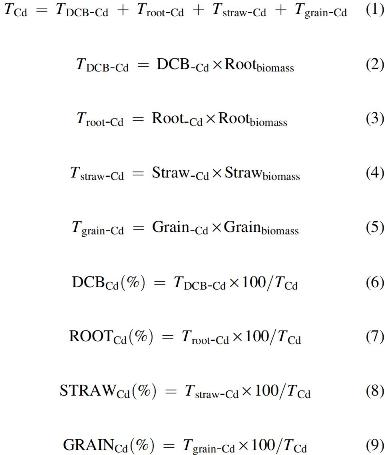
where TDCB-Cd, Troot-Cd, Tstraw-Cd, and Tgrain-Cd represent the total Cd amount in the DCB extracts of roots, straw, and grains, respectively; DCB-Cd, Root-Cd, Straw-Cd, and Grain-Cd are Cd concentrations in the DCB extracts of roots, straw, and grains, respectively; and DCBCd (%), ROOTCd (%), STRAWCd (%), and GRAINCd (%) are Cd distributions in the DCB extracts, roots, straw, and grains, respectively.
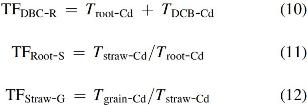
The translocation factor (TF) was applied to evaluate the translocation capacity for Cd translocation. The DCB-to-root TF for CK (TFDCB-R) and for O (TFDCB-R-O), root-to-straw TF for CK (TFRoot-S) and for O (TFRoot-S-O), and straw-to-grain TF for CK (TFStraw-G) and for O (TFStraw-G-O) were calculated as follows:
Statistical differences were analyzed using Duncan's new complex range method and box plots (SPSS 22.0 software). The relationships between variables were determined by correlation analysis, and the fitted model was developed by multiple regression analysis (MLR) using the stepwise method (Sharma et al., 2020).
The MLR equations were as follows:
where y is the dependent variable (Cd concentration and TF parameters in rice); x1 and x2 are the independent variables (DCB-Fe and DCB-Mn, respectively); β0 is the y intercept (the value of the dependent variable y when x1 and x2 = 0); β1 and β2 are the estimated multiple regression coefficients; and the term ɛ is a random error.
Results and Discussion
Dry biomass in rice tissues
O method can significantly increase the dry biomass of rice tissues. As shown in Table 2, with the advancement of the rice growth stage,
Fe–Mn plaque formation under O
As shown in Table 3, there was more Fe plaque than Mn plaque on roots in both treatments, and DCB-Fe (mg/g) showed a significant positive correlation with DCB-Mn (mg/g) in CK. With the advancement of rice growth, Fe–Mn plaque in CK and DCB-Mn of the O group decreased first and then increased. The amount of Fe–Mn plaque in CK was highest at the tillering stage (DCB-Fe: 17.79 mg/g and DCB-Mn: 0.27 mg/g) and lowest at the filling stage (DCB-Fe: 5.88 mg/g and DCB-Mn: 0.13 mg/g), DCB-Fe in the O group was highest (15.74 mg/g) at the tillering stage and lowest (5.94 mg/g) at the maturity stage, and DCB-Mn in the O group was highest (0.19 mg/g) at the tillering stage and lowest at the jointing stage (0.13 mg/g). DCB-Fe in the O group was higher than that in CK at the filling stage, while DCB-Mn in the O group was higher than that in CK at the filling and maturity stages.
DCB-Fe and DCB-Mn (mg/g) on the Rice Root Surface
The correlation was significant at the 0.01 level.
Lowercase letters indicate significant differences between treatments (p < 0.05).
DCB, dithionite-citrate-bicarbonate.
O affected the soil properties, and caused an increase in the amount of Fe or Mn plaque at the filling and maturity stages, including soil pH, soil catalase activity (SCA), and the available phosphorus content (APC) in the soil. O method can increase the SCA and APC at some growth stages
Cd concentration and translocation in rice
As shown in Fig. 2, with the advancement of rice growth, DCB-Cd and Straw-Cd decreased first and then increased, and Root-Cd in the O group increased first and then decreased. Grain-Cd in the O group decreased gradually, while Grain-Cd in CK increased gradually. The highest Cd concentration was in the roots (ranging from 1.62 to 4.01 mg/kg), and the lowest was in the grains (ranging from 0.13 to 0.29 mg/kg). At the filling and maturity stages, Cd concentrations in roots, straw, and grains in the O group were lower than those in CK, most of the Cd was distributed in the DCB extract, roots, and straw, and only 5.69–22.82% was transferred to rice grains. At the filling and maturity stages, total Cd content in the soil (TCS) in the O group was higher than that in CK (Supplementary Table S4). O might decrease the TCS in rice at the filling and maturity stages. As shown in Fig. 3, with the advancement of the rice growth stage, TFDCB-R and TFDCB-R-O increased first and then decreased and TFRoot-S and TFRoot-S-O decreased first and then increased, while TFStraw-G and TFStraw-G-O increased gradually. TFDCB-R-O and TFStraw-G-O at the filling and maturity stages were lower than those in CK. At the maturity stages, TFRoot-S-O was higher than TFRoot-S.
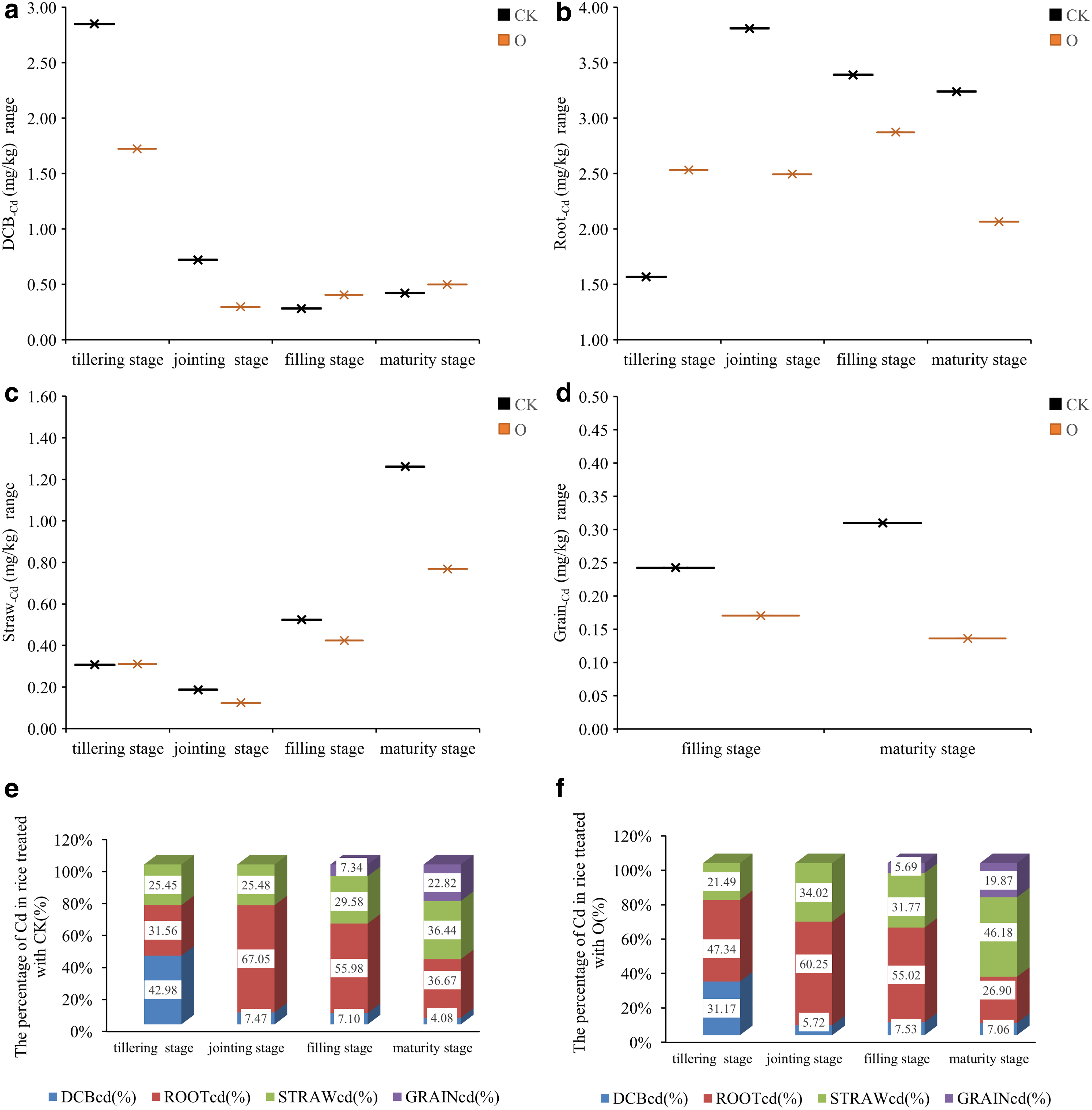
Mean Cd absorption (mg/kg), translocation (mg/kg), and variation in the CK and O groups;
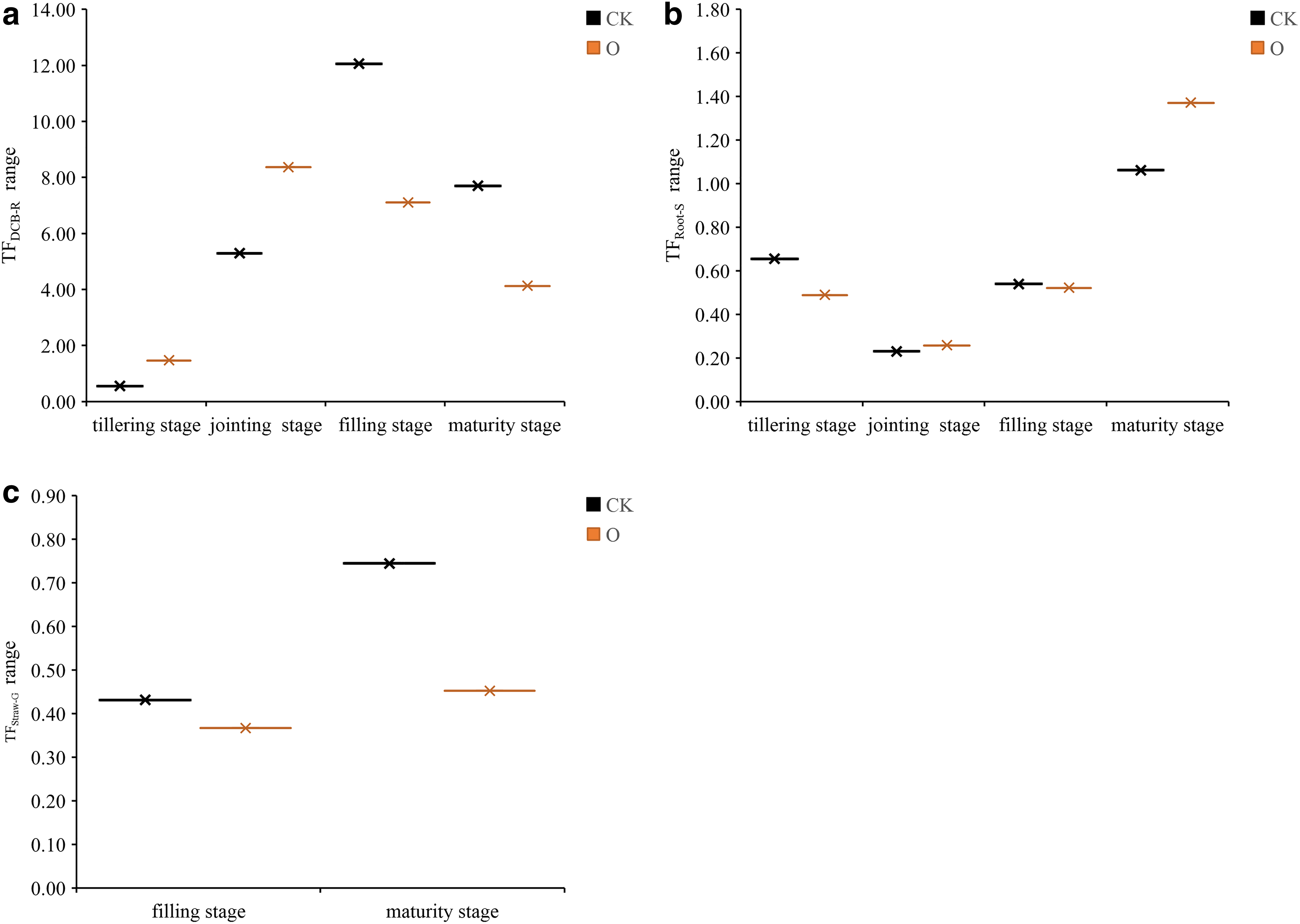
Mean Cd TFs (mg/kg) and variation in the CK and O groups;
Our findings confirmed that O affected the Cd concentration in rice tissues and TFs and promoted redistribution of Cd in rice tissues at the filling and maturity stages. Controlling TFStraw-G is a very important strategy for alleviating Cd stress (Wang et al., 2019). It was speculated that plants can alter their Cd translocation capacity to adapt to Cd stress through certain mechanisms by increasing Fe–Mn plaque formation under O conditions (Cui et al., 2015; Pardo et al., 2016; Amaral et al., 2017; Yu et al., 2017; Borges et al., 2019). Correlation analysis will reveal more specific results.
Correlation analysis
The results of the correlation analysis between Fe–Mn plaque and total Cd concentration in rice tissues and TFs are presented in Table 4. In both the CK and O group, the amount of Fe–Mn plaque had a significant negative correlation with TFDCB-R. The amount of Fe–Mn plaque in CK had a negative relationship with Root-Cd, but was positively correlated with DCB-Cd. Furthermore, DCB-Fe in the O groups had a positive relationship with DCB-Cd and a negative relationship with TFStraw-G-O, and DCB-Mn in O group had a negative relationship with Root-Cd and a positive relationship with TFRoot-S-O. Fe plaque affects Cd uptake in rice through various interactions with contaminants in the soil (Bao et al., 2019). Through MLR analysis, the Cd concentration in rice tissues and TFs was controlled by Fe–Mn plaque. The fitted models indicated that Fe plaque influenced DCB-Cd and TFDCB-R in CK, and influenced DCB-Cd, Grain-Cd, and TFStraw-G-O in the O groups. Mn plaque influenced Root-Cd, TFDCB-R-O, and TFRoot-S-O under O conditions. Our findings confirmed that Fe–Mn plaque in the O group inhibited Cd accumulation in the rice roots and grains, and decreased the TFDCB-R-O and TFStraw-G-O of the plants at the filling and maturity stages.
Correlation Coefficients Between the Amount of Fe–Mn Plaque and the Cd Absorption and Translocation Factors for the Fitted Models
ns, the correlation was not significant; R2 shows that the percentage of the total variation in the Cd concentration and TFs explained by the predictor variables.
The correlation was significant at the 0.05 level.
The correlation was significant at the 0.01 level.
MLR, multiple regression; TF, translocation factor; Cd, cadmium.
Conclusions
We studied the features of Cd accumulation in four rice tissues through pot experiments. The results of our study show that, from the filling stage to the maturity stage, Fe–Mn plaque was the most significant factor affecting Cd accumulation in rice for the O group. With the increase in the amount of Fe–Mn plaque, the Cd concentration increased in the DCB extract (DCB-Cd), but decreased in rice roots and grains. Therefore, O method can strengthen the ability of Fe–Mn plaque to hinder Cd accumulation in rice, and is suitable for rice cultivation in soil that is slightly polluted by Cd.
Footnotes
Author Disclosure Statement
No competing financial interests exist.
Funding Information
This research was partially supported by research grants from the Natural Science Foundation of China (Project No.51909088), the Hunan Science and Technology Project of China (Project No. 2018JJ 3243), and the Key Project of Hunan Education Department of China (Project No. 17A094).

References
Supplementary Material
Please find the following supplemental material available below.
For Open Access articles published under a Creative Commons License, all supplemental material carries the same license as the article it is associated with.
For non-Open Access articles published, all supplemental material carries a non-exclusive license, and permission requests for re-use of supplemental material or any part of supplemental material shall be sent directly to the copyright owner as specified in the copyright notice associated with the article.
