




Abstract
Thermal desorption (TD) is an effective physical remediation technology for polycyclic aromatic hydrocarbons (PAHs) contaminated soil. Reaction temperature is the key of TD, and the increase of the vacuum degree and addition of catalysts could improve the remediation efficiency. Therefore, testing of TD experiments (test equipment and method: Patent No. 201220468562.5) under different heating temperature and vacuum-enhanced and alkali-assisted conditions at low temperature was conducted to remediate soil contaminated by PAHs from a coking plant. The aim of the test was to improve PAHs removal efficiency and investigate its influence on physicochemical properties of contaminated soil. The results indicated that the removal efficiencies of PAHs increased with the increase of heating temperature, which reached 85.4%, 87.1%, 83.0%, and 76.2% removals of ∑PAHs, PAHs containing 2-3 benzene rings (LPAHs), PAHs containing 4 benzene rings (MPAHs), and PAHs containing 5-6 benzene rings (HPAHs) at 450°C, respectively. But the residual concentrations of Phe, BbF, and DBA were still higher than the corresponding screening levels for soil environmental risk assessment of residential land in Beijing. The vacuum-enhanced and alkali-assisted TD improved the removal of PAHs compared with the TD at 200°C, especially the vacuum-enhanced TD, which could remove almost all the available PAHs and partly unavailable PAHs owing to the lowered of melting point and increased steam flow rate by vacuumizing. Relative high-temperature TD (450°C) and vacuum-enhanced TD had a greater effect on the dissolved organic carbon, and specific surface area (SSA) of bulk soil, and volatilization of pollutant and agglomeration of particles affected the SSA during TD simultaneously, which led to the difference of removal efficiencies of PAHs probably.
Introduction
Polycyclic aromatic hydrocarbons (PAHs) are highly hydrophobic hydrocarbons consisting of two or more unsubstituted benzene rings, which have attracted extensive attention throughout the world owing to their strong carcinogenic, teratogenic, and mutagenic properties mostly (Kuppusamy et al., 2017). PAHs are mainly generated from incomplete combustion and pyrolysis of organic materials, coking industry is one of the main anthropogenic sources of PAHs, and the rapid development of coking industry in China since 1990s caused serious pollution of PAHs in soil (Xia et al., 2015). Remediation of PAHs contaminated soil is necessary and crucial owing to the risks and potential toxicity to ecological environment. However, PAHs could adsorb onto soil particles readily, aging and locking over times, which increased the difficulty of its remediation (Mastral and Callén, 2000; Kuppusamy et al., 2017).
Thermal desorption (TD) has been suggested to be a suitable physical remediation technology for its efficient, low cost, and relative high removal efficiency (Vidonish et al., 2016; Sorengard et al., 2020). Also, TD can be classified as low-temperature thermal desorption (LTTD, 100–300°C) and high-temperature thermal desorption (300–550°C) depending on the treatment temperature (USEPA, 1994; Vidonish et al., 2016). Most previous studies were focused on the fundamental research, including the effect of heating temperature, flow rate of carrier gas, reaction time, etc. on removal efficiency of organic pollutants (such as polychlorobiphenyls, pentachlorophenol, and per- and polyfluoroalkyl substances) (Chawla and Pourhashemi, 2006; Guemiza et al., 2017; Sorengard et al., 2020). Specifically, it has been shown that the mode of heating, heating temperature, treatment time, and soil characteristics could affect the removal efficiency of organic pollutant significantly (Wu et al., 2014; Hou et al., 2019). It was found that lipid could be removed mostly by 450°C heating temperature, more than 99% n-hexadecane in soil could be adsorbed under the heating temperature that exceeds 300°C (Araruna et al., 2004; Merino and Bucala, 2007). Although the heating temperature was affected by soil characteristic, pollution property, and so on, the heating temperature required for high boiling point pollutants was lower than that for low boiling point pollutants significantly (Liu et al., 2019; Han et al., 2020).
Compared with artificial contaminated soil, actual contaminated soil was affected by tar leakage and atmospheric sedimentation of crude gas, which impacted the composition of PAHs and polluting property (Xia et al., 2015). Meanwhile, the melting and boiling points of PAHs have a wide range due to different amount of benzene rings, which caused low removal efficiency of PAHs with four to six benzene rings probably (Zhao et al., 2018). So the removal of high benzene rings of PAHs was the key point of PAHs that actually contaminates soil by TD. The removal efficiency of PAHs could be improved by extending heating time, but it would increase energy consumption dramatically. To improve the removal efficiency of organic pollution, some researches reduce the boiling point of pollutants by increasing the vacuum degree of TD system to decrease the heating temperature and energy consumption. Kunkel et al. (2006) found that more than 99.8% mercury was removed under 64–74 mL/min extraction condition and 244–259°C heating temperature, which was much lower than the boiling temperature (356.6°C) of mercury at normal atmosphere. For some volatile organic compounds (trichlorphenyl ether, tetrachloromethane, trichloro ethylene, etc.), the removal efficiencies at 60–80°C increased obviously under the pressure of 0.26 atm decreased by 0.66 atm (Fansworth et al., 2002). In recent years, many researchers studied on catalysts (salt or alkali) to improve organic pollution removal efficiency in soil (Comuzzi et al., 2011). Although the results were controversial, the methods were necessary for TD under low temperature.
Generally, the studies discussed above were mainly focused on enhancing removal efficiency of organic pollution in soil under different experiment conditions (Kuppusamy et al., 2017; Hou et al., 2019). Actual PAHs contaminated soil repaired by TD under vacuum-enhanced and catalysts-assisted conditions has seldom been conducted, but is necessary for fundamental research and actual remediation.
Therefore, the objective of this study is to investigate the effect of vacuum-enhanced and alkali-assisted TD under low temperature on PAHs removal, and of the physicochemical property from a coking plant soil sample. The effect of heating temperature (50–450°C) on removal efficiencies and residual concentration of soil PAHs were tested. The extraction schemes of available PAHs based on sodium thiosulfate oxidation methods were applied. The obtained results can provide useful information and technical support for actual TD technology for remediation of soil contaminated by PAHs.
Materials and Methods
Soil samples
Soil sample were collected from an abandoned coal-chemical plant in the east of Beijing. Contamination with PAHs was detected from the surface to a depth of 3 m in coking plant. The collected soil was air-dried and ground before sieving to remove >1 mm gravels and then homogenized.
Experimental apparatus and procedures
Contaminated soil samples were treated simulating rotary heating process of cement kiln using a bench scale rotary furnace test equipment and method (Fig. 1, Patent No. 201220468562.5), which consists of an input gas transport section [Fig. 1(1–3), with flowmeter and pressure gauge], heating system [Fig. 1(4–9), vacuum tube indirect heater, XTL1100-80], which could reach a maximum temperature of 2,000°C, with a quartz cylindrical tube (inner diameter: 80 mm, length: 1,000 mm, constant length: 150 mm), and the gas outlet section [Fig. 1(10–14), mainly including n-hexane traps and activated carbon filters].

Schematics of the experimental apparatus (1, carrier gas; 2, reducing valve; 3, pressure airway; 4, quick coupling; 5, barometer; 6, flange; 7, hearth; 8, furnace tube; 9, pressure lock; 10, condenser pipe; 11, latex tubing; 12, glass delivery tube; 13, absorption bottle; 14, activated carbon adsorber).
Based on the previous experiment results, the removal efficiencies of each PAHs achieved 92–99%, ∑PAHs achieved 95% under conditions of heating temperature of 300°C, and heating time of 20 min (Wei, 2013). So, considering the removal efficiency and melting and boiling points of PAHs, the TD experiments at different heating temperature (50°C, 100°C, 150°C, 200°C, 250°C, 300°C, 350°C, 400°C, or 450°C) under 30 min heating time were tested. Once the heating temperature reached the desired temperature with the heating rate of 7°C/min during the experiments, soil sample [100 g soil for TD and vacuum-assisted LTTD and 100 g soil +2 g Ca(OH)2 for alkali-assisted LTTD] was added to the constant temperature part of quartz tube, then the quartz tube was purged with nitrogen (a pressure of 0.02 MPa for TD and alkali-assisted LTTD, −0.08 MPa for vacuum-assisted LTTD) for 30 min maintaining the selected temperature. After the experiment, the soil samples were removed from the quartz tube, cooled at room temperature, and stored in dark room at 4°C before analyzing. The experiments were performed in triplicate.
Analysis of sample characteristics and PAHs
Total organic carbon (TOC) and dissolved organic carbon (DOC) were measured with a TOC analyzer (Elementar, Langenselbold, Germany). Specific surface area (SSA) was measured by dew-point instrument (WP4-T).
The content of PAHs in soil was determined after extraction using a Soxhlet extraction process. Five grams soil samples were extracted using n-hexane/dichloromethane (1:1 v/v) as solvent for 2 h, then the solvent was left to evaporate and the remaining residue was dissolved in 2 mL acetonitrile. The PAHs extracts of each fraction were analyzed by high performance liquid chromatography (HPLC) (HPLC-FL; Agilent 1200) fitted with a 4.6 × 250 mm reverse phase C18 column using acetonitrile/water as the mobile phase at a flow rate of 1.0 mL/min. Results were obtained from three replicates and compared at each time point.
Data statistics and analysis
The experimental data were analyzed using a one-way ANOVA (SPSS 16.0). Duncan's multiple range test was used to determine the statistical significance (p < 0.05).
Results and Discussions
Characterization of soil sample
Selected physicochemical properties and contamination of the soil are listed in Tables 1 and 2, respectively. As shown in Table 1, the soil sample was neutral sandy soil. The values of TOC and DOC were 16.9 g/kg and 337.1 mg/kg, respectively. It indicated that the collected sample was adaptable to soil TD method from the perspective of remediation.
The Initial Physicochemical Properties of the Soil Sample
DOC, dissolved organic carbon; TOC, total organic carbon; SSA, specific surface area.
Physiochemical Properties of 16 Polycyclic Aromatic Hydrocarbons and Contamination Analysis of Soil Sample
Ace, acenaphthene; Acy, acenaphthylene; Ant, anthracene; BaA, benzo(a)anthracene; BaP, benzo(a)pyrene; BbF, benzo(b)fluoranthene; BgP, benzo(g,h,i)perylene; BkF, benzo(k)fluoranthene; Chr, chrysene; DBA, dibenzo(a,h)anthracene; Flt, fluoranthene; Flu, fluoranthene; Ipy, indeno(1,2,3-cd)pyrene; HPAH, PAHs containing 5-6 benzene rings; LPAH, PAHs containing 2-3 benzene rings; MPAH, PAHs containing 4 benzene rings; Nap, naphthalene; Phe, phenanthrene; Pyr, pyrene; SL, screening level; TEF, toxic equivalency factor.
The toxic equivalency factor, melting point, and boiling point of 16 US-EPA priority PAHs increased with the increasing of their molecular weight as shown in Table 2. The 16 US-EPA priority PAHs were all detected in soil sample and the sample was mainly contaminated with PAHs containing 2-3 benzene rings (LPAHs) (LPAHs/∑PAHs = 0.76). Also, nine PAHs exceeded the corresponding screening levels for soil environmental risk assessment of residential land in Beijing (SL in Table 2, DB11/T 811-2011), including Flu, Phe, BaA, BbF, BkF, BaP, Ipy, DBA, and BgP with the range of exceed multiples from 1.56 to 55. PAHs with five benzene rings, by contrast, achieved higher exceed multiples (from 27.00 to 55.00), which included BbF, BaP, Ipy, and DBA.
Removal efficiencies of PAHs by TD
The removal efficiencies of ∑PAHs, LPAHs, PAHs containing 4 benzene rings (MPAHs), and PAHs containing 5-6 benzene rings (HPAHs) at the heating temperature 50–450°C by TD are shown in Fig. 2. Generally, a high TD temperature would induce high removal efficiencies of ∑PAHs, LPAHs, MPAHs, and HPAHs. Under LTTD (100–300°C), the removal efficiencies of MPAHs and HPAHs were pretty low and seemed less dependent on TD temperatures at the range of heating temperature, especially from 50°C to 150°C, and their removal efficiencies increased with the increase of heating temperature, with the highest values of 81.3% and 76.2% of MPAHs and HPAHs at 450°C, respectively. So MPAHs and HPAHs were not suitable for TD under low temperature. The removal efficiencies of ∑PAHs and LPAHs were higher than that of MPAHs and HPAHs at heating temperature from 100°C to 400°C significantly (p < 0.05), especially under low temperature (<300°C), and there was no significant differences on removal efficiencies of different kinds of PAHs at 450°C.
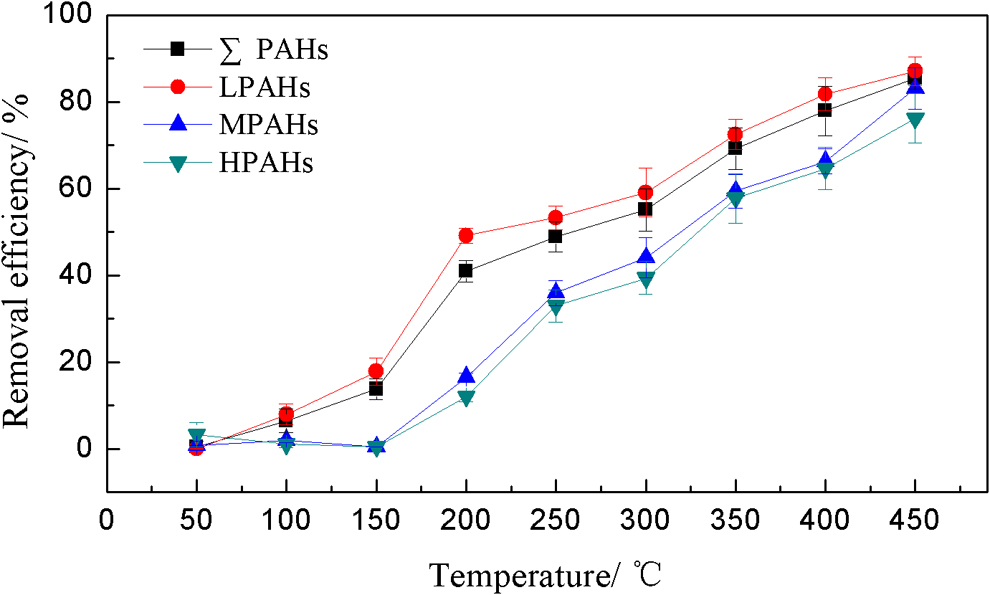
The removal efficiencies of ΣPAHs, LPAHs, MPAHs, and HPAHs at the heating temperature 50–450°C by thermal desorption. HPAH, PAHs containing 5-6 benzene rings; LPAH, PAHs containing 2-3 benzene rings; MPAH, PAHs containing 4 benzene rings.
Although the lower fusion points and boiling points of LPAHs lead to lower heating temperature of TD treatment, almost all the 16 PAHs were removed effectively under 200°C, which corresponded to their fusion points but not boiling points. It implied that the removal efficiencies of PAHs were not only related to their molecular weight, fusion, and boiling points but also related to other influence factors. The content of available PAHs was closely related to their behavior under TD probably, compared with unavailable PAHs, available PAHs were easily removed under 250–350°C (Cuypers et al., 2000). Under the highest heating temperature of 450°C, the available PAHs were supposed to be removed mostly. Silica particles, submicrometer, and nanoscale micropores of soil lead to the dramatic decline of PAHs mobility and availability (Ghosh et al., 2001; Luo et al., 2004), and the effectiveness decreased with the increase of aging time (Ling et al., 2010).
In addition, species and concentrations of heavy metal elements (such as copper, lead and cadmium) in soil were not changed after TD and were not affected by changes of heating temperature as shown in Table 3. Further research of the influence of TD on the effectiveness of PAH removal is necessary for the mechanism research.
Concentrations of Heavy Metals of Contaminated Soil Before and After Thermal Desorption at 450°C/mg/kg
Residual concentration of PAHs after TD
Changes of residual concentrations of six PAHs, which were severely exceeded the corresponding screening levels for soil environmental risk assessment of residential land in Beijing, are shown in Fig. 3. The removal efficiencies of six target PAHs increased with the increase of heating temperature. However, the residual concentrations of six PAHs were all exceeded the screening values at 200°C heating temperature. The residual concentrations of Phe, BbF, and DBA were 4.6, 15.2, and 8 times higher than screening values even at 450°C heating temperature, respectively. The results indicated that the key TD parameter should be adjusted, such as sharp increase of the heating temperature or heating time, to obtain the lower residual concentrations of target PAHs, which led to the increase of technical difficulty and energy consumption. Although the residual PAHs might be considered as unavailable state based on the previous study, total quantity control was still necessary. Except for increasing the heating temperature and retention time, recent studies showed that the addition of salt, alkali (Smith et al., 2001; Dai et al., 2020), and vacuum-enhanced TD (Kunkel et al., 2006) increase the removal efficiency of PAHs effectively.
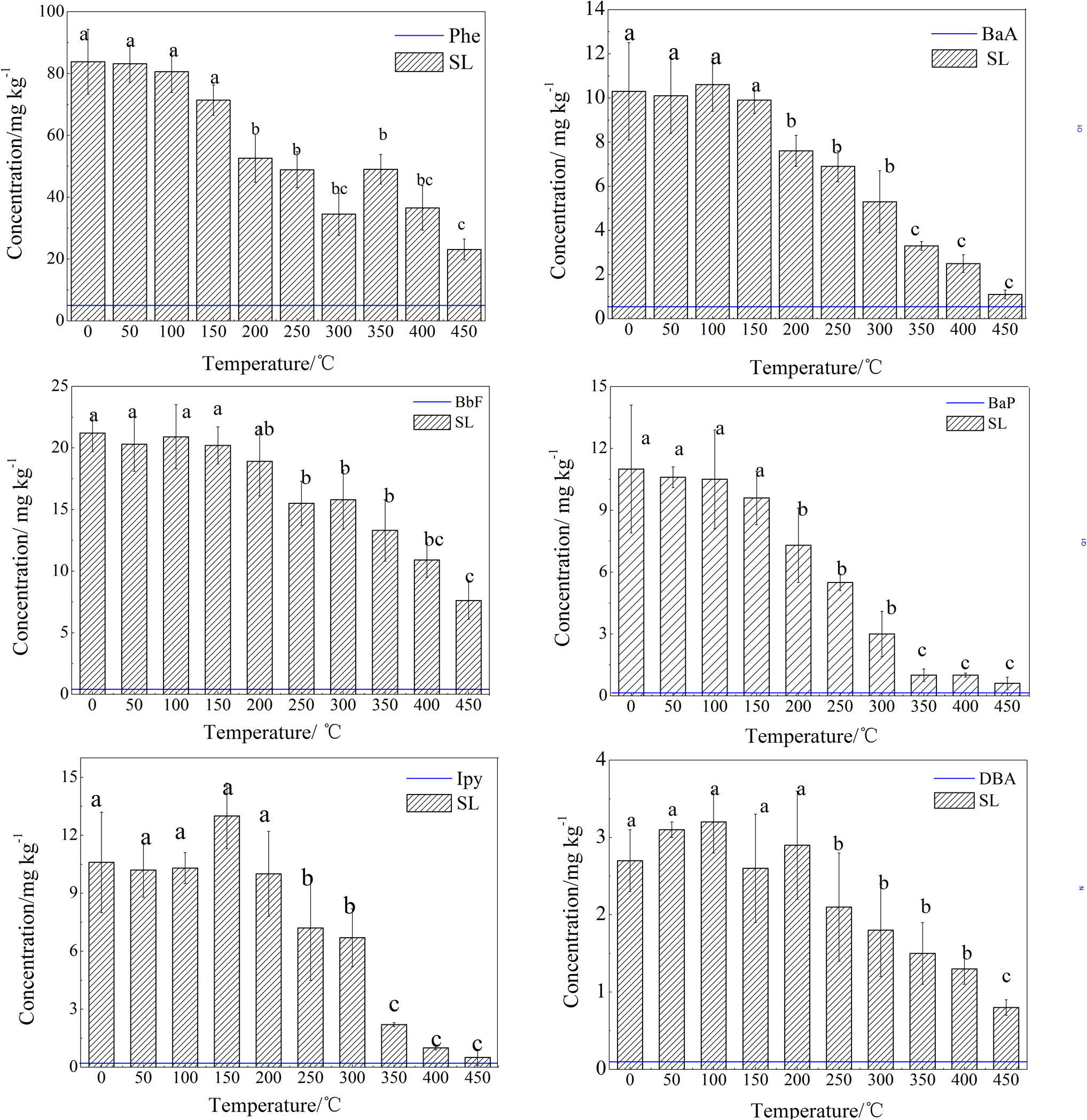
Changes in residual concentration of six target PAHs in soil at different heating temperature by thermal desorption. a–c, the same small letters do not differ significantly at p < 0.05 according to one-way ANOVA for dependent samples.
Removal efficiency of PAHs under vacuum-enhanced and alkali-assisted TD
The curve of residual concentration of PAHs over time conforms to the first-order kinetic response model (Smith et al., 2001):

where C is residual concentration of PAHs after TD, C0 is the initial concentration of PAHs, k is rate of the concentration decay.
First order kinetic model curves of PAHs TD behavior under low temperature, vacuum-enhanced and alkali-assisted TD are shown in Fig. 4. The fitting result indicated that the first-order kinetic response model had good fitting effects in the changes of ∑PAHs, LPAHs, MPAHs, and HPAHs concentrations with heating time (Table 4). Among them, the imitative effects of ∑PAHs and LPAHs (R2 > 95%) were better than these of MPAHs and HPAHs, especially under LTTD. At the first 10 min of the LTTD experiment, a rapid desorption of PAHs occurred, while at 10–20 min, the desorption rate is limited owing to the internal diffusion phenomena probably (Falciglia et al., 2011). As shown in Fig. 4, vacuum-enhanced and alkali-assisted LTTD restrained the internal diffusion of PAHs, especially the desorption of HPAHs by vacuum-enhanced LTTD.
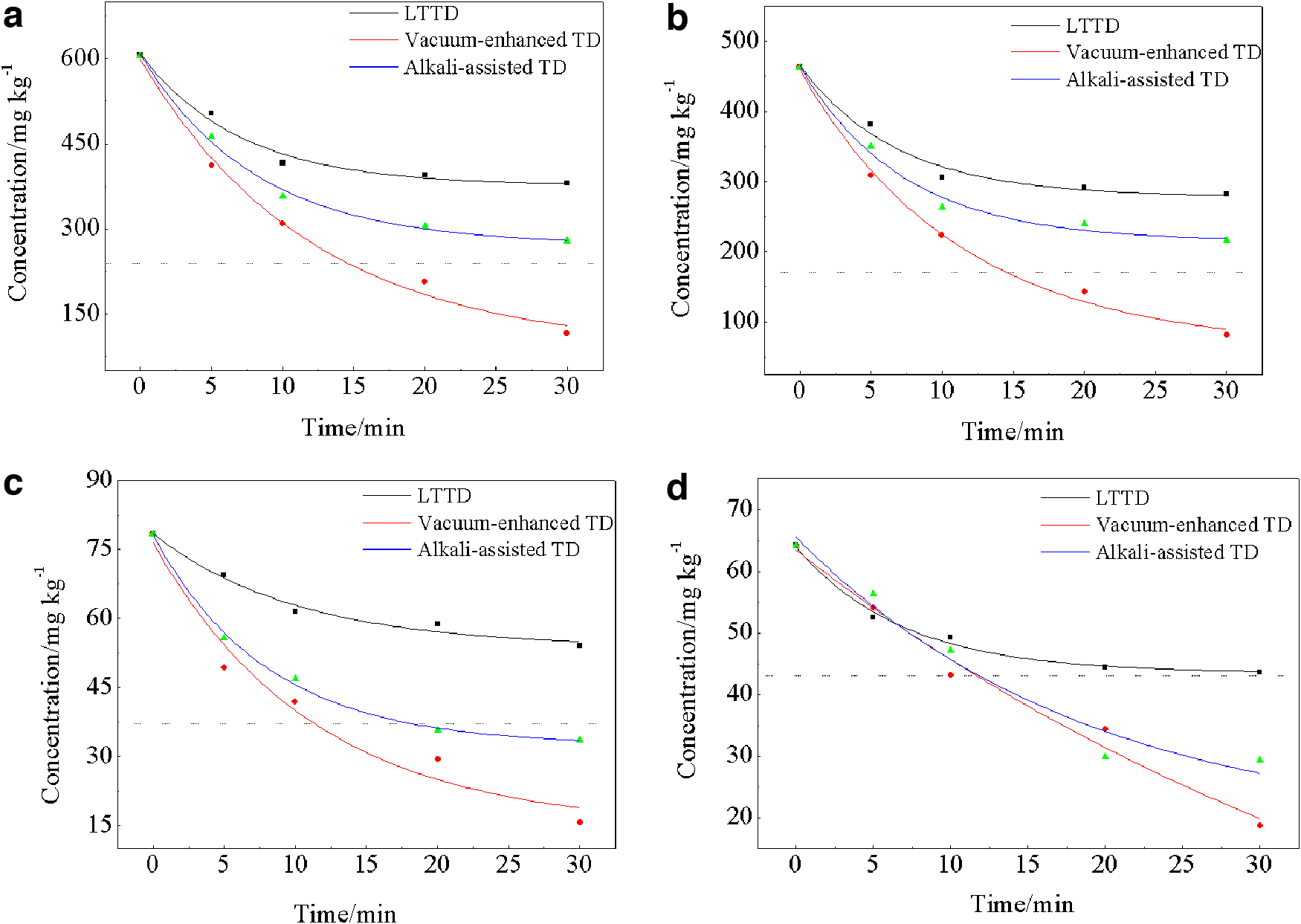
First-order kinetic model curves of PAHs thermal desorption behavior
The Parameters of First Order Kinetic Model Curves of Polycyclic Aromatic Hydrocarbons Thermal Desorption Behavior
The residual concentrations of ∑PAHs, LPAHs, MPAHs, and HPAHs decreased with the increasing residence time under three TD modes, however, the rates of decay of all kinds of PAHs concentration under vacuum-enhanced TD were apparently higher than that under low temperature and alkali-assisted TD. Also, the addition of alkali slightly increased the desorption rate of PAHs compared with LTTD. The melting point of PAHs increased with the number of benzene rings, it reached the melting point of LPAHs and MPAHs under 200°C, therefore, the rate of the concentration decay decreased with the increase of the number of benzene rings, which with the range of k was 0.099–0.147. Based on the results of alkali-assisted TD, there were no noticeable change of the k of ∑PAHs and LPAHs compared with LTTD, but the addition of alkali had impact on MPAHs and HPAHs, it even had a dampening effect on the desorption of HPAHs. The soil agglomeration was restrained by the addition of alkali and consequently increased the desorption of PAHs probably (Zhao and Zheng, 2012; Chen 2020). Also, the addition of alkali lowered the activation energy of the desorption reaction and started and accelerated the reaction at lower temperature (Jia et al., 2001). While vacuum-enhanced TD could promote the desorption of all kinds of target PAHs, with the range of k 0.022–0.089, owing to the lowered melting point and increased steam flow rate by vacuumizing (Kunkel et al., 2006).
Species of PAHs were tested based on sodium thiosulfate oxidation method (Cuypers et al., 2000), the concentration of available PAHs were 60.0%, 63.5%, 52.7%, and 32.9% of ∑PAHs, LPAHs, MPAHs, and HPAHs (as shown in Fig. 4 by dotted lines), respectively. It indicated that available PAHs and partly unavailable PAHs could be removed effectively by vacuum-enhanced LTTD, and 90% concentrations of all species of PAHs were removed under the experiment condition of 200°C heating temperature and 30 min retention time, especially for the removal of unavailable PAHs of MPAHs and HPAHs, which were more effective compared with LTTD. However, the removal efficiencies of MPAHs and HPAHs were much higher under alkali-assisted LTTD than LTTD, but not effective in removing available species of PAHs, especially of the MPAHs. Therefore, PAHs could be removed effectively under lower heating temperature and shorter reaction time by vacuum-enhanced LTTD.
Effect of soil physiochemical properties under TD
The comparison of physiochemical properties of soil sample before and after TD is shown in Table 5. It showed that the values of TOC, DOC, and SSA were affected by different TD to some degree. The content of soil TOC decreased significantly (p < 0.01) under high temperature (450°C) TD, and fluctuated slightly under low temperature, vacuum-enhanced, and alkali-assisted LTTD, so the higher the temperature, the greater the impact on content of TOC. The values of DOC increased under LTTD and vacuum-enhanced LTTD, which might be related to the form changes of TOC under heating condition (Wang et al., 2011). Except for LTTD, the SSA decreased to different extent under other TD conditions. Most pollutant volatilized from the pores of soil particles after TD treatment, which could increase the soil porosity and led to the increase of SSA (Merino et al., 2003; Han et al., 2020), however, the similar results were not found in our research. Previous studies showed that the changes of SSA were affected by many factors, probably affected by the volatilization of pollutant and agglomeration of particles simultaneously, which led to the increase and decrease of SSA, respectively. The agglomeration of particles could change the physiochemical properties of soil particle surface, but the mechanism of agglomeration and its affection to soil reuse after TD are not clear, and the further research is needed.
Comparison of the Physiochemical Properties of Soil Sample Before and After Thermal Desorption
Mean values (n = 3) differ significantly at p < 0.05.
Conclusions
The removal efficiencies of ∑PAHs, LPAHs, MPAHs, and HPAHs from a coking plant soil increased with the increase of heating temperature by TD experiments under the condition of 50–450°C heating temperature and 30 min heating time. The effective desorption temperatures of 16 PAHs were around their melting point, the removal efficiencies of LPAHs, MPAHs, and HPAHs increased significantly (p < 0.05) under 150°C, 200°C, and 200°C, respectively. The highest removal efficiencies were obtained under the 450°C heating temperature, which ranged from 76.2% to 86.7%, but the residual concentrations of some PAHs, such as Phe, BbF, and DBA, were still higher than screening values under 450°C.
The first-order kinetic response model had good fitting effects in the changes of ∑PAHs, LPAHs, MPAHs, and HPAHs concentrations with heating time under low temperature, vacuum-enhanced, and alkali-assisted LTTD. The vacuum-enhanced and alkali-assisted LTTD (200°C) increased PAHs desorption efficiencies effectively, and the removal efficiencies increased 38.8–49.1% and 14.4–26.3% under vacuum-enhanced and alkali-assisted LTTD compared with LTTD, respectively. Especially under vacuum-enhanced LTTD, the improved vacuum promote the desorption rate compared with alkali-assisted TD. The higher the number of benzene rings, the greater the increase of growing rate of PAHs desorption efficiency. Meanwhile, available PAHs and partly unavailable PAHs could be removed effectively under vacuum-enhanced LTTD, especially for unavailable PAHs of MPAHs and HPAHs. The changes of SSA under TD experiments indicated that the agglomeration of soil particles affected the desorption of PAHs to some extent.
Footnotes
Author Disclosure Statement
No competing financial interests exist.
Funding Information
This research was supported by Beijing Science and Technology Plan (Z101109003810001).