




Abstract
Three oxidants (sodium hypochlorite [NaClO], ozone, and ultraviolet rays) were combined with powdered activated carbon (PAC) and ultrafiltration (UF) for advanced treatment of the secondary effluent of sewage treatment plants. This study investigated the optimal oxidant dosing in the combined process, tested the removal efficiency of antibiotic resistance genes (ARGs) in the secondary effluent, and explored the removal of cell-associated and cell-free ARGs in the secondary effluent by the three combined processes. The results showed that the three combined processes could effectively reduce ARGs in the secondary effluent. The NaClO-PAC-UF process removed 3.02–4.07-log of ARGs (tetA, tetC, tetG, sulI, sulII), Class I integron-integrase (intI1) and 16S rRNA in the secondary effluent with the best reduction effect. Cell-associated ARGs were not detected in the membrane effluent of the three preoxidation-PAC-UF combined processes. The NaClO-PAC-UF combined process had the best removal effect on cell-free ARGs with a removal amount of 3.02–3.28-log. The three oxidants combined with PAC and UF can be used as a combined process to effectively reduce ARGs in secondary effluent.
Introduction
Antibiotics were first discovered in 1929 and have since been widely used in human medicine and animal husbandry to treat infectious diseases and promote animal growth (Luo et al., 2010). However, the excessive use of antibiotics has led to the emergence and spread of antibiotic-resistant bacteria (ARB) and antibiotic resistance genes (ARGs) in the environment (Munir et al., 2011). ARGs in the environment usually have two forms: cell-associated resistance genes and cell-free resistance genes. Cell-associated ARGs can transmit drug resistance through horizontal transfer between bacteria, whereas cell-free resistance ARGs are a DNA residue secreted or inactivated by ARB, which can transfer ARGs to downstream bacteria via transformation or transduction (Rizzo et al., 2013).
ARGs enter bacterial cells through conjugation, horizontal transfer, and heredity to cause bacteria that do not have resistance to gain resistance or bacteria with limited resistance to gain more resistance and become superbacteria (multi-ARB) (Zhang and Zhang, 2011). Common infectious diseases that can be treated with antibiotics may thus soon become untreatable and life-threatening (Karkman et al., 2016). In addition, integrin integrase (int), as the mobile genetic factor of bacteria, carries one or more genes related to ARGs, and carries out horizontal transfer between bacteria (Chen, 2019). The most common type is the Class I integrin integrase (intI1). At the same time, studies (Li, 2015) have shown that the detection of 16S rRNA can directly reflect the microbial content in water samples, which is closely related to the concentration of ARGs. The emergence and spread of antibiotic resistance has therefore become a global problem for human and animal health (De Leener et al., 2004).
Sewage treatment plants are an important place to collect and treat domestic sewage, which provides favorable conditions for the selection and spread of ARB and ARG resistance in domestic sewage and municipal solid waste (Zhang et al., 2018). ARGs have been widely detected in sewage treatment plants worldwide (Du et al., 2015). However, traditional wastewater treatment processes do not usually efficiently remove ARGs. Recent studies showed that (Pruden et al., 2013; Li et al., 2017) the concentration of ARGs detected in secondary effluent was still higher than that in the natural water and soil, and the secondary effluent from the sewage treatment plant was considered to be an important source of ARGs in the environment. Secondary effluent therefore requires further advanced treatment before being discharged or reused.
Ultrafiltration (UF) combined with powdered activated carbon (PAC) treatment has been recently popularized and applied in the field of water treatment (Sun et al., 2019). The process of PAC-UF combines physical adsorption and membrane retention, which is a combined process that can effectively remove ARGs from water. However, the main disadvantage of this method is that it does not destroy ARGs, but rather transfers ARGs from the liquid phase to the solid surface. It is therefore necessary to explore whether processing units such as advanced oxidation can effectively remove ARGs in water.
In recent years, the research on oxidation as a pretreatment of membrane filtration has received more and more attention, and commonly used oxidants are ozone (O3), ultraviolet (UV), etc. Karnik et al. (2005) found that the O3/UF combined process can reduce 50% dissolved organic matter in raw water while significantly increasing membrane filtration flux. Compared with gaseous chlorine, sodium hypochlorite (NaClO) has higher stability and safety (Zhang, 2006), and the technical operation is simple and the cost is low. UV has the advantages of wide spectrum, high efficiency, and no secondary pollution. The solubility of O3 in water is 13 times that of oxygen, which can decolorize, deodorize, oxidize, and decompose various organic pollutants in the water (Cheng et al., 2016), and effectively inactivate the internal DNA of bacteria.
In this study, the research object was the secondary effluent of a sewage treatment plant in Beijing and three oxidants such as NaClO, O3, and UV were combined with the PAC-UF process. The removal of ARGs and organic matter in water and the action mechanism were discussed, which could provide useful engineering application guidance for the advanced treatment of reclaimed water and the assurance of safe water reclamation.
Materials and Methods
Materials and wastewater samples
The water samples used in the experiments were collected from the effluent of a secondary sedimentation tank of a municipal sewage treatment plant. Table 1 shows the raw water quality. The water sample was stored in a sterile container in a constant temperature cell-freezer at 4°C. The membrane for the UF test was a polyethersulfone (PES) ultrafiltration membrane (Millipore, Germany) with a cut relative molecular mass of 100 kDa. The UF membrane diameter was 76 mm, the membrane effective area was 41.8 cm2. The UF membrane was stored in a 4°C constant temperature refrigerator. The mode of UF was batch flow. PAC was provided by Shanghai Xi Carbon Environmental Technology Co., Ltd. with a particle size of 200–300 mesh, specific surface area of 587.38 m2·g−1, average pore diameter of 3.351 nm, iodine values of 2–13 mL·g−1, and 100–150 mL·g−1.
Secondary Effluent Quality Index of Sewage Plant
DOC, dissolved organic carbon; NTU, nephelometric turbidity unit; TP, total phosphorus.
Experimental device
In this experiment, O3, UV, and NaClO solutions were used to oxidize the raw water. A schematic diagram of the test device is shown in Fig. 1. Pure oxygen was used to prepare O3 by using an O3 generator. The valve and gas flow meter was adjusted to reach the target dosage (1.0, 2.0, 3.0, 4.0 mg/L). The raw water and O3 were mixed for 20 min to complete the oxidation treatment. The test fixed the UV intensity at 100 μW/cm2 and adjusted the irradiation time (100, 200, 400, and 600 s) to achieve the target UV dose (10, 20, 40, and 60 mJ/cm2). The dosage of NaClO solution was adjusted to set the available chlorine concentration in the water sample to 2, 4, 8, or 12 mg/L. The reaction contact time was 30 min. After each oxidation was completed, sodium thiosulfate was added as a terminator.

Schematic diagram of the test system.
The water sample after oxidation treatment was combined with 20 mg/L PAC and shaken at a constant temperature for 24 h. The mixture was filtered with a 100-kDa UF membrane (filtration pressure of 0.10 MPa), and the filtered membrane was stored in a low-temperature refrigerator (−20°C) used for DNA extraction to determine the type and concentration of the resistance genes.
DNA extraction and quantification of ARGs
The raw water was treated by UF with a 1 k PES UF membrane and collected in the filtered membrane. A fast DNA spin kit for soil (MP Bio) was used to extract the total genomic DNA from the biomass trapped on the filter membrane and compared with the extracted DNA solution. The concentration and mass were measured on a Nanodrop spectrophotometer (Nanodrop) and stored at −20°C.
After polymerase chain reaction (PCR) amplification using a 2 × T5 Fast qPCR Mix (SYBR Green I), the gene sequence was purified and recovered using Tiangen gel recovery kit, DNA was ligated to pMD-19T vector after appropriate concentration, and the plasmid optical density (OD) value was detected after positive clone and sequencing identification. The copy number was simultaneously calculated according to Eq. (1). The SYBR Green real-time quantitative PCR method was used to quantitatively analyze the tetracycline ARGs (tetA, tetC, tetG), sulfonamide ARGs (sulI, sulII), intI1, and 16S rRNA. The standard curve was constructed according to 10-fold dilutions. For each plasmid, appropriate standards were selected from pretests to draw the standard curve. Standard plasmids, environmental samples, and negative controls were all made in parallel, and the average value was taken for the calculation.
ARGs detection method
Real-time quantitative polymerase chain reaction (qPCR) was carried out in ABI PRISM® 7900 instrument (ABI), and the final volume was 20 μL, including 10 μL Power SYBR Green PCR Master Mix (ABI), plus 0.3 μL of each primer, and 1 μL of template DNA, following the PCR protocol below: the thermal cycle consists of an initial 3-minute denaturation step at 95°C; this step consists of subsequent 50 cycles, a 30 s denaturation step at 95°C, a 30 s annealing step at 54°C, and perform a 30 s extension step at 72°C, and finally extend it at 72°C for 7 min. Each reaction was performed in triplicate for each sample. The PCR efficiency of each gene ranges from 88% to 100%, and the R2 values of all calibration curves are greater than 0.99. The specificity of qPCR products was further checked by melting curve and agarose gel electrophoresis.
Cell-free and cell-associated ARGs detection method
After the test water samples were mixed, they were divided into multiple sterile 1-L bottles and each group was divided into two samples after processing. One part was used for direct DNA extraction detection, and the test result was the total ARG concentrations; the other part of the water sample was added with 500 U (about 250 μg DNA that could degrade DNA, which was greater than the DNA content in the water sample) of deoxyribonuclease (DNase I) to degrade the cell-free state ARGs, shaken, and reacted at 15°C for 2 h, then held at 80°C for 10 min to stop the reaction. At this time, the DNA detection result in the extracted water sample represents the concentration of cell-associated ARGs. The concentration of cell-free ARGs was determined as the difference between the concentration of total ARGs and concentration of cell-associated ARGs.
Determination of the concentration of free radicals
The hydroxyl radical •OH content can be determined by high-performance liquid chromatography (HPLC) p-hydroxybenzoic acid (p-HBA) content to quantitatively analyze the •OH content in the system. p-HBA is a stable product formed by the reaction of •OH with benzoic acid (BA). Cosmosil C18-PAQ column (4.6 × 250 mm) was used to detect p-HBA, the mobile phase was a mixture of acetonitrile and 1% trifluoroacetic acid (TFA)/water (65:35, v/v), and the flow rate was 1 mL/min. The wavelength is 255 nm, and the detection limit of the instrument is 0.1 μM.
Results and Discussion
Removal efficiency of oxidants and PAC-UF on ARGs
Optimum oxidant dosage
The PAC dosage during the experiments was determined to be 20 mg/L according to the previous work of Sun (Sun et al., 2018). The oxidant dosage directly affects the removal effect of the combined process on ARGs in the secondary effluent. During the test, by changing the dosage of the three oxidants, the water sample was preoxidized and then adsorbed by PAC, and then the ARGs content in the water was detected. The results are shown in Fig. 2.

Effect of oxidant dosage on the ARG removal effect:
Figure 2a shows that the concentrations of various ARGs, int I1, and 16S rRNA in the water after preoxidation and PAC adsorption of the secondary effluent decrease with increasing NaClO dosage (in terms of effective chlorine concentration). When the available chlorine concentration was 8.0 mg/L, the abundances of tetA, tetC, tetG, sulI, sulII, intI1, and 16S rRNA in the treated water were 102.80, 103.89, 103.25, 104.30, 103.77, 105.32, and 104.98 copies/mL, respectively. When the concentration of available chlorine increased to 12.0 mg/L, the effluent concentration of the various ARGs and intI1 did not significantly decrease. The optimal dosage of NaClO (in terms of available chlorine concentration) was therefore determined to be 8.0 mg/L.
Figure 2b shows that with the increase of O3 dosage, the effluent concentration of various ARGs and intI1 showed a trend of first decreasing and then increasing. The detected levels of the five ARGs and intI1 genes in the water after treatment were the lowest when the O3 dosage was 2.0 mg/L. At this time, the abundances of tetA, tetC, tetG, sulI, sulII, and intI1 were 102.92, 104.27, 103.40, 104.45, 104.01, and 106.04 copies/mL, respectively.
Figure 2c shows that the concentrations of various ARGs, int I1, and 16S rRNA in the water after UV preoxidation and PAC adsorption decreased with increasing UV dose. When the UV dose was 40 mJ/cm2, the abundances of tetA, tetC, tetG, sulI, sulII, intI1, and 16S rRNA in the water after treatment were 103.24, 104.45, 103.56, 104.64, 104.41, 106.02, and 106.20 copies/mL, respectively. When the UV dose was increased to 60 mJ/cm2, the effluent concentration of each ARG and intI1 decreased by only about 0.10-log. The optimal UV dosage was determined to be 40 mJ/cm2.
An explanation for these findings is as follows: the effluent concentrations of ARGs decreased with the increase of NaClO dosage, which may be due to the low concentration of hypochlorous acid (HClO) produced after NaClO hydrolysis that cannot reach the cytoplasm and cause DNA damage, whereas at higher HClO concentrations, it can effectively penetrate the cell wall and react with nucleic acids, causing high levels of DNA damage (Stange et al., 2019).
O3 has strong oxidizing properties, which can quickly react with cell structures, and is easily consumed by the dissolved organic matter in secondary effluent; as a result, the removal effect of O3 on ARGs and does not increase with the increase in dosage (Sun et al., 2019). UV can penetrate the cell structure and directly destroy nucleic acids. DNA absorbs UV rays and forms pyrimidine dimers, thereby inhibiting DNA replication and protein synthesis, resulting in ARGs damage (Czekalski et al., 2016). Therefore, the concentration of ARGs in the effluent gradually decreases with the increase of UV dosage.
Removal of ARGs by the combined process
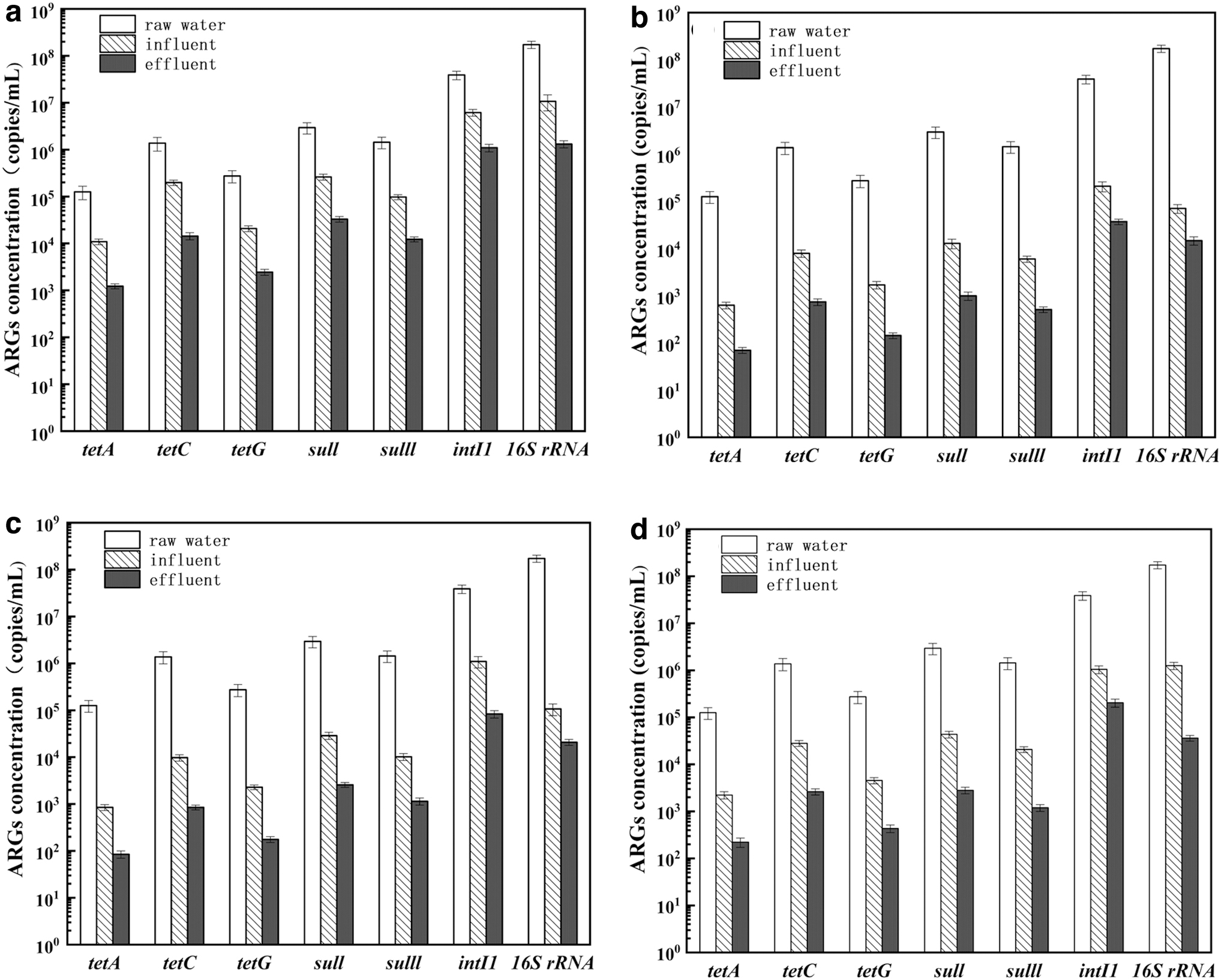
According to the optimal dosage of the three oxidants selected above, this article explored the reduction of ARGs in secondary effluent under the optimal dosage of each combined process. During the test, the concentrations of different types of ARGs, intI1, and 16S rRNA in the raw water (secondary effluent) and membrane influent and effluent of different combined processes were detected, respectively, and the results are shown in Fig. 3. The removal of ARGs by each treatment process is listed in Table 2.
Detection of ARGs before and after each treatment process:
Removal of Antibiotic Resistance Genes by Each Treatment Process (-log)
The difference between the base-10 logarithmic value of the ARGs in raw water with and process effluent was recorded as the removal amount.
ARGs, antibiotic resistance genes; NaClO, sodium hypochlorite; O3-PAC-UF, ozone-powdered activated carbon-ultrafiltration; UV, ultraviolet.
It can be seen from Fig. 3 and Table 2 that the four processes of PAC-UF, NaClO-PAC-UF, O3-PAC-UF, and UV-PAC-UF all showed removal effects on ARGs, intI1, and 16S rRNA in raw water. Specifically, the removal amounts of tetA, tetC, tetG, sulI, sulII, intI1, and 16S rRNA by PAC-UF were 2.01-log, 1.98-log, 2.05-log, 1.95-log, 2.07-log, 1.55-log, and 2.12-log, respectively. The adsorption of PAC combined with the retention of UF showed a better removal effect on ARGs in the secondary effluent. The removal of tetA, tetC, tetG, sulI, sulII, intI1, and 16S rRNA by the NaClO-PAC-UF process was 3.25-log, 3.27-log, 3.28-log, 3.47-log, 3.45-log, 3.02-log, and 4.07-log, respectively. The removal of the latter was slightly larger than that of the PAC-UF process, and the reason is that NaClO can damage the DNA structure (cell-free and cell-associated DNA) of ARGs, resulting in a higher removal rate.(Zhang, 2014).
The specific reductions of tetA, tetC, tetG, sulI, sulII, intI1, and 16S rRNA by the O3-PAC-UF process were 3.17-log, 3.21-log, 3.19-log, 3.06-log, 3.10-log, 2.67-log, and 3.92-log, respectively. The removal effect of the O3-PAC-UF process on tet genes was better than for sul genes, which means that the latter is more tolerant to O3 treatment. The removals of tetA, tetC, tetG, sulI, sulII, intI1, and 16S rRNA by the UV-PAC-UF process were 2.75-log, 2.72-log, 2.80-log, 3.02-log, 3.08-log, 2.28-log, and 3.68-log, respectively. The reduction of sul genes by the UV-PAC-UF process was higher than that of tet genes because tetracycline ARB usually has a lower UV absorption coefficient (Guo et al., 2015).
Removal of ARGs with different existing forms by the combined process
Different preoxidation methods on the removal of cell-associated and cell-free ARGs
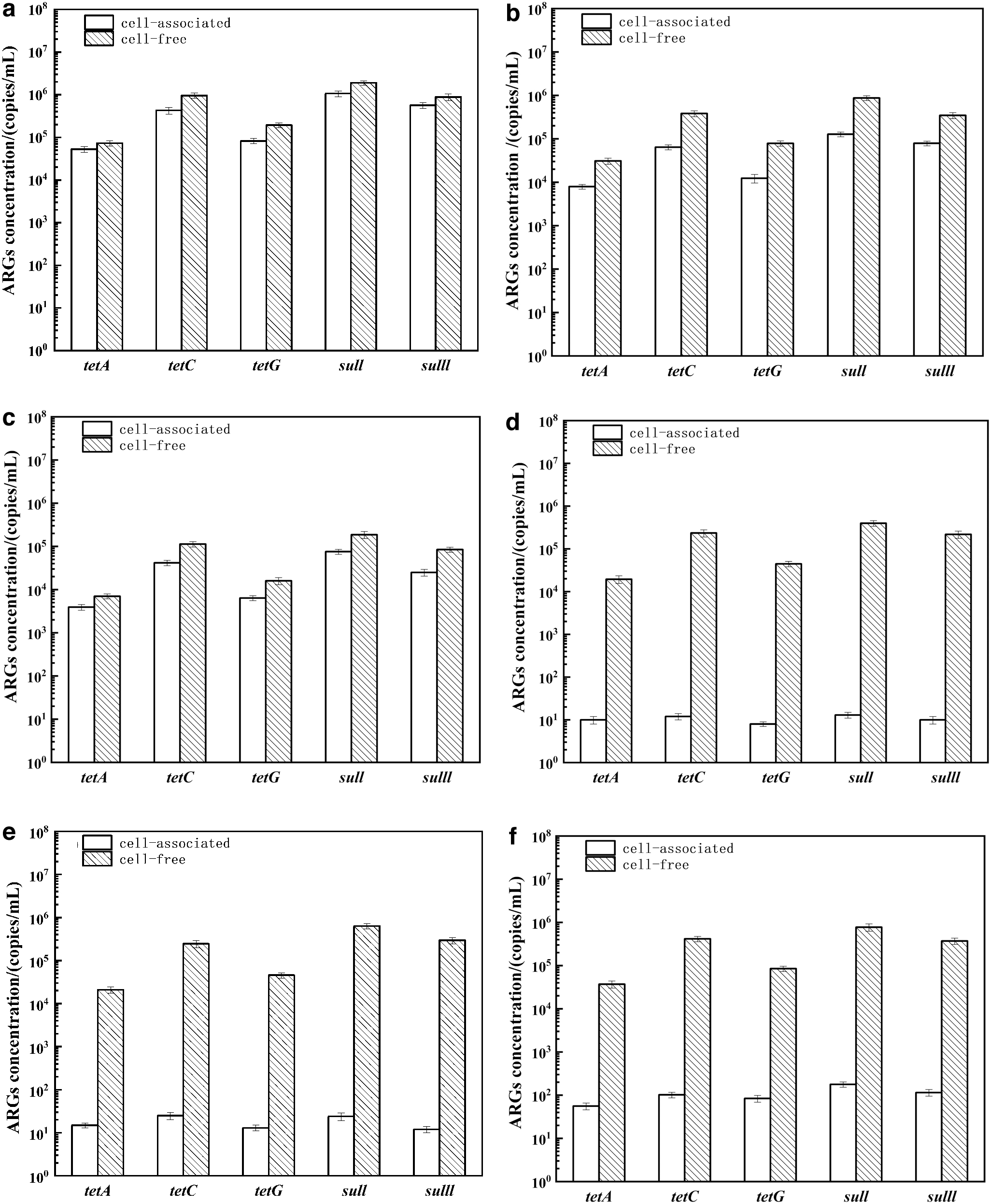
This article studied the distribution of cell-associated and cell-free ARGs in the secondary effluent, as well as the removal of cell-associated and cell-free ARGs by different processing units of the combined process. The results are shown in Fig. 4 and Table 3.
Distribution of cell-associated and cell-free resistance genes in the effluent from different treatment units:
Cell-Associated and Cell-Free Antibiotic Resistance Genes Removal in Secondary Effluent by Each Treatment Process (-log)
Figure 4a shows that the concentration ranges of the cell-associated tetA, tetC, tetG, sulI, and sulII in the secondary effluent of the wastewater treatment plant were 104.82–104.89, 105.94–106.01, 105.25–105.32, 106.23–106.30, and 105.90–105.97 copies/mL, respectively. The concentration ranges of cell-free tetA, tetC, tetG, sulI, and sulII were 104.70–104.75, 105.61–105.65, 104.89–104.94, 105.99–106.05, and 105.72–105.77 copies/mL, respectively. The concentration of cell-free ARGs in raw water was higher than that of the cell-associated ARGs.
Figure 4b and Table 4 show that the removal of ARGs by direct UF was 0.81–0.93-log, which removed more than 85.9% of cell-associated ARGs, while the removal efficiency of cell-free ARGs in raw water was relatively poor and the removal amount of each free state ARGs is only 0.33–0.40-log. This is because most of the cell-associated ARGs can be directly retained by the UF membrane, whereas cell-free DNA are flexible molecules that can be stretched in high-speed water flow and squeezed through much smaller membrane pores (Sousa et al., 2017).
Removal of Cell-Free Antibiotic Resistance Genes in Secondary Effluent by Each Combined Process (-log)
Figure 4c and Table 4 show that the removal of ARGs in each cellular state in the secondary effluent by PAC adsorption was 1.01–1.35-log, and the removal of cell-free ARGs was 0.92–1.08-log. Both forms of ARGs show a high removal capacity, among which the removal efficiency of cell-associated ARGs was relatively better. Figure 4d–f and Table 4 illustrate that the three oxidants had good removal effects on the cell-associated ARGs in the secondary effluent with removal amounts of 3.72–4.91-log, 3.54–4.67-log, and 3.27–4.01-log for NaClO, O3, and UV, respectively. The removal rate of ARGs in each cell state was as high as 99.0%, whereas the removal efficiency of cell-free ARGs was low. The removal of cell-free ARGs in raw water by NaClO, O3, and UV was 0.29–0.38-log, 0.47–0.63-log, and 0.57–0.68-log, respectively.
Removal efficiency of different combination processes on cell-associated and cell-free ARGs
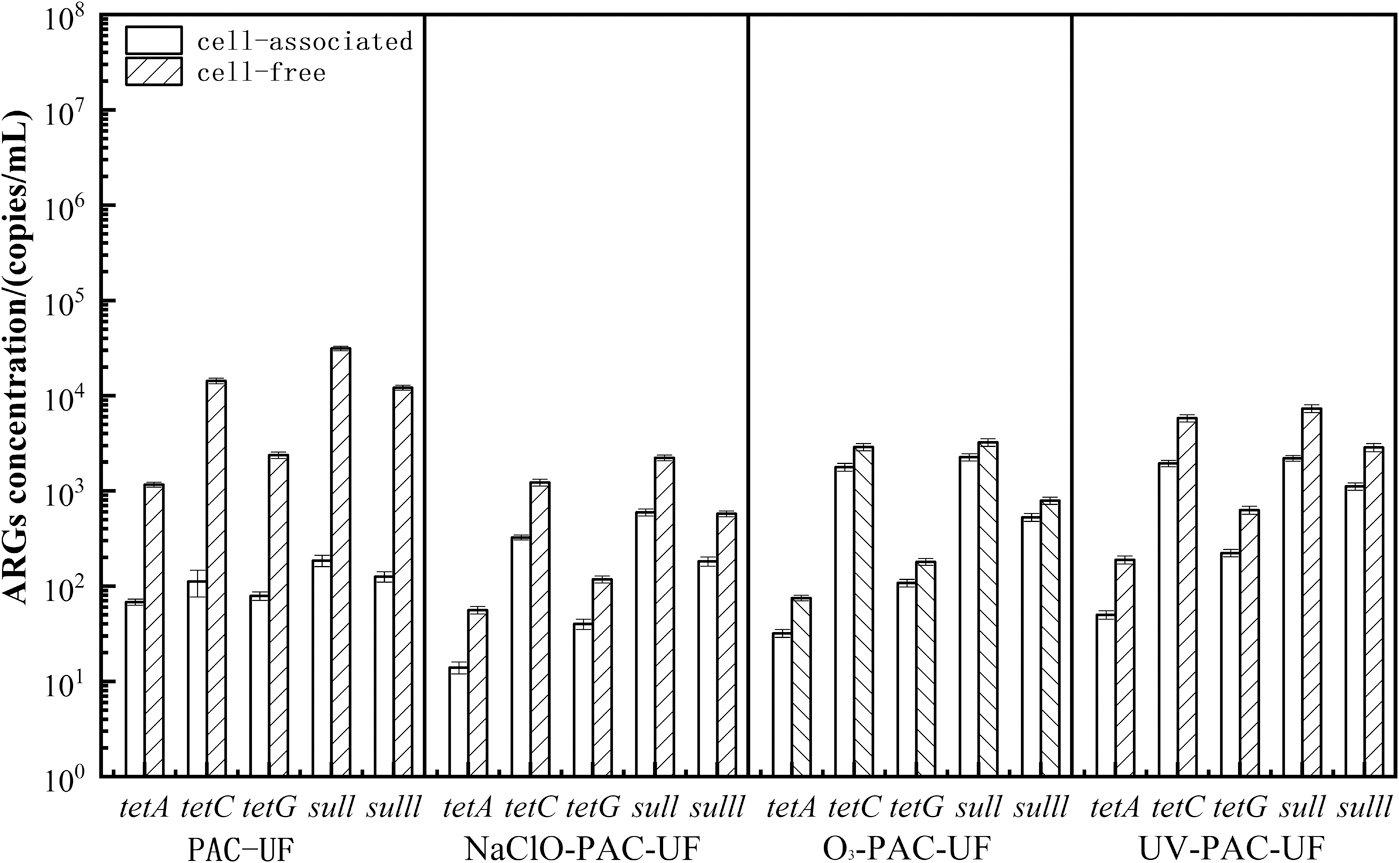
After determining the reduction of the cell-associated and cell-free ARGs in the secondary effluent by each treatment unit, the distribution and removal efficiency of the cell-associated and cell-free ARGs in the membrane effluent of each combined process were further studied. The results are shown in Fig. 5 and Table 4.
Distribution of cell-associated and cell-free resistance genes in the effluent of each combined process.
Figure 5 and Table 4 show that the PAC-UF combined process could remove 2.89–3.76-log and 1.78–1.91-log for the cell-associated and cell-free ARGs in the raw water, respectively, which was more than direct UF or PAC adsorption on the removal of cell-associated and cell-free ARGs (Table 4). Cell-associated ARGs with larger molecular weight in water samples were directly retained by the UF membrane, while cell-associated ARGs and cell-free ARGs with smaller molecular weight were adsorbed by PAC in the water and ultimately removed by the retention effects of the UF membrane (Zhang et al., 2019a).
When NaClO, O3, and UV were used as oxidants and combined with PAC-UF, the removal efficiency of the two forms of ARGs in the secondary effluent was further improved. The concentration of each cell-associated ARG in the membrane effluent of the three combined processes was not detected, indicating that the three combined processes almost entirely removed the cell-associated ARGs in the secondary effluent. The three combined processes removed the cell-free ARGs in the secondary effluent to amounts of 3.02–3.28-log, 2.87–3.05-log, and 2.52–2.87-log, respectively. Compared with the PAC-UF combined process, the three combined processes improved the removal of cell-free ARGs, which implies that the preoxidation process can strengthen the water removal of cell-free ARGs (Cheng et al., 2017). The combination of preoxidation and PAC-UF therefore achieves efficient removal of cell-associated and cell-free ARGs in secondary effluent.
Mechanism of free radicals in preoxidation to remove ARGs
Concentration of free radicals produced by oxidant decomposition under variable preoxidation conditions
Hydroxyl (•OH) is the most important active free radical in the oxidation reaction. The second-order rate constant of the reaction between •OH and organic matter is very high, which can reach as high as 109 M−1·s−1, thus various types of water can be removed without selection of organic pollutants (Bu, 2019). During the test, three oxidants, NaClO, O3, and UV and BA solution (50 mg/L), were added under the optimal dosage conditions over a reaction time of 30 min. High-performance gel liquid chromatography was then used to analyze the p-HBA content in the water after reaction. The •OH concentration is quantified by measuring p-HBA, which is a stable product formed by the reaction of •OH and BA. The cumulative •OH concentration is calculated based on 5.87 times the p-HBA concentration (Wei, 2013).
Table 5 shows that •OH was not detected in the NaClO system, which generates strongly oxidizing HClO through hydrolysis, thereby oxidizing and removing ARGs in water. The O3 produced 0.0419 mM •OH during the oxidation process, and the UV radiation produced 0.0089 mM •OH during the radiation process. Generally, •OH has a very high standard redox potential (+2.80 V), the oxidation reaction is not selective, and the oxidation of microorganisms and various pollutants typically proceeds very quickly (Liao et al., 2019). However, in the O3 and UV systems, the effect of •OH on the removal of ARGs remained unclear and further study is required.
•OH Contents in Different Oxidant Systems
The dosages of NaClO (in terms of available chlorine concentration), O3, and UV were 8.0, 2.0 mg/L, and 40 mJ/cm2, respectively. The molar mass of p-HBA was 138.12 g/mol.
p-HBA, p-hydroxybenzoic acid.
Role of free radicals in preoxidation to remove ARGs
To determine the influence of O3 and •OH generated during the preoxidation of UV on the removal of ARGs, this study used tert-butanol (TBA) as a free radical inhibitor. The reaction rate of TBA with •OH is very fast, and it can be used as a capture agent for •OH (Dodd et al., 2009). In the experiments, the optimal dosages of O3 and UV were 2.0 mg/L and 40 mJ/cm2, respectively. Excessive TBA (•OH: TBA = 1:50) was added to the UV and O3 preoxidation system to verify the effect of •OH on ARGs. The ARG concentrations before and after TBA inhibition are shown in Fig. 6.

Effect of hydroxyl radicals on ARG removal efficiency:
Figure 6a shows that the concentrations of tetA, tetC, tetG, sulI, and sulII in the water after treatment with O3 alone were 104.32, 105.39, 104.66, 105.80, and 105.47 copies/mL, respectively. After treatment with 0.04 mM TBA, the concentrations of tetA, tetC, tetG, sulI, and sulII increased slightly to 104.57, 105.60, 104.82, 105.94, and 105.65 copies/mL, respectively. The experimental results showed that in the O3 system, the addition of TBA has a certain inhibitory effect on the removal of ARGs, but the effect is not outstanding. It is generally believed that the O3 system can oxidize and remove pollutants through two mechanisms: one is the direct oxidation of O3 molecules to remove the pollutant and the other is the indirect oxidation of •OH produced by the decomposition of O3 (Cheng, 2017).
Previous studies have shown that in the O3 preoxidation process, O3 molecules can attack the double bond and negative electron part existing in different types of ARGs (Lueddeke et al., 2015), whereas •OH can destroy the side chain and main chain of the protein and cause fragmentation, as a result, the free ARGs in the water are reduced. However, •OH usually reacts quickly and nonselectively with most compounds, the generated •OH is quickly consumed by the dissolved organic matter in the sewage, and the reaction rate exceeds the reaction between •OH and ARGs (Yoon et al., 2017). Also, •OH will first attack the cell wall and cell membrane, causing the rupture of the bacterial cell membrane and the inactivation of the bacteria, and then the active substance enters the cell to oxidize the gene, so the removal rate of cell-free ARGs in water will be slightly higher than that of cell-associated ARGs. Studies (Zhou, 2020) can also confirm this. In summary, the direct oxidation of O3 molecules is dominant in the removal of ARGs in secondary effluent.
Figure 6b shows that the concentrations of tetA, tetC, tetG, sulI, and sulII in the water after UV treatment were 104.57, 105.62, 104.93, 105.89, and 105.57 copies/mL, respectively. After adding TBA to the UV system, the concentrations of tetA, tetC, tetG, sulI, and sulII in the water were 104.59, 105.63, 104.94, 105.89, and 105.58 copies/mL, respectively, and there was no significant change in the concentration of each ARG when oxidized by UV alone. This indicates that low concentrations of •OH have little effect on the oxidation and removal of ARGs. The removal of ARGs in the UV oxidation process therefore mainly relies on UV radiation to destroy bacterial nucleic acid and inhibit DNA replication, and mainly removed ARGs in water through photochemical reaction oxidation (Zhang et al., 2019b).
Conclusions
The optimal dosages of NaClO (in terms of available chlorine concentration), O3, and UV were 8.0, 2.0 mg/L and 40 mJ/cm2, respectively. The three combined processes could effectively remove ARGs and organics in secondary effluent. The best ARG removal effect among these three combined processes was achieved by NaClO-PAC-UF with a removal amount of 3.25–3.47-log.
The concentration of cell-free ARGs in the secondary effluent was higher than the concentration of cell-associated ARGs. The removal efficiency of UF was higher on cell-associated ARGs, whereas the removal amount of cell-free ARGs was only 0.33–0.40-log. The removal amount of PAC-UF for cell-associated ARGs was 2.89–3.76-log, whereas the removal amount of cell-free ARGs was 1.78–1.91-log. No cell-associated ARGs were detected in the membrane effluent of the three combined processes, and the removal effect of NaClO-PAC-UF was the best for cell-free ARGs, with a removal amount 3.02–3.28-log.
NaClO mainly oxidizes and decomposes ARGs through HClO generated by hydrolysis. O3 and UV oxidation processes produce •OH, but the amount of free radicals generated by UV is very small. The oxidation mechanism of O3 for ARGs is mainly the direct oxidation of O3 molecules, and the oxidation of •OH is auxiliary. The oxidation mechanism of UV on ARGs is mainly through the photochemical oxidation of UV to remove ARGs and •OH has little effect.
Footnotes
Author Disclosure Statement
There are no conflicts of interest to declare.
Funding Information
This study was supported by National Natural Science Foundation of China (Nos. 52070011, 51678027, and 51678026).