




Abstract
In this article, low-molecular-weight organic acids were applied to remediate the hexavalent chromium [Cr(VI)]-contaminated soil. The influence of different parameters (washing concentration, solid–liquid ratio, time, and pH value) on the repair effect was explored, and the form distribution and desorption kinetic experiments of the soil were performed. The results show that the pH of eluents can significantly affect the form distribution of chromium, with the exchangeable form increasing considerably at a lower pH. The kinetics of Cr(VI) desorption can be described by the pseudo-second-order kinetics equation. The best washing scheme was determined to be the citric acid as the eluent at a concentration of 0.3 mol/L, a solid to liquid ratio of 1:10, pH 4, and a washing time of 6 h. The removal rate can be as high as 73.52%. After washing, the leaching concentration of Cr(VI) in the soil was reduced from 23.76 to 1.05 mg/L, well below the regulatory constraint of 5 mg/L. Additionally, the characterizations of X-ray diffractometer and scanning electron microscope showed little effect of adopting citric acid as a washing agent on soil structure and surface morphology. This study can provide a theoretical basis for the remediation of Cr(VI)-contaminated soil at industrial sites.
Introduction
Chromium and its compounds are vital industrial raw materials widely used in leather, chemical, electroplating, steel manufacturing, and other industries (Zhang et al., 2018; Li et al., 2020). During their production process, a large amount of chromium residue and chromium-containing wastewater is generated (Liu et al., 2020a). Without proper disposal, the chromium from these pollutants can enter the soil through natural processes (weathering and biochemical) (Dhal et al., 2013; Zhang et al., 2020b), posing serious pollution problems to the soil, surface water, and groundwater (Hausladen et al., 2018). Trivalent chromium [Cr(III)] and hexavalent chromium [Cr(VI)] are the main oxidation states of chromium (Miretzky and Cirelli, 2010). The former is less toxic and relatively stable (Qiang et al., 2018). In contrast, Cr(VI) is highly toxic and has higher instability (Sturm et al., 2018). Furthermore, people are likely to develop cancer when being exposed to a high concentration of Cr(VI) over a long time (Liu et al., 2020a). Therefore, Cr(VI) treatment is the key to the remediation of chromium-contaminated soils.
At present, two common methods for the treatment are: (1) changing the form of Cr(VI); and (2) removing Cr(VI) from the soil. The former is achieved by adding a reducing agent to convert Cr(VI) to Cr(III). Although the method is fast and effective, the reaction products are unstable and can be reoxidized to Cr(VI) (Fu et al., 2020; Zhang et al., 2020a). The second approach mainly includes phytoremediation (Kumar et al., 2020), microbial restoration (Wang et al., 2015), and soil washing restoration (Liu et al., 2018). Among them, phytoremediation and microbial remediation require longer cycles and are therefore more time costly. Soil washing exploits the high mobility and instability of Cr(VI) to rapidly transfer heavy metals in the soil from solid phase to liquid one (Jean-Soro et al., 2012; Dhal et al., 2013). Common eluents include strong acids, chelator, and low-molecular-weight organic acids (LMWOAs). Strong acids cause irreversible damage to soil properties, while chelator tends to cause the loss of soil nutrients (Wang et al., 2019b). LMWOAs are easily degraded and environmentally friendly, making them a hotspot for soil washing agents' research (Zou et al., 2019).
LMWOAs include oxalic, citric, malic, formic, acetic, lactic, tartaric acids, etc., which are mainly produced by plant root exudates, microbial metabolism, and soil matter decomposition (Chen et al., 2018). Some studies have reported that organic acids strongly influence the migration and transformation of heavy metals in the soil (Schwab et al., 2008; Geng et al., 2020). It has also been shown that the chelation, precipitation, and redox of organic acids with heavy metals can all affect the fixation of heavy metals in soils (Malek et al., 2009). Obviously, LMWOAs play an important role in removing heavy metals from soils. However, few studies have been carried out to screen the effect of LMWOAs washing on the removal of Cr(VI) from soils and to optimize conditions based on the distribution of heavy metal species in soils.
This study's objectives are: (1) To select the organic acid with the best removal efficiency from citric, malic, and tartaric acids under different washing conditions. (2) To determine the optimal operating parameters of organic acids given the form distribution of Cr in soils before and after washing. (3) To evaluate the repair effect and to characterize the soil before and after washing.
Materials and Methods
LMWOAs and soil sample
Citric, tartaric, and malic acids used in the experiment are all analytical reagents (Aladdin, Shanghai, China). Soil samples for this experiment were collected from an abandoned chromium salt chemical company in Chongqing, China. After removing impurities, the soil was air dried, ground, and then passed through a 100-mesh sieve. The soil was well mixed then sealed for storage. The basic properties of the soil are shown in Table 1.
Basic Properties of the Experimental Soil
Cr(VI), hexavalent chromium.
Experimental method
Soil washing experiments
Concentration screening: The soil samples (5 g) were placed in a series of centrifuge tubes (100 mL), with 50 mL of citric acid, tartaric acid, and malic acid solutions of 0.01, 0.03, 0.05, 0.1, 0.3, and 0.5 mol/L were added. The suspensions were shaken at 200 r/min in a shaking table for 2 h and centrifuged at 3,000 r/min for 20 min. The concentration of Cr(VI) in soil samples was determined by the alkaline digestion method of (USEPA 3060A, 1996) and (USEPA 7196A, 1992).
Solid–liquid ratio screening: Based on the results of (1), the best concentration of LMWOAs was selected for the solid–liquid ratio experiment. The solid–liquid ratio was set at 1:1, 1:2, 1:5, 1:8, 1:10, and 1:15. Refer to (1) for other steps.
Time screening: Based on the result of (2), the optimum concentration and solid–liquid ratio was chosen for different time experiments. The time was set to 0.5, 1, 2, 4, 6, 10, 16, and 24 h. Refer to (1) for other steps.
The selection of pH value: The most effective organic acid was selected based on the results of (1), (2), and (3), and then the pH range was set to 3, 4, 5, 6, and 7 by adjusting the NaOH solution. Refer to (1) for other steps.
Speciation analysis of Cr
The Tessier (Tessier et al., 1979) sequential extraction method was used to extract the metal species of Cr in soils. The specific procedure is shown in Table 2. The centrifuged solution was transferred to a 50-mL volumetric flask and measured by graphite furnace atomic absorption spectrometry (AA800) after being filtered through a 0.45 μm microporous membrane.
Sequential Extraction Procedure
Leaching
The soil samples were pretreated according to the “Solid waste-extraction procedure for leaching toxicity–sulfuric acid & nitric acid method” (HJ/T299-2007, 2007). The leaching solution was then measured by 1,5-diphenylcarbohydrazide spectrophotometric method (GB/T15555.4-1995, 1995) at 540 nm on an ultraviolet–visible spectrophotometer (UV756CRT; Shanghai Youke Instrument Co., Ltd.).
Characterization
The crystal structure, surface morphology, and elements' composition of the soil were analyzed by X-ray diffractometer (XRD; X’ Pert PRO), scanning electron microscope (SEM; FEI inspect F50), and energy-dispersive X-ray spectroscopy (EDS; EDAX Super Octane), respectively.
Results and Discussion
Effect of washing agent concentration
Figure 1 shows the effects of citric, malic, and tartaric acids on the removal rates of Cr(VI) in soils under different concentration gradients. According to the Fig. 1, the removal rate increased rapidly when the washing concentration ranged from 0.01 to 0.1 mol/L, and when the concentration reached 0.3 mol/L, the removal rates of citric acid (79.65%), malic acid (79.27%), and tartaric acid (77.41%) gradually leveled off. This may occur because large amounts of organic acids bound with the heavy metals in the soils by chelation and continued to form heavy metal complexes, as the concentration of organic acids increased at the initial stage of rinsing (Wuana et al., 2010). The metal complexes were able to exchange cation with the soil so that the heavy metals can be resolved continuously, thus increasing the removal rate rapidly. When the dynamic equilibrium was reached, the removal rate tended to be flattened. According to the results of the concentration screening test, the three organic acids were best removed at a concentration of 0.3 mol/L. Therefore, a concentration of 0.3 mol/L was chosen for the next experiment.

The removal rate of Cr(VI) in soil using malic acid, tartaric acid, and citric acid as washing agents under different washing concentrations. Cr(VI), hexavalent chromium.
Effect of solid– liquid ratio
The effects of three washing agents on removing Cr(Ⅵ) from soils under different solid–liquid ratios at a concentration of 0.3 mol/L are shown in Fig. 2. The removal rate rose rapidly in the smaller range of solid–liquid ratio. Tartaric acid gradually stabilized when the solid–liquid ratio was 1:5, and the removal rate at this time was 76.73%; citric acid and malic acid became stable when the solid–liquid ratio was 1:10, and their removal rates at this time were 81.28% and 76.55%, respectively. This could be explained by the fact that the washing agent could not be fully mixed with the soils at a small solid–liquid ratio. When the ratio increased, the contact area between the soil and the washing agent gradually augmented; so that the removal rate gradually rose. Since the trend in tartaric acid removal rate flattened out when the solid–liquid ratio was 1:5, the solid–liquid ratios for the three eluents were 1:5 for tartaric acid, 1:10 for citric acid, and malic acid, respectively, to conserve water.
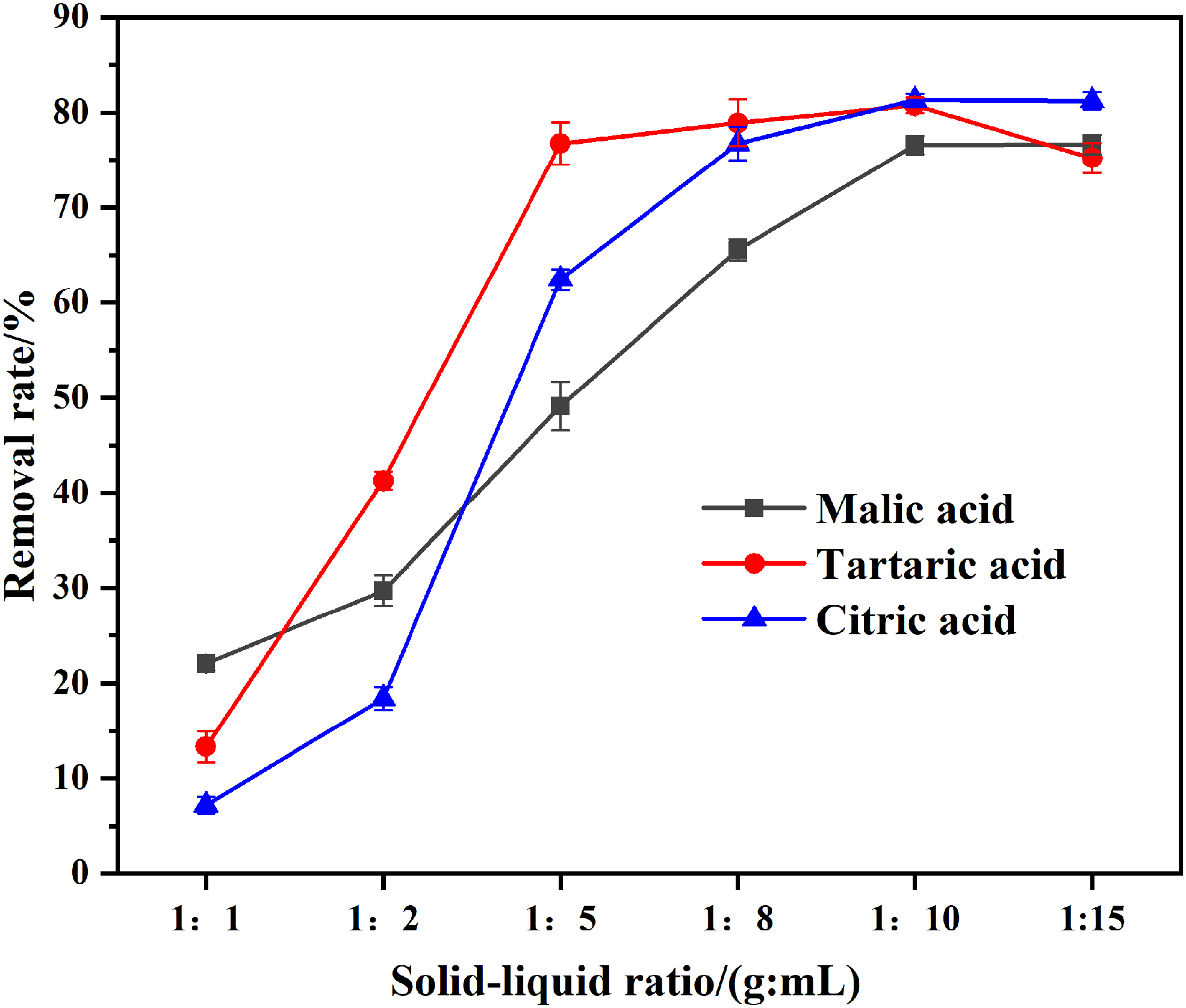
The removal rate of Cr(VI) in soil using malic acid, tartaric acid, and citric acid as washing agents under different washing solid–liquid ratios.
Effect of washing time and kinetic study
The experiment of elution time screening was carried out on the basis of previous screening results. According to Fig. 3, the removal process of Cr(VI) in the soils can be divided into two stages, one is the rapid rise stage, and the other is the stable stage. The reason why it could not increase after becoming stable is that there was residual Cr(Ⅵ) tightly bound to the soils. Organic acids also have a reduction effect on Cr(VI) (Wang et al., 2019a), which is easily reduced to Cr(Ⅲ) by organic acids under acidic conditions (Deng and Stone, 1996). The effective functional groups (carboxyl and hydroxyl) in organic acids can combine with Cr(Ⅲ) to form soluble Cr(Ⅲ)–organic acid complexes, which will increase the fluidity of Cr(Ⅲ) so that it can be washed out (Puzon et al., 2008; Cao et al., 2011). The removal rate of three organic acids on Cr(Ⅵ) in the soil after stabilization can be ranked as citric acid > tartaric acid > malic acid. According to related studies, the more effective the functional groups contained in organic acids, the easier it is to associate with heavy metal ions, for these groups provide more adsorption sites and a larger surface area (Jing et al., 2007; Taghipour and Jalali, 2013; Geng et al., 2020). Citric acid contains three carboxyl groups, so its removal rate is the highest. Although both tartaric acid and malic acid contain two carboxyl groups, the former has two hydroxyl groups, whereas the latter has only one; therefore, the former's removal rate is higher (the molecular and structural formulas of organic acids are shown in Table 3).

The removal rate of Cr(VI) in soil using malic acid, tartaric acid, and citric acid as washing agents under different washing times.
Organic Acid Molecular Formula and Structural Formula
The release process of Cr(Ⅵ) in soil is a complex combination of adsorption and desorption. To figure out the release kinetics of Cr(Ⅵ) in soil, two kinetic equations (Elovich kinetics and pseudo-second-order kinetics) were used in this work. The parameters of desorption kinetic equations are shown in Supplementary Table S1. Correlation coefficient (R2) is an indicator of the degree of fit of the trend line, a higher R2 represents a better fit. According to Supplementary Table S1 and Fig. 4, it can be seen that the pseudo-second-order equation model is more suitable to describe the desorption of Cr(Ⅵ) in soil. Besides, it was claimed that the desorption process of Cr(Ⅵ) in soil with organic acid might be a heterogeneous diffusion reaction (Aharoni et al., 1991).
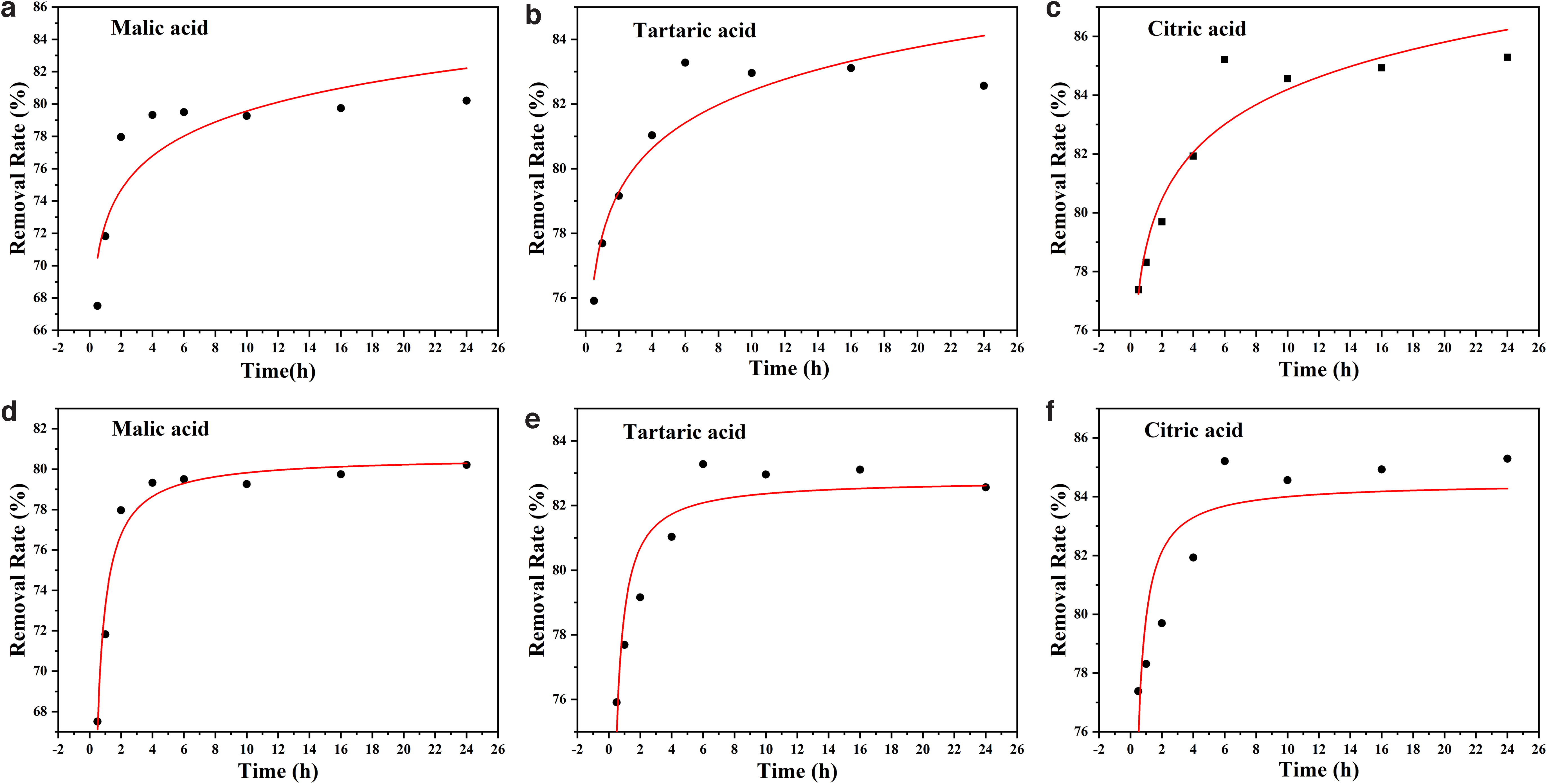
Comparison of fitting effects of two kinetic models.
Since citric acid is cheap and has the highest removal rate, it was chosen as the washing agent. The best washing conditions were achieved at a concentration of 0.3 mol/L, a solid–liquid ratio of 1:10, and a washing time of 6 h.
Effect of pH
The pH is one of the vital parameters controlling the transfer of metal elements from the solid to liquid phase (Houben et al., 2013). Figure 5 exhibits the effect of citric acid with a pH of 3–7 on the content and removal rate of Cr(Ⅵ) from the soil. With the increase of pH, the content gradually rose and the removal rate decreased gradually to 75.91%, 73.52%, 67.01%, 55.31%, 51.70%, sequentially. The results show that citric acid had a higher removal rate of Cr(Ⅵ) in soil under acidic conditions, which is consistent with a previous study (Zhang et al., 2017). According to related research reports, changes in pH value significantly affect the distribution of Cr in the soil, which is an important indicator for evaluating the hazard of contaminated soil to the surrounding environment (Wang et al., 2018; Geng et al., 2020; Xu et al., 2020). To minimize the harmfulness of the soil after treatment, we need to screen the pH according to the distribution of heavy metal species before and after washing, rather than just on the basis of removal rate. Based on the experimental results of the previous step, the top three citric acid eluents (pH 3, 4, and 5, respectively) were selected to study the effect of pH on the distribution, with the remaining operating conditions unchanged.

The concentration and removal rate of Cr(VI) in the soil after washing with citric acid of different pH.
The influence of eluent pH on form distribution
A sequential extraction method divided into five forms was adopted to analyze the distribution of Cr in the soil. Figure 6 shows the speciation distribution in the soil after washing with a citric acid eluent of different pH values compared with the original soil. It can be seen that the total forms of the soil after washing was significantly reduced, and they decreased to the minimum after being washed at pH 4. The content of the exchangeable form, carbonate bound form, and residual form decreased gradually as the pH of the eluent increased, whereas the Fe-Mn oxide bound form and organic bound form presented the opposite trend. Among the five forms, the Fe-Mn oxide bound form was the most abundant.
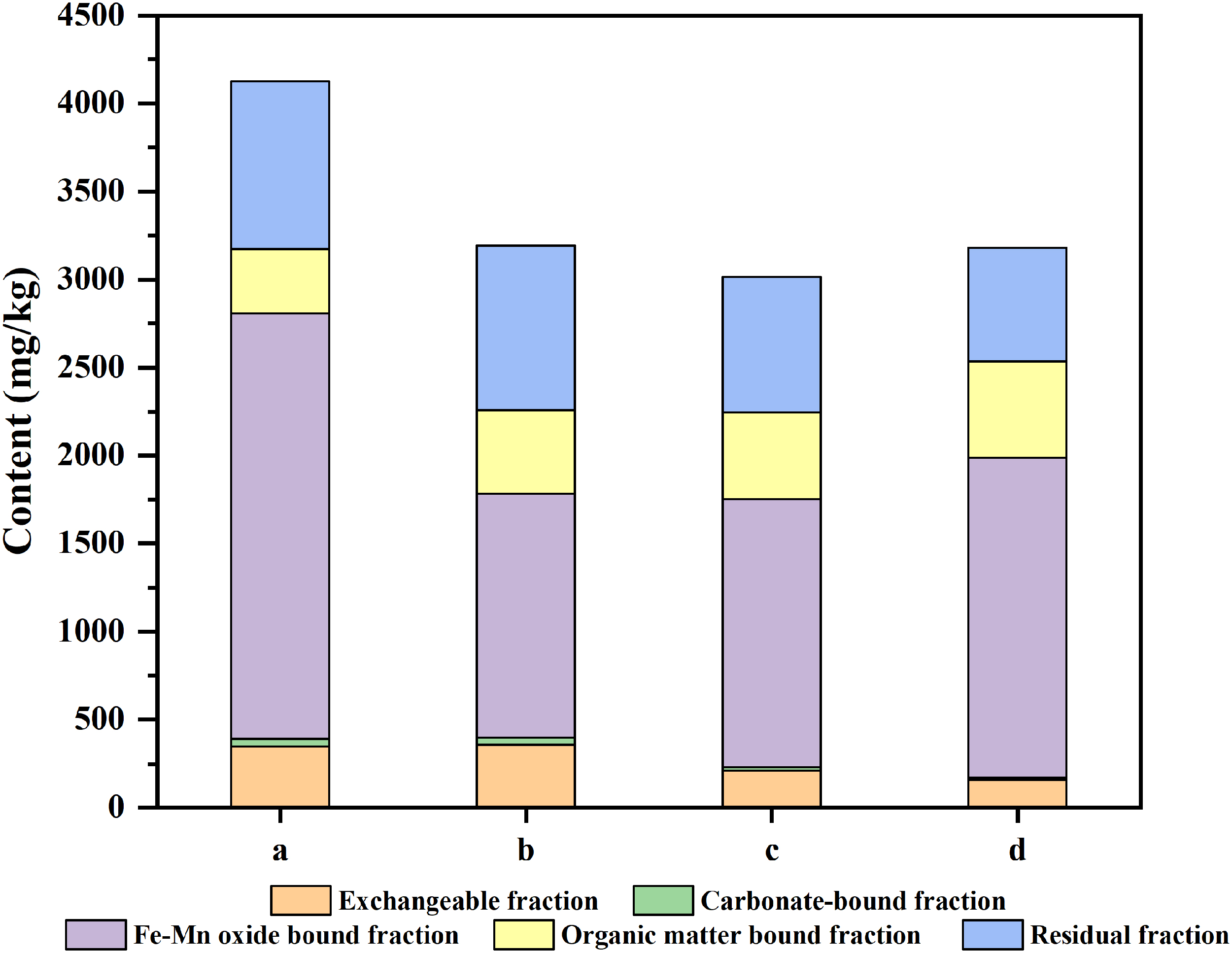
Speciation distribution of Cr in soils before and after washing. (a) Untreated soil. (b) Soil after washing with citric acid at pH 3. (c) Soil after washing with citric acid at pH 4. (d) Soil after washing with citric acid at pH 5.
The residue and organic bound form are relatively stable and have low bioavailability. However, the carbonate bound form, especially the exchangeable form is easy to migrate and transform, which is extremely harmful to the environment (Ertani et al., 2017; Wu et al., 2020). According to Xu et al. (2020) and Dhal et al. (2013), the exchangeable Cr content in the soil may increase under acidic conditions. Therefore, the pH of the eluent should not be too low; otherwise, the pH of the soil would be lowered. Moreover, Mn oxide can promote the formation of Cr(VI) through catalytic oxidation, and the promotion effect is obvious with increasing soil pH (Apte et al., 2006; Liu et al., 2020b). The pH values of the soil after washing were 6.45, 7.46, and 9.52. Accordingly, the eluent with pH 4 was the optimal choice.
In summary, the citric acid eluent with a pH of 4 reached the best conditions for treating Cr(VI) contaminated soil when the concentration was 0.3 mol/L, the solid–liquid ratio was 1:10, and the washing time was 6 h. The leaching concentration of the treated soil was 1.05 mg/L, which was lower than the leaching limit of 5 mg/L for Cr(VI) specified in the Standard for Identification of Leaching Toxicity of Hazardous Wastes (GB5085.3-2007, 2007).
Characterization analysis before and after washing
XRD and SEM analyses were performed to investigate whether citric acid eluent affects the crystal structure and surface morphology of the soil.
Figure 7 displays the XRD spectra of the soil before and after treatment with citric acid eluent with different pH values, and the characteristic peaks of minerals were identified using a matching program based on PDF files. The results show that the contaminated soil mainly contains SiO2 (main characteristic peak at 20.859°, 26.640°, 59.960°, and 68.313°), NaAlSi3O8 (main characteristic peak at 27.893°), and MnO2 (main characteristic peak at 21.060° and 36.572°). After washing with different pH citric acid eluent, these peak positions and peak intensities did not change significantly, indicating that citric acid as a washing agent had little effect on the crystal structure of the soil. This is probably because the chelation of LMWOAs with soil heavy metals could only form stable new ions, but not new crystal structures. In addition, the Cr(III) phase was not detected, indicating that the Cr(III) phase may be amorphous and unable to form crystal structure, or the amount of crystal structure formed may be too small to reach the detection limit (Yuan et al., 2019). The presence of the crystalline compound MnO2 also confirmed the presence of significant amounts of manganese oxides in the soil.

XRD spectra of the soil before and after treatment with citric acid of different pH. XRD, X-ray diffractometer.
Figure 8 shows the surface morphology and elements' distribution of the soil before and after treatment with citric acid under optimal conditions. As can be seen in the Fig. 8, the contours of the soil surface before washing were visible (Fig. 8a). Although the surface morphology of the soil had slightly changed after washing (Fig. 8b), the outline of the soil particles was still clearly under the microscope, indicating that the citric acid as a washing agent had only a little erosive effect on the soil and did not damage it. In addition, the EDS spectrum reveals that the proportion of Cr, Fe, and Mn in the soil after washing has decreased significantly. Therefore, citric acid is a suitable washing agent for the treatment of Cr(VI)-contaminated soil.
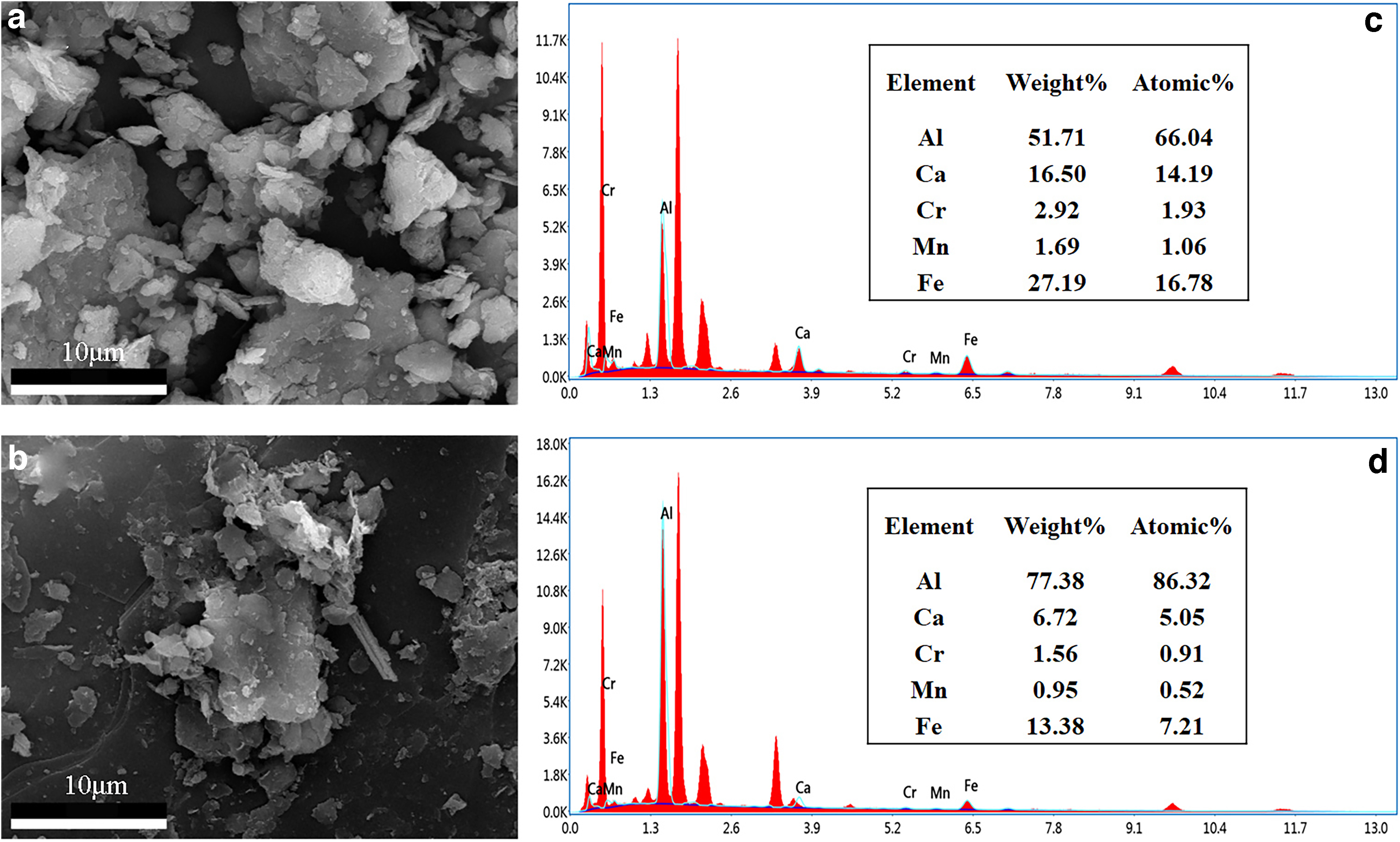
SEM images of the surface morphology of the soils before
Conclusions
In this work, three common LMWOAs (citric, tartaric, and malic acids) were screened and optimized, and it was determined that citric acid was the most effective at a concentration of 0.3 mol/L, a solid–liquid ratio of 1:10, pH 4, and a washing time of 6 h. The removal rate of soil Cr(VI) reached 73.52%, and the leaching concentration of soil Cr(VI) was 1.05 mg/L after treatment. Citric acid is economically feasible for engineering applications, thanks to its low price, and using it for the remediation of Cr(VI)-contaminated soils has broad application prospects. It is also concluded that, when washed under different pH conditions, the distribution of heavy metal forms varied greatly, and exchangeable Cr was more distributed in the soil after washing under lower pH conditions. Moreover, a proper pH value should be ensured during washing to reduce the damage of exchangeable Cr to the environment. For soils containing more Mn oxides, the pH of the eluent should also be considered when washing.
Footnotes

References
Supplementary Material
Please find the following supplemental material available below.
For Open Access articles published under a Creative Commons License, all supplemental material carries the same license as the article it is associated with.
For non-Open Access articles published, all supplemental material carries a non-exclusive license, and permission requests for re-use of supplemental material or any part of supplemental material shall be sent directly to the copyright owner as specified in the copyright notice associated with the article.
