




Abstract
Abstract
Co-pyrolysis characteristics of rice husk and cow manure using SnCl2, ZnCl2 and Fe3O4 as an additive were studied in a fixed tubular furnace. The effects of additive loading amount (0–20 wt.%) on the pyrolysis processes were investigated. The thermogravimetric-derivative thermogravimetric results showed that the weight loss rate was increased with the increase of additive content. There was no obvious shoulder peak appeared after the addition of Fe3O4, while the peak of weight loss was moved to the low-temperature region with the ZnCl2 addition. Gas yield was increased with the increase of Fe3O4 content while it was decreased after the addition of SnCl2 and ZnCl2. The highest gas yield (0.39 Nm3/kg) was obtained at 20% Fe3O4. At the same time, the additives could obviously improve the quality of syngas which promoted H2 content and reduced CO content. The H2 content was increased by 7.9%, 8.88%, and 4.44%, respectively, for SnCl2, ZnCl2, and Fe3O4. The results of GC/MS showed that the additives promoted hydrogen bond breaking and the cracking of macromolecules resulting in an increase of small polycyclic aromatic hydrocarbons production. Meanwhile, the additives made a great influence on the oxygen-containing functional groups in the biochar, which increased the content of O–H and O–C–O functional groups.
Introduction
With the development of economic, the consumption of the energy is more and more large. The traditional fossil fuels cannot satisfy the energy requirement which forces human to develop new energy sources. As a renewable alternative for traditional fossil fuels, biomass utilization had been attracted much attention. Compared with fossil energy, biomass energy can reduce air pollution, cut down CO2 emissions, and effectively alleviate the greenhouse effect (Brown et al., 2021).
Biomass can be converted into a series of high-value products such as combustible gas, bio-oil, biochar (Rasha et al., 2022), biogas residue, and biogas slurry through anaerobic digestion (Qunpeng et al., 2020; Qunpeng et al., 2016), pyrolysis (Koranit et al., 2021; Shi et al., 2019), and so on. Pyrolysis is considered as one of the most promising technologies for converting biomass into various fuels (Evan and Garcia-Perez, 2019; Henkel et al., 2016). Three kinds of products, including syngas, biochar, and bio-oil can be obtained during the pyrolysis of biomass. However, the characteristic of the products significantly depends on the biomass types and reaction conditions (Jian et al., 2020; Ningbo et al., 2020; Yafei et al., 2020).
To promote the quality of products, co-pyrolysis with other feedstocks was considered as a promise method (Nadia et al., 2017; Shuang et al., 2019; Varsha et al., 2021). Sharypov et al. (2002) found that the addition of polymer on the pyrolysis of wood biomass could increase the syngas yield and promote the quality of syngas. Jiang et al. (2022) investigated the co-pyrolysis characteristics of polypropylene and chlorex and found that the synergistic effect of co-pyrolysis could reduce the activation energy, promote the formation of aliphatic hydrocarbons, and inhibit the formation of aromatization and nitrogen compounds. Wang et al. (2016) investigated the co-pyrolysis of rice husk (RH) and sludge through thermogravimetric analysis (TGA). The results showed that the addition of RH reduced the production of H2 and CH4, while increased CO2 content (Teng et al., 2020).
Meanwhile, the additives, especially containing metallic cations, can play an important role on the pyrolysis process and product characteristics. Many studies have been conducted to evaluate the effects of additives on the biomass pyrolysis (Güray et al., 2013; Makiko et al., 2010). Chen et al. (2003) selected a variety of transition metal oxides for biomass pyrolysis and found that Cr2O3 at 850°C was the most effective with a hydrogen content of 56%. Demirbaş (2001) investigated the effect of ZnCl2, Na2CO3, and K2CO3 on the catalytic pyrolysis of olive shell, cotton cocoon shell, and tea residue. The results showed that H2 content of K2CO3 in the catalytic pyrolysis of cotton cocoon shell was 4.2% higher than that of Na2CO3 at 975 K. However, for olive shell, Na2CO3 had a better catalytic effect, and the H2 content was 5.1% higher than that of K2CO3 (Demirbaş, 2001).
Different additives made different effects on pyrolysis products. Meanwhile, the same additive also made great affect on the pyrolysis of products among the different raw materials. Wang et al. investigated the effect of CaO additive on co-pyrolysis behavior of bituminous coal and cow dung. The results showed that CaO promoted the synergistic effect between coal and cow dung during their co-pyrolysis at the range of 350–450°C and CaO also increased the content of high-valued tar products such as benzenes and naphthalenes (Jiaofei et al., 2020). While Chen et al. (2017) investigated the effect of CaO on the product composition of polyethylene, paper pulp, and bamboo and found that CaO could promote H2 yield and reduce tar yield.
Studies showed that the metals such as Fe, Zn, and Sn had a good catalytic effect on the conversion of biomass into desired products (Feiqiang et al., 2018b; Sangsanga et al., 2014; Zhijie et al., 2021), while the effects of additives, including SnCl2, ZnCl2, and Fe3O4 on the co-pyrolysis characteristics of RH and cow manure (CM) had not yet been reported. Therefore, in this article, the pyrolysis experiments of co-pyrolysis of RH and CM with three additives were conducted in a fixed bed reactor. Moreover, the influences of additives on the pyrolysis products, including syngas, biochar, and tar components were comprehensively evaluated. This work would be benefit for understanding the function mechanism of additives on co-pyrolysis of RH and CM and provide guidance for the scale-up pyrolysis.
Experiment
Raw material
RH obtained from a grain processing plant in Hubei Province was washed with distilled water and dried in a drying oven at 105°C for 12 h. CM obtained from a breeding farm in Hubei Province was also dried in a drying oven at 105°C for 12 h. RH and CM were physically mixed at a mass ratio of 1:1. The additive amount of SnCl2, ZnCl2, or Fe3O4 were set as 0%, 3%, 5%, 10%, 15%, and 20% calculated by the mass ratio.
Experiment procedure
The experiments were carried out in a fixed tubular furnace. N2 was used as the protect gas. The pyrolytic temperature was set at 800°C and the retention time was kept for 20 min. The syngas was collected by the air bag. Tar was collected and dissolved in CH2Cl2. Biochar was also collected and weighed.
Methods
X-ray fluorescence was carried out by ZSX Primus II X-ray fluorescence spectrometer (Rigaku, Japan). The component of syngas, including H2, CO, CO2, and CH4 as well as the heat value, was analyzed by the Gasboard Analyzer (TY-6330P). TGA for the samples was determined by thermogravimetric analyzer (TMA-4000; Perkin Elmer, USA). Nitrogen (99.99%) was served as the carrier gas at a flow rate of 80 μL/min, and the heating rate was 10°C/min from ambient temperature to 900°C. The X-ray diffraction (XRD) was analyzed by ShimadzuXRD-600 with scanning speed ≥6°. The surface functional groups of the biochar were measured using an infrared spectrometer (VERTEX 80V; Bruck, Germany). The tar composition was determined by 7890A/5975C gas chromatography-mass spectrometry (Agilent, USA).
Results and Discussion
Effects of additives on weight loss during co-pyrolysis
Figure 1a and d showed the weight loss of the samples with SnCl2. At 5% SnCl2, there were two obvious weight loss peaks at 266°C and 330°C, except the weight loss peak caused by free water, and the shoulder peak was appeared at near 266°C. While with the increase of SnCl2 amount, the weight loss peak was moved to the low temperature region. Meanwhile, it could be seen that the weight loss rate in 10% SnCl2 was higher than that of 15% SnCl2 before 526°C, indicating that 15% SnCl2 had a significant effect on promoting biomass pyrolysis. The final yields of biochar were 33.49%, 43.96%, and 42.21%, respectively, for 5%, 10%, and 15%. Figure 1b and e showed the weight loss of the samples with ZnCl2. The thermogravimetric (TG) curves in 10% and 15% ZnCl2 were similar.
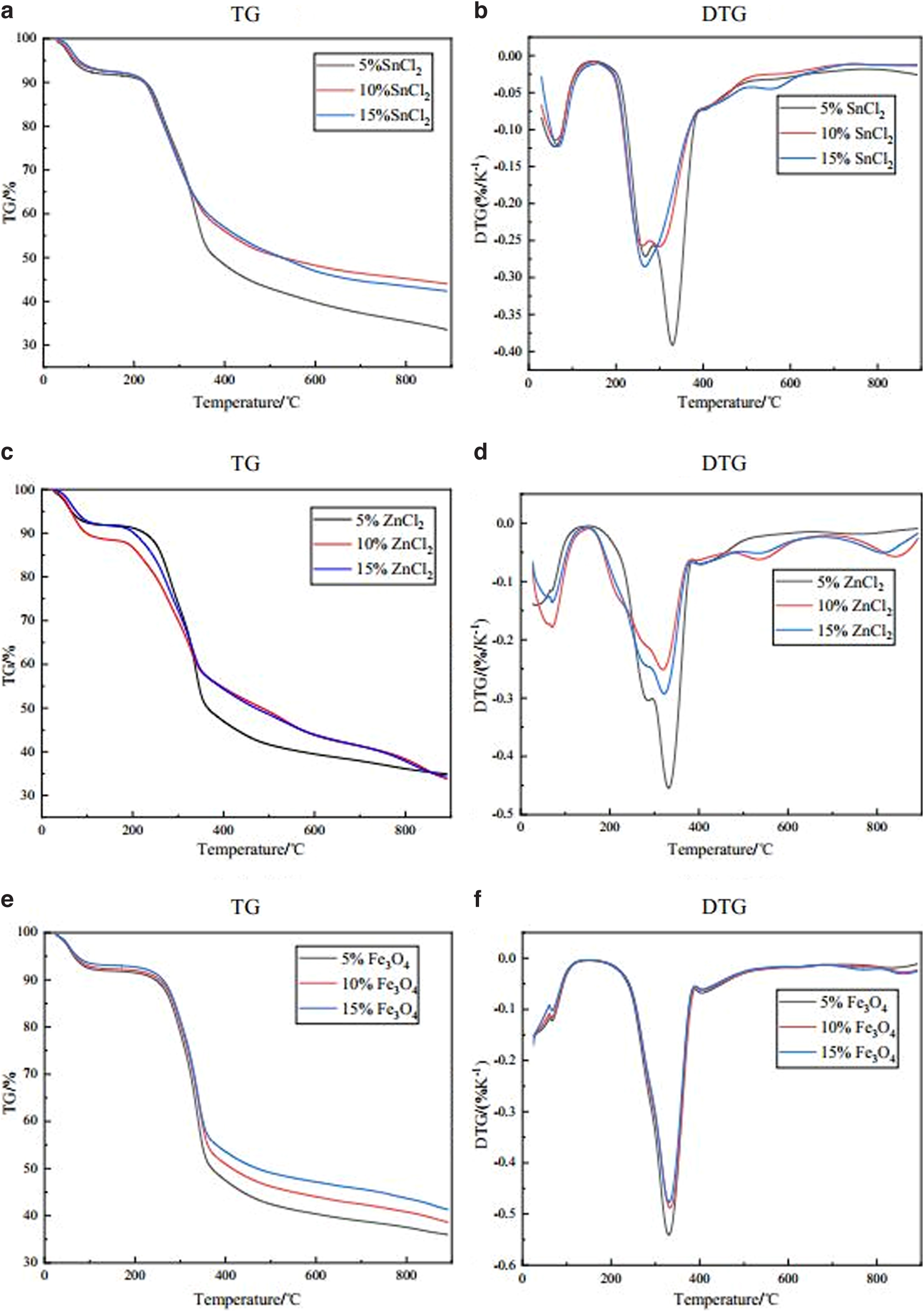
TG and DTG of curves with SnCl2
The weight loss was mainly taken place in 170°C–350°C. Derivative thermogravimetric (DTG) curves showed that the corresponding temperatures of weight loss peaks were 332°C, 319°C, and 322°C for 5%, 10%, and 15%, respectively. Similar results were found in the ZnCl2 compared with SnCl2. The weight loss peak was moved to the low-temperature region, and the shoulder peak was weakened with the increase of additive amount. Some researches' results indicated that the addition of ZnCl2 could promote the decomposition of cellulose, hemicellulose, and lignin (Molina-Sabio and Rodríguez-Reinoso, 2004). The yields of biochar were very close which were 34.92%, 34.32%, and 33.81% for 5%, 10%, and 15%, respectively. The weight loss of the samples with Fe3O4 could be seen in Fig. 1c and f. The trends of TG and DTG curves in all groups were similar.
The corresponding temperatures of weight loss peaks were about 330°C. There was no shoulder peak appeared which was different from the cases in SnCl2 and ZnCl2. The peak at about 300°C was related to the decomposition of hemicelluloses which indicated that the pyrolysis path of hemicellulose was changed (Haiping et al., 2007).
Effects of additives on pyrolysis
The effects of additives on the products of pyrolysis were displayed in Fig. 2. It could be seen that the biochar yield was decreased with the increase of additives. The additives promoted the crack of organic chemical bonds resulting in a decrease of biochar yield. The lowest biochar yield was appeared at 15% SnCl2. It indicated that the addition of additives could promote the biomass pyrolysis and the decomposition of biomass was sufficiently finished in this case. When the content of SnCl2 was increased to 20%, the biochar yield was increased caused by the additives.

The effect of temperature on the pyrolysis products:
SnCl2 could accelerate the primary decarbonization step and reduce solid product yield (Fei et al., 2016), while the effect of Fe3O4 on solid product yield was relatively small. The syngas yield was increased with the content of Fe3O4, but it was decreased with the content of SnCl2 and ZnCl2. The highest syngas yield (0.39 Nm3/kg) was obtained at 20% Fe3O4.
Influence of additives on the gas composition in co-pyrolysis
The variation of gas composition affected by the additives was shown in Fig. 3. With the increase of additives amount (Fig. 3a), the content of H2 and CO2 were increased, while the CO, CH4, and CnHm were decreased. With the increase of SnCl2 amount, H2 content was increased from 4.78% to 14.81%, which was increased by 209.83%. CO content was decreased from 15.78% to 8.11%. The content of CH4 and CnHm were slightly decreased. It could be explained by that the addition of SnCl2 could reduce the rate of C–O bond cracking to CH4 and increase the high C–C bond breaking rate for hydrogen production (Huber et al., 2003).
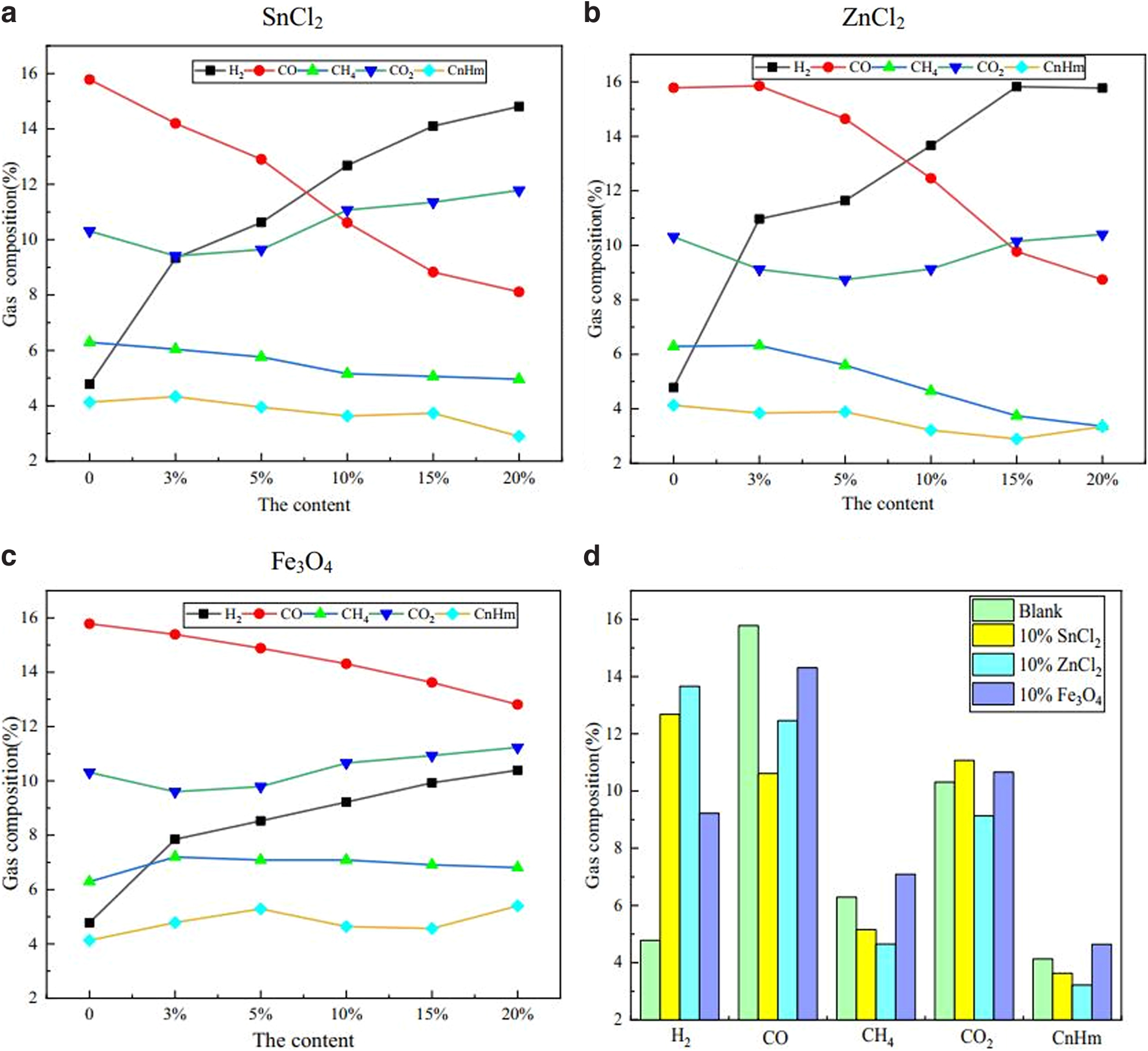
Effects of additives on gas composition:
The addition of ZnCl2 could increase the contents of H2, CO2, and CH4, while reduce the contents of CO and CnHm (Fig. 3b). This was because ZnCl2 could reduce the activation energy required for the release of H2, CO2, and CH4 and increase the activation energy for CO production (Feiqiang et al., 2018a). Zn2+ could interact with oxygen atoms to form a volatile-Zn2+ complex. C–O bond in the side chain and methoxy group was activated and cracked producing CO2 and CH4 (Wang et al., 2016). With the increase of ZnCl2 amount, H2 content was increased from 4.78% to 15.82% and CO content was decreased from 15.78% to 8.74%.
There were few changes in the content of CO2, while the content of CH4 kept decreasing. It indicated that ZnCl2 enhanced the CO2–CH4 reforming reaction (CO2+CH4↔2H2+2CO), which resulting the increase of H2 and CO. Meanwhile, the decrease of CnHm content also indicated that the ZnCl2 could promote the crack of macromolecular resulting in an increase of H2 content.
With the addition of Fe3O4 (Fig. 3c), H2 content was increased from 4.78% to 10.39% and CO content was decreased from 15.78% to 12.81%. The mechanism of Fe3O4 on the pyrolysis of biomass was different from the above two additives. During the reaction, Fe3O4 could be reduced to Fe2O3, FeO, and Fe by pyrolytic coke, while Fe2O3, FeO, and Fe could also be oxidized to produce Fe3O4 by CO and H2, thus forming a redox cycle reaction. Hence, it had high catalytic activity for tar cracking (Chao et al., 2017).
The comparison of gas components with 10% SnCl2, ZnCl2, and Fe3O4 was displayed in Fig. 3d. All the three additives could increase H2 content and reduce CO content. Only Fe3O4 promoted the generation of CH4 and CnHm, which increased by 0.52% and 1.27% compared with no addition, respectively. ZnCl2 has the most significant effect on the H2 content, which was increased 0.98% and 4.44% more than SnCl2 and Fe3O4, respectively. SnCl2 could obviously inhibit CO production, which was decreased from 15.78% to 10.61%.
Influence of additives on tar components
The components of tar with three additives were shown in Fig. 4. Strong peaks were appeared at 2.51 and 4.16 min for all the groups, corresponding to benzene and toluene, respectively. The peaks were mainly concentrated in 2–4, 6–8, and 11–15 min. The ion peak appeared after 10 min was enhanced after the additive which indicated that the content of the substance appeared after 10 min was increased.

GC/MS of Tar:
The tar was mainly composed of monocyclic aromatic hydrocarbons (MAHs, mainly benzene and its phenolic derivatives), aliphatic hydrocarbons and oxygen-containing heterocyclic rings (mainly oxindene) (Fig. 4a). Naphthalene was the main polycyclic aromatic hydrocarbons (PAHs) which was accounting for 2.65%. Compared without additive, the intensity of peak at 2.15 and 2.92 min represented for chlorinated hydrocarbons was strengthened after the addition of SnCl2 (Fig. 4b). The content of phenol at 10.98 min was increased from 3.60% to 4.94%, while the content of o-cresol and p-cresol were decreased, which promoted the formation of monomer phenol. The monomer phenolic compounds and oligomers were mainly derived from the lignin, suggesting that SnCl2 promoted the pyrolysis of lignin (Rolf and Dietrich, 2009).
Compared with blank group, the addition of SnCl2 promoted the production of furfural and furfuryl alcohol, which may be caused by the cyclization of the double bond formed by the dehydration of glucose chain (Song et al., 2021). Toluene, m-xylene and p-xylene in MAHs were decreased, while chlorinated hydrocarbons was increased, which indicated that the conversion of dehydrogenation of aliphatic hydrocarbons into aromatic hydrocarbons was inhibited by SnCl2. The content of oxygen-containing aliphatic hydrocarbons was decreased from 5.44% to 0.39%, in which ketones were decreased from 3.25% to 0.14%. SnCl2 promoted the cracking of oxygen-containing components resulting in an increase of CO2 content.
Compared with blank group, an obvious peak occurred at 5.97 min, was repeated for furfural with 13.88%. Furans (furfural) mainly came from the dehydration of carbohydrates in hemicellulose (Chenxi et al., 2017; Qiang et al., 2009), indicating that ZnCl2 could promote the pyrolysis of hemicellulose (Fig. 4c). ZnCl2 could inhibit the formation of monomer phenol, resulting that the content of phenol decreasing from 6.13% to 4.78% (Jun et al., 2017). ZnCl2 had the most obvious effect on H2 content due to (1) ZnCl2 greatly promoted the rearrangement reaction of aromatic rings, forming stable carbon structure and releasing H2; (2) ZnCl2 also promoted demethylation and part of H2 came from decomposition of CH4. The addition of ZnCl2 could inhibit the formation of tar, in which the toluene content was reduced from 20.60% to 14.03% (Ma et al., 2015).
The components of tar with Fe3O4 are shown in Fig. 4d. Benzene and toluene contents in MAHs were decreased, in which benzene was decreased from 33.36% to 30.12% and toluene was decreased from 20.60% to 16.75%. The contents of m-xylene and p-xylene were also decreased correspondingly. CO2 mainly came from the crack of methyl and methylene. The rise of CO2 content in gas products indicated that Fe3O4 could promote the fracture of methyl. Phenolic substances were increased from 6.13% to 9.52%, which mainly came from the crack of ether bonds in lignin (Linlin et al., 2019).
All the components of tar from pyrolysis were classified according to carbon framework: MAHs, PAHs, aliphatic hydrocarbons, oxygen-containing aliphatic hydrocarbons, and heterocyclic compounds (Table 1). Compared with blank group, the three additives all increased the content of PAHs, and reduced the content of MAHs, aliphatic hydrocarbons, and oxygen-containing aliphatic hydrocarbons. The additives promoted the conversion of heavy aromatic hydrocarbons to light aromatic hydrocarbons, and increased the content of dicyclic and tricyclic hydrocarbons leading to an increase of PAHs. Fe3O4 had little effect on monocyclic aromatic hydrocarbons, while SnCl2 could significantly reduce the content of aliphatic hydrocarbons and oxygen-containing aliphatic hydrocarbons. ZnCl2 increased the content of furfural resulting in the increase of heterocyclic compounds.
Classification of Tar by Carbon Skeleton
MAH, monocyclic aromatic hydrocarbons; PAH, polycyclic aromatic hydrocarbon.
Influence of additives on pyrolytic coke characteristics
Fourier infrared spectroscopy was used to analyze the surface functional groups of biochar. As could be seen from Fig. 5, biochar contained functional groups with complex structures such as carboxylic acid, ether, alcohol and substituted benzene groups. The band around 3410 cm−1 was vibration of –OH group (Yue et al., 2011), 2925 cm−1 represented for the vibration of C–H bond, 1620 cm−1 and 1080 cm−1 were the vibration of C = O bond, and C–O out-of-plane bending vibration, respectively. OH, C–O, and C = O were enhanced under the action of additives, indicating that the metal properties in additives had obvious effect on oxygen-containing functional groups. Meanwhile, the wider absorption band caused higher concentration of functional groups.

FT-IR diagram of biochar under the action of three additives. FT-IR, Fourier infrared spectroscopy.
The XRD diagram of biochar with three additives at 800°C could be seen in Fig. 6. The results showed that the valence state was changed after the addition of SnCl2, in which Sn and SnO2 could be found in biochar, which indicated that Sn2+ was reduced to Sn and oxidized to SnO2 due to disproportionation reaction. SnCl2 could react with H2 and CO to reduce to Sn, and combine with the oxygen released from the biomass to oxidize to SnO2. The fixation of oxygen atom had positive effect on improving the quality of syngas. After the addition of ZnCl2, a new metal crystal structure was formed. Zn2+ reacted with oxygen atoms to form ZnO, which reduced the migration of oxygen atoms into the gas phase.
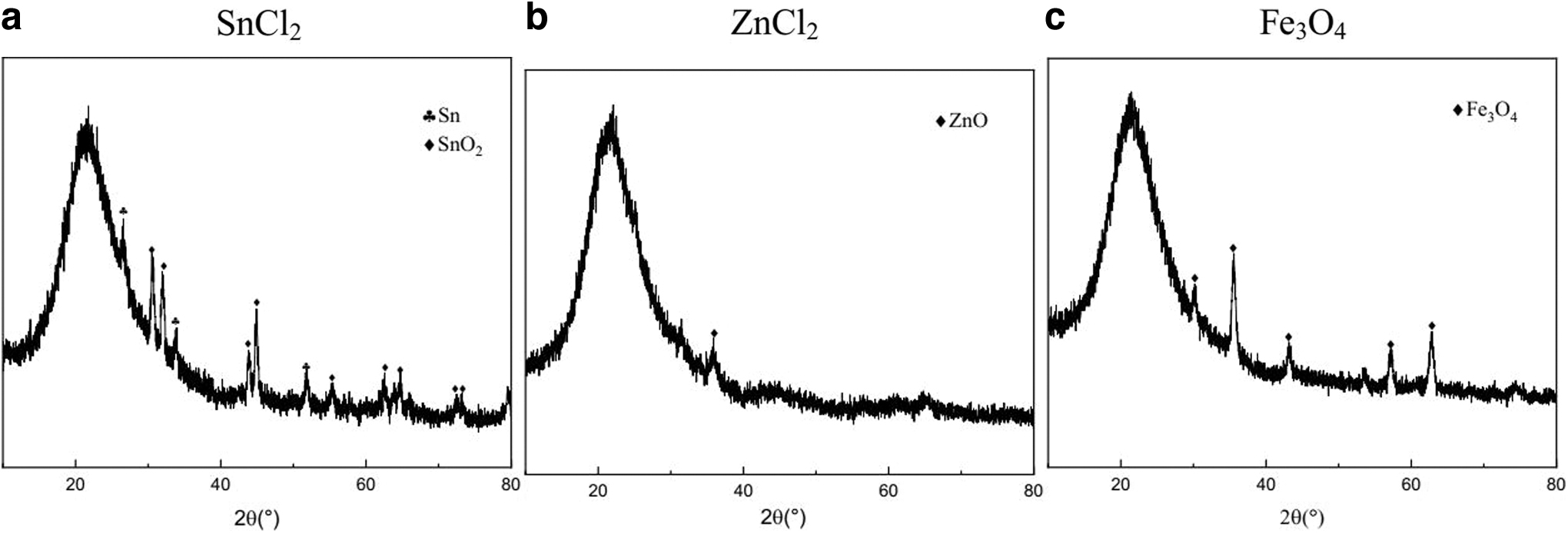
XRD diagram of biochar under the action of three additives:
However, Fe3O4 did not change significantly. Iron atoms had a high affinity for oxygen, leading to a high coverage rate of oxygen species on the metal active site, resulting in the reduced Fe2O3 and FeO oxidizing into Fe3O4 (Ashok and Kawi, 2014).
Conclusion
The effects of SnCl2, ZnCl2, and Fe3O4 on the co-pyrolysis of RH and CM were investigated. The results showed that the additives could obviously improve gas quality which increased H2 content and reduced CO content. At the same time, the additives could also improve the distribution of liquid products, which promoted the cracking of heavy PAHs to light PAHs, and reduced aliphatic hydrocarbons and oxygen-containing aliphatic hydrocarbons. Fe3O4 promoted the crack of methyl groups and increased the content of CO2. ZnCl2 promoted the pyrolysis of hemicellulose, increased furfural compounds, and inhibited the formation of monomer phenols. SnCl2 promoted the pyrolysis of lignin, which promoted the increase of monomer phenols. However, the toxicity and environmental impacts about the addition of those metals need to be further studied.
Footnotes
Authors' Contributions
W.Q.: Writing—original draft/review and editing and data curation. Y.L.: Data curation and experiment. J.L.: Software. G.F.: Data curation. G.S.: Conceptualization. Q.C.: Writing—review and editing.
Author Disclosure Statement
No competing financial interests exist.
Funding Information
The authors acknowledge the financial support provided by Hubei Jiebang science and technology project (2021BEC026), Hubei Important Project of Technological Innovation (2022BCA081) and the Central Committee Guides Local Science and Technology Development Special Project of Hubei Province (2019ZYYD059).