




Abstract
Sulfur-modified biochar was prepared and used to efficiently remove Chromium (Cr) from water. It was found that the sulfur-modified biochar prepared from lower primary pyrolysis temperature (<400°C), higher secondary pyrolysis temperature (>400°C), appropriate secondary pyrolysis time, and S/C ratio was favorable for Cr removal. According to the response surface methodology analysis, the biochar prepared under the primary pyrolysis temperature of 350°C, secondary pyrolysis temperature of 450°C, secondary pyrolysis time of 60 min, and S/C ratio of 2:1 could achieve the maximum Cr removal (92%). The S-modified biochar prepared under the optimum condition exhibited greater capacity of adsorbing Cr(VI) or reducing Cr(VI) into Cr(III) compared with the biochar without the S modification. The enhanced Cr(VI) adsorption and reduction were likely because some of the sulfur-containing groups formed on the modified biochar could bind and interact with the Cr(VI). Besides, the enhanced surface area by the sulfur modification also played a role in prompting the removal and reduction of Cr(VI).

Introduction
Chromium (Cr) is an extremely toxic and carcinogenic metal that originates mainly from chemical and smelting industries, such as metal electroplating, solvents for leather processing and preparation, rubber, and papermaking and printing industry (Essid et al., 2020; Yang et al., 2020). Cr has many oxidation states, in which Cr(VI) and Cr(III) are the two major forms in water environment (Malaviya and Singh, 2016; Song et al., 2021). The toxicity of Cr(VI) is hundreds of times higher compared with Cr(III), and its teratogenicity is nearly a thousand times higher compared with Cr(III) (Wang et al., 2020b; Wang et al., 2016). In addition, Cr(VI) has strong oxidation ability and migration ability in liquid environment (Wang et al., 2020a).
Several methods have been employed to treat Cr(VI)-contaminated water or soil, including chemical precipitation and washing (Gaikwad and Balomajumder, 2017; Tan et al., 2022), ionic exchange (Xiao et al., 2016), membrane separation (Diez et al., 2017), biological treatment (Musah et al., 2021), and adsorption (Guo et al., 2018). Of these methods, adsorption is widely applicable for the removal of Cr(VI) due to its cost effectiveness, high removal efficiency, and environmental compatibility (Yang et al., 2022a; Yang et al., 2022b; Zheng et al., 2016). Furthermore, magnetic adsorbent used to remove Cr(VI) can be easily recycled (Lei et al., 2016; Lei et al., 2015).
In recent years, biochar prepared from the pyrolyzation of waste biomass under high temperature and oxygen limitation conditions has been widely studied for Cr(VI)-contaminated water because of low cost, simple preparation process, and easy access of precursors (Shi et al., 2020; Zheng et al., 2021). Biochar is considered an effective adsorbent to control Cr(VI) pollution (Rajapaksha et al., 2018) owing to its richness of porous structure as well as surface functional groups, which are favorable for Cr(VI) reduction through redox reaction and subsequent Cr(III) immobilization on biochar surface (Zhou et al., 2016).
However, the Cr(VI) removal efficiency by the biochar prepared from agricultural waste was relatively lower compared with other adsorbents due to their limited surface area and abundance of functional groups (Ambika et al., 2022; Zhou et al., 2020). Therefore, developing innovative and cost-effective approaches to modify the characteristics of biochar, which can quickly and effectively treat Cr-polluted soils and water, is of interest (Hong et al., 2021; Song et al., 2019).
Sulfurization of biochar is an emerging strategy for improving the efficiency of contaminant remediation using biochar (Gao et al., 2020; Lyu et al., 2018). Abundant sulfur (S)-contained functional groups will be formed on the surface through elemental S modification, which could improve the adsorption of heavy metals (Huang et al., 2019; Rajendran et al., 2019; Zhang et al., 2019). Lyu et al. (2017) found the biochar-supported nanoscale iron sulfide (FeS) was very effective for Cr(VI) reduction, where 57% of Cr(VI) removal was due to reduction. Tian et al. (2023) found that polyethyleneimine-modified biochar-supported nano zero valent iron (n-ZVI) could effectively enhance the removal of Cr(VI) from aqueous solution, which indicated that S-containing functional groups could play a crucial role. At present, the report on the removal of Cr(VI) by sulfur-modified biochar is still lacking.
In this article, from the perspective of resourceful treatment and utilization of biomass, a sulfur-modified biochar composite that underwent secondary pyrolysis was prepared by corn stover and was utilized for removing Cr from water. The effect of the preparation condition of sulfur-modified biochar on the Cr removal was evaluated and compared with those without sulfurization. The morphology and physicochemical characteristics of the sulfur-modified biochar were characterized to interpret the mechanism of Cr(VI) removal by sulfur-modified biochar.
Materials and Methods
Preparation of S-modified biochar
The raw material for biochar preparation was a typical agricultural waste (corn straw) harvested from a farm in Baoshan District, Shanghai, China. The biomass was first washed with deionized water thrice and oven dried at 60°C for 72 h, and then was pulverized and screened with a 100-mesh sieve. To prepare raw biochar, around 4 g of biomass powder was pyrolyzed in a tubular electric furnace under N2 flow according to the following temperature programs: heating from room temperature to 100°C at 10°C/min for 20 min, followed by heating to the target primary pyrolysis temperature (T1) at 10°C/min, and holding for 2 h (t1). After being naturally cooled under N2 flow, the sample was ground to pass through a 100-mesh sieve and stored free from air.
To prepare S-modified biochar, raw biochar was evenly mixed with elemental sulfur by different ratios (S/C, by mass) and pyrolyzed again in a tubular furnace under N2 flow (99.99%, 120 mL/min). The temperature program of S modification was the same as that for the preparation of raw biochar, but with different peak secondary pyrolysis temperature (T2) and secondary pyrolysis duration (t2). The prepared biochar sample was named as BC/BSXX(XX) [e.g., BC300(300) or BS300(300)]. The BC or BS represents unmodified biochar or modified biochar, respectively. The first number after the letter referred to the primary temperature, whereas the second number in the bracket represented the secondary pyrolysis temperature.
Since the conditions of biochar preparation (e.g., the pyrolysis temperature, pyrolysis time and S addition) can significantly affect the removal of Cr, preliminary experiment to obtain the optimal condition for S-modified biochar preparation was carried out under the condition of different primary pyrolysis temperatures (factor A, T1 = 300–700°C), secondary pyrolysis temperatures (factor B, T2 = 300–600°C), secondary pyrolysis times (factor C, t2 = 5–120 min), and S/C ratios (factor D, 1:1, 2:1 and 3:1, respectively). The results of Cr removal were compared with those by the unmodified biochar, which was prepared under the same conditions, except for no sulfurization.
According to the removal efficiencies of Cr by S-modified samples, the response surface methodology with Box-Behnken design (BBD) (Afshin et al., 2021; Ben Khalifa et al., 2022) was employed to optimize the preparation of S-modified biochar by an array of four factors at three levels (Table 1). The details of the experimental design are compiled in Supplementary Table S1.
Factors and Levels of Response Surface Methodology
Batch Cr removal test by S-modified biochar
In a typical Cr removal trial, 0.02 g S-modified biochar was added into a 100 mL glass flask containing 50 mL Cr(VI) solution (100 mg/L), followed by adjusting pH to 2.0 with 0.1 M HCl or NaOH. After vigorous stirring, the flask was sealed, wrapped with aluminum foil, and agitated at a rate of 200 rpm. After reaction, the supernatant was recovered by filtration through a 0.22 μm membrane for the analysis of Cr species, and the solid was oven-dried at 60°C for sample characterization. Each test was carried out in triplicate.
Analysis
Solid sample characterization
The surface morphology and characteristics of solid sample (biochar) were observed by a scanning electron microscope (Hitachi S-4800; Hitachi). The specific surface area and pore diameter of sample were measured by multipoint N2-BET (Brunauer-Emmet-Teller) adsorption method with a specific surface area and pore diameter analyzer (Autosorb iQ; Quantachrome). The surface functional groups of samples were characterized using an infrared spectrometer (UPT-II-40L; Thermo Fisher) at a wave number of 500–4,000 cm−1. The surface composition was determined by X-ray photoelectron spectroscopy (ESCALAB250Xi, Krato AXIS Ultra DLD). The inorganic sulfur on biochar was determined using a sequential extraction technique (Landers et al., 1983; Nriagu and Soon, 1985). Water-soluble sulfate (H2O–S) and adsorbed sulfate (Absorbed-S) were extracted at a ratio of 1:10 (w/v) with distilled water and NaH2PO4, respectively. Hydrochloric acid-soluble sulfur (HCl–S) was extracted using 50.00 mL HCl (0.025 M) and elemental S were extracted with acetone.
Liquid sample analysis
The concentration of total Cr in solution was determined by an inductively coupled plasma optical emission spectrometer (ICP-OES, Prodidy; Leeman). The concentration of Cr(VI) in aqueous phase was determined by a modified 1,5-diphenylcarbazide method (Mu et al., 2015) with a ultraviolet (UV)-vis spectrophotometry (UV-752N; Jingke, Shanghai, China). The concentration of Cr(III) was obtained by the difference of total Cr and Cr(VI) concentrations. The SO42− in the solution was determined by typical barium sulfate turbidimetry (Johnson and Henderson, 1979). The contents of S2−, S2O32−, and SO32− in solution were determined by the Iodometric method (Gallino et al., 2008).
The reduction capacity of the biochar was roughly estimated as the following equations:
where Qe (III, s) (mg/g) is the adsorption capacity of Cr(III) by biochar. Qe (VI, s) (mg/g) refers to the adsorption capacity of Cr(VI) by biochar, Qe (reduction) (mg/g) is the amount of Cr(VI) reduced to Cr(III) by biochar, and C0 (mg/g) is original content of total Cr in liquid. C1 (mg/g) is the content of total Cr in liquid after adsorption, C2 (mg/g) is the content of Cr(III) in liquid after adsorption, η(III) (%) is the percentage of Cr(III) and η(VI) is the percentage of Cr(VI) (%) on biochar based on the estimation of the content of Cr2p peak intensity on the spectra of X-ray Photoelectron Spectroscopy (XPS), and V (mL) is the volume of liquid.
Results and Discussion
Effect of the preparation condition of S-modified biochar on Cr removal
The effect of the S modification condition on the Cr removal was investigated and compared with the biochar without modification (Fig. 1). To make a fair comparison, the removal of Cr by the unmodified biochar was also prepared by both primary and secondary pyrolysis without sulfurization (Supplementary Fig. S1).

The content of Cr(VI) and Cr(III) in the liquid after the adsorption using the sulfur-modified biochar prepared under various
Figure 1a exhibits the effect of primary pyrolysis temperature of S-modified biochar on the removal of Cr(VI) under the fixed condition of T2 = 700°C, t2 = 60 min, and S/C = 2:1. The Cr(VI) and Cr(III) remaining in the liquid phase were increased with increasing primary pyrolysis temperatures, suggesting the adsorption of Cr(VI) was favorable under the condition of low primary pyrolysis temperature.
This is likely because the biochar prepared under higher primary temperature had less functional groups on the surface compared with those prepared under lower temperatures, which could not react with the sulfur to form the sulfur-containing functional groups during the secondary pyrolysis. And the sulfur-containing groups were speculated as the major functional groups adsorbing and reacting with the Cr(VI). It was found that the Cr(III) was present in the liquid phase during the adsorption test, suggesting that some of the Cr(VI) was reduced to Cr(III) by the functional groups of the S-modified biochar with different primary pyrolysis temperatures. The content of Cr(III) after the adsorption test was lower when the primary pyrolysis temperature was lower, suggesting the formation and adsorption of Cr(III) were also affected by the generation of sulfur-containing groups.
As shown in Supplementary Fig. S1a, the Cr(VI) and Cr(III) content after the adsorption test using the unmodified biochar prepared under various primary pyrolysis temperatures (T1) and the condition of fixed T2 = 700°C, t2 = 60 min, and S/C = 2:1 were determined. It could be found the Cr(VI) and Cr(III) concentration left in the liquid were fairly high and comparable for all the primary pyrolysis temperatures. This suggested that the adsorption capacity of unmodified biochar was low and the varying primary pyrolysis temperatures did not have significant impact on the Cr adsorption.
Figure 1b shows the effect of secondary pyrolysis temperature on Cr(VI) removal under the fixed condition of T1 = 300°C, t2 = 60 min, and S/C ratio of 2:1. The Cr content remaining in the liquid phase was significantly decreased by the biochar when the temperature exceeds 400°C. It may be because the boiling point of sulfur is around 444°C.
The S tended to form smaller S rings instead of long chain or large S aggregates under the secondary pyrolysis temperature over its boiling point (Reddy et al., 2014), where the smaller S rings were more favorable for the formation of S-containing functional groups to be interacted with the Cr compared with the large S aggregates. On comparison, the Cr content in the liquid phase was increased with the increasing secondary pyrolysis temperature with the unmodified biochar (Supplementary Fig. S1b), which was likely attributing to the reduction of functional groups and surface area by the increasing pyrolysis temperature.
The impact of secondary pyrolysis time with the S modification was evaluated under the fixed condition of T1 = 300°C, T2 = 700°C, and S/C = 2:1. As shown in Fig. 1c, the removal of Cr(VI) by S-modified biochar was increased with the prolonged modification time until 60 min, whereas the adsorption was weakened after 60 min of modification. This is because longer impregnation time could improve the evenness of the distribution of sulfur on the biochar surface (Hsi et al., 2002). However, too long pyrolysis time could disattach the sulfur from the biochar, resulting in a weakened adsorption. As for the unmodified biochar, the secondary pyrolysis temperature did not significantly affect the Cr removal, as shown in Supplementary Fig. S1c.
The effect of S/C ratio on the removal of Cr(VI) under the fixed condition of T1 = 300°C, T2 = 500°C, and t2 = 60 min was also evaluated (Fig. 1d). The removal of Cr(VI) increased with the increasing S content, where the highest removal was achieved at the S/C ratio of 2:1. However, the further addition of S during the pyrolysis led to a significantly decreased Cr removal. This is likely because the sites at which sulfur can be functionalized in BC were limited (Jeon et al., 2020). Besides, to prove the effect of S modification on the biochar, the elemental S was mixed with the unmodified biochar after the secondary pyrolysis instead of being added during the secondary pyrolysis for sulfurization (Supplementary Fig. S1d).
The removal of Cr(VI) was proportionally decreased with the increase of S addition, which suggested the elemental S could not contribute to the removal of Cr(VI) without sulfurization. In addition, the Cr(III) was detected in all the samples during the adsorption tests using various biochars, which suggest that both the S-modified biochar and unmodified biochar possessed a strong capacity for reducing Cr(VI) into Cr(III).
Response surface methodology optimization
The total Cr removal achieved by the S-modified biochar under various conditions was optimized using response surface methodology. According to the BBD experiment design, the quadratic multiple regression equation of the effect of S-modified biochar on the removal of total Cr in the solution was generated and fitted (Supplementary Table S2). As shown in Fig. 2, the model provided the predicted optimized conditions, where the factor A (T1) was 350°C, the factor B (T2) was 450°C, the C (t2) was 60 min, and the factor D was 2:1. The maximum Cr removal from S-modified biochar was calculated as 95%. The validation test under the predicted optimum conditions was conducted and the results show the removal of total Cr by S-modified biochar was around 92%, which suggested that the predicted optimum result was reliable.
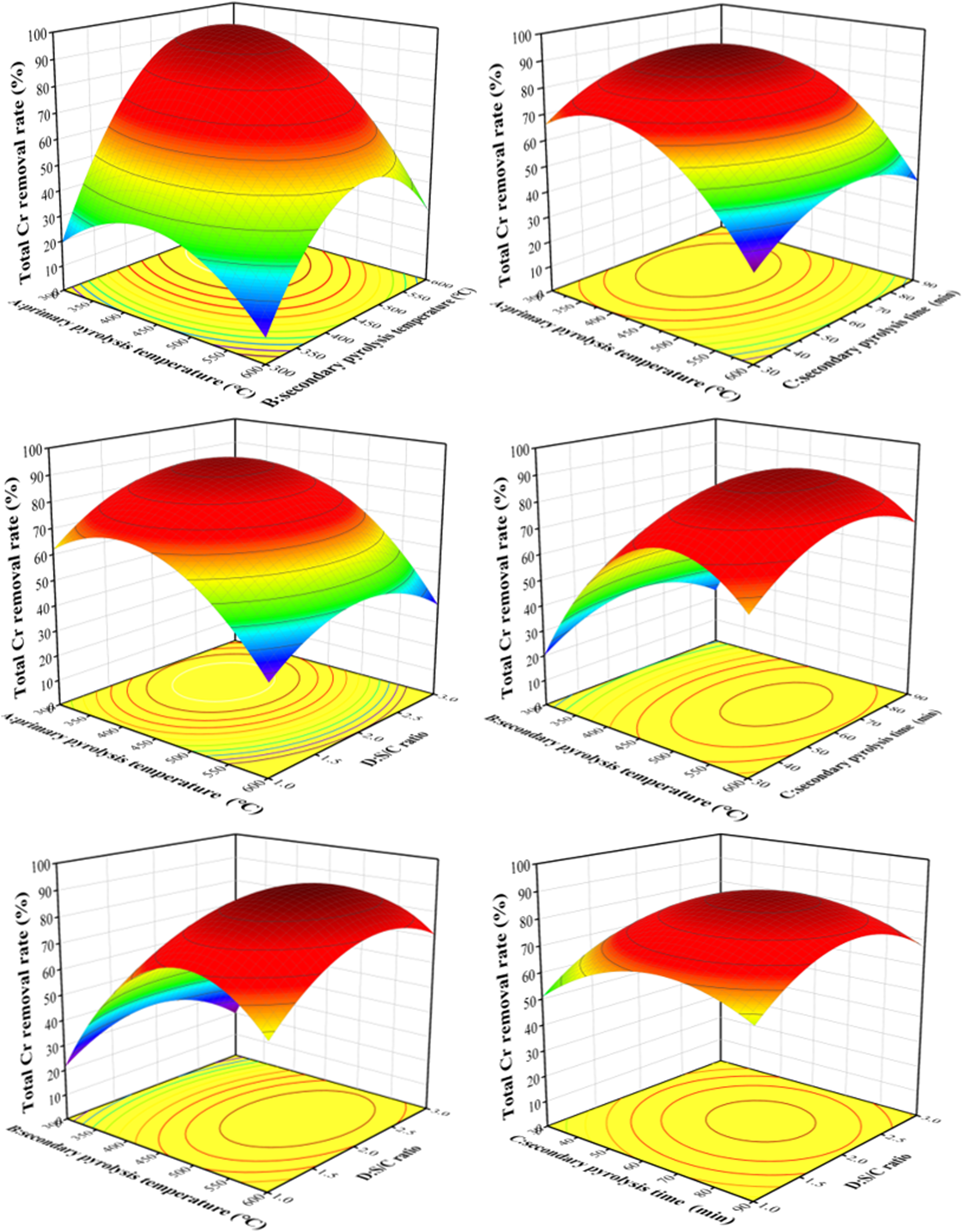
The influence of pairwise interaction factors on total Cr removal.
The pseudo first- and second-order model were used to fit the experimental data of Cr removal using the biochar prepared under the optimum condition. As shown in Supplementary Table S3, the fitting coefficient of pseudo second-order model was fairly high (R2 = 0.999), while the fitting coefficient for pseudo first-order model was lower (R2 = 0.813).
The equilibrium adsorption capacity fitted by the pseudo second-order kinetics is 40.2 mg/g, which is close to the actual adsorption capacity of S-modified biochar for Cr(VI) (40.0 mg/g). This suggested that the pseudo second-order kinetic model was more suitable to describe the adsorption of Cr(VI) by the S-modified biochar compared with the first-order model. As the model indicated that the adsorption rate control step was based on multi-molecular layer chemical adsorption such as chemical reaction or electron gain and loss (Liu et al., 2020; Qiao et al., 2020), it could be speculated that the removal of Cr(VI) by sulfur-modified biochar may largely depend on the redox reaction caused by the functional groups on its surface.
Characterization of biochars
To investigate the mechanism of Cr removed by S-modified biochar, the modified and unmodified biochars prepared from different temperatures, including BC300(300), BC300(450), BS300(300), and BS300(450) (BC indicates the biochar without S modification, BS indicates the biochar with S modification, and the first number after BC or BS represents the primary pyrolysis temperature, and the number inside the bracket represents the secondary pyrolysis) were systematically characterized using elemental analysis, BET, Fourier Transform Infrared Spectroscopy (FTIR), and XPS.
The elemental characteristics of the above unmodified biochars and S-modified biochars are presented in Table 2. The surface sulfur content of BC and BC450 was <0.3%, while the sulfur content of BS300(300) and BS300(450) was much higher. This indicates that the sulfur was successfully attached to the surface of biochar. Although the sulfur content of BS300(300) was higher, the Cr removal of it compared with BS300(450) was lower. This might be because when the secondary pyrolysis temperature was lower than the boiling point of S, some of the S could agglomerate into the form of S8 rings. The large S8 could not enter the micropores of biochar to form sulfur-containing functional groups. However, the S tended to exist in the form of short chains S2 and S6 at higher temperature, which were more reactive and easier to migrate into the narrower pores of the carbon matrix (Korpiel and Vidic, 1997).
Physicochemical Characteristics of Unmodified and S-Modified Biochars
It is worth mentioning that after S modification, the specific surface area, pore diameter, and pore volume of BS300(450) were all improved compared to BS300(300) and the unmodified biochars. This indicated that the sulfur modification with high secondary pyrolysis temperature enhanced pore formation, which was likely due to the melting and volatilization in reaction with feedstock (Park et al., 2019). However, it was found the BS300(300) had a lower specific surface area, pore diameter, and pore volume than those of BC300(300). This was likely resulting from the formation of large S8 rings under the boiling point of S, which blocked the pores of the original biochar.
The morphology of BC300(450) and BS300(450) was characterized by SEM and is shown in Fig. 3. As shown in Fig. 3a and b, the surface of BC300(450) has an irregular fiber structure, while the BS300(450) has a smoother surface structure compared with BC300(450). After high-temperature carbonization, there are still a large number of pores on the surface and inside of the BS300(450) (Fig. 3c), where the pore structure was well developed. These properties were favorable for the adsorption of Cr(VI). Figure 3d exhibits that BS300(450) had a loose porous structure. The EDS element mapping analysis of BS300(450) was conducted and the results are shown in Supplementary Fig. S2. It was found the S element was uniformly distributed on the surface of BS300(450), which further confirmed that the sulfur-containing functional groups were successfully incorporated into the biochar.

SEM images of
The functional groups of BC300(300), BC300(450), BS300(300), and BS300(450) were characterized using FTIR spectroscopy. As shown in the Fig. 4, both BC300(450) and BS300(450) showed absorption peaks at around 1,420, 1,010, and 880 cm−1 of the spectra, which could be ascribed to -COOH (Wang et al., 2021), C-OH (phenolic), -O-C-O- like functional groups (Fan et al., 2020), and aromatic C-H bending vibrations (Liu et al., 2020), respectively. The peaks at near 1,210/1,050 and 730 cm−1 were found in the spectra of BS300(300) and BS300(450), which are associated with the symmetric stretching vibrations of O = S = O in sulfite (Huang et al., 2019), C = S, and S = O in sulfoxide (Pap et al., 2021; Wu et al., 2019), respectively. The spectrum for BS300(450) after the Cr adsorption was similar as that before the adsorption, which suggested no structural change occurred after Cr adsorption.
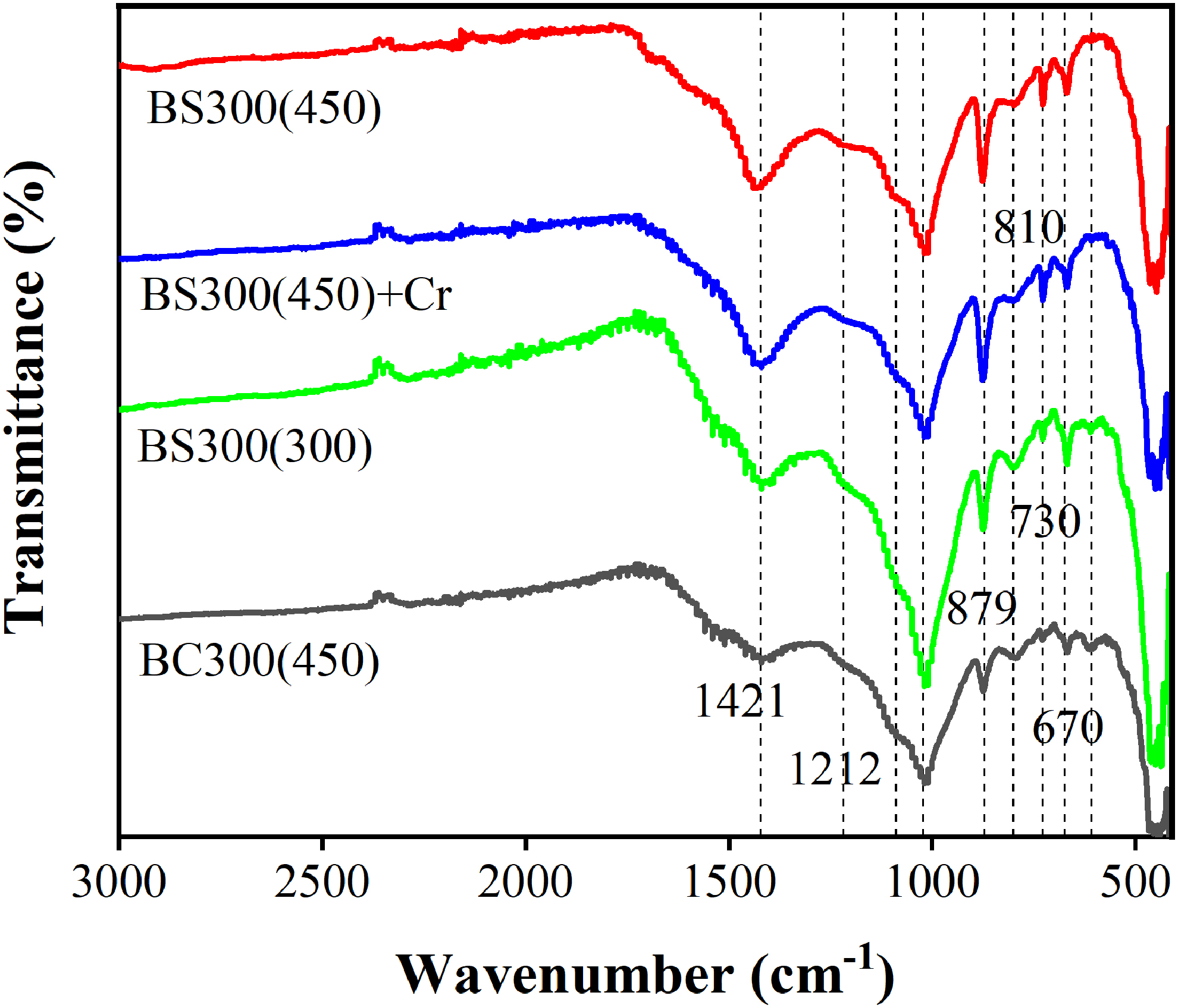
ATR-FTIR spectra of BS300(450), BS300(450)+Cr, BS300(300), and BC300(450). ATR-FTIR, Attenuated Total Reflectance-Fourier Transform Infrared Spectroscopy.
To further clarify the role of BC300(450) and BS300(450) for removing Cr, XPS spectra of C1s, O1s, S2p, and Cr2p were determined for on BC300(450) and BS300(450) to understand the changes in chemical conditions of C, O, and S before and after adsorption, as well as the changes in the valence of Cr. It was found the C1 and O1 peaks were found in all the biochar samples, suggesting the carbon- and oxygen-containing functional groups appeared on the surface of all the biochars. The Cr2p peak was observed on the biochar after the adsorption of Cr, confirming the Cr was adsorbed on the BC300(450) and BS300(450).
The S2p peak was found on the full XPS spectrum of BS300(450) (Supplementary Fig. S3a), which confirmed that the sulfur had been successfully fixed on the biochar. The percentage of S2p in BS300(450) was around 17%, whereas the content of this group was significantly decreased to 7% after the adsorption of Cr on the biochar. This proved the Cr(VI) was attached to BS300(450) by the reaction with the sulfur-containing functional groups.
To further understand the attachment of Cr and S on the biochar, the Cr2p and S2p peaks were further deconvoluted and the separated peaks are shown in Fig. 5a and b. The peaks associated with Cr(III) and Cr(VI) appeared on the spectra of BC300(450) and BS300(450), where the peaks related to Cr(III) on BC300(450) and BS300(450) accounted for 88% and 87%, respectively. This indicated that a great amount of the Cr(VI) adsorbed on these biochars were reduced to Cr(III).

XPS spectra of
The S2p peaks on the BS300(450) before and after Cr adsorption were also deconvoluted (Fig. 5c), the peaks at 167, 165, 163, and 161 eV were identified on the biochar before the adsorption, which were associated with the sulfoxide (11. 9%) (Seredych et al., 2014), thiophene/elemental sulfur (26.7%) (Jeon et al., 2020; Zhang et al., 2019), sulfoxide thiol (53.9%) (Zhao et al., 2022), and metallic sulfur (S-M; 7.6%), respectively.
After the adsorption with Cr(VI) (Fig. 5d), the peak intensities of thiol and sulfoxide were decreased by 62% and 100%, respectively, whereas the peaks related to sulfone at around 168 eV (Hou et al., 2018) were formed. The reduction of thiol and sulfoxide groups was likely due to the interactions of these groups with the Cr(VI), whereas the increased sulfone content was the likely the result of reaction of sulfur-containing groups with Cr2O72−. Besides, despite the intensity of the peak of thiophene/elemental sulfur (25%) not significantly changing, it could participate in the reactions with Cr(VI) to form sulfoxide.
The C1 and O1 peaks of the spectra of BC300(450) and BS300(450) before and after adsorption are shown in Supplementary Fig. S3. The peaks related to C = O, O-C = O, C = C, and C-O were found on the deconvoluted C1 spectrum of BC300(450) before and after the Cr(VI) adsorption. The content for C = O and O-C = O was slightly increased after the adsorption of Cr(VI), suggesting these groups could be formed during the reduction of Cr(VI) and Cr(III).
For the O1 peak of BC300(450), only C-O and C = O peaks were found for the biochar before adsorption, whereas C-O, C = O, and M-O peaks appeared on the spectrum of biochar after the adsorption. The M-O was associated with the metal oxides, which was likely the Cr- and O-containing species. The content of C = O was enhanced for the biochar after the adsorption compared with those before adsorption. This may be ascribed to the reaction between Cr(VI) and the functional groups (e.g., C-O) under acidic conditions, leading to the formation of the C = O group (Liu et al., 2012).
The content of O-C = O and C = O on the spectrum of C1 peak for BS300(450) was increased for the biochar after adsorption than that before adsorption. This result was consistent with the unmodified biochar, where the reduction of Cr(VI) could occur with the formation of O-C = O and C = O groups. For the O1 peak of BS300(450), the formation of M-O and C = O was also found after the biochar being reacted with Cr.
Mechanism of Cr removal by sulfur-modified biochar
As shown in Supplementary Fig. S4a, when the secondary pyrolysis temperature is 300°C, the sulfur in BS300(300) mainly exists in the form of elemental S, accounting for 78.8% of total sulfur, while only 9.7% of total sulfur was present as organic sulfur. In comparison, the elemental S on the surface of BS300(450) was significantly reduced, while the organic sulfur on the surface was enhanced (64.8%). This result suggested when the pyrolysis was over the S boiling point; the form of S on biochar could be significantly altered and thereby affect the Cr(VI) adsorption/reduction by the modified biochar.
The release curve of SO42−, S2O32−, SO32−, and S2− in liquid by BS300(450) is shown in Supplementary Fig. S4b. The release of SO42− from BS300(450) occurred mainly within 2 h, which was attributed to the rapid reduction of Cr(VI) in liquid by biochar. During the 72-h adsorption experiment, only small amounts of S2O32−, SO32−, and S2− are released into the solution, suggesting that the S-modified biochar could be stably used during the adsorption test.
As shown in Supplementary Fig. S5, the reduction capacity of BS300(450) for Cr(VI) reached about 57 mg/g, which was much higher compared with BC300(450) to Cr(VI). For the unmodified biochar, the reduction of Cr(VI) was likely related to the reductive oxygen-containing functional groups (such as C-O and C = C) on the surface. For the S-modified biochar, the reductive S-functional groups such as -SH, S = O, and R1-S-R2 on the surface were likely involved in Cr(VI) reduction.
It has been reported that Cr(VI) was less adsorbed and more available for diffusion into the reduction sites of biochar under lower pH and higher ionic strength solution condition (Fang et al., 2007). In this study, BC300(450) was able to reduce most of the Cr(VI) into Cr(III) at pH = 2 and fix them on the biochar, which resulted in only a small amount of Cr(VI) (7.2 mg/g) being adsorbed on the biochar at the end of the reaction.
The possible mechanism of the Cr(VI) removed by S-modified biochar from water has been illustrated in Fig. 6. S-modified biochar containing reductive S-functional groups, such as -SH, S = O, and R1-S-R2, could bind with and reduce the Cr(VI) into Cr(III). The reaction converted some of these functional groups into O = S = O groups. Moreover, some of the Cr(VI) and reduced Cr(III) could also attach to the dissociated acidic functional groups (C-O) on the biochar surface, where the reduction of Cr(VI) likely promoted the formation of more oxygen-containing groups (O-C = O and C = O) on the biochar surface. In addition, the S modification on the biochar led to much greater specific surface area and pore structure compared with the unmodified biochar, which provided more adsorption sites and affected the adsorption mechanisms of biochar such as pore filling and intraparticle diffusion. This also enhanced the efficiency of Cr(VI) adsorption.

Mechanisms of Cr(VI) removal by S-modified biochar.
Conclusions
The biochar modified by adding sulfur during the secondary pyrolysis was prepared to enhance the removal of Cr from aqueous solution. The S-modified biochar exhibited better Cr removal efficiency under lower primary pyrolysis temperature (<400°C), higher secondary pyrolysis temperature (>400°C), appropriate secondary pyrolysis time, and S/C ratio condition. The optimum condition for the Cr removal reached 92% under the primary pyrolysis temperature of 350°C, secondary pyrolysis temperature of 450°C, secondary pyrolysis time of 60 min, and S/C ratio of 2:1. Much greater Cr(VI) adsorption and reduction were achieved using S-modified biochar compared with the unmodified biochar.
The greater adsorption efficiency was likely attributed to the greater surface area and higher affinities of S-containing functional groups of S-modified biochar compared with unmodified biochar, while the greater reduction capacity was possibly because Cr(VI) was reacted with the reductive S-containing functional groups formed by the sulfurization modification. The results of this demonstrated that the sulfur-modified biochar had great potential as an alternative adsorbent for dealing with Cr-contaminated water.
Footnotes
Acknowledgment
The support from the UTS–SHU Key Partnership Program is gratefully acknowledged.
Authors' Contributions
Z.D.: Conceptualization and writing—original draft. M.Y.: Investigation and validation. Y.Y.: Investigation and formal analysis. X.Z.: Conceptualization, writing—review and editing, and funding acquisition. H.C.: Validation. H.H.N.: Writing—review and editing. Q.L.: Conceptualization, writing—review and editing, and supervision.
Author Disclosure Statement
No competing financial interests exist.
Funding Information
This work was supported by the National Natural Science Foundation of China (41877123).

References
Supplementary Material
Please find the following supplemental material available below.
For Open Access articles published under a Creative Commons License, all supplemental material carries the same license as the article it is associated with.
For non-Open Access articles published, all supplemental material carries a non-exclusive license, and permission requests for re-use of supplemental material or any part of supplemental material shall be sent directly to the copyright owner as specified in the copyright notice associated with the article.
