




Abstract
A cross-institutional faculty mentoring program was initiated by the Association of Environmental Engineering and Science Professors to support junior faculty. Across three cohorts, 117 junior-faculty mentees and 68 senior-faculty mentors have participated in this program. The second cohort was asked to complete a written survey to assess the program through collection of quantitative and qualitative data. Mentees reported that university type, personality, research area, and parental status were important characteristics in their mentors; however, the mentors had less specific preferences. Both mentees and mentors generally agreed upon the importance of various areas of growth and satisfaction with the program. Suggestions for future iterations of the program included additional program structure.
Introduction
Prior research has confirmed that faculty mentoring programs within academic units (e.g., department, college, university) facilitate retention and advancement, enhance social integration, increase collegiality, improve productivity in both mentees and mentors, and provide organizational stability (Fountain and Newcomer, 2016). Moreover, faculty mentoring programs are common components of university-wide efforts to support female and minoritized faculty members (Fountain and Newcomer, 2016; Holmes, 2015; Palepu et al., 1998; Tillman, 2001; Voytko et al., 2018). While faculty mentoring programs are common at the institutional level, fewer efforts have been reported for professional societies.
Importantly, some institutions do not have formal mentoring programs, potentially limiting the development and success of their faculty. We posited that mentors external to the mentee's institution could provide value by creating a safe space to ask personal and professional questions without fear of potential consequences at the time of promotion and tenure. For that reason, the Association of Environmental Engineering and Science Professors (AEESP) launched its first faculty mentoring program in 2019.
The goal of the AEESP faculty mentoring program was to connect junior faculty mentees (i.e., assistant professors, including tenure track, research, and teaching faculty) with senior faculty mentors (i.e., associate or full professors, senior lecturers) from other institutions to provide guidance and advice on questions related to research, teaching, advising/mentoring, and other aspects of an academic career. This program was motivated by the (1) desire to support junior faculty in environmental engineering and science, (2) absence of formal mentorship programs at some universities, and (3) ambition to build a strong, inclusive community of AEESP members across all faculty ranks. Mentee-mentor pairs were encouraged to meet virtually at least two times per year and in person at the biennial AEESP conference. Instructions were provided in the form of a one-page mentoring agreement (Supplementary Information).
To assess the impact of the AEESP faculty mentoring program and enable continuous improvement, the 2022 cohort of mentors and mentees were asked to complete a short survey on their motivation for joining the program, experience in the program, and personal and institutional demographics. This article aims to (1) share the survey results and (2) encourage greater participation in the AEESP faculty mentoring program. The results may help inform other discipline-specific, cross-institutional mentoring programs.
Methods
The AEESP Membership and Demographics committee matched mentees and mentors based on specific requests, general research area, institution type, and time zone. Most requests were related to personality traits (e.g., willingness to help, openness), but others involved specific research areas, experience in changing institutions, and/or demographic considerations (e.g., international faculty, faculty who started families on the tenure track). The faculty mentoring program was run in 2019, 2022, and 2023, and at least 117 mentees and 68 mentors have participated (Supplementary Table S1); note, several mentors not only agreed to support more than one mentee, but also participated in multiple years of the program.
Faculty from the 2022 cohort were invited via email to complete an online Qualtrics survey 13 months after the mentor teams were assigned. We sent two reminders about the survey, and offered a raffle for two $50 gift cards as incentives. The survey included questions about the availability of mentoring programs at participants' home institutions, format and frequency of AEESP mentoring meetings, perceived importance of faculty mentoring topics, characteristics sought in mentors/mentees (adapted from Tracy et al., 2004), and mentoring activities and impact (adapted from Canale et al., 2015). Because some mentors volunteered to have multiple mentees, the survey also asked whether they met as a team or individuals. The survey allowed mentors to answer questions about mentoring activities and impact separately for each mentee.
All participants were asked to provide their personal and institutional demographics. All data were anonymously collected, including demographics. Paired comparison of mentee and mentor responses is not possible. A copy of the mentor and mentor surveys are provided in the Supplementary Information. The study was approved by the Rutgers IRB (Pro2023000141).
Results and Discussion
Survey responses were received from 13 mentees (out of 35 for a mentee response rate of 37%) and 12 mentors (out of 27 for a mentor response rate of 44%) that participated in the 2022 cohort. Most teams met virtually (36%), in person (31%), or both (29%) (Supplementary Table S2). Two mentees had not met their mentors, and only one of them had plans to connect. About 90% of mentors already had formal (N = 5/12), informal (N = 3/12), or both types of mentees (N = 3/12) at their home institution (Supplementary Table S3). In contrast, almost 40% of mentees indicated that they had neither formal nor informal mentors (N = 5/13) at their institution. Other mentees had informal (N = 4/13), formal (N = 2/13), or both types of mentors (N = 2/13).
At participants' home institutions, programmatic support (e.g., programs to match mentors and mentees, structured peer-mentoring, and so on), recognition (e.g., awards), and funding (e.g., stipends for mentors' time, professional development funds) were the most common types of support (Supplementary Table S4). Most mentoring pairs did not know one another or only knew one another professionally before being matched (Supplementary Table S5).
The importance of personal and professional demographics in prospective mentors (as indicated by mentees) and mentees (as indicated by mentors) is reported in Fig. 1. Mentees considered most aspects to be more important than mentors, with the differences following the order: university type>personality>research area>parental status>marital status>race/ethnicity (all p < 0.041, Wilcoxon) with gender near significant (p = 0.0455). Personality, rank, and parental status (in descending order) were also considered important characteristics to mentors and mentees in a pilot mentoring program in gynecology, where participants selected their own mentors (Tracy et al., 2004).
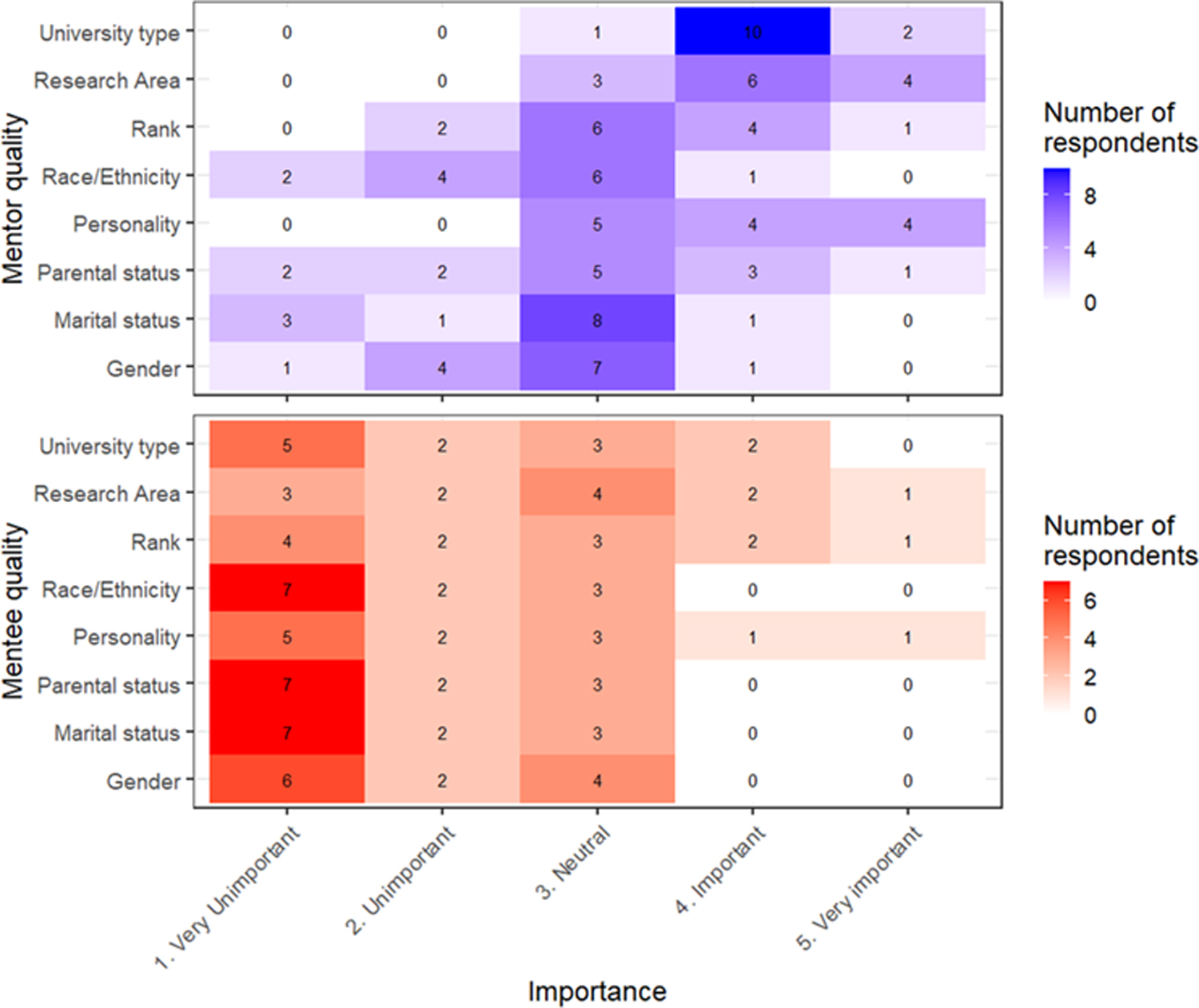
Importance ranking for preferred characteristics of mentors (top, blue, reported by mentees) and mentees (bottom, red, reported by mentors).
Most mentors ranked every mentee characteristic as neutral, unimportant, or very unimportant. This pattern suggests an inclination among mentors to prioritize the mentoring of junior faculty primarily based on mentee need, highlighting a dimension that is not adequately represented by the predefined options in the survey. Demographics data for participants are provided in Supplementary Tables S6–S10. The opportunity to give back was previously noted as one aspect of mentoring appreciated by emeriti engineering faculty mentors who mentored underrepresented minority faculty in engineering (Mendez et al., 2019).
Mentors and mentees generally agreed on the importance of topical areas for discussion (Fig. 2). Grant writing, research group management, and time management were identified as the most important topics by both sets of participants. In contrast, mentors placed a greater emphasis on navigating departmental culture than mentees (p = 0.03, Wilcoxon). This difference may highlight mentors' interest in protecting junior faculty from departmental issues that affected them earlier in their career; furthermore, the cross-institutional organization of this mentoring program provides a safe space for honest conversation from both parties. Interestingly, providing political guidance was among the important outcomes that junior faculty from minoritized groups reported in a previous study (Mendez et al., 2020).

Importance of topical areas according to mentees and mentors.
Grant writing was considered a more important area for mentees' growth than teaching or service (both p < 0.002, pairwise t-test). These findings were not surprising given the lower teaching and service expectations (relative to research) for promotion and tenure at many institutions. Publishing was not considered a major priority for mentoring discussions for some mentees. Interestingly, an increase in the number of publications was the only significant improvement observed for a formal junior faculty mentoring program in pharmacy (Jackevicius et al., 2014).
In written comments, mentees reported the following benefits: proposal ideation/feedback; strategic discussions on grant/article submissions and proposal development; networking through invitations to present a seminar or introductions to colleagues; research collaboration; and input on work/life balance and parental leave policies. Mentors not only mentioned the same topics, but also indicated the importance of sharing promotion and tenure documents, proposals, and other resources, navigating student/department issues, discussing potential moves, and considering changes in research direction.
Most participants indicated that the mentoring program met their expectations (Fig. 3). Mentees reported slightly lower scores for “satisfactory progress towards goals” than mentors (p = 0.015, Wilcoxon). To improve the effectiveness of the mentoring relationship, mentees requested (1) additional structure through goal-setting exercises or accountability systems and (2) incentives, awards, or recognition for mentors. At least one mentee suggested that their mentor should offer to review proposals and other research products and “give feedback on the quality of work.” These actions are consistent with the “hands-on” approach portion of the mentoring model for underrepresented minority faculty from Zambrana et al. (2015). Multiple mentors indicated that their mentees “could have asked more questions in between meetings” or “for more meetings” to take better advantage of this program; in contrast, one mentor noted that their mentee “expected a lot of me in terms of time and availability (but it was OK).” One mentor noted that it was challenging to mentor a faculty working in an area outside of AEESP's focus. Multiple mentors cited the lack of defined mentoring guidelines as a major challenge, with one mentor suggesting that they would “likely develop an individual development plan” in the future.
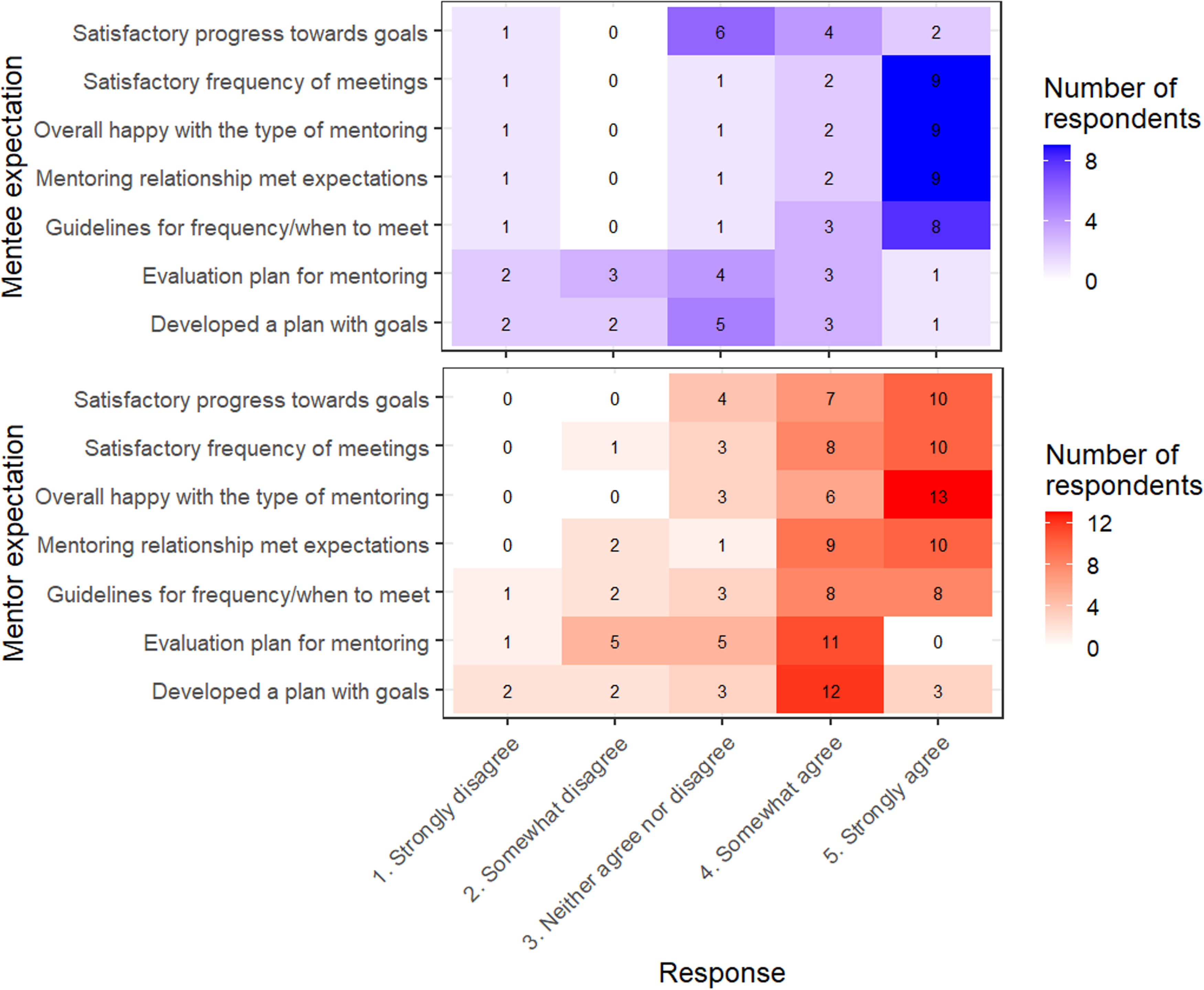
Agreement on whether the program met the mentees' (blue, top) and mentors' (red, bottom) expectations.
Results were presented in aggregate for mentees in teaching-, research-, and tenure-track positions in the present study due to the small cohort size. The lack of mentoring for nontenure track faculty has been noted as a barrier to advancement in other academic fields (de Saxe Zerden et al., 2015), motivating the inclusion of these faculty in our program.
After three iterations of the AEESP faculty mentoring program, we have learned several key lessons. First, we emphasize the importance of asking mentees for their preferred characteristics in mentors. This aspect was especially important for teaching-focused faculty and those from historically marginalized groups that wanted mentors who could relate to the personal and professional challenges faced by these groups. Second, we realized the need to continue growing the mentor pool. Several of our mentors have participated in two or more iterations of the program, often serving two or more mentees per year. To ensure the sustainability of the program, additional effort is needed to recruit other senior faculty. To incentivize their participation, some formal recognition of mentors may be useful. Third, the organizers have taken a lot of responsibility for forming the mentor-mentee pairs based on personal knowledge of research areas and needs. To streamline the pairing process and prevent conflicts of interest, we recommend asking additional questions about former institutions, research areas, and topics of interest to mentees and mentors in the application process. On a related note, we considered time-zones when forming mentor-mentee pairs to avoid challenges in scheduling meetings, which some participants noted was useful. Finally, both mentees and mentors would benefit from regular reminders to check-in with each other and a list of potential discussion topics centered around the mentee's professional development and success.
Given the positive responses in Fig. 3, AEESP plans to continue its faculty mentoring program. Results from this survey have already led to improvements for the third cohort (2023). For example, mentoring pairs were provided with a representative individual development plan and encouraged to develop their own during their first meeting. Since a lack of engagement was reported by some mentees, the AEESP Membership and Demographics committee now sends reminders to encourage regular participation. Ultimately, the AEESP cross-institution faculty mentoring program was beneficial to both mentors and mentees, and we encourage all members of the environmental engineering and science field to consider future participation. We believe that other professional organizations can benefit from a similarly structured faculty mentoring program.
Footnotes
Acknowledgments
Funding for the participant raffle prizes was provided by AEESP.
Authors' Contributions
N.L.F.: conceptualization, methodology, formal analysis, data curation, investigation, writing—original draft, visualization, and writing—review and editing. L.B.: conceptualization, methodology, writing-original draft, and writing—review and editing. K.G.: methodology, formal analysis, and writing—review and editing. R.T.: conceptualization, formal analysis, and writing—review and editing. L.L.: conceptualization, methodology, formal analysis, investigation, and writing—review and editing. T.S.: conceptualization, methodology, and writing—review and editing.
Author Disclosure Statement
No competing financial interests exist.
Funding Information
No funding was received for this article.

References
Supplementary Material
Please find the following supplemental material available below.
For Open Access articles published under a Creative Commons License, all supplemental material carries the same license as the article it is associated with.
For non-Open Access articles published, all supplemental material carries a non-exclusive license, and permission requests for re-use of supplemental material or any part of supplemental material shall be sent directly to the copyright owner as specified in the copyright notice associated with the article.
