




Abstract
The definition of environmental engineering has been updated to be: develop solutions for problems of “planetary health,” a phrase that concisely and inclusively captures the breadth of public health, global health, and one health. This new definition is consistent with the missions of the American Academy of Environmental Engineers and Scientists and Association of Environmental and Science Professors (AEESP), and it encompasses the environmental engineering grand challenges of the National Academies of Science, Engineering, and Medicine. The updated job description of environmental engineers is both an opportunity and a challenge. To solve problems of planetary health, environmental engineers will apply foundational principles of engineering science and engineering design, including sustainability and life-cycle assessment, all of which is well established in the ABET program criteria for educational programs in environmental engineering. It is also essential to improve social contracts to promote justice, equity, diversity, and inclusion across individuals, communities, and countries. The skills and practices to solve this second challenge, for example, environmental justice, are still emerging in the field. There are strong parallels between the field of environmental engineering and the profession of nursing, for which the 150-year-old mandate of Florence Nightingale is still relevant: promote wellness, prevent illness, and cure disease, which are best supported by a healthy environment, including fresh air, pure water, sanitation, hygiene, and sunlight. Environmental engineering, nursing, and other professions of caregiving can partner and share strategies to achieve planetary health.
In September 2023
The updated description of environmental engineers included in the Occupational Outlook Handbook states, “Environmental engineers use engineering disciplines in developing solutions to problems of planetary health,” (BLS, 2023). This update—solving problems of planetary health—is significant because environmental engineering currently is the only job description that references planetary health, according to online BLS data.
Originally described in 2015, planetary health includes the health of human civilization (i.e., people and society) and the state of the natural systems on which human civilization depends (i.e., global ecosystems) (Whitmee et al., 2015). As presented in Fig. 1, the concept of planetary health is a grand theory, which is intended to encompass all aspects of less inclusive theories, including (presented from most focused to most inclusive) environmental health; public health; global health, which is focused solely on human health; and one health, which includes humans, animals, and the environment.
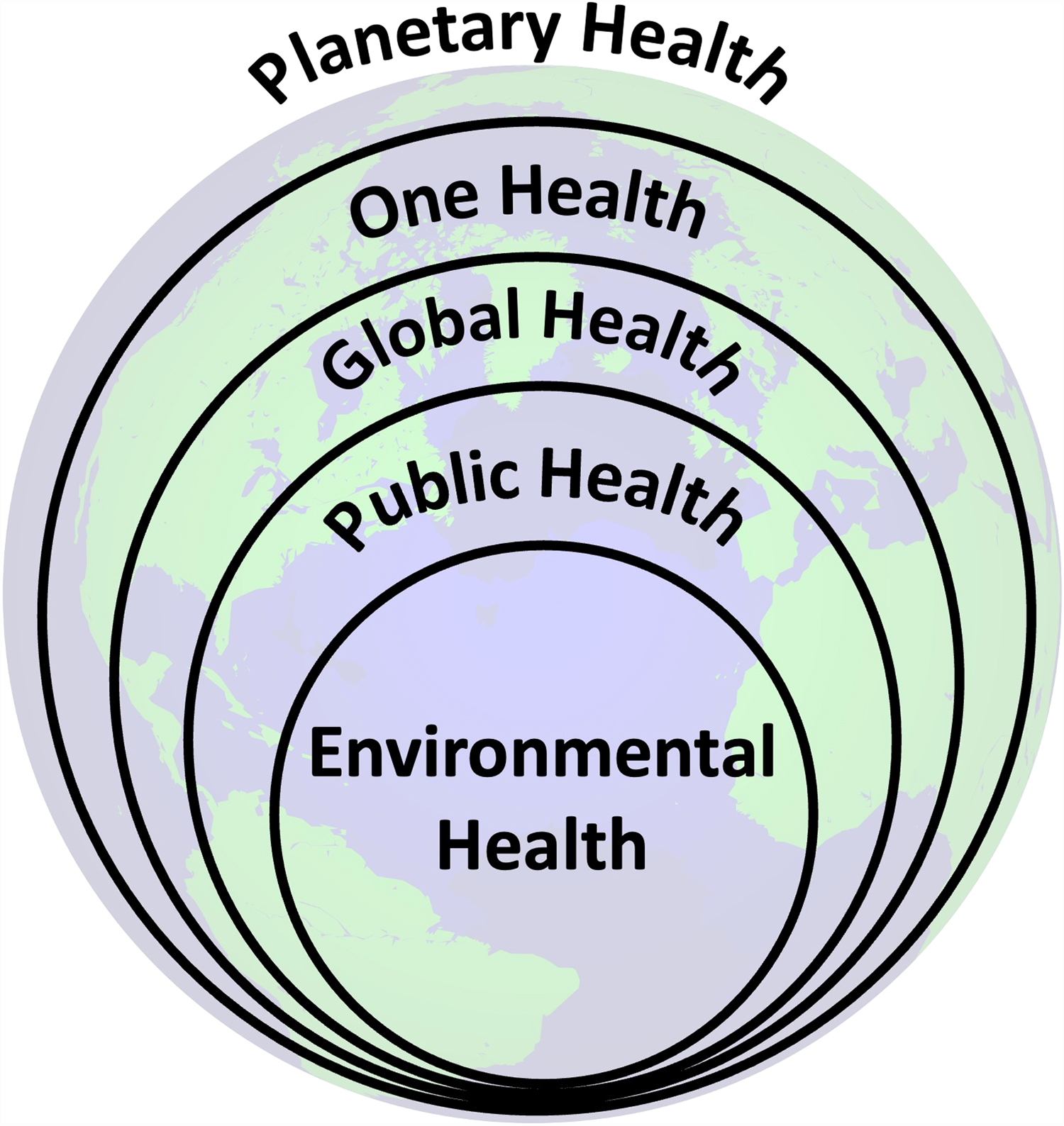
Nested theories, including planetary health.
The definition of planetary health offered by the Rockefeller Foundation-Lancet Commission on Planetary Health shares many similarities to the definition of environmental engineering offered in the bylaws of the American Academy of Environmental Engineers and Scientists (AAEES). Founded in 1955, the academy bylaws define environmental engineering as “the application of engineering principles to improve and maintain the environment for the protection of human health, for the protection of nature's beneficial ecosystems, and for environment-related enhancements of the quality of human life,” (AAEES, 2022).
There is also consistency with the grand challenges identified by the National Academies of Sciences, Engineering, and Medicine in which environmental engineering is positioned to secure sustainable food, water, and energy; curb climate change; design a future without pollution or waste; create efficient, healthy, resilient cities; and foster informed decisions and actions (NASEM, 2019). Finally, there is also consistency with the Association of Environmental Engineering and Science Professors (AEESP) that recently concluded its biennial conference that highlighted challenges of a changing climate, emerging environmental quality and human health threats, aging infrastructure and networks, marginalization of communities, and evolving education demands (AEESP, 2023).
The academy's description of the responsibilities of environmental engineers is strikingly similar to the Environmental Theory originally developed by the founder of modern nursing, Florence Nightingale. As originally described in her seminal work, Notes on Nursing: What it is, and What is it not, Nightingale's Environmental Theory may be summarized in two axioms, namely (1) the natural state of humanity is healthy and (2) the chief purpose of the health care provider is to modify the environment to promote wellness, prevent illness, and cure disease (Nightingale, 1859). Nightingale specifically advocated that human health is best supported by a healthy environment, including fresh air, pure water, efficient drainage (i.e., sanitation), cleanliness (i.e., hygiene), and sunlight.
The list of components of the environment noted by Nightingale is highly consistent with the list of components of the environment currently required for study as described within the ABET Program Criteria for Environmental Engineering and similarly named programs. In particular, the curriculum must include “material and energy balances, fate, and transport of substances in and between air, water, and soil phases… [as well as] hands-on laboratory experiments, and analysis and interpretation of the resulting data in more than one major environmental engineering focus area, e.g., air, water, land, environmental health,” (AAEES, 2023; ABET, 2022).
Thus, the ∼1000 students graduating each year from ABET-accredited programs of environmental engineering are being provided with many of the skills they need to solve problems of planetary health.
Although this list of environmental components appears inclusive, its historical interpretation excluded global environmental processes including climate change. In 2007, the legal definition of pollutant was expanded to include greenhouse gas emissions when the supreme court ruled in Massachusetts versus the U.S. Environmental Protection Agency (EPA) that greenhouse gases are air pollutants under the Clean Air Act (CAA), which defines a pollutant as a substance that endangers public health and welfare.
In 2009, the U.S. EPA Administrator signed the “Endangerment Finding,” which was that greenhouse gases in the atmosphere threaten the public health and welfare of people, and the EPA then had the legal authority to take actions about greenhouse gases under the CAA. Climate change is an enormously complex environmental risk with the potential to negatively affect food security, human health, infrastructure, and other systems that impact well-being. The environmental engineering community is uniquely positioned to address this global problem, having the skills to think about sustainability in the context of complex interrelated systems (Clarens and Peters, 2016).
As we described previously, two of the major problems facing environmental engineers include “(1) How can technology be used to help us [humans] to continue to thrive when faced with the limitations of the global carrying capacity of the natural world? [and] (2) How can social contracts be improved to promote justice, equity, diversity, and inclusion as the financial benefits—and environmental consequences—of thriving are apportioned among individuals, communities, and countries?” (Oerther and Oerther, 2022a).
Learning how to provide solutions to the first problem, for example, appropriate technology, often may be addressed through the well-known process of engineering design, which considers items such as sustainability and life-cycle principles (Oerther, 2022a). But solving the second challenge, for example, environmental justice, is perhaps less well known to faculty, students, and professionals practicing environmental engineering.
One place where environmental engineers can look to partner to solve the problem of environmental justice is the profession of nursing. For example, the recent article entitled, “The Public Health Crisis is Planetary—and Nursing is Crucial to Addressing It,” begins with two impactful sentences, namely “If the Earth were our client, her status would be multisystem failure. She is not ready for hospice, but she does need intensive care to survive,” (Kurth and Potter, 2022). Nurses understand justice. They know how to center the person while decentering people to emphasize the importance of the environment as critical to human health (Oerther, 2022b).
As we described previously, the key to supporting environmental engineers to solve problems of planetary health is emphasizing the caring nature of the profession of environmental engineering (Oerther et al., 2022). Environmental engineering—like nursing—employs science, technology, and math using an empathetic lens (Oerther and Oerther, 2022b). This approach to STEM plus empathy, or STEMpathy, is vital to the success of using technology to achieve justice, and the professions of nursing and environmental engineering both are vested in solving problems of planetary health, local to global, in partnership with individuals, communities, and countries.
Table 1 provides a side-by-side comparison of the various definitions examined in this article. We note that the updated job description of environmental engineers recently published by the BLS is both an opportunity and a challenge. Environmental engineers should practice technological leadership employing well-known skills such as engineering design. And the challenge faced by environmental engineers is to move boldly to address the issues of environmental justice.
Side-by-side comparison of definitions
Many of these issues are not yet fully addressed in the most developed communities, and they remain significant hurdles to human health in many of the least developed communities. Because the effects of planetary change often fall disproportionately on those who are least equipped to offer resistance or to bounce back (i.e., resilience), we encourage environmental engineers to partner with, borrow from, and support other caring professions—such as nursing—in our shared work to solve the problems of planetary health.
Footnotes
Authors' Contributions
The authors contributed equally to this article including conceptualization, writing, review, and editing.
Author Disclosure Statement
No competing financial interests exist.
Funding Information
No funding was received for this article.