




Abstract
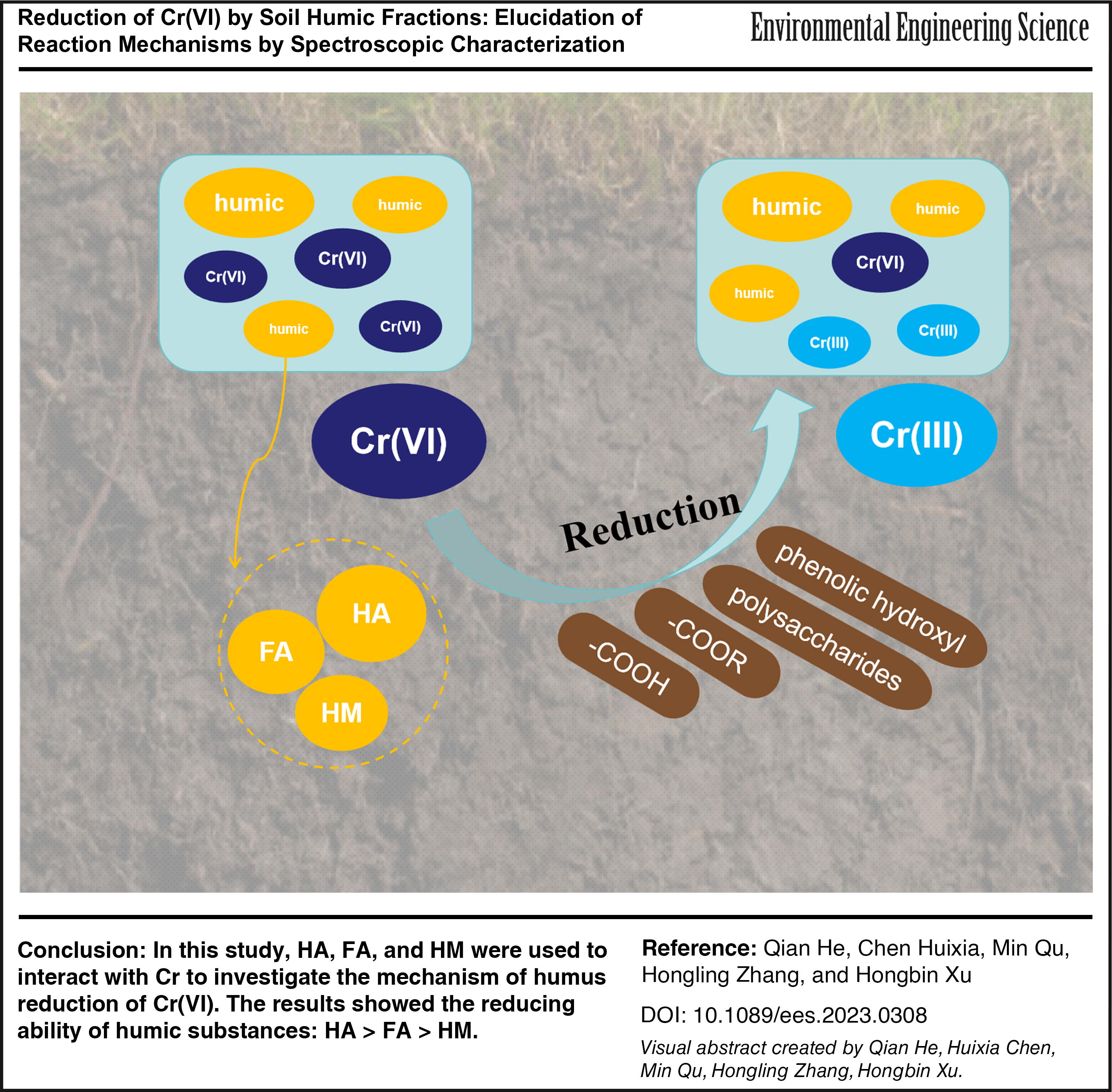
As a heavy metal element with great harm and heavy pollution in soil pollution, chromium (Cr) has posed a great threat to the soil environment and human living environment. Chromium mainly exists in the form of Cr(III) and Cr(VI) in the soil. It is of great significance to reduce Cr(VI) with strong toxicity and easy migration to Cr(III) with low toxicity and low migration. There are a large number of active groups in soil humus, which have a strong affinity with heavy metal ions and play an important role in the reduction of chromium. Humic substances are classified into three categories; however, fewer studies have been carried out simultaneously to investigate the functional groups involved in the reactions of humic acid (HA), fulvic acid (FA), and humic matter (HM) with Cr. In the present study, HA, FA, and HM were used to interact with Cr to investigate the mechanism of humus reduction of Cr(VI). The results showed the reducing ability of humic substances: HA > FA > HM. The functional groups that play a reducing role in humic substances are mainly carboxyl groups, ester groups, phenolic hydroxyl groups, and polysaccharides. The C=O and C—O bonds play a major role in the reduction of humus, but not all C=O and C—O bonds have changed during the reaction. The adsorption–reduction process was mainly carried out on the surface of humic substances, and Cr(III) was mainly adsorbed on humic substances with trace amounts of Cr(VI).
Introduction
Hexavalent chromium Cr(VI) polluted soil can pose serious threats to human health because of its high mobility and carcinogen properties (Yuan et al., 2022). Cr is one of the most abundant heavy metals, but the frequent industrial applications have led to groundwater and contamination (Du et al., 2023; Singh et al., 2023). Cr exists in the soil environment mainly as Cr(III) and Cr(VI) (Chen et al., 2021; Chen et al., 2022), Cr(III) usually exists as CrO2− and Cr3+, and Cr(VI) exists as Cr2O72− and CrO42− (Mohamed et al., 2020; Rouhaninezhad et al., 2020). Cr(III) is easily adsorbed and immobilized in the soil, with less mobility and less harm to plants, animals, and microorganisms. Cr(VI) is characterized by its solubility in water, high toxicity, high mobility, and high activity, which is mutagenic and carcinogenic to human body. In soil, Cr(VI) and Cr(III) can be interconverted in soil because of the fact that soil humus is rich in a large number of reactive groups, which have a strong affinity for heavy metal ions and have a reducing effect on Cr(VI) (Duan et al., 2022; Tan et al., 2022).
On the basis of the differences in acid–base solubility of different humus components, humus components can be classified into three types: humic acid (HA), fulvic acid (FA), and humic matter (HM) (Alidokht et al., 2021; Namdar et al., 2021). Dissolved organic matter and HA are currently the most studied (Drozdova et al., 2020; Jia et al., 2021), whereas HM is less studied. Different humus fractions have different properties and contain different functional groups, leading to differences in the interaction mechanisms between different humus fractions and Cr. Therefore, it is necessary to study the differences in the reaction mechanisms of HA, FA, HM, and Cr(VI).
The adsorption of Cr(VI) on HA is quite different from that of common heavy metals, which is mainly because of the redox process. In humus, HA mainly exists in the form of insoluble state (Klučáková & Kolajová, 2014). HAs are rich in functional groups such as carboxyl and phenolic hydroxyl groups, which can complex with heavy metals (Huang et al., 2022). Some studies have shown that carboxyl groups in HA aliphatic hydrocarbon structure are involved in the reduction of Cr(VI). Some scholars believe that the adsorbed Cr(VI) is complexed by carboxyl and ester. (Zhang et al., 2017; Zhang et al., 2019). Studies have shown that fatty polar functional groups dominated by carboxyl groups are the main sites for hydroxyapatite to reduce Cr(VI) (Chen et al., 2011). Studies have also shown that the phenolic group is the main functional group that reduces Cr(VI) to Cr(III), thereby forming a carbonyl or carboxyl group (Zhao et al., 2016). Some scholars believe that higher HA concentration increases the reduction of Cr(VI) to Cr(III), which may be because of the electron transfer provided by functional groups such as –CO, –OH, and –COOH in PAC and HA (Chen et al., 2022). Owing to the unexplored adsorption relationship between functional groups and Cr(VI) on HA, a variety of functional groups were observed to participate in the reaction during the experiment. FA is characterized by a large number of oxygen-containing functional groups such as carboxyl, alcohol hydroxyl, and phenolic hydroxyl groups. It also has better water solubility, stronger redox ability, and smaller molecular weight. These characteristics of FA provide more active sites for heavy metal pollutants, making them valence and stabilizing Cr (Luo et al., 2023; Wu & Chen, 2019). At present, there are few studies on the interaction between HM and heavy metal ions, and the research on Cr(VI) as the target is rarely reported. Some scholars found that phenolic hydroxyl and carboxyl groups in humus were involved in arsenic complexation by the reaction of HM with As (Dai et al., 2024). Some scholars have shown that HM can reduce Cr(V) by producing organic-free radicals, which can adsorb and remove Cr(III) (Han et al., 2022). The complexation functional groups (such as carboxyl and phenolic hydroxyl groups) contained in the molecular structure of HM and Cr(III) belong to hard base and hard acid, which are more likely to form stable complexes. The reduction of Cr(VI) to Cr(III) contributes to the adsorption of Cr by HM. Therefore, the adsorption process of Cr(VI) by different HA components was studied, and the relationship between the functional group characteristics of different HA components and their adsorption of Cr(VI) was revealed.
In this article, the reaction between humus and Cr(VI) was carried out to accelerate the reaction process between humus and Cr(VI) and increase the disturbance degree of Cr(VI) on humus functional groups, so as to improve the significance of the difference in the spectral characterization results of humus functional groups in the reaction process. The related experiments were completed under acidic conditions (pH 2). The reaction mechanism of humus and Cr(VI) was explored. The pH conditions set in the experiment are also common in actual contaminated sites, such as electroplating contaminated sites, where the pH value of electroplating wastewater can be as low as about 1 (Huang et al., 2017). On the basis of the above considerations, this article will focus on (1) kinetic comparison of the interaction of three types (HA, FA, and HM) of humic substances with Cr(VI), (2) characterization analysis before and after the reaction; and (3) the effects of functional groups in humus on the reduction of Cr(VI) to Cr(III) were analyzed.
Materials and Methods
Chemicals were purchased at analytical grade except humic fractions.
Preparation of soil humic fractions
International Humic Substances Society with minor modification was used for extraction of different humus fractions by Lvliang Shengda Biological Development Co. Ltd (D.L. et al.). Briefly, soil samples were ground and sieved before put into the bottle. Under an inert N2 atmosphere, samples were blended with the mix solution 0.1M Na2P4O7 + 0.1M NaOH and oscillated for 24 h. Supernatant (used to extract FA and HA) and precipitate (used to extract HM) were obtained by centrifugation. HM fraction was suspended in a solution of 0.1M HCl + 0.3M HF to remove mineral impurities and then dialyzed until ions of chloride was eliminated. HA and FA extraction was based on the procedure of (Tan et al., 2018; Yu et al., 2020).
Batch experiments for Cr(VI) removal
1gHA, FA, and HM were added to 200 mL 5 mM Cr(VI) solution prepared by dissolving K2Cr2O7 and kept at pH ∼2 by adding HCl, respectively. All reaction flasks were placed in a constant temperature oscillation incubator and oscillated horizontally at 25°C and 200 rpm until Cr(VI) concentration stabilized (Zhang et al., 2017). The reaction cycle of this experiment was 28 days and sampled for analysis on day 0, 1, 2, 3, 5, 7, 10, 15, 20, 24, and 28.
Cr analysis
Liquid samples were collected at specified intervals by a syringe, and 0.45 microfiltration membranes were used to remove the insoluble substances for subsequent experiments. The concentration of Cr(VI) in solution was detected by a UV–visible spectrophotometer at 540 nm. Cr(T) concentration was analyzed by using an inductively coupled plasma-optical emission spectrometer (Optima 5300 DV, Perkin Elmer). The concentration of Cr(III) was determined by the concentration difference between Cr(T) and Cr(VI).
The Content of Chromium Changed When the HA, FA, HM Was Reacted to 28 Days at pH 2
d, day; FA, fulvic acid; HA, humic acid; HM, humic matter.
Kinetic Model-Fitting Parameters
FA, fulvic acid; HA, humic acid; HM, humic matter.
Characterization analysis
The samples were ground for characterizations after treatment of centrifugation and freeze-drying. Fourier transform infrared spectrometer (FTIR, Thermo Scientific Nicolet iS50) was used to analyze the functional groups of humus samples by the KBr compression method. X-ray photoelectron spectrometer (XPS, Thermo Scientific ESCALAB 250Xi) was used to analyze the valence states of elements of Cr in the samples.
Kinetics modeling and data analysis
The kinetic model was used to further study the adsorption, desorption, and reduction of Cr(VI) and Cr(III) in the liquid phase. The parameters of the model can be viewed in our previous study (Chen et al., 2017). The data analysis method of this model adopts Ode45 of Matlab v.7.1(R-14) and Runge–kutta method of 4–5 order.
Results and Discussion
Variation of chromium content
The experiment examined the reduction and adsorption complexation ability of HA, FA, and HM humic substances before and after the reaction. The results (Table 1, Fig. 1, Supplementary Fig. S1, Supplementary Table S1, Supplementary Fig. S4, Supplementary Fig. S5 and Supplementary Fig. S6) revealed that the humic substances reduction and adsorption complexation ability ranked from high to low as HA > FA > HM. The reduction rate for Cr(VI) was between 10.7%−78.9%, and for Cr(T), it was reduced by about 7%−20%. The content of Cr(VI) decreased from 903.76 to 410.10 mg/L, whereas the Cr(T) content did not change much, from 1004.85 to 961.05 mg/L. Furthermore, the reaction rate slowed after the third day, and the reduction rate for Cr was < 10% in the following 20 days. In addition, the FA adsorption reduction rate was about 15%, and the reaction was intense during the first 4 days, with more reduction of Cr(VI). However, the reaction rate slowed down from the fourth day. HM had an extremely low ability to reduce Cr(VI), while for the above three humic substances, HA had the strongest ability to reduce Cr with a reduction rate of about 78%, and it could adsorb complexed partial Cr. FA had a reduction rate of about 15–18%, while HM had a very low ability to reduce Cr. In summary, HA has the highest reduction ability among the humic substances, with a reduction rate of about 78%, and it can adsorb complexed partial Cr. FA has a reduction rate of about 15–18%, and HM has the lowest ability to reduce Cr.

Variation of Cr(VI) content when the HA, FA, HM was reacted to 28 days at pH = 2. FA, fulvic acid; HA, humic acid; HM, humic matter.
Kinetics modeling of adsorption-coupled reduction
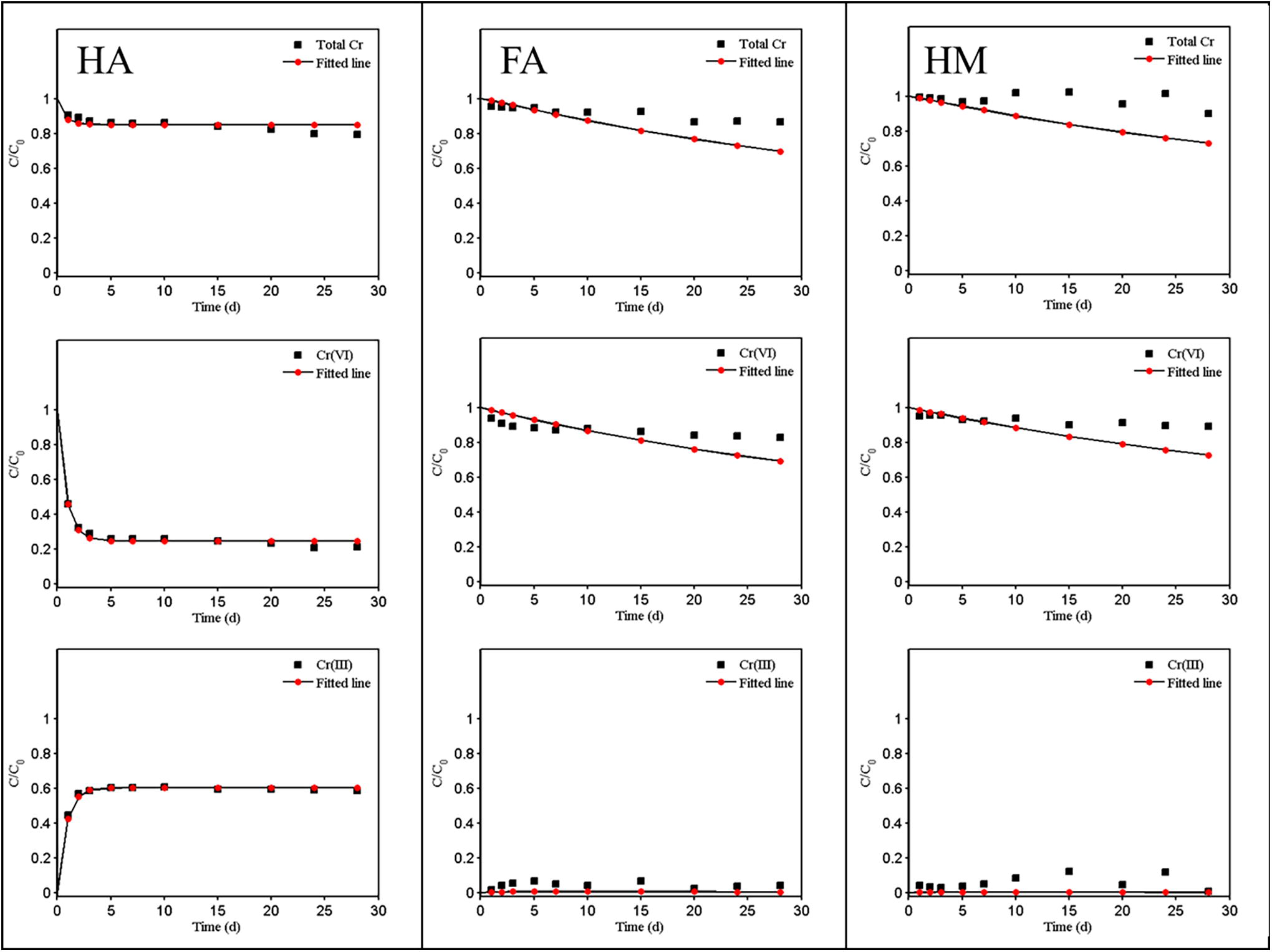
The experimental data of humus were fitted by a stable kinetic model, and the fitting method was described in the previous study (Chen et al., 2017). Where C/C0 is the ratio of the concentration of Cr at t and the initial time, and the fitting parameters are listed in Table 2. The relationship between the experimental and predicted values of Cr(T), Cr(VI), and Cr(III) during the reaction between humus and Cr solution at room temperature is shown in Figure 2. In the whole experiment of reducing Cr by humus, the change trend of HA basically coincided with the predicted value. Compared with the fitted curve, the experimental values of HM and FA fluctuate slightly, but considering their poor reduction ability, the measured Cr content is low, and slight fluctuations are normal. In summary, the experimental value and the predicted value are basically the same.
Kinetic model-fitting result.
Characterization
Fourier transform infrared spectrometer
The FTIR spectra, showing the chemical composition before and after the HA reaction, are presented in Figure 3. The analysis was performed on the range between 1800 and 750 cm—1. During the reaction, the absorption peaks at 1380 and 1237 cm—1 corresponding, respectively, to the stretching vibrations of aliphatic C—H bond and phenolic hydroxyl C—O single bond-gradually decreased. This indicates that the carboxyl C=O double bond, ester C=O double bond, aliphatic C—H bond, and phenolic hydroxyl C—O single bond are involved in the reaction. On the contrary, the absorption peak at 1548 cm—1—corresponding to the stretching vibration of the complexed carboxyl group—significantly increased. In addition, the absorption peak at 804 cm—1 also slightly increased. This specific absorption of Cr(III) at this wavelength shows that the increase of the peak intensity is related to the adsorption of Cr(III) on the surface of HA (Li et al., 2019).

FTIR trends before and after HA reaction. FTIR, Fourier transform infrared spectrometer; HA, humic acid.
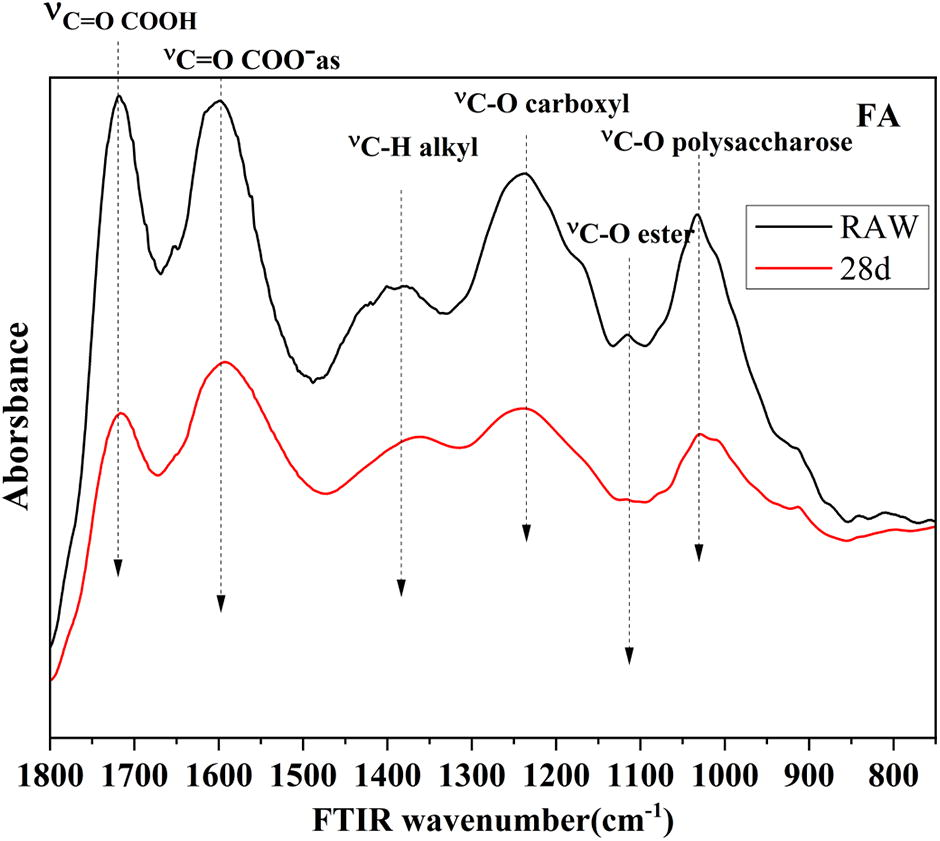
The trend of change in both FA and HA is similar, and they correspond to the same functional group structure (Fig. 4). However, the difference between the two is that the absorption peaks of FA are weakened at 1115 and 1032 cm—1, which correspond to the C—O single bond stretching vibration in the lactone group as well as the polysaccharide structure. This indicates that functional groups such as carboxyl group, phenolic hydroxyl group, lactone group, and polysaccharide are involved in the Cr reduction reaction. The peak intensity at 804 cm—1 did not show any significant change, and Cr(III) was not noticeably adsorbed. This result is consistent with the experimental test results.
FTIR trends before and after FA reaction. FTIR, Fourier transform infrared spectrometer; HA, humic acid.
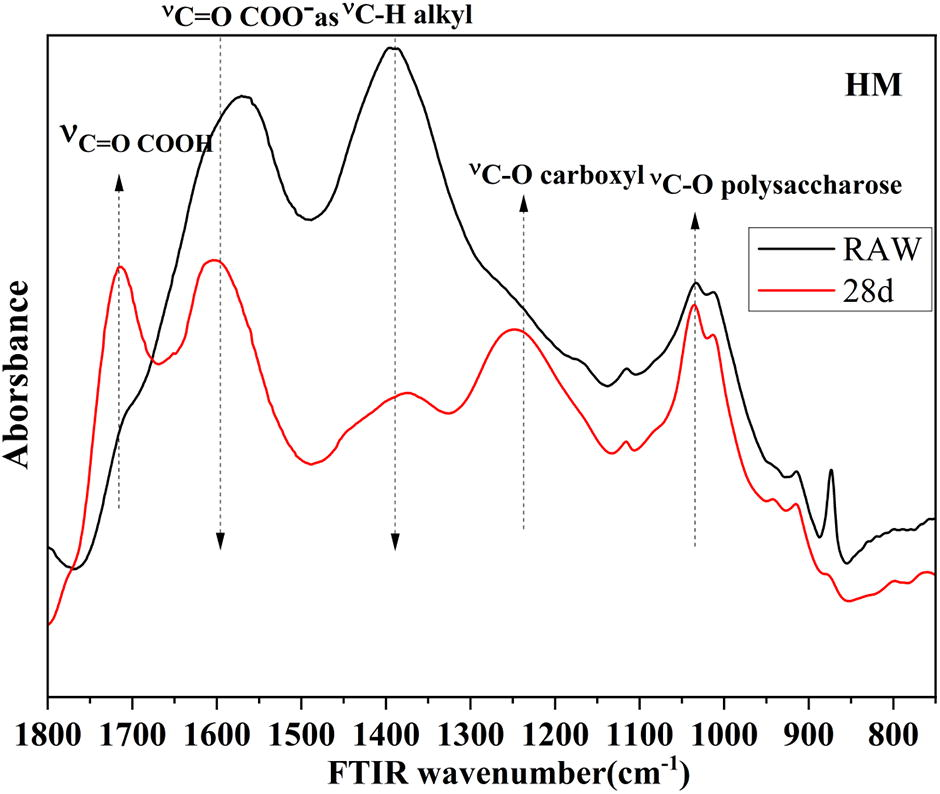
Figure 5 depicts the FTIR spectra before and after the HM reaction. The wave numbers at 1718 and 1237 cm—1 indicate the stretching vibration of the C=O double bond of the carboxyl group and the stretching vibration of the C—O single bond of the phenolic hydroxyl group. As the reaction proceeded, the intensity of the absorption peaks at 1600, 1380, and 1032 cm—1 increased. These peaks corresponded to the asymmetrical stretching vibration of the C=O double bond of the ester group, the stretching vibration of the aliphatic C—H bond, and the stretching vibration of the C—O single bond in the lactone group, respectively.
FTIR trends before and after FA reaction. FA, fulvic acid; FTIR, Fourier transform infrared spectrometer.
In summary, during the reaction of HA and FA, the stretching vibration of carboxyl C=O double bond, ester C=O double bond, and phenolic hydroxyl C=O single bond are mainly involved. In the case of HM, it is mainly the stretching and vibrating of the carboxyl C—O double bond and the phenolic hydroxyl C—O single bond that participate in the reaction (Chen et al., 2020; Mu et al., 2022).
X-ray photoelectron spectrometer
All three humic surfaces of HA, FA, and HM adsorbed Cr after 28 days of reaction (Fig. 6). The binding energy of 578.3 eV corresponds to Cr(VI) and 587.2, 577.4, and 576.7 eV correspond to Cr(III). Peak splitting revealed that Cr peaks with different intensities appeared in all three humic substances, indicating that Cr(VI) and Cr(III) were adsorbed on the surface of humic substances. Among them, the adsorption of Cr(VI) was worse than that of Cr(III), indicating that the adsorption–reduction process mainly occurred on the humic surface, that is, Cr(VI) was first adsorbed onto the humic surface and then Cr(VI) was reduced to Cr(III), resulting in the accumulation of more Cr(III) and lower Cr(VI) on the humic surface. Comparing the test results of HA, FA, and HM humic substances together, it was found that the adsorption amounts were in the order of more to less: HA > FA > HM, and this result was consistent with the experimental results. Moreover, the FTIR results showed that the peak intensity was slightly enhanced at 804 cm−1 wave number in the FTIR spectrum, representing Cr(III). Combined with the XPS results, it was found that more Cr(III) was adsorbed on the humic substances. It is worth noting that Cr(VI) was not detected in the IR spectrum because of the low amount of Cr(VI) being adsorbed (Barnie et al., 2018).

Cr content in XPS spectra before and after HA, HM and FA reactions. FA, fulvic acid; HA, humic acid; HM, humic matter; XPS, X-ray photoelectron spectrometer.
The humic spectra of C1s in XPS are shown in Supplementary Figure S2. The C spectrum mainly showed C=O, C–O, and C=C bonds. After 28 days of reaction, the strength of the C=O and C–O bonds corresponding to three humic substances, HA, FA, and HM were weakened to varying degrees. The binding energies of 288.8, 286.6, and 284.7 eV corresponded to C=O, C–O, and C=C, respectively. The peak strengths of the C=O bonds were significantly weakened after 28 days of reaction, whereas the C–O peak was weakened to a lesser extent because of its lower content in the original material. This suggests that the C=O and C–O double bonds of HA, FA, and HM humic substances are involved in the reaction with Cr. HM decreased in trace amounts, FA decreased in a greater quantity, while HA underwent the most significant change, which is consistent with previous experimental results. This is in agreement with the change of Cr2p.
In contrast, the O1sp spectrum (Supplementary Fig. S3), compared with the spectrum of the humic substances that did not participate in the reaction, a new peak was generated at a binding energy of 531.6 eV with a stronger peak intensity, which corresponds to Cr(III); new peaks with lower intensity were generated at binding energies of 530.4 and 530.6 eV, which corresponds to Cr(VI). It indicates that more Cr(III) and trace Cr(VI) are adsorbed on the humic surface, and the adsorbed Cr is combined with O, mainly in the form of Cr2O3 and CrO3. Combined with the analysis of Cr2p profiles, it is consistent with the changes of O1s profiles: higher content of adsorbed Cr(III) and lower content of Cr(VI). The overall change pattern of the above three humic substances is consistent with the experimental change pattern, that is, HA > FA > HM.
Conclusion
In this work, three humic substances, HA, FA, and HMs, were reacted with Cr under acidic conditions to test the reaction mechanism of humic substances with Cr. The obtained results as follows:
Humic reduction capacity: HA > FA > HM. The reaction cycle of Cr reduction by humic substances was 28 days. The conclusion was proved credible by kinetic fitting, and the experimental results were consistent with the trend of the fitted results. Changing the reaction with humic substances produced by different manufacturers, and the conclusions obtained were consistent with the above. This indicates that the experimental results are reproducible. Therefore, the experimental results are reliable and not a chance occurrence. The functional groups that play a reducing role in humic substances are mainly carboxyl groups, ester groups, phenolic hydroxyl groups, and polysaccharides. The reaction was counter-verified by using pure reagents with each functional group involved. The phenolic hydroxyl group and polysaccharide were found to have an extremely strong reducing ability, and the ester group and quinone group were slightly weaker. The carboxyl group was less reducing, and a review of the relevant literature showed that the carboxyl group mainly plays a complexing role, while the reducing ability is weak. The C=O and C–O bonds are the main ones that play a reducing role in humic substances, but not all the C=O and C–O bonds in the whole sample were changed. The humic substances before and after the reaction were characterized by XPS, and it was found that the signal peak intensity of C=O double bond and C–O single bond decreased significantly after the reaction, indicating that almost all C=O and C–O-related functional groups on the surface of the samples were oxidized. Combined with FTIR, it was found that the IR absorption of C=O double bonds in the carboxyl, ester, and phenolic hydroxyl structures and C–O single bonds in the polysaccharide structure were still very obvious in the IR spectra, indicating that the humic substances still contained a certain amount of carboxyl, ester, phenolic hydroxyl, and polysaccharide after the reaction, and not all of them were oxidized. The adsorption–reduction process was mainly carried out on the surface of humic substances, and Cr(III) was mainly adsorbed on the humic substances, while trace amounts of Cr(VI) were adsorbed.
By characterization, it was found that Cr combined with O, mainly in the form of Cr2O3, CrO3, where Cr(III) was mainly adsorbed on humic substances, with trace amounts of Cr(VI) adsorbed on humic substances.
Footnotes
Authors’ Contributions
Q.H.: Writing—original draft, investigation, and visualization. H.C.: Writing—review and editing and funding acquisition. M.Q.: Formal analysis. H.Z.: Project administration. H.X.: Supervision.
Research Involving Human Participants and/or Animals
This article does not contain any studies involving human participants or animals performed by any of the authors.
Author Disclosure Statement
The authors declare that they have no conflicts of interest.
Funding Information
This work was financially supported by

References
Supplementary Material
Please find the following supplemental material available below.
For Open Access articles published under a Creative Commons License, all supplemental material carries the same license as the article it is associated with.
For non-Open Access articles published, all supplemental material carries a non-exclusive license, and permission requests for re-use of supplemental material or any part of supplemental material shall be sent directly to the copyright owner as specified in the copyright notice associated with the article.
