




Abstract
We investigated the adsorption of organic pesticides on environmentally relevant polystyrene (PS) microplastics. In this study, the PS microplastics underwent distinct laboratory aging treatments to stimulate the aged microplastic waste found in natural environments: i) ultraviolet (UV) light exposure-only treatment (UV-aged group), ii) UV light exposure combined with hydrogen peroxide oxidation treatment (UV + H2O2 group), and iii) a control group without artificial aging treatments (nonaged group). Both aging treatments led to surface defects and generated carbonyl and hydroxyl functional groups on the microplastics’ surface, increasing the hydrophilicity and decreasing the zeta potential of PS microplastics. Three hazardous organic pesticides—alachlor, lindane, and methomyl—with different physicochemical characteristics were selected as adsorbates. The adsorption experiments revealed diminished capacities for alachlor and lindane on PS microplastics after both aging treatments. The adsorption of methomyl was below the limit of detection across all the PS microplastics groups. Within the same PS microplastics adsorbent group, the adsorption affinity of the three pesticides to the MPs was ranked from highest to lowest as lindane, alachlor, methomyl, corresponding with their octanol/water partition coefficient (log Kow) values, indicating that hydrophobic interactions were the primary adsorption mechanism for the PS microplastics. The better correlation using the Freundlich model implies heterogeneous adsorption sites on the PS microplastics’ surface. These findings emphasize that aging processes can increase the hydrophilicity of PS microplastics and highlight the importance of considering the aging effects on PS microplastics when evaluating their potential risks as adsorbents and carriers of organic contaminants in the environment.

Introduction
In the natural environment, discarded plastic products undergo various aging processes such as ultraviolet (UV) irradiation, chemical oxidation, physical abrasion, and biodegradation (Luo et al., 2022) that fragment large plastic pieces into microplastics (size <5mm). These aging processes also contribute to polymer chain scission and the development of surface cracks, resulting in a reduction in microplastic size and an increase in specific surface area. Moreover, the aging processes facilitate the formation of oxygen-containing groups, leading to increased microplastic hydrophilicity and alterations in surface charges. Consequently, the adsorption behaviors of microplastics change with the aging processes (Arp et al., 2021; Luo et al., 2022).
Microplastics are typically transported through wind and water runoff, ultimately settling in downwind or downstream regions or being carried into the ocean (Koutnik et al., 2021). The concentration of microplastics in freshwater varies widely, ranging from 1 × 10⁻² to 1 × 10⁸ particles per cubic meter (Koelmans et al., 2019). Typically, smaller sizes are associated with higher concentrations (Lindeque et al., 2020). Fragment and fiber shapes are the predominant microplastic shapes in the aquatic environment, accounting for 52% and 29% of the total, respectively (Burns and Boxall, 2018; Koelmans et al., 2019).
Polystyrene (PS), with a density of 0.96–1.05 g/cm³, is one of the most frequently identified types of microplastics in water columns and sediments, especially in urban canals, wetlands, river, and lake sediments (Burns and Boxall, 2018; Koelmans et al., 2019; Koutnik et al., 2021). PS serves as the primary material for manufacturing disposable food containers, packaging, and building insulator foams (Kik et al., 2020). By 2018, the total cumulative volume of primary PS waste had reached 400 million metric tonnes (Geyer, 2020).
Recent studies have highlighted the potential environmental risks associated with the adsorption of organic contaminants onto microplastics. In aquatic environments, microplastics demonstrate the capacity to adsorb organic contaminants, acting as carriers that transport these contaminants globally (Santana-Viera et al., 2021; Yu et al., 2021). In agricultural settings, microplastics have been reported to compete with soil for the adsorption of organic pesticides (Hüffer et al., 2019), establishing microplastics as both accumulators and sources of pesticides in the environment (Fang et al., 2019; Li et al., 2021). Furthermore, within the ecological community, the ingestion and subsequent bioaccumulation of microplastics bring “Trojan horse” effects, where contaminants adsorbed onto microplastics can enter food webs alongside the microplastics (Krause et al., 2021). This shortcut route has been observed for a variety of organic contaminants with wide-ranging hydrophobicities, including polycyclic aromatic hydrocarbons, polychlorinated biphenyl, bisphenol A, and polybrominated diphenyl ethers (Diepens and Koelmans, 2018; Tang et al., 2020).
The understanding of the adsorption processes for environmentally relevant microplastics remains insufficient. This knowledge gap mainly arises from the fact that some existing results are based on the application of pristine synthetic microplastics without aging treatments, which may behave differently from their authentic counterparts in environmental conditions (Yu et al., 2021). In this study, PS microplastic microplastics were generated from commercial disposable food trays and subjected to distinct aging treatments to simulate the environmentally relevant aged PS microplastics.
In this study, three organic pesticides—alachlor (the octanol/water partition coefficient [log Kow] = 3.52), lindane (log Kow = 3.72), and methomyl (log Kow = 0.60)—were selected as adsorbates for their differing hydrophobicities and distinct chemical structures. Alachlor is a herbicide used to control annual grasses and broadleaf weeds, whereas lindane and methomyl are broad-spectrum insecticides. All these pesticides are associated with ecological risks and health concerns, leading to their regulation by the US Environmental Protection Agency (EPA). The agency set the maximum contaminant level (MCL) for alachlor and lindane at 2 µg/L and 0.2 µg/L, respectively. Even though EPA has no established MCL for methomyl, the Office of Drinking Water has established 1- and 10-day Health Advisory Levels (HALs) of 300 µg/L and a lifetime HAL of 200 µg/L for methomyl (USEPA 2019). They have been detected in both surface water and groundwater worldwide over the past few decades (Holden et al., 1992; Ngueleu et al., 2013; Van Scoy et al., 2013).
This study evaluated the adsorption of hazardous organic pesticides with varying hydrophobicities—alachlor, lindane, and methomyl—onto these environmentally relevant aged PS microplastics, integrating adsorption kinetics and isotherms, liquid and gas chromatography, attenuated total reflectance—Fourier transform infrared (ATR-FTIR) spectroscopy, scanning electron microscopy/electron-dispersive X-ray diffraction spectroscopy (SEM/EDS), and X-ray photoelectron spectroscopy (XPS).
Materials and Methods
Quality control
The use of plastic materials was reduced as much as possible to avoid MP background contamination. All experimental instruments and glassware were sonicated for 30 min in an ultrasonic bath with ultrapure water (18 mΩ) and covered with aluminum foil between sonication and use. All benchtops were carefully cleaned, and all laboratory procedures were conducted in a fume hood. All adsorption experiments used 60 mL borosilicate glass vials with aluminum foil-lined caps to minimize potential adsorption onto Polytetrafluoroethylene (PTFE) liners.
Materials
To generate environmentally relevant PS microplastics, the disposable PS foam food containers were first cut into 5 × 5 mm small pieces using scissors. Then, these small pieces of PS materials were placed in a ball milling machine (SPEX SamplePrep 8000M) equipped with a stainless-steel grinding vial set (SPEX 8007). The generated PS microplastics were subsequently divided into three groups for distinct treatments separately: i) UV-aged group; the PS microplastics were irradiated in a UV chamber (Mystaire MY-DB42C) providing 254 nm UV light at an intensity of 1 W/cm2 for 40 days, which is equivalent to about 5–6 years of solar irradiation at the Earth’s surface; ii) UV + hydrogen peroxide (H2O2) group; the PS microplastics were immersed in 30% H2O2 within covered fused silica Petri dishes, which were then placed in the same UV chamber for 15 days; and, iii) the control group of PS microplastics that did not undergo any artificial aging processes (nonaged group). The length of 15 days was not selected based on comparing the aging treatments between each other, instead to produce two different sets of microplastics with a unique functional chemistry from each other. Following the aging treatments, all three groups of PS microplastics were sieved into the 25–75 μm using consecutive vacuum sieving with 500 mesh (25 μm) and 200 mesh (75 μm) stainless steel filters to ensure size consistency.
Alachlor (CAS:15972-60-8, analytical grade, purity ≥98.0%), lindane (CAS:58-89-9, analytical grade, purity >97%), and methomyl (CAS:16752-77-5, analytical grade, purity ≥98.0%) were purchased from Sigma-Aldrich. All the solutions were prepared with deionized water (18 mΩ).
Characterization
The microplastic surface morphology and elemental composition were examined using an SEM (FEI Quanta 600) equipped with EDS (Bruker QUANTAX XFlash6) X-ray microanalysis system. In addition, the surface composition of the microplastics was further analyzed by XPS, utilizing the Mg anode of a PHI 300-Watt Twin Anode X-ray source with a Physical Electronics (PHI) double-pass cylindrical mirror analyzer. The Feret diameter of the particles was then determined with ImageJ based on these SEM images. The functional groups on the PS microplastics were analyzed by ATR-FTIR (ThermoFisher, Nicolet iN10 MX). The surface charges of the microplastics were measured by ζ-potential analysis (Malvern, Zetasizer Advance Ultra).
To confirm the adsorption of pesticides, after the adsorption isotherm experiments, the PS microplastics from the samples with the highest pesticide concentration (6 mg/L) were collected by filtering through filter paper (Whatman, 1442–055). The PS microplastics retained on the filter papers were kept in a vacuum desiccator for 24 h to ensure thorough drying. They were then analyzed by ATR-FTIR and SEM/EDS to confirm the adsorption of pesticides.
Adsorption experiments
In the adsorption kinetics experiments, 40 mg of PS microplastics were added to borosilicate glass vial containing 40 mL of 6 mg/L adsorbate solution to yield a PS microplastic concentration of 1 mg/mL. The borosilicate glasses had volume capacity of 60 mL. The initial pH of all solutions was 7.0. Then, the vials underwent shaking using a rotisserie tube rotator (SCILOGEX SCI-RL-E) at 80 rpm with a relative centrifugal force of 0.46 g to ensure thorough mixing of PS microplastics and the adsorbate solution. Samples were collected after 0.25, 0.5, 1, 2, 4, 8, 16, 24, 36, and 48 h of shaking and subsequently filtered through 0.45 μm glass fiber filters to remove PS microplastics.
In the adsorption isotherm experiments, 40 mg of PS microplastics and 40 mL of adsorbate solutions with increasing initial concentrations (1, 2, 3, 4, 5, and 6mg/L) were added into the borosilicate vials. The shaking and sampling procedure followed the identical protocol as the kinetics experiments. Based on the results of kinetics experiments, the mixing time was set to 48 h to ensure the attainment of adsorption equilibrium.
The alachlor and lindane concentrations were determined following EPA Method 8081 B. The analytes were extracted by hexane (1:1, v/v). The samples were measured on a gas chromatograph coupled with an electron capture detector (GC-ECD, Agilent 6890) with a DB-5 capillary column (30 m × 0.25 mm × 0.25 μm, J&W). The concentrations of methomyl were analyzed following the methodology established by Hancock et al., 2004, using a liquid chromatography-mass spectrometry (Shimadzu LCMS 2020) with a C18 column (C18, 2.1 × 100 mm, 3 μm, Shimadzu). The adsorption experiments were conducted in triplicate, and blank samples were included. All adsorption experiments were conducted at 25°C.
Carbonyl index and hydroxyl index
The carbonyl index (CI) and hydroxyl index (HI) were used to examine the generation of functional groups associated with the oxidation of the PS microplastics. The CI was calculated from the ratio between absorbances of the carbonyl (C = O) peak from 1,850 to 1,650/cm and the methylene reference peak from 1,500 to 1,420/cm:
The HI was calculated from the ratio between absorbances of the hydroxyl
Adsorption isotherm models
The adsorption isotherm data were fitted by Langmuir model (3) and Freundlich model (4) (Ayawei et al., 2017):
Data analysis
The adsorption equilibrium time is determined using the analysis of variance (ANOVA) Tukey test at 95% confidence. The ζ-potential values and adsorption capacities between each group are compared by t-test. The data in each group passed the test for equal variances and the normality test (p > 0.05).
Results and Discussion
Characteristics
The SEM images (Fig. 1C, 1D, 1E) demonstrate that there are more cracks and defects appearing on the surface of the PS microplastics in both the UV-aged and UV + H2O2 groups than in the nonaged group. These surface morphology changes by aging treatments align with previous studies, as the exposure to UV irradiation and oxidants can accelerate the polymer chain cleavage and the oxidation of side groups (Hüffer et al., 2018; Liu et al., 2019). Furthermore, the microplastics of the UV + H2O2 group exhibit a slight degree of yellowing, whereas those in the UV-aged group display a much deeper yellowing (Supplementary Fig. S1). This yellowing phenomenon in PS plastics is attributed to degradation processes where the benzene ring is oxidized to open chains and forming conjugated structures (Zhang et al., 2021). The Feret diameter of the three groups of PS microplastics is statistically equivalent (Fig. 1B, p > 0.56). This similarity reduces the impact of size differences in subsequent adsorption experiments.

Characterization of the PS microplastics.
The ATR-FTIR spectra (Fig. 1A) revealed the generation of hydroxyl groups (3,700–3,200/cm board band) and carbonyl groups (1,850–1,650/cm) under both aging treatments. Previous studies have demonstrated that in aqueous environments, characterized by a higher concentration of hydrogen ions and a lower utilization ratio of UV light energy, hydroxyl groups are preferentially generated, whereas carbonyl groups are preferentially generated in atmospheric environments (Cai et al., 2018). In this study, both the CI and HI of the UV-aged group are higher than those of the UV + H2O2, indicating a higher aging degree (Fig. 1B). The microplastics in the nonaged group also exhibited oxygen-containing functional groups. This occurrence may be partially due to the additives and processing agents prevalently used in plastic production (Wiesinger et al., 2021).
The presence of hydrophilic oxygen-containing functional groups led to a decrease in the ζ-potential of PS microplastics (Fig. 1B). The UV-aged group (−51.48 ± 3.46 mV) exhibited a notably lower ζ-potential compared with the UV + H2O2 group (−46.46 ± 5.04 mV). The ζ-potential of all three groups microplastics is less than −30 mV, indicating the all the PS microplastics generated in the experiment have a good ability to form a stable colloidal suspension in water (Lunardi et al., 2021). Therefore, the aged microplastics, characterized by an increased abundance of hydrophilic and oxygen-containing functional groups, along with their smaller size and lower ζ-potential, are more likely to remain stably suspended in natural water bodies, potentially posing ecological risks (Dong et al., 2020).
UV and chemical oxidants are commonly employed in laboratory experiments to simulate natural aging processes (Supplementary Table S1). Although UVC (200–280 nm) is absorbed by atmospheric ozone and does not reach the ground, its higher irradiation intensity can efficiently accelerate photo-aging, making it a useful tool in artificial weathering simulations (Ouyang et al., 2022). Although the aging methods vary, they lead to changes with similar trends in PS microplastics, including size reduction, surface cracking, lower ζ-potential, and the generation of oxygen-containing functional groups (Supplementary Table S1).
Adsorption experiments
The adsorption kinetics indicate that the adsorption of alachlor and lindane by all three groups of microplastics reached equilibrium within 16 h (Fig. 2). However, no significant methomyl adsorption (p > 0.40) was observed by any of the three groups of microplastics (Supplementary Fig. S2 , Fig. S3). At equilibrium, for samples with an initial concentration of 6 mg/L, the lindane adsorption capacities of the UV-aged group, the UV + H2O2 group, and the nonaged group are 1.14 ± 0.25 mg/g, 1.04 ± 0.20 mg/g, 2.05 ± 0.26 mg/g, respectively. The alachlor adsorption capacities of the UV-aged group, UV + H2O2 group, and nonaged group are 0.41 ± 0.07 mg/g, 0.42 ± 0.07 mg/g, and 0.80 ± 0.08 mg/g, respectively. There was no significant difference (p > 0.11) in the adsorption capacities of alachlor and lindane between the UV-aged group and UV + H2O2 group. The solution pH remained at the initial value of 7.0 in all experiments. Figure 3 shows that the Freundlich isotherm model exhibits a better fit for all adsorbate-adsorbent groups with higher coefficients of determination with smaller root-mean-square errors of the regression than the Langmuir model. This suggests the presence of heterogeneous sites on the surface of PS microplastics and supports the potential occurrence of multilayer adsorption. As the Langmuir model only fits well for the data of alachlor adsorption onto nonaged PS microplastics, the estimated maximal adsorption capacities and Langmuir constants are provided for this case here.
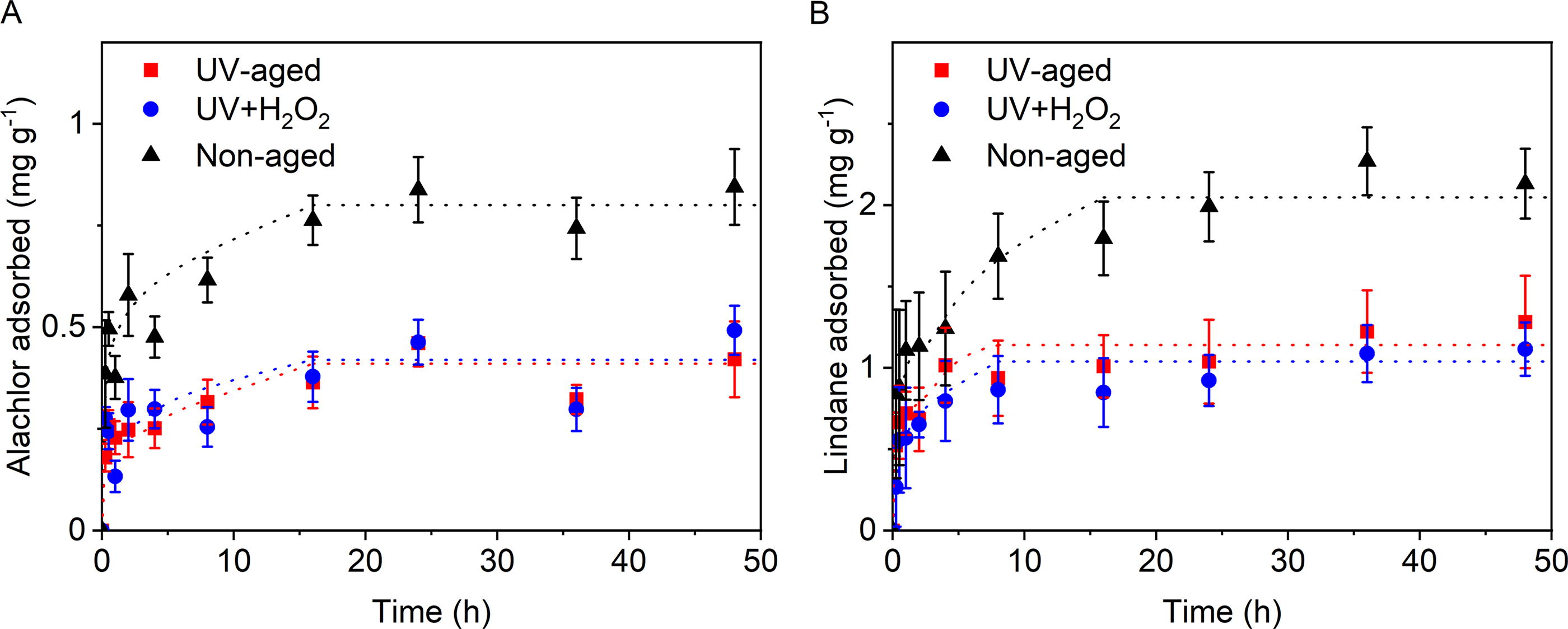
Adsorption kinetics for alachlor
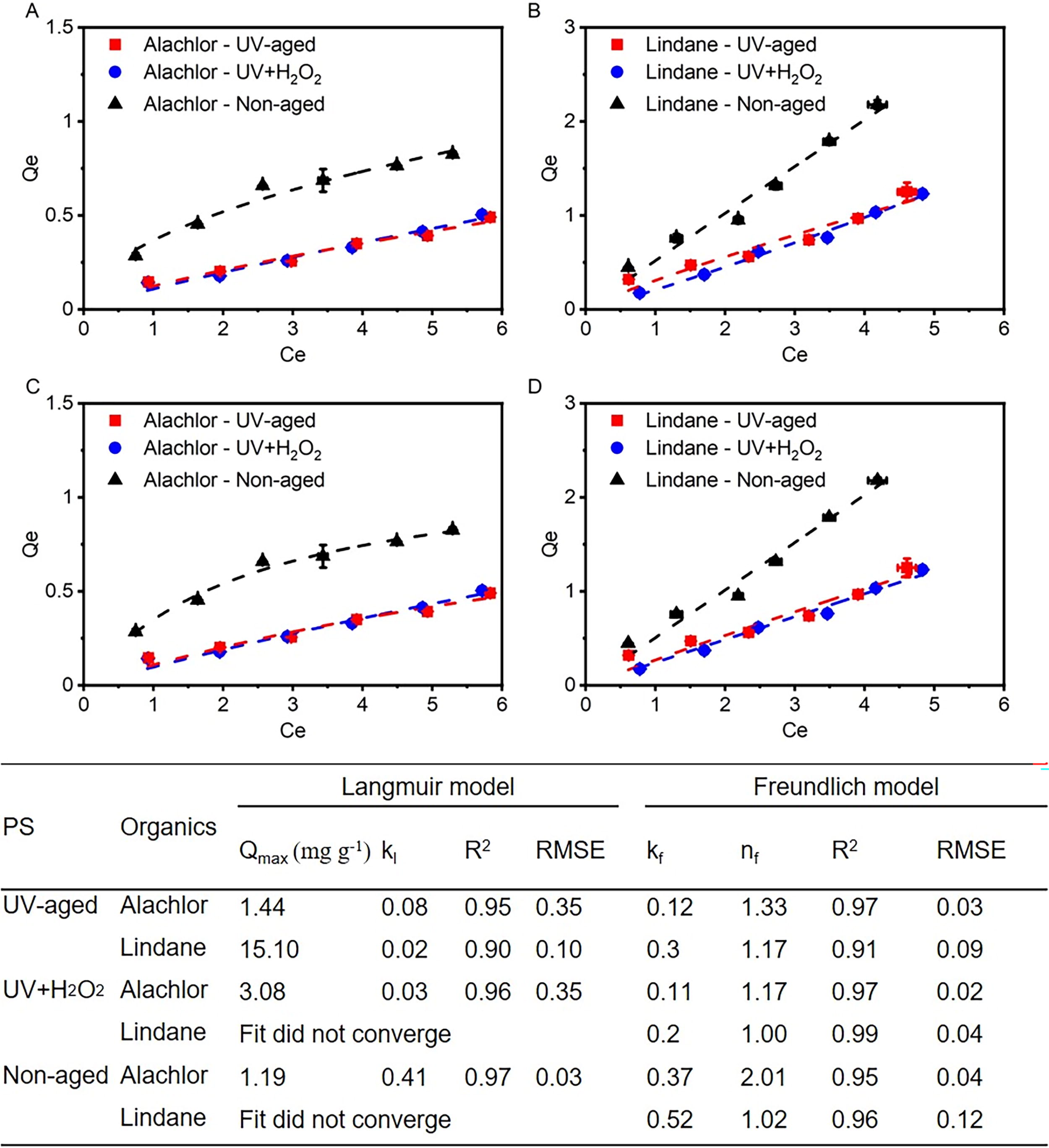
Adsorption isotherms of
After the adsorption experiments, the microplastics were collected and analyzed by EDS and XPS to confirm the adsorption of pesticides (Fig. 4A, 4B, 4C). Five elements—C, O, N, S, and Cl—were selected for elemental analysis: alachlor was characterized by Cl and N contents, lindane by Cl content, and methomyl by N and S contents in the particles. EDS provides the elemental composition of bulk particles, while XPS focuses on the surface. In all three groups of PS microplastics, O content ranged from 2.6% to 7.1% of the total mass according to EDS, whereas XPS analysis revealed O content ranging from 14.1% to 19.8% by mass. This indicated that oxygen-containing functional groups were primarily located on the particle surface and were generated by aging processes. This trend was also observed in nonaged PS microplastics, when considered alongside ATR-FTIR results, indicated that natural aging is not negligible; therefore, nonaged PS microplastics generated from commercial materials were not considered entirely pristine (Bhat et al., 2024). It is also noteworthy that the oxygen contents of all groups of PS microplastics did not entirely align with the CI and HI from ATR-FTIR results. This discrepancy may be attributed to the accuracy limits of EDS and XPS for nonmetallic elements, as well as matrix effects (Biesinger, 2022; Carter et al., 2016). The low content of N (≤0.5%), S (≤0.7%), and Cl (≤0.3%) detected by EDS and XPS on each PS microplastic sample before the adsorption experiments suggests that few additives containing these elements were used in the production of the commercial PS products and that the aging processes did not generate functional groups containing these elements. The differences in N (−0.1% to 1.8%), S (−0.7% to 0.1%), and Cl (−0.2% to 0.4%) contents measured by XPS before and after the adsorption experiments across all groups could be viewed as minimal when considering the method’s accuracy limit. Especially for N, which is a low atomic number element, quantitative analysis is limited because of interfering peaks (Newbury and Ritchie, 2015). The results show that few adsorbate residues remained on the particles, implying that the adsorption was highly reversible, with desorption mainly occurring during the particle collection and drying processes.

Spectroscopy analyses of the PS microplastics before and after sorption. EDS analyses are shown on panels A, B, C for the UV-aged group, UV + H2O2 group, and nonaged group, respectively. ATR-FTIR analyses are shown on D, E, F panels for the UV-aged group, UV + H2O2 group, and nonaged group, respectively. ATR-FTIR, attenuated total reflectance—Fourier transform infrared; EDS, electron-dispersive X-ray diffraction spectroscopy; PS, polystyrene; UV, ultraviolet.
The interfering peaks also affected the identification of pesticides in our ATR-FTIR analysis (Fig. 4D, 4E, 4F): the C-Cl bond (800–600/cm), chosen for identifying alachlor and lindane, overlapped with C-H bond; the C-N amine bond (1,250–1,050/cm), chosen for identifying alachlor and methomyl, overlapped with C-O bond; the C = N oxime bond (1,690–1,640/cm), used for identifying methomyl, overlapped with C = C and C = O bonds. Previous studies have used ATR-FTIR to detect adsorption, as adsorption typically induces changes in surface functionalization and, consequently, in vibrational modes (Foucaud et al., 2021). However, when identifying the adsorption of organics onto microplastics in the aquatic environment, which occurs at a liquid–solid interface, the ATR-FTIR technique may be limited by factors including the matrix background signal and the irreversibility of adsorption (Mudunkotuwa et al., 2014).
As the properties of both the organic adsorbates and the microplastic adsorbents can influence adsorption (Hüffer et al., 2018). Our results, along with the previous adsorption studies involving a wide range of hydrophobicity and chemical structures for the organic adsorbates, as well as variations in size, shape, and aging degree of the PS microplastic adsorbents, reveal some commonalities (Table 1). The Freundlich model consistently proves to be the suitable model for describing the absorption of organics by PS microplastics. Despite some studies favoring the linear or Langmuir models for data fitting, the Freundlich model remains a robust choice, demonstrating good fit (R2 > 0.90) in these instances (Table 1). The maximum adsorption capacities of PS microplastics, calculated using the Langmuir model, are also presented in Table 1. However, the environmental conditions (e.g., pH, salinity, and temperature) and the physicochemical properties of the adsorbents (e.g., surface area, pore size, and types of chemical functional groups) vary across the studies. Therefore, comparing the adsorption capacities across these studies is not accurate.
Summary of the Adsorption of Organics by Polystyrene Microplastics
The adsorption mechanisms of microplastics involve various physical and chemical interactions, including hydrophobic interactions, electrostatic interactions, Van der Waals forces, π–π bond interactions, hydrogen bonding, cation exchange interactions, and pore blockage (Fu et al., 2021). From the chemical structures of the three organic pesticides (Supplementary Fig. S4), alachlor and methomyl both have the potential to form π–π bond interactions with the phenyl group on the PS microplastics. In addition, alachlor, with its ketone structure, can act as an acceptor to interact with the hydroxyl and carboxyl groups generated during the aging treatment to form hydrogen bonds. In contrast, lindane does not have the potential to form π–π bond interactions or hydrogen bonding with PS microplastics. Electrostatic interactions occur because of the presence of fixed or induced charges on particle surfaces. In polar media, the primary charging mechanisms are (i) irreversible or preferential adsorption of ions, ionic surfactants, and charged polymers (polyelectrolytes) and (ii) dissociation of ionogenic groups chemically bound to the surface (Adamczyk, 2003). In this experiment, the adsorbates—alachlor, lindane, and methomyl—are nonionic organic compounds. Especially, lindane is nonpolar, which means electrostatic interactions are expected to play a minimal role in the adsorption process. However, the adsorption capacities of the three organic pesticides rank from high to low as lindane, alachlor, and methomyl, which is consistent with their hydrophobicities, outweighing the additional interactions they may have with the PS microplastics. This highlights the predominant role of hydrophobic interactions in the adsorption processes of PS microplastics. This inference is further supported by comparing the adsorption capacities of the same adsorbate among the three groups of microplastics, the nonaged PS microplastics, which are more hydrophobic with fewer hydroxyl and carboxyl functional groups, exhibits significant higher adsorption capacities of the lindane and alachlor than both aged groups.
Environmental implications
Hydrophobic interactions have been identified as the primary adsorption mechanism of organic contaminants by PS materials in various studies (Table 1). This is mainly attributed to the hydrophobic nature of PS (Thormann et al., 2008). Table 1 also shows that electrostatic interactions and π–π interactions play a major role in some cases. The phenyl groups of the PS materials can interact with organics containing structures such as double bonds, triple bonds, and phenyl groups through π–π interactions. Electrostatic interactions become a key mechanism when the organics are hydrophilic and possess good water solubility (Guo et al., 2019). These interactions enable PS microplastics to act as a vector, attracting and absorbing organic contaminants (Endo and Koelmans, 2019; Prajapati et al., 2022). In addition, to alachlor and lindane investigated in this study, numerous other hydrophobic organic pesticides of environmental concern are widely used worldwide, including 2,4-D, dicamba, dichlorodiphenyltrichloroethane, methazole, metolachlor, picloram, and propyzamide (Cosgrove et al., 2019; Gevao et al., 2000). This suggests that PS microplastics may serve as a transport medium for a wide range of organic pesticides.
As microplastics age, their size decreases, and their specific surface area increases, whereas hydrophilic groups are generated and hydrophobicity decreases. These changes can increase adsorption capacities for hydrophilic contaminants (Liu et al., 2019). However, predicting the adsorption capacities for hydrophobic contaminants is still complex (Hüffer and Hofmann, 2016). The aging process may not consistently lead to an increase in adsorption capacities for hydrophobic contaminants, contrary to hydrophilic contaminants. This dynamic nature poses a potential risk, as desorption of adsorbed organic contaminants during microplastics transportation could occur because of the diminished adsorption capacity, potentially releasing hydrophobic organic contaminants into the natural environment.
Conclusion
In this study, the characterization of PS microplastics showed aging treatments induced surface defects and introduced carbonyl and hydroxy groups to the PS microplastics, rendering them more hydrophilic. The capacity of microplastics to adsorb alachlor and lindane decreased after the aging processes. The Freundlich model provided a good fit for all the adsorption isotherm data, indicating heterogeneous adsorption sites for these pesticides on the PS microplastics. The adsorption of the three pesticides ranked from highest to lowest as lindane, alachlor, methomyl, corresponding with their log Kow values, indicating that hydrophobic interactions were the primary adsorption mechanism for the PS microplastics. These findings underscore the importance of considering the aging effects of microplastics when evaluating their environmental fate and potential risks. Aging processes in the natural environment make PS microplastics more hydrophilic, which does not consistently lead to increased adsorption of hydrophobic contaminants, unlike hydrophilic contaminants. This poses a potential risk, as the diminished adsorption capacity may cause the desorption of adsorbed organic contaminants during the transportation of microplastics, potentially releasing hydrophobic organic contaminants into the natural environment.
Authors' Contributions
R.C.: Conceptualization, methodology, validation, formal analysis, investigation, writing—original draft, and visualization; J.S.: Conceptualization, investigation, methodology, visualization, and writing—review and editing, D.T.: Investigation and methodology, M.M.: Conceptualization, methodology, resources, writing—review and editing; supervision; project administration, funding acquisition; N.M.: investigation; methodology; J.G.-E.: Conceptualization, methodology, resources, writing—review and editing, visualization, supervision; project administration, funding acquisition.
Footnotes
Authors' Contributions
The authors have no conflicts to disclose.
Funding Information
The research reported in this publication was supported by the

References
Supplementary Material
Please find the following supplemental material available below.
For Open Access articles published under a Creative Commons License, all supplemental material carries the same license as the article it is associated with.
For non-Open Access articles published, all supplemental material carries a non-exclusive license, and permission requests for re-use of supplemental material or any part of supplemental material shall be sent directly to the copyright owner as specified in the copyright notice associated with the article.
