




Abstract
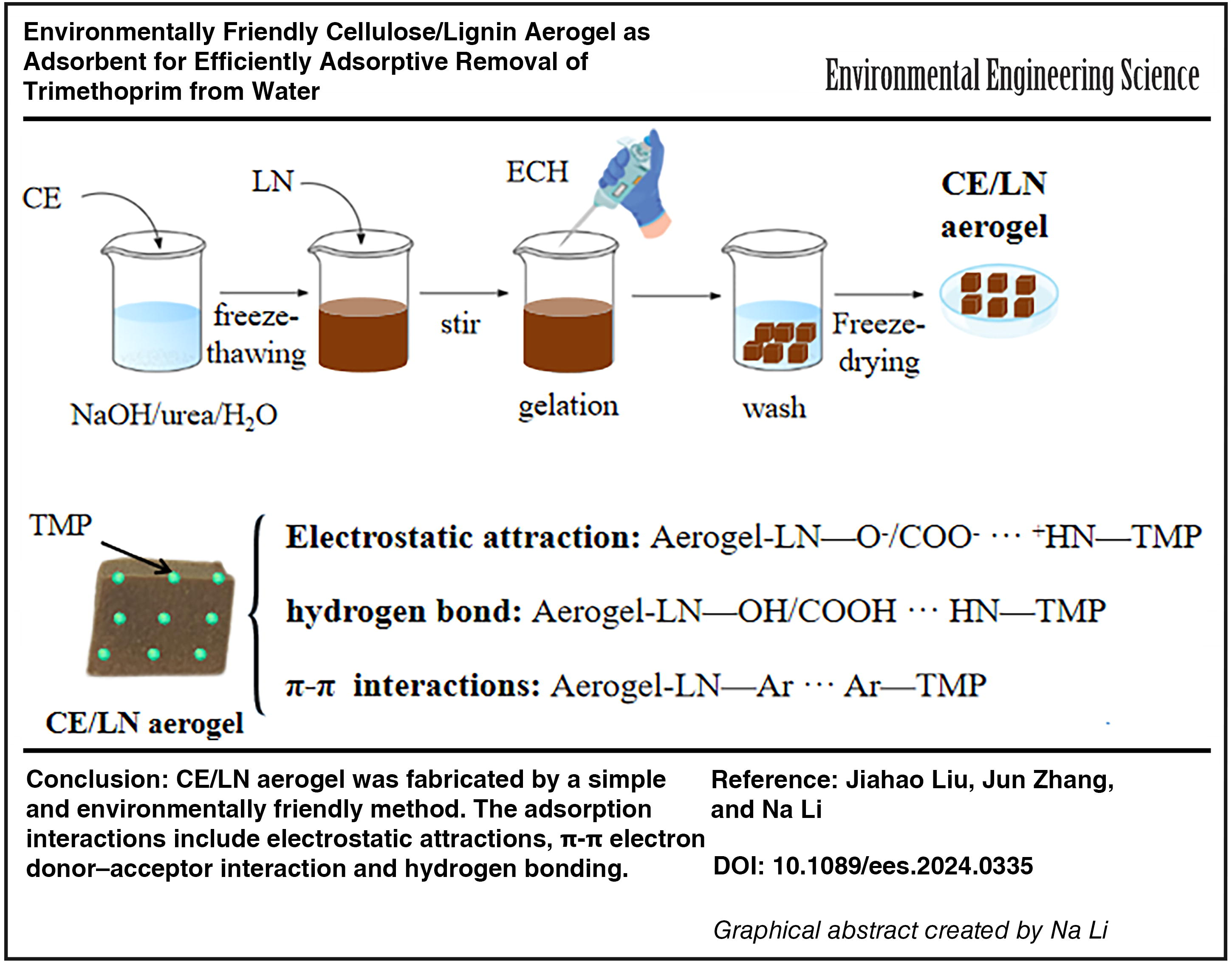
An environmentally friendly aerogel (CE/LN), composed of cellulose (CE) and lignin (LN) was synthesized via one-pot cross-linking method at room temperature, followed by freeze-drying. The CE/LN aerogel exhibited good mechanical properties and abundant functional groups, making it an effective adsorbent for the adsorption and removal of the antibiotic trimethoprim (TMP) from water. This study systematically investigated the effects of solution pH, aerogel dose, contact time, initial TMP concentration, temperature, ionic strength, and various water sources on TMP adsorption. The CE/LN aerogel demonstrated a higher TMP adsorption capacity of TMP than the CE aerogel across the entire pH range of 2.0–10.0. The adsorption process was well described by the Langmuir isotherm model and pseudo-second-order kinetic model. The CE/LN 6% aerogel achieved the highest adsorption capacity, with a theoretically maximal TMP uptake of 0.402 mmol/g at pH 6.0. However, high concentration of NaCl significantly reduced TMP uptake on the CE/LN 6% aerogel due to the electrostatic shielding effect. After five cycles of adsorption, the CE/LN 6% aerogel maintained a high adsorption capacity, retaining 80% of its initial uptake. Combined with the adsorption performance, the Fourier transform infrared spectrometry and X-ray photoelectron spectroscopy analyses spectroscopy analysis before and after TMP adsorption, it can be concluded that the adsorption mechanism involved hydrogen bonding, electrostatic interactions, and π–π electron donor–acceptor interactions. Thus, the CE/LN aerogel, with its simple preparation method, good adsorption capacity, and reusability, shows great potential for widespread application in the removal of antibiotics from water.
Introduction
Antibiotics are widely used to control infectious diseases in both humans and livestock by reducing or preventing the growth of microorganisms (Bastos et al., 2018; Sarmah et al., 2006). However, significant quantities of these antibiotics remain unmetabolized, resulting in their presence in surface water, groundwater, wastewater, sludge, and soil (Kraemer et al., 2019; Liu et al., 2018). Trimethoprim (TMP), a commonly used sulfonamide antibiotics, is also employed as a synergist in antibiotics treatments and is utilized for treating various bacterial infections (Aryee and Han, 2022; Mpatani et al., 2021). Unfortunately, conventional wastewater treatment processes exhibit low efficiency in removing TMP, leading to its accumulation and posing significant threats to human health and ecosystems (Yilmaz et al., 2017). Various methods have been reported for the elimination of antibiotics, including advanced oxidation processes, membrane separation, coagulation, photocatalytic degradation, and adsorption (Alexander et al., 2012; Mpatani et al., 2021; Nasrollahi et al., 2022; Wang and Zhuan, 2020). Among these, adsorption is considered a promising method for removing antibiotics from water due to its simplicity, low cost, and effectiveness (Ahmed et al., 2015). However, the practical application of conventional powdered adsorbents is hindered by difficulties in their use and recovery (Aristilde et al., 2016; Park et al., 2020; Zhao et al., 2011).
Aerogel, a kind of materials with three-dimensional porous structure, has garnered significant attention from researchers due to its high porosity, low density, high specific surface area, and ease of separate from aqueous solutions. It has been effectively used to remove various pollutants from water and wastewater (Hasanpour and Hatami, 2020a, 2020b, 2024). Cellulose (CE), derived from sources such as wood, cotton, rice straw, cannabis, bagasse and potato tubers, possesses several properties including biocompatibility, biodegradability, low cost, thermal stability, and a rich hydroxyl group content (Klemm et al., 2005). As a result, CE aerogels are promising adsorbents because of their low density, high porosity, and large specific surface area (Ashori et al., 2024; Azimi et al., 2024; Fazel et al., 2024; Long et al., 2018). Incorporating other materials, such as polymer, clay, and graphene oxide, metal-organic frameworks (MOFs) into CE aerogel is an effective method to introduce functional groups and improve their mechanical properties and pore structures. However, challenges such as complicated preparation methods and hazardous additive materials limit the actual applications of CE-based aerogels (Chen et al., 2021b; Rahmanian et al., 2021). Lignin (LN), the second most abundant natural polymer, is distributed in various sources and can also be produced from byproducts of commercial pulping processes (Duval and Lawoko, 2014; Meng et al., 2019). Due to its phenylpropane structure and the presence of various oxygen-containing functional groups, LN serves as an excellent chemical modifier to enhance the adsorption performance and mechanical stability of CE aerogels (Gao et al., 2021, 2022b). To our knowledge, the use of CE and LN composed aerogels for the removal of antibiotics has been rarely reported.
In this study, a series of CE/LN aerogels with varying LN content were fabricated using a simple and environmentally friendly method. The structural properties and morphologies of CE and CE/LN aerogels were analyzed through Fourier transform infrared spectroscopy (FTIR), X-ray photoelectron spectroscopy (XPS), field-emission scanning electron microscopy (FESEM), and Brunauer–Emmett–Teller (BET) characterization. Additionally, the adsorption performance of the aerogels for TMP was assessed, considering the effects of pH, aerogel dose, ionic strength, different water sources, and the regeneration and reusability of CE/LN aerogels. The adsorption capacity of the CE/LN aerogels for other antibiotics was also investigated. Finally, the adsorption mechanism was explored through adsorption kinetics, adsorption isotherms and thermodynamics, FTIR, and XPS analysis conducted before and after adsorption.
Materials and Methods
Chemicals
CE power (25 μm in size), LN, epichlorohydrin (ECH), TMP (>98 wt%), ofloxacin (OFL, >98 wt%), enrofloxacin (ENR, >98 wt%), norfloxacin (NOR, >98 wt%), and tetracycline (TC, >98 wt%) were purchased from Aladdin Chemistry Co., Ltd. (Shanghai, China). Other reagents, including sodium chloride (NaCl), sodium hydroxide (NaOH), urea, ethyl alcohol, and hydrochloric acid (HCl), were obtained from Sinopharm Chemical Reagent Co., Ltd. (Shanghai, China). All reagents were used as received without further purification.
Preparation and characterization of aerogels
CE/LN aerogels were prepared at room temperature as follows. First, an aqueous NaOH/urea/H2O solution with a mass ratio of 7:12:81 was cooled to −20°C for 2 h. Four percent of CE powder was swollen in the cooled solution and maintained at −20°C for an additional 2 h to form a transparent liquid. Subsequently, varying amounts of LN were introduced to the CE solution, and the mixture was stirred until the LN was completely dissolved, resulting in final LN ratios of 2%, 4%, and 6%, respectively. Finally, ECH was added as a cross-linker, slowly dropped into the above solution, and stirred until gelation occurred at room temperature. The obtained hydrogel was washed repeatedly with deionized water, immersed in ethyl alcohol, and then freeze-dried at −60°C for 48 h. The obtained CE/LN aerogels were designated as CE/LN 2%, CE/LN 4%, and CE/LN 6%, respectively. For comparison, a CE aerogel, without the addition of LN, was prepared using the same procedure.
FTIR spectra was obtained using a Thermo Nicolet IS 20 spectrometer (USA) in the range of 500–4000 cm−1. The morphologies of the aerogels were examined using FESEM (Sigma, ZEISS ΣIGMA, Germany). The compressive mechanical properties of the CE/LN 6% aerogel were measured with a universal testing machine (34SC-1, Instron, USA). Specific surface areas were determined using a BET analyzer (ASAP2020, Micromeritics, USA) after activation at 393 K for 6 h. XPS (PHI5000 VersaProbe, ULVAC PHI, Japan) was utilized to analyze the elementary composition of the CE/LN 6% aerogel before and after TMP adsorption. The point of zero charge (pHpzc) was measured using a pH meter (FE28-Standard, Mettler-Toledo, Switzerland).
Batch adsorption experiments
All batch adsorption experiments were conducted to evaluate the adsorption performance of CE/LN aerogels for TMP. 10 mg of aerogel was immersed in 30 mL of TMP solution with an initial concentration of 0.20 mmol/L, across varying pH levels (2.0–10.0), and shaken at 180 rpm for 12 h at 298 K. The adsorption capacity of the CE/LN 6% aerogel for other antibiotics (OFL, ENR, NOR, TC) was also studied at an initial concentration of 0.20 mmol/L and pH of 6.0. The effects of the aerogel dose on the TMP uptake were investigated with the dose ranging from 5 mg to 30 mg. The effects of ionic strength on the TMP uptake by the aerogels were examined using NaCl solutions of varying concentrations (0–50 mmol/L) at an initial TMP concentration of 0.20 mmol/L. Additionally, the adsorption performance of the CE/LN 6% aerogel for TMP in deionized water, tap water, and Nandu River water was measured. The tap water and Nandu River water were filtered by a 0.45 μm filter and spiked with TMP solution at an initial concentration of 0.02 and 0.20 mmol/L, respectively.
The kinetic studies were conducted using 80 mg of aerogel in 240 mL of TMP solution at pH 6.0, with continuous shaking. TMP samples were collected at varying reaction time intervals. The adsorption isothermal studies were performed with the initial TMP concentrations ranging from 0.05 to 0.25 mmol/L at pH 6.0. Additionally, adsorption thermodynamics were studied at various temperatures: 298 K, 308 K, and 318 K. After adsorption, the solution was extracted from the container using a syringe, and the TMP concentrations in aqueous solution, both before and after adsorption, were measured at 270 nm using a UV–vis spectrophotometer (U-2910, Hitachi, Japan). The adsorption capacity of TMP (qe, mmol/g) was calculated using the following equation [Eq. (1)]:
The regeneration and reusability of the CE/LN aerogel were also investigated. After achieving saturated adsorption, the CE/LN 6% aerogel was washed with 0.01 mol/L NaOH solution for approximately 2 h. Once fully desorbed and regenerated, the aerogel was separated, washed with distilled water, and reused in subsequent experiments. The adsorption–desorption cycle was repeated five times.
Results and Discussion
Structure and morphologies characterizations
A series of CE/LN aerogels with a double-network structure were prepared using ECH as a cross-linking agent, succeeded by freeze-drying. FTIR spectra was employed to analyze functional groups of the aerogel, as shown in Figure 1. The characteristic bands of CE aerogel at 3367, 2878, and 1023 cm−1, corresponding to the stretching vibrations of O–H, C–H, and C–O, were observed in the spectrum of CE/LN aerogels (Chen et al., 2021a). New peaks around 1590, 1508, and 1420 cm−1, which are indicative of the aromatic skeletal vibrations of LN, were observed in CE/LN 2%, CE/LN 4%, and CE/LN 6% aerogels. Additionally, the characteristic peak at 1723 cm−1 was attributed to the stretching vibration of the saturated aliphatic carboxylic acid groups on LN (Gao et al., 2021). These results indicated that CE/LN 2%, CE/LN 4%, and CE/LN 6% aerogels were successfully prepared.

The FTIR spectra of CE, CE/LN 2%, CE/LN 4%, CE/LN 6% aerogels, and CE/LN 6% after TMP adsorption (CE/LN 6% ad TMP). CE, cellulose; FTIR, Fourier transform infrared spectroscopy; LN, lignin; TMP, trimethoprim.
Figure 2a–d illustrates the morphology of CE, CE/LN 2%, CE/LN 4%, and CE/LN 6%, respectively. A similar porous structure is observed across all four aerogels, which can be attributed to the supporting role of the CE skeleton. From Figure 2b–d, it is evident that the addition of LN in the aerogels reduced wall thickness while increasing pore density. This change is likely to improve contact between the aerogel surface and pollutants, thereby enhancing the aerogel’s elasticity. Photographs of the CE and CE/LN aerogels are shown in Figure 2e. The color of the CE/LN aerogels is consistent with the dark brown hue of LN, while the pure CE aerogel appears white. Additionally, the compressive strength of CE/LN 6% aerogel was investigated, as presented in Figure 2f. The CE/LN 6% aerogel can sustain a maximum compression strain of approximately 90%, with a maximum compressive strength of 1.050 MPa (Fig. 2f), demonstrating the good stability of the aerogel during the adsorption process. The specific surface area of different aerogels follows the order of CE/LN 2% (2.4872 m2/g) > CE/LN 4% (2.3665 m2/g) > CE (2.2145 m2/g) > CE/LN 6% (1.5981 m2/g). Notably, both CE and CE/LN aerogels exhibit relatively lower specific surface areas compared to typical aerogels (Dong et al., 2017; Wang et al., 2022). This may be attributed to the larger pore sizes and the structural collapse or aggregation of the aerogels during the freeze-drying process (Dong et al., 2017; Gao et al., 2022a).
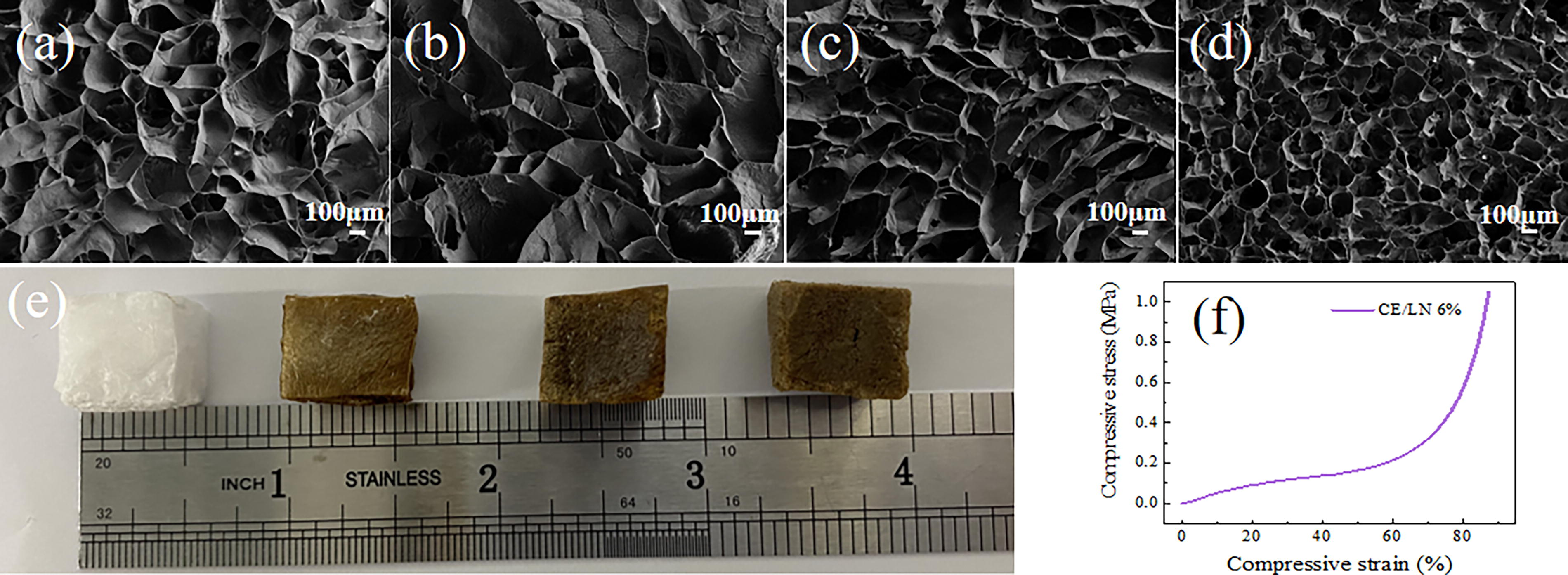
FESEM micrographs of
Adsorption performance
Effects of solution pH
Since solution pH can change the surface charges of aerogels and the speciation of antibiotics (Awad et al., 2019), the effects of pH on the adsorption process were investigated. The chemical structure of TMP is shown in the inset of Figure 3a. The pKa values of TMP are 1.35 and 7.45, respectively, indicating TMP can form three species, divalent cationic (pH < 1.35, TMP2+), cationic (1.35 < pH < 7.45, TMP+) and neutral species (pH > 7.45, TMP0) (Esteki et al., 2020). Figure 3a shows that the adsorption capacity of CE aerogel for TMP was nearly 0 mmol/g across all tested pH levels. Furthermore, the UV–vis spectra of the TMP solution before and after the addition of various aerogels, shown in Figure 3b, reveal negligible spectral changes following the addition of the CE aerogel. This result further confirms that CE acted as the skeleton in the composed aerogels. The UV–vis spectra of the four aerogels indicated the TMP uptake on aerogels follows the order: CE < CE/LN 2% < CE/LN 4% < CE/LN 6% (Fig. 3b). The higher content of LN in the composed aerogels provides more functional groups such as carboxyl, hydroxyl groups, and benzene ring, which may enhance the adsorption capacity for TMP (Gao et al., 2021). The adsorption capacities of the three CE/LN aerogels followed similar pH dependence in Figure 3a, that is, increased with rising pH initially and then decreased, with a maximum uptake of 0.352 mmol/L by CE/LN 6% aerogels at pH 6.0. The pHzpc of three CE/LN aerogels ranged from 5.4 to 5.8, with the surface charges of aerogels transitioning from positive to negative at this pH. At pH values below 6.0, the deprotonated carboxyl and hydroxyl groups of the CE/LN aerogels may have electrostatic attractions to the amino groups of TMP [Eq. (2)]. These electrostatic interactions increased with rising pH due to the increasing positive charge of TMP (Fig. 3a). Additionally, π–π electron donor–acceptor interactions between the benzene rings of the CE/LN aerogels and TMP [Eq. (3)], along with hydrogen bonding between the carboxyl, hydroxyl groups of CE/LN aerogels, and the amino groups on TMP [Eq. (4)], also contributed to TMP adsorption (Li et al., 2023). When the pH exceeds 6.0, the positive charge of TMP gradually decreased (Fig. 3a), leading to the weakened electrostatic attractions between the CE/LN aerogels and TMP. Nevertheless, the CE/LN aerogels still demonstrated a certain adsorption capacity for TMP at higher pH values, confirming the significant roles of other interactions, such as hydrogen bonding and π–π electron donor–acceptor interactions in the adsorption process under the alkaline conditions.
Ar: aromatic rings on LN

The adsorption capacity of CE/LN 6% for other antibiotics was also investigated with the initial antibiotics concentration of 0.20 mmol/L at pH 6.0, as illustrated in Figure 3c. The results demonstrated that CE/LN 6% aerogel presented high adsorption capacity of OFL, ENR, and NOR, with capacities of 0.292, 0.307, and 0.292 mmol/g, respectively. This similarity in adsorption capacity can be attributed to their similar molecular structures. In contrast, the TC uptake on CE/LN 6% was only 0.024 mmol/g, illustrating that the electrostatic attraction between the amine group of TMP and the carboxyl and hydroxyl groups of CE/LN 6% is the dominant interaction in the adsorption process [Eq. (2)]. This indicates that the functional groups on both the adsorbent and the antibiotic molecules play a crucial role in determining the adsorption capacity.
Effects of aerogel dose
The effects of the aerogel dose on the adsorption capacity and removal efficiency of TMP were shown in Figure 3d. The removal efficiency of TMP by CE/LN 6% aerogel increased from 30.62% to 81.77%, with the aerogel dose ranging from 5 mg to 30 mg. This increase can be attributed to the greater availability of adsorption sites and functional groups on the aerogel at higher doses, which enhances the interaction between the aerogel and TMP. On the contrary, the adsorption capacity decreased sharply with the increased dose of aerogel. Taking into account both the adsorption capacity and economic considerations, a dose of 10 mg was identified as the optimal choice for subsequent studies. This dosage effectively balances the removal efficiency with cost-effectiveness, ensuring efficient TMP removal while minimizing material expenditure.
Effects of ionic strength
Inorganic salts, such as NaCl, frequently coexist with antibiotics in actual wastewater (Wang et al., 2017; Zhou et al., 2020), significantly impacting the adsorption of TMP on CE/LN aerogels. As illustrated in Figure 4a, the adsorption capacity of three types of CE/LN aerogels notably decreased with increasing NaCl concentration. Specifically, when the NaCl concentration exceeded 20 mmol/L at pH 6.0, the uptake of TMP reached equilibrium, even with further increases in NaCl concentrations. This phenomenon can be attributed to the competition for active adsorption sites on the CE/LN aerogels between cation Na+ and –NH+ groups of TMP. The presence of these competing ions effectively inhibits the adsorption of TMP molecules, leading to reduced overall uptake. The inhibition efficiencies of CE/LN 2%, CE/LN 4%, and CE/LN 6% at a NaCl concentration of 50 mmol/L, were 100%, 94.52%, and 89.07%, respectively. These results suggest that electrostatic attractions are the primary interaction between CE/LN aerogels and TMP under acid conditions (Chang et al., 2022; Chen et al., 2021b). Furthermore, it was observed that the salt resistance of the aerogels improved with an increasing proportion of LN in the formulation, indicating that the composition of the aerogel influences its performance in saline conditions.

Effects of varied water sources
To assess the application potential of the CE/LN 6% aerogel, the adsorption performance of CE/LN 6% aerogel for TMP in tap water and Nandu River water was also measured with initial TMP concentration of 0.02 and 0.20 mmol/L, respectively. The water quality parameters for tap water and Nandu River water are summarized in Table 1. Figure 4b shows that the removal efficiencies of TMP in deionized water were 100% for 0.02 mmol/L and 58.68% for 0.20 mmol/L. However, in tap water and Nandu River water, the removal efficiencies decreased, obeying the order: deionized water > tap water > Nandu River water. These results indicate that the presence of both organic and inorganic matter in tap water and river water competes for the adsorption sites on the aerogel, thereby reducing the TMP removal efficiencies. Notably, the removal efficiency of TMP was consistently higher for the lower initial concentration of 0.02 mmol/L across all water types. This finding underscores the aerogel’s potential for effectively removing low concentrations of TMP. However, the results also demonstrated that the CE/LN 6% aerogel can be utilized in actual wastewater after appropriate pretreatment processes to eliminate most organic and inorganic pollutants. To improve the selectivity of the CE/LN 6% aerogel toward TMP, further improvements could be made by incorporating additional materials into the aerogel composition. Such modifications may optimize its performance in complex water matrices, thereby increasing its utility in practical wastewater treatment scenarios.
Water Quality Parameters of Tap Water and Nandu River Water
Not detected.
Adsorption kinetics
The adsorption kinetics of the CE/LN aerogels toward TMP was investigated by observing the effect of contact time on TMP adsorption, as illustrated in Figure 5a. The adsorption curves for CE/LN 2%, CE/LN 4%, and CE/LN 6% aerogels displayed similar patterns. Initially, the uptake of TMP by the aerogels increased rapidly within the first 2 h. Notably, the adsorption capacity of TMP on CE/LN 6% reached 72.55% of its equilibrium adsorption capacity during this initial period. Afterward, the adsorption rate began to slow as more adsorption sites were occupied, ultimately reaching equilibrium at approximately 12 h. To further analyze the adsorption kinetics of the CE/LN aerogels, the pseudo-first-order (Ho and McKay, 1998), pseudo-second-order (Lagergren, 1898) models were applied to evaluate the kinetic data, and they are expressed as Eqs (5) and (6), respectively:

Adsorption
The parameters of the two kinetic models are summarized in Table 2. The adsorption process of TMP on aerogels was expressed as pseudo-second-order with a high correlation coefficients (R2). This suggests that the adsorption process is primarily driven by a chemical interaction rather than a physical one, implying that the bonding between TMP and the aerogel is significant.
Fitting Parameters of Kinetic Models for TMP Adsorption on CE/LN Aerogels at PH 6.0 with the Initial TMP Concentration of 0.20 mmol/L
CE, cellulose; LN, lignin; TMP, trimethoprim.
Adsorption isotherms and thermodynamics
Adsorption isotherm models are commonly utilized to investigate the characteristics and mechanisms of interaction between the adsorbate and the adsorbent (Yang et al., 2019). The adsorption isotherms for the aerogels at temperature of 298 K and pH of 6.0 were presented in Figure 5b and detailed in Table 3. The adsorption capacity of aerogels increased significantly with the initial concentration of TMP ranging from 0.05 mmol/L to 0.15 mmol/L, owing to the sufficient adsorption sites on the surface of aerogel and then gradually achieved the adsorption equilibrium when the most of adsorption sites were occupied. Langmuir and Freundlich models were used to fit the adsorption isotherms results (Freundlich, 1906; Langmuir, 1918).
Fitting Parameters of the Adsorption Isotherms Models for TMP Adsorption on CE/LN Aerogels
CE, cellulose; LN, lignin; TMP, trimethoprim.
Langmuir model (Langmuir, 1918) can be expressed as follows [Eq. (7)]
Freundlich model (Freundlich, 1906) can be written as follows [Eq. (8)]:
The calculated parameters corresponding to the adsorption isotherm models are shown in Table 3. The fitting degree of Langmuir model to the TMP adsorption date was higher than that of the Freundlich model, which indicated that the adsorption of TMP on CE/LN aerogels was monolayer chemisorption. The electrostatic attractions, hydrogen bonding, and the π–π electron donor–acceptor interaction synergistically promote the adsorption of TMP on the CE/LN aerogels. According to the Langmuir model, the calculated maximum adsorption capacity of TMP by CE/LN 6% reaches 0.402 mmol/g (equivalent to 116.708 mg/g) at 298 K, which was relatively high value compared to reported adsorbents, as summarized in Table 4 (Aryee and Han, 2022; Berges et al., 2021; González et al., 2017; Juengchareonpoon et al., 2021; Perez et al., 2020), indicating the good adsorption property of CE/LN 6% aerogel for TMP.
Comparison of the Maximum Adsorption Capacities of TMP on Various Adsorbents
CE, cellulose; LN, lignin; TMP, trimethoprim.
The effect of temperature on the adsorption of TMP by CE/LN 6% aerogel was investigated, as shown in Figure 6. The results indicated that as the temperature increased, the adsorption capacity for TMP decreased. This trend suggests that the adsorption process is exothermic. The thermodynamic parameters were calculated and are presented in Table 5. Gibbs free energy change (ΔGo, kJ/mol), enthalpy change (ΔH°, kJ/mol), and entropy change [ΔS°, kJ/(mol·K)] were conducted according to Eqs (9), (10) and (11) (Tran et al., 2017), respectively:

Adsorption isotherms of CE/LN 6% aerogel for TMP adsorption at different temperatures and the initial pH of 6.0. CE, cellulose; LN, lignin; TMP, trimethoprim.
Fitting Parameters of Adsorption Thermodynamics for CE/LN 6% Aerogel in Adsorption of TMP
CE, cellulose; LN, lignin; TMP, trimethoprim.
Reusability
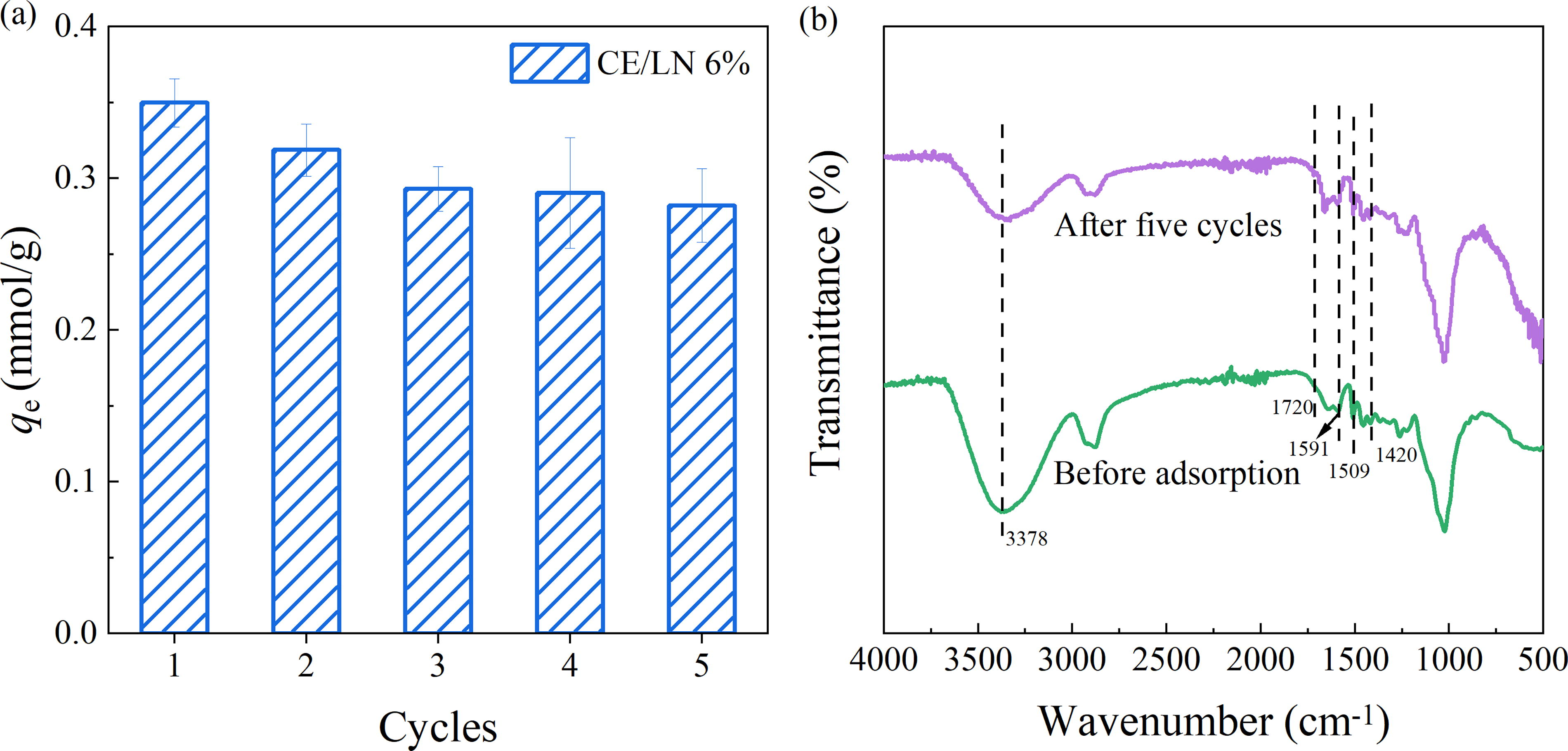
The recycling performance of the adsorbent is crucial for its practical application in real water treatment (Mohammad et al., 2021). The recyclability of the CE/LN 6% aerogel was investigated using a dilute NaOH aqueous solution as the eluent, and the results are illustrated in Figure 7a. During first two adsorption–desorption cycles, the adsorption capacity of TMP on CE/LN 6% aerogel gradually decreased and then decreased rapidly in the successive three cycles, but still reached approximately 80% of the initial capacity, corresponding to a value of 0.282 mmol/g after five adsorption–desorption cycles (Fig. 7a). This outcome suggests the stable adsorption performance and good reusability of CE/LN 6% aerogel. In addition to assessing adsorption capacity, the structural integrity of the CE/LN 6% aerogel after five consecutive cycles was examined. The characteristic peaks of CE/LN 6% aerogel at 3378, 1720, 1591, 1509 and 1420 cm−1, which belong to –OH, the saturated aliphatic carboxylic acid and aromatic skeletal groups could also be observed (Fig. 7b). The presence of these peaks indicates the good structural stability of CE/LN 6% aerogel, further confirming its potential for practical applications in water treatment.
Adsorption mechanisms
The adsorption behavior of CE/LN 6% aerogel was verified by FTIR and XPS spectra characterizations. As shown in Figure 1, the characteristic peaks at 3379 and 1721 cm−1, assigned to –OH and –COOH groups respectively, exhibited a blueshift to 3354 and 1713 cm−1 after TMP adsorption, demonstrating the involvement of –OH and –COOH in the adsorption process of TMP (Chen et al., 2021b). A new band was observed at 1662 cm−1, which can be attributed to the amine group of TMP (Juengchareonpoon et al., 2021). These results reveal the electrostatic attractions and hydrogen bond interactions between –OH and –COOH of CE/LN 6% aerogel and the amine group of TMP. To further explore the chemical state and binding modes between CE/LN 6% aerogel and TMP, the XPS spectra of CE/LN 6% aerogel before and after TMP adsorption were employed, as presented in Figure 8a–f. The C 1 s spectrum of the aerogel before adsorption exhibited four peaks at binding energies of 283.20, 284.82, 285.99, and 287.28 eV, which corresponds to C=C, C–C, C–O and C=O, respectively in Figure 8a. After TMP adsorption, these characteristic peaks remained observable in Figure 8d, indicating that the fundamental structure of the aerogel was maintained despite the adsorption process (Lu et al., 2019). The O 1 s spectrum can be divided into two components corresponding to –COO, and C–O groups, with binding energies at 529.61 and 531.30 eV, respectively (Chen et al., 2021b). After TMP adsorption, the peak intensity of O 1 s decreased and moved to the higher binding energies (Fig. 8b, e), suggesting that oxygen-containing groups play a key role in TMP adsorption through hydrogen bonding and electrostatic attraction. A new characteristic peak of N 1 s appearing after TMP uptake, which can be divided into –NH–/–N– and –NH2+ at 399.50 and 400.48 eV (Fig. 8c, f) (Azimi et al., 2024), was ascribed to the electrostatic attraction and hydrogen bonding interaction between CE/LN 6% and –NH–/–N– and –NH2+ groups on TMP (Gao et al., 2021; Zhang et al., 2019). According to the FTIR and XPS spectra before and after TMP adsorption, it is confirmed that the interactions between the functional groups of CE/LN 6% aerogel and the TMP molecules, includes electrostatic attractions [Eq. (2)], π–π electron donor–acceptor interaction [Eq. (3)] and hydrogen bonding [Eq. (4)].

The XPS spectra analysis of CE/LN 6% aerogel before
Conclusions
In this work, a series of CE/LN composed aerogels with varying LN concentration (2%, 4%, and 6%) in the CE solution were fabricated using a straightforward cross-linking and free-drying technique. The introduction of LN notably enhanced the number of reactive groups available on the aerogels. The CE/LN composed aerogels exhibited good mechanical properties and high adsorption capacity for TMP. Notably, higher LN content in the composed aerogels corresponded to increased adsorption capacity for TMP. CE/LN 6% achieved a theoretical maximum adsorption capacity of 0.402 mmol/g (116.708 mg/g) at pH 6.0. The TMP uptake on CE/LN aerogels decreased with the increasing NaCl concentration, indicating that electrostatic attractions were the dominant interaction between CE/LN aerogels and TMP. The aerogels performed less effectively in tap water and Nandu River water compared to deionized water, likely due to the interference of organic and inorganic substances present in those waters. Notably, CE/LN 6% aerogel proved especially efficient in removing low concentrations of TMP. Adsorption kinetics and isotherm data were well fitted by the pseudo-second-order kinetic model and the Langmuir model, respectively, suggesting that the adsorption process was characterized by monolayer chemisorption. Adsorption thermodynamics studies indicated that the adsorption process was exothermic. Based on the adsorption performance, FTIR, and XPS spectroscopic characterizations before and after adsorption, TMP was presumed to be adsorbed on CE/LN composed aerogels through hydrogen bonding, electrostatic attractions, and π–π electron donor–acceptor interactions. After five consecutive adsorption–desorption cycles, the CE/LN 6% aerogel retained approximately 80% of its initial TMP adsorption capacity. Additionally, the aerogel exhibited high adsorption capacities for other antibiotics, including OFL, ENR, and NOR. Therefore, CE/LN aerogels are proposed as eco-friendly and effective adsorbents for purifying antibiotic-contaminated wastewater, with the potential for complete degradation and removal of the adsorbed antibiotics via photocatalysis, advanced oxidation processes, and electrocatalysis.
Footnotes
Authors’ Contributions
J.L.: Data curation, investigation and writing—original draft. J.Z.: Funding acquisition, supervision, writing—review and editing. N.L.: Writing—original draft, formal analysis, methodology and data curation.
Data Availability Statement
All data included in this study are available upon request by contact with the corresponding author.
Author Disclosure Statement
No potential conflict of interest was reported by the authors.
Funding Information
This work was supported by the Key R&D projects of Hainan Province under Grant number ZDYF2022SHFZ307.