




Abstract
The Environmental Protection Agency’s Interim Framework for Advancing Consideration of Cumulative Impacts was issued as a foundation for implementing approaches to address the cumulative burden of environmental exposures and health disparities that impact many communities. This commentary describes disparities in environmental exposures and health and identifies biomarkers of and potential mechanisms underlying vulnerability and health disparities. It also observes the parallel approaches utilized in the fields of exposomics, One Health, and sustainability to prioritize and characterize exposure and health disparities in ways that can identify actions to mitigate adverse exposures and yield healthier and more sustainable communities.
Keywords
INTRODUCTION
Environmental Protection Agency (EPA)’s Interim Framework for Advancing Consideration of Cumulative Impacts (Framework) is a foundation for developing and implementing approaches to addressing the cumulative burden from environmental stressors and vulnerabilities affecting communities. 1 This Framework is intended to serve as a shared reference point for EPA to determine when and how to consider cumulative impacts, with the goals of more fully characterizing the realities that all communities face; identifying opportunities for intervention across the broad range of actions available to the EPA; and improving outcomes such that all people are protected from adverse environmental health risks and hazards and enjoy the benefits of a healthy environment.
EPA has traditionally used the source–outcome paradigm for single and multiple chemical risk assessments used in environmental decision making. 2 This paradigm has been valuable for developing methodologies and mechanisms; risk-based methods have greatly improved or maintained air, water, and soil quality and reduced chemical exposures as measured with national indicators. 3 The source-to-outcome paradigm, as applied, has not, however, been effective for addressing problems within the lived experiences of communities. Risk-based methods based on this paradigm have failed to protect the population equally, and thus risks to environmental health and well-being are disproportionately higher for some population groups and communities.4,5 Moreover, many socially vulnerable communities also shoulder multiple and disproportionate pollution burdens. These communities, defined in identified using EPA's EJScreen as communities with higher percentages of people of color, low income, low educational attainment, and/or linguistic isolation, are shouldering not one or two sources of pollution, but six, seven, eight, or nine sources at higher levels than other communities. 6
To effectively pursue its mission to protect human health and the environment, EPA should continue to incorporate cumulative impacts and cumulative risk assessment 7 into its evolving decision processes. 8 Adding a consideration of cumulative impacts can improve and augment current risk-based methods by more completely including existing exposures and impacts of these multiple burdens.
EPA’s Framework describes this as incorporating the Total Environment as described in the section on The Total Environment, Exposome, and Exposomics, into decision making: the consideration of place-based nonchemical stressors, the existing burden of pollution, and accessibility/inaccessibility to salutatory environmental benefits and combining these with chemical risk assessment to determine overall impacts on community health and quality of life (Fig. 1).
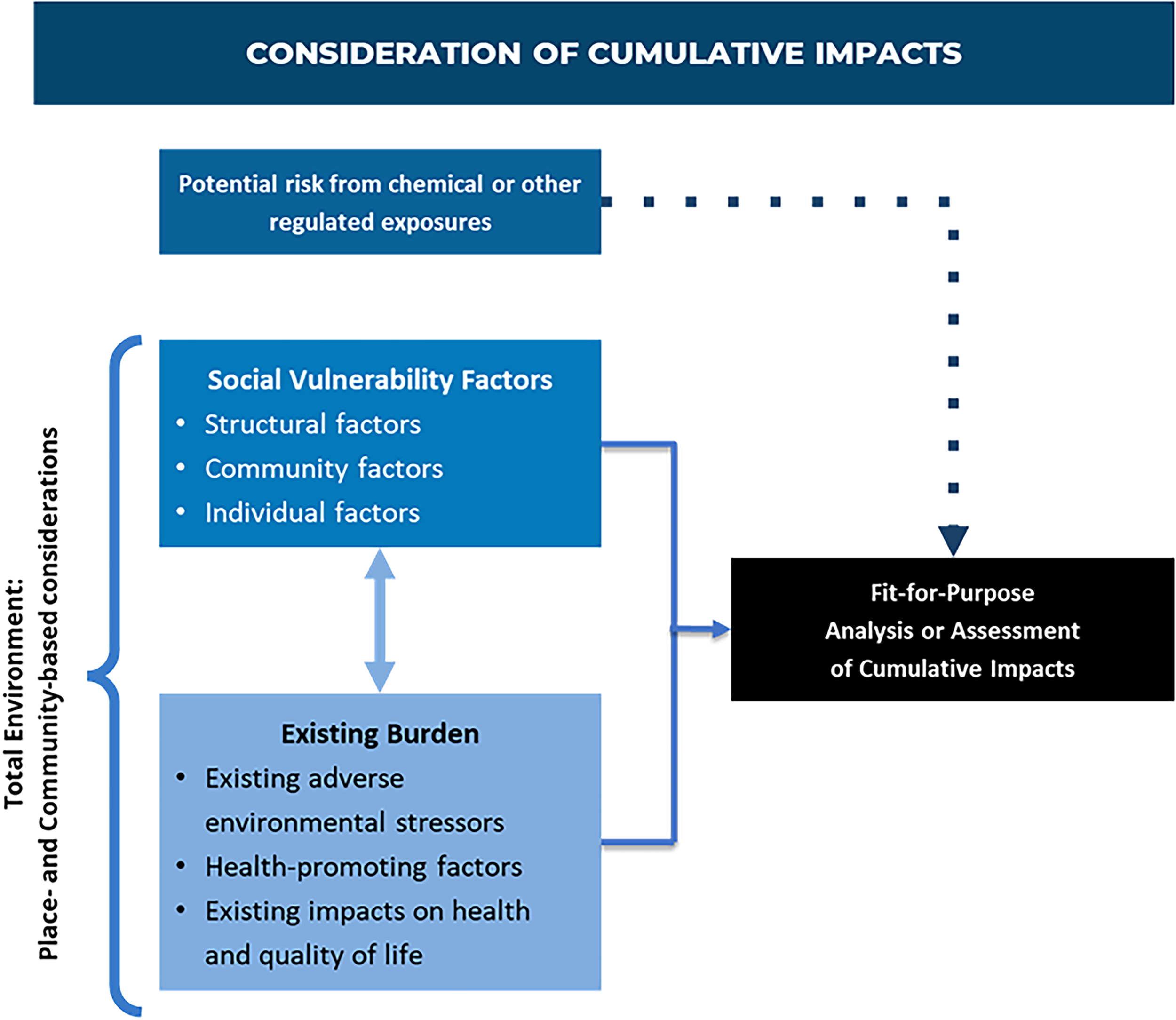
The cumulative impacts paradigm incorporates the existing, total burden of social vulnerability and environmental stressors experienced by communities—defined broadly as individuals, geographically defined communities, or definable population groups or lifestages—into environmental decision-making. Cumulative impacts assessment include risk from chemical or other regulated exposures as determined by traditional or cumulative risk assessment in combination with or as an input to cumulative impacts assessment. Figure from EPA’s Interim Framework for Advancing Consideration of Cumulative Impacts.
At the heart of the cumulative impacts paradigm is the evidence that the benefits of environmental protection actions have not been distributed equally, such that the adverse cumulative impacts of environmental pollution and the lack of environmental benefits on environmental public health and quality of life are disproportionately borne in some places by some communities. This commentary reviews the scientific evidence for this understanding and proposes that frameworks based on the exposome, One Health, and sustainability may be useful for identifying actions to mitigate cumulative exposures and health impacts.
PLACE MATTERS: EXPOSURE AND HEALTH DISPARITIES
There are significant cumulative impacts resulting from longstanding, place-based inequalities across exposures to environmental hazards; health disparities are linked to these inequalities.9,10,11,12,13,14,15 There is substantial scientific evidence that pollution, lack of greenspace and other environmental benefits, socioeconomic disadvantage, disinvestment in frontline communities and political marginalization, and health susceptibility and vulnerability tend to be clustered spatially in recurrent, persistent, and systematic patterns.16,17,18,19,20,21,22,23,24,25,26 Even when environmental conditions improve in disadvantaged places, the relative burdens of environmental hazards remain the same or worsen, with exposure and health disparities that continue over multiple generations.27,28,29,30,31,32,33 The long-lasting adverse impacts of racial discrimination in housing loans and other related practices on air quality, provision of ecosystem services (natural benefits), urban heat islands, and public health conditions demonstrate that historical, policy-based structural drivers of inequality are associated with current environmental conditions and health disparities in many communities.34,35,36,37
EPA’s Framework supports the development of methods and tools to more fully and accurately characterize the realities that communities face with the goal of identifying opportunities for taking action to improve environmental conditions and health.
EPA refers to cumulative impacts as the totality of exposures to combinations of chemical and nonchemical stressors and their effects on health, well-being, and quality of life outcomes.
38
EPA further explains that cumulative impacts:
Include contemporary exposures to multiple stressors throughout a person’s lifetime. Are influenced by the distribution of stressors and encompass direct and indirect effects on people through impacts on resources and the environment. Characterize the potential state of vulnerability or resilience of a community. Can be considered in the context of individuals, geographically defined communities, or definable population groups.
THE TOTAL ENVIRONMENT, EXPOSOME, AND EXPOSOMICS
EPA’s definition of cumulative impacts is built on the Total Environment framework, that is, the total environment is comprised of the built, natural, and social environments where a person lives, learns, and plays (i.e., home, school, daycare, and community).39,40 The Total Environment framework adapted for cumulative impacts describes the interrelationships among intrinsic characteristics (including lifestage), activities and behaviors, and extrinsic stressors from the built, natural, and social environments that influence health and well-being. 41 Evidence for the Total Environment framework comes from studies of children’s health, studies of the developmental origins of health and disease, and community health. This includes the influences of social determinants of health and environmental (chemical) exposures on obesity, 42 general cognitive ability,43,44 ADHD, and childhood externalizing behaviors. 45 Additional research shows the importance of socioeconomic and neighborhood factors on allostatic load 46 and health outcomes, including kidney dysfunction,47,48 diabetes, 49 lung function 50 and asthma, 51 and cardiovascular disease.52,53,54,55
The Total Environment is closely related to the concept of the exposome, the cumulative measure of environmental influences and associated biological responses throughout the lifespan, including exposures from the environment, diet, behavior, and endogenous processes. 56 By including endogenous processes, the exposome emphasizes the body’s cumulative adaptive and maladaptive biological responses to the external environment and, through these responses, links to adverse outcome pathways leading to disease phenotypes.57,58,59 The developing field of functional exposomics, the process of collecting comprehensive and systematic data on environmental exposures and evaluating how they impact biology and health and disease phenotypes across an organism’s lifespan, provides an approach to proactively research cumulative impacts. Functional exposomics advocates for developing biomarkers of exposure and effect at all levels of biological organization, linking exposures to phenotype60,61,62 (Fig. 263,64). Functional exposomics describes how people literally embody exposures 65 to better characterize the roots of disease in the broad combination of fixed and dynamic intrinsic biological factors, such as genes and DNA methylation or other epigenetic changes, and external stressors, including environmental pollutants, encountered throughout the lifetime. McHale et al. and Bowers and McCullough 66 present examples of the interaction of preexisting disease, social resilience, or other factors with environment and using exposomics for better assessing health risks from multiple stressors and for assessing cumulative impacts.

Consideration of cumulative impacts connects intrinsic (blue box) and extrinsic determinants (white boxes) of health, in the upper half of this figure, to vulnerability and health outcomes (lower right, green box). In the lower half of the figure, a functional exposomic assessment strives to link prioritized exposures from the exposome to internal exposure response biomarkers, including molecular initiating events and key events triggering adverse outcome pathways, resulting in the allostatic state or frank morbidity that defines a vulnerable phenotype. These extrinsic and intrinsic factors and the exposomic assessment are arrayed along the EPA’s traditional source-to-outcome pathway to show how consideration of cumulative impacts and adverse outcome pathways interact with and add to EPA single and multiple chemical evaluations. Modified from Kristin Malecki et al. (2022). EPA (2019), Environmental Protection Agency.
While the exposome has been widely cited as a tool for individualized, precision medicine, 67 its utility for consideration of cumulative impacts comes from concepts that emphasize public health applications of the exposome. For example, Juarez et al. 68 demonstrate the efficacy of the Public Health Exposome for strengthening linkages between science, practice, and public policy to more fully characterize risk factors contributing to neighborhood asthma clustering and strengthen public health actions. Senier et al. 69 emphasize that operationalizing the exposome requires attention to the social and political forces that produce inequitable distribution of environmental hazards. This emphasis is echoed by Foreman et al., who recommend that “social circumstances, including inequity, structured racism, and social exclusion, should be incorporated into exposome research as an integral component, leading to physiological and pathological changes that can be traced through internal biomolecular changes.” 70 Nwanaji-Enwerem et al. 71 emphasize the importance of including these social circumstances and the importance of diverse population sampling in the context of identifying biomarkers of exposure. This last is especially important given the overwhelming biases toward European ancestry in genomic and epigenomic databases.72,73
The challenge of exposomics, like the challenge of cumulative impacts, is how to get past the challenges of needing to “measure everything” or “reconstruct a lifespan.” 74
One approach, especially for early-in-life influences, is research designs that focus on exposomal characterization of critical windows of development for target organ systems. 75 Bennett et al. 76 took advantage of longitudinal sample collection in a children’s agricultural cohort to show that exposure to 87 different pesticides dropped significantly over time in a cohort of farmworkers. While this study did not examine health outcomes, it showed the feasibility of characterizing pesticide exposome potentially affecting neurodevelopment.
An example of an integrative indicator of cumulative impacts comes from studies of the accelerated aging phenotype. Markers of accelerated aging are one way of evaluating allostatic load, the cumulative harm to our bodies that may result from chronic stress exposure and accompanying long-term shifts in biological mechanisms that keep our bodies functioning normally. 77 Accelerated aging is sensitive to environmental pollutants and social determinants of health as part of the root cause of racial health disparities. 78 Adverse neighborhood environment factors, such as poor air quality, abandoned cars, streets in poor condition, nonart graffiti, and low social cohesion, are associated with epigenetic markers of accelerated aging and mortality.79,80,81 In a cohort of patients with cardiovascular disease, exposure to traffic-related air pollutants was associated with epigenetic biomarkers of accelerated aging and peripheral arterial disease. 82
These findings are demonstrations of weathering or epigenetic modification, the biological markers of the cumulative impact of being chronically exposed to and having to cope with environmental and socially structured stressors. 83 Weathering has been investigated as an explanation for racial disparities in health and has been associated with preterm birth, low birth weight, infant mortality, hypertension, and stroke. 84 The idea behind weathering or embodiment is that humans literally “embody” our lifetime accumulation of exposures. 85 This embodiment can yield a vulnerable phenotype when the interaction of extrinsic stressors and intrinsic biological responses produces allostatic changes86,87,88 (Fig. 3). Research findings also point to health-promoting impacts of providing environmental benefits through improvements in quality of the built and natural environment and social determinants of health.89,90 Reducing adverse cumulative impacts to health and well-being is the product of both providing salutogenic (health-promoting) environmental conditions and reducing exposures to adverse environmental stressors. 91 This emphasis on considering the contributions of health-promoting and risk-/impact-reducing actions in a systems framework to protect health and well-being is discussed below.

A vulnerable or allostatic state can result from cumulative impacts of exposure to extrinsic stressors. In systems biological terms, perturbation of intrinsic biological systems by extrinsic physical, chemical, or social stressors can yield early biological responses that yield resilient adaptive exposure responses resulting in continued normal function or an adverse response. Adverse outcomes include a direct pathway to morbidity or mortality or a change in homeostatic, intrinsic biological systems leading to a vulnerable or allostatic state characterized by lessened resilience, a heightened response to subsequent exposures, and a shorter pathway to morbidity or mortality.
The examples of research on longitudinal pesticide exposure and accelerated aging are steps toward community-level exposomics. 92 Community-level exposomics recognizes that there is a need to distinguish between causes of individual cases and causes of the incidence of disease. Taking a community-level approach to exposomics is consistent with characterizing cumulative impacts in that it makes the explicit connection between population-level policies, patterns of exposure, and health effects, emphasizing the need to generate knowledge to support and inform population-level interventions and cumulative assessments. A focus on individual-level exposures often supports prevention focused on personal responsibility, rather than acknowledging the inequitable population-level practices that contribute to harmful effects of environmental exposures yielding health disparities. Characterizing the community exposome also emphasizes the importance of community participation and participatory science 93 for prioritizing exposures and health impacts of concern. Community-level exposomic studies should give affected communities an opportunity to identify contaminants of concern, formulate research questions that will document them, and be part of the deliberative process that determines how those findings can be translated into protective policies that reduce exposures. 94
USING ONE HEALTH AND SUSTAINABILITY TO INFORM COMMUNITY EXPOSOMICS
NASEM 95 recommended that EPA take a One Health approach, including the exposome, in its science designed to support addressing environmental health challenges such as cumulative impacts. One Health 96 emphasizes the interconnections between humans, agriculture, and wildlife, adding an emphasis on biological pathogens 97 to the noncommunicable diseases often referenced in the exposome framework. 98 Like the community exposome, One Health recognizes that a big data, systems approach is needed to do the integrative research necessary to identify and measure or model multiple sources and receptors of pollution and stress across spatial (local → national) and temporal (past, present, future, critical developmental periods) scales. 99
One Health also helps to link cumulative impacts to analytic, systems-based frameworks for sustainability like Driver, Pressure, State, Impact, Response (DPSIR) 100 and Driver, Pressure, State, Exposure, Effect, Action (DPSEEA).101,102 These support decision making on actions to reduce the burden of disease by describing environmental health problems from their root causes through to their health effects and by identifying areas for intervention.103,104,105,106 These frameworks consider aspects of the lived experience (social, cultural, economic), health benefits (e.g., reduction of chronic disease), and sustainability that are not considered in traditional risk assessments. DPSIR provides a conceptual and causal basis for integrating these aspects into environmental and human health outcomes, shifting away from a focus on singular aspects of complex issues 107 ; DPSEEA is designed to achieve sustained health and environmental benefits in accordance with the principles of sustainable development.
The benefit of considering cumulative impacts and the community exposome through the lens of these frameworks is that they can help to construct health pathways and explain the interlinked relationships between multiple drivers, exposures, and health. DPSIR and DPSEEA can be used as decision tools to identify intervention points along a health pathway and identify possible responses or actions to ameliorate adverse outcomes. 108 These goals are aligned with the goals stated in EPA’s Framework.
Yee et al. 109 use DPSIR to integrate socioeconomic factors, biological and physical sciences, and decision science to address human health and environmental quality. Their DPSIR approach makes a link to exposomic approaches by including multiple factors influencing exposure and internal responses to exposures. Their hierarchical model of asthma includes the same breadth of factors included by Juarez et al. 110 in their exposomic model of asthma, with the added benefit of identifying potential responses (actions) affecting the conditions that cause or trigger asthma. Adza et al. 111 use DPSEEA to identify actions to mitigate exposures associated with hypertension and cardiovascular disease, demonstrating the benefit of using this sustainability analysis to structure prioritized exposures such as those characterized in exposomic analyses of cardiovascular disease. 112
CONCLUSION
A growing body of scientific evidence indicates that vulnerability and health status are the products of the cumulative impacts of broadly defined extrinsic exposures (defining the Total Environment) interacting with intrinsic biological processes across the lifespan, notably
113
that:
Health disparities among racial/ethnic, socioeconomic, and other marginalized groups are significant. Place-based inequalities in exposures to environmental hazards are significant and linked to increased risk of adverse health outcomes. Extrinsic social and structural factors at the individual and community levels may amplify the effects of environmental hazards and contribute to health disparities. Intrinsic biological and physiological factors can amplify the effects of environmental factors and contribute to differences in the frequency and severity of environmentally mediated disease across population groups.
Functional and community-level exposomics describe approaches to prioritizing and characterizing external stressors and internal markers of adverse environmental exposures in the context of population-level policies and patterns of exposure, linking these through adverse outcome pathways to health effects. One Health and sustainability analyses can be used to map the relationships between multiple stressors from the built, natural, and social environment and the interactions of these stressors with human and ecological receptors. This can facilitate the use of exposomic and cumulative impacts analysis to target actions to mitigate adverse environmental burdens affecting communities.
Footnotes
ACKNOWLEDGMENTS
Many thanks to Nicolle Tulve, Sarah Mazur, and Emma Lavoie for their helpful comments and discussions on this commentary. Thanks also to EPA’s Cumulative Impacts Working Group for the extensive discussions and collaborations that helped to bring forward all the dimensions of cumulative impacts.
AUTHOR DISCLOSURE STATEMENT
The author declares that he has no competing interests.
FUNDING INFORMATION
No funding was received for this article.