




Abstract

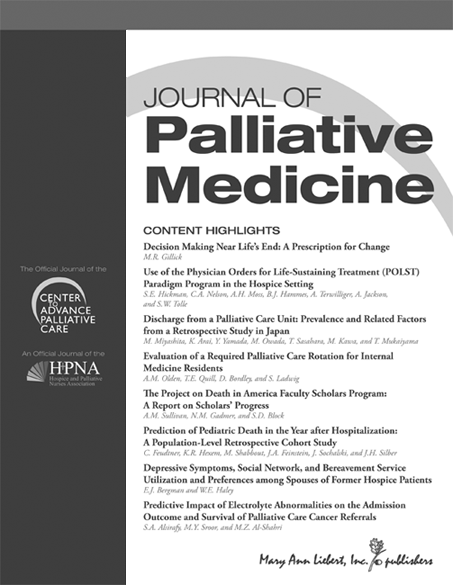
Letter to the Editor
A growing number of elderly living in nursing homes die without benefiting from palliative care. Although many studies have revealed this failure in care, no explanation has yet been found.
Page 1089
Brief Reports
Case series of seven patients who were neurologically intact before the decision to withdraw care due to extensive systemic critical illness.
Page 1095
Fast Facts and Concepts
Medical Management of Bowel Obstructions, 2nd ed. #45
Invasive Treatment Options for Malignant Bowel Obstructions, 2nd ed. #119
Page 1151
Personal Reflection
Maya was so present. And I prayed that somehow the doctors were wrong and she would magically recover.
Page 1157
Case Discussions in Palliative Medicine
The concept of boundary crossings and violations in palliative care using the case of a trainee who experiences difficulties in maintaining boundaries with a dying patient.
Page 1159
Book and Media Reviews
Page 1163
Recent Literature
Page 1167
Silence
The solutions of today engender the problems of tomorrow. In response to the admonition to “use silence” in clinical interviews, novice clinicians can generate unease in both the patient and clinician. Yet, silence in an interview can be enriching—enabling a kind of communication between clinician and patient that fosters healing. A typology of silences, including compassionate silence, is described. (page 1113)
Oncology Fellows and Bad News
Oncologists often deliver bad news. Yet, 89% of program directors of U.S. oncology fellowship programs reported that they themselves received little to no formal training in delivering bad news. Only 3% of program directors did not believe any training is needed. The majority of oncology fellows do receive some training in delivering bad news. Most program directors feel institutional support for training fellows in delivering bad news is lacking. (page 1119)
Dignity Assessment
Nurses were highly positively correlated with the physicians about what constituted dignity. The subjects representing patients were also highly positively correlated with each other. Strikingly, the health professionals and the patient representatives were negatively correlated. The health professionals felt that treating a patient with disrespect and not carrying out their wishes resulted in erosion of dignity. In contrast, patients felt that poor medical care and untreated pain were the most important factors leading to erosion of dignity at life's end. (page 1125)
Access to Pediatric Palliative Care
Nurses play a critical case management role in ensuring access to services in Florida's statewide program of pediatric palliative care. Interestingly, nurses who have experience with a pediatric palliative care program are more likely to refer children to programs earlier than nurses without such experience. Clearly, expanded nurse training will be essential for equitable and appropriate referrals across a diverse set of illnesses. (page 1131)
Consultations and Hospital Culture
Focus groups conducted among physicians and nurses after 1 year of a hospital-based palliative care program yielded five major themes regarding the positive and/or transformational impact of the program on patient/family services, medical staff, the hospital, quality of care, and time. Physician and staff observations regarding perceived barriers included patient/family resistance, cultural differences, and the need for increased services. (page 1137)
Acculturation
Caregivers who were less acculturated were more positively predisposed to use of a feeding tube at end of life (EOL), more likely to perceive that they received too much information, less likely to use mental health services and desire additional services than their more acculturated counterparts. Caregivers who were less acculturated felt their religious and spiritual needs were supported by both the community and medical system, had increased self-efficacy, and had stronger family relationships and support. (page 1143)