




Abstract
Abstract
Presenting posters at national meetings can help fellows and junior faculty members develop a national reputation. They often lead to interesting and fruitful networking and collaboration opportunities. They also help with promotion in academic medicine and can reveal new job opportunities. Practically, presenting posters can help justify funding to attend a meeting. Finally, this process can be invaluable in assisting with manuscript preparation. This article provides suggestions and words of wisdom for palliative care fellows and junior faculty members wanting to present a poster at a national meeting describing a case study or original research. It outlines how to pick a topic, decide on collaborators, and choose a meeting for the submission. It also describes how to write the abstract using examples that present a general format as well as writing tips for each section. It then describes how to prepare the poster and do the presentation. Sample poster formats are provided as are talking points to help the reader productively interact with those that visit the poster. Finally, tips are given regarding what to do after the meeting. The article seeks to not only describe the basic steps of this entire process, but also to highlight the hidden curriculum behind the successful abstracts and posters. These tricks of the trade can help the submission stand out and will make sure the reader gets the most out of the hard work that goes into a poster presentation at a national meeting.
Introduction
Why Present at National Meetings?
Given that it takes a fair amount of work to put together an abstract and presentation, it is fair to ask what is to be gained from the effort. The standard answer is that presentations at national meetings aid in the dissemination of your findings and help further the field. Although this is certainly true, there are also several practical and personal reasons that should hold at least equal importance to fellows or junior faculty members (see Table 2). Perhaps most importantly, presenting at a national meeting helps develop your national reputation. People will begin to know your name and associate it with the topic you are presenting. Additionally, it provides an opportunity to network and collaborate, which can then lead to other projects. Many of us have begun life-long collaborative relationships after connecting with someone at a national meeting. Even if you don't make a personal connection at the meeting, if people begin to associate your name with a topic, they will often reach out to you when they need an expert to sit on a committee, write a paper, or collaborate on a project.
Development of a national reputation is important not only in garnering interesting opportunities, but it is also key to career advancement. For fellows, presenting at national meetings can forge connections with future employers and lead to that all-important “first job.” For junior faculty, demonstration of a national reputation is often the main criterion for promotion and presentations at national meetings help establish this reputation. 8 Junior faculty may also make connections that lead to potential job opportunities of which they might not otherwise have been aware.
There are three additional practical reasons to present at a national meeting. First, having something accepted for presentation is often the only way your department will reimburse your trip to the meeting. Second, going through the work of abstract submission and presentation helps tremendously in manuscript preparation. It provides a deadline and forces you to organize your thoughts, analyze your data, and place them in an understandable format. This makes the eventual job of writing the manuscript much less daunting. Third, presenting also allows you to get immediate feedback, which can then make the manuscript stronger before it is submitted. Such feedback often gives the presenter additional ideas for analyses, alternate explanations for findings, and ideas regarding future directions.
Although these personal and practical reasons for presenting are derived from our own experiences, they are concordant with the survey results of 219 presenters at the Society of General Internal Medicine Annual Meeting. 9 This survey also highlighted how posters and oral presentations can meet these needs differently. For example, for these presenters, posters were preferred for getting feedback and criticism and for networking and collaborating. Oral presentations, on the other hand, were preferred for developing a national reputation and sharing important findings most effectively. For all of these reasons, many academic centers have developed highly effective programs for trainees and junior faculty to help encourage submissions10,11 so it is wise to seek out such programs if they exist in your home institution.
Getting Started
Realizing the importance of presenting at national meetings may be the easy part. Actually getting started and putting together a submission is where most fall short. The critical first step is to pick something that interests you. For original research, hopefully your level of interest was a consideration at the beginning of the project, although how anxious you are to work on the submission may be a good barometer for your true investment in the project.
For case studies, make sure the topic, and ideally the case, fuel a passion. Unlike original research, in which mentors and advisors are usually established at study conception, case studies often require you to seek appropriate collaborators when contemplating submission. It is the rare submission that comes from a single author. In choosing collaborators, look for a senior mentor with experience submitting posters and an investment in both you and the topic. There is nothing more disheartening for the junior clinician than having to harass a mentor whose heart is not in the project.
Another critical step is to choose the right meeting for the submission. Although many submissions may be to palliative care meetings (e.g., American Academy of Hospice and Palliative Medicine), there is great benefit to both the field and your career in presenting at other specialty meetings. Presentations at well-recognized nonpalliative care meetings further legitimize the field, increase your national visibility, and lead to interesting and fruitful collaborations. Additionally, these types of presentations may be looked on with more favor by people reviewing your CV who are not intimately familiar with the world of palliative care. Table 1 presents some questions you should discuss with your mentor and ask yourself when choosing a meeting. Some of these questions may have conflicting answers, and you should be thoughtful in weighing what is most important.
Once you have chosen your meeting, go to the meeting's website and review all of the instructions. Check requirements regarding what material can be presented. For example, many meetings will allow you to present data that were already presented at a regional meeting but not data that were previously presented at another national meeting. Most meetings also do not allow you to present data that are already published, although it is generally acceptable to submit your abstract at the same time you submit your paper for publication. If the paper is published before the meeting, make sure to inform the committee—most often you will still be able to present but will be asked to note the publication in your presentation. Regarding the submission, most conferences have very specific instructions and the rules are strict. The applications are generally online with preset fields and word limits. It is helpful to examine review criteria and deadlines for submission, paying particular attention to time zones. Finally, it can be invaluable to read published abstracts from the last meeting and to talk with prior presenters to get a sense of the types of abstracts that are accepted.
The next step is to start writing. The key to success is to leave enough time as there are often unavoidable and unplanned technical issues with the online submission that you will confront. Additionally, you will want to leave time to get input from all of the authors and from people who have not been primarily involved in the project—to make sure that a “naïve” audience understands the message of the abstract. Finally, remember that an abstract/poster does not have to represent all of the data for a study and can just present an interesting piece of the story.
Most submissions require several rewrites. These can become frustrating, but it is important to realize that there is a very specific language for these types of submissions that your mentor should know and that you will learn over time. The most common issue is the need to shorten the abstract to fit the word limit. Strategies to ensure brevity include using the active voice, employing generic rather than trade names for drugs and devices, and avoiding jargon and local lingo. Use no more than two or three abbreviations and always define the abbreviations on first use. Do a spelling/grammar check and also have someone proofread the document before submitting. References are generally not included on abstracts. Most importantly, be concise, write lean, and avoid empty phrases such as “studies show.” A review of 45 abstracts submitted to a national surgical meeting found that concise abstracts were more likely to be accepted, 12 and this small study certainly reflects our experiences as submitters and reviewers.
The Abstract for an Original Research Study
The styles of abstracts for original studies vary. Guidelines exist for manuscript abstracts reporting various types of original research (CONSORT,13–15 IDCRD, 16 PRISMA, 17 QUOROM, and STROBE 18 ) and review of these guidelines can be helpful to provide a format. There are also guidelines that exist for evaluating conference abstracts that may be informative, such as the CORE-14 guidelines for observational studies. 19 In general, a structured abstract style is favored.20–21 In this paper, we will present general styles for each type of abstract that will need to be adapted to the type of study and the rules of the conference. Table 3 outlines the general format for an abstract for original research. Each section contains tips for how to write the section, rather than example text from a study. Therefore, you may find it most helpful to review the figures alongside examples of previously accepted abstracts.
In any abstract, it is particularly important to focus on the title as it is often the only item people will look at while scanning the meeting program or wandering through the poster session. It should be no more than 10–12 words 2 and should describe what was investigated and how, instead of what was found. It should be engaging, but be cautious with too much use of humor as this can become tiresome and distracting. Below the title, list authors and their affiliations. The remaining sections of the abstract are discussed in the figure.
The Abstract for a Case Study
The abstract for a case study contains many of the same elements as the abstract for original research with a few important differences. Most importantly, you need to use the abstract to highlight the importance of the issue the case raises and convince the reader that both the case and the issue are interesting, novel, and relevant. A general format is provided in Table 4.
Preparing Posters
Once the abstract is prepared, submitted, and, hopefully, accepted, your next job is to prepare the presentation. Whereas a few select abstracts are typically selected for oral presentation (usually 8–10 minutes followed by a short question-and-answer period), the majority of submitted abstracts will be assigned to poster sessions. (Readers interested in advice for oral presentations are referred to reference 22). Posters are large (generally approximately 3 × 6 ft) visual representations of your work. Most posters are now one-piece glossy prints from graphics departments or commercial stores, although increasingly academic departments have access to printing facilities that may be less expensive than commercial stores. Additionally, many meetings now partner with on-site printing services, which are convenient and reasonably priced. Generally, the material is prepared on a PowerPoint (or equivalent) slide and this is given to the production facility. The easiest way to prepare your first poster is to ask your institution if it has a preferred or required template. If such a template does not exist, ask for a trusted colleague's slide from an accepted poster. This gives you the format and institutional logos, and you simply need to modify the content. In preparing your poster for printing, review the meeting instructions and try to make your poster as close to the maximum dimensions as possible. Try to complete the poster early to allow for production delays. Consider shipping your poster to the conference or carry it in a protective case and check with the airline regarding luggage requirements. On-site printing eliminates travel hassles but does not allow much time for any problems that may arise.
What goes on the poster?
Both the content and the visual appeal of the poster are important. In fact, one study found that visual appeal was more important than content for knowledge transfer. 23 Although the poster expands the content of your abstract, resist the urge to include too much information. It is helpful to remember the rule of 10s: the average person scans your poster for 10 seconds from 10 feet away. When someone stops, you should be able to introduce your poster in 10 seconds and they should be able to assimilate all of the information and discuss it with you in 10 minutes. 3 Figures 1 and 2 show the layouts of posters for a case and for an original study. The general rule is to keep each section as short and simple as possible, which allows for a font large enough (nothing smaller than 24 point 4 ) for easy reading of the title from 10 feet away and the text from 3–5 feet away. Leave blank space and use colors judiciously. Easily read and interpretable figures and simple tables are more visually appealing than text, and they are typically more effective in getting one's message across. It is helpful to get feedback on one's poster before finalizing and printing—ideally from people not familiar with the work to get a true objective view.
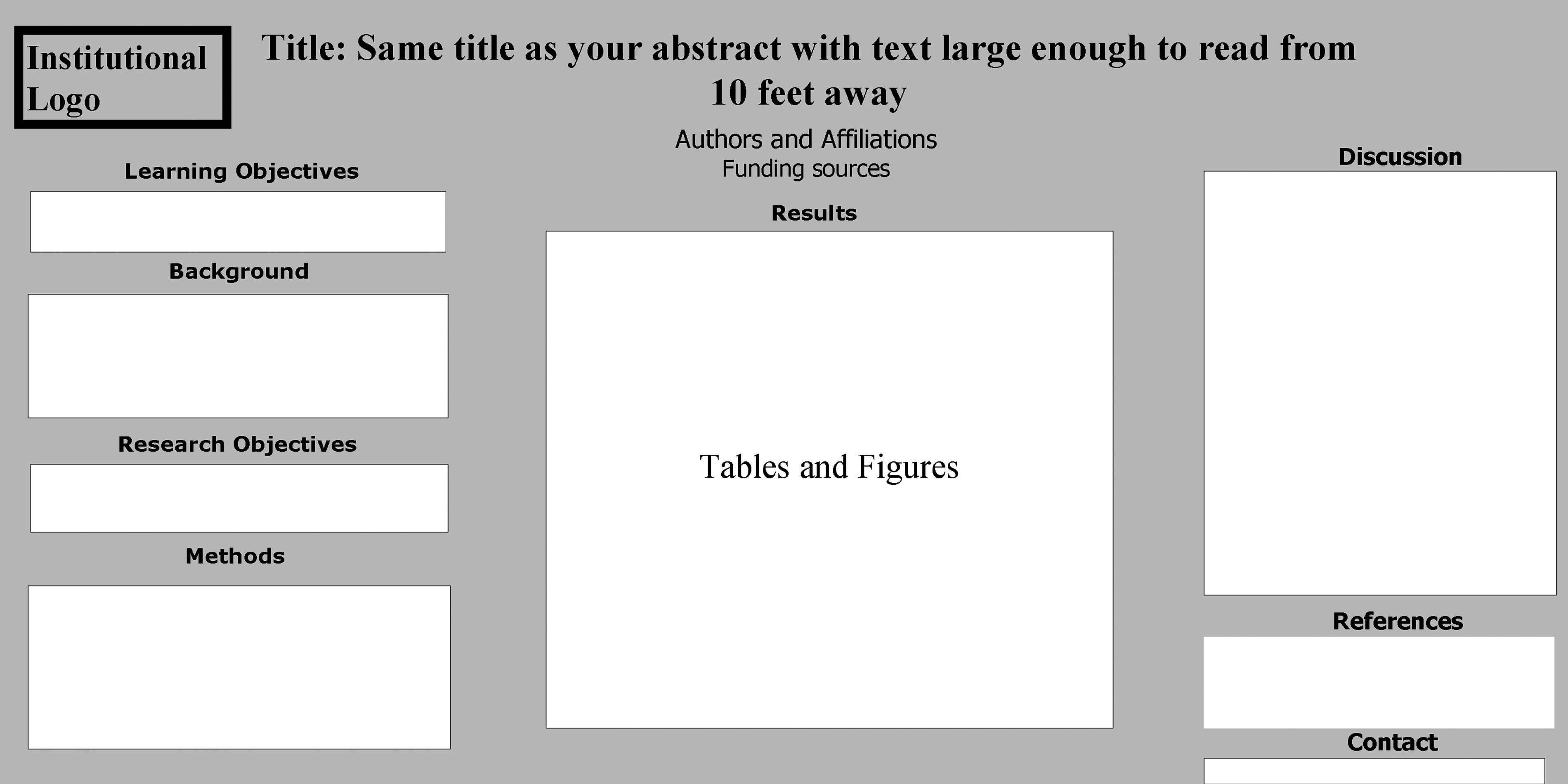
Poster for original research.
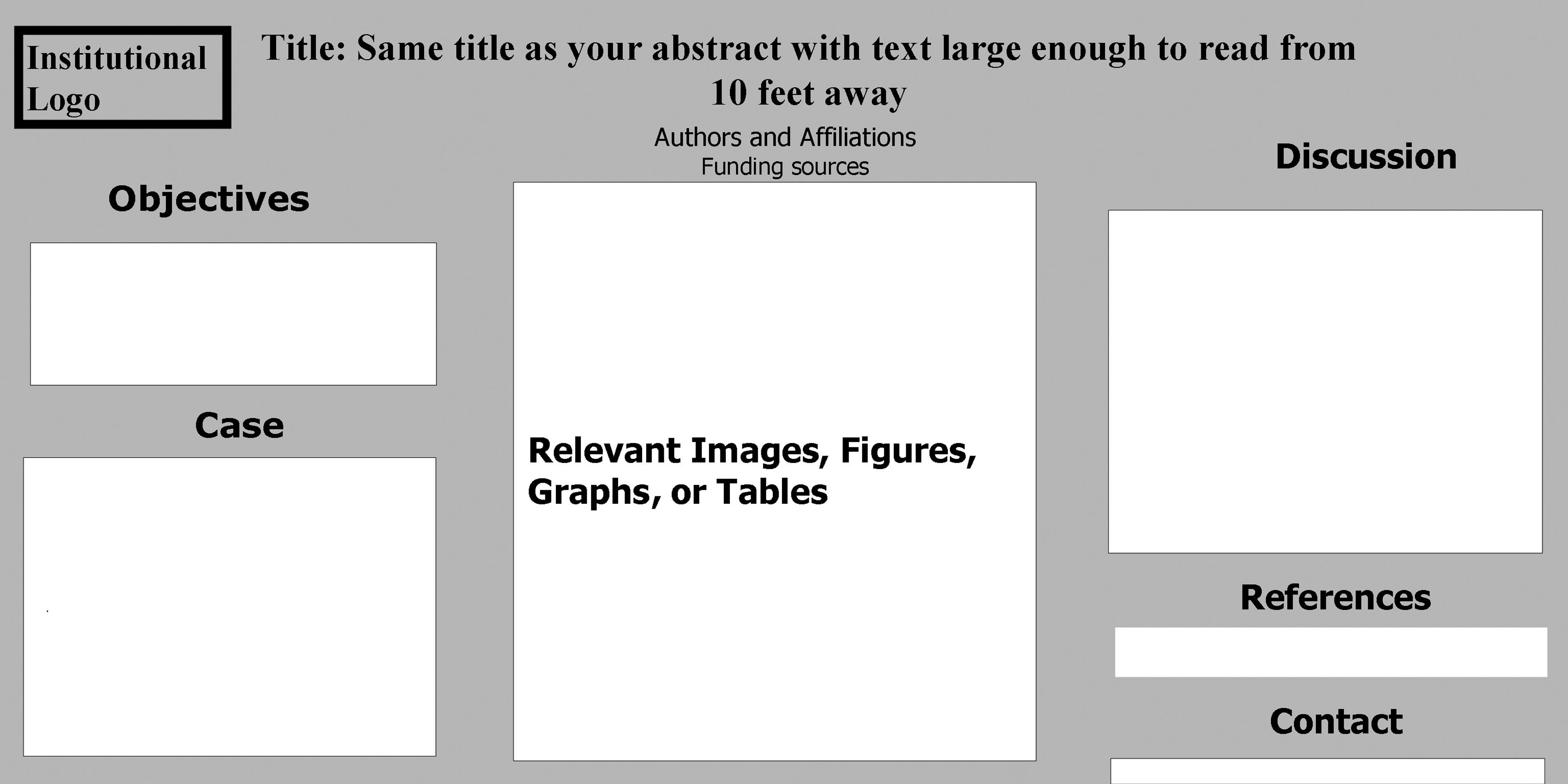
Poster for case study.
Although it may seem simple enough to prepare a good poster, many fall short. One author reviewed 142 posters at a national meeting and found that 33% were cluttered or sloppy, 22% had fonts that were too small to be easily read, and 38% had research objectives that could not be located in a 1-minute review. 5 Another study of an evaluation tool for case report posters found that the areas most needing improvement were statements of learning objectives, linkages of conclusions to learning objectives, and appropriate amount of words. 24
The Poster Presentation
Posters are presented at “Poster Sessions,” which are designated periods during the meeting when presenters stand by their posters while conference attendees circulate through the room. Refreshments are often served during these sessions and the atmosphere is generally more relaxed and less stressful than during oral presentations. Additionally, the one-on-one contact allows greater opportunity for discussion, feedback, and networking. Awards are often presented to the best posters and ribbons may designate these posters during the session.
The first step to a successful poster presentation is to simply show up. Surveys of conference attendees clearly indicate that it is necessary for the presenter to be with his/her poster for effective communication of the results. 23 This is also your time to grow your reputation, network, and get feedback, so do not miss the opportunity to reap the rewards of your hard work. In preparation, read any specific conference instructions and bring business cards and handouts of the poster or related materials. While standing at your poster, make eye contact with people who approach but allow them to finish reading before beginning a discussion. 4 As noted above, you should be prepared to introduce your poster in 10 seconds then answer questions and discuss as needed. Practicing your introduction and answers to common questions with colleagues before the meeting can be invaluable. Before your presentation, your mentor should also contact important people in the field related to your topic and ask them to come by your poster. You should have a list of these people and know who they are and when they are coming. Standard questions you may ask are included in Table 1. You should also have prepared questions targeted specifically for each of the people your mentor has contacted. You should then suggest these people as reviewers when you submit your manuscript.
After the Presentation
After the presentation, key steps remain to get the most out of the process. First, ask for feedback so you can make adjustments for the next presentation. Also, think about what parts of the poster you can use for other reasons. It is often helpful to export a graph or figure to use in future presentations. The key is to “double-dip” and use everything to its fullest extent. In addition, to make the maximal use of the networking opportunities you should follow up with anyone who asked for more information or inquired about collaborations. In the excitement of the meeting anything seems possible, but it is easy to lose that momentum when you get home. In one study, only 29% of presenters replied to requests for additional information, and they generally took over 30 days to respond. 25
Finally, and perhaps most importantly, it is critical to write up your work for publication. Although posters are important, publications are the true currency of academia. Unfortunately, the percentage of abstracts that are eventually published is low. 26 When asked why they had yet to publish, respondents in one study 27 cited: lacked time (46%), study still in progress (31%), responsibility for publication belonged to someone else (20%), difficulty with co-authors (17%), and low priority (13%). Factors that have been shown to increase the likelihood of abstract publication include: oral presentation (as opposed to a poster), statistical analysis, number of authors, and university affiliation.28–31 Time to publication is generally about 20 months. 29
Conclusions
Writing abstracts and developing posters for national meetings benefit the field in general and the junior clinician in particular. This process develops critical skills and generates innumerable opportunities. We have presented a stepwise approach based on the literature and our personal experiences. We have also highlighted the hidden curriculum that separates the successful submissions from the rest of the pack. Hopefully, these tools will help palliative care fellows and junior faculty more easily navigate the process and benefit the most from the work they put into their projects.
Footnotes
Acknowledgments
Dr. Morrison is supported by a Mid-Career Investigator Award in Patient Oriented Research from the National Institute on Aging (K24 AG022345). A portion of this work was funded by the National Palliative Care Research Center.
Author Disclosure Statement
No competing financial interests exist.