




Abstract
Abstract
Background:
The encounter of students and patients with a terminal illness plays an important role in this teaching. However, for ethical as well as practical reasons, there are limitations regarding the involvement of patients in palliative care teaching. In this study we investigate the effects of an obligatory 90-minute teaching intervention on a palliative care ward by means of quantitative and qualitative methods.
Methods:
Self-perceived knowledge, confidence and attitudes were elicited by means of a questionnaire which has been developed by the authors. The instrument includes statements which could be answered by means of numerical rating scales - NRS (1 = very low, 10 = very high). In addition, open-ended questions regarding students' self-perceptions and evaluation of the teaching were analyzed according to the principles of content analysis.
Results:
All 163 participants completed the questionnaire. Participants rated their knowledge in palliative care as poor prior to the course (median, 3). Medical students indicated significantly improved confidence regarding the encounter with patients in palliative care (p < 0.001; median, 3 before versus 5.5 after), and higher interest for the subject of palliative care (median 7 before vs. 8 after). The student-patient encounter could be identified as a relevant factor contributing to the positive evaluation as part of the analysis of qualitative data.
Conclusions:
This evaluation study of an obligatory course in palliative care indicates that even a short teaching module that includes a student-patient encounter has significant effects on the medical students' self-perceived knowledge, confidence and attitudes, and their interest in palliative care.
Introduction
The student–patient encounter has been suggested as an important part of palliative care education on the basis of its effects on attitudes and social skills.5,13–19 However, there are ethical and practical limitations, such as the vulnerability of patients, the limited number of palliative care beds and the time constraints of the medical staff.
In this article, we describe a 90-minute obligatory teaching module for fourth year medical students on a palliative care ward and its effects on the participants.
Methods
Palliative care has been one of 14 topics in internal medicine included in the Bedside Teaching Course attended by all students in the fourth of a total of 6 years of medical school at the University Medical Centre of Mainz since 2008. Each week, two groups of students (each with a maximum of seven participants) in parallel receive an obligatory 90-minute teaching session by usually the same two palliative care physicians with board certification. After a joint 30-minute introduction to palliative care, both groups meet a patient usually suffering from far-advanced cancer under the supervision of their teacher. The session ends with reflections triggered by the students on the patient's medical and psychosocial aspects and the impact of a permanent professional exposure to terminally ill patients.
The questionnaire containing closed- and open-ended questions was developed by the authors in cooperation with the local Centre for Quality Management. Development was based on the authors' interest in and knowledge about the topic, as well as perceptions gained as part of an earlier informal course evaluation. It was tested for comprehensibility and acceptance by the first two groups of the students (n = 14). The questionnaire was distributed during the winter term 2008/2009. Participation was voluntary. The folded completed questionnaires were collected when students received their confirmation of participation at the end of the session. The local research ethics committee decided that no formal approval was necessary for this study.
A numerical rating scale (NRS from 1 = very low to 10 = very high) was used to measure the self-perception of students before and after the teaching regarding knowledge, confidence and interest in palliative care, as well as their views on palliative care as a career option. Data were analyzed using SPSS release 17 (SPSS Inc., Chicago, IL). The Wilcoxon test was used for differences for combined samples and the Mann-Whitney U test was used to compare uncombined samples. Correlations were calculated with the help of the Spearman's rank correlation coefficient. Dependencies between variables were examined by linear regression. Answers to open-ended questions on students' expectations toward the course prior to the teaching session and course evaluation were analyzed using the principles of content analysis. 20 In a first step all quotes of the students were categorized independently by the authors who have background in palliative medicine (M.W.), medical student (J.B.), and medical ethics (J.S.). The generated codes were discussed among the authors until a consensus for the coding of each quote was found. In the course of these discussions reference to literature in the fields of palliative medicine, medical education and medical ethics has been made to support or challenge different interpretations.
Results
The course was attended by 194 students. The first two groups of students (n = 14) served as a pilot to test the questionnaire. Seventeen of the remaining 180 students did not attend the unit at the palliative ward. All remaining participants (n = 163) filled in the questionnaire: 115 students were female (70.6%), 44 male (27.0%) and of 4 students gender was not indicated; median age was 23 (range, 21–36; 4 missing).
The majority of students assessed their knowledge in palliative medicine (median 3/10 on the NRS) and their confidence (median of 3/10 on the (NRS) as low, as indicated in Table 1 and Figure 1. Seventy-seven students (47.2%) reported never having heard about palliative care topics in previous courses. The majority of participants disclosed a great interest in palliative care, and most of the students estimated working on a palliative care ward as satisfactory (median of 7/10). There was a significant increase in the confidence in the student's own ability to interact with terminally ill and dying patients (median before, 3; median afterwards, 5.5; p < 0.001), as well as an increase in the interest for palliative care (median before, 7; median afterwards, 8; p < 0.001). The positive assessment of the doctor's work on a palliative care ward also increased (median before, 7; median afterwards, 8; p < 0.001).
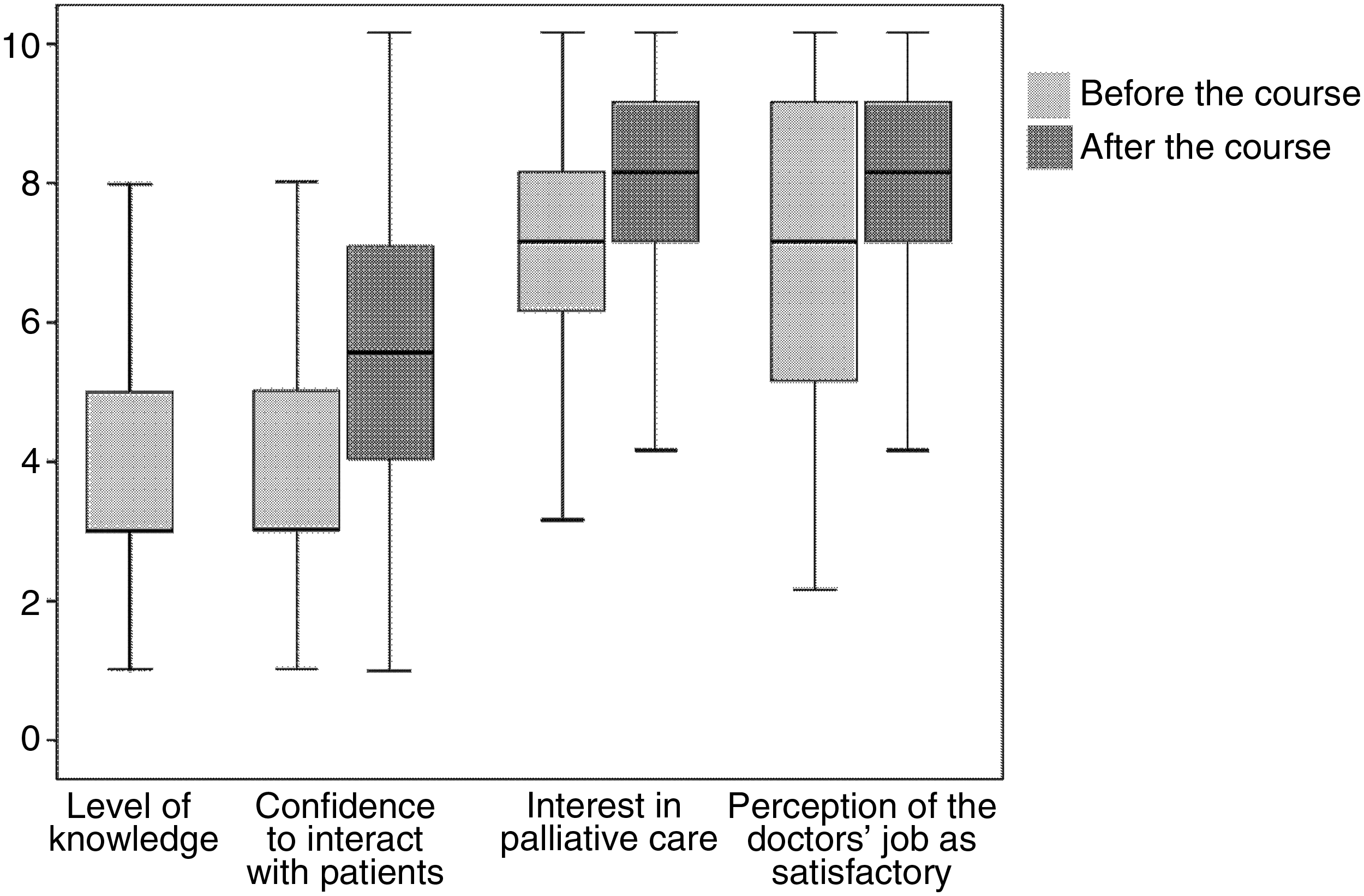
Boxplots of the rating on a numeric rating scale (1–10) regarding the level of knowledge before the course, the confidence to interact with patients before and after the course, the interest in palliative care before and after the course and the perception of the doctors' job as satisfactory before and after the course.
No statistically significant gender-related influences could be found. However, male students expressed somewhat less interest than female students. Furthermore, the male students considered the doctor's work on a palliative care ward as less satisfactory. After the course the results of male and female students converged (Fig. 2).

Boxplots of the rating on a numeric rating scale (1–10) regarding the interest in palliative care before/after the course and the perception of the doctors' job as satisfactory before/after the course, subdivided by gender.
At the end of the course, 90 participants (55.2%) rated the course with 10 of 10 possible points on the NRS, and a further 43 (26.4%) participants with 9 of 10. Concerning the learning success, 128 students (78.6%) chose a ranking of 8 points or more (Table 1). There was a weak correlation between their own assessment of knowledge and interest in palliative care and confidence in being able to interact with dying patients (correlation coefficient 0.288 and 0.377, respectively). There was no influence found of the student's age on the assessment of their knowledge (p = 0.156), the interest for palliative care (p = 0.873) or the rating of a palliative doctor's work as satisfactory (p = 0.067). A dependency on the age was found only in the case of the confidence in being able to interact with terminally ill and dying patients (p < 0.001).
The qualitative analysis of open-ended comments revealed that this short educational unit with patient encounter not only increased knowledge but also had a strong impact on the student's attitude toward the relevance of palliative care. Only a few comments included critical feedback (Table 2).
Discussion
The lack of confidence of fourth-year students facing terminally ill and dying patients, the low self-perceived knowledge and the high interest of the majority of students in palliative medicine, as well as significant improvements regarding self-perceived competences, are key findings of this research. In this context, the mixed-method approach and the analysis of open-ended comment provide valuable insight and clues for the interpretation of the quantitative data. The low self-assessment of the subject knowledge reflects the insufficient representation of palliative care in the German undergraduate medical curriculum. In line with our results, a study of Papke et al. 21 reports that only 16% of the participants questioned had ever had contact with palliative care during their studies. The significant improvement of the self-assessed confidence in interacting with incurably ill patients by meeting these patients in a secure surrounding is in accordance with the positive effects reported in the context of patient-centered palliative courses.5,16,19,22 The results of the qualitative evaluation support the view that this change may well be attributed to the teaching format of small groups and student-patient encounters. While the students rather anticipated receiving theoretical and practical knowledge in how to treat terminally ill patients, the direct encounter with these patients obviously had a deep impact on their understanding of their situation and the possible role of physicians in their care. The qualitative analysis indicates that listening to terminally ill patients who talk in an open and frank manner about their very personal situation near death is a deeply moving and enriching experience for students. It may encourage them to get involved in such communication themselves instead of avoiding it, to reduce subliminal fears of contact and to view terminally ill patients just as people with special problems and symptoms seeking the attention of sensitive and well educated doctors. Moreover, the role-modeling effect of the teachers in these short educational units could be of paramount importance.
Limitations
The well-known critique regarding the validity of data based on students' perceptions has to be taken into account. Our methodology did not offer the possibility to gain information about the actual competency of course participants. However, according to Bandura's theory of self-efficacy, the belief in being able to perform in a certain way is relevant to one's performance in practice.23–25 A further limitation pertains to collecting the questionnaires when handing over the confirmation of participation, which may have caused a bias due to the teacher's presence. Even though the completed questionnaires were folded and collected on a pile and there was no further contact between the palliative care teachers and students in other teaching sessions, it is possible that this setting may have influenced the answers of the students toward a more positive evaluation. Finally, the fact that the questions to be filled in at the beginning and the end of the course were printed on the same sheet of paper may also have influenced the students when answering the questionnaire at the end of the course.
Conclusions
We recommend the inclusion of a student–patient encounter as an essential and motivating part of a palliative care curriculum, being feasible even with regard to a limited number of palliative care beds, time constraints of the staff and the vulnerability of palliative care patients. It not only increases familiarity with the goals of palliative care, but may also be formative to medical students.
Footnotes
Author Disclosure Statement
No competing financial interests exist.