




Abstract

Letter to the Editor
Physicians delivering excellent care, preventing suffering at life's end and acting according to a patient's wishes should have clear legal protections (page 736)
Fast Facts and Concepts
#236 Pharmacologic Treatment of Acute Venous Thromboembolism in Patients with Advanced Cancer (page 828)
#254 Complicated Grief (page 829)
Personal Reflection
Palliative care providers have made great progress in identifying the unintended consequences that contribute to the fragmentation that marks so much of our current health care crisis. (page 833)
Case Discussions in Palliative Medicine
A complex case of progressive dyspnea and its treatments in a patient with advanced pancreatic cancer: Review of literature on pulmonary drug toxicity and tumor lymphangitic spread, and the role of corticosteroids in relieving dyspnea in the palliative care setting. (page 834)
Book and Media Reviews
(page 838)
Recent Literature
(page 839)
Using Videos in Goals-of-Care Discussions
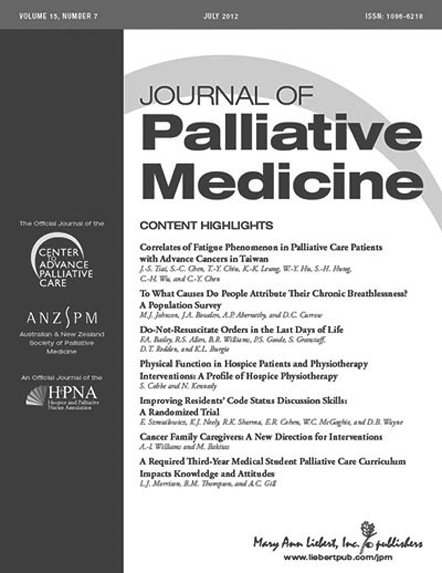
Older nursing home patients were randomized to a verbal narrative or a video describing goals-of-care options, including life-prolonging, limited, and comfort-care approaches. In the video cohort, 80% chose comfort-based care, compared to 57% in the verbal narrative cohort. Among all patients who chose comfort care, 29% had a DNR in the verbal narrative group, compared to 33% in the video group. (page 805)
DNR Orders at End of Life
This study describes the presence and timing of do-not-resuscitate (DNR) orders for more than 1000 imminently dying patients in VA Medical Centers. Of the 63.7% who had an active DNR order at time of death, 32.2% were written within the last 24 hours. Veterans with family members present at the time of death, and those who received pastoral care were more likely to have DNR orders. African American veterans and veterans who died unexpectedly were less likely to have DNR orders. (page 751)
Teaching Code Status Discussions
In this prospective, randomized controlled trial, residents completed a 2-hour teaching session with deliberate practice of communication skills, on-line modules, self-reflection, and a booster training session in addition to assigned clinical rotations. Control-group residents completed the clinical rotations alone. The intervention group scored higher on a simulated code status discussion than the control group, and skill improvement was durable for at least 2 months. (page 768)
Living with Breathlessness
Researchers surveyed more than 4400 community-dwelling Australians and found that almost 9% reported chronic breathlessness. Patients who attributed their dyspnea to lung disease experienced breathlessness for an average of 13.8 years. (page 744)
Comparing Symptom Burden
This retrospective study found that symptom burden is similar in cancer patients with localized and metastatic disease. Patients with relatively good prognoses had significant symptom burdens in the physical, emotional, and existential domains. (page 760)
Measuring Quality in Palliative Care
The authors tested quality measures for examining and improving palliative care for seriously ill patients in hospitals and hospices, and describe them as feasible and reliable. (page 798)
Children and Quality of Life
A survey of 98 parents whose children were enrolled in an integrated pediatric palliative care program found a wide variety of health states and needs for children with serious illness, including impairments in self-care, mobility, and cognition. (page 790)
Complexities of Fatigue as a Symptom
Researchers in Taiwan assessed 440 advanced cancer patients for fatigue in an inpatient palliative care unit. While fatigue was mainly associated with physical factors, they also found correlations between self-efficacy, emotion, and fatigue. (page 737)
Becoming a Caregiver
Qualitative interviews with 135 caregivers of adult cancer patients revealed four themes: becoming a caregiver; new and altered relationships; personal responses to caregiving; and antecedents and social context. The authors describe areas for future research on caregiver support. (page 775)
Teaching Medical Students
The authors describe how a required palliative care workshop, patient encounter, online module and reflective essay impacted third-year medical students' knowledge and attitudes. (page 784)