




Abstract

Letter to the Editor
It has been noted that patients are not usually offered access to adequate psychological services in hematologic malignancies treatment. Lower levels of depression can contribute to the preservation of immunity capacities and to therapeutic adherence. (page 260)
Brief Reports
Research has not kept pace with the rising use of hospice by cancer patients and thus we know little about how hospice nurses communicate. The overriding objective of this pilot study was to provide insight into these in-home visits. (page 277)
Fast Facts and Concepts
#250 Tracheostomy Care (page 359)
#251 Carotid Blowout Management (page 360)
Personal Reflection
The conversation happened in the early evening with just the parents and the primary oncologist. It was tearful and hard, but in the end, the patient agreed that he did not want to be intubated. (page 368)
Case Discussions in Palliative Medicine
An uncommon late grade 4 adverse event of large bowel colitis in a patient initially radiated with 8 Gy in a single fraction, and re-irradiated to the same area three months later due to pain progression with 20 Gy in five fractions. (page 370)
Book and Media Reviews
(page 374)
Recent Literature
(page 375)
Accusations of Murder against MDs
In an internet-based survey, more than half of 663 physicians had experienced accusations by patients' families or other clinicians of palliative treatments as euthanasia, murder, or killing in the last five years. Overall, 25 physicians (4%) had been formally investigated for hastening a patient's death. At the time of the survey, none had been found guilty but they reported substantial anger and worry. (page 334)
Ketamine Infusion for Cancer Pain
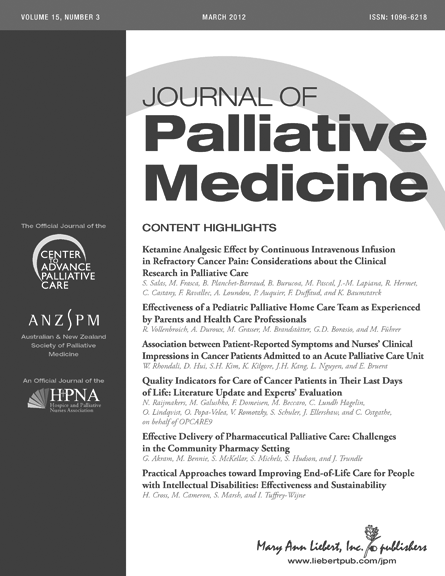
In a randomized, double-blind study, 20 patients with refractory cancer pain on morphine received a ketamine infusion or placebo. Patients' reported pain did not differ between the two groups, but tolerance for ketamine was satisfactory. (page 287)
Nurses' Impressions of Patient Symptoms
Eduardo Bruera and colleagues followed 118 patients admitted to their palliative care unit over a four-month period and found the clinical impressions of highly trained palliative care nurses showed poor association with patient-reported symptom intensity. They conclude that validated symptom assessment tools are needed for bedside clinical assessment. (page 301)
Community Pharmacies
This qualitative study describes the challenges facing community pharmacists operating in a local palliative care network in Scotland. (page 317)
Care for People with Intellectual Disabilities
The authors report on a three-year project to identify barriers and improve access to palliative care for people with intellectual disabilities. (page 322)
Caregivers' Experience of Pediatric Palliative Care
A survey of parents and health care professionals found that a pediatric palliative care team greatly improved the quality of care of seriously ill children and their families at home. (page 294)
Parents' Perception of Children's Illness
Little research has been done on the thoughts and perceptions of parents after hearing their child has incurable cancer. Researchers conducted semi-structured, open-ended interviews with parents and identified broad themes that likely impact parents' coping and medical decision-making. (page 340)
Survival after Discharge from Inpatient Palliative Care Unit
This retrospective study reviewed 62 discharges from a palliative care unit (PCU) to a residential care facility and found that age, PCU length of stay, functional status, and living alone prior to PCU admission affected survival. (page 327)
Quality Indicators for Last Days of Life
After reviewing the literature and national guidelines, these authors asked an international panel of experts to evaluate the identified quality indicators (QIs) for care in patients' final days of life. (page 308)