




Abstract

Dear Editor:
Approximately 5% to 10% of patients with advanced cutaneous cancer and metastasis of breast and internal organ cancers to the skin demonstrate cutaneous ulcers that are malodorous, which markedly impairs the QOL. 1 For cutaneous ulcers complicated with infections and a large amount of exudate and bleeding, medical professionals employ radiotherapy and topical dermal drugs to relieve the symptoms. However, such treatments have provided less than satisfactory effects and in many cases patients have no choice but to endure these symptoms. In these patients, a surgical procedure may lead to symptom relief and postoperative improvement of the QOL. 2 Thus, we performed a study to evaluate cutaneous symptoms before and after surgery in patients with malignant tumors involving cutaneous ulcers who underwent palliative surgery.
Subjects and Methods
The study included ten patients (mean age: 66.1±18.4 years) with advanced/recurrent cancer who underwent palliative surgery for the purpose of relieving cutaneous symptoms (discharge of a large amount of exudate, malodor, and pain from ulcers) between June 2007 and May 2012 (see Table 1). To investigate pre- and postoperative symptoms associated with cutaneous ulcers, we considered the scores of the Japanese version of the Support Team Assessment Schedule (STAS-J) on the day before and one month after surgery. 3 For statistical analysis, Statview (Statview version 5 for Windows; SAS Institute Inc., Cary NC) was used. The paired t-test was used to compare the scores of STAS-J and a p-value less than 0.01 was considered significant.
FSG, free skin grafting; MFH, malignant fibrous histocytoma; MM, malignant melanoma.
Results
All patients showed an improvement of subjective cutaneous symptoms. The patients and their families felt very satisfied with the result of the operation (see Figures 1 and 2). Due to the relief of symptoms after surgery, they could almost asymptomatically stay at home for a limited period (mean: 9.5±6.3 months). All patients died (mean postoperative survival: 14.4±9.3 months). The score of STAS-J after versus before surgery indicated a significant improvement (p<0.01).
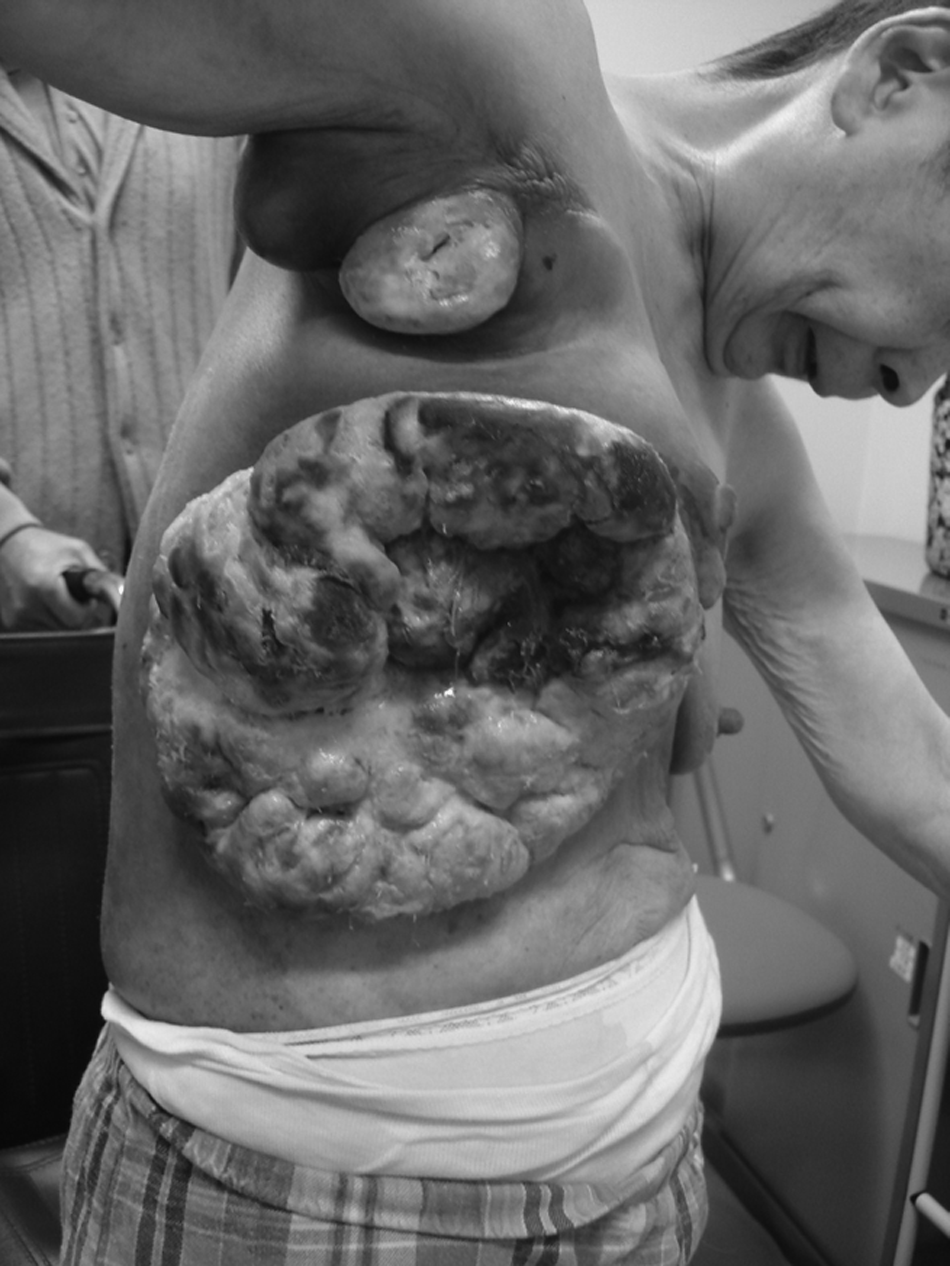
Preoperative view of the breast cancer. A 23-cm x 21-cm tumor, which developed a fungating wound with infection, malodor, and massive discharge was present on her right breast.
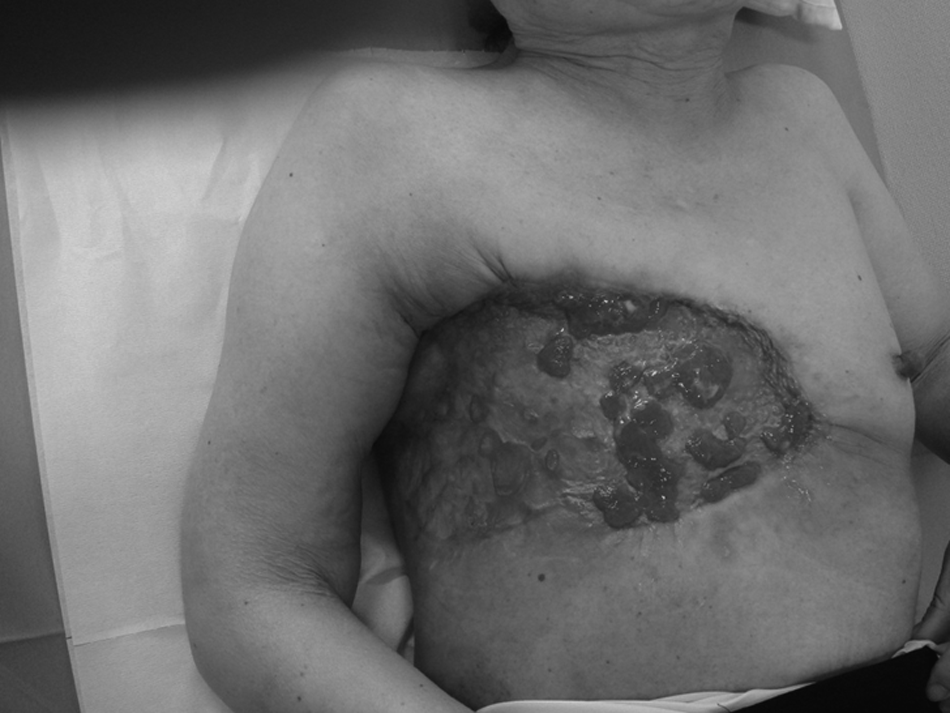
A three-week postoperative view of the wound. The wound had almost resurfaced with a dotted raw surface showing no infection, odor, and minimal discharge.
Discussion
All of the patients become exhausted with long-term inpatient hospital care and, in many cases, hope to live with their families at home as early as possible. Palliative surgery satisfactorily fulfilled this hope.
When investigating the STAS-J scores, we observed a significant improvement in the symptoms. Additionally, some patients demonstrated a relief of depressive symptoms. This suggests that palliative surgery not only improved local symptoms, but also had a favorable effect on patients' mental state.
Palliative surgery involves a possible drawback in that surgical stress may induce various cytokines and growth factors, 4 which can accelerate residual tumor growth. Therefore, the surgical stress itself may promote cancer progression and worsen the prognosis. According to the operative plan, en bloc resection of the underlying muscle and simple amputation were performed. Free skin grafting and local flap use, which are less invasive techniques, were chosen for wound resurfacing. However, since palliative surgery is intended to improve postoperative patients' symptoms and QOL, regardless of the presence of a residual tumor, the possibility of worsening the prognosis is less of a consideration.