




Abstract
Abstract
Background:
A question prompt sheet (QPS) is a structured list of potential questions available for patients to ask their doctor during a clinical encounter. Although it has been shown to improve physician–patient interaction during clinical consultations, there is paucity of data on its use in the palliative care setting. The aim of this study was to develop a single-page consensus list of prompt questions for use by patients attending outpatient palliative care.
Method:
An expert group of experienced physicians and mid-level providers were invited to participate in the study conducted in three Delphi rounds. A consensus in this study was defined a priori as an agreement (i.e., agree or strongly agree) by a minimum of 80% of the experts.
Results:
One hundred percent of the 22 invited experts participated in all the three Delphi rounds of the study. The top 25 questions with the highest level of endorsement were chosen and used toward the development of the QPS. Twenty-eight percent of the questions were about symptoms, treatment, and lifestyle, 24% were about commonly asked questions by caregivers, 20% were regarding end-of-life issues, 16% were regarding the nature of the palliative care service, and 12% were regarding the type of available support.
Conclusion:
A 25-item, single-page QPS was developed for use by patients attending outpatient palliative care. Further studies are needed to determine its clinical effectiveness in assisting physician–patient communication.
Introduction
E
A question prompt sheet (QPS) is a structured list of potential questions available for the patient to ask their doctor during a clinical encounter. It may help patients to obtain their desired level of information regarding their illness, assist with decision making, and facilitate the overall communication process. 12 There are limited studies regarding the development of prompt sheets in patients receiving palliative care. The ones available are either very long 13 and, therefore, may not be feasible for use by patients and families given the constraints of time availability at a busy outpatient clinic, were developed for only caregivers of cancer patients, 14 were focused on only end-of-life issues, 14 or were not developed in a palliative care setting. 15
The objective of this study was to develop a single-page consensus list of prompt questions for use by patients attending outpatient palliative care.
Methods
An expert group of palliative care physicians and mid-level providers in the Department of Palliative Care and Rehabilitation Medicine at the MD Anderson Cancer Center were invited through face-to-face contact, by phone, or by an e-mail to participate in a Delphi study. Participants were board certified/board eligible in palliative medicine or had at least three years experience in palliative care clinical practice, and were actively practicing palliative care. A thorough literature review on the development of a prompt sheet was conducted by the authors and an initial list of 119 questions was adapted from a previous study by Clayton et al. and other studies.13,14,16 A web-based survey was then developed with the adapted list of questions using Qualtrics online software (Qualtrics Labs, Inc., Provo, UT). Those who consented to participate in the study were provided with a link to the web-based questionnaire. The process was conducted in three Delphi rounds:
Demographic information about the participants was collected and efforts were made to preserve their anonymity and confidentiality. The study was reviewed and approved by our institutional review board.
Statistical analysis
The results of each round of the study were analyzed using summary statistics such as frequencies, as well as descriptive statistics such as mean, standard deviation, median, and interquartile range.
Results
The study was conducted between December 2014 and May 2015. A 100% of the 22 experts invited to participate in this study accepted the invitation and completed all the three Delphi rounds (Table 1).
Interquartile range.
Mid-level provider includes advanced practice nurse and physician's assistant.
Some panel members had more than one secondary specialty.
Figure 1 gives information on the various Delphi rounds. At the end of Round 1, two new questions were suggested by participants and these were included during revision of the round results.
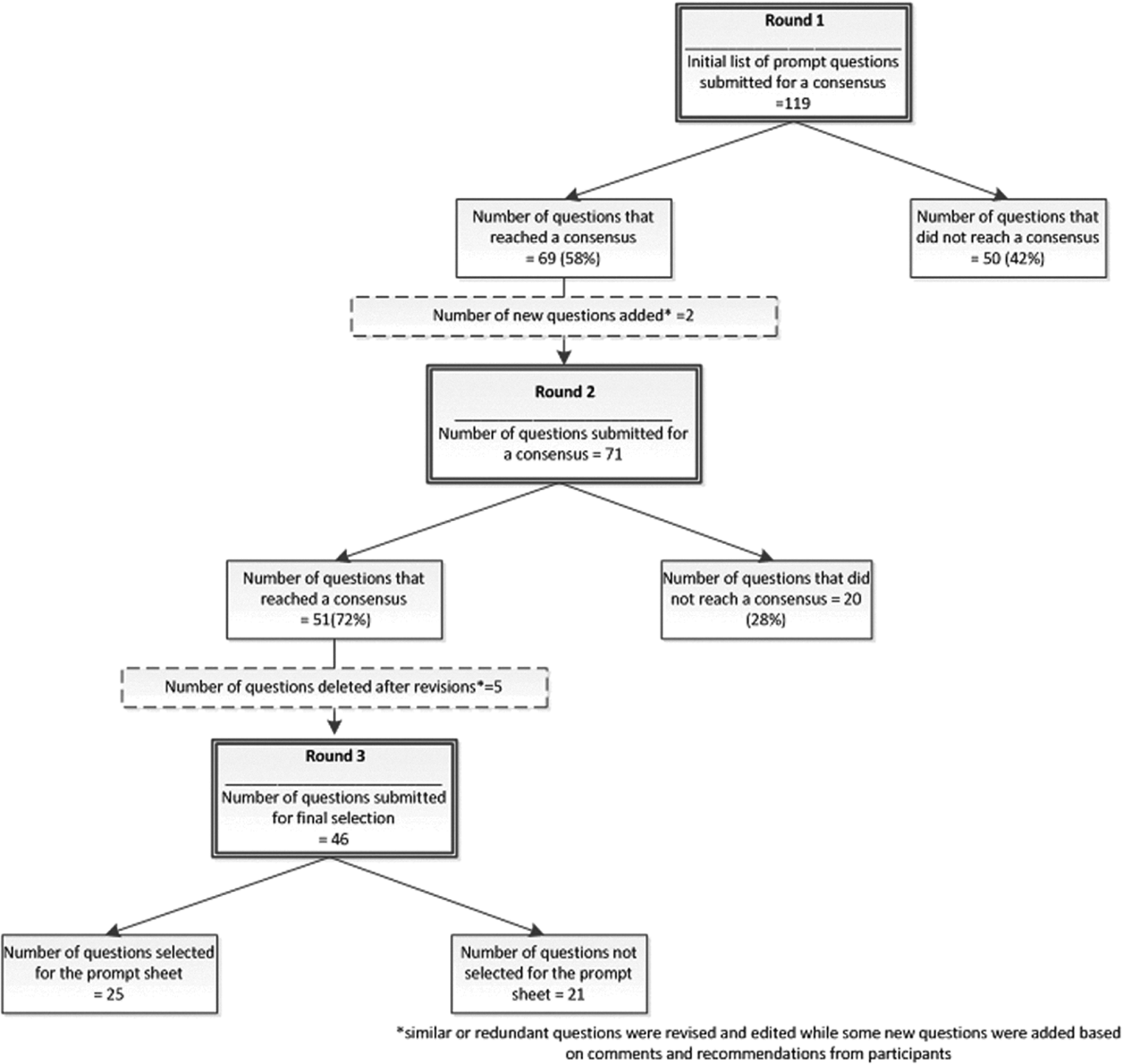
The Delphi results flowchart.
Table 2 shows the top 25 questions selected by the panelists in Round 3 in descending order of frequency. Twenty-eight percent of the questions were about symptoms, treatment, and lifestyle, 24% were particularly caregiver-related questions, 20% were regarding end-of-life issues, 16% were regarding the nature of the palliative care service, and 12% were regarding the type of support available to patients.
Number of participants who selected the question to be in the top 25 questions for the prompt sheet.
Discussion
To our knowledge, this is the first single-page prompt sheet that incorporates the most relevant questions on diverse aspects of palliative care for use by patients attending an outpatient palliative care clinic. Different versions of the prompt sheet have been developed in diverse fields of medicine, including general medicine, 17 geriatric medicine, 18 gynecological and dermatological conditions, 19 surgery, 20 diabetes, 21 and cancer. 22 There is, however, paucity of data on its use in the palliative care setting. 14 Clayton et al. developed a 20-page, 112-item QPS for palliative care patients by conducting focus groups and individual interviews in 19 patients, 24 caregivers, and 22 palliative care physicians, followed by a pilot study on 23 patients. 16 They found that participants perceived the QPS as useful in their communication with their doctors. We used this study as the basis for the development of our prompt sheet since it was thoroughly conducted with the participation of healthcare professionals, patients, and caregivers. Since this QPS was intended for the majority of palliative care patients with advanced disease, not all the questions might be relevant for the minority of clinic patients seen with severe symptom issues such as treatment-related neuropathy or mucositis in the context of potential cure. Therefore, clinical teams may need to customize the use of the QPS to contain only the relevant questions.
It is interesting to note that expert members endorsed a significant number of questions about end-of-life issues. Clayton et al. during the development of a QPS found that some healthcare professionals had reservations about including questions regarding end-of-life issues in the QPS. They felt that such questions were sensitive and may be perceived as confronting to patients. However, in the pilot study that followed the QPS development, patients and caregivers perceived those end-of-life questions as helpful in facilitating hitherto difficult discussions regarding the topic and readily endorsed them. 16
The expert panel consisted of members with great experience in caring for patients with advanced cancer and hence were well equipped to provide the most needed information for the development of the QPS (Table 1). When panel members have an in-depth knowledge of the topic under investigation, this greatly enhances content validity. 23 Moreover, the panel consisted not only of physicians but also of experienced advanced practice nurses and physician assistants in the field of palliative care. The inclusion of the mid-level providers was a step toward ensuring diversity of opinions while maintaining the level of rich experience and expertise required in the development of the prompt sheet.
In the development of the QPS, we focused on the outpatient setting of care because there is a great emphasis on the importance of integrating palliative care into oncologic care early in the trajectory of illness, and this evolving model predominantly happens in the outpatient setting.24–26 Also, the development of the prompt sheet was intended for both patient and caregiver use because ambulatory palliative care is provided with strong caregiver involvement. It was, therefore, important to generate one single prompt sheet that could be used by both the patient and the caregiver. The QPS content may need to be rearranged and categorized with appropriate instructions and directions for easy completion by patients and caregivers.
The use of the Delphi technique in this study resulted in numerous advantages. The approach enabled us to refine and revise the questions at each stage of the study based on the experts’ recommendations and opinions. Furthermore, it made the study quick, feasible, and cost-effective to conduct. Another strength of the study was the excellent participation rate (100%), which helped in eliminating any potential nonresponder bias. One limitation of this study was that it was conducted only at a tertiary academic palliative care center. In future studies, it may be important to broaden participant invitation to include other palliative care clinicians in diverse clinical settings. The next step in the process of implementing this tool will be to assess the helpfulness and feasibility of the prompt sheet among patients and caregivers in the outpatient palliative care setting.
Conclusion
In this Delphi process, palliative care experts successfully reached a consensus on a 25-item, single-page QPS for use by patients attending outpatient palliative care. Further studies are needed to determine the clinical effectiveness of the QPS in assisting patient–physician communication.
Footnotes
Author Disclosure Statement
No competing financial interests exist.