




Abstract

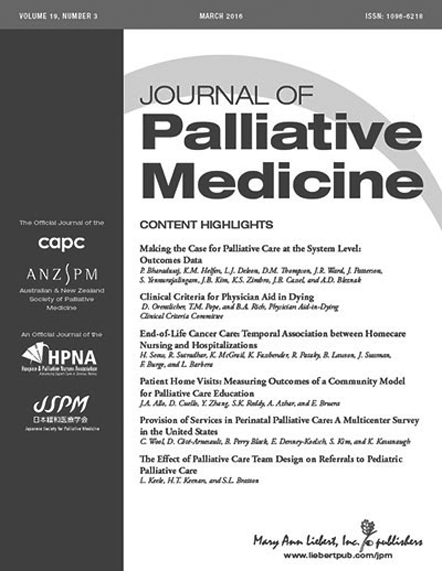
Letters to the Editor
Approximately 40% of our outpatient clinic population are cancer survivors without evidence of disease. Many of these individuals were initiated on opioids during active treatment and had dose escalations in response to progressive pain. With the transition to survivorship, the approach to the treatment of pain in this group of patients must undergo significant transformation. (page 254)
Brief Reports
A comparison of metal needles and plastic cannula (winged and nonwinged) for continuous subcutaneous infusion was done during a quality improvement project to reduce device induced complications at our hospital. (page 318)
Fast Facts and Concepts
Nonpharmacologic Management Strategies in ALS #300 (page 333)
Pharmacologic Management Strategies in ALS #301 (page 335)
Personal Reflection
I have written on the collision between my professional and personal worlds, the 42 months of bittersweet waiting, and the million losses we experienced along the path. The final days brought even greater reality to my research. I experienced the sights, smells, and sounds of the dying process that I had only read and heard about secondhand. I experienced deep emotional reactions to increasing physical changes in the most important person in my life. (page 337)
Book and Media Reviews
(page 341)
Recent Literature
(page 343)
Criteria for Physician-Assisted Death
The author reviews the work of the Physician Aid-in-Dying Clinical Criteria Committee, convened by Compassion & Choices in July 2012. The committee, which includes experts in medicine, law, bioethics, hospice, nursing, social work, and pharmacy, used an iterative consensus process to draft the criteria over a one-year period. (page 259)
Order Protocol for Symptom Crisis
Researchers implemented an inpatient order protocol for respiratory distress and acute pain crisis among pediatric palliative care patients, and then surveyed nurses and physicians about their experiences with the protocol. Respondents who supported the protocol hoped it would relieve patients' distress quickly, but some worried about hastening death. Overall, 95% of respondents reported they would use the protocol in the future. (page 306)
Nurse Ratings of Physician Communication
As part of an interdisciplinary intervention to improve end-of-life care at 15 hospitals in Washington State, nurses completed surveys on physician-nurse communication, physician-family communication, and patients' quality of dying in the intensive care unit. Based on 1173 surveys, specific physician-nurse communication topics were positively associated with quality of dying: family questions, family dynamics, spiritual/religious issues, and cultural issues. However, discussions between nurses and physicians about nurses' concerns for patients or families were negatively associated. (page 292)
Impact of Generalist Home-Based Nursing on Cancer Care
The authors conducted a retrospective cohort study among more than 80,000 cancer decedents in Canada, which has homecare systems employing generalist nurses to provide end-of-life care. The study showed a protective effect of nursing with an end-of-life intent on hospitalization across the last six months of life, and the trends were similar across three homecare systems in different provinces. (page 263)
Palliative Care System Integration
In this descriptive study using retrospective medical records, researchers identified benefits in length of stay, mortality, readmissions, saved ICU days, cost avoidance, and hospice referrals among seven federated hospitals with different paths to palliative care growth before system integration. They argue their findings support investment in systemwide palliative care programs to match health care's changing reimbursement models and quality mandates. (page 255)
Pediatric Palliative Care Team Design
In descriptive surveys of pediatric palliative care directors and hospital administrators, the authors found that team composition (as defined by the American Academy of Pediatrics and the American Academy of Hospice and Palliative Medicine) and availability were not crucial to palliative care utilization. They recommend hospitals start with existing resources and personnel, and modify over time. They found the addition of advanced nurse practitioners, pain specialists, and palliative medicine specialists increased referrals over time. (page 286)
Assessing Perinatal Palliative Care
The authors examined characteristics of perinatal palliative care programs in 28 states, assessed their alignment with the National Consensus Project domains of care, and identified providers and disciplines involved in these programs. They found a variety of types of programs within this small and developing field, and called for identification of quality measures to address the needs of perinatal care patients and their families. (page 279)
Educational Value of Home Visits
Bruera and colleagues surveyed health care professionals who participated in a home visit program over a nine-year period, and nearly all respondents reported the experience as highly effective in increasing their knowledge and skills in palliative care. (page 271)
Advance Directives Among Young Transplant Patients
In a retrospective chart review of nearly 100 patients aged 14–26 undergoing hematopoietic stem cell transplant, a minority of patients had advance directives. However, patients received care that was strongly associated with their preferences. With the exception of cardiopulmonary resuscitation, the use of life-sustaining treatment did not differ between those with advance directives and those without. (page 300)