




Abstract

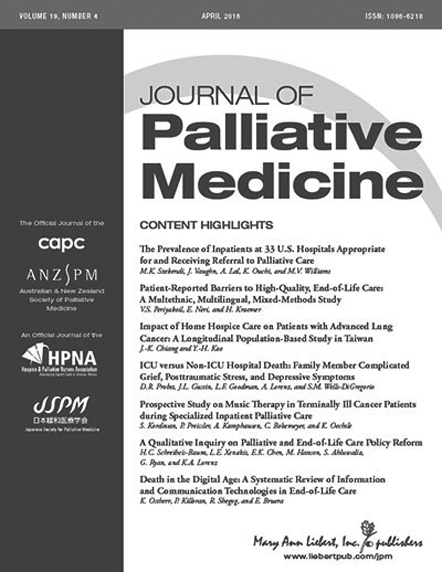
Letters to the Editor
Although some health care providers have hobbled together home-based palliative care programs, we know little about what program attributes are most effective. (page 354)
Brief Reports
Study to evaluate the feasibility of implementing a multiple-component hospital-based intervention on completion of advance care planning forms among heart failure patients.
(page 451)
Fast Facts and Concepts
Locked-In Syndrome #303 (page 460)
Dysgeusia #304 (page 462)
Personal Reflection
The first patient that day was waiting to die, the cancer eroding what remained of his life. His final weeks to months would be spent fixating on a winding down clock. The second patient wasn't waiting to die so much as measuring what moments he had left. (page 468)
Book and Media Reviews
(page 469)
Recent Literature
(page 470)
Psychological Distress of Death Inside and Outside the Intensive Care Unit
This observational study found no significant differences in rates or levels of complicated grief, posttraumatic stress disorder, or depression among family members whose loved ones died in an intensive care unit (ICU) versus a non-ICU hospital setting. Both groups of family members reported distressing experiences, but each setting of care presented unique stressors for family members. (page 387)
Palliative Care Growth in Impoverished Communities
The authors compiled state-level data for 2011 from multiple published sources in public health, and found that poverty rates were negatively correlated with the percentage of hospitals with palliative care programs. States with more hospital-based palliative care programs had significantly lower rates of prolonged acute mechanical ventilation, tracheostomies, and hemodialysis but higher rates of nutritional support compared to states with fewer palliative care programs. (page 421)
Variation in Palliative Care Referrals
This multisite, retrospective analysis determined the characteristics of inpatients at 33 U.S. hospitals appropriate for palliative care referral, as well as the percentage of these patients who actually received palliative care services. The authors identified factors influencing differences in referral patterns, including nonstandardized perceptions of referral criteria and variation in palliative care service structures. (page 360)
Resident-Led Education
The authors describe a resident-led curriculum that improved internal medicine residents' self-assessed general knowledge of palliative care, resources for patients, and the differences between palliative care and hospice. In their evaluations, residents reported a statistically significant increase in comfort in each domain of palliative medicine covered in the curriculum. (page 428)
Hospice in Taiwan
Using Taiwan's National Health Insurance Claims Database, researchers found that home hospice care enabled patients with advanced lung cancer to increase their chance of dying at home by 33%, decrease hospital stays by eight days, and reduce health care costs by 35% in the last month of life, compared with patients receiving inpatient hospice care. Predictors of hospice care at home were female sex, decreased hospital stays, and longer hospice care duration. (page 380)
Palliative Care Policy Reform
A sample of 22 state and federal-level advocates working in the field of palliative care and/or aging identified in semistructured phone interviews the challenges and potential solutions for promoting, adopting, and implementing policies that would support or expand high-quality palliative care. (page 400)
Death in the Digital Age
The authors review the use of information and communication technologies in end-of-life care. They argue that the growing evidence base for e-health applications in related fields should guide future interventions in end-of-life care, and additional research is needed to adapt older, analog technologies for use in the digital age. (page 408)
Music Therapy
On an inpatient palliative care unit, music therapy was feasible and well accepted by terminally ill cancer patients. Frequency and duration of music therapy, previous experience with music, and sociodemographic factors influenced the positive effects of music therapy. (page 394)
Cultural Barriers to End-of-Life Care
Researchers identified barriers to high-quality end-of-life care among multiethnic patients and families through a cross-sectional, mixed-methods study in Burmese, English, Hindi, Mandarin, Tagalog, Spanish, and Vietnamese. Primary patient-reported barriers were (1) finance/health insurance issues, (2) physician behaviors, (3) communication chasm between doctors and patients, (4) family beliefs/behaviors, (5) health system barriers, and (5) cultural/religious beliefs. (page 373)