




Abstract

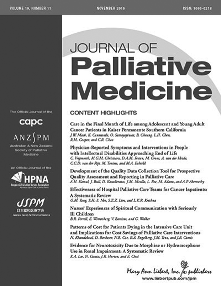
Letters to the Editor
A retrospective analysis of code status documentation within the electronic medical record, of metastatic pancreatic cancer patients from 2008 to 2014 at a single academic medical center. (page 1134)
Brief Reports
Study to explore variables associated with death during an established episode of delirium in palliative care patients when haloperidol treatment had been commenced. (page 1205)
Fast Facts and Concepts
Olzanzapine for Nausea, Delirium, Anxiety, Insomnia, and Cachexia #315 (page 1224)
Mindfulness Self-Care Strategies for Clinicians #316 (page 1226)
Personal Reflection
“Who would like to share their most emotionally powerful death?” asks the teacher. I want to have an answer to the question, but I feel ashamed of my story. This shouldn't be about me. It should be about him. It should be about his mother, who held him after he died and said, “Thank you…” (page 1231)
Book and Media Reviews
(page 1234)
Recent Literature
(page 1236)
Innovative Tool for Capturing Quality Data
Arif Kamal and colleagues present the Quality Data Collection Tool for Palliative Care (QDACT-PC), which reports on >80% of all published palliative care quality measures and 100% of high-priority measures. They explain how electronic methods for collecting point-of-care quality monitoring data can be developed using collaborative partnerships between community and academic palliative care providers. (page 1148)
Care of Young Adults at End of Life
In this retrospective study, a majority of 111 young adults with advanced cancer desired life-prolonging care as they entered their last month of life. Most patients subsequently wished for comfort, but intensive care was prevalent among this group of young adults. (page 1136)
Patterns of Cost for Patients Dying in the Intensive Care Unit
In this analysis, terminal admissions to the intensive care unit (ICU) had consistent cost patterns across patient characteristics. The authors assert that savings can be realized with interventions that align care with patient preferences and help to prevent unwanted ICU utilization at end of life. Their cost modeling suggested that results will vary depending on time horizon and reimbursement models. (page 1171)
Benefits of Inpatient Palliative Care
The authors conducted a systematic literature review to evaluate the effectiveness of palliative care for cancer patients in the acute inpatient hospital setting, and found no evidence for any benefit from hospital-based palliative care. (page 1156)
Exploring Spirituality with Children
In qualitative interviews, pediatric nurses described conversations in which seriously ill children questioned God and the reason for their illness, had a desire to talk about the afterlife as a way of understanding their limited lifespan, and shared descriptions of an afterlife. These nurses conveyed the importance of being present and engaging in spiritual communication with children. (page 1166)
Standards of Care in Japan
This retrospective cohort study investigated medical treatments for more than 2800 patients in the last two weeks of life in a national sample of 37 palliative care units in Japan. The authors found significant variations in care between centers increased as death neared. (page 1188)
Assessing Spiritual Distress
Researchers asked 21 physicians, nurses, and social workers about their role in identifying and addressing spiritual distress in patients. Despite spirituality being highlighted as important to care, few professionals felt able to address spiritual suffering, citing time constraints, a lack of training, and the sense that others could do a better job. (page 1197)
End-of-Life Symptoms in Patients with Intellectual Disabilities
The authors surveyed 81 physicians who care for people with intellectual disabilities about symptom prevalence and common interventions for their patients at end of life. (page 1142)