




Abstract

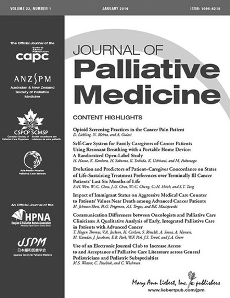
Letters to the Editor
Heart failure is more common in rural populations, but challenges in end-of-life care for these patients are not well understood. (page 7)
Brief Reports
Study focusing on describing characteristics of patients who were seen at an urban academic hospital, and their care team's adherence to 5 out of 10 measuring what matters quality indicators. (page 75)
Fast Facts and Concepts
Language for Routine Code Status Discussions #365 (page 98)
Recommending a Do-Not-Resuscitate Order for Patients with Advanced Illness #366 (page 100)
Personal Reflection
Reflectively listen and motivationally interview. Recall the acronyms, the communications brew.
Avoid missteps, assumptions, and indelible regret by providing a gentle expectations reset.
What would this look like if things go well? (page 108)
Case Discussions in Palliative Medicine
Case of intraosseous insertion, to a 56-year-old man, tetraplegic for many years due to progressive spinal muscular atrophy and with refractory suffering. (page 109)
Book and Media Reviews
(page 112)
Recent Literature
(page 113)
Communication Differences between Oncology and Palliative Care
An analysis of 68 audio-recorded oncology clinic visits found that, compared with oncologists, palliative care clinicians tended to assess and elaborate on understanding of prognosis and treatment, and emphasize effective coping, caregiver needs, and advance care planning. These results illuminate the communication elements by which early integrated palliative care may improve patient and caregiver outcomes. (page 41)
Opioid Screening Practices in Cancer Patients
In a survey of 106 physicians, cancer status played a role in clinicians' decision to screen and monitor opioid compliance in the oncology population. For patients with active cancer, clinicians are more likely to prescribe opioids despite patient refusal for toxicology screen as well as history of substance abuse. For patients with no history of cancer, clinicians are more likely to refuse a prescription refill and eliminate opioids from treatment regimen. (page 10)
Disparities in End-of-Life Care for Immigrants
Analysis of data from coping with cancer, a prospective multi-institutional cohort study, found that immigrant patients with advanced cancer are more likely to receive aggressive end-of-life care as well as care counter to their wishes compared with nonimmigrant patients. (page 34)
Treating Urological Symptoms
Experts from the Japanese Society for Palliative Medicine developed comprehensive clinical guidelines for the management of urological symptoms in patients with cancer. (page 54)
Promoting Palliative Care through an Electronic Journal Club
The authors report on an electronic journal club as a feasible and acceptable method of increasing readership and discussion of palliative care articles across an institution, as well as enhancing palliative care knowledge among subspecialist and general pediatric services. (page 50)
Patient–Caregiver Concordance on Treatment
In a longitudinal study, researchers examined the evolution of and factors impacting patient–caregiver concordance on life-sustaining treatment preferences over cancer patients' last 6 months. (page 25)
Resonant Breathing at Home
Researchers examined the usefulness and ease of implementation for family caregivers to administer resonant breathing using a portable device at home for patients with advanced cancer and autonomic dysfunction. (page 18)