




Abstract
Objective:
To describe museum-based education (MBE) as an emerging pedagogy in our four hospice and palliative medicine (HPM) training programs.
Background:
MBE is a pedagogy that uses art and the museum space to promote a variety of skills, including reflective practice, self-awareness, and interprofessional teamwork. While MBE has been extensively applied and studied in undergraduate medical education, it is not a common educational strategy in HPM education.
Methods:
We summarize the characteristics of MBE initiatives in our institutions, including makeup of fellowship class, MBE site, facilitators, exercises, number of sessions, number of years using MBE, and expenses and funding to support MBE in our training programs.
Results:
To date, we have used MBE to train 104 HPM fellows. Evaluations from MBE have been overwhelmingly positive.
Conclusion:
MBE holds great promise as a pedagogic strategy to improve metacognition, tolerance of uncertainty, appreciation of multiple perspectives, and teamwork among hospice and palliative care professionals. Further research is needed to identify best practices for MBE across HPM training programs.
Introduction
Hospice and palliative medicine (HPM) is distinguished from other fields by an expertise in addressing multiple dimensions of suffering, a commitment to an interdisciplinary team approach, and a focus on the patient and family as the unit of care. 1 Teaching these complex tasks to HPM trainees requires more than simply conveying technical knowledge of symptom management and patient communication strategies. The Accreditation Council for Graduate Medical Education (ACGME) recognizes the importance of nontechnical domains in medical education by including “reflective practice,” “self-awareness,” and “interprofessional and team communication” in their HPM Milestone program. 2 Such skills, however, are exceptionally difficult to teach using conventional pedagogies such as lecture, observation, and examination, and thus, it is imperative for HPM training programs to identify, research, and promote novel educational strategies to ensure trainee competence in these domains.
Museum-based education (MBE) involves using art and the museum space as tools to develop a multitude of skills from improved observation to tolerance of ambiguity. 3 MBE has been used for decades in both undergraduate medical and nursing education.4,5 Over the past several years, our four HPM training programs have used MBE to help train fellows in self-referential and metacognitive domains. We have found MBE to be an invaluable part of our educational programs. This article offers an introduction to MBE for the HPM educator. We will present supporting evidence, introduce common MBE exercises, discuss the value of MBE in HPM education, and highlight areas for research. We will also describe how our four institutions have implemented MBE as part of HPM fellowship training.
MBE in Medical Education
Evidence shows that MBE has impact on a wide variety of learning domains. For example, one study showed that medical students who underwent a facilitated description of a painting identified more diagnostic features in a clinical photograph than students who attended a lecture about taking a history and physical or a lecture about abdominal radiography. 4 A pre–post analysis of 32 students who underwent three 90-minute MBE sessions showed improved tolerance of ambiguity and a more positive view toward health professional communication skills. 6 Similarly, in a pre–post analysis of 47 first-year medical students who underwent 6 MBE sessions, the authors found an improvement in reflective ability, awareness of the subjectivity of perception, and a recognition of the course as a place for restoration and connection to classmates. 7 Smaller studies have linked MBE to awareness of biases, understanding doctor–patient relationships, ability to see patient as a whole, 8 as well as empathy and emotional recognition,9,10 identification of story and narrative, 10 and developing a broader differential diagnosis. 11 Furthermore, MBE has been associated with renewed commitments to family and friends, spending time on daily reflection, and connecting more with patients. 12 Exposure to the visual arts has also been inversely correlated with some components of burnout. 13
MBE in Practice
MBE can be approached in multiple ways. 3 The two approaches we use most in our institutions are Visual Thinking Strategies (VTS) and the Personal Responses Tour.
VTS are a well-established student-centered teaching method that develops critical thinking, communication skills, and visual literacy by slow and thoughtful looking at a work of art. 14 An ideal work is sufficiently complex with an implied narrative and some ambiguity to facilitate at least 20 minutes of discussion. Types of art can include painting, drawing, printmaking, sculpture, and other forms of visual art. The facilitator instructs the group to look silently at the work for a few minutes and then asks questions that promote deep looking, reflection, and continued synthesis of information in group sharing (Fig. 1). In our experience, participants comment on how much more they saw the longer they looked and the awareness of slowing down. They remark on how their interpretation is different from others and develop insights about their biases. In addition, learners comment on how their perspectives change as the other members of the group share observations. As group members become aware that everyone has a unique perspective, we see that the group increasingly appreciates multiple perspectives, tolerates uncertainty, and works as a team.
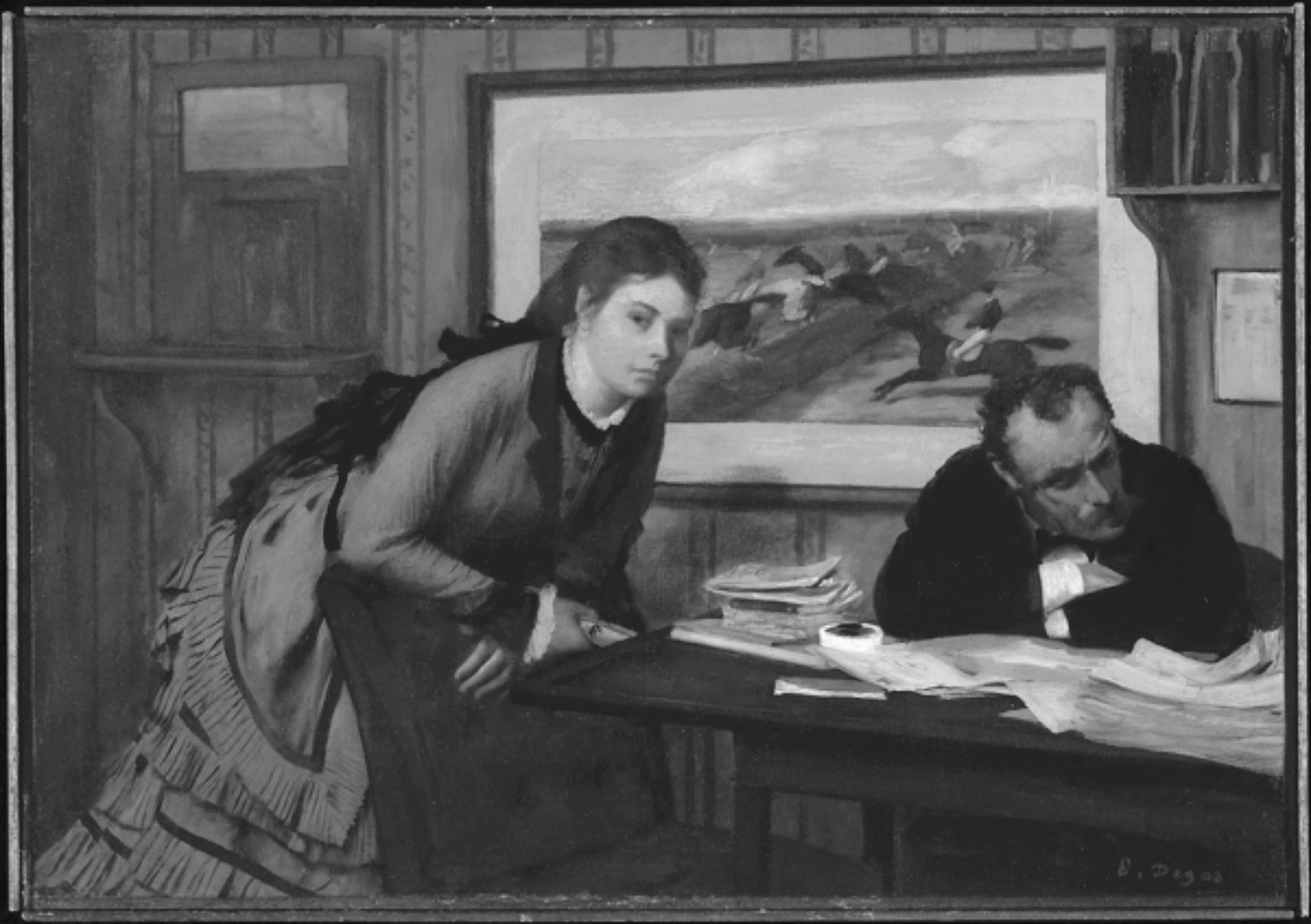
Visual thinking strategies: The first question, “What's going on in this picture?” starts the discussion broadly. The second question, “What do you see that makes you say that?” ensures that the learners ground their observations in evidence. The third question, “what more can we find?” encourages ongoing discussion and deeper looking. The teacher cycles through the last two questions, paraphrases responses, and links comments as connections arise. The session typically ends with some discussion about the experience and its connection to our work in HPM. HPM, hospice and palliative medicine. (Artwork by Edgar Degas ca. 1870, The Metropolitan Museum of Art, Open Access Collection.)
The Personal Responses Tour 15 allows learners to link works of art with personal experiences and allows the art to elicit meaning—such as personal joys and struggles—in a way that may otherwise be difficult in a group setting. A facilitator assigns prompts to each group member that are designed to achieve the educational goals of the session. For example, for a session focused on self-care, a prompt may read: “Find a work of art that speaks to a difficult emotion in your practice” or “Find a work of art that speaks to your life outside of medicine.” Learners explore the museum to discover a piece that aligns with their prompt. The group then reassembles and moves to each person's selected work, where the learner reads the prompt and explains why they chose the work of art. As with VTS, the exercise typically ends with a discussion about the experience and its implications for HPM clinical practice.
MBE in Palliative Medicine
MBE in palliative care has been less studied than in undergraduate medical education. One mixed-methods study used MBE to teach core concepts of palliative care to undergraduate medical students in Spain. 16 Students in this course developed an appreciation for complex decision making in palliative care and the need for individualized care plans. In addition, it led students to reconceptualize their relationships with patients and families and their role as physicians. Another study used art and museums to explore how personal experiences, communication, and tolerance for uncertainty shape interpretations of pain among a group of emergency medicine, internal medicine, and palliative care attending physicians, trainees, and advance practice providers. 17 Participants noted that the intervention helped them think about how their implicit biases, heuristics, and communication impact how they interpret another person's pain. These two studies highlight the potential MBE holds to build metacognitive skills among palliative care learners, but the impact of MBE on HPM fellows has not been studied.
MBE in Our HPM Fellowship Programs
Based on the evidence above and our experiences as learners and teachers, we have all initiated MBE curricula within our HPM fellowship programs (Table 1). We find that using MBE allows our trainees time and space to disconnect from the health care system, reflect on themselves and their relationship with others (e.g., colleagues and patients), and develop community. We find value in using art objects as highly effective “third things,” 18 or primary points of reference, that allow participants to safely reflect on sensitive and personal issues. By deeply looking at a complex and layered work of art, our learners discover, often with a sense of wonderment, connections between engaging with a complex piece of art and reading a family meeting or a patient's experience of total pain.
Characteristics of Museum-Based Education Initiatives in Four Hospice and Palliative Medicine Training Programs
HPM, hospice and palliative medicine; MBE, Museum-based education; VTS, visual thinking strategies.
Over the last five years, 104 trainees have participated in MBE courses among our four institutions. We have each developed partnerships with our local art museums and ensure our learners have protected time to participate in MBE experiences. Our curricula vary in structure and duration, but all use VTS and Personal Responses Tour as foundational exercises. Evaluations have been overwhelmingly positive. Representative quotes from our routine fellow evaluations highlight team building and appreciation of multiple perspectives: “I learned more about [the other fellows] in that short exercise than I had all year” and “[I] enjoyed viewing art through the lens of my co-fellows. It brought us closer and it offered this idea that we all see things a little or perhaps very differently.” Others noted how it helped with diagnostic skills: “It opened my eyes to the importance of detail” and helped with “avoidance of premature closure!” Some commented on reflective ability and well-being saying it provided “dedicated time for self-reflection in a way that didn't feel forced” and was valuable in providing “time to reflect and self-care.” It also helped with communication: “This session allowed me to begin to develop my expressive communication amongst a group of new people and learn a bit about the views and communication styles of those within my group.”
As HPM educators, we have seen strong parallels between the insights derived from using VTS or a personal responses tour in the museum setting and the nontechnical but core aspects of our work. How do we wholly engage with a patient or family (or painting) that we find challenging? How do we tolerate the uncertainty inherent in trying to make sense of a complicated medical situation (or complex collage) that is difficult to fully comprehend? How can we slow down to look at a patient (or sculpture) more deeply and intentionally? How do the perspectives of others alter how we think of a patient (or piece of art)? How can we use exercises with art as tools to make ourselves vulnerable to share our hopes, worries, and struggles with our team members? Our experiences in MBE suggest that these questions are all worthy of deeper inquiry.
It is important to acknowledge the spectrum of access to museum based resources. While our four institutions are fortunate to be located near easily accessible, well-resourced art museums, we imagine that institutions in other settings might effectively utilize smaller museums or collections of visual art. For those without geographic access, projecting images in spaces where trainees are protected from clinical duties and supported in reflection may be a creative alternative. Furthermore, use of other technology such as virtual reality 19 holds promise for providing immersive experiences to learners who cannot accommodate a trip to an art museum. Nonetheless, our experience suggests that being in the museum space is essential to creating the environment for deep reflection we seek; thus we highly encourage achieving a museum visit whenever possible.
Conclusion
MBE has a compelling and growing evidence base showing that it is a valuable educational pedagogy in medical education. From our experience of implementing MBE with our HPM fellows, we believe that MBE can be an effective strategy to develop nontechnical metacognitive clinician competencies of heightened perception, empathy, reflective practice, and resilience—all of which are critical in developing and maintaining a strong palliative care workforce. In this light, we also believe that MBE has the potential for application in interprofessional palliative care education to flatten hierarchy, support interdisciplinary collaboration and teamwork, and promote humanistic health care. Further research and investment on MBE is required in HPM to assess the impact on trainee/patient/team outcomes and identify specific pedagogical strategies and structures within MBE that are best suited for HPM programs, including “dosing” (i.e., number of required sessions), timing, faculty training, participant groupings, and spectrum of art works.
Footnotes
Acknowledgments
The authors thank the Harvard Macy Institute Art Museum-based Health Professions Education Fellowship for their mentorship and support of Drs. Wood and Zarrabi in their preparation of this article.
Funding Information
No funding was received for this work.
Author Disclosure Statement
No competing financial interests exist.