




Abstract

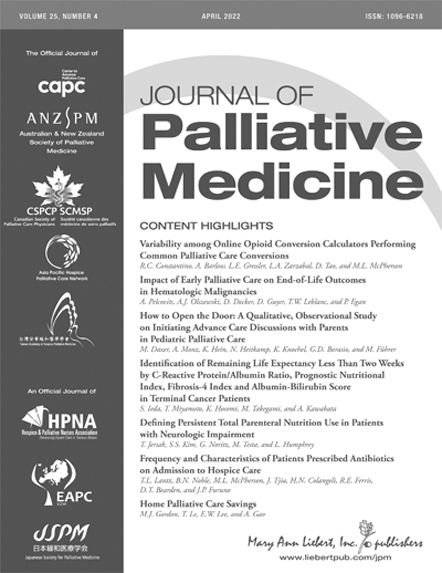
Letters to the Editor
Patients suffering from a neurodegenerative disease have the possibility to donate their organs after euthanasia in countries where physician-assisted death is legally allowed. However, numerous patients and health care professionals are not aware of this possibility. (page 527)
Brief Reports
People with life-limiting illnesses experience a range of distressing symptoms. Appetite-related symptoms are common, but studies have found varied prevalence, and the distress caused has limited quantification. (page 636)
Fast Facts and Concepts
End-of-Life Considerations for Muslim Patients #435 (page 678)
Just-in-Time Teaching in Palliative Care #436 (page 680)
Personal Reflection
How did that go so horribly wrong? We were supposed to be skilled in communication and compassion. The primary neurologist had turned to us to help navigate these advance care planning conversations with grace and tact. We ended with nothing. No therapeutic relationship. It was impossible not to feel incompetent. (page 682)
Case Discussions in Palliative Medicine
Switching from ketamine to methadone may be a beneficial strategy to manage intractable neuropathic cancer pain without decreasing activities of daily living. (page 686)
Book and Media Reviews
(page 693)
Variability in Opioid Conversion Calculators
Opioid conversion calculators are now commonly available online. This mirrors the variability among opioid conversion tools more broadly. In this convenience sample from among adult learners enrolled in an online masters degree program in palliative care, the majority held a “Negative Sentiment” toward these calculators after a structured activity requiring their use. Given the same information, clinicians can come to widely different opioid doses depending on how and which online calculators are used. The results illustrate why online opioid calculators should be avoided in favor of conventional approaches with manual calculations documented in the medical record. (page 549)
Early Palliative Care in Hematological Malignancies
Patients with hematological malignancies receive more disease-directed care at the end of life as compared with solid tumors. They die more often in the hospital. Although it has been advocated, the impact of early palliative care consultation has not been well described. In this single-institution study, a palliative care specialist was embedded in a malignant hematology team in the hospital. A retrospective review of patients with acute myeloid leukemia in the two years before (Cohort A) and after (Cohort B) was performed. Among 139 patients, there was no significant improvement in outcomes. (page 556)
Prognostication
The development of additional prognostication tools in patients with advanced cancer is needed. In this retrospective study, 483 patients who died had their C-reactive protein/albumin ratio, prognostic nutritional index, fibrosis-4 index, and albumin–bilirubin score evaluated. Of those potential indicators, three and four combinations provided significantly reliable estimation of a life expectancy less than two weeks. (page 570)
Persistent Total Parenteral Nutrition in Neurological Impairment
In this retrospective chart review of patients aged 0–38 years enrolled in the complex health care program, 208 patients were included. Of them, 26 patients had total parenteral nutrition initiated. Mortality rate was 14%. We propose further study of persistent total parenteral nutrition as a risk factor for mortality in patients with neurological impairment. (page 577)
Home Palliative Care
Among 506 people referred for home palliative care, a retrospective review was done comparing annual health care cost. Overall medical cost for 396 people showed a gross savings of $24,643 per person (17% decrease) as compared with those receiving usual care. For members enrolled for 1–5 months, annual gross savings were $23,314 per person (16% decrease). For people enrolled 6–12 months, annual gross savings were $26,409 per person (18% decrease).
In a separate study, 3533 people enrolled in home palliative care, key patient-centered outcome measures were obtained either by trained research staff or by patients or by proxies. There were significant differences between these groups. Research staff identified more issues than patients or proxies in a persistent manner over time. This has profound implications for program measurement design. (page 591)