




Abstract
Background:
Oral medications, intravenous medications, and invasive interventions are effective means of neuropathic pain control. In patients with pain refractory to more conventional approaches, cingulum bundle ablation is an alternative treatment modality not routinely considered by providers.
Case Description:
A 42-year-old woman with history of cervical cancer in remission presented with intractable left lower extremity pain. Workup revealed radiation-induced left iliopsoas osteosarcoma complicated by deep venous occlusion and thrombosis. Her pain remained intractable to pharmacologic therapies and more invasive pain control interventions. A multidisciplinary decision was made to pursue bilateral subcortical cingulum bundle radiofrequency ablation. After a technically successful surgery, the patient exhibited improved pain control as evidenced by a decline in her numerical rating scale of pain and analgesic medication requirements.
Conclusion:
Cancer-related neuropathic pain often requires treatment with multiple modalities involving multidisciplinary teams. In select refractory cases, cingulum bundle ablation may be an effective alternative treatment modality.
Introduction
Adequate pain control is a common concern shared by cancer patients and is intimately linked with their overall quality of life.1,2 Pain prevalence rates among individuals with advanced, metastatic, or terminal disease are cited as high as 66.4%. 3 Pharmacologic therapy remains the mainstay in the treatment of neuropathic cancer-related pain with well-established guidelines regarding administration and escalation.4–6 However, studies suggest that 20%–40% of cancer-related pain is not adequately controlled with pharmacotherapy alone. 4 In recent years, more invasive pain interventions such as intrathecal analgesia, nerve blocks, and spinal cord stimulation (SCS) have been utilized for additional pain relief in those patients where traditional pharmacotherapy alone has failed. 7 Even still, there remain a select few patients, often in the late stages of their disease process, whose pain remains refractory to both traditional pharmacotherapy and these more invasive pain interventions.
Historically, in these complicated cases, more invasive neurosurgical interventions have been pursued as alternative treatment options.8,9 Cingulotomy is one such intervention that has been used in the treatment of chronic refractory cancer-related pain.9–11 While its mechanism is not fully understood, the cingulate gyrus is involved in cognitive, motor, and pain processing with the anterior cingulate cortex playing a role in the descending modulation and perception of pain. A cingulotomy procedure cleaves fibers passing through the cingulate gyrus, which contribute to the affective component of pain perception.
Prior reports have indicated that patients with advanced disease and limited prognosis, diffuse pain syndromes, and elements of significant emotional distress, and who have failed to achieve sustained pain relief by best medical treatment or due to intolerable side effects may benefit most from cingulotomy.7,9,10,12 The permanent procedure carries risks, including transient post-operative confusion, bowel and bladder incontinence, seizures, hemorrhage, hemiparesis, ataxia, and decreased memory. Impairments in executive function, including apathy and decreased activity, appear to be more frequently reported in the literature, but still remain relatively rare. 10 Given the niche patient population for which this procedure's potential benefits outweigh its not insignificant risks, it is not surprising that limited data and evidence exist as to its use and efficacy.
As such, the use of cingulotomy as a treatment for late-stage and uncontrolled cancer pain refractory to other therapies remains a grade III-C level recommendation, indicating its use is neither recommended nor inadvisable based on current evidence. 7 In this study, we contribute to the existing body of evidence by describing a patient with cancer-related neuropathic and somatic pain refractory to pharmacotherapy and invasive neuromodulation techniques, who underwent palliative bilateral subcortical cingulum bundle radiofrequency ablation for her refractory cancer-related pain.
Case Description
A 42-year-old female (64.2 kg, 162.6 cm) with radiation-induced osteosarcoma of the left iliopsoas and remote history of large cell neuroendocrine cervical cancer was admitted for intractable left lower extremity pain. She was initially diagnosed with cervical cancer in 2012 and treated with chemotherapy, total abdominal hysterectomy/bilateral salpingo-oophorectomy, and intracavitary brachytherapy. She remained in remission until November 2020. At that time, she presented with lower extremity edema secondary to an iliopsoas muscle mass contributing to a lower extremity deep vein thrombosis and external iliac vein compression. Magnetic resonance imaging revealed an 11 × 5 cm left iliopsoas mass approximating the anterior acetabulum and inner table of the left iliac bone involving the iliac neurovascular bundle.
Biopsy of the mass revealed SATB2 positive extraosseous osteosarcoma, thought to be radiation induced. The patient was started on systemic anticoagulation and completed three cycles of doxorubicin plus zinecard. Despite multimodal pain control for her somatic and neuropathic pain, involving methadone, oxycodone, gabapentin, baclofen, and morphine, she continued to report left lower extremity pain and swelling. The decision was made for intrathecal pump placement with the administration of hydromorphone and bupivacaine for pain control with venous angioplasty for persistent swelling. Unfortunately, her venous angioplasty was aborted secondary to pain intolerance. She was subsequently discharged home.
Shortly thereafter, the patient was readmitted for uncontrolled left lower extremity pain. At this time, she was continued on intrathecal bupivacaine, transitioned from intrathecal hydromorphone to intrathecal morphine, placed on a morphine patient-controlled analgesia (PCA) pump, baclofen, and given home methadone, oxycodone, and gabapentin.
During her hospital course, analgesic medication doses were uptitrated and intrathecal bupivacaine dose settings titrated so that a peripheral nerve block could be achieved. Notably, duloxetine was not included in the patient's analgesic regimen, despite its known efficacy in the treatment of neuropathic pain.13,14 As the patient had long been stable on sertraline and olanzapine for her depression, it was deemed not appropriate to add an seratonin and norepinephrine reuptake inhibitor (SNRI) or wean her effective selective seratonin reuptake inhibitor (SSRI) during this time. Ketamine infusion was additionally trialed with some benefit, but was not deemed an appropriate long-term therapy secondary to inadequate pain control and inability to discharge with ketamine infusion. See Table 1 for a complete listing of analgesics used during hospitalization and the corresponding doses used on select dates.
Summary of Patient Analgesic Medication Use Throughout Hospitalization
Doses charted of intrathecal bupivacaine only reflect continuous dose. Patient additionally had as needed bolus dosing, which combined with continuous dosing would equal to a max of 14 mg per day. Unfortunately, patient's bolus bupivacaine use was not charted by nursing staff.
Total morphine milliequivalents calculated do not include IV or PO methadone.
Patient-controlled analgesia.
IV, intravenous; PCA, patient-controlled analgesia; PO, oral (per os); POD, post-operative day; PRN, as needed.
Despite these interventions and subsequent adjustments of her regimen, the patient continued to express concerns for significant diffuse pain and suffered side effects that limited the use of her pain modalities, most concerning was lethargy. The patient wanted her pain controlled, but more importantly, her goals were to be awake with family as much as possible and eventual discharge home. A multidisciplinary discussion was had with palliative care, neurosurgery, acute pain services, and the primary oncology team to discuss the patient's refractory pain. The decision was made to proceed with cingulotomy with the patient's and her family's agreement. Eight weeks after initial palliative care consultation, the patient underwent elective bilateral subcortical cingulum bundle radiofrequency ablation with neurosurgery.
At three days post-operation, her pain score was zero (Fig. 1) and she was weaned to oral and intrathecal morphine doses totaling 13 morphine milligram equivalents (MME) with decreased doses of gabapentin, intrathecal bupivacaine, and one dose of Tylenol as adjuncts. With her decreased opioid requirements, the patient was less sedated, liberated from her PCA, and able to interact with providers and family meaningfully, which achieved her presurgical goals of better quality of time with her family. Plans to discharge home with hospice were begun. Unfortunately, over the course of post-operative days four and five, the patient suffered an aspiration event in the setting of small bowel obstruction secondary to malignant stricture and transitioned to comfort care.
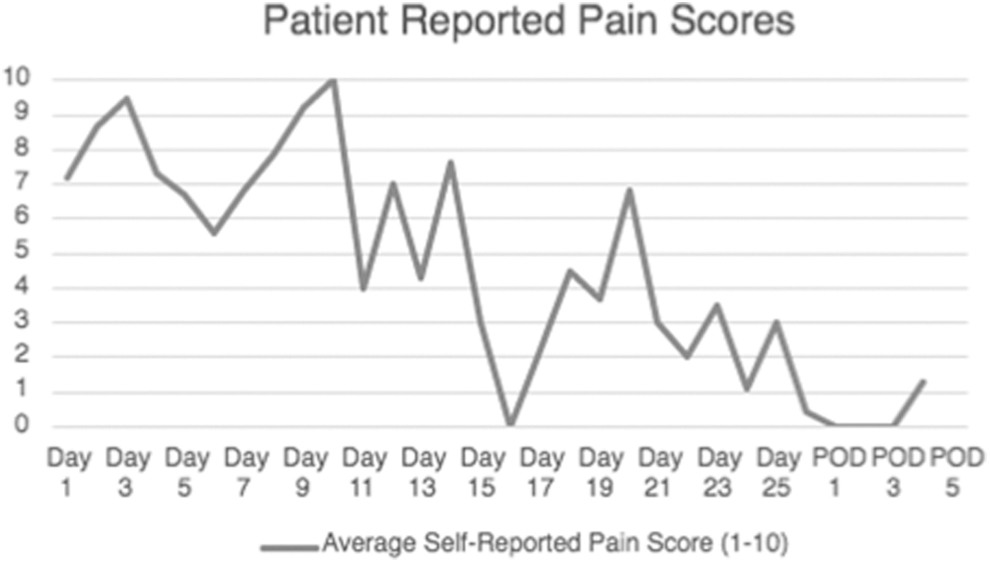
Average patient-reported pain score on pain numeric rating scale by day of hospitalization, in which 0 indicates no pain and 10 indicates the worst possible pain.
Discussion
While both this case report and the literature suggest the utility of cingulotomy in refractory neuropathic and somatic pain palliation,9–11 its indication and use should be considered within a broader context of other neuromodulatory pain interventions, as well as more invasive neurosurgical interventions. These interventions include, but are not limited to intrathecal analgesic infusions through implantable pumps, SCS, peripheral neural blockades, cordotomy, and myelotomy. Delivery of continuous analgesics into the epidural and intrathecal space through implantable and external pumps has proven beneficial in reducing cancer-related pain. Guidelines exist regarding analgesic choice and type for use in cancer-related pain.15–17 SCS attenuates pain signals by stimulating the dorsal columns with electrical impulses. Multiple case reports and retrospective reviews have shown it to be an effective treatment for cancer-related pain, reporting reduced analgesic use and pain relief in up to 76% of trial participants.18–26
Limited data suggest a possible benefit for nonmalignant pain with dual modality treatment comprising implanted intrathecal pumps and spinal cord stimulators.27,28 The interdisciplinary team opted not to pursue SCS in the case of our patient, given her existing intrathecal pump and little to no data regarding the efficacy and utilization of both modalities in cancer-related pain. Non-neurolytic peripheral nerve blockades are another intervention, whereby medications, including local anesthetics, are injected in the proximity of target nerves and disrupt pain signal transmission. While no RCT has been identified, several reports and studies illustrate the effectiveness of this intervention in palliating pain in those patients with intractable cancer-related pain. 29
Our patient's intrathecal bupivacaine doses were titrated such that a peripheral nerve blockade could be functionally achieved. Surgical cordotomy works through disruption of the spinothalamic tract and is considered in those patients with unilateral medically refractory cancer-associated nociceptive pain. Pain relief post-cordotomy is noted to have a finite duration and side effects include new deafferentation neuropathic pain, which can be as severe as initial pain in some reports.7,9,30 Myelotomy is another permanent neurosurgical intervention indicated for abdominal or pelvic visceral pain, which works to palliate pain by disruption of the dorsal column. The evidence for this intervention is grade III-C.7,9
In the case of our patient, her cancer-related pain was diffuse, somatic, neuropathic, and refractory to pharmacotherapy and more invasive interventions, including intrathecal analgesia and functional peripheral nerve blockade. This was either due to inadequacy of therapy or side effect profiles, which limited therapy escalation. This coupled with the patient's stated goals of remaining alert and interactive with loved ones, desire to discharge home, and significant pain burden, prompted consideration of more invasive palliative neurosurgical techniques. While a significant portion of her pain was localized to the left lower extremity (LLE) on initial presentation, she additionally experienced diffuse pain secondary to widespread metastasis involving her liver, mesentery, colon, and lungs.
The somatic, neuropathic, and bilateral nature of her pain, in addition to her significant emotional distress, led to the interdisciplinary decision to pursue cingulotomy over other more invasive neurosurgical interventions, as previously described. Post-operatively, the patient's pain was reduced, as evidenced by decrease in her numerical pain ratings (Fig. 1) and reduction in her overall analgesic usage (Table 1). In addition, the patient subjectively was more alert and interactive with family members and providers. Both patient and family members noted pain improvement to such a degree that they felt comfortable with initiating plans to pursue the patient's original goal of discharging home with hospice. Her aspiration event and subsequent decline on post-operative day 5 unfortunately prevented this.
A limitation of this report includes the inability to evaluate the long-term effects of cingulotomy on our patient's pain control, given her death shortly after the procedure. Prior studies, which have reviewed post-cingulotomy pain relief in cancer patients, have shown continued pain relief for the majority of patients (>50%) at 3-, 6-, and 12-month follow-up. 11 Nevertheless, our patient derived significant benefit from cingulotomy as it palliated her intractable cancer-related pain to an extent that she was comfortable discharging home with hospice and allowed her to be awake and without significant pain, while interacting with her loved ones before her death.
These benefits were of significant value to both the patient and her family, as evidenced by her mother stating the surgery was “worth it,” even with the knowledge of her impending death. An additional limitation of this report is the inability to delineate the effect of cingulotomy on the patient's performance status. While her decline and subsequent death occurred within a week of her operation, it is believed her aspiration event and decline were due to continued progression of her malignancy causing a colonic stricture and subsequent small bowel obstruction, as evidenced on imaging. However, it cannot be definitively stated that the patient's performance status was not affected by her operation. Another limitation includes variability in surgical technique and site/size of ablation, which may hinder reproducibility of cingulotomy results.
This case report contributes to the growing body of literature regarding palliative cingulotomy and serves to highlight and remind providers that cingulotomy remains a treatment option to consider for those patients with limited prognosis suffering from intractable diffuse somatic and neuropathic cancer-related pain refractory to more traditional pharmacotherapy and invasive techniques. Interdisciplinary collaboration is critical to ensure appropriate patient selection and effective use of cingulotomy as a pain palliation technique for intractable cancer-related pain.
Footnotes
Authors' Contributions
J.A.: data curation, writing—original draft, and writing—review and editing; G.G.: data curation, writing—original draft, and writing—review and editing; A.J.: data curation, writing—original draft, and writing—review and editing.
Funding Information
No funding was received for this article.
Author Disclosure Statement
The authors whose names are listed immediately above certify that they have no competing interests or affiliations with or involvement in any organization or entity with any financial interest (such as honoraria; educational grants; participation in speakers' bureaus; membership, consultancies, stock ownership, or other equity interest; and expert testimony or patent-licensing arrangements) in the subject matter discussed in this article.