




Abstract

Letter to the Editor
A brief analysis aimed to determine the extent to which patients’ electronic health record documentation captured their self-advocacy, defined as patients’ decision-making and communication regarding priorities and values. (page 427)
Brief Report
Hospice and palliative care teams created, implemented, and evaluated a 5-point scale to summarize the Preference for Acute Rehospitalization (PAR Scale) for children on concurrent care hospice. After three months, users were surveyed about the PAR Scale. (page 499)
Fast Facts
Management of Behavioral Disturbances in Dementia: Part 1 Non-Pharmacologic—#498 (page 549)
Management of Behavioral Disturbances in Dementia: Part 2 Pharmacologic—#499 (page 552)
Personal Reflection
“The operation went well,” I was told, over mutterings of geriatric consults, CAM scores, and lack of rehabilitation potential, phrases I stored greedily to Google later.
But when her eyes would groggily open, she rarely recognized me. Nor I her. (page 556)
Case Discussions
In this report, we discuss the case of a patient with end-of-life distress secondary to stage 4 astrocytoma who received psilocybin-assisted therapy (PAT) through Health Canada’s Special Access Program. The patient had a positive response to PAT without adverse events. (page 557)
Book and Media
(page 560)
Original Article Key Points
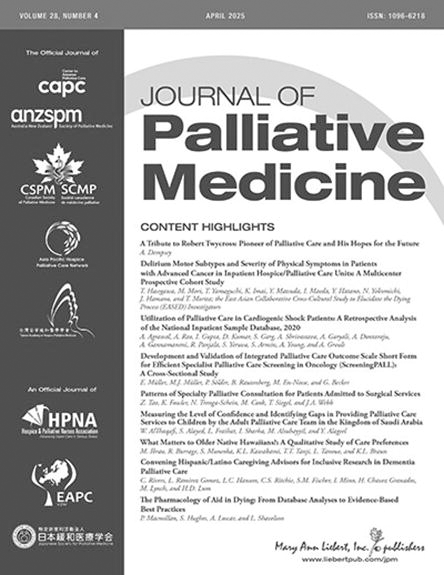
This article is the first to analyze various medical aid-in-dying medication protocols. One sedative/cardiotoxin protocol produced acceptable time to death for patients receiving medical aid-in-dying care. Developing an evidence-based paradigm for the practice of medical-aid-in-dying is paramount to good patient care. (page 492)
Pain and dyspnea were more severe in patients with hyperactive delirium than in those without delirium. The presence of hypoactive delirium was not associated with a greater severity of physical symptoms. Screening patients with terminal cancer and severe pain or dyspnea intensity for delirium, including the delirium motor subtype, is necessary. (page 437)
We queried a large national database to assess the utilization of palliative care in patients with cardiogenic shock to assess the extent and patterns of palliative care consultation across sociodemographic groups and comorbidities in the United States. Even in this era, the rates of palliative care involvement remain low and we aim to encourage higher palliative care utilization in cardiogenic shock patients. (page 446)
Using participatory methods to partner with caregivers with lived experience, we describe how involvement of Hispanic/Latino dementia caregivers in the cultural adaptation process is critical to supporting the design and conduct of inclusive dementia palliative care research. (page 484)
The use of patient-reported outcome measures as screening tools for the need for specialist palliative care in oncology could facilitate broad-based screening. Our results show that an IPOS short form with only six items can identify nine out of 10 patients in need of specialist palliative care. (page 453)
Adult palliative care physicians in Saudi Arabia demonstrate a strong desire to provide pediatric palliative care but face significant training gaps, especially age-specific skills. Addressing these deficiencies through targeted educational programs, resources, and support from a specialized pediatric palliative care team is crucial to empower physicians, ensuring they can deliver compassionate and effective care to terminally ill children in need. (page 466)
This study examines the impact of specialty palliative consultation on patients admitted to surgical services at a tertiary academic center. The study findings highlight that specialty palliative consultation does not preclude the pursuit of surgery, nor does it necessitate transition to comfort-focused care for surgical patients. (page 461)