




Abstract

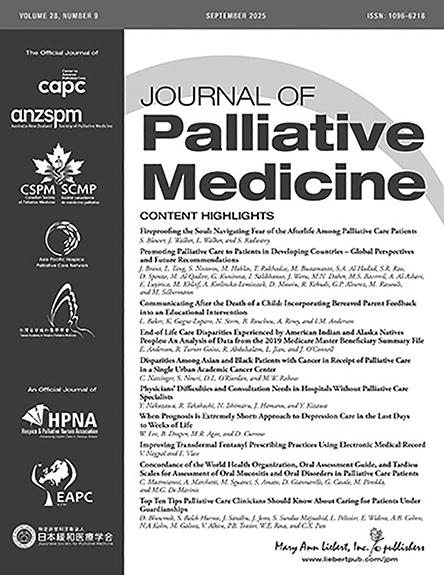
Letter to the Editor
While productivity metrics are necessary for financial sustainability, advanced practice providers play a multifaceted role in palliative care. Expectations should balance encounter volume with essential nonbillable functions that foster high-quality care. Academic institutions must refine productivity measurement to ensure palliative care teams remain both financially viable and clinically effective. (page 1139)
Brief Reports
Authors explore the benefits and burdens of vaporized medicinal cannabis flower bud for anorexia from the perspectives of trial participants with advanced cancer and their carers. (page 1246)
Fast Facts
The Dual Framework: Understanding Psychological Processes in Patients Facing Serious Illness #508. (page 1274)
Integrating Therapeutic Silence in Serious Illness Communication #509. (page 1276)
Personal Reflection
Adult patients taught me how to live, and pediatric patients, most of the time through the loving decisions of their parents, taught me how to die. I learned that death brings focus to the people, objects, and experiences we value the most. (page 1279)
Case Discussions
Case in which a patient was erroneously identified as a registered sex offender, including the communication errors that stalled clarification of this misinformation, hindered eligibility for placement at appropriate care facilities, and ultimately delayed a timely hospital discharge. (page 1283)
Book and Media
(page 1287)
Original Article Key Points
Palliative care is expanding globally in many developing countries, and success is highly dependent upon country-specific palliative care champions who are instrumental in creating change. Developing countries can use this report to benchmark progress and to engage in conversation with Ministries of Health to improve palliative care services. (page 1155)
This is a retrospective study of racial–ethnic disparities in receipt of palliative care for outpatients with cancer. Compared with White patients, Asian patients had higher odds of palliative care receipt and less time from referral to death; Black patients had higher odds of referral to palliative care for pain. (page 1193)
This study found that 9.5% of patients in palliative care units were physically restrained, with benzodiazepines and nasogastric tubes as notable risk factors, particularly among female cancer patients. It underscores the need for health care professionals to critically assess the use of these interventions to enhance the quality of end-of-life care. (page 1175)
Bereaved parent volunteers have valuable insights for trainees learning to communicate with grieving families. Yet their perspectives are often missing from educational interventions. We elicited and analyzed feedback from bereaved parent volunteers on the well-established GRIEV_ING framework for death notification. (page 1170)
Using a large sample of Medicare beneficiaries, we found that American Indian/Alaska Native adults spend more days in the hospital and fewer days in hospice at the end-of-life than their Non-hispanic white counterparts, and chronic conditions were associated with increased hospice use. (page 1185)
This study demonstrates the feasibility and acceptability of the supportive care digital application “THRIVE” for patients with advanced nonsmall cell lung cancer, warranting follow-up efficacy testing of THRIVE for improving patients’ Quality of Life, physical symptoms, and other psychosocial outcomes. (page 1210)
An interdisciplinary workshop integrating psychotherapeutic concepts into serious illness communication delivered at multiple sites significantly improved palliative care clinicians’ knowledge, confidence, and application of formulation and countertransference. This scalable model enhances therapeutic communication, supports clinician sustainability, and addresses a critical gap in mental health training across palliative care disciplines. (page 1202)
Physicians in nonspecialist hospitals reported greater difficulties alleviating symptoms, especially those treating fewer cancer patients annually. High consultation needs were identified for unfamiliar medications and medication choice tips, with hospitals with a lower number of cancer deaths showing a greater need for guidance on nerve block and radiation therapy eligibility. (page 1220)