




Abstract
This article provides a geographically inclusive empirical framework for studying changing U.S. patterns of Hispanic segregation. Whether Hispanics have joined the American mainstream depends in part on whether they translate upward mobility into residence patterns that mirror the rest of the nation. Based on block and place data from the 1990–2010 decennial censuses, our results provide evidence of increasing spatial assimilation among Hispanics, both nationally and in new immigrant destinations. Segregation from whites declined across the urban size-of-place hierarchy and in new destinations. Hispanics are also less segregated from whites than from blacks, but declines in Hispanic-black segregation have exceeded declines in Hispanic-white segregation. This result is consistent with the notion of U.S. Hispanics as a racialized population—one in which members sometimes lack the freedom to join whites in better communities. Hispanic income was significantly associated with less segregation from whites, but income inequality alone does not explain overall Hispanic segregation, which remains high. The segmented assimilation of Hispanics that we observe supports two seemingly contradictory theories: both the idea that spatial assimilation can come from economic and cultural assimilation and the notion that economic mobility is no guarantee of residential integration.
Keywords
The recent Hispanic diaspora—the movement from immigrant gateways to new destinations—has raised concerns about patterns of racial and ethnic change and residential segregation in America’s cities and communities (Johnson and Lichter 2010; Lee, Iceland, and Farrell 2014; Tienda and Fuentes 2014). Estimates of neighborhood segregation from the 2010 census indicate that Hispanic-white segregation is at a standstill or even increasing in some cities (Logan and Stults 2011; Rugh and Massey 2014); metropolitan segregation levels, as measured by the index of dissimilarity, have been fixed at moderately high levels for at least 30 years—at roughly 50. 1 Some of the most heavily populated and segregated Hispanic metropolitan areas also have experienced increasing segregation. For example, the Los Angeles metropolitan area has experienced increases in Hispanic segregation every decade since 1980, rising from 57.3 in 1980 to 63.4 in 2010 (Logan and Stults 2011). In metropolitan areas, the typical Hispanic person today lives in a neighborhood that is 46 percent Hispanic, 35 percent white, and 11 percent black. Mapping changing patterns of Hispanic residential segregation at other spatial scales, however, has been surprisingly limited (Fossett et al. 2014; Lee, Iceland, and Farrell 2014; Parisi, Lichter, and Taquino 2011, 2015), even as America’s Hispanic population has become more spatially dispersed. Hispanics have increasingly bypassed traditional gateway states and cities, moving down the urban hierarchy into smaller metropolitan cities, suburbs, and rural communities.
Our fundamental goal here is to provide a geographically inclusive analytic framework for studying racial residential segregation, one that acknowledges that metropolitan (metro) and nonmetropolitan (nonmetro) areas represent systems of places—cities, suburbs, and small towns—that shape the ethnic and racial profile of neighborhoods. As Hispanics become “racialized” (Rumbaut 2009), cultural and economic boundaries and social distance from other racial groups will likely be revealed in shifting patterns of residential segregation. Tienda and Fuentes (2014, 500) now claim that a burgeoning and diverse Hispanic population has “reconfigured the ethnic and geographic landscape” of the United States. Indeed, much of the Hispanic growth has occurred in new immigrant destinations, including suburban and rural “boomtowns” (Lichter 2012; Massey 2008). Hispanics will redefine America’s shifting racial and ethnic boundaries and residence patterns over the foreseeable future.
This article builds on previous empirical studies of racial and ethnic segregation by providing up-to-date national estimates of Hispanic residential segregation in 2010, along with comparative estimates for 1990 and 2000 (Iceland, Weinberg, and Hughes 2014; Logan and Stults 2011). Our analyses are inclusive of metro central cities, suburban communities, and nonmetro small towns. Second, we highlight recent patterns of Hispanic segregation from both whites and African Americans. Rapid Hispanic population growth makes the usual black-white paradigm of racial and ethnic relations seem increasingly outmoded in today’s multicultural, multiracial society (Waters, Kasinitz, and Asad 2014). Third, we update recent estimates of Hispanic segregation in so-called new destinations. We evaluate whether the recent movement from traditional urban gateways to new Hispanic destinations has upended conventional theoretical interpretations of immigrant integration and cultural and economic incorporation (also see Flippen and Kim, this volume). Fourth, our analytical approach explicitly recognizes that segregation occurs at different geographic scales (Lee et al. 2008; Reardon et al. 2008), i.e., neighborhoods are nested within places, which in turn are located within metro (and nonmetro) areas (Lichter, Parisi, and Taquino 2012; Parisi, Lichter, and Taquino 2011). Here we estimate hierarchical linear models to examine the extent to which place-to-place differences in segregation account for the overall differences in Hispanic neighborhoods in metro (nonmetro) areas.
Recent settlement patterns raise an obvious question: Are America’s Hispanics “moving toward” whites or blacks, as measured by conventional segregation indices (i.e., an indirect indicator of social distance)? For Hispanics, has integration been achieved by distancing themselves from blacks? Are Hispanics “whitening,” as indicated by shifts in segregation along the black-white continuum of spatial exclusion? Or, instead, are (some) Hispanics being “racialized,” i.e., integrating spatially with America’s historically disadvantaged black population?
Spatial Assimilation: Hispanic Segregation in the New Century
Recent studies of Hispanic segregation have been framed largely by dueling theoretical perspectives that emphasize either spatial assimilation or place stratification (Iceland and Nelson 2008; Kim and White 2010). Spatial assimilation theory argues that spatial integration is a product of increasing cultural and economic integration. That is, segregation of immigrants from the majority population declines with upward social and economic mobility. U.S. immigrants typically first settle in gateway communities (e.g., enclaves where cultural and institutional support is ensured) but “move up and out” over time or across generations as they learn English, acquire new job skills, and become “Americanized.” Spatial mobility reflects and reinforces socioeconomic mobility among America’s new immigrant populations, including Hispanics from Mexico and other Latin American countries. That family income among Hispanics is positively associated with neighborhood quality gives empirical credence to the spatial assimilation model (Alba et al. 2014).
Indeed, Iceland and Scopilliti (2008), using restricted U.S. census data for metro areas, found that native-born Hispanics (D = 48.1) were less segregated than foreign-born Hispanics (59.9) from native-born whites in 2000. Native/foreign-born differences in segregation disappeared when sociodemographic characteristics of Hispanics (e.g., household income) and metro characteristics were controlled in the multivariate analysis. Although these results are consistent with spatial assimilation theory, native-born Hispanics have remained highly segregated from native-born whites because they have not been fully incorporated into American society on many important dimensions, such as education, income, and English language usage. Among the foreign-born population, Hispanic segregation declined only modestly with length of time in the country (Iceland and Scopilliti 2008; Iceland and Nelson 2008). In new immigrant destinations, Hispanic segregation also is often higher than in established gateways (Hall 2013; Lichter et al. 2010; Fossett et al. 2014; but see Park and Iceland 2011). This pattern seemingly reflects low-wage, low-skill Hispanic immigrants increasingly bypassing traditional gateways for new destinations (Lichter and Johnson 2009). Traditionally, spatial and social mobility went hand in hand. Today, however, the historical link between social and spatial assimilation is perhaps less easily established, especially in smaller cities, suburban communities, and rural places that represent sites of first settlement for Hispanics.
The widespread spatial dispersion of Hispanics seemingly suggests greater spatial integration with the native population (Massey, Rothwell, and Domina 2009), but the continuing concentration and neighborhood segregation of Hispanics in new destination communities also suggest something less benign. At a minimum, new patterns of Hispanic population redistribution call into question the inevitability of spatial assimilation and suggest that Hispanic origin is becoming a racial marker that is reflected in persistent segregation from whites (Tienda and Fuentes 2014). This view is probably accommodated best by the place stratification perspective. This conceptual framework has many variations, but the essential point is that upward social and economic mobility, which often accompanies assimilation, is no guarantee of spatial integration with the majority population. The racialization of Hispanics, in particular, means that they sometimes lack the freedom of movement to join whites in better communities or neighborhoods, where job opportunities, quality schooling, and safety may be more abundant (Alba et al. 2014). Hispanics instead are often locked in place by low incomes and housing discrimination (Iceland and Scopilliti 2008); segregation from whites persists but perhaps is observed in a different spatial form (e.g., in new immigrant enclaves and destinations) from the past (Lee, Iceland, and Farrell 2014; Lichter 2013).
Persistent Hispanic segregation also is reinforced by a new “political economy of place,” one in which local communities mobilize politically to exclude racial and immigrant minorities. Exclusionary zoning is on the upswing, and discriminatory or exploitive lending practices prey disproportionately on historically disadvantaged populations (Rothwell and Massey 2009; Rugh and Massey 2010). At the same time, places with rapidly growing immigrant populations, including some new immigrant destinations, face the prospect of “white flight” (Crowder, Hall, and Tolnay 2011), which may contribute to a new kind of segregation in which entire communities (rather than just neighborhoods) shift from majority white to majority minority. Under the circumstances, it is perhaps unsurprising that past declines in Hispanic-white segregation have slowed or even reversed. A spatially inclusive approach—one that fully recognizes that Hispanic segregation might occur simultaneously at different scales of geography—may yield complementary insights and new conclusions that build on a large metro-centric empirical literature on residential segregation.
Although the spatial assimilation and place stratification perspectives are sometimes represented in the literature as competitors, they might better be viewed as complementary conceptual and analytical frameworks. It is an empirical fact that some Hispanic subgroups are becoming more residentially integrated over time with whites; racial boundaries of all kinds are being “crossed” with Hispanic gains in education, upward socioeconomic mobility, and more intermarriage. Other Hispanic populations—those distinguished by national origin (e.g., Mexicans versus others), phenotype (e.g., skin color or stature), or legal status—may be self-segregating or may face discrimination or other barriers that prevent them from relocating into white neighborhoods (Iceland, Weinberg, and Hughes 2014). A recent study by Hall and Stringfield (2014), for example, found that local metro shares of undocumented immigrants were associated with more neighborhood segregation from whites and less segregation from blacks. One interpretation is that some economically and culturally disadvantaged Hispanic groups are assimilating into a black underclass, sealed away in neighborhoods and places that provide few opportunities for upward mobility. Iceland and Nelson (2008) also found that foreign-born black Hispanics (mostly from the West Indies) were far more likely than foreign-born white Hispanics to be segregated from whites (D = 79 vs. 58 in 2000). Hispanic assimilation, if measured by residential segregation patterns, is highly segmented.
Current Study
Our article makes several specific contributions to the literature on Hispanic settlement patterns. First, we provide an up-to-date and geographically inclusive empirical approach (using block and place data from the 2010 and earlier decennial censuses) that acknowledges the new geographic dispersal of Hispanics over the past 20 years. We document emerging patterns of segregation in cities, suburban areas, and small towns, and, using hierarchical linear modeling (HLM), the extent to which demographic and economic differences between places contribute to the overall differences in residential segregation across metro (nonmetro) areas.
Second, we document residential segregation of Hispanics from both whites and blacks. Although roughly 50 percent of Hispanics self-identify as white, the percentages of Hispanics reporting as such vary widely over geographic space (Rumbaut 2009). This suggests that racial identification—and its implications for Hispanic-white segregation—are situational or contextual. Hispanics in the South, for example, are far more likely to identify as nonwhite than they are in other parts of the country. Increasingly, Hispanicity is a racial marker that is both imposed and internalized, which will be reflected in changing patterns of Hispanic-white and Hispanic-black segregation.
Third, we provide a baseline assessment of trends in Hispanic residential segregation and update several previous studies of segregation in new Hispanic destinations (Hall 2013; Lichter et al. 2010) based on 2000 or earlier data. Rather than being viewed as an indicator of growing social and economic integration, the emergence of new destinations for Hispanics may represent a new kind of racial and spatial balkanization in America. Neighborhood segregation may be giving way to new forms of segregation, where place-oriented social, economic, and political processes have become ascendant in the new century (Lichter, Parisi, Taquino 2015).
Methods
Data and measurement
Most previous studies of segregation use metro areas, central (principal) cities, or urbanized areas as units of analyses. They typically emphasize changing patterns of segregation across metro neighborhoods, as proxied by census tracts; the entire metro area is treated as a single housing or labor market that sorts different population groups into different neighborhoods in the metro region. The new “political economy of place” suggests, however, that communities rather than neighborhoods also represent important but often unrecognized actors that include or exclude desirable and undesirable population groups. Indeed, Farrell (2008, 467) claims that “[u]rban and suburban municipalities are replacing neighborhoods as the central organizing units of metro segregation.” As organized collective actors, places can include or exclude specific populations while either promoting or discouraging ethnoracial diversity and intergroup relations.
Racial segregation across neighborhoods may therefore start first with the sorting of individuals across cities and communities, which are perceived by movers as possible residential destinations or not (Krysan and Bader 2009; Sharkey 2012). For the purposes of our study, we use places as defined by the U.S. Census Bureau in 1990, 2000, and 2010. Places include all incorporated cities, towns, and villages, as well as unincorporated communities and housing developments (called “census designated places” by the Census Bureau) that lack municipal governments. Places are located both in metro and nonmetro areas, which are defined using a fixed 2013 definition throughout the 1990–2010 period of study.
For our analysis, we focus on all places with at least 200 Hispanics residents in 1990, 2000, or 2010. We identified 6,806 cities, suburbs, and rural communities. In 2010, these places were home to 83.3 percent of the U.S. Hispanic population. Of these places, 5.4 percent were classified as metro central cities, 72.3 percent suburban cities and communities, and 22.3 percent as nonmetro small towns. Our selection criterion—one based on population size—reflects a floating definition from decade to decade. This means that changes in Hispanic segregation levels may reflect changes in the universe of places that meet our selection criterion. Our approach nevertheless arguably represents the reality of changing Hispanic segregation in America over a period of widespread growth and dispersion in the Hispanic population. Eliminating “new places” or destinations (i.e., those places now meeting but previously failing to meet the 200-person criterion) obviously would misrepresent a major dimension of changing Hispanic segregation in America.
We also classified some places as new Hispanic destinations. These are places with comparatively small Hispanic populations initially but that subsequently experienced unusually rapid Hispanic growth (Lichter et al. 2010). Identifying new destinations involved three specific steps. First, as a baseline, we selected all places in 1990 with Hispanic percentages of less than the U.S. Hispanic percentage in 1990 (9 percent). Second, from these places, we identified those that grew by at least 200 Hispanics between 1990 and 2000 or 2000 and 2010, which served to eliminate fast-growing places that added only a small number of Hispanics. Third, new destinations—those with exceptional Hispanic growth—were defined as places with rates exceeding the average Hispanic growth rate by at least one standard deviation. These thresholds were set separately for metro central cities, suburban areas, and nonmetro places. Our measurement approach yielded a total of 446 new destinations. Of these, 257 were classified as new destinations during the 1990s, and an additional 189 places were defined as new destinations for the 2000s. More than 11 percent of new destinations were central cities, 67.5 percent were suburban places, and the remaining 21.1 percent were nonmetro places.
We use blocks rather than census tracts (neighborhoods) as accounting units to calculate Hispanic segregation (e.g., Lee et al. 2008; Lichter, Parisi, and Taquino 2012; Parisi, Lichter, and Taquino 2015). Blocks are ideal for multiscale analyses of place-to-place differences in residential segregation in metro and nonmetro areas. For small towns and many suburban places, census tracts are often too large to effectively measure the changing distribution of Hispanics from other populations. Some small suburban or rural towns also may be represented by only one or two census tracts, which sometimes do not represent legal boundaries. Blocks can be uniquely nested within place boundaries and provide the spatial granularity needed to measure the within-place spatial distribution of different racial and ethnic groups. Blocks, however, should not be viewed as neighborhoods, nor can segregation within small towns—especially rural communities—be treated as conceptually similar to segregation in big cities. In rural communities, highly segregated populations may nevertheless share the same streets and sidewalks, shopping centers, local public schools, and playgrounds and parks.
We measure place segregation using the index of dissimilarity (D). Dt is defined as

where hit and wit are the respective percentages of the Hispanic population and whites residing in census block i at time t. This index is based on pair-wise comparisons and varies from 0 (no segregation) to 100 (complete segregation). D indicates the percentage of Hispanics that would have to move to other city or community blocks to achieve parity between Hispanics and whites in their percentage distributions across all blocks.
Analytical strategy
The analysis begins with a simple description of levels and trends in Hispanic segregation between 1990 and 2010 for the total United States and, separately, for central cities, suburbs, and nonmetro places. We then estimate multilevel models of Hispanic segregation in 2010 to examine (1) the extent to which place characteristics influence neighborhood segregation and (2) the extent to which place-to-place differences account for overall metro (nonmetro) segregation. Specifically, we estimate models in which place coefficients are allowed to vary by metro and nometro areas (i.e., varying intercept model). The former are typically but not exclusively composed of multiple metro counties, and the latter are distinguished either as micropolitan areas, which may include one or more nonmetro counties, or as noncore counties. We also estimate the intraclass correlation coefficient (ICC) to highlight the contribution of metro-to-metro and place-to-place differences to the overall differences in neighborhood segregation. Finally, for the same time period, we examine the level and trends of Hispanic segregation in “new” Hispanic destinations and similarly model the within- and between-place components of segregation using HLM with 2010 data.
Results
Hispanic segregation patterns, 1990–2010
Hispanic segregation from the rest of America
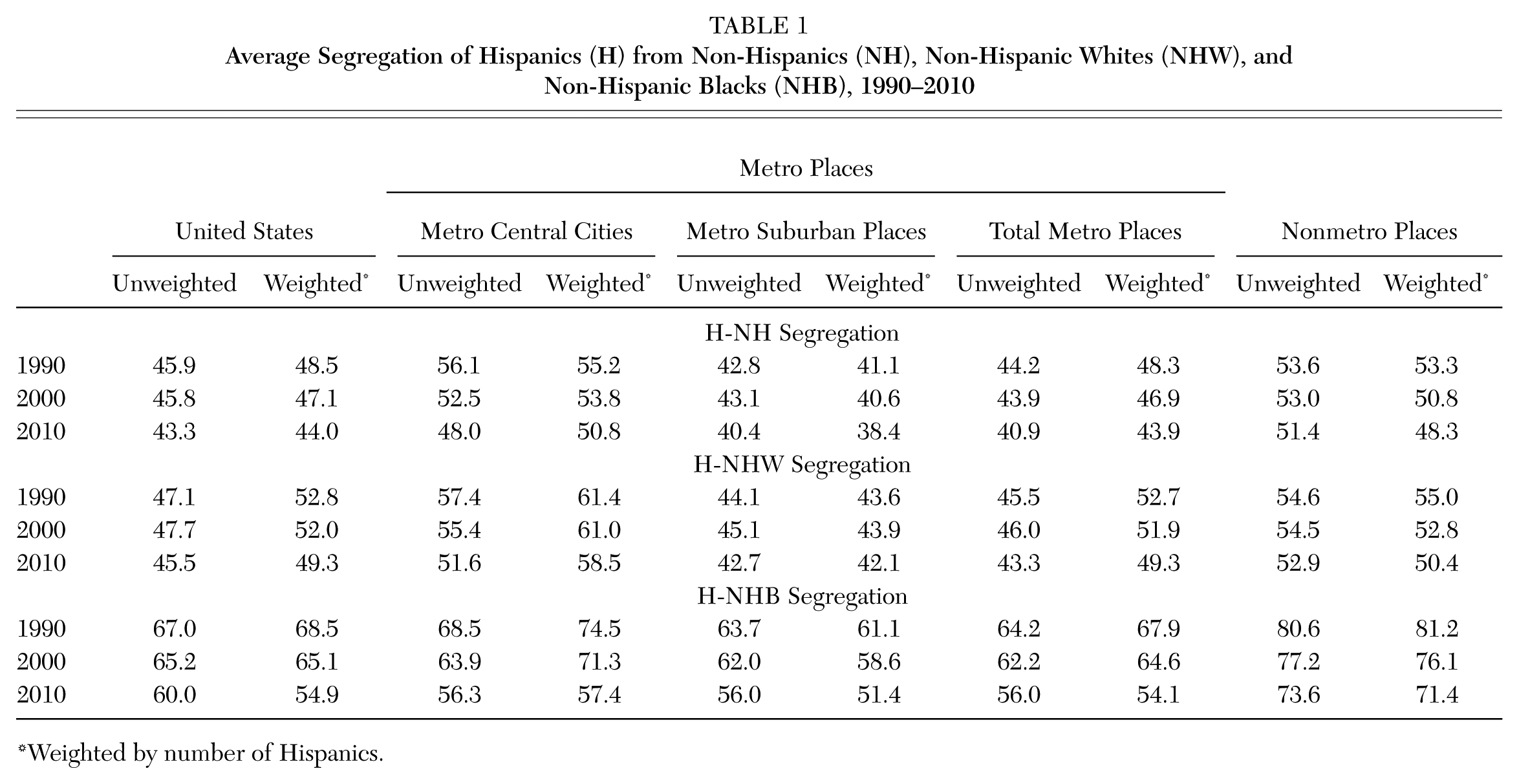
Table 1 (top panel) provides unweighted and weighted segregation indices between Hispanics and non-Hispanics during 1990–2010. Weights are based on the relative size of the Hispanic population, i.e., we give greater weight to places with larger Hispanic populations. The weighted value indicates the level of segregation experienced by the average Hispanic person rather than the average segregation of places (based on the unweighted D).
Average Segregation of Hispanics (H) from Non-Hispanics (NH), Non-Hispanic Whites (NHW), and Non-Hispanic Blacks (NHB), 1990–2010
Weighted by number of Hispanics.
These initial benchmark estimates indicate the level of residential segregation of Hispanics from the “rest of America”; as such, D indicates the broad spatial integration of Hispanics in American society. These data provide several specific insights. For starters, Hispanic/non-Hispanic segregation in America’s cities and communities is moderately high nationally (first column), indicating the slow spatial integration of Hispanics with the rest of American society. Between 1990 and 2010, Hispanic/non-Hispanic segregation—those weighted by the Hispanic population—nevertheless declined from 48.5 to 44.0, roughly a 10 percent decrease. Similar but smaller declines in segregation were observed using the unweighted Ds (i.e., average decline from 45.9 to 43.3 over the 20-year period). Such declines are consistent with spatial assimilation theory (Iceland and Scopilliti 2008), but these results are perhaps surprising in light of the fact that much of recent Hispanic population growth is due to immigration (and the second-order effects of high rates of natural decrease; Johnson and Lichter 2008). Immigrants are typically more segregated than the native born (Hall and Stringfield 2014; Iceland and Scopilliti 2008).
Declines in Hispanic/non-Hispanic segregation also were observed across the urban-rural continuum (Table 1). Our estimates clearly show that segregation is not strictly a metro or big-city phenomenon. In fact, overall segregation among nonmetro Hispanics was 48.3 in 2010, compared with 43.9 in metro areas overall and 50.8 in central cities. Hispanic/non-Hispanic segregation has been decidedly lower in suburban communities (e.g., 38.4 in 2010) than elsewhere, but recent declines in Hispanic segregation have also been more modest in suburban areas over the past two decades. For Hispanics, suburbanization clearly is associated with spatial integration.
Hispanic segregation from whites and blacks
Overall segregation of the Hispanic population from the non-Hispanic population reflects reinforcing and offsetting patterns and shifts in segregation from both whites and blacks. The bottom two panels of Table 1 provide parallel estimates of Hispanic-white and Hispanic-black segregation since 1990. We address the question of whether Hispanics are more segregated from blacks or from whites, and whether increases or decreases in segregation over time suggest more spatial assimilation with whites or blacks. 2
These analyses reveal several conclusions. For example, the Ds indicate high but declining Hispanic-white segregation, on average, for all places (that met our selection criteria). The overall Hispanic-white D was 49.3 for all places in 2010, a slight decline from 52.8 in 1990. (These patterns are similar when D is weighted by the white population.) In comparison, the Hispanic-black D was higher in 2010 than the Hispanic-white D (55.0 vs. 49.3), but the former has experienced significantly larger declines since 1990. Hispanic-black segregation declined by 20 percent between 1990 and 2010, from 68.5 to 55.0; while Hispanic-white segregation declined by roughly 10 percent over the same period. Spatial integration of Hispanics into American society is occurring much more slowly with whites than with blacks. Although Hispanics are still more spatially integrated with whites than with blacks, current trends suggest that this may not be true in the future.
These recent declines in Hispanic-white and Hispanic-black segregation are also broadly observed across the urban hierarchy. That is, declines in D have occurred in metro central cities and suburbs and in nonmetro communities. Still, large spatial differences in the segregation of Hispanics from whites and blacks persist across different types of places. For example, these data reveal large city-suburb differences in Hispanic-white segregation but not in Hispanic-black segregation. In cities, Hispanics are segregated at similarly high levels from whites and blacks (Ds are 58.5 and 57.4, respectively). The big differences in segregation are in the suburbs of metro areas, where Hispanics are more segregated from blacks than from whites but where segregation from blacks has declined most rapidly since 1990 (from 61.1 to 51.4 between 1990 and 2010). Hispanic segregation from whites is lower in the suburbs, with Ds fixed over time in the low 40s. Declines in Hispanic-black segregation are now being reinforced by the growing racial diversity in (at least some of) America’s suburbs.
In nonmetro communities, Hispanic-black segregation is very high (over 70) but has also declined very rapidly since 1990; indeed, Hispanic-black declines have been much more rapid than Hispanic-white segregation declines. The main point is clear: Everywhere, Hispanics are assimilating more rapidly with blacks than with whites, a trend that is likely to manifest itself in lower Hispanic-black than Hispanic-white segregation in the future. Still, over the foreseeable future, Hispanics are almost certain to remain highly segregated from other U.S. racial and ethnic groups, including both whites and blacks. Our results clearly show that Hispanics are highly segregated spatially.
Multilevel models of Hispanic segregation, 2010
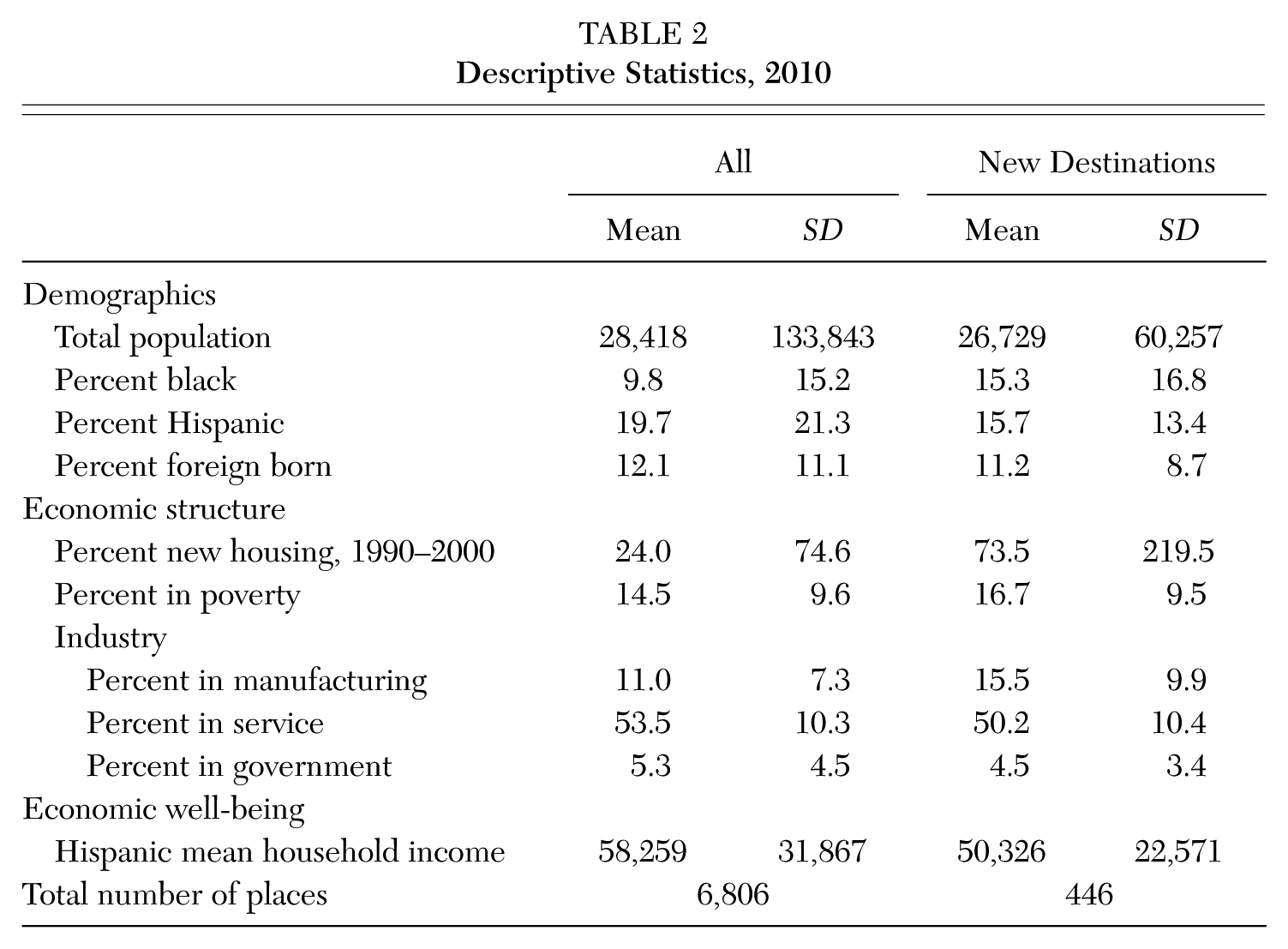
Our descriptive analyses of recent trends in Hispanic segregation raises an obvious question: What accounts for the current high levels of neighborhood residential segregation between Hispanics and both whites and blacks? Here, we fit multilevel models of Hispanic segregation nationally but restrict our analyses to the 2010 period. These analyses link our place-based segregation estimates drawn from the 100 percent count of the 2010 decennial census with the 2008–2012 American Community Survey. Variable definitions and descriptive statistics, which are identified from previous studies (e.g., Iceland 2004; Lichter et al. 2010), are reported for all places and for new destinations in Table 2.
Descriptive Statistics, 2010
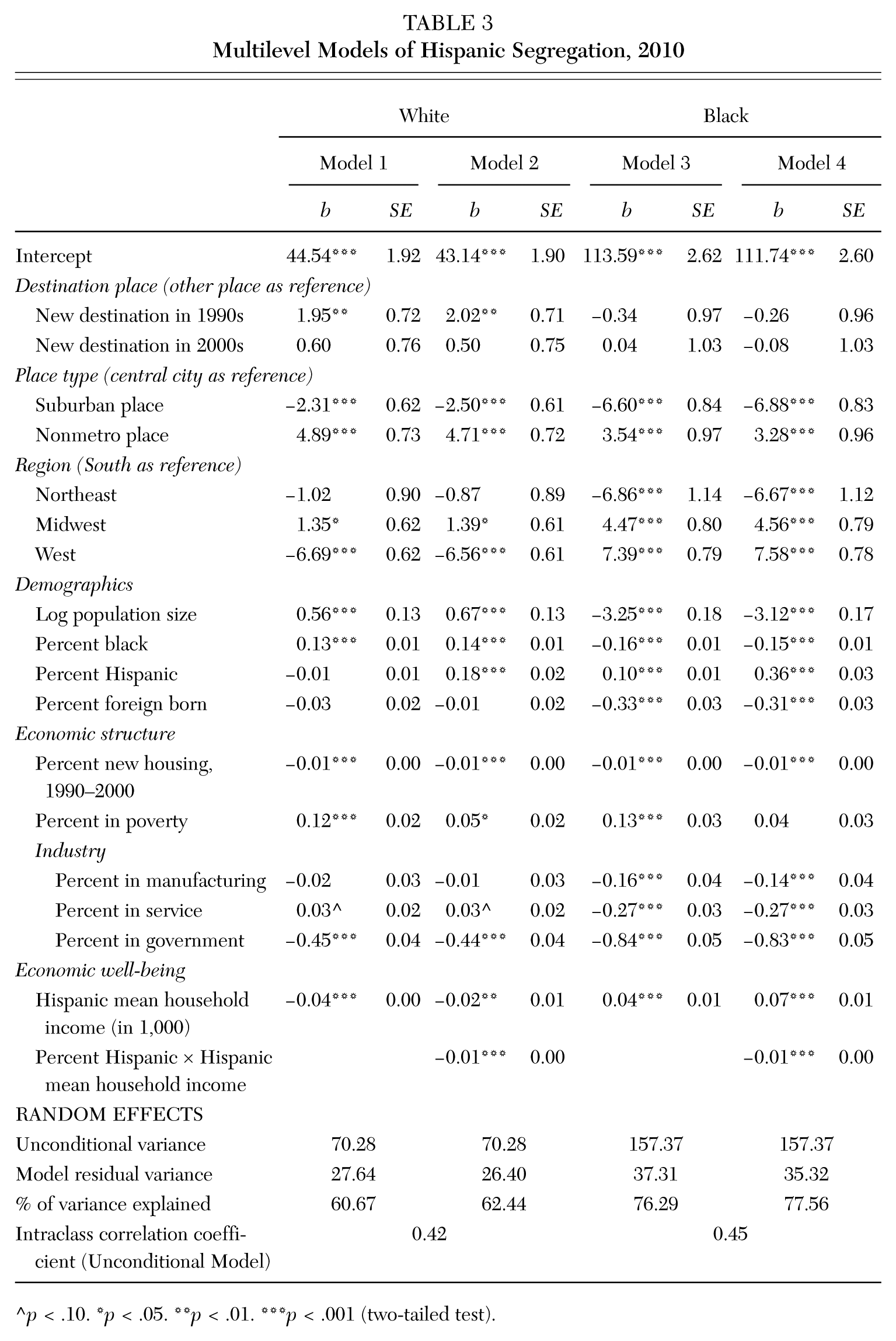
The HLM estimates in Table 3, at a minimum, reinforce the conclusions based on the bivariate segregation results previously reported. For example, they indicate that Hispanic segregation, nationally, is significantly higher in new destinations than in established gateways in the 1990s (b = 1.95) and in nonmetro places (b = 4.89). Suburban places of all sizes and places in the West had lower levels of Hispanic segregation, net of the other variables in the model. Hispanic-white segregation is also positively associated with population size (b = 0.56) and size of the black population (b = 0.13). One interpretation is that Hispanic segregation from whites is greatest in places with a large black presence, perhaps because the housing stock has been highly differentiated along racial lines over a long period of time or because large shares of African Americans exacerbate the racial “threat” associated with rapid Hispanic population growth. Yet our results also show that increases in the share of Hispanics and the foreign-born population are statistically unrelated to changes in Hispanic-white segregation, a finding that argues against the “minority group threat” hypothesis (see also Iceland and Scopilliti 2008).
Multilevel Models of Hispanic Segregation, 2010
p < .10. *p < .05. **p < .01. ***p < .001 (two-tailed test).
Spatial patterns of Hispanic-white segregation are also associated with the economic or industrial structure of a community. As expected, Hispanic-white segregation increases with overall poverty rates but declines with growth in the housing stock (i.e., growth tends to occur at the periphery of many communities; see Lichter et al. 2010). Hispanic-white segregation is lowest in places with disproportionate shares of employment in the government sector, but Hispanic segregation does not vary by the percentage of workers employed in the service sector or in manufacturing (which comprises nondurable manufacturing, such as food processing).
Last, we included a measure of Hispanic economic well-being, which we defined as the mean household income of Hispanics. As expected, Hispanic segregation from whites is lower in places with higher Hispanic incomes (b = −0.34; Table 3). Moreover, in some additional analyses (not shown), using the same model specification but focused on Hispanic-black segregation, we discovered that Hispanic segregation from blacks increased significantly with increases in Hispanic household income (b = 0.04). Higher incomes clearly “move” some Hispanics toward whites and away from blacks on the racial continuum, which is consistent with our hypothesis of segmented assimilation. Income “whitens,” seemingly separating high-income Hispanics from their less affluent counterparts and from blacks. Although such results are consistent with a spatial assimilation perspective, they also indicate a highly segmented process based on socioeconomic status.
In a final model (column 2, Table 3), we included an interaction term between Hispanic income and percent Hispanic to address the question of a “Hispanic threat.” The expectation is that any threat associated with growing shares of Hispanics would dissipate with increasing Hispanic income. Indeed, the significant positive effect of percent Hispanic (b = −18) is offset by the significant and negative interaction term (b = −0.01). The results are consistent with expectations that Hispanics are seen as less threatening—and segregation is reduced—as Hispanics “whiten” with increasing household income. Additional analyses are required before making strong conclusions about the substantive significance of Hispanic income vis-à-vis other key predictors of Hispanic-white segregation.
For comparative purposes, we also provide similar HLM estimates of Hispanic-black segregation in 2010. Unlike the Hispanic-white segregation results, Hispanic-black segregation was lowest in the largest cities (b = −3.25) and in places with relatively large black populations (b = 0.16). This provides some evidence that Hispanic populations are merging with black populations in the neighborhoods of the nation’s largest cities and communities with sizable black populations and where employment is concentrated in manufacturing, services, and government. Finally, unlike the negative effects of Hispanic income on Hispanic-white segregation, Hispanic income is positively and significantly associated with Hispanic-black segregation (b = 0.04). Money whitens. Indeed, the lack of money tends to bring Hispanics and blacks closer but tends to set Hispanics apart from whites.
The results reported in the bottom of Table 3 indicate the value of our place-based theoretical and empirical approach. The intraclass correlation indicates that 42 percent of the overall segregation of Hispanics from whites is explained by metro/nonmetro-to-metro/nometro differences in neighborhood segregation, while 58 percent is explained by place-to-place differences within metro or nonmetro areas. To be sure, places are useful analytic units, as they effectively sort Hispanics into neighborhoods with different mixes of whites and minority populations.
Hispanic segregation in new destinations
Segregation in the 1990s and 2000s
Much of the recent attention on Hispanic redistribution patterns has centered on new immigrant destinations (Crowley and Ebert 2014). In our earlier work (Lichter et al. 2010), Hispanic segregation from whites was found to be greater in new destinations than in established gateways, based on census data from 1990 and 2000. The implication is that the 1990s introduced a new form of spatial and racial segregation, an emerging macrosegregation, as Hispanics became increasingly concentrated in specific new immigrant destinations (Lichter 2012; Tienda and Fuentes 2014). With newly released data from the 2010 decennial census, ongoing trajectories of Hispanic spatial assimilation can now be tracked by trends in segregation of new Hispanic destinations over the subsequent 10-year period, from 2000 to 2010.
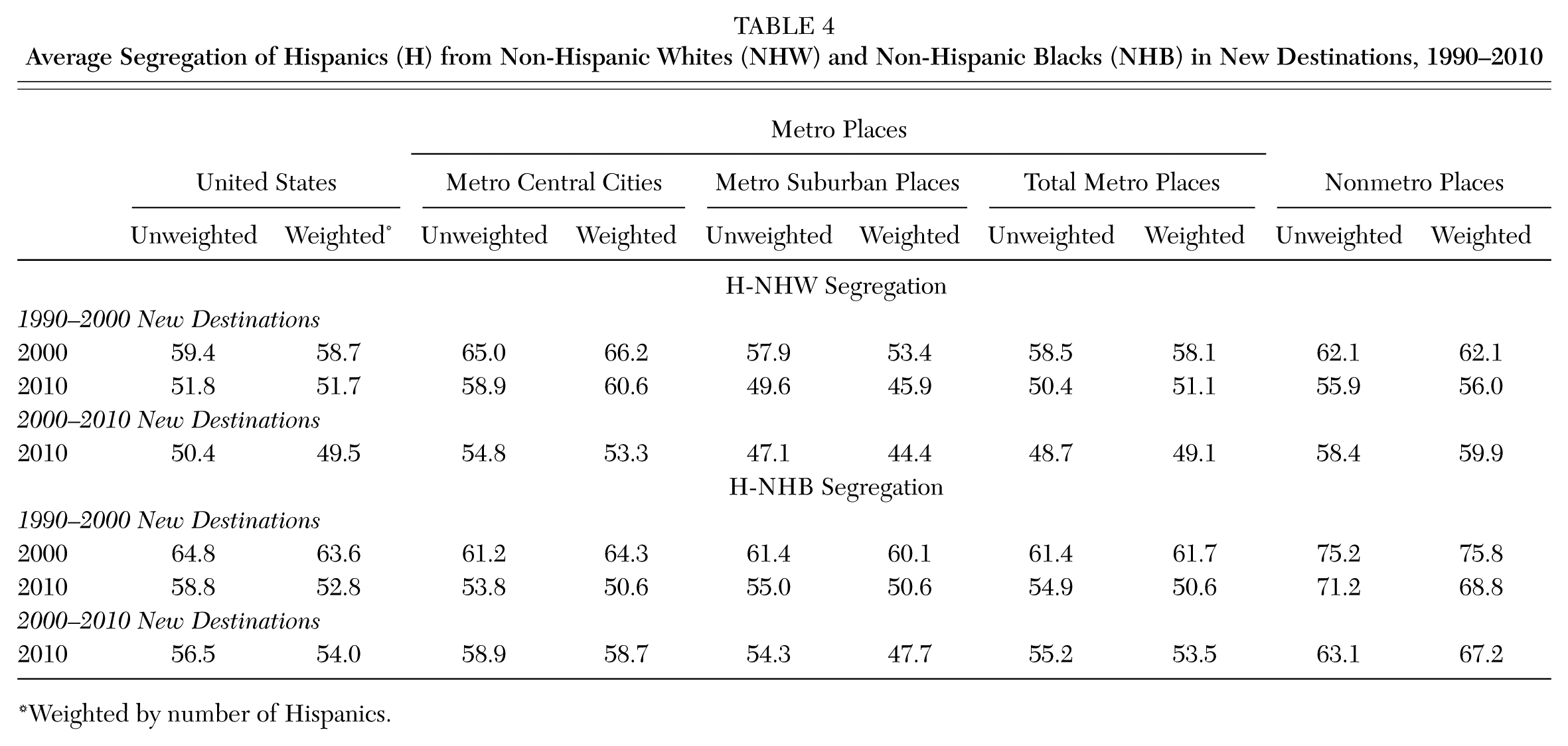
The weighted segregation indices reported in Table 4 (first column) clearly indicate continuing high levels of Hispanic segregation in new destinations (as defined in the methods section)—higher than among all places (see Table 1). Yet in new destinations (defined by 1990s growth), Hispanic-white segregation is 51.7 in 2010, down significantly from 58.7 in 2000. Segregation levels in 2010 among the “newest” new destinations (49.5) are still lower. These data provide clear empirical evidence of (slowly) increasing spatial assimilation of Hispanics between 2000 and 2010 in new Hispanic destinations.
Average Segregation of Hispanics (H) from Non-Hispanic Whites (NHW) and Non-Hispanic Blacks (NHB) in New Destinations, 1990–2010
Weighted by number of Hispanics.
Some caveats nevertheless are warranted. As found in previous studies (Hall 2013; Lichter et al. 2010), Hispanic-white segregation remains slightly higher in the 1990s among new destinations (51.9) than for the country overall (49.3; see Table 2). Moreover, for the first wave of new destinations, Hispanic-white declines in segregation paled in comparison to declines in Hispanic-black segregation, which dropped from 63.6 to 52.8 during the 2000s (see Table 4, panel B). Spatial integration of Hispanics is occurring more rapidly with blacks than with whites in new destinations. Hispanic segregation from blacks, however, was very similar nationally (55.0) to segregation patterns in new destinations that emerged both in the 1990s (D = 53.8) and 2000s (D = 54.0). But the evidence nevertheless supports a singular conclusion: Hispanics in new destinations are assimilating more rapidly with blacks than with whites.
Recent declines in Hispanic segregation have proceeded more rapidly in new destinations compared to all places, whether in central cities, suburbs, or nonmetro places. For example, Hispanic-white segregation declined only slightly overall in metro areas during the 2000s (from 52.7.0 to 49.3) but dropped more rapidly in the 1990s’ new destinations (from 58.1 to 51.1). This pattern of differential declines in Hispanic-white segregation was also apparent in suburban and nonmetro places. Still, in each instance, Hispanic-white segregation in 2010 was higher in new destinations than in all places.
Unlike the case with whites, Hispanic segregation from blacks in new destinations was slightly lower (rather than higher) than the estimates nationally (Table 1). For example, Hispanic-black segregation was 52.8 and 54.0 in the 1990s’ and 2000s’ new destinations, respectively, compared with 54.9 nationally. As is the case nationally, Hispanic-black segregation in nonmetro places is exceptionally high in new destinations (68.8 and 67.2; see Table 4). The current widespread redistribution of America’s Hispanic population arguably is associated with greater spatial integration with America’s black population, even as segregation from whites has declined.
Multilevel models of Hispanic segregation in new destinations
An important general lesson from the multilevel models (not shown) is that conventional predictors of segregation are much less useful for understanding segregation in fast-growing Hispanic communities. Compared with the results for all places (Table 3), far fewer independent variables are statistically significant. We therefore limit our discussion to some empirical commonalities that new destinations share with all places (reported earlier in Table 3). The full results are available in our online supplemental tables. 3
For example, Hispanic-white segregation in new destinations is lowest in the West (b = −4.94) but also rises as the black percentage increases (b = 0.20). These associations in new destinations are generally similar in direction and significance to those estimated for all places (see Table 3). One clear exception is population size. In the national sample, Hispanic-white segregation increases with population size (model 1, Table 3), but in new destinations segregation is statistically unrelated with population size. Measured by the relative sizes of the income coefficient, the association with Hispanic income and Hispanic-white segregation is stronger in new destinations than it is nationally (b = −0.15 vs. −0.04). Upward income mobility seems to be a clear route to greater spatial integration with whites in new destinations. Economic incorporation is tied to spatial assimilation among Hispanics. This finding arguably provides some support for the spatial assimilation model, but it might also indicate that some low-income Hispanic communities are “left behind.” The experience of incorporation—spatially or otherwise—is highly segmented in new destinations.
The results indicate that Hispanics are least segregated from blacks in the suburbs, which suggests that the new destinations in the suburbs are disproportionately black in racial composition. Hispanic-black segregation also declines with increasing population size (b = −3.19) but increases with larger shares of Hispanics in the community (b = 0.21). This positive effect, however, is offset by growing shares of the foreign-born population (b = −0.30), a result that suggests that foreign-born Hispanics rather than native-born Hispanics are concentrating more rapidly in black neighborhoods in these new destinations. Finally, more Hispanic income in new destinations is associated with less segregation from blacks (b = −0.10), as it is with whites (b = −0.15). This pattern is different from the national results reported in Table 3. It seems that more Hispanic income contributes to greater spatial assimilation with the local population—whether it is white or black.
Finally, the interclass correlations from these supplementary analyses of new destinations indicate that 41 percent of Hispanic-white segregation is explained by metro/nonmetro-to-metro/nometro differences in within-place neighborhood segregation. The remaining 59 percent of Hispanic-white segregation is explained by place-to-place differences within metro or nonmetro areas. Clearly, even in new destinations, segregation patterns among Hispanics arguably must be contextualized by demographic, economic, and political processes occurring at the community or place level (Waters and Jiménez 2005).
Discussion and Conclusion
The new growth of Hispanics in smaller metro cities, in rapidly diversifying suburban communities, and in new rural destinations has upended conventional interpretations of spatial assimilation and intergroup relations among America’s minority and immigrant populations (Parisi, Lichter, and Taquino 2015; Tienda and Fuentes 2014; Waters, Kasinitz, and Asad 2014). In this article, we argue for a new scholarly commitment to spatial inclusion in the study of racial and ethnic segregation, one that acknowledges the growing significance and impact of a highly diverse and spatially dispersing Hispanic population. The singular focus on neighborhood segregation in the largest metro areas is clearly important, but it arguably misses part of an evolving story of racial change and differentiation in the U.S. settlement system (Lee, Iceland, and Farrell 2014; Lichter, Parisi, and Taquino 2015).
Whether Hispanics are joining the majority mainstream depends, at least in part, on whether they are able to translate upward mobility into residence patterns that mirror those of the rest of the nation. Based on our results, we view spatial assimilation theory and the place stratification model as complementary rather than strictly competitive perspectives. Indeed, our empirical results provide evidence of spatial assimilation among Hispanics, both nationally and in new immigrant destinations. From a place rather than big-city or metro-level perspective, Hispanic segregation from whites has declined significantly over the past 20 years. Hispanic income is also associated with less segregation from whites. At the same time, our results also raise the prospect of growing Hispanic spatial assimilation with blacks; declines in Hispanic-black segregation have proceeded more rapidly than declines in Hispanic-white segregation. The segmented assimilation of Hispanics therefore seems to accommodate spatial assimilation theory for some groups (e.g., highly educated Hispanics) but a place stratification perspective for the most disadvantaged Hispanic populations, who are integrating most rapidly with blacks. Our results raise the question of spatial assimilation “with whom.”
Our analyses provide an empirical baseline for additional research, especially on the apparently divergent residential trajectories of different segments of the Hispanic population. Our results showing average declines in Hispanic segregation from both whites and blacks over the past 20 years suggest the need to consider multigroup segregation or even the new blending of residence patterns among different racial and ethnic groups in an increasingly diverse society (Logan and Zhang 2010). The presence of new Hispanic populations is sometimes viewed as serving as a spatial buffer between blacks and whites (Iceland 2004; Parisi, Lichter, and Taquino 2015), perhaps even contributing to declines in black-white segregation. Our results give little indication that the black population plays a similar role between Hispanics and whites. Quite the opposite is true: Hispanic segregation from whites increased (rather than decreased) with the growth in the relative size of the black population. One obvious interpretation is that Hispanics—or some segment of the Hispanic population—are now joining blacks in highly segregated minority and immigrant neighborhoods. In fact, this finding may account for the rapid declines in Hispanic-black segregation over the study period, even as Hispanic-white segregation declined more slowly.
Our study is not without some limitations. We have neither considered racial differences in Hispanic segregation, nor differences among Hispanic national origin groups. To be sure, Mexicans, Puerto Ricans, and Cubans are highly differentiated spatially, in part because of cultural differences and economic disparities. Iceland and colleagues’ (2014) recent analyses of 1980–2010 data showed widely uneven patterns of segregation among Hispanic national origin groups. Mexicans were less segregated (D = 50.3 in 2010) than other Hispanic groups (e.g., El Salvadorans) from whites and blacks. Moreover, a recent metro-based study by Kim and White (2010) reported very high rates of segregation among national origin groups, even among those that shared the same pan-ethnic identification (e.g., Asians). Treating Hispanics as a monolithic may misrepresent the experiences of different Hispanic national origin groups.
Our study has also not identified the specific demographic mechanisms that have produced declining Hispanic segregation from whites and blacks. For example, a growing Hispanic population can either replace or displace white or black populations in local communities, or, stated differently, declining Hispanic segregation can reflect the movement of whites to better neighborhoods (leaving behind less expensive housing for other minorities to fill). Or, instead, whites can leave predominately white neighborhoods (“white flight”) that are undergoing a new minority population infusion. Neither scenario suggests that declining segregation means that Hispanics are increasingly residing in “good” communities or better neighborhoods than in the past.
In conclusion, our study has placed the spotlight squarely on recent trends in Hispanic segregation—both from whites and blacks—across many different levels of geography. The results clearly provide an empirical basis for both optimism and pessimism. The hope of improving race relations implied by declining Hispanic segregation and greater ethnoracial inclusion is counterbalanced by persistently high levels of residential segregation among America’s disadvantaged Hispanic and other minority populations. Ongoing trends in Hispanic population redistribution and residential patterns are perhaps the linchpin to shifting patterns of racial residential segregation in an increasingly diverse and multicultural American society.
Footnotes
NOTE:
The authors acknowledge the helpful comments of the volume coeditors and critical suggestions of the two reviewers, as well as support from the Cornell Population Center and the National Strategic Planning & Analysis Research Center (nSPARC) at Mississippi State University. The authors’ previous collaborative studies of place-based or multiscale segregation, including rural segregation, appear in Social Forces, Rural Sociology, Demography, Sociological Science, Social Problems, and Social Science Research, among other publications.
Notes
Daniel T. Lichter is Ferris Family Professor in the Department of Policy Analysis and Management, professor of sociology, and director of the Cornell Population Center, all at Cornell University.
Domenico “Mimmo” Parisi is a professor of sociology and director of the National Strategic Planning & Analysis Research Center (nSPARC) at Mississippi State University.
Michael C. Taquino is deputy director and an associate research professor at nSPARC at Mississippi State University.
References
Supplementary Material
Please find the following supplemental material available below.
For Open Access articles published under a Creative Commons License, all supplemental material carries the same license as the article it is associated with.
For non-Open Access articles published, all supplemental material carries a non-exclusive license, and permission requests for re-use of supplemental material or any part of supplemental material shall be sent directly to the copyright owner as specified in the copyright notice associated with the article.
