



Abstract
This study examines the potential for small-scale acts of giving that are not directly reciprocated, or generalized generosities, to build social bonds and promote contributions to the group. Social exchange theorists define such acts as generalized exchange. The potential for generalized exchange to build strong social bonds relative to other forms of exchange is the subject of theoretical debate. In this article, I build on two prominent theories of social exchange—affect theory and the theory of reciprocity—to propose that a strong norm of generalized reciprocity may bridge the connective benefits of generalized exchange with the connective benefits of productive exchange, which is a collaborative form of social exchange that involves sharing pooled resources. I argue that a strong norm of generalized reciprocity will activate mechanisms theorized to build strong social bonds in generalized and productive exchange systems, and will promote additional behavioral investments into the group. I test my argument with a controlled laboratory experiment, finding strong support for the proposed causal model. The results of this study have implications for research on generosity, collective action, collaboration, sense of community, and social capital.
Acts of generosity have a host of personal and social benefits (Smith and Davidson 2014). This study considers the connective value of generosity by examining the potential for acts of giving to provide the foundation for integrative social bonds, such as trust and commitment, which hold society together, promote collective action, and facilitate social capital. In particular, I focus on the exchange of relatively small, anonymous acts of generosity that are not reciprocated directly back to the giver (e.g., paying for the next person in line at a drive-thru). Such instances of generalized generosity are akin to the random acts of kindness of popular culture.
Social exchange theorists define such acts of indirect reciprocation (i.e., repayment from someone other than the recipient) as generalized exchange. Generalized exchange is the practice of giving something of benefit to another person without them giving something back in return (e.g., helping a stranded motorist), because one expects to receive benefits from someone else in the future or because one has received benefits from someone else in the past (Ekeh 1974; Lawler 2001; Lawler, Thye, and Yoon 2008; Molm 1994; Molm, Collett, and Schaefer 2007; Simpson et al. 2018; Whitham 2018). Generalized exchanges abound in social life, such as anonymously reviewing a journal submission, volunteering assistance after a disaster, or participating in a Secret Santa gift exchange.
To examine the potential for such interactions to build social bonds, this study integrates research on generosity with theories of social exchange. Social exchange theorists study social interactions that take the form of a mutual exchange of benefits (for a recent review, see Savage and Whitham 2018). These benefits can be any object or action the other person values, including tangible goods, intangible services, and social outcomes. Recurrent social exchange interactions have long been theorized to serve as the foundation for building strong social bonds (Blau 1964; Homans 1974; Thibaut and Kelley 1959), and contemporary research supports these predictions (e.g., Lawler et al. 2008; Molm, Collett, and Schaefer 2007). The conditions under which this happens, however, are the subject of theoretical debate. There is particular disagreement regarding the potential to build strong bonds through generalized exchanges relative to other forms of exchange, such as negotiating terms or reciprocally trading benefits. Two prominent contemporary theories make opposing predictions regarding the potential for generalized exchanges to produce strong social bonds: the theory of reciprocity argues that generalized exchanges produce the strongest bonds, whereas affect theory argues that such exchanges produce the weakest bonds.
In this study, I argue that under certain conditions, generalized exchanges can take on the characteristics of another form of exchange: productive exchange. Productive exchange is a highly collaborative form of social exchange that involves pooling resources and sharing the collective benefits (Emerson 1976; Lawler et al. 2008; Molm 1994). When collaboration provides the most profitable possible outcome, individual actors often take joint action to produce a shared product that is greater than what could have been produced individually (Emerson 1976). For example, academics collaborate on research to reduce costs or to cross disciplinary boundaries (Leahey 2016), and law enforcement agencies share intelligence to solve or prevent crimes (Zhao et al. 2006). Through collaboration, the pooled benefit is greater or less costly than what could have been produced alone, and the benefits are collectively shared. Affect theory predicts that productive exchanges will produce the strongest social bonds (Lawler et al. 2008), just as the theory of reciprocity predicts for generalized exchanges (Molm, Collett, and Schaefer 2007).
If, as I argue, a generalized exchange system can take on the collaborative characteristics of a system of productive exchange, this may activate the bonds-building mechanisms both theories propose. 1 The present study integrates the theoretical mechanisms from both the theory of reciprocity (Molm 2010; Molm, Collett, and Schaefer 2007; Molm, Whitham, and Melamed 2012) and affect theory (Lawler 2001; Lawler et al. 2008; Lawler, Thye, and Yoon 2009; Thye, Lawler, and Yoon 2019) to propose and test a theoretically-grounded causal model. I propose that a strong norm of generalized reciprocity may bridge the connective benefits of generalized exchange with the connective benefits of productive exchange, and this will lead to strong social bonds. I also argue that a strong norm of generalized reciprocity will promote additional behavioral investments into the group, further reinforcing the norm of generalized generosity.
I test my argument with a controlled laboratory experiment. Results support the proposed causal model. I find that a strong norm of generalized reciprocity increases giving within the group, and bridges the connective characteristics of generalized and productive exchange, and this leads to stronger social bonds.
I conclude with a discussion of how the results contribute to the broader sociological literature. Despite being quite common in social life, both generalized exchange and productive exchange are relatively understudied (Savage and Whitham 2018). Both are collective forms of exchange that require and, in turn, promote collective action. Examining the dynamics between the two forms of exchange, as well as the potential to bridge their strengths, can shed light on the micro-level foundations of cooperation, generosity, and social bonds, with theoretical and practical implications for understanding processes of collective action, collaboration, sense of community, and social capital.
The Structure of Social Exchange
Contemporary theory development in the social exchange literature has primarily focused on how similarities and differences across various forms of exchange affect exchange processes and outcomes (Molm 2010; Savage and Whitham 2018). In this study, I examine similarities and differences between generalized exchange and productive exchange. 2 Figure 1 depicts examples of these two forms of exchange. As shown in Diagram A in Figure 1, in generalized exchange, actors contribute a benefit to another actor who will not directly repay those benefits, with the expectation or recollection of receiving benefits from a third actor instead. For example, A transfers benefits to F, F “pays forward” benefits to B, and so on, and A is eventually repaid by E. In productive exchange, two or more actors contribute to a collective benefit pool. For example, in Diagram B in Figure 1, actors A, B, C, D, E, and F contribute benefits to a collective pool, and the collective product is then shared among them. Social exchange theorists typically compare the forms of exchange according to three key structural characteristics of the exchange process: (1) the act of reciprocity, (2) actors’ structural dependencies, and (3) the flow of benefits (Molm 1994, 2003, 2010).
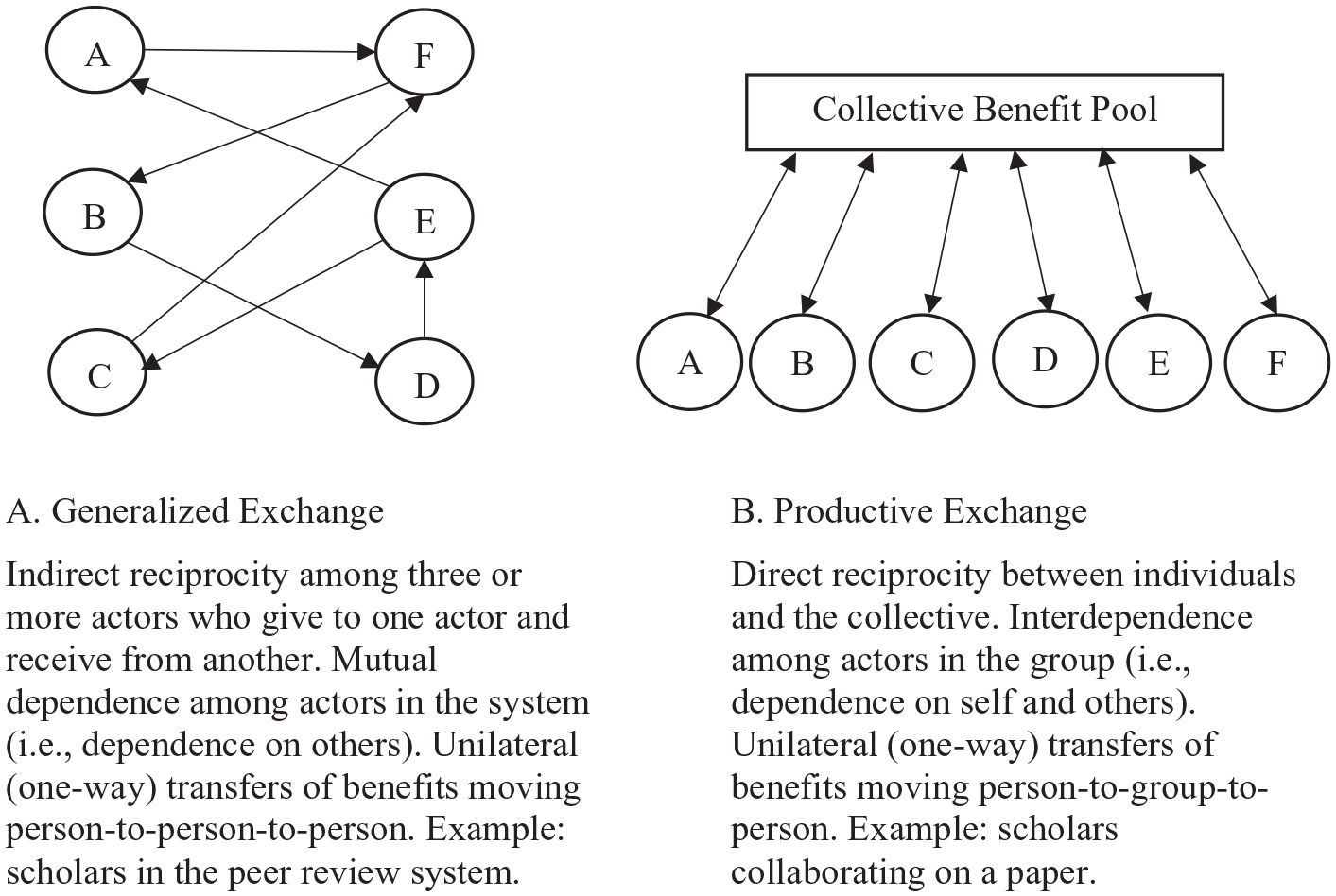
Examples and Descriptions of Generalized Exchange and Productive Exchange
Reciprocity
Reciprocity in social exchange can be direct or indirect, which is determined by whom an actor pays for benefits they receive (Molm 1994). Direct reciprocity is defined by payment to and repayment from the same actor (e.g., two friends trading favors). Most forms of exchange are direct—either between two individuals or, as in productive exchange, between individuals and the group to which they collectively contribute.
Indirect reciprocity is unique to generalized exchange (Molm 1994; Molm, Collett, and Schaefer 2007). The process involves transfers of benefits among three or more actors who give benefits to an actor in the system and take benefits in return from a third actor in the system (Ekeh 1974; Lawler et al. 2008; Molm 1994; Molm, Collett, and Schaefer 2007; Simpson et al. 2018). For example, in Diagram A in Figure 1, A gives benefits to F and receives benefits in return from E. Simpson and colleagues (2018) further distinguish this indirect process of repayment into two types: “generalized reciprocity,” in which a person pays forward previously received benefits, and “indirect reciprocity,” in which a person receives benefits after having given benefits to someone else; the distinction effectively depends on the timing of repayment (i.e., before giving versus after giving).
Dependence
An actor’s outcomes can be structured by varying degrees of dependence, based on who controls the actor’s outcomes: self (independence), other (dependence), or self and other (interdependence) (Molm 1994). Most exchange relations are based on mutual dependence, which characterizes situations in which (1) an actor’s outcomes depend on the giving behavior of another person and (2) another person’s outcomes depend on the giving behavior of that actor—either the same actor upon whom they are dependent (direct exchanges) or a third actor (indirect exchanges). Indirect exchanges involve a web of dependencies among at least three actors. For example, in Diagram A in Figure 1, A’s outcomes depend on E’s giving behavior, B’s outcomes depend on F’s giving behavior, and so on.
Interdependence is unique to productive exchange (Molm 1994). In situations of interdependence, actors have mutual control over the outcomes of exchange, with each actor’s outcomes dependent on the giving behaviors of self and other(s). In non-productive forms of exchange, an actor’s outcomes depend solely on receiving a contribution of benefits from another actor (other). In productive exchange, however, one’s outcomes depend on one’s own contribution to the collective pool (self) and the contributions of other actors to the collective pool (others). The value of the shared benefit pool in productive exchange thus depends on the contributions of all actors in the group. For example, in Diagram B in Figure 1, A’s outcome depends on the combined value of the benefit pool, which is determined by her contribution to the benefit pool and the contributions of B, C, D, E, and F.
Benefit Flows
The exchange of benefits can flow bilaterally (two-way) or unilaterally (one-way) in a discrete transaction (Molm 2003). Benefits flowing bilaterally go both ways in a single transaction, such as paying for and receiving purchased goods. Benefits flowing unilaterally go in only one direction at a time, typically in a sequential series of exchange transactions, such as friends trading a series of favors over the course of their relationship.
Benefits flow unilaterally in both generalized and productive exchange. Each act of giving in generalized exchange constitutes an independent discrete transaction. For example, in Diagram A in Figure 1, A transferring benefits to F is a transaction, and F “paying forward” benefits to B is another transaction. Productive exchange involves multiple actors making separate contributions to the collective benefit pool: each contribution constitutes a discrete transaction with resources flowing unilaterally from the actor to the benefit pool. These contributions add up to something greater than what any actor would have individually achieved—that is, additional value is gained through collaboration (Emerson 1976). The collective benefits can then unilaterally flow back to the actors in another discrete transaction once the collective product has been achieved. For example, in Diagram B in Figure 1, each actor’s contribution to the benefit pool constitutes a transaction, and each actor’s receipt of benefits from the pool constitutes a reciprocal transaction.
The flow of benefits in generalized exchange can be structured or unstructured. Structured generalized exchange, or chain-generalized exchange, is characterized by three or more actors participating in a fixed structure of exchange that determines who gives to whom, such as a closed linear chain or circle (e.g., A gives to B, B gives to C, C gives to A) (Bearman 1997; Ekeh 1974; Malinowski 1926). A classic example is the Kula ring studied by Malinowski. Most studies of generalized exchange, including tests of affect theory (Lawler et al. 2008) and the theory of reciprocity (Molm, Collett, and Schaefer 2007), have studied chain-generalized exchange.
In contrast, I consider an unstructured form of generalized exchange, which is much more common in everyday life yet remains relatively understudied: pure-generalized exchange. In pure-generalized exchange any actor in the system can give to or receive from any other actor, with no predetermined structure defining who gives to whom (Takahashi 2000; Whitham 2018; Willer et al. 2012). Diagram A in Figure 1 depicts an example of the flow of benefits in pure-generalized exchange. Studying the development of social bonds through pure-generalized exchange is ideal for examining the consequences of generalized generosities, and is especially relevant for understanding how generosity functions in broader social contexts.
Ideal Types of Exchange
The forms of exchange defined by the above structural characteristics are ideal types. They provide an abstracted theoretical framework that can be used to better understand various aspects of the exchange process, including actors’ expectations, motivations, behaviors, and outcomes. For example, the indirect reciprocity that defines generalized exchange and the interdependence that defines productive exchange can both facilitate free-riding, which provides a theoretical link to research on social dilemmas (see Yamagishi and Cook 1993). In practice, however, any specific example of an exchange activity may blend characteristics of multiple exchange types. As I will argue, a strong norm of generalized reciprocity in a system of generalized exchange can bridge aspects of generalized and productive exchange, with corresponding implications for actors’ expectations, motivations, behaviors, and outcomes—including individual contributions to the group and the emergence of social bonds.
Social Exchange and the Emergence of Social Bonds
Both the theory of reciprocity (Molm 2010; Molm, Collett, and Schaefer 2007; Molm et al. 2012) and affect theory (Lawler 2001; Lawler et al. 2008, 2009; Thye et al. 2019) propose that differences in the structure of exchange can have important implications for the development of social bonds. Molm and colleagues examine social solidarity between persons (person-to-person ties) and between persons and social units (person-to-group ties) along dimensions of trust, affective regard, social unity, and commitment. Lawler and colleagues examine micro social orders, which involve actors coming to perceive the exchange network as a social unit and developing affective attachments to the social unit. The present study focuses on the conceptual overlap between the two, defining social bonds as ties between individuals and the social units to which they belong, and evaluating them along four dimensions: trust, affective regard, commitment, and group identity.
The theory of reciprocity and affect theory make conflicting predictions about the propensity for different forms of exchange to build social bonds, and there is evidence to support both arguments. The most extreme divergence between the theories is their conflicting predictions regarding the effect of generalized exchanges on social bonds. Generalized exchange exists at the endpoints of both theories: as the form of exchange likely to generate either the strongest social bonds (Molm and colleagues’ theory of reciprocity) or the weakest social bonds (Lawler and colleagues’ affect theory). Affect theory predicts that productive exchange will instead build the strongest social bonds. It is the unique features of these two forms of exchange—indirect reciprocity in generalized exchange and interdependence in productive exchange—that are proposed to lead to stronger bonds.
Building Bonds through Indirect Reciprocity: The Theory of Reciprocity
The theory of reciprocity argues that the indirect reciprocity of generalized exchange strengthens its potential to build social bonds relative to other forms of exchange (Molm 2010; Molm, Collett, and Schaefer 2007). The theory focuses on exchanges involving mutual dependence only—that is, negotiated, reciprocal, and generalized exchanges—and thus excludes productive exchange. The theory considers how the act of reciprocity differs due to the other two structural characteristics of the exchange process: direct versus indirect reciprocity and bilateral versus unilateral flow of benefits. These structural differences in reciprocity are proposed to affect the development of social bonds through three mechanisms: (1) the risk of nonreciprocity, which is the potential of incurring a net loss by not receiving comparable rewards in return for rewards given (Molm 1994; Molm, Collett, and Schaefer 2007; Molm, Schaefer, and Collett 2009); (2) expressive value, which is the symbolic value, over and above the utility value, of benefits given (Molm, Schaefer, and Collett 2007); and (3) the salience of conflict, which refers to the relative awareness of conflict versus cooperation involved in the exchange (Molm, Collett, and Schaefer 2006, 2007).
Molm, Collett, and Schaefer (2007) argue that because reciprocity in generalized exchange is indirect, it has the greatest potential to produce strong social bonds through these mechanisms, relative to either reciprocal or negotiated exchange. Generalized exchange has the highest risk of nonreciprocity, which builds bonds by providing opportunities for actors to demonstrate trustworthy behavior. Generalized exchange also builds bonds by conveying the most expressive value because giving is more uncertain, more seemingly voluntary, and will not be directly repaid. Finally, generalized exchange is experienced as the least conflictual, which reduces barriers to bonds such as competition. Molm and colleagues test their argument with an experimental study, finding strong empirical support for their theoretical argument.
Building Bonds through Interdependence: Affect Theory
Affect theory argues that the interdependence of productive exchange strengthens its potential to build social bonds relative to other forms of exchange (Lawler et al. 2008; Thye et al. 2014). The theory proposes that emotions generated in exchange processes can lead to stronger or weaker affective attachments to social units (i.e., dyads, groups, networks). The key factors affecting this causal chain are (1) the valence of the emotions (i.e., positive or negative) produced through exchange, and (2) the jointness of the exchange task, which refers to the degree to which it is possible to separate out each exchange partner’s individual contributions to the exchange outcome(s). The theory proposes that greater jointness of task encourages more frequent successful exchanges, which lead to more positive emotions and engender a sense of shared responsibility for exchange outcomes, making the social unit of the exchange relation a more salient target for the attribution of these positive emotions. This emotional attribution—its strength, valence, and the degree to which it is attributed to the exchange relation—affects the degree of solidarity that develops in the relation.
Lawler and colleagues (Lawler 2001; Lawler et al. 2008) argue that jointness of task is highest in productive exchange because it involves interdependence (rather than the mere mutual dependence of generalized, negotiated, or reciprocal exchange). Conversely, jointness of task is lowest in generalized exchange because it involves indirect reciprocity (rather than the direct reciprocity of productive, negotiated, or reciprocal exchange). Thus, productive exchange should produce the strongest emotional attributions to the group and therefore the strongest bonds, whereas generalized exchange should produce the weakest emotional attributions to the group and therefore the weakest bonds (with negotiated and reciprocal exchange falling between these endpoints). In an experimental test of the theory, Lawler and colleagues (2008) find the strongest bonds emerging through productive exchange and the weakest social bonds emerging through generalized exchange, as predicted.
The Structure of Generalized Generosity: Building Bonds through Generalized-Productive Exchange
To account for the theoretical and empirical divergence between these prominent theories, the present study examines a potential link between generalized and productive exchange: the norm of generalized reciprocity. I propose a strong norm of generalized reciprocity will bridge the indirect reciprocity of generalized exchange with the interdependence of productive exchange. I predict this will strengthen social bonds by activating the bonds-building mechanisms proposed by both theories, and it will also promote additional behavioral investments into the group.
The Norm of Generalized Reciprocity
In interpersonal relationships, the norm of reciprocity is the expectation that social debts will be repaid (Gouldner 1960; Malinowski 1926). The receipt of a kindness from another individual obliges a reciprocal kindness. An individual who does a friend a favor, for example, may expect a favor in return to repay the “debt.”
This expectation can aggregate beyond direct interpersonal ties to extend to group members more generally (Brewer 1999; Gouldner 1960; Malinowski 1926; Putnam 2000; Tajfel et al. 1971; Yamagishi and Kiyonari 2000). The norm of generalized reciprocity refers to the expectation that group members can anticipate reciprocity from fellow group members, whether or not they know them personally. When group members feel confident that benefits given to a fellow member will be repaid, the group becomes a “container of generalized reciprocity” (Yamagishi and Kiyonari 2000), facilitating overall generosity levels by signaling that any one group member may expect their own generosity to be reciprocated.
Expectations of generalized reciprocity may be stronger in some groups than others, however, as the strength of the norm of generalized reciprocity can vary across groups. The strength of the norm of generalized reciprocity is defined by the frequency of indirect (i.e., generalized) giving within the group. A strong norm of generalized reciprocity reflects frequent generalized giving within the group, which should lead to the confident expectation that benefits given to a fellow group member will be repaid. Thus, a strong norm of generalized reciprocity signals that the group is a “container of generalized reciprocity.”
The strength of the norm of generalized reciprocity within a group may affect social bonds. Research on generosity, for instance, indicates that repeated behaviors of intentional giving have greater capacity than one-shot or infrequent giving to build meaningful social connections and strengthen existing relationships (Smith and Davidson 2014; Wilcox and Dew 2016). Research on social capital likewise suggests stronger norms of reciprocity may relate to localized trust and greater capacity for collective action (Putnam 1993, 2000).
In line with research on generosity and social capital, I predict that the strength of the norm of generalized reciprocity will positively affect the emergence of social bonds of trust, affective regard, commitment, and group identity: a strong norm of generalized reciprocity will lead to strong social bonds, and a weak norm of generalized reciprocity will lead to weak social bonds. Drawing on social exchange theory, I propose a causal model involving mediation (through giving, perceived interdependence, and positive sentiments) and moderation (by risk). The mechanisms in the model are drawn from the theory of reciprocity and affect theory, as discussed below. Figure 2 presents a visual representation of the model.
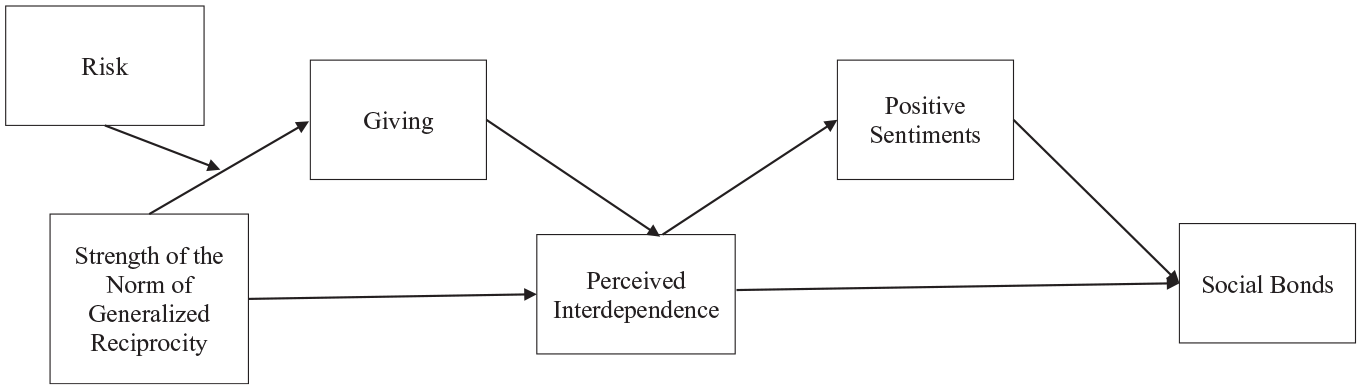
Conceptual Model, All Arrows Indicate Positive Effects
The scope conditions for the theoretical model are based on the traditional scope conditions for theories of social exchange (including the theory of reciprocity and affect theory): actors are dependent on others to acquire benefits, and actors engage in repeated exchanges with the same actors over time (rather than one-shot transactions) (Molm and Cook 1995). Due to the collective nature of generalized and productive exchanges, however, the same actors are not necessarily the same individuals, but fellow members of the same group. I define group simply as an exchange network, which is a set of three or more individuals who provide opportunities for exchange transactions with one another (Emerson 1972). Exchange networks are the social structures examined in previous work assessing the potential for social bonds to emerge through social exchanges (e.g., Lawler et al. 2008; Molm Collett, and Schaefer 2007). This usage also mirrors the “minimal group” definition used in previous work assessing generalized reciprocity (e.g., Yamagishi and Kiyonari 2000). Importantly, this definition of group describes a base social structure that has the potential for social bonds to emerge, rather than a social structure with preexisting social bonds such as group identity.
Individual Giving
Giving in generalized and productive exchange can be problematic, as their structural features facilitate free-riding, or receiving benefits without giving benefits in return. The indirect reciprocity of generalized exchange facilitates free-riding because one may benefit from the generosity of others while never “paying it forward.” Similarly, in productive exchange, if all actors are allowed to share in the collective benefit pool, regardless of their contributions, an individual may reap the benefits without contributing to the system. When there are no sanctions for not giving, both productive and generalized exchange are social dilemmas due to the conflict between individual and collective interests—if everyone cooperates, all gain, but there are individual disincentives (i.e., costs) to cooperating (Takahashi 2000; Yamagishi and Cook 1993).
A considerable amount of research shows how giving can be encouraged or enforced in systems of indirect reciprocity, such as through reputation systems and morality judgments (Nowak and Sigmund 1998, 2005; Simpson et al. 2018; Takahashi 2000). Such efforts, however, can be complex, information intensive, and potentially problematic (Fehr and Gachter 2002; Kuwabara 2015; Nowak and Sigmund 2005; Simpson and Willer 2015). The causal model proposed in the present study assumes no such avenues for enforcing giving. Assuming no avenues for enforcing giving accounts for and maintains the risk of free-riding involved in both generalized and productive exchange and allows for a straightforward assessment of how the strength of the norm of generalized reciprocity affects giving, absent potential sanctions.
The model predicts the strength of the norm of generalized reciprocity will have a positive effect on individuals’ giving (see Figure 2). Experimental research on generalized giving suggests norms regarding generalized reciprocity should be self-reinforcing—a stronger norm should promote greater giving, and a weaker norm should promote greater greed. Actors tend to respond in kind when they encounter either generosity or greed, even when the person to whom they reciprocate is not the person who behaved generously or greedily toward them (Gray, Ward, and Norton 2014). If frequent giving can be established, however, it tends to persist (Molm, Collett, and Schaefer 2007). These findings fit with the broader literature on cooperation, which suggests both giving and keeping can be contagious. Giving to others (i.e., cooperation) can “cascade” (Fowler and Christakis 2010), leading to higher levels of exchange. On the other hand, noncooperation can quickly spread through a network (Nowak and Sigmund 1998), leading to very low levels of exchange across time. Based on previous research that suggests norms of generalized reciprocity should be self-reinforcing, I predict the following:
Hypothesis 1: The strength of the norm of generalized reciprocity will have a positive effect on giving in generalized exchange.
Risk
In the context of social exchange, risk is defined as the potential to incur a net loss by giving benefits and receiving less or nothing in return (Molm 1994). Risk (giving without receiving) is the flipside of free-riding (receiving without giving). One element of risk is cost. In social exchange, cost is defined as the degree of self-sacrifice involved in giving to others, such as the relinquishing of an object, the effort of performing a beneficial act, the time involved in exchange, or the forgone opportunity of exchanging with an alternative actor (Molm 1994). The greater the cost of something given, the greater the benefit one will need in return to avoid incurring a net loss.
Evidence suggests greater risk in the form of higher cost may reduce giving in generalized exchange (Molm, Collett, and Schaefer 2007), and I predict this effect may be attenuated or exacerbated by a relatively strong or weak norm of generalized reciprocity. A strong norm of generalized reciprocity will not eliminate the structural risk inherent in generalized exchange, but it may reduce the uncertainty that typically goes hand-in-hand with risk. Uncertainty is the degree to which the outcome(s) of an exchange activity are unknown prior to the exchange (Molm et al. 2009). There is very little uncertainty regarding the outcomes of exchange when the terms are negotiated beforehand and are binding to both parties, for instance. Outcomes in generalized exchange typically involve a higher degree of uncertainty relative to other forms of exchange, because one is giving a benefit to a person who will not be the one to reciprocate. Uncertainty can be reduced in direct, person-to-person exchanges over time as actors repeatedly exchange with one another and learn what outcomes they can expect (Kollock 1994; Lawler, Thye, and Yoon 2000). Similarly, a norm of generalized reciprocity should reduce uncertainty in generalized exchange as actors are better able to determine what might happen in future exchanges. A strong norm of generalized reciprocity indicates that benefits given will likely be returned, which may attenuate risk and reduce the potential reduction in giving associated with higher cost found in previous research. Conversely, a weak norm of generalized reciprocity suggests benefits given are unlikely to be returned, which may compound risk and exacerbate the potential reduction in giving associated with higher cost. Thus, I predict risk in the form of higher cost will moderate the effects of the strength of the norm of generalized reciprocity on giving (Hypothesis 1):
Hypothesis 1a: The effects of the strength of the norm of generalized reciprocity on giving will be stronger when risk is higher.
Perceived Interdependence
Interdependence—the defining feature of productive exchange—stems from pooling resources and sharing in the collective benefits. I argue that a strong norm of generalized reciprocity integrates a sense of interdependence into the process of generalized exchange. A strong norm of generalized reciprocity in a generalized exchange system reflects the collaborative giving efforts of system members who are, in effect, pooling resources to create a shared benefit: a reliable system of generosity. Actors contribute to the “benefit pool” by giving to others in the system, and they receive benefits from the benefit pool when another member of the system gives to them. These exchanges come to resemble the person-to-group-to-person exchange process of productive exchange. Giving to another person in the generalized exchange system becomes, in a sense, not just a transfer of benefits to another actor, but a transfer of benefits to the collective system of giving (person-to-group), and that shared system of giving is available to the giver in return (group-to-person). A strong norm of generalized reciprocity thus produces a collaboratively-achieved, collectively-shared benefit that is, in the words of Yamagishi and Kiyonari (2000), “the group as the container of generalized reciprocity.”
This perceived interdependence goes hand-in-hand with two mechanisms argued to produce social bonds: salience of cooperation and jointness of task. Actors contribute to a strong norm of generalized reciprocity by giving to (i.e., cooperating with) others. This should result in the greater salience of cooperation that the theory of reciprocity predicts will build social bonds (Molm 2010; Molm, Collett, and Schaefer 2007). Additional research on cooperation in social exchange further supports this point: a cooperative exchange context, relative to a more competitive exchange context, builds stronger social bonds (Kuwabara 2011), as does receiving more benefits through exchange (i.e., experiencing more cooperative exchanges) (Willer et al. 2012). A sense of mutual control over the collaborative production of a shared benefit should also be coupled with perceived jointness of task and an associated sense of shared responsibility, which affect theory predicts will build social bonds (Lawler 2001; Lawler et al. 2008). Additional social exchange research further supports the link between jointness of task and social bonds (Collett and Avelis 2011; Kuwabara 2011).
Following the logic of both theories, the next steps in the model predict the strength of the norm of generalized reciprocity will have a positive effect on perceived interdependence, and perceived interdependence will subsequently have a positive effect on social bonds (see Figure 2). That is, the model predicts a stronger norm of generalized reciprocity will bridge the indirect reciprocity of generalized exchange with the interdependence of productive exchange by giving rise to perceived interdependence—a sense of pooling resources and sharing the collective benefits through cooperative, joint action—and this perceived interdependence will subsequently build social bonds. A weaker norm of generalized reciprocity, in contrast, will result in a sense of atomization leading to weaker social bonds. Perceived interdependence should be affected by (1) individuals’ behaviors (giving) and (2) others’ behaviors (the norm of generalized reciprocity), independent of individual giving behavior. Additionally, I predict that perceived interdependence will in turn have a positive effect on social bonds.
Hypothesis 2: Individual giving will have a positive effect on perceived interdependence.
Hypothesis 3: The strength of the norm of generalized reciprocity will have a positive effect on perceived interdependence.
Hypothesis 4: Perceived interdependence in generalized exchange will have a positive effect on social bonds.
Positive Sentiments
Positive sentiments are a key mechanism in both affect theory (in the form of positive emotions) and the theory of reciprocity (in the form of expressive value). According to affect theory, positive emotions that are attributed to the group are the driving force through which interdependence builds social bonds (Lawler 2001; Lawler et al. 2008; Thye et al. 2019). The theory predicts joint action that results in successful exchanges (i.e., interdependence) will produce the strongest positive emotions attributed to the group, and these feelings will promote stronger person-to-group ties. The theory of reciprocity argues expressive value—the symbolic value of care and regard expressed through giving—is greatest in generalized exchange because it combines unilateral giving with indirect reciprocity, which makes giving riskier and seemingly more voluntary (Molm 2010; Molm, Collett, and Schaefer 2007; Molm, Schaefer, and Collett 2007). Greater expressive value communicated through generalized exchange should lead to stronger person-to-group solidarity.
By combining a sense of interdependence with indirect reciprocity, a strong norm of generalized reciprocity should activate the positive sentiments proposed by both theories to build strong social bonds. A strong norm of generalized reciprocity creates greater perceived interdependence, which according to affect theory should foster positive emotions and build stronger person-to-group ties. These exchanges nonetheless maintain the indirect and unilateral reciprocity of generalized exchange, which according to the theory of reciprocity conveys expressive value and leads to stronger social bonds. Thus, the final steps in the causal model (see Figure 2) predict perceived interdependence will lead to positive sentiments attributed to the group (i.e., positive emotions, expressive value), and these positive sentiments will lead to social bonds.
Hypothesis 5: Perceived interdependence will have a positive effect on positive sentiments attributed to the group.
Hypothesis 6: Positive sentiments attributed to the group will have a positive effect on social bonds.
Building Bonds through Generalized-Productive Exchange
In summary, I argue that a strong norm of generalized reciprocity will bridge the indirect reciprocity of generalized exchange with the interdependence of productive exchange, and this will build social bonds of trust, affective regard, commitment, and group identity. The causal model (see Figure 2) predicts this will occur through a process of serial mediation, with the strength of the norm of generalized reciprocity positively affecting social bonds through its positive effects on giving, perceived interdependence, and positive sentiments. Thus, I predict a strong norm of generalized reciprocity will produce strong social bonds and a weak norm of generalized reciprocity will produce weak social bonds through the following mediated pathways:
Hypothesis 7: The strength of the norm of generalized reciprocity will have a positive effect on social bonds mediated through perceived interdependence.
Hypothesis 8: The strength of the norm of generalized reciprocity will have a positive effect on social bonds mediated through perceived interdependence and positive sentiments attributed to the group.
Hypothesis 9: The strength of the norm of generalized reciprocity will have a positive effect on social bonds mediated through giving, perceived interdependence, and positive sentiments attributed to the group.
Method
Design Overview
I conducted a controlled laboratory experiment to test the proposed theoretical model. The 3x2 factorial design crossed three levels of the strength of the norm of generalized reciprocity with two levels of risk in a setting of pure-generalized exchange. The exchange process involved a series of opportunities to give points to or receive points from other participants. The strength of the norm of generalized reciprocity was operationalized as the frequency with which participants’ partners chose to give points to the participant across the exchanges, set at three levels: weak (25 percent giving), moderate (50 percent giving), or strong (75 percent giving). Risk was operationalized by the relative cost (high or low) to the participant when she chose to give points to another participant.
Participants were 180 undergraduates age 18 to 24, recruited through campus flyers and recruitment emails sent to a randomly selected sample of students. Recruitment materials explained that participants would interact with others in the experiment and those interactions would determine their earnings, which ranged from a guaranteed $12 to a potential maximum of $23. Typical earnings were around $13 to $16.
Procedure
One to three participants were scheduled for each experimental session. Each participant was randomly assigned to one of the six conditions prior to arriving at the laboratory, and they remained in the same condition for the duration of the experiment. Interaction occurred via a computer interface programmed using z-Tree software (Fischbacher 2007). To prevent nonexperimental factors such as sex or appearance from having an influence on their behaviors, participants never met face-to-face. Each participant was instructed to wait at a unique, isolated location near the laboratory and was individually escorted to a private room upon arrival, to prevent participants from interacting prior to the experiment. Participants read detailed instructions and went through a series of practice exchanges before participating in the generalized exchange opportunities. After completing the exchange opportunities, participants completed a questionnaire, were debriefed, and paid.
Each participant interacted with a simulated pure-generalized exchange network. Participants were told they were interacting with an unknown number of other actors. Their fellow participants, however, were in fact simulated actors programmed to behave in specified ways. This allowed for experimental control of the actions of their partners to test how particular levels of the norm of generalized reciprocity affect the theoretical mechanisms and the development of social bonds.
There is some debate within the social sciences regarding the use of deception in behavioral experiments (Barrera and Simpson 2012). Some form of deception, however, is relatively common in experimental sociological research—including the use of simulated actors (e.g., Molm, Schaefer, and Collett 2007; Simpson et al. 2018). I followed ethical guidelines and worked closely with my university’s Institutional Review Board to ensure there was no undue harm to participants and fully disclosed the deception in the debriefing process.
Evidence indicates deception does not affect the validity of experimental results (Barrera and Simpson 2012). Nonetheless, I took steps to avoid two potential validity issues: “contamination” of the participant pool and suspicious participants. Participants were told during the debriefing process that their interaction partners had been simulated actors, making it possible that participants could tell others in the participant pool about deception in the study. Aspects of the debriefing process (e.g., asking participants to promise not to tell others about the experiment) and the recruitment process (e.g., recruiting through a random sample of emails and excluding individuals who heard about the study through “word of mouth”) helped limit this. To prevent suspicions about the presence of others, aspects of the experimental procedure and the laboratory space suggested the presence of a number of other “real” participants. Despite precautions, six participants indicated during the debriefing process that they were suspicious about the presence of others during the interactions. These cases were dropped and replaced with new participants.
Generalized Exchange Process: “Transfer Opportunities”
The pure-generalized exchange process was designed to allow for the emergence of perceived interdependence while maintaining the unique features of generalized exchange. The process, modeled after previous experimental operationalizations of generalized exchange (Baker and Levine 2010; Lawler et al. 2008; Molm, Collett, and Schaefer 2007; Whitham 2018; Yamagishi and Cook 1993), involved a series of opportunities for participants to give points to or receive points from other actors in the system. These points were worth money (3 cents per point), and participants’ pay was determined by the number of points they accumulated during the experiment. Participants had full information about the point system and a continuously-updated point bank kept track of their accumulating point total.
Participants were paired with a new, anonymous (simulated) exchange partner for each “transfer opportunity.” At the start of each opportunity, the participant and her partner were each assigned to one of two corresponding roles: Role A, who was given an endowment of points she could give away or keep, and Role B, who would receive points if A chose to give. These roles were reassigned on each transfer opportunity. The assignment of roles was programmed such that for half the opportunities the participant was in Role A and for half the opportunities she was in Role B.
When assigned to Role A, the participant had 10 points added to her point bank and was instructed to decide whether to give some of the points away to her partner B or keep all the points for herself. The decision was made by clicking a button labeled “Keep” or a button labeled “Transfer.” In all conditions, if A chose to keep, she kept all 10 points in her point bank and knew that her partner B would receive zero points for that transfer opportunity. In all conditions, if A chose to transfer she knew B would receive 16 points. If A chose to transfer, she also got to keep some of her 10 points. The amount of kept points differed across two conditions: low risk or high risk. In the low-risk condition, A got to keep 8 points (80 percent of her endowment) when opting to transfer. In the high-risk condition, A got to keep 2 points (20 percent of her endowment) when opting to transfer. Thus, risk was determined by the cost of giving.
The payoff schedule reflected the collective benefit of giving to others in generalized exchange. When A chose to keep, only 10 points were distributed (all of which went to A). When A chose to transfer, the collective payoff was higher: in the high-risk condition, 18 points were distributed (2 for A, 16 for B), and in the low-risk condition, 24 points were distributed (8 for A, 16 for B). Thus, when A chose to transfer, the collective payoff was akin to a benefit pool, with more points being distributed and shared (albeit unequally).
When assigned to Role B, the participant was informed that her partner would choose whether to transfer or keep points. The strength of the norm of generalized reciprocity was operationalized as the frequency with which the simulated actors gave points to the participant when the participant was in Role B. The simulated actors chose to give about 75 percent of the time in the strong-norm condition (22 times out of 30), 50 percent of the time in the moderate-norm condition (15 times out of 30), and about 25 percent of the time in the weak-norm condition (8 times out of 30).
All exchange partners were anonymous, so participants had no way of knowing whether they had been paired with a partner on previous trials. Although participants had full information regarding their own outcomes for each transfer opportunity, including whether they were transferred points when in Role B, they otherwise had no information on the giving behavior or earnings of any other actor in the system. This was designed to maintain the independence of decisions involved in the indirect nature of generalized exchange—actors were not motivated to transfer points to avoid a bad reputation, nor were they motivated to reward or punish the past giving behavior of a potential beneficiary. The design thus maintained both the relatively higher risk of nonreciprocity in generalized exchange as well as the potential for free-riding that is possible in both generalized and productive exchange.
There were 60 transfer opportunities. Pretesting indicated this was a sufficient number of opportunities to reach a stable level of exchange, but was not so many that participants grew bored or overly suspicious about being paired with a new partner each time. To avoid endgame effects (i.e., participants giving less at the end of the experiment), participants did not know how many opportunities there would be.
Measures
To assess the effect of the strength of the norm of generalized reciprocity on giving across time, each giving decision is included in the longitudinal models as a dummy variable (1 = give, 0 = not give). To assess how levels of participants’ giving affect the subsequent mechanisms in the causal model, the remaining models use a measure of giving calculated as the percentage of exchange opportunities in which the participant chose to transfer points when assigned to Role A. Participants transferred points 66 percent of the time, on average, with a range of 0 to 100 percent.
Measures assessing perceived interdependence, positive sentiments, and social bonds are from participants’ answers to the post-experiment questionnaire. The measures are drawn from previous studies testing the mechanisms of affect theory and the theory of reciprocity (e.g., Kuwabara 2011; Lawler et al. 2008; Molm, Collett, and Schaefer 2007) and studies of group identity (e.g., Ellemers et al. 1988; Irwin and Simpson 2013; Yamagishi and Kiyonari 2000). As with previous studies testing the theoretical mechanisms, the focus of this study is on the emergence of social bonds between individuals and social units. Each measure assesses how participants evaluated their “interaction group,” including their sense of interdependence with fellow participants, emotional responses to the interactions, and sense of social bonds with fellow participants.
Perceived interdependence is assessed with a mean scale of six items 3 addressing jointness of task and salience of cooperation (α = .92). Two items are from a series of questions asking participants to evaluate their interaction group using the following bipolar adjectives: 1 = self-oriented/7 = team-oriented and 1 = adversaries/7 = partners. Three items are from a series of questions asking participants to evaluate the social climate of the interaction group using the following bipolar adjectives: 1 = competitive/7 = cooperative, 1 = friendly/7 = hostile (reverse coded), and 1 = conflictual/7 = harmonious. The sixth item asked participants which of the following statements best described how they thought about themselves and the other participants during the experiment (Molm, Collett, and Schaefer 2007): “We were competitors, working against each other” (coded 1); “We were separate individuals, each working for ourselves” (coded 3); “We were separate individuals, but working together” (coded 5); and “We were a group, a team, working together” (coded 7).
Positive sentiments toward the group are assessed with a mean scale (α = .95) of four questionnaire items asking participants how their interactions made them feel using a series of bipolar adjectives. Two items address positive emotions: 1 = pleased/7 = displeased (reverse coded) and 1 = dissatisfied/7 = satisfied. Two items address expressive value: 1 = cared for/7 = neglected (reverse coded) and 1 = taken advantage of/7 = treated well.
Social bonds are measured with four mean scales assessing trust, affective regard, commitment, and group identity. The measures for trust and affective regard are from a series of questions asking participants to evaluate their interaction group using bipolar adjectives. Trust is measured using a mean scale of three items (α = .92): 1 = trustworthy/7 = untrustworthy (reverse coded), 1 = unreliable/7 = reliable, and 1 = undependable/7 = dependable. Affective regard is measured using a mean scale of three items (α = .93): 1 = bad/7 = good, 1 = cold/7 = warm, and 1 = pleasant/7 = unpleasant (reverse coded). Commitment to the group is measured with a mean scale of two items (α = .91) asking respondents the extent to which they would want to continue working with the group if given the opportunity, and whether they would want to work with the same group on another task. Response options ranged from 1 = not at all to 7 = very much. Group identity is measured with a mean scale of three items (α = .83) assessing three aspects of group identity: belongingness, compatibility, and capability. The questions asked whether participants felt they belonged to the group, whether group members were well-suited to one another, and whether they performed well on the task. Again, options ranged from 1 = not at all to 7 = very much.
Sex (1 = female, 0 = male) is included as a covariate because it has been shown to affect exchange behaviors such as giving (e.g., Simpson and Van Vugt 2009; Whitham 2018). Fifty-nine percent of participants were female. To control for the effects of time, the longitudinal models also include the number of the exchange opportunity and the square of the number, because the effects of time may not be linear due to endgame effects. That is, participants are more likely to behave selfishly across time because each opportunity seems more likely to be the last and there is no instrumental reason to give away points in the final opportunity (Kuwabara and Sheldon 2012).
Analytic Strategy
To assess how the strength of the norm of generalized reciprocity affects giving over time, I use hierarchical generalized linear modeling. The models are hierarchical to account for the longitudinal nature of the giving data, with 30 giving decisions (level 1) nested in 180 participants (level 2). The models are specified as random-intercept logistic regression models. The models include both fixed-effects (norm strength, risk, sex, opportunity, and opportunity-squared, as well as interactions between norm strength, risk, and the opportunity variables) and, because I cannot assume independence among the decisions for the same participant, a participant-specific random intercept for each participant. The strength of the norm of generalized reciprocity is included as a three-category variable: weak (25 percent giving), moderate (50 percent giving), or strong (75 percent giving). The moderate norm of generalized reciprocity is used as the reference category, allowing a test of how a relatively weak norm of generalized reciprocity and a relatively strong norm of generalized reciprocity compare to a moderate norm of generalized reciprocity. I then compare the predicted probabilities (Long and Mustillo 2018) of population-averaged giving decisions across time for each of the three levels of the strength of the norm of generalized reciprocity at high and low risk.
To assess the remaining predictions, I use conditional process analysis 4 (Hayes 2018; Hayes and Rockwood 2020). Conditional process analysis is a statistical analytic strategy that integrates mediation analysis with moderation analysis. The model (1) quantifies and examines the direct and indirect pathways proposed in the causal model (see Figure 2), which predicted the strength of the norm of generalized reciprocity affects social bonds through giving, perceived interdependence, and positive sentiments (mediation), and (2) tests whether the predicted causal process is conditional on risk (moderation). Conditional process analysis is rooted in the principles of ordinary least squares regression and tests conditional indirect effects using bootstrap confidence intervals, which respect potential irregularities of the sampling distribution and provide greater statistical power and yield more accurate inferences than would a “normal theory” approach (e.g., the Sobel test) (Hayes 2018). The model uses 5,000 bootstrap samples and allows all variables presumed to be causally prior (i.e., farther to the left) to affect all variables later in the causal sequence (i.e., farther to the right). As with the longitudinal giving analyses, the model treats the strength of the norm of generalized reciprocity as a three-category antecedent and uses the moderate norm of generalized reciprocity as the reference category. The model requires a single data point for giving, that is, I cannot use the series of giving decisions used in the longitudinal analysis. To account for the longitudinal effects of the strength of the norm of generalized reciprocity on giving, the analyses use the percentage of giving in the last half of the exchange opportunities.
Results
Giving
I predicted giving would be positively affected by the strength of the norm of generalized reciprocity (Hypothesis 1), and this effect would be moderated by risk (Hypothesis 1a). The interactive effects of the strength of the norm of generalized reciprocity and risk on average levels of giving across time are depicted in Figure 3. The figure starts with the first giving decision made by participants (opportunity #2), prior to any divergences in how the simulated actors behaved to achieve different levels of the strength of the norm of generalized reciprocity. The remaining plotted points show levels of giving across time for each of the four quarters of the exchange opportunities. The figure shows a relatively dramatic response to the low levels of giving in the high-risk, weak-norm condition. There is an opposite, but less dramatic, response to the high levels of giving in the high-risk, strong-norm condition.
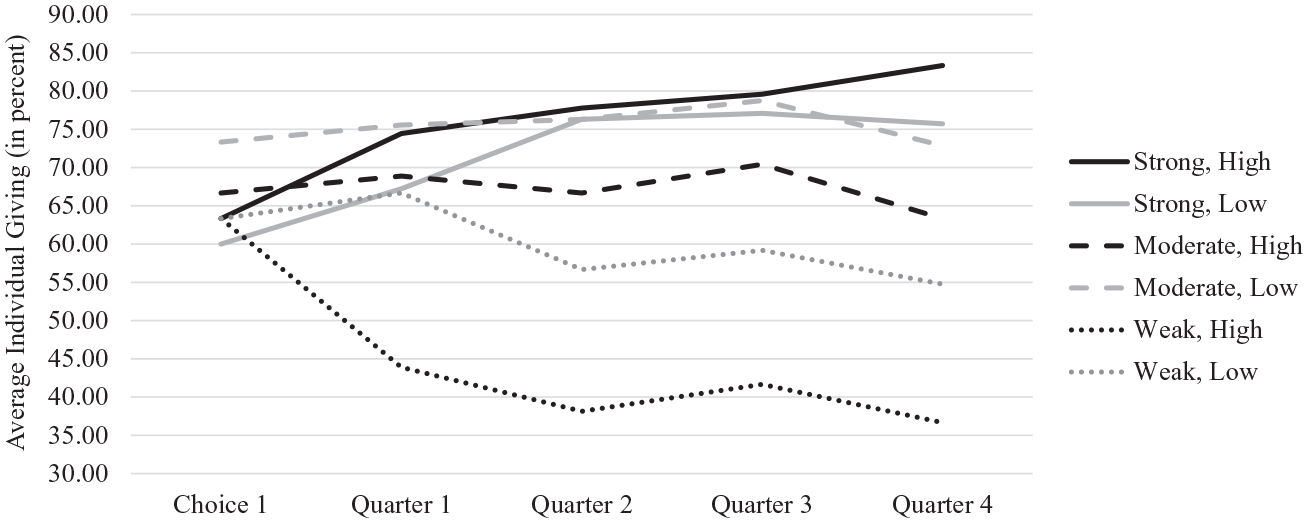
Interactive Effects of the Norm of Generalized Reciprocity and Risk on Individual Giving across Time
The models in Table 1 formally test the longitudinal effects of the strength of the norm of generalized reciprocity on giving decisions, as well as whether the effects were moderated by risk. For methods based on probabilities, such as logistic regression models, conclusions about conditional effects depend on the values of the independent variables where the comparison is made (Long and Mustillo 2018)—in this case, the opportunity number, the strength of the norm of generalized reciprocity, and the level of risk. I compare the predicted probabilities of giving across exchange opportunities for each level of the strength of the norm of generalized reciprocity at high and low risk.
Longitudinal Logistic Regression Results for Giving: Coefficients, Standard Errors, and Model Summary Information (N = 5,400)
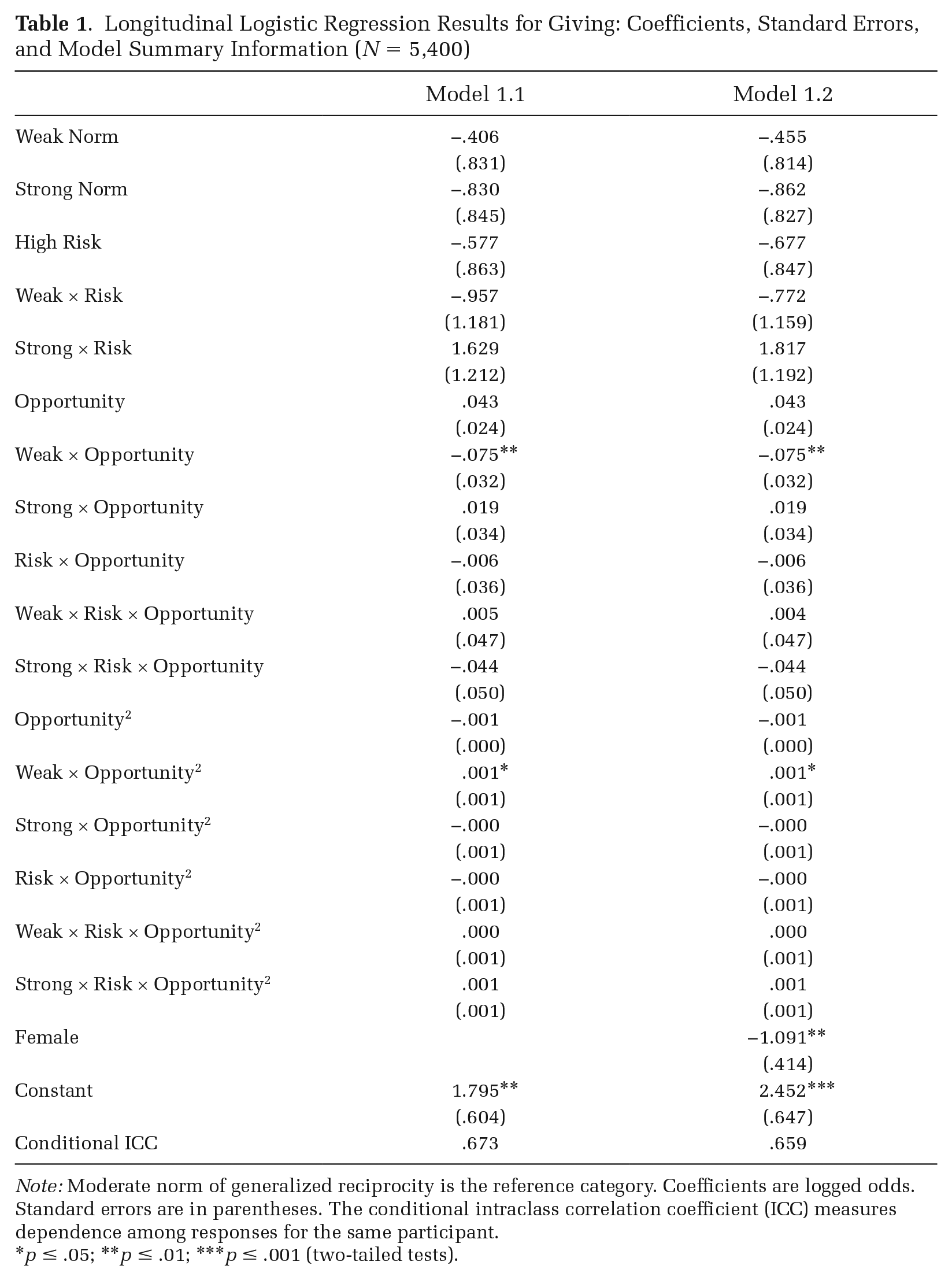
Note: Moderate norm of generalized reciprocity is the reference category. Coefficients are logged odds. Standard errors are in parentheses. The conditional intraclass correlation coefficient (ICC) measures dependence among responses for the same participant.
p ≤ .05; **p ≤ .01; ***p ≤ .001 (two-tailed tests).
The comparisons indicate that a weaker norm of generalized reciprocity, relative to a moderate norm, has a statistically significant negative effect on giving across time. This effect begins at opportunity 5 for the high-risk condition (ΔPr = −.175, p = .041) and opportunity 16 for the low-risk condition (ΔPr = −.200, p = .047), controlling for sex, and remains statistically significant for each of the remaining opportunities. The initial moderation effect of risk levels-off by opportunity 36, when the difference between the probability of giving in the weak-norm, high-risk condition versus the weak-norm, low-risk condition becomes nonsignificant (ΔPr = –.210, p = .051). Overall, the results show that the effects of a weak norm of generalized reciprocity were fast and damaging even in contexts of low risk (see Figure 3).
The comparisons indicate that a strong norm of generalized reciprocity, relative to a moderate norm, has a positive effect on giving across time, but only in conditions of high risk. The effect was statistically significant starting at opportunity 45 in conditions of high risk (ΔPr = .812, p = .044), controlling for sex, and remained so for the remainder of the opportunities. The effect was not statistically significant at any opportunity in conditions of low risk. These findings suggest that a context of higher risk may have inclined actors to give less, but after experiencing the group as a “container of generalized reciprocity” with some consistency, they may have felt their giving was likely to be returned and in response gave more to others. This effect was somewhat delayed, however, compared to the effect of a weaker norm of generalized reciprocity, suggesting the negative effects of a weak norm were more immediate than the positive effects of a strong norm.
The longitudinal models are mirrored by the first two models in Table 2, which assess the effects of the strength of the norm of generalized reciprocity on the percentage given in the second half of the experiment, as well as whether the effects were moderated by risk. Model 2.2 shows that a weak norm of generalized reciprocity, relative to a moderate norm, has a negative effect on giving in the second half of opportunities, and this effect is not moderated by risk. Participants in the weak-norm condition, relative to participants in the moderate-norm condition, gave 20 percent less in the second half of opportunities, controlling for sex. Probing the interaction between a strong norm of generalized reciprocity and risk by analyzing the simple slopes (Aiken and West 1991; Hayes 2018) (i.e., comparing the differences in predicted values between the strong-norm and moderate-norm conditions across both levels of risk while holding all other variables at their means), indicates that a strong norm of generalized reciprocity has a statistically significant effect on giving in conditions of high risk only. In conditions of high risk, a strong norm of generalized reciprocity, relative to a moderate norm, increases the percentage given in the final half of opportunities by 17 percent (p = .03), controlling for sex.
Regression Results for Mechanisms: Coefficients, Standard Errors, and Model Summary Information (N = 180)
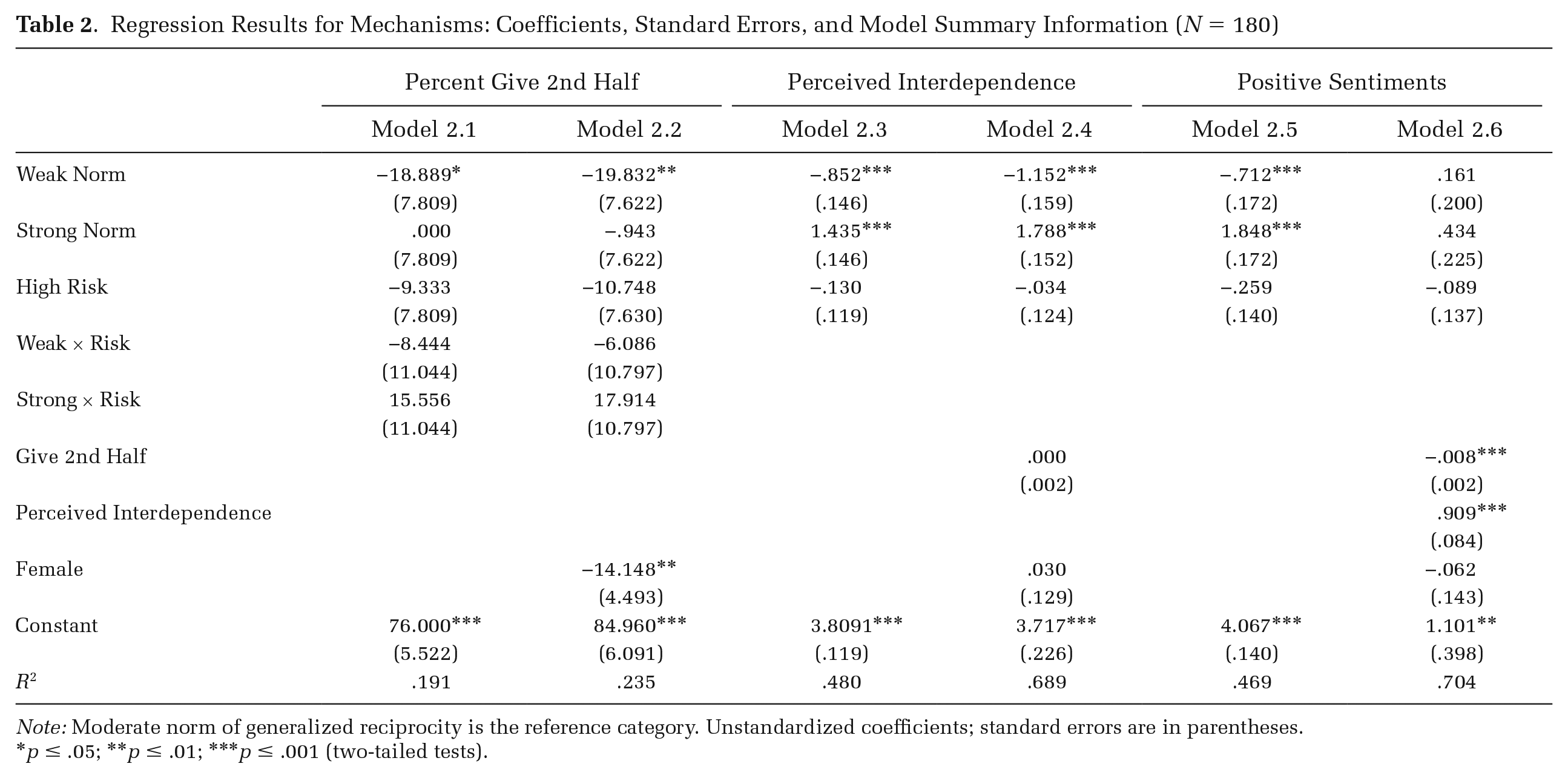
Note: Moderate norm of generalized reciprocity is the reference category. Unstandardized coefficients; standard errors are in parentheses.
p ≤ .05; **p ≤ .01; ***p ≤ .001 (two-tailed tests).
Results also show that women tended to give less than men. 5 The predicted probability of giving was about .251 [= e−1.091/(1 + e−1.091)] lower for women than for men (Model 1.2), and overall women gave 14 percent less than men in the final half of the experiment (Model 2.2). Supplemental analyses show these effects were also conditional on risk, with women being more strongly affected by risk than were men. This suggests women may give less to avoid risk, which is in line with previous research on sex and giving (Simpson and Van Vugt 2009).
Perceived Interdependence and Positive Sentiments
The remaining models in Table 2 present the regression analyses for perceived interdependence and positive sentiments. The first model for each outcome shows the isolated effects of the experimental manipulations on each variable with no covariates. The models indicate the strength of the norm of generalized reciprocity has a statistically significant positive effect on the theoretical mechanisms: a weaker norm, relative to a moderate norm, has a negative effect, whereas a stronger norm, relative to a moderate norm, has a positive effect. Risk has no effect on either mechanism.
The second model for each mechanism presents the conditional process analysis that formally tests Hypotheses 2, 3, and 5. Hypothesis 2 predicted that individuals’ generalized giving would have a positive effect on perceived interdependence. Model 2.4 shows this hypothesis was not supported. Results do support Hypothesis 3, which predicted the strength of the norm of generalized reciprocity would have a positive effect on perceived interdependence. When controlling for giving and sex, a weaker norm, relative to a moderate norm, reduces perceived interdependence by 1.152 points (on a seven-point scale), and a stronger norm, relative to a moderate norm, increases perceived interdependence by 1.788 points. These findings suggest receiving benefits (Hypothesis 3) may be more important than giving benefits (Hypothesis 2) for the formation of positive impressions of exchange partners as cooperative collaborators working together to produce a reliable system of generosity.
The results also support Hypothesis 5, which predicted perceived interdependence would have a positive effect on positive sentiments attributed to the group. Model 2.6 shows that a one-point increase in perceived interdependence increases positive sentiments by .909 points (on a seven-point scale). Interestingly, the model also shows that individuals’ giving had an unpredicted negative effect on positive sentiments. Perhaps this is because giving more raised the bar for feeling pleased (versus displeased), satisfied (versus dissatisfied), cared for (versus neglected), and treated well (versus being taken advantage of), which were the variables used to measure positive sentiments. The effect is small—every one-percentage-point increase in giving reduces positive sentiments by .008 points—but suggests giving did not have a positive effect on givers’ emotions, as previous generosity research has found (e.g., Dunn, Aknin, and Norton 2008).
Social Bonds
The models in Table 3 present the regression analyses for each of the four social bonds. The first model for each outcome shows the isolated effects of the experimental manipulations on each social bond with no covariates. For each outcome, results indicate a weak norm of generalized reciprocity, relative to a moderate norm, weakens the social bond, whereas a strong norm of generalized reciprocity, relative to a moderate norm, strengthens the social bond.
Regression Results for Social Bonds: Coefficients, Standard Errors, and Model Summary Information (N = 180)
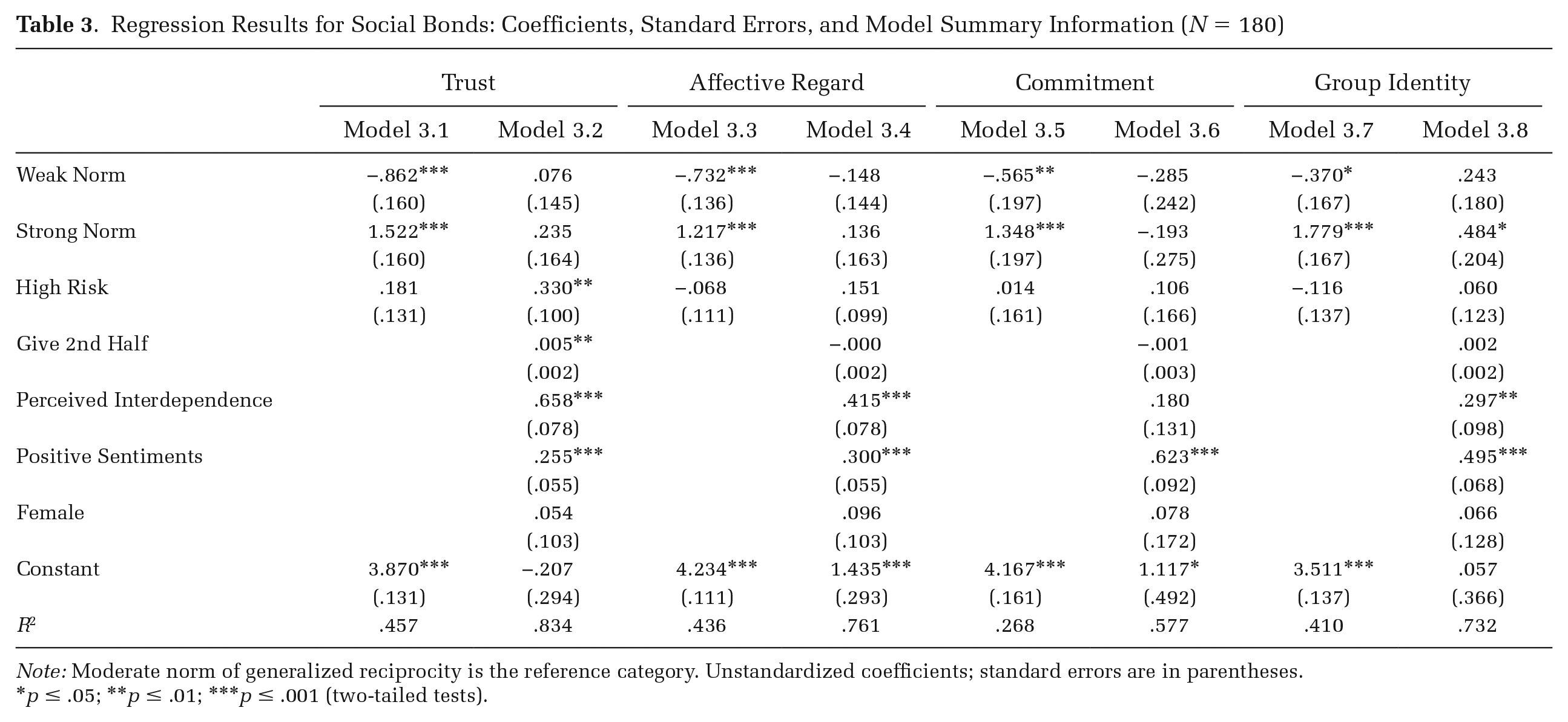
Note: Moderate norm of generalized reciprocity is the reference category. Unstandardized coefficients; standard errors are in parentheses.
p ≤ .05; **p ≤ .01; ***p ≤ .001 (two-tailed tests).
As predicted, the conditional process model results indicate these effects were mediated by perceived interdependence and positive sentiments. The second model in Table 3 for each bond presents the conditional process analysis results formally testing Hypotheses 4 and 6. As Hypothesis 4 predicted, the models indicate that perceived interdependence has a positive effect on trust, affective regard, and group identity; each one-point increase in perceived interdependence corresponds to a .658-point increase in trust, .415-point increase in affective regard, and .297-point increase in group identity (each on a seven-point scale). Perceived interdependence has no statistically significant effect on commitment, however. As Hypothesis 6 predicted, positive sentiments have a positive effect on each of the social bonds: a one-point increase in positive sentiments corresponds to a .255-point increase in trust, .300-point increase in affective regard, .623-point increase in commitment, and .495-point increase in group identity. Model 3.1 also indicates that giving has a small but statistically significant effect on trust, with each one-percentage-point increase in giving corresponding to a .005-point increase in trust. The model also shows that greater risk corresponds to a .330-point increase in trust. Finally, Model 3.8 shows that a strong norm of generalized reciprocity has a positive direct effect on group identity after accounting for the mediating mechanisms: a strong norm of generalized reciprocity, relative to a moderate norm, corresponds to a .484-point increase in group identity. This was the only remaining direct effect on any of the social bonds after accounting for the mechanisms, and the effect is in addition to mediated effects on group identity. This suggests receipt of benefits through generalized exchange has a strong effect on one’s sense of belonging to the group.
The conditional process model results for all seven indirect pathways are presented in Table 4. The models formally test the predicted serial mediation processes. Hypothesis 8 was supported: the predicted three-step pathway (Pathway 6: norm → interdependence → sentiments → bonds) is statistically significant for all the social bonds outcomes, with a strong norm of generalized reciprocity, relative to a moderate norm, leading to stronger social bonds, and a weak norm of generalized reciprocity, relative to a moderate norm, leading to weaker social bonds. This supports the theoretical arguments that interdependence (i.e., cooperative, joint action) and positive sentiments (i.e., expressive value and positive emotions) produce strong social bonds, in support of both the theory of reciprocity and affect theory. The results also support the argument proposed in the present study: a strong norm of generalized reciprocity can bridge the indirect reciprocity of generalized exchange with the interdependence of productive exchange, and this will build strong social bonds.
Conditional Process Model Results: Indirect Effects (N = 180)
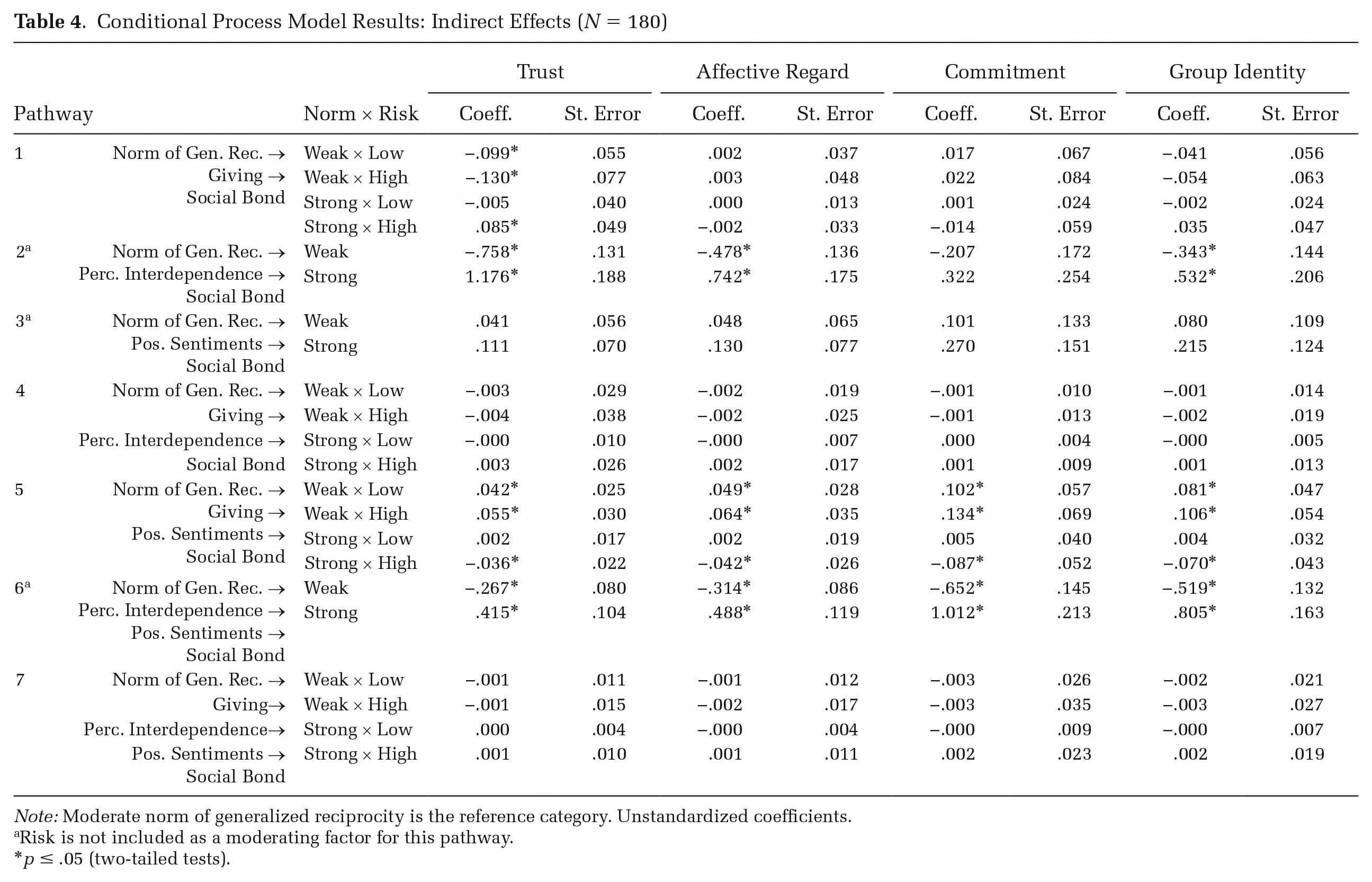
Note: Moderate norm of generalized reciprocity is the reference category. Unstandardized coefficients.
Risk is not included as a moderating factor for this pathway.
p ≤ .05 (two-tailed tests).
The argument is further supported by results indicating that, as predicted by Hypothesis 7, the strength of the norm of generalized reciprocity has an indirect effect on trust, affective regard, and group identity through perceived interdependence (Pathway 2: norm → interdependence → bonds), in addition to its effect on these bonds via the predicted three-step pathway (Pathway 6). This indicates the experience of the exchanges as cooperative, joint actions has a strong effect on trust, affective regard, and group identity. This effect was not statistically significant for commitment, however, which was more strongly affected by positive sentiments.
Hypothesis 9, however, was not supported: the predicted four-step pathway (Pathway 7: norm → giving → interdependence → sentiments → bonds) was not statistically significant for any of the social bonds outcomes because giving was not found to have a statistically significant effect on perceived interdependence. Moreover, the strength of the norm of generalized reciprocity was found to have an unexpected statistically significant negative effect on social bonds via giving’s negative effect on positive sentiments (Pathway 5: norm → giving → sentiments → bonds). A weak norm of generalized reciprocity, relative to a moderate norm, reduced giving, which positively affected positive sentiments, leading to stronger social bonds. Conversely, a strong norm of generalized reciprocity, relative to a moderate norm, increased giving, which negatively affected positive sentiments, leading to weaker social bonds, but only in conditions of relatively higher risk. Notably, however, trust was positively affected by the strength of the norm of generalized reciprocity via its positive effect on giving (Pathway 1: norm → giving → trust). A weak norm of generalized reciprocity, relative to a moderate norm, decreased giving and subsequently decreased trust, regardless of risk. A strong norm of generalized reciprocity, relative to a moderate norm, increased giving and subsequently increased trust, but only in conditions of higher risk. I discuss the implications of these findings in the conclusion.
Discussion and Conclusions
This study integrates two prominent but conflicting theories of social exchange by reconciling aspects of the most extreme divergence between the theories—their opposing predictions that generalized exchange will either produce the strongest social bonds (the theory of reciprocity) or the weakest social bonds (affect theory). I find complementarity in the theories, as have other scholars who have weighed in on other aspects of the theoretical debate (Collett and Avelis 2011; Kuwabara 2011; Willer et al. 2012). The theories predict social exchanges will build the strongest social bonds when the exchanges are indirect, as in generalized exchange (e.g., Molm, Collett, and Schaefer 2007) or when they are interdependent, as in productive exchange (e.g., Lawler et al. 2008). In this study, I integrated the mechanisms of both theories and incorporated research on generosity to propose a causal model predicting that a strong norm of generalized reciprocity would bridge the indirect reciprocity of generalized exchange with the interdependence of productive exchange, and this would lead to strong social bonds. By examining the dynamics between these two collective forms of exchange, the project sheds light on the foundations of generosity in groups, as well as the potential for a strong norm of generalized reciprocity to foster social connections and build community.
Results of a controlled laboratory experiment support my theoretical argument. A strong norm of generalized reciprocity bridged indirect reciprocity with interdependence in systems of generalized exchange to build stronger social bonds through two serial mediation pathways. First, a stronger norm of generalized reciprocity led to an evaluation of the exchanges as more interdependent (i.e., cooperative, joint actions), which led to more positive sentiments (i.e., positive emotions and expressive value), which in turn strengthened social bonds of trust, affective regard, commitment to the group, and identification with the group (norm → interdependence → sentiments → bonds). Conversely, a weaker norm of generalized reciprocity led to an evaluation of the exchanges as less interdependent, leading to less positive sentiments and weaker social bonds. The two-step pathway flowing just through perceived interdependence (norm → interdependence → bonds) was also statistically significant for trust, affective regard, and group identity, with a stronger norm leading to stronger social bonds and a weaker norm leading to weaker social bonds. These findings bridge the bonds-building mechanisms proposed by affect theory (Lawler et al. 2008; Thye et al. 2014) and the theory of reciprocity (Molm 2010; Molm, Collett, and Schaefer 2007), as well as other research on social exchange (Collett and Avelis 2011; Kuwabara 2011; Willer et al. 2012) and generosity (Smith and Davidson 2014; Wilcox and Dew 2016). This supports the theoretical argument proposed in the present study: a strong norm of generalized reciprocity can bridge indirect reciprocity with interdependence, and this can have prosocial consequences.
The results also show that the strength of the norm of generalized reciprocity has positive effects on additional behavioral investments in the group over time and that this effect may be moderated by risk. Over time, a stronger norm of generalized reciprocity promoted greater individual giving in conditions of higher risk. Risk generally reduced giving, but this effect was counteracted by a strong norm of generalized reciprocity. Individuals in higher-risk exchange systems with a stronger established norm of generalized reciprocity, who thus experienced more frequent receipt of benefits despite the risk involved, gave benefits more often in return, thus reinforcing the strong norm of generalized reciprocity. A weaker norm of generalized reciprocity, on the other hand, had a strong negative effect on giving at both higher and lower levels of risk, and this effect was relatively immediate. Thus, by driving down giving, a weak norm of generalized reciprocity was likewise self-reinforcing. These findings are in line with research suggesting generosity begets further generosity, and greed begets further greed (e.g., Fowler and Christakis 2010; Gray et al. 2014; Molm, Collett, and Schaefer 2007).
Taken together, the results show that the strength of the norm of generalized reciprocity can have powerful effects on group cohesion and members’ investments in the group. A strong norm of generalized reciprocity provides a sense of interdependence and reliability to the exchange process, such that the exchange system—the group, community, or network within which the exchanges are embedded—comes to be seen as a cohesive, trustworthy group that provides a shared, reliable resource of generosity, and this encourages further investments in the group. The sense of atomization associated with a weak norm of generalized reciprocity, however, damages group cohesion and trust and discourages further investments in the group.
There was one unexpected finding, however. The positive effects of the strength of the norm of generalized reciprocity on giving did not in turn activate the perceived interdependence and positive sentiments mechanisms that produce stronger bonds. Instead, the strength of the norm of generalized reciprocity had a negative effect on social bonds through giving and positive sentiments (norm → giving → sentiments → bonds), because giving had a negative effect on positive sentiments. This finding affirms the power of positive sentiments to affect social bonds, as both the theory of reciprocity and affect theory predict. However, it contradicts arguments about the positive effects of generosity for givers (e.g., Dunn et al. 2008). Although the negative effect of giving on positive sentiments was quite small, it reflects that the more one gives, the more one needs to receive in return to feel satisfied and treated well (as opposed to feeling taken advantage of). Participants in the strong-norm condition received from their simulated partners 75 percent of the time, which means they experienced noncooperation from their partners 25 percent of the time. Perhaps the more one gives, the worse one feels for each instance of noncooperation. It is also possible that the experimental setting may have highlighted competition in ways that a real-world interaction might not, compounding the effects of noncooperation. This strengthens the general argument that a stronger norm of generalized reciprocity can promote prosocial outcomes despite potentially competitive motives, but it may have dampened the potential for the act of giving to produce positive sentiments.
The act of giving did give rise to trust, however. The strength of the norm of generalized reciprocity increased trust by increasing giving (norm → giving → trust). This finding suggests norms, giving, and trust are highly connected, and giving may reflect some degree of trust. The results also show that greater risk led to greater trust. Risk is vital for building trust—one cannot demonstrate trustworthiness without a context of risk (Kollock 1994; Molm, Collett, and Schaefer 2007; Molm et al. 2009; Molm, Takahashi, and Peterson 2000).
The results also show that women may respond to the risk involved in generalized exchange differently from men. This is in line with previous research on sex and giving, which has found women are more likely to respond to the fear (of being exploited) component of social dilemmas, whereas men are more likely to respond to the greed component of social dilemmas (Kuwabara 2005; Simpson 2003). The results of the present study suggest the fear component was stronger in high-risk conditions, but the greed component remained consistent across conditions, prompting a reduction in giving from women in high-risk conditions but no comparable response from men. Future research should further examine these effects in contexts of generalized and productive exchange.
A limitation of this study results from a common feature of experimental social exchange research. Although the hypothesized causal relationships are theoretically grounded and logically consistent, the mediating mechanisms (perceived interdependence and positive sentiments) and outcomes (social bonds) were measured in the same post-experiment questionnaire. This means there is no way to be absolutely certain of the causal ordering of the relationships among these variables. Although not ideal, this is common practice in social exchange research testing mediation hypotheses (e.g., Schilke and Rossman 2018; Willer et al. 2012). Future studies might avoid this limitation with a series of questionnaires interspersed with the interaction (for a recent example, see Thye et al. 2019). The tradeoff is that such a strategy involves interruptions to the flow of the interaction and may alert participants to the nature of the study.
This study contributes to the sociological literature in several ways. The results provide important insight into the processes and potential outcomes of generalized and productive exchange, which has broad sociological relevance. Generalized exchange is a ubiquitous social process across the varied domains of social life, including work, community, family, and friend networks. Indeed, the generalized exchange process characterizes many of the social interactions that have prompted arguments about “the strength of weak ties” (Granovetter 1973). This study finds that generalized exchanges build social bonds and promote behavioral investments in the system, even in the absence of preexisting personal connections, avenues for norm enforcement, or concerns about reputation—the key motivations for prosocial behaviors (Simpson and Willer 2015). Moreover, the present study extends social exchange theory by assessing key theoretical mechanisms and their consequences in a process of pure-generalized exchange, a form of exchange that is quite common in everyday social life and is especially relevant for understanding processes of generosity in broader social contexts. Productive exchange, too, is quite common in social life, yet it has remained relatively understudied in the social exchange literature. Productive exchange is essential to successful collective action, and collaboration—the root of the productive exchange process—may be key to solving a host of social problems, from fighting crime (Zhao et al. 2006) to mitigating climate change (Stern 2008).
The present study addressed a persistent theoretical puzzle in the social exchange literature: how to reconcile the question of whether, and how, generalized exchanges build strong social bonds. Future work could extend this effort by comparing the generalized exchange process with an otherwise comparable system of productive exchange. This would allow a direct comparison of how generalized exchange and productive exchange affect social bonds, perceived interdependence, positive emotions, and giving.
The results of this study contribute to the broader sociological literature on generosity and cooperation. Results align with arguments that generosity does not have to be motivated by altruism (e.g., Smith and Davidson 2014). Giving to others in a system of generalized exchange can come to resemble a productive exchange context in which contributors can expect rewards in return from the collectively-produced, shared resource of reliable giving within the group (see also Yamagishi and Kiyonari 2000). The exchange of generosities in such a context thus allows for participation based on both altruistic motivations (i.e., giving without concern for returns to self) and rational-choice motivations (i.e., giving with the expectation of returns to self).
This study was designed to examine generalized generosities in the absence of avenues for norm enforcement (e.g., reputation systems). Future work could build on the results of this study by engaging with literature on conditional cooperation (e.g., Bendor and Swistak 2001; Fehr and Gachter 2002; Flache 2004; Nowak and Sigmund 1998, 2005; Takahashi 2000) to examine how an enforced norm of generalized reciprocity may affect perceived interdependence, positive sentiments, or social bonds. Research suggests enforcing giving through reputation systems may undermine social bonds including trust (Kuwabara 2015), but future research might identify strategic norm enforcement strategies that avoid such effects by strengthening other mechanisms such as perceived interdependence.
The results of this study also contribute to the study of social capital, sense of community, and collective action. As the results demonstrate, “generalized generosities” may reinforce the norms of reciprocity and trust that are essential to networks of social capital (Putnam 2000). The findings also suggest that these small acts of giving can generate what Lawler and colleagues (2008) call a micro social order, characterized by recurrent interactions, emotional reactions, perceptions of groupness, and affective sentiments. Thus, generalized generosities can have a powerful effect on social connections and sense of community. They may also help to facilitate collective action. The experimental manipulation of the strength of the norm of generalized reciprocity is similar to the real-world experience of moving to a new community or joining a new organization characterized by an established norm of generalized reciprocity that is strong, weak, or moderate. Future research could compare processes of generalized exchange in established groups with a given level of generalized reciprocity, which, given the findings of this study, may help predict the success or failure of group attempts at collaborative collective action. Future research could also study potential interventions for strengthening the norm of generalized reciprocity in groups. For instance, previous research suggests social bonds such as group identity may promote greater giving (e.g., Whitham 2018; Yamagishi and Kiyonari 2000), which suggests avenues for potential interventions for motivating generosity, perceived interdependence, and collective action, such as strengthening group identity with team-building activities.
This study focused on the connective value of relatively small, anonymous generosities in generalized exchange systems. The results suggest that even low-cost generalized exchanges, such as the “random acts of kindness” promoted in popular culture, can have important prosocial consequences. The next step is to assess the causal argument supported in this experimental project in preexisting groups outside the laboratory, such as organizations or communities. A strong norm of generalized reciprocity may effectively scale up the bonds-building benefits of productive exchange to the larger collective, such that investments made by individuals will, eventually, flow back to them, thus reinforcing the positive value of community membership and motivating further investments in the community. In this way, generalized generosities can, indeed, make a difference.
Footnotes
Acknowledgements
I gratefully acknowledge Hannah Clarke for her generous feedback on the ideas presented in this work. I thank Heather McLaughlin, Kelley Sittner, the anonymous reviewers, and the ASR editors for detailed and helpful comments on this paper. I thank Kaylind Baker, Tristen Cook, Erin Elsenbeck, Ben Maes, and Kelsey Pierce for their capable assistance with data collection.
