



Abstract
The contribution of this study is to disclose the main determinants of the duration of the U.S. antitrust federal court decisions, an issue that has been nearly overlooked by most related studies. As an indirect measure for the time needed to dispose cases, this study uses the duration of the case from the filing of the complaint to the date of the opinion. Using this metric, we employ parametric and nonparametric panel data techniques on a sample of 613 appellate court proceedings on U.S. antitrust cases during the period 1995–2018. The empirical research reveals spatial heterogeneity in terms of case duration among the circuits of the appellate U.S. courts. The econometric analysis supports that the duration of appellate antitrust court decisions depends on administrative-related factors including the way the case was filed in the circuit, the jurisdiction in the case, the “pro se” representation of the undertakings, and the nature of the final judgment. Lastly, based on the flexible semi-parametric analysis, we argue that the impact of these parameters on case duration is linear, regardless of the specification of the parametric part of the model.
I. Introduction
. . . Justice too long delayed is justice denied. (Martin Luther King Jr.)
It is widely accepted by judges, lawyers, and legal professionals that the duration of appellate court proceedings is one of the most important drivers of judiciary efficiency. 1 The speed and accuracy at which the court decisions are issued and implemented to the “stakeholders” (e.g., corporations and individuals) constitute the cornerstone of a coherent and efficient judicial system, thus contributing to the long-run economic growth. 2
Although antitrust legislation dates to 1890 when the Sherman Act shaped the legal framework for price-fixing agreements (Section 1 of the Sherman Act), best known as “cartels” and abuse of dominance (Section 2 of the Sherman Act), little is known about the key determinants of the duration of appellate court investigations for antitrust cases. 3 A deeper knowledge of these parameters could assist the workload of the two U.S. competent agencies (Federal Trade Commission and Department of Justice [DoJ]) to reach administrative and judiciary goals. 4 Moreover, it would also help the undertakings (appellants and appellees) to allocate their (scarce) resources (e.g., time, money, labor hours) during the process of an appeal before a U.S. circuit. 5
According to the workload statistics of the Antitrust Division of the U.S. DoJ during the fiscal years 2010–2019, the number of total investigations initiated has shown a significant increase equal to 16.5 percent (from 115 cases in 2010 to 134 cases in 2019). 6 From a comparative perspective, it is noteworthy that during the same period, the total number of antitrust case investigations examined by the European Commission showed a decline equal to 18.3 percent (from 169 cases in 2010 to 138 cases in 2019). 7
Of the separate types of antitrust investigations (e.g., restraint of trade, monopoly, mergers, others), merger cases of the Clayton Act (see Section 7) are the most prominent ones, since their number has shown an increase reaching seventy-two cases in 2019 compared to sixty-four cases back in 2010. 8 However, this overall increasing trend does not reflect an analogous rise in the total amount of fines and penalties imposed since, within the same period, the total fines imposed by the DoJ exhibit a 25-percent decrease (from $343 million in 2010 to $257.2 million in 2019), while the average number of years of incarceration has declined on average by approximately 80 percent (from two years and six months in 2010 to six months in 2019). It must be noted though that, during the last two fiscal years (2018–2019), the total amount of fines and penalties imposed for antitrust cases has reached almost 29 percent (from 199.3 million to $257.2 million in 2019).
Based on the aforementioned data, the convicted firms for breaching antitrust violations incur significant incentives to stand before the appellate courts (e.g., the Court of Appeals and Supreme Court), to rule out the decision imposed by the antitrust agency. 9 This is driven mainly by two main reasons including the reduction of the occurrence of legal errors and the refinement of existing case law and regulations. 10 Interestingly, comparing the latest numbers of first-stage appeals (Court of Appeals) in U.S. antitrust cases reveals a significant increase, from forty-three appeals in the 2000–2009 period to fifty-nine appeals in the 2010–2019 period (+37.2%). Similarly, the number of second-stage appeals (Supreme Court) has dramatically increased (+128.6%) during the last ten years (from twenty-eight in the period 2000–2009 to sixty-four in the period 2010–2019).
The scope of this study is to examine the key drivers of investigation length made by the district courts regarding the antitrust cases appealed before the U.S. court circuits over the period 1995–2018. To quantify these parameters, this work employs parametric and semi-parametric panel data techniques on a sample of 613 antitrust cases.
The relevant study contributes to the literature on many fronts. To the best of our knowledge, this is the first study focusing on the main determinants of the duration of the U.S. antitrust federal court decisions, an issue that has been nearly overlooked by a few strands of related literature. 11 Second, it uses an extensive publicly available dataset on the U.S. court caseload and case disposition times for antitrust cases provided by the U.S. Federal Judicial Center (FJC). Third, it goes beyond the existing literature since it employs flexible semi-parametric techniques to examine this research problem. In this way, we do not impose functional form restrictions on the model specification (e.g., linear, quadratic, and so on). The reason for relying on a “hybrid” econometric model where some of its explanatory variables enter in a nonlinear form, is justified by the fact that only in rare cases, the economic theory implies a particular functional form for an empirical model specification. 12 Besides, an incorrect parameterization of the regression equation might result in inconsistent estimates. 13 Therefore, we let the data reveal the structural relationship between the sample variables. 14
The empirical findings support that the duration of appellate antitrust court decisions depends on administrative-related factors including the way the case was filed in the circuit, the jurisdiction in the case, the “pro se” representation of the undertakings (i.e., when parties appear on their behalf), and the nature of the final judgment. Based on the flexible semi-parametric analysis, we argue that the impact of these parameters on case duration is mildly nonlinear, regardless of the specification of the parametric part of the model.
The remainder of the paper unfolds as follows. Section 2 discusses the related literature. Section 3 describes the sample selection and the variables used in the empirical analysis, while special attention is given to the research design and the formulation of research hypotheses. Section 4 discusses the empirical findings drawn from the parametric and nonparametric econometric analysis. Lastly, Section 5 summarizes the main results of the study offering some useful policy implications for undertakings and government officials (e.g., antitrust agencies), while focusing on future research.
II. Literature Review
Despite the profound interest in this topic induced by lawyers, judges, economists, and competition authorities, scarce attention has been paid to the examination of the main determinants of the duration of court decisions. However, during the last two decades, little literature on the relationship between the settlements and appeals has emerged. 15
In a related study that also uses the same dataset as our work, there is an attempt to investigate what type of information (other than legal doctrine or judicial philosophy) allows the researchers to predict what a court will do. 16 The relevant study uses data from transcripts of oral arguments over the period 2004–2007. Data contain counts of questions and total words asked in each case, broken down by party and justice. They argue that the losing party gets on average about five to six more questions and about 150–200 more words worth of questions than the winning party. In other words, they argue that the party that asked more questions during oral arguments in the U.S. Supreme Court is more likely to lose. Moreover, they claim that the U.S. Supreme Court decides cases that may have big effects on industries or interest groups, so predicting outcomes has high stakes. The empirical findings are consistent with two different models of judging. The first refers to the “legalistic” theory demonstrating that correlation is due to judges being bothered by objectively weaker arguments and asking more questions to probe them. The second is connected to the “realistic” theory, posing that the correlation is due to judges signaling votes to each other or the public.
In a similar vein, another study explores possible explanations for the low appellant win rate in civil cases in U.S. Federal courts over the period 1980–2009. 17 The study uses ordinary least squares (OLS) regression analysis accepting that the main reason for the falling win rate remains unexplored. To this end, this work argues that courts may need to justify decisions not only in individual cases but also at a systemic level.
In a more related setting, another study examines the main factors justifying the investigation length of the Greek courts (upper and lower courts of the first instance, appeals courts) to dispose cases. 18 By using the ratio of cases remaining at the end of the year to total cases as the main dependent variable, they employ time series econometric techniques (i.e., SURE FGLS estimators) to assess the impact of the main determinants of case disposal over the sample period 1970–2002. The study reports a steady increase in the duration of case disposal over the sample period. The empirical analysis dictates that the lack of sufficient staffing for a given caseload is negatively correlated with judiciary efficiency, revealing a slow disposition of cases in appeals courts and higher civil trial courts, but not in lower civil trial courts or administrative courts.
In another study, the driving forces of the duration of the merger decisions issued by the New Zealand Commerce Commission for the period 2001–2010 are investigated. 19 The analysis applied employs a semi-parametric analysis namely the Cox proportional hazard model for a dataset of over 130 merger decisions. The empirical findings indicate that the key drivers that formulate the merger case duration are related to the nature of the decision, the size of the application, the potential impact on competition, proxied by structural industry indicators (market concentration, barriers to entry), the complexity of the economic analysis, and the Commission’s merger workload. The relevant study argues that there is a differentiation in the impact and intensity of these factors. They also support that declined decisions are much more time-consuming since declines can lead to an appeal to the High Court by the parties (appellants, appellees).
In related work, the determinants of the duration of cartel enforcement decisions issued by the European Commission over the period 2000–2011 are assessed. 20 This study exemplifies several key drivers of investigation length including inter alia the speed of cartel detection, the type of cartel agreement (horizontal, vertical), the scrutinized industry, and the cooperation of the undertakings with the European Commission. The study relies on time series analysis arguing that both the number of cartel members and the number of national countries involved in the cartel do not impose a significant effect on case duration.
In the most related work to ours, an extensive dataset comprising 263 appeal decisions on fifty-four cartel-convicted cases by the European Commission over the period 2000–2012 is employed to investigate the determinants of the duration of the appeals process. 21 The empirical findings indicate asymmetric effects regarding the main drivers of the duration of court decisions. It is argued that the investigation length of the court of the first instance (General Court of the European Union) cartel decisions is statistically significantly correlated with several explanatory variables such as the complexity of the case, the clarity of the applied rules and regulations, and previous or simultaneous U.S. investigations. However, the second-stage appellate court (European Court of Justice [ECJ]) proceedings appear to be largely unaffected by those drivers.
In another study, the impact of regulation on courts’ performance by using data regarding regulatory cases and appellees filed in U.S. district courts is investigated. 22 The empirical findings signify the increased reliance on regulation, which leads to growth in regulatory court cases. Based on their results, it is highlighted that the courts continue to play an important role regarding institutional quality especially when regulation is retained to tackle litigation problems.
Lastly, in a subsequent study, data from Brazil’s state courts over the period 2009–2014 are employed to disentangle judicial productivity following a two-stage approach. 23 In the first stage, they use the merits of Data Envelopment Analysis as a flexible nonparametric technique to calculate Malmquist productivity measures (e.g., technical change and pure and scale efficiency change). In the second stage, they apply panel data fixed-effects regression analysis to quantify the impact of key determinants of judicial productivity growth. The empirical findings reveal a slight increase in judicial productivity trend, driven mainly by efficiency change, and an absence of a significant correlation between judicial quality and efficiency improvement. In addition, other drivers of judicial productivity include judges’ remuneration, legal complexity, and technological use.
III. Data and Methodology
A. Data Curation and Sample Selection
We have compiled an unbalanced panel dataset of more than 600 antitrust cases filed from 1995 to 2018, collected and published by the Administrative Office of the United States Courts (AOUSC) appeared in the Integrated Data Base (IDB). 24 The latter is provided by the FJC, which is the research arm of the United States Courts and includes all federal court cases. The IDB contains data on the civil case and criminal appellee filings and terminations in the district courts, along with bankruptcy court and appellate court case information.
Specifically, the FJC receives quarterly updates of the case-related data that are routinely reported by the courts to the AOUSC and published in the Judicial Business Reports. The FJC then post-processes the data, consistent with the policies of the Judicial Conference of the United States governing access to these data, into a unified longitudinal database, the IDB.
The basic data elements available on the cases included in each version of the IDB are essentially the same. The circuit and district in which the case was filed, the office code, and the docket number combine to create a unique case identifier. Dates of filing and termination (if applicable) are available in each case, as is the type of termination. Apart from these common fields, the information in each IDB file includes the case-level information relevant to each area of litigation. In the civil files, information on the nature of the suit, jurisdiction, origin codes, the names of plaintiffs and defendants, class action allegations, the procedural progress of the case at termination, and the nature and amounts of judgment are all included in the files.
To analyze only the antitrust cases over other civil data categories (e.g., civil rights, contract, torts, fraud, real property, and so on), there is a variable identifying the subject matter of the case, and antitrust cases have a separate designation. 25 This variable includes only civil cases and not criminal cases. The IDB is organized by the fiscal year in which each case was terminated. However, the database does provide filing dates for all cases, and thus, one can easily create a panel dataset constituting a census of all antitrust cases filed on any given date spanning the period 1995–2018. To limit our attention to the effectiveness of the U.S. antitrust authorities, the sample excludes from the analysis private litigation (i.e., cases not involving the government as a party).
The primary selection of the U.S. antitrust cases reported almost 3,410 cases. However, we limit our sample to 609 cases since the date the district court received the final judgment of the case was missing (“termination date”) in most of the originally reported antitrust cases. Regarding the disposition of the sample, it is highlighted that we only include settled cases and not cases transferred to another district or remanded to a state court or U.S. agency.
Table 1 provides a detailed overview of the names, types, definitions, and descriptions of the sample variables broken down into three separate categories (time, spatial, and administrative-related variables).
Description of the Variables Used in the Empirical Analysis.

Source. Federal Judicial Center, Integrated Data Base, Civil Documentation, and authors’ elaboration.
The dataset does not include private antitrust litigations.
Table 2 presents the descriptive statistics for the sample variables. As it is evident, the variable denoting the case duration measured in days (duration) exhibits the highest variation among the other variables, which is to be expected for the only integer variable of our model (see panel A). The average delay of the U.S. appellate court decisions is roughly 1.8 years (647 days or 21.6 months). 26 However, there is a significant variation in the investigation length between first- (General Court [GC]) and second-stage appeals (ECJ). In the courts of the first instance (GC), the average case duration is nearly fifty-one months, while in the second-stage appeals court (ECJ), it decreases to twenty months approximately. 27 The median of the distribution for case duration is lower and estimated to be 540 days (nearly 1.5 years). This means that 50 percent of the distribution of the related variable (duration) lies below the specific value (540 days), and the rest is above this “threshold.” Since the (arithmetic) mean is greater than the median, the distribution is not symmetric. The relevant finding can be confirmed by the visual inspection of Figure 1. It is obvious the curvature of the dependent variable does not follow the normal distribution (see the thin blue line in Figure 1) since it is skewed on the right.
Descriptive Statistics for the Sample Variables.

Note. Panel A presents the summary statistics for the sample variables over the whole sample, while panel B generates descriptive statistics for the average case duration for each of the eight distinct sub-samples reported in brackets. Duration denotes the average investigation length of the case (measured in days). Duration (logged) denotes the natural logarithm of the average investigation length of the case. Origin denotes the way the case was filed in the court district. Jurisdiction denotes if the governmental body (U.S. government, DoJ, FTC, federal state) is the appellant or the appellee before the U.S. district court. Proceeding reports if either the appellant or the appellee is proceeding “pro se” or are represented by third parties before the U.S. district court, and Nature denotes the nature of the final judgment (monetary or non-monetary judgment). DoJ = Department of Justice; FTC = Federal Trade Commission.
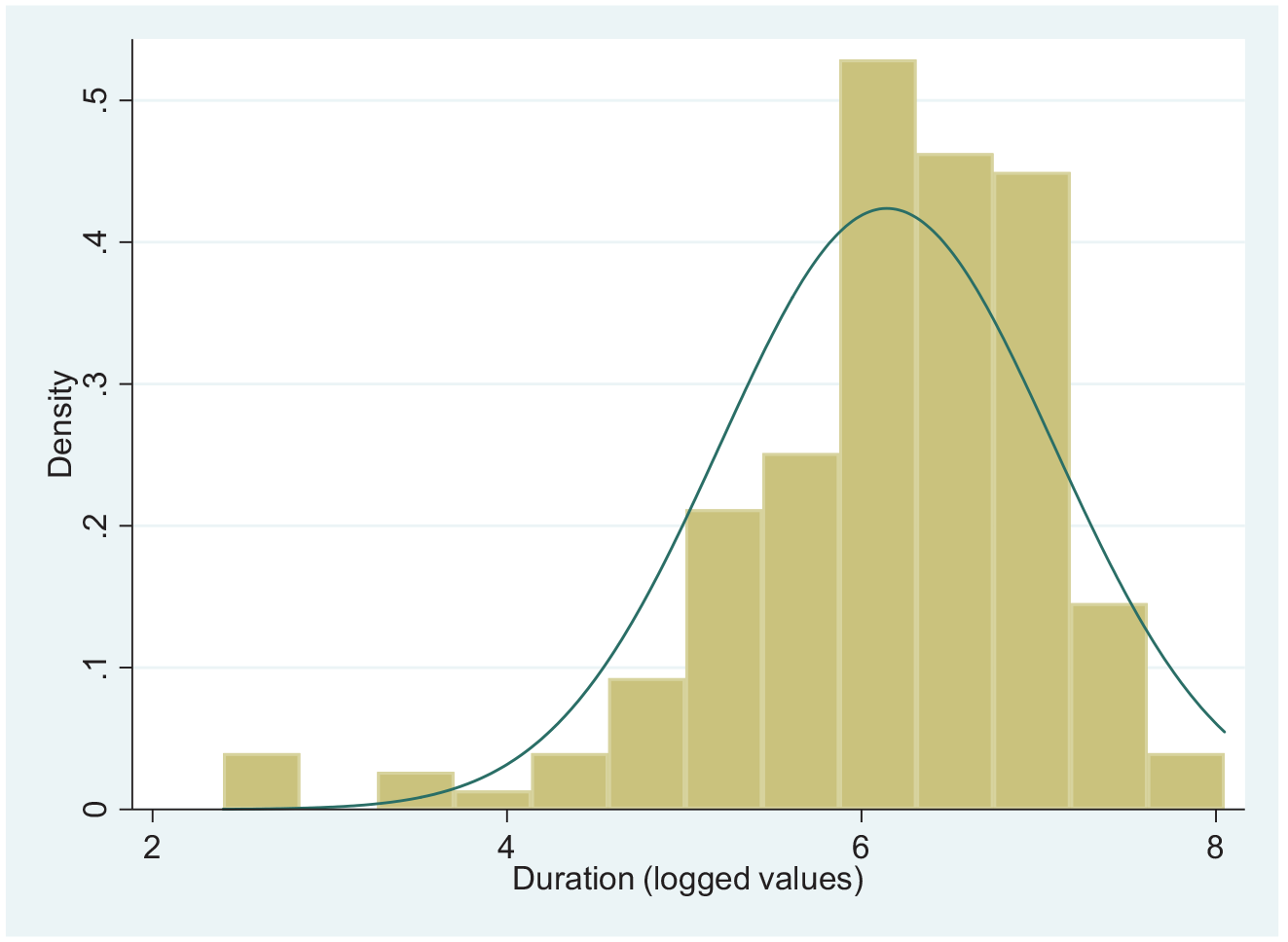
Histogram of the dependent variable (case duration in logged values).
The asymmetry is also confirmed by the positive value of the skewness measure, which is calculated to be 1.726, indicating a positively asymmetric distribution. As indicated earlier, the relevant variable exhibits substantial variation around its mean, within a spectrum of eleven days to 3,130 days or 8.6 years. Most of the rest variables are negatively skewed, (e.g., logged values of duration, origin, and nature) following a leptokurtic distribution.
Panel B reports summary statistics for the average case duration separately for each of the sub-sample (e.g., “pro se” and represented parties, original proceeding cases, and so on). By splitting the whole sample into different sub-samples, one can easily check what the average numbers look like in the data. This separation may also reveal potential issues with the coding of the variables. If we carefully look at the relevant table, some interesting results emerge. First, if we limit the sample to cases where governmental agencies (e.g., Federal Trade Commission [FTC], DoJ, state courts, federal government) are appellants, the average case duration drops to less than one year (254 days). On the contrary, when the sample includes only antitrust cases where the governmental body is the appellee, the case delay reaches almost two years (658 days). This “asymmetric” effect is further validated by the empirical analysis as it is presented in a subsequent section of the paper. Second, the duration of the cases significantly increases to approximately 1.2 years (435 days = 824–389) when the parties are represented by themselves (“pro se” parties), while in the opposite case, the average time duration barely exceeds one year (389 days). Third, the highest delay (nearly 2.4 years or 863 days) in the appellate court decisions is evident when the sample does not include monetary award cases (see the last line of panel B). Lastly, the duration variable in all the sub-samples is positively skewed and follows a leptokurtic distribution (e.g., sharply peaked with heavy tails) since all the kurtosis values are positive.
Having analyzed the main descriptive statistics of the sample variables, the analysis proceeds with the visualization of the main variable of interest (duration). Figure 2 presents the boxplot of the investigation length (Duration) broken down by the competent circuit in which the case was filed (twelve circuits in total).

Boxplot of the investigation length of the court decision per circuit.
As it is evident from the relevant figure, the Second, Fourth, and Tenth circuits exhibit high variability in terms of case duration, while the First, Seventh, and Ninth present almost the least variability within the sample (see also Figure 3). Moreover, the distribution of case duration for some of the court circuits is characterized by a tail, or it is skewed to the right (i.e., toward the large number of days taken to issue the decision). This is most evident in the Tenth and Eleventh judicial circuits where the maximum average case duration exceeds two years (more than 1,000 days). The relatively slow disposition of cases in these appellate courts could be attributed to the heavy caseload combined with the lack of sufficient staffing. 28 The opposite holds for the First, Seventh, and Ninth circuits which seem to be more “efficient” in terms of case speed than the previous ones since the average case duration does not exceed one year.
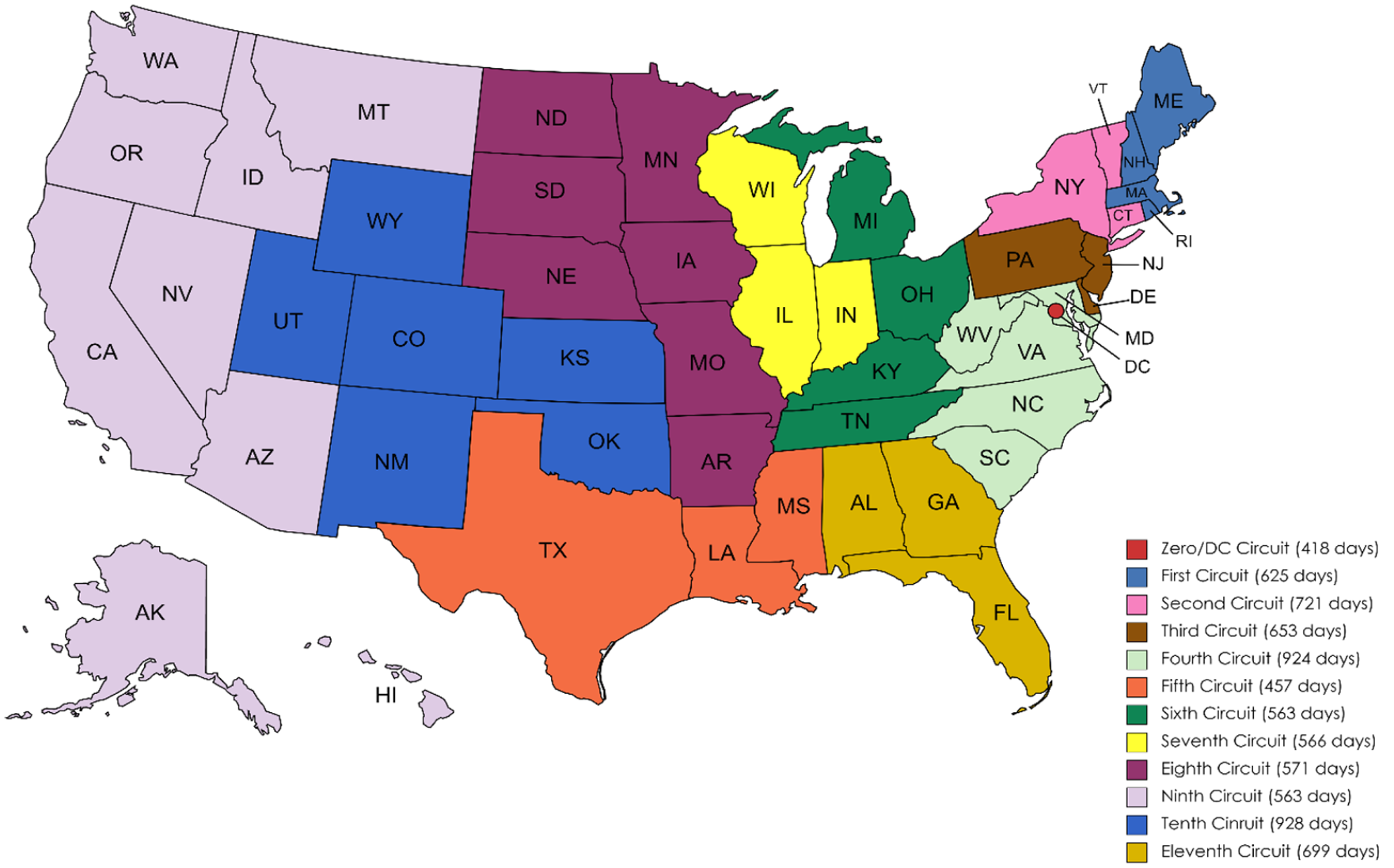
Average antitrust case duration (days) in each U.S. circuit over the period 1995–2018.
Lastly, Figure 4 presents the kernel density plot of the case duration for all the U.S. appellate court circuits. 29 The main reason for relying on the nonparametric kernel distribution function for fitting the data is related to the absence of a normal (Gaussian) distribution of the sample variables (see the last column in Table 1). Moreover, Kernel density estimates have the advantage over other graphical approximations (i.e., histograms) of being smooth and independent of the choice of origin corresponding to the location of the bins in a histogram. It is noteworthy that the application of the nonparametric kernel distribution function for fitting the data is a standard approach frequently used by researchers for data sets that are not normally distributed (e.g., any standard parametric distribution).

Kernel density estimate for the duration of the court decisions.
As it is evident from the relevant figure, there is a large variation in days that creates a deviation of the distribution from normality (left-skewed). The largest mass of the case court delay is concentrated around one and a half years (almost 500 days), but a substantial amount is also concentrated around the 1,000-day interval, while the remaining part of the distribution is extended beyond the two years. The Kernel density scatterplot is in alignment with the descriptive statistics of the sample variables (see Table 1—panel A).
B. Research Design
To investigate the determinants of the duration of the court appeals decisions, we use the following (reduced-form) equation:

where Durationit denotes the average case duration (measured in days) of each case per circuit i = 0,1,. . .11 at time True = 1995,1996, . . ., 2018. This variable is a proxy for the duration of the case from the filing of the complaint to the date of the decision. 30 Origin denotes the way the case was filed in the court district. The variable takes value one if the case constitutes an original proceeding and zero otherwise. Jurisdiction denotes if the governmental body (U.S. government, DoJ, FTC, federal state) is the appellant or the appellee before the U.S. district court. The variable takes value one if the basis of jurisdiction is the U.S. government appellant and zero if the basis of jurisdiction is the U.S. government appellee. Proceeding reports if either the appellant or the appellee is proceeding “pro se” or is represented by third parties before the U.S. district court. The variable takes value one if either the appellant or the appellee is proceeding “pro se” and zero if they are represented by third parties (attorneys). Nature denotes the nature of the final judgment (monetary or non-monetary judgment). The relevant variable takes value one if the case incurs a monetary award only and zero in all other (non-monetary) cases. Trend denotes the (linear) time trend accounting for the unobservable impact of technological change in the case court process, and Trend-squared is the quadratic time trend. Moreover, ε it is the error term.
To account for the unobserved heterogeneity, we control for circuit, district, and time fixed effects (e.g., three sets of fixed effects). 31 Specifically, n i is the unit-specific residual that differs between circuits but remains constant for any circuit (circuit dummies), while μj is a vector of dummies for each district except for one (district fixed effects). Similarly, to the circuit fixed effects, the district fixed effect is modeled as a district-specific intercept that does not vary over time. 32 The vector v t consists of time dummies (time fixed effects) that control for underlying observable and unobservable systematic differences between observed time units. Time fixed effects differ across years but are constant for all circuits in a particular year. The latter are standardly obtained using time-dummy variables, which control for all time unit-specific effects. All the parametric models were estimated using both fixed and random effects, but the random effects estimator was rejected based on the Hausman test (see Hausman, 1978). We thus report fixed-effects estimates only.
One could use an additional set of explanatory variables including inter alia the fee status (“Informa Pauperis”), the monetary amount demanded, the county of residence, the procedural progress, and the termination class action. However, due to severe data constraints, our analysis is limited to the related independent variables employed in this study (see Equation 1).
The aforementioned explanatory variables directly or incidentally affect case duration. However, there might be a reverse causality issue. For example, the nature of the final judgment affects case duration, but it might also be possible that the duration of the case will be what affects the nature of the final judgment. Similarly, there is a difference in duration across U.S. court districts, but the government may be making strategic decisions about which types of cases to file in which districts (e.g., anti-competitive conduct vs merger cases). Then, it is not something about the district that is causing the duration, but it might be that cases with a certain complexity are more likely to be filed in certain jurisdictions. Consequently, the causal direction could be unrelated to or even in the reverse direction of what is claimed by the study. To deal with possible reverse causality issues, we re-estimate our model by using Generalised Method of Moments (GMM) techniques that also address endogeneity.
C. Formulation of Research Hypotheses
In this section, we develop the research hypotheses on possible determinants of the duration of the appeals process in U.S. antitrust cases. We build our framework around the four main administrative-related variables (explanatory variables). We provide several testable results based on the specific dataset that does not allow for the inclusion of other key determinants such as the education profile or the career incentives of judges. Our empirical analysis, though not guided by a strong theoretical model but relies on the findings of several empirical studies, tests four distinct research hypotheses fully described in the following sections.
Specifically, the duration of the appeals process might depend on the origin of the case that is filed before the U.S. court circuit. This happens since, ceteris paribus, it might take more time for the court to fully investigate the arguments raised by the legitimate parties (e.g., appellants, appellees) in a reinstated or reopened case than in an original proceeding case. Moreover, it is reasonable to assume that judiciary delays might occur should a case be transferred from another district. Similarly, if a case falls within the scope of multi-district litigation, it might take more time for an appellate circuit to reach a decision. 33 Besides, the types of antitrust cases that are appealed before the U.S. appellate courts tend to be relatively complex, and this could justify an increased investigation length. The complexity of antitrust litigation and the fact that most appellate court cases are decided by generalist judges not specialized in the interdisciplinary object of competition law increases the court duration. 34 Therefore, it is straightforward to hypothesize the following:
Another determinant of the case duration refers to the jurisdiction of the case. The investigation length might likely be affected by the fact that the U.S. governmental body (FTC, DoJ, the federal government, and so on) is the appellant or the appellee in the case. In a related empirical study dealing with cartel cases, it is argued that the case duration of the appeals process before the European appellate court seems to decrease with the level of leniency discount granted to a group of appellants. 35 This happens since the antitrust authority (i.e., Directorate-General for Competition in the European Union) has more detailed information on the case and is, therefore, able to close it sooner. Therefore, we may argue that the investigation length of an antitrust case decreases (increases) when the governmental body acts as the appellant (appellee) provided that a leniency program is active and granted to the undertaking companies. For this reason, we attempt to test the following hypothesis:
In a recent study, a negative and statistically significant structural relationship between a “pro se” appellant and the successful outcome of the case is provided. 36 In other words, they argue that a “pro se” appellant proceeding reduces the appellant win rate, whereas an (appellant) third-party representation has the opposite outcome. As a result, it is likely to assume that there might be a connection between the case duration and the “pro se” representation of the parties (appellants and appellees) involved in the case. The duration of the appeals process might be extended when the undertakings are represented by third parties (e.g., attorneys, technical experts, legal and economic consultants, and so on) since they need more detailed information on the case, and therefore, the competent circuit is not able to close it sooner. It is worth mentioning that in the antitrust case Deiter vs Microsoft Corp. where the undertakings were represented by third parties, the appellate court decision was delayed for 2,282 days or nearly 6.3 years (from July 20, 2000, to September 25, 2006). We, therefore, expect the case duration to decrease (increase) when the parties are proceeding “pro se” (by third parties). As a result, we test the following research hypothesis:
Lastly, the nature of the final judgment may affect the duration of the case court decision. Judgment is a court decision that settles a dispute between two parties by determining the rights and obligations of each party. Judgments are usually monetary but can also be non-monetary and are legally enforceable (e.g., injunction, forfeiture, foreclosure, condemnation, costs, and attorney fees). Therefore, it can be expected that the length of the investigation increases when the appellate court issues a non-monetary judgment since it can be assumed that the more drastic step of a non-monetary judgment from the appellate circuit takes more time to investigate with the necessary accuracy than a comparably simple monetary judgment. Consequently, we may formulate the following testable hypothesis:
To sum up, as shown in Figure 5, administration-related factors are conducive to explaining some of the proceedings, specifically how the case was filed in the circuit, the jurisdiction of the case, the “pro se” representation, and the nature of the final judgment. The research hypotheses formulated earlier will now be tested based on panel data analysis of the U.S. appellate court districts.

Conceptual framework of the research hypotheses.
IV. Results and Discussion
This section presents the empirical findings of the econometric analysis. We begin by estimating a parametric (quadratic) model that will be contrasted with the semi-parametric model. This serves as a necessary robustness check to strengthen the validity of our findings.
A. Parametric Estimates
1. Basic Model Results
Table 3 presents the results obtained by the basic parametric pooled specifications that will be contrasted with the semi-parametric model. The first two columns refer to the OLS specification of the (linear) parametric model, while the rest (see columns 3–6) account for the existence of various fixed effects (e.g., circuit, district, and time fixed effects). The last two columns (columns 5 and 6) account for the nonlinear (quadratic) specifications. As it is evident, nearly all the variables are statistically significant and plausibly signed (e.g., see also the four testable research hypotheses). The static OLS regression analysis (see column 1) reveals that all the explanatory variables exhibit a negative and statically significant correlation with the dependent variable (case duration) leading to the acceptance of all the research hypotheses.
Pooled Parametric Regression Results (Basic Model).

Note. Duration denotes the average investigation length of the case (measured in days). Duration (logged) denotes the natural logarithm of the average investigation length of the case. Origin denotes the way the case was filed in the court district. Jurisdiction denotes if the governmental body (U.S. government, DoJ, FTC, federal state) is the appellant or the appellee before the U.S. district court. Proceeding reports if either the appellant or the appellee is proceeding “pro se” or are represented by third parties before the U.S. district court, and Nature denotes the nature of the final judgment (monetary or non-monetary judgment). Trend denotes the linear time trend. Circuit, district, and time dummies when included are not reported for brevity. Robust standard errors are in parentheses. OLS = ordinary least squares; FE = fixed effects; GMM = Generalised Method of Moments; DoJ = Department of Justice; FTC = Federal Trade Commission.
p < .1. **p < .05. ***p < .01.
To begin with, it is shown that for every one-unit increase in the independent variable (origin), the case duration decreases by about 59.4 percent. 37 This outcome fully confirms H1, revealing that an original proceeding antitrust case reduces the duration of the appellate court decision. The opposite holds when the case is transferred by another district or reopened several times (up to six times).
Similarly, the status of the U.S. governmental body plays a crucial role in speeding up the case decisions. As it is obvious, the empirical analysis unveils a statistically significant impact of the “status” of governmental jurisdiction on case duration. Specifically, when the U.S. governmental body is the appellant, the case duration decreases. The estimated coefficient is −1.737, denoting that a one-unit increase (decrease) in the relevant variable (Jurisdiction) stimulates the duration of the court decisions by about −82.4 percent. On the contrary, it appears that the delay in the appellate antitrust court decisions is larger when the governmental body is the appellee posing significant concerns about the efficiency of the judiciary system in the United States. The estimated coefficient leads to the validity of H2.
Moreover, the “pro se” proceeding before the appellate court creates a negative though marginally significant impact on the overall duration of appellate court proceedings. The estimated coefficient is roughly minus one (−0.950), reporting a significant decrease in the case duration equal to 61.3 percent for every one-unit increase in the related variable (Proceeding). This finding leads to a significant decrease in the average case duration, limiting the number of days to 250 (from 647 days on average to 397). The negative correlation between the relevant variables confronts the acceptance of H3.
The nature of the final judgment (monetary judgment vs non-monetary award) is also negatively related to the court duration since the relevant coefficient is estimated to be −2.039. This indicates that the case duration could be decreased up to 87 percent for every one-unit increase in the explanatory variable (Nature), thus leading to the validity of our H4.
The linear time trend which is included in the model (Trend) to account for the unobservable technological change in the appellate court process is statistically significant and comes with a negative sign as expected (−0.156). This means for instance that if the courts are equipped with better technological infrastructure, the delay in the decision process can be reduced. It is estimated that for every one-unit increase in technological change, the case duration will be decreased by 14.4 percent. This means that the average case duration can be reduced by about three months (ninety-three days).
The results obtained by the OLS dynamic model (see column 2), where the dependent variable comes with a time lag operator of order one (t-1) at the right-hand side (RHS) of Equation (1), are quite similar to the previously reported ones. Except for the lagged dependent variable (log duration t-1), nearly all the explanatory variables are statistically significant with the expected signs though with larger magnitudes. Finally, the picture does not drastically change when we control for three different categories of fixed effects (see columns 3 and 4). Similar findings are also evident in the nonlinear models where we include a quadratic time trend (see columns 5 and 6).
2. Alternative Model Results
Although the basic model includes several variables that are likely to be correlated with case duration, one could argue that some important drivers are missing. 38 Therefore, to further investigate the determinants of the average appellate case duration broken down by the twelve U.S. court circuits, we built an alternative regression model that can be represented by the following equation:

where Workload denotes the total number of antitrust cases per year t and court circuit i. Legal represents a dichotomous variable taking value one for cases with a change in the legal system at the time when the case started and zero otherwise. The latter takes into consideration the fact that the average case duration could crucially depend on the legal system at the point in time when the case started. This might happen since there might be changes in the law during the observation period not necessarily reflected by the existing empirical analysis. 39
Table 4 depicts the empirical results generated by the inclusion of the two other explanatory variables (workload and legal) in the alternative model (OLS-FE). As it is evident, nearly all the estimated coefficients have the anticipated signs and are statistically significant. The origin of the case is negatively correlated with the average case duration since the estimated coefficient is −0.382. This outcome confirms H1, indicating that an original proceeding antitrust case reduces the duration of the appellate court decision. In contrast with the previous results, the “status” of governmental jurisdiction reveals a positive but not statistically significant impact on case duration, leading to the rejection of H2.
Pooled Parametric Regression Results (Alternative Model).
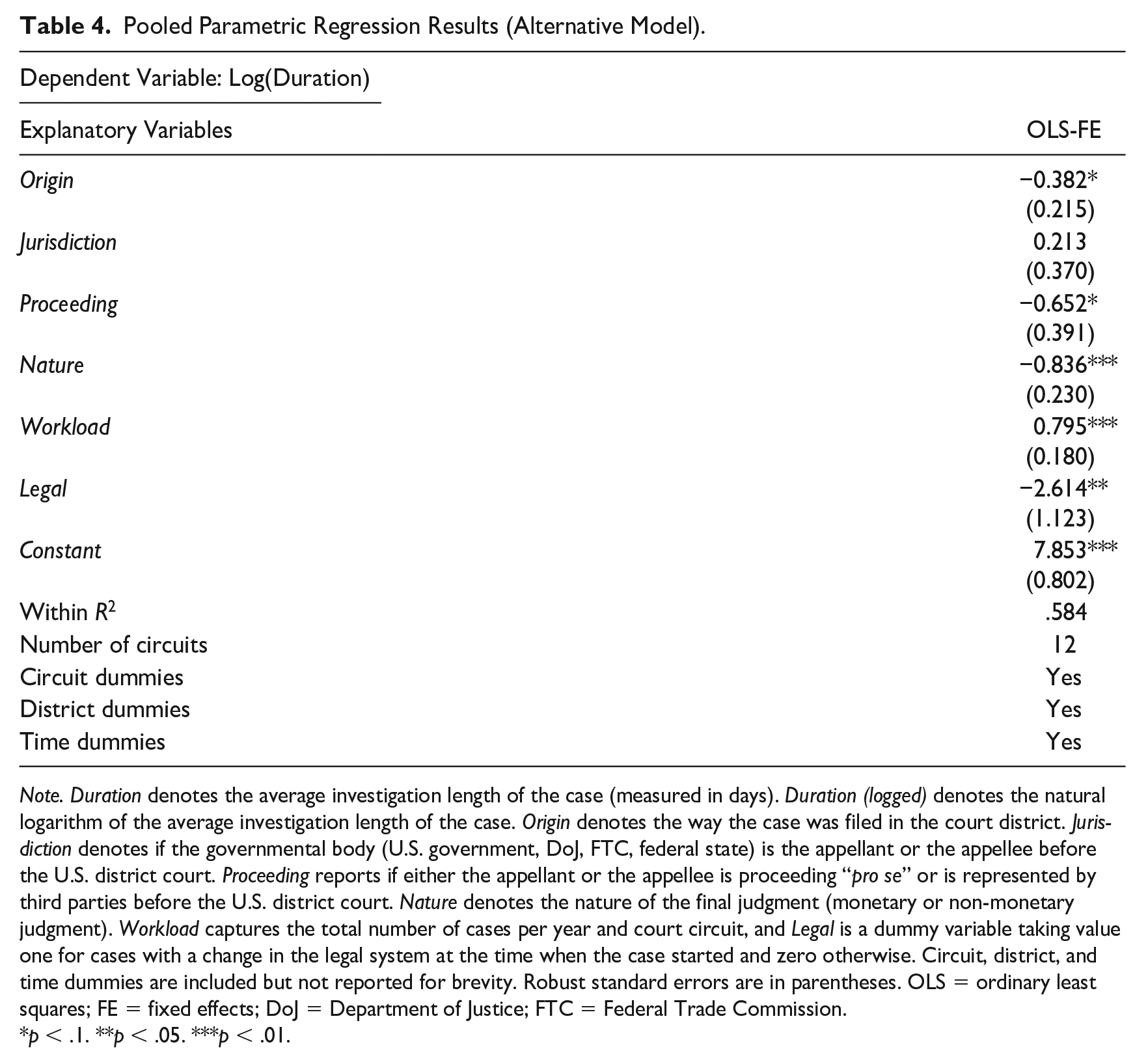
Note. Duration denotes the average investigation length of the case (measured in days). Duration (logged) denotes the natural logarithm of the average investigation length of the case. Origin denotes the way the case was filed in the court district. Jurisdiction denotes if the governmental body (U.S. government, DoJ, FTC, federal state) is the appellant or the appellee before the U.S. district court. Proceeding reports if either the appellant or the appellee is proceeding “pro se” or is represented by third parties before the U.S. district court. Nature denotes the nature of the final judgment (monetary or non-monetary judgment). Workload captures the total number of cases per year and court circuit, and Legal is a dummy variable taking value one for cases with a change in the legal system at the time when the case started and zero otherwise. Circuit, district, and time dummies are included but not reported for brevity. Robust standard errors are in parentheses. OLS = ordinary least squares; FE = fixed effects; DoJ = Department of Justice; FTC = Federal Trade Commission.
p < .1. **p < .05. ***p < .01.
Moreover, the “pro se” proceeding imposes a negative and statistically significant impact on the overall duration of appellate court proceedings, with the relevant estimated coefficient equal to −0.652. The negative correlation between the relevant variables leads to the validity of H3. The nature of the final judgment is also negatively related to the court duration as before, but the relevant coefficient is much smaller now (−0.836 compared to −2.039). The relevant finding validates H4.
It is interesting to highlight that the average case duration per year is positively affected by the workload of the courts in terms of the number of cases they must deal with simultaneously within one year. The relevant estimated coefficient is statistically significant and equals 0.795. This means that with a given, fixed stock of staff resources, the average duration per case is longer when more cases are handled at the same time than in a scenario with fewer cases. Lastly, it seems that the average case duration depends on the legal system at the point in time when the case started. This might happen since there might be changes in the law during the sample period. The relevant estimated coefficient is statistically significant and equals −2.614, denoting that a change in the legal system at the time when the case started increases the delay in the average case investigation length. The negative correlation between the two variables might be attributed to the fact that legal changes at the time when the case started incurred further delays in its final assessment by the competent court circuit.
3. Robustness Checks
In this section, we perform the necessary robustness checks to account for the presence of endogeneity and reverse causality, while addressing the existence of clustered standard errors in the parametric specifications.
As was mentioned before, dealing with endogeneity and reverse causality are difficult tasks, and it is important to properly account for these problems that distort when presenting the causal relations of the sample variables.
To give but an example of the problems generated by severe endogeneity, it is important to stress that the parametric results show that the nature of the final judgment affects case duration, but it may be possible that the duration of the case will be what affects the nature of the final judgment. Similarly, there is a difference in duration across U.S. court districts, but perhaps the government is making strategic decisions about which types of cases to file in which districts (i.e., anti-competitive conduct vs anticompetitive merger cases). Therefore, it is not something about the district that is causing the duration, but it might be that cases with a certain complexity are more likely to be filed in certain jurisdictions. Thus, the causal direction unraveled by the aforementioned parametric analysis could be unrelated or even in the reverse direction of what is claimed.
Given the fact that the existence of endogeneity is a serious issue, we also include the GMM results and discuss the question of to what extent a GMM estimator might prevent or reduce endogeneity. As it is obvious from the relevant table (see columns 3–6 of Table 3), the original proceedings have shorter durations, the cases brought by the U.S. government have also shorter durations, “pro se” cases are negatively correlated with the investigation length, and finally the nature of the judgment (monetary or not) shortens the duration of the case. Thus, we argue that the results obtained by the GMM models do not substantially deviate from the OLS-FE estimations, leading to the validity of the four research hypotheses as described earlier.
As a final robustness check, it is important to assess how the significance of the estimated coefficients change when clustered standard errors (based on court circuits) are used instead of robust standard errors. For this reason, we have re-estimated the parametric models to account for this. From the empirical results, we argue that the estimated coefficients in all six parametric specifications (linear and nonlinear) are quite close in their magnitude and statistical significance to the ones reported here (e.g., Table 3). This finding strengthens the robustness of our primary (parametric) findings. 40
B. Semi-Parametric Estimates
We use the flexible semi-parametric fixed-effects estimator, which has been widely used in empirical analysis. 41 This approach considers a linear fixed-effects model allowing for a nonparametric specification for one particular regressor (e.g., time trend). In this way, our model, avoids any pre-determined assumption regarding the functional form (e.g., “inverted U” or “N shape”), while it allows the data to guide the empirical research. 42
This analysis relies on a semi-parametric model, namely the Semi-parametric Fixed-Effects Model (SPFEM), which combines the flexibility of nonparametric regressions with the structure of standard parametric models, reducing the curse of dimensionality and the computational cost of model selection and estimation.
Let the model be given by the following equation:

where
The nonparametric part (fzit) is approximated either by a B-spline interpolation or a kernel-weighted local polynomial fit (Epanechnikov). It is worth mentioning that the former approach is preferable to the latter, since it better approximates complex nonlinear shapes, while it does not suffer from Runge’s phenomenon.
Figures 6 and 7 plot estimates of the impact of technological change (horizontal axis) on case duration (vertical axis) along with 95-percent confidence bands (gray-shaded area). Figure 6 provides nonparametric estimates of technological change denoted by the Trend variable on the case court duration process using spline interpolation. As it is evident from the relevant figure, there are signs of weak nonlinear effects on case duration, yet most of the estimated effect is not significantly different from zero, as the 95-percent confidence band includes zero, except for some outliers at the beginning. This means that the SPFEM does not reveal a strong nonlinear relationship among the sample variables though flexible enough compared to the parametric specifications (see Section IV.1).
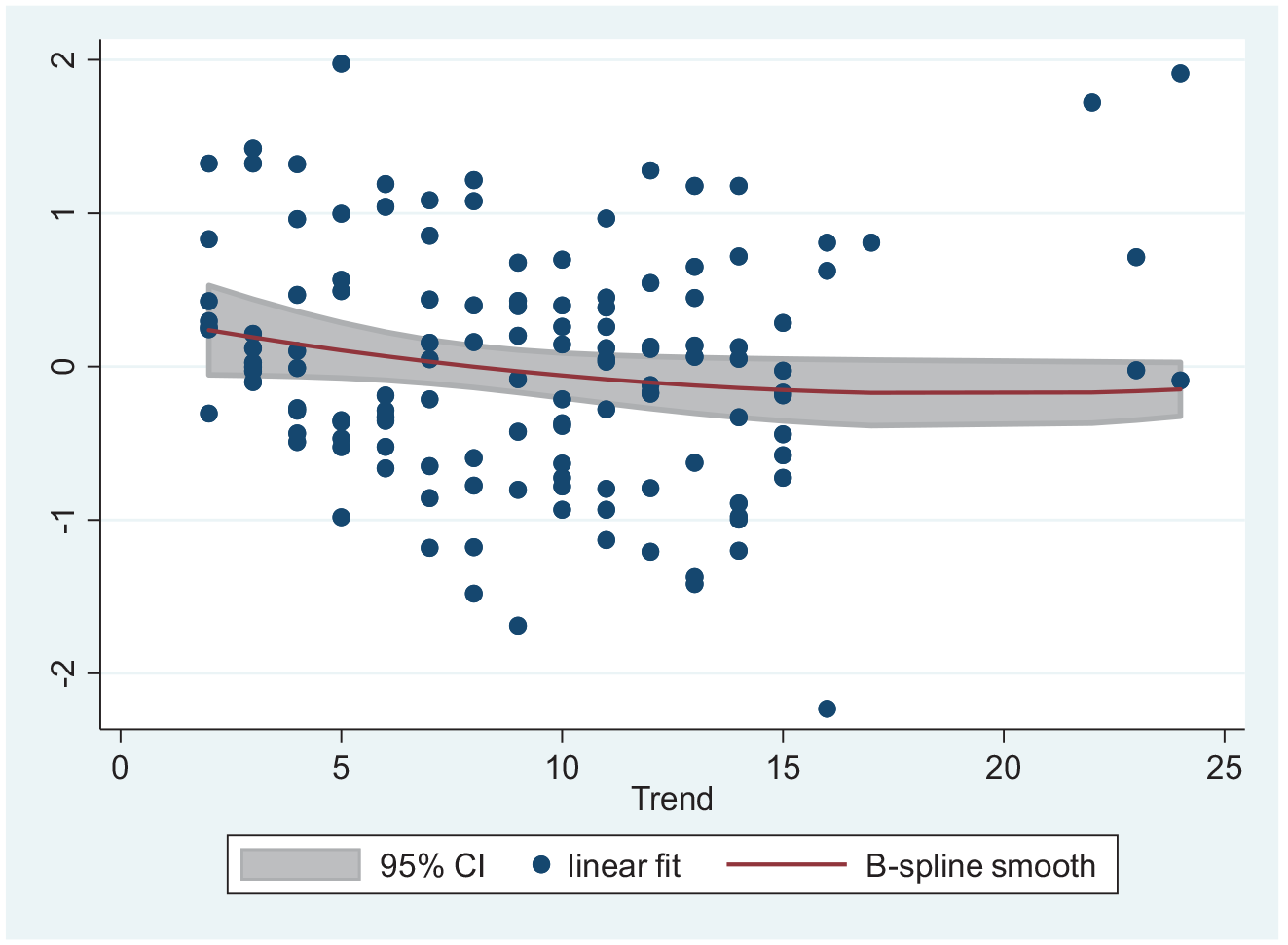
Nonparametric estimates of technological change on case duration using spline interpolation.

Nonparametric estimates of technological change on case duration using kernel-weighted local polynomial smoothing.
The relevant findings do not dramatically change even if we employ a kernel-weighted local polynomial smoothing to our semi-parametric model. As it is obvious, there is a mild linear and statistically significant negative relationship between the technological change and the court case duration mostly evident at the beginning, whereas the situation is fully reversed since the confidence bands (see gray area) become very wide. This means that from this point, the relevant relationship is not statistically significant anymore.
V. Concluding Remarks
An efficient judiciary system characterized by a speedy process in terms of appellate court duration is one of the main pillars of institutional integration. The present study aims to identify the main determinants of the duration of U.S. antitrust federal court decisions. Although there are existing studies that deal with similar research questions, the geographical focus on the United States seems to be novel in the law and economics literature.
The findings in this paper validate the four main research hypotheses since all the explanatory variables have highly statistically significant, negative correlations with case duration (dependent variable). Our empirical results suggest that a range of factors formulate the appellate case duration, including (1) the way the case is filled in the court circuit (original proceeding), (2) the jurisdiction in the case, and especially if the U.S. government is the appellant before the district court, (3) the “pro se” proceeding of the appellate parties, and (4) the monetary nature of the final judgment.
For the U.S. antitrust governmental bodies (FTC and DoJ) and the undertaking parties (e.g., companies, business associations, authorities, individuals, and so on), the policy lessons regarding the efficient supervision of antitrust investigations are rather straightforward, since most of the key drivers that appear to impact case duration are within their control (administrative related variables). For example, the “pro se” representation by the undertakings (e.g., “in-house” lawyers) significantly reduces the case duration in all the empirical specifications accelerating the timely decisions issued by the U.S. appellate district courts. This might be the result of the asymmetric information that appears when an antitrust case is represented by third parties (e.g., attorneys, technical experts, legal and economic advisors, and so on). In this case, the “principal-agent” problem seems to increase substantially the time length of the final appellate court decision. The relevant finding runs contrary to the conventional wisdom arguing that the complexity of antitrust litigation makes it rather difficult to pursue a claim without an expert team of lawyers and economists to work with.
In addition, reducing caseload, by limiting the number of cases that are reopened or transferred by another court district, appears to have a significant impact on case duration, since it is documented by the empirical analysis that an original proceeding case significantly restricts the time length of the appellate court decision. Our analysis also revealed that the time length of the appellate court decision may be accelerated when the U.S. governmental party (antitrust agency, state court, federal government) has the legal role of the appellee in the case leading to the acceptance of H3. However, more future research (i.e., the use of survey data) would be useful in understanding the mechanism behind this outcome.
The relevant study does not come without limitations. First, future research may shed light on the education profile of judges and lawyers focusing on their knowledge regarding antitrust issues. It is commonly argued that legal professionals’ lack of understanding of economic and business issues and their implications on the legal level playing field creates a lack of knowledge, which is evident in courts and business life. Many judges, due to the lack of economic reasoning in certain aspects of the cases they are dealing with (i.e., competition policy, regulation, tax fraud, banking issues, real estate, housing, and so on), run the risk of supporting the wrong decision. Moreover, the complexity of antitrust cases and the fact that many of them are being issued by generalist judges not specialized in competition law and economics may further elucidate the case delay.
Nowadays, due to the ongoing pandemic crisis affecting many economies, even more judges and practitioners increasingly rely on economic reasoning to resolve legal disputes. In some areas of legal practice (i.e., antitrust law, tax law, bankruptcy, corporate and securities law), economic reasoning seems to be rather crucial to support legal arguments. Therefore, the possible interaction between the education profile of legal professionals (judges, lawyers, legal practitioners, and so on) and the appellate antitrust case duration remains a challenging open question and an avenue for future research.
Second, more research is needed to explain the spatial heterogeneity between the U.S. district courts and possible spillover effects on the case duration. To achieve these goals, future research may focus on econometric techniques designed on a district-by-district basis (GMM, FGLS, and so on).
Lastly, another interesting research area is to conduct a survey in appellate courts, to discover more about the real obstacles in their scrutinized work. In this way, a researcher may include more antitrust-related variables (qualitative as well as quantitative) such as the amount of imposed fines, the adoption of the leniency program, and the aggravating and mitigating factors in the cartel participation, generating a significant added value to the existing literature.
Footnotes
Acknowledgements
The author wishes to thank the Editor-in-Chief William J. Curran and an anonymous referee of this journal for their valuable comments that enriched the relevant study both in substance and exposition of its results. Special thanks also go to William Hubbard and Frank Verboven for helpful and fruitful insight suggestions that enhanced the merit of the paper both in substance and appearance. Any remaining errors are solely the author’s alone. The usual disclaimer applies.
Declaration of Conflicting Interests
The author(s) declared no potential conflicts of interest with respect to the research, authorship, and/or publication of this article.
Funding
The author(s) received no financial support for the research, authorship, and/or publication of this article.
1.
See for example F. Smuda et al., Determinants of the Duration of European Appellate Court Proceedings in Cartel Cases, 53
2.
3.
For an excellent study of the U.S. antitrust litigation, see among others M. Panhans & R. Schumacher, Theory in Closer Contact With Industrial Life: American Institutional Economists on Competition Theory and Policy, 17
4.
Since 1914 and the amendment of the Clayton Act, the Federal Trade Commission (FTC) has been also assigned both with investigatory and adjudicative powers like the Department of Justice (DoJ), which until then served as the sole enforcement agency in antitrust matters.
5.
Hüschelrath et al., supra note 1.
8.
Under the auspices of Section 7 of the Clayton Antitrust Act as amended, mergers, acquisitions, and certain joint ventures where the effect may be to substantially lessen competition must be prohibited.
9.
See Smuda et al., supra note 1.
10.
See M. Hellwig et al., Settlements and Appeals in the European Commission’s Cartel Cases: An Empirical Assessment, 52
11.
See for example A. Daughety & J. Reinganum, Appealing Judgments, 31
12.
M. Lokshin, Difference-Based Semiparametric Estimation of Partial Linear Regression Models, 6
13.
K. A. Tran & E. Tsionas, Local GMM Estimation of Semiparametric Panel Data with Smooth Coefficient Models, 29
14.
See M. Kasioumi & T. Stengos, The Environmental Kuznets Curve with Recycling: A Partially Linear Semiparametric Approach, 13
15.
See, inter alia, G. Priest & B. Klein, The Selection of Disputes for Litigation, 13 J.
16.
L. Epstein et al., Inferring the Winning Party in the Supreme Court from the Pattern of Questioning at Oral Argument, 39 J.
17.
18.
Mitsopoulos & Pelagidis, supra note 11.
19.
See Q. G. Yang & M. Pickford, Modeling the Duration of Merger Reviews in New Zealand, 12 J.
20.
Hüschelrath et al., supra note 1.
21.
Smuda et al., supra note 1.
22.
G. Randolph & J. Fetzner, The Impact of Regulatory Accumulation on U.S. Federal District Courts, 12 J.
23.
T. A. Fauvrelle & A. Almeida, Determinants of Judicial Efficiency Change: Evidence from Brazil, 14
24.
25.
The variable is called “nature of suit,” and the variable value “410” is the code for “antitrust” (see page 65 of the civil codebook).
26.
Similar findings are reported in a related study, where the duration of the appeals process for the European Union (EU) cartel cases is about 57 months, see Smuda et al., supra note 1.
27.
This could be attributed to the heavy case load since, the GC had to handle 32 separate cases for the period 2000-2012 compared to the 17 cases of the ECJ.
28.
The territorial jurisdiction of the Tenth Circuit includes the six states of Oklahoma, Kansas, New Mexico, Colorado, Wyoming, and Utah, plus those portions of the Yellowstone National Park extending into Montana and Idaho (see https://www.ca10.uscourts.gov). The Eleventh Judicial Circuit has jurisdiction over US federal cases originating in the states of Alabama, Florida, and Georgia (see https://www.ca11.uscourts.gov/about-court). For the spatial distribution of the average case court duration see also  .
.
29.
A kernel density estimation is a non-parametric way to estimate the probability density function of a random variable. Kernel density estimation is a fundamental data smoothing problem where inferences about the population are made, based on a finite data sample, see M. Rosenblatt, Remarks on Some Nonparametric Estimates of a Density Function, 27
30.
See W. Hubbard, Testing for Change in Procedural Standards, With Application to Bell Atlantic v. Twombly, 42 J.
31.
In panel data analysis, fixed effects models control for, or partial out, the effects of time-invariant variables with time-invariant effects.
32.
See S. Smith, The Indirect Purchaser Rule and Private Enforcement of Antitrust Law: A Reassessment, 17
33.
This category involves cases transferred to a district by an order entered by Judicial Panel on Multi District Litigation pursuant to 28 USC 1407.
34.
See M. R. Baye & J. Wright, Is Antitrust Too Complicated for Generalist Judges? The Impact of Economic Complexity & Judicial Training on Appeals, 54 J.
35.
See Smuda et al., supra note 1.
36.
See Siegelman & Lahav, supra note 17.
37.
Since only the dependent/response variable is log-transformed the estimated coefficient -0.466 incurs a decrease of the dependent variable (case duration) by about 59.4% = [exp (−0.466) – 1) × 100].
38.
We greatly thank an anonymous reviewer for spotting this.
39.
The complexity of the cases might also affect the average case duration since more complex cases need more time to be decided and the opposite. One proxy variable that could be used in such a case is the number of pages/words of the decision documents or the number of pleas brought forward. However, due to severe data restrictions for the antitrust cases in the U.S. appellate district courts, the complexity of the cases could not be proxied.
40.
The econometric results accounting for clustered standard errors are available from the author on request.
41.
See B. Baltagi & D. Li, Series Estimation of Partially Linear Panel Data Models with Fixed Effects, 3
42.
Alternative one could use the Cox proportional hazard model, which also provides a means of semiparametric estimation without specifying the functional form of the hazard function.