




Abstract
With regard to the topicality of corporate social responsibility (CSR) in retail practice, only a few studies have comprehensively analyzed the role of CSR in retail. Due to the specific role of a retailer as a gatekeeper between the producer and the consumer in the supply chain, a comprehensive understanding of the impact of consumer perceptions of CSR activities is of great relevance. Therefore, this study contributes information regarding the impact of CSR activities on retailer performance. Using a comprehensive conceptualization of CSR, the results of our customer survey (N = 3,313) suggest that CSR has positive implications as driver of customer loyalty and favorable consumer purchasing behavior. The authors demonstrate the CSR dimensions that are most important for retailers to influence positively consumer purchasing behavior. This study highlights the significance of the credibility of retailer CSR activities and show that consumers’ CSR orientation impacts the relationship between retailer CSR activities and consumer behavior.
Corporate social responsibility (CSR) is a relevant topic in business practice across all industries (Chabowski, Mena, & Gonzales-Padron, 2011; Wagner, Lutz, & Weitz, 2009). Wilson (2008), in a leading U.S. retail practice magazine Chain Store Age, and quoting an unnamed retailer, labeled sustainability as “The defining issue of our time.” Even though CSR is not a new concept and many retailers have long traditions of socially responsible behavior, CSR activities such as ethical sourcing, corporate philanthropy, cause-related marketing, or socially responsible employment, have been introduced or intensified by retail companies in the past few years. The long academic literature debate includes the discussion of what domains of responsiveness CSR includes. At present, a company’s CSR activities should not only relate to making a profit; but corporations also should strive to further some social good that goes beyond the interests of the firm as well as the requirements of the law. CSR has been addressed in numerous academic studies (see Chabowski et al., 2011; De Bakker, Groenewegen, & Den Hond, 2005). One of the most important questions in this realm of study is whether CSR activities create competitive advantages for companies. This issue has mainly been addressed from a company perspective, examining, for example, the company’s market value or financial performance (see Orlitzky, Schmidt, & Rynes, 2003, and Wu, 2006, for meta-analyses). In contrast, there remains a limited understanding of the relationship between consumer perception of CSR activities and the perceived credibility of corporate social behavior and consumer behavior. Especially, regarding its topicality in retail practice, few studies have comprehensively analyzed the role of CSR in retailing. However, the correct management of CSR to become good corporate citizens in the perception of consumers is not an easily realized task, especially for retailers. Consumer perceptions of the ethically and socially responsible behavior of retailers depend on more than the retailer’s own CSR activities. They rather also depend on the socially responsible behavior of product manufacturers and other parties in the supply chain (e.g., logistics providers).
With regard to this specific role of a retailer as a gatekeeper between the producer and the consumer in the supply chain, a comprehensive understanding of the impact of consumer perceptions of CSR activities on consumer behavior is of great relevance. This study addresses whether, and how, the CSR activities of retailers are perceived by consumers and contribute to retailer performance. The authors chose to analyze the impact of CSR from the point of view of consumers and focus on whether the CSR initiatives of retailers have the effect of enhancing consumer loyalty and purchasing behavior. We decided on this approach because one of the main arguments in the literature about why retailers engage in CSR initiatives is that retailers are aware that customers more frequently evaluate retailers according to socially responsible corporate behavior. To our interest, this argument seems to be accepted as “common knowledge,” but it has seldom been challenged by the academic literature. Therefore, the authors investigate the effects of CSR initiatives on consumer loyalty and purchasing behavior.
The remainder of this study is organized as follows. First, we introduce the relevant aspects of CSR for our study by reviewing the relevant literature, focusing on possible effects of CSR activities on consumer behavior as a basis for our conceptual model and hypotheses. Next, we present details regarding the method and specifications of the hypotheses testing in which Partial Least Squares (PLS) structural equations modeling of data from a customer survey (N = 3,313) was performed. We then provide an overview and discussion of the results and conclude with a summary of our findings, outlining the implications and limitations of the present study.
Literature Review and Conceptual Background
The concept of CSR has been discussed in the literature in considerable detail; however, no single definition has been established as the dominant approach for conceptualizing CSR (Maignan & Ferrell, 2004). According to Schuler and Cording (2006, p. 544), CSR can be understood as “a voluntary (i.e., not directly mandated by government regulation) business action that produces social (third-party) effects” and includes three main elements: social outcomes, market and social behavior, and voluntary behaviors. While there has been general agreement that CSR relates to “a company’s commitment to minimizing or eliminating any harmful effects and maximizing its long-run beneficial impact on society” (Mohr, Webb, & Harris, 2001, p. 47), the main discussion in the literature has been focused on what activities or domains should be included as components of CSR. A widely used concept is the “pyramid of corporate social responsibility” developed by Carroll (1979, 1991). Carroll conceptualized CSR as four expectations that society has of organizations: the economic domain (“being profitable”), the legal domain (“obeying the law”), the ethical domain (“being ethical”), and the philanthropic domain (“being a good citizen”). Based on this concept, several attempts have been made to classify the CSR practices of corporations (Brunk, 2010; Maignan, Ferrell, & Ferrell, 2005; Wagner et al., 2009).
For the purposes of this study, the authors mainly refer to the suggested categorization of Sen and Bhattacharya (2001), because their comprehensive understanding of this classification most appropriately covers all important facets of socially responsible behavior in the retail sector. Similarly to Brunk (2010), these authors analyzed the CSR activities of 600 companies and classified them into six domains: (a) community support, (b) diversity, (c) employee support, (d) environment, (e) non-domestic operations, and (f) products. The specific activities that companies perform in each of the six aforementioned domains will differ between industries. In the retail sector, which constitutes our research context, CSR for example relates to community support (e.g., supporting charity foundations); diversity programs, employee treatment and support (e.g., fair-minded wages and working hours, education and health safety protection); environmental programs (e.g., climate stores); ethical sourcing (e.g., sustainable farming, no child labor); product quality, pricing, services, and the combination of products offered (e.g., fair trade products and private labels). Today, retailers consider these activities to be important elements of their overall marketing strategy (e.g., Wal-Mart’s Global Responsibility Report, 2012); and it is increasingly common for retailers to spend money, time, and effort on CSR-related activities to influence the overall perceptions of customers and non-customers about the store’s position as a good corporate citizen. Retailers communicate their socially responsible behavior to society to improve their image in the marketplace (Gupta & Pirsch, 2008). However, being perceived by consumers as a good corporate citizen is a complex and difficult goal, especially for retailers. Because of the specific role of retailers as an intermediary—a gatekeeper—between the supplier and the consumer, consumer perceptions of the ethically and socially responsible behavior of retailers not only depend on the CSR activities of retailers but also on the socially responsible behavior of suppliers and other parties in the retailer’s supply chain. Thus, if a supplier demonstrates a socially irresponsible behavior in the production process, such as non-ethical sourcing or human rights violations, one would expect a spill-over effect of this unethical behavior in consumer perceptions of the retailer. In the context of ethically and socially responsible retail, offering products associated with irresponsible behavior might have a negative impact on retailer image, consumer loyalty toward the retailer, and consumer purchasing behavior at the retailer, thereby reducing the retailer’s performance in the marketplace.
A large number of studies have addressed the impact of CSR activities on company performance, focusing, for example, on market value or corporate financial performance (Orlitzky et al., 2003; Wu, 2006) and on how these activities create value for stakeholders (see Peloza & Shang, 2010, for an overview). Surprisingly, only a few studies have analyzed the impact of CSR activities from the consumer perspective, even though consumers are one of the key stakeholders because their purchase decisions directly affect a company’s revenue and overall financial performance (Schuler & Cording 2006). The findings of Folkes and Kamins (1999) suggest that, in general, consumers reward CSR activities with positive attitudes and beliefs toward the company or with favorable purchasing behavior. Furthermore, the results of Sen and Bhattacharya (2001) imply strong impacts on consumer behavior arising from the consumer perception of CSR activities and CSR communications. Therefore, the concept of CSR has become an important driver of shopping behavior (Oppewal, Alexander, & Sullivan, 2006). In this context, the findings of Handelman and Arnold (1999) showed that CSR activities have a positive impact on the intention to purchase at CSR-motivated retailers and on positive word of mouth. Moreover, CSR is expected to have a positive effect on customer satisfaction and on loyalty toward the retailer (Gupta & Pirsch, 2008). However, consumers seem to challenge the (“true”) intentions of companies to engage in CSR and their CSR orientation (Chabowski et al., 2011). Therefore, unethical activities will decrease the ethical assessment of the retailer and decrease satisfaction with the product and services provided (Wagner et al., 2009).
Today, consumers expect different kinds of CSR activities, not only in traditional marketing areas but also in how retailers execute their marketing strategy in society (Gupta & Pirsch, 2008; Oppewal et al., 2006). Furthermore, it is necessary for CSR initiatives to exceed consumer expectations (Creyer & Ross, 1997). The relationship between perceived CSR activities and consumer behavior is indirect, moderated by the moral values of consumers (Luo & Bhattacharya, 2006; Schuler & Cording 2006). Barone, Miyazaki, and Taylor (2000) and Scholder Ellen, Webb, and Mohr (2006) showed that the perceived motivation, orientation, and credibility of CSR initiatives are relevant to the purchasing intentions of consumers. In addition, the fit between a company’s social marketing activities on one hand and its products (or services) and the motivation of consumers on the other hand is of considerable importance (Simmons & Becker-Olsen, 2006). Aggressive and insincere CSR practices or activities, perceived as deleterious or illegitimate, foster negative consumer attitudes and reactions in terms of purchasing behavior (Creyer & Ross, 1997; Sen & Bhattacharya, 2001). In addition, past studies have provided evidence that consumers evaluate CSR activities with regard to other elements of the marketing mix, such as price or product quality (Folkes & Kamins, 1999; Mohr & Webb, 2005). For example, in the context of retail brands, Handelman and Arnold (1999) showed that perceived CSR activities and traditional store attributes, such as merchandise assortment, price, or convenience of location, influence purchase intentions. In summary, previous research implies that CSR should have a positive impact on consumer behavior, but the underlying processes that lead to such positive effects remain undefined. Previous retailing research usually only included few aspects of socially responsible behavior (e.g., only philanthropic or ecologically oriented activities). The authors, therefore, extend previous findings by following the comprehensive conceptualization of Sen and Bhattacharya (2001), including their six domains of CSR, to analyze the impact of consumer perceptions of CSR on loyalty and purchasing behavior.
Hypotheses Development
With our conceputal model (see Figure 1), we follow research which explains the effects of customer-based associative concepts by schemata and memory networks (Hartman & Spiro 2005; Krishnan 1996) and refer to associative network theory that relates to how information is stored in consumers’ memory and schemata to explain the influence of perceived store image and perceived CSR activities on consumer behavior. Within the context of associative network memory theory, store image, and CSR image of the retailer, each represent distinctive brand associations which are linked to the retail brand node in consumers’ memory. Thus, a favorable evaluation should contribute positively to consumer behavior in terms of loyalty and purchase intentions. In this context, the authors assume that CSR credibility and consumer CSR orientations play an important role as they refer to the schemata that are stored in the consumers’ minds.
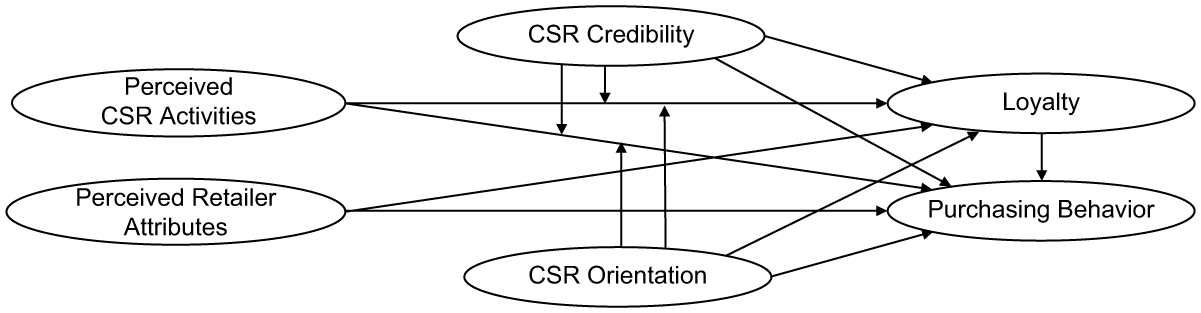
A conceptual model for analyzing the impact of consumers’ perception of CSR on consumer behavior.
Store image literature has proposed that consumer evaluations of a retailer are influenced by their perceptions of the retail store and comprise a store’s image (Baker, Greval, & Parasuraman, 1994). Consumers evaluate whether the retail store fits their personal needs based on their perception of the entire retail marketing mix. Past investigations analyzed aspects of retail store perception, recognizing certain attributes as determinants of retailer patronage (Lindquist, 1974; Mazursky & Jacoby, 1986). In their meta-analysis, Pan and Zinkhan (2006) identified product quality, price, product selection, convenience, service quality, friendliness of salespeople, store atmosphere, and fast checkout as the most salient store attributes that positively impact consumer loyalty, consumer patronage, and consumer purchasing behavior. The positive link between retailer perception and retail patronage has also been shown, for example, by Merrilees, McKenzie, and Miller (2007). Based on the previous discussion, the authors propose the following hypothesis:
Hypothesis 1: The positive evaluation of the different dimensions of retailer attributes positively influences consumer (a) loyalty toward the retailer and (b) purchasing behavior.
Even though previous research on retailer perceptions is dominated by store image dimensions, consumers do not limit their perceptions of retailers to the perceptions of diverse store attributes. Non-functional elements also have to meet expectations to satisfy consumers and to increase loyalty (Mohr & Webb, 2005). In this context, corporate associations, meaning information about a company that is available to consumers (Brown, Dacin, Pratt, & Whetten, 2006), are of major importance. One type of corporate association of substantial interest in this research context is the CSR of the retailer as perceived by consumers (Scholder Ellen et al., 2006). According to stakeholder contract theory (Jones, 1995), a company’s social performance initiatives could lead to a reduction of relational costs with stakeholders who expect firms to play fair, according to the moral values of stakeholders. When a firm respects this implicit contract, the firm will foster social harmony and maintain its relationship with stakeholders (Schuler & Cording, 2006). Consequently, consumer awareness of CSR activities is of particular interest and plays a major role in the research regarding CSR effectiveness. The effect of awareness has been shown in several laboratory experiments (Auger, Burke, Devinney, & Louviere, 2003; Sen & Bhattacharya, 2001). Previous retailing research has suggested that if companies adequately communicate CSR efforts, and if these activities align with the ethical and moral values of consumers, perception of the six CSR dimensions posited by Sen and Bhattacharya (2001) will positively influence consumer attitudes toward the retailer, retailer image, loyalty, and purchasing behavior (Becker-Olsen, Cudmore, & Hill, 2006; Yoon, Gürhan-Canli, & Schwarz, 2006). Therefore, consumers are willing to reward a socially responsible company and to punish an unethical firm, by participating in a consumer boycott, which would be reflected in consumer purchase intentions and consumer purchasing behavior (Klein, Smith, & John, 2004; Schuler & Cording, 2006). Based on the previous discussion, the authors propose the following hypothesis:
Hypothesis 2: Perceptions of the six dimensions of CSR of a retailer have positive effects on (a) consumer loyalty toward the retailer and (b) purchasing behavior.
In addition, even though the authors propose a generally positive impact of perceived CSR on consumer behavior, we do not propose that this link is automatically established. Instead, we assume that consumers challenge the motivation of retailers to engage in CSR activities and attempt to understand the motives of retailers and to determine the (true) intentions of the CSR initiatives (Yoon et al., 2006) of retailers, that is, whether the motivations of retailers are self-serving or publically oriented (Becker-Olsen et al., 2006). We, therefore, propose that the credibility of retailer CSR activities plays a major role in the formation of consumer attitudes (Scholder Ellen, Mohr, & Webb, 2000). In addition, the persuasion knowledge model implies that consumers use persuasion knowledge as a coping strategy to correct initially favorable beliefs about the CSR activities of retailers with less-favorable beliefs (Becker-Olsen et al., 2006). That correction is caused by the general skepticism of consumers, who intuitively believe that corporate social initiatives are primarily motivated by corporate self-interest (Webb & Mohr, 1998). Therefore, the authors assume the perceived CSR credibility to have a positive direct effect and a moderating effect in the relationship between retailer loyalty and purchasing behavior with respect to the retailer, proposing the following hypotheses:
Hypothesis 3: The perceived credibility of retailer CSR activities has a positive effect on (a) consumer loyalty toward the retailer and (b) purchasing behavior.
Hypothesis 4: The perceived credibility of retailer CSR activities positively influences the relationships between perceived retailer CSR activities and (a) consumer loyalty toward the retailer and (b) purchasing behavior.
Previous research on the role of motivational forces in explaining consumer shopping behavior has suggested that consumer motivations play a major role in developing loyalty or store choice intentions (e.g., Bagozzi & Dholakia, 1999). The retailing literature has generally agreed that consumers place a specific and variable degree of value on specific retailer attributes based on their motivational state (Osman, 1993). Following the research of Mohr et al. (2001, p. 47), the authors define consumer CSR orientation as consumers basing their “acquisition, usage, and deposition of products on a desire to minimize or eliminate any harmful effects and maximize the long-run beneficial impact on society.” Thus, consumer CSR orientation can be interpreted as a specific form of motivational force, interpreted as a functional motivation (e.g., ecological aspects of a product) or a non-functional motivation (e.g., motives related to the avoidance of child labor). Thus, consumer CSR orientation should be an important factor of influence on consumer behavior, because consumers will evaluate if the retailer schemata that they hold in their mind fits with their own CSR motivation. Based on the previous research on motivational influences and the influences of CSR on consumer store choice, we propose the following hypothesis:
Hypothesis 5: Consumer CSR orientation positively influences (a) consumer loyalty toward the retailer and (b) purchasing behavior.
In addition, previous research has suggested that consumer motivations impact the formation of loyalty and retail patronage intentions, thus having moderating effects (e.g., Steenkamp & Wedel, 1991). Therefore, the authors expect that consumer CSR orientation influences store choice formation, which has also been suggested by previous research with a specific focus on CSR. For example, Sen and Bhattacharya (2001) and Webb, Mohr, and Harris (2008) demonstrated that consumer CSR orientation influences product and brand evaluation because consumers analyze the “fit” of customer–company identification according to ethical and moral values. We expect consumer CSR orientation to act as a moderator of the influence of perceived retailer CSR activities on consumer loyalty and purchasing behavior, respectively, as in the proposed following hypothesis:
Hypothesis 6: Consumer CSR orientation has a positive moderating effect on the relationships between perceived CSR activities of the retailer and (a) consumer loyalty toward the retailer and (b) purchasing behavior.
Methodology: Measures and Procedure
To test these hypotheses, the authors conducted a consumer survey. We chose 15 retail companies from different retail sectors (e.g., grocery, textile, consumer electronics, and furniture) based on market share and the number of outlets in Germany to ensure that the respondents were familiar with the selected companies, company CSR activities, and company communications. We used three different forms of data collection methods, avoiding direct (face-to-face) contact with respondents to control for possible systematic error in research design (Bailer, Bailey, & Stevens, 1977). First, we administered questionnaires to consumers in pedestrian areas of two German cities (N = 459 respondents), one large city in the south-west of Germany and one mid-sized city in the center of Germany. Second, we conducted telephone interviews (N = 134 respondents), and third, an online survey (N = 2,720 respondents), including respondents from all over Germany. Following Tourangeau and Smith (1996), we chose these approaches to avoid social desirability bias in the study’s measures. All N = 3,313 respondents were randomly distributed among retail sectors. The authors asked about the retailers in that sector that were most familiar to the respondents. That process produced a sample group comprised of respondents who were almost equally distributed among 15 retail companies. We assessed the sample group for differences in consumer characteristics between the diverse forms of data collection, retail companies, and retail sectors. The authors detected no significant differences between the selected retail companies and retail sectors in terms of consumer shopping orientations. Table 1 provides an overview of the characteristics of the resulting sample.
Socio-Demographic Characteristics of the Sample Group.
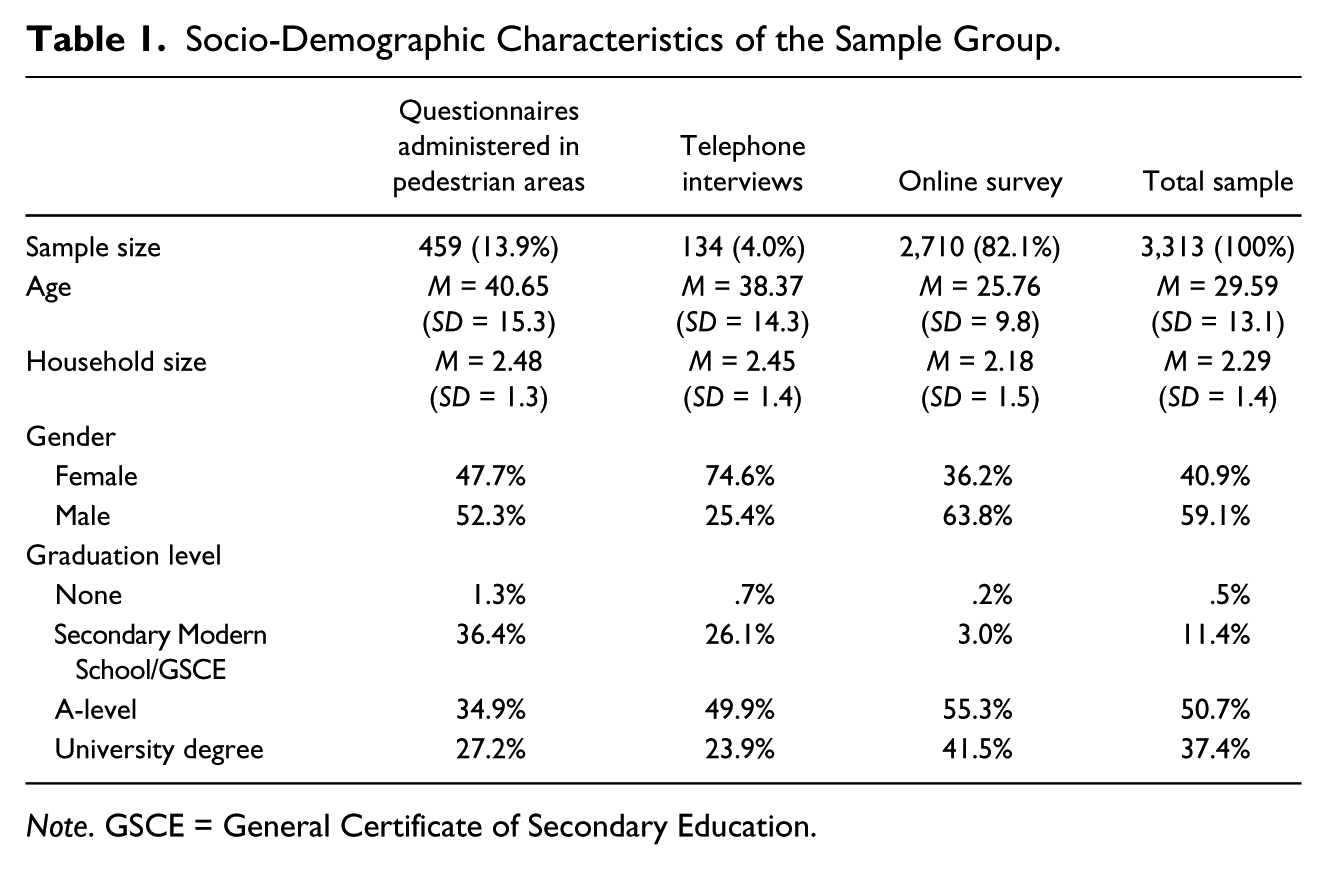
Note. GSCE = General Certificate of Secondary Education.
The authors conducted measure validation and model testing using SmartPLS (Partial Least Squares). We chose PLS because it allows an easy representation of formative and reflective latent constructs (Jarvis, Mackenzie, & Podsakoff, 2003) and avoids the problem of underidentification in the case of complex models that can occur with covariance-based analysis (as in LISREL; Bollen, 1989). We pretested all measurement scales. All scales used in this study are presented in the appendix.
To capture perceived CSR activities, perceived retailer attributes, and consumer CSR orientation, the authors chose a formative measurement approach. In contrast to reflective (or effect) measurement models, which are usually regarded as producing behavior captured by their indicators meaning that a variation in the construct leads to a variation in its indicators (Bollen, 1989), formative constructs are regarded as being formed by their indicators, meaning that the construct is induced by its measures (Fornell & Bookstein, 1982). Thus, changing a formative indicator will change the construct without affecting any of the construct’s other indicators (Franke, Preacher, & Rigdon, 2008). A decision about whether the measurement model is reflective or formative should be based on theoretical considerations. According to Coltman, Devinney, Midgley, and Venaik (2008), three broad theoretical considerations are of particular importance: (a) the nature of the construct, (b) the direction of causality between the indicators and the latent construct, and (c) the characteristics of the indicators used to measure the construct. Regarding the nature of the construct, in a formative model, the latent construct is a combination of its indicators, meaning that the latent construct cannot exist independent of the measures. Thus, the construct depends on a constructivist, operationalist, or instrumentalist interpretation by the researcher (Borsboom, Mellenbergh, & van Heerden, 2003). Concerning the direction of causality, in a formative model causality flows from the items to the construct (Bollen & Lennox, 1991). Therefore, a change in an indicator will change the construct under study (Jarvis et al., 2003). Moreover, because the indicators in a formative model define the construct, adding or removing an indicator can significantly change the conceptual domain of the construct. However, as long as the selected indicators conceptually capture the domain of interest (the latent construct), they could be considered by the researcher to be adequate for empirical prediction (Coltman et al., 2008).
With regard to the conceptual framework of this study and the theoretical rationale in the development of our hypotheses, a formative model will capture the perceived CSR activities, perceived retailer’s attributes, and the consumer’s CSR orientation of the latent constructs, while also retaining the assumptions of the three theoretical considerations. Considering the critical and inextricably linked issues of content specification and indicator specification, the authors sought to capture the major characteristics of these constructs by developing the formative scales according to Borsboom et al. (2003), drawing from a broad literature review, managerial interviews in the retail industry, consumer focus groups, and theoretical rationales. Furthermore, with regard to indicator collinearity and external validity, the authors conducted a pretest of the formative indicators in our measurement model. After the pretest, we conducted a purification of our measurement model, following the suggestions of Diamantopoulos and Siguaw (2006). We eliminated those items from the initial scale that showed high levels of collinearity (applying a cut-off level of .3 tolerance), and excluded items from the scale that had no distinct influence on the latent variable (applying a cut-off level for t-values of .1). We then checked that the items in the final scales still exhibited sufficient breadth of content to capture the constructs. This criterion was important as “the items used as indicators must cover the entire scope of the latent variable [. . .] [and] be sufficiently inclusive in order to fully capture the construct’s domains of interest” (Diamantopoulos & Winklhofer, 2001, pp. 271-272).
To capture perceived CSR activities as a formative construct, we developed our scale from Wagner, Bicen, and Hall’s (2008) scale of “corporate social irresponsibility” and followed the concept of Sen and Bhattacharya (2001). The scale is intended to capture all six domains, specifically focusing on the relevant CSR activities of retail companies. The authors measured consumer perception of the different items using a five-point rating scale (“1” = not at all, “5” = very high). Because of our intention to capture all salient characteristics of these constructs and eliminate items deemed irrelevant to consumers from the scale, after the pretest was complete, we reduced our initial battery of 24 items to a scale consisting of 13 items, comprising 2 items for community support, 2 for employee support, 4 for environmental support, 2 for non-domestic operations/sourcing and 3 for product/assortment (see the appendix for a full list of measurement items). We developed the measurement scale for the formative construct perceived retailer attributes from the literature on store image, especially from the findings of Mazursky and Jacoby (1986) and Pan and Zinkhan (2006). After pretesting our scale, we reduced the initial battery of 10 items to 6, thereby capturing the most salient attributes of retail stores (see appendix for full list of items). Respondents evaluated every indicator on a five-point scale (1 = do not agree at all, 5 = totally agree). We also measured consumer CSR orientation with a formative measurement approach. For this study, the authors generally followed the Social Responsible Purchase and Disposal (SRPD) scale of Webb et al. (2008), which consists of three dimensions: (a) purchasing based on a company’s CSR performance, (b) recycling, and (c) avoidance and use reduction of products based on their environmental impact, and adapted it to the retail context. After the pretest, we reduced our initial scale of 14 items to 10 items that captured all three of the SRPD dimensions (see appendix for all items). Respondents evaluated all items on a five-point rating scale (1 = do not agree at all, 5 = totally agree).
In the case of our formative measurement models, substantial collinearity among indicators would affect the stability of indicator coefficients because they are based on linear equation systems (Diamantopoulos & Winklhofer, 2001). In our study, none of the indicators revealed multicollinearity problems (none of the variance inflation factors exceeded 2.37). To test for external validity, we assessed the nomological validity of all formative constructs by including in the survey additional items that captured reactions to irresponsible corporate behavior (e.g., negative word of mouth, defection) and several items to capture respondents’ general perceptions of CSR activities (e.g., trustworthiness of CSR activities) conducted by retail companies (as a summary judgment). According to the theoretical discussion, the formative constructs should positively relate to these constructs. To test that relationship, the authors estimated bivariate correlations between the formative constructs (results from PLS regression) and the mentioned additional items. All correlations were positive and significant (ranging from .14 to .59, p < .05). Given that the constructs behaved as expected with respect to other constructs to which they theoretically relate (Churchill, 1995), the nomological validity was satisfactory with respect to all relevant variables.
The authors measured the respondents’ evaluations of a retailer’s CSR credibility as a part of the company’s reputation (Herbig & Milewicz, 1993) according to the corporate credibility scale of Newell and Goldsmith (2001) using reflective indicators. We adapted the corporate credibility scale to retailer CSR activities using two items: (a) respondent evaluations of the authenticity of a company’s ethical, social, and environmental initiatives, and (b) the respondents’ belief that a company keeps its promises about these activities (1 = do not agree at all, 5 = totally agree). Internal consistency of the scale was satisfactory with a Cronbach’s alpha of .85, average variance extracted (AVE) of .87, and composite reliability (CR) of .93. Cronbach’s Alpha is the often used estimate for the degree to which a set of items of a scale measures a single unidimensional construct based on the intercorrelations among the test items. The higher the intercorrelations between the test items, the better the internal consistency of the scale. The average variance extracted (AVE) is the amount of common variance among latent construct indicators and should exceed .5, while CR estimates the extent to which a set of latent constructs indicators share in their measurement of a construct (Hair, Anderson, Tatham, & Black, 1998). Based on Sirohi, McLaughlin, and Wittink (1998), we chose a reflective measurement approach to conceptualize the constructs loyalty and purchasing behavior. According to Zeithaml, Berry, and Parasuraman (1996) and Aaker (1996), we captured loyalty with 3 items measuring the intention to recommend, commitment, and willingness to pay a price premium at the retailer in question (1 = do not agree at all, 5 = totally agree). Following Steenkamp and Wedel (1991), we captured purchasing behavior using 3 items: purchasing frequency, purchase intentions (1 = very rarely, 5 = very often), and the customer’s share of wallet at a specific retailer (1 = up to 20%, 5 = 81%-100%). Both reflective measurement models yielded a satisfactory level of internal consistency with a Cronbach’s Alpha of .69 (loyalty) and .70 (purchasing behavior), AVE of .58 (loyalty) and .63 (purchasing behavior), and CR of .78 (loyalty) and .75 (purchasing behavior).
The authors assessed all reflective indicators for discriminant validity using Fornell and Larcker’s (1981) criterion. The average variance extracted (AVE) for each reflective construct was higher than the squared correlations between that construct and any other construct (see Table 2). Discriminant validity was, therefore, satisfactory with respect to all relevant variables.
Matrix of Construct Correlations and Squared Construct Correlations.
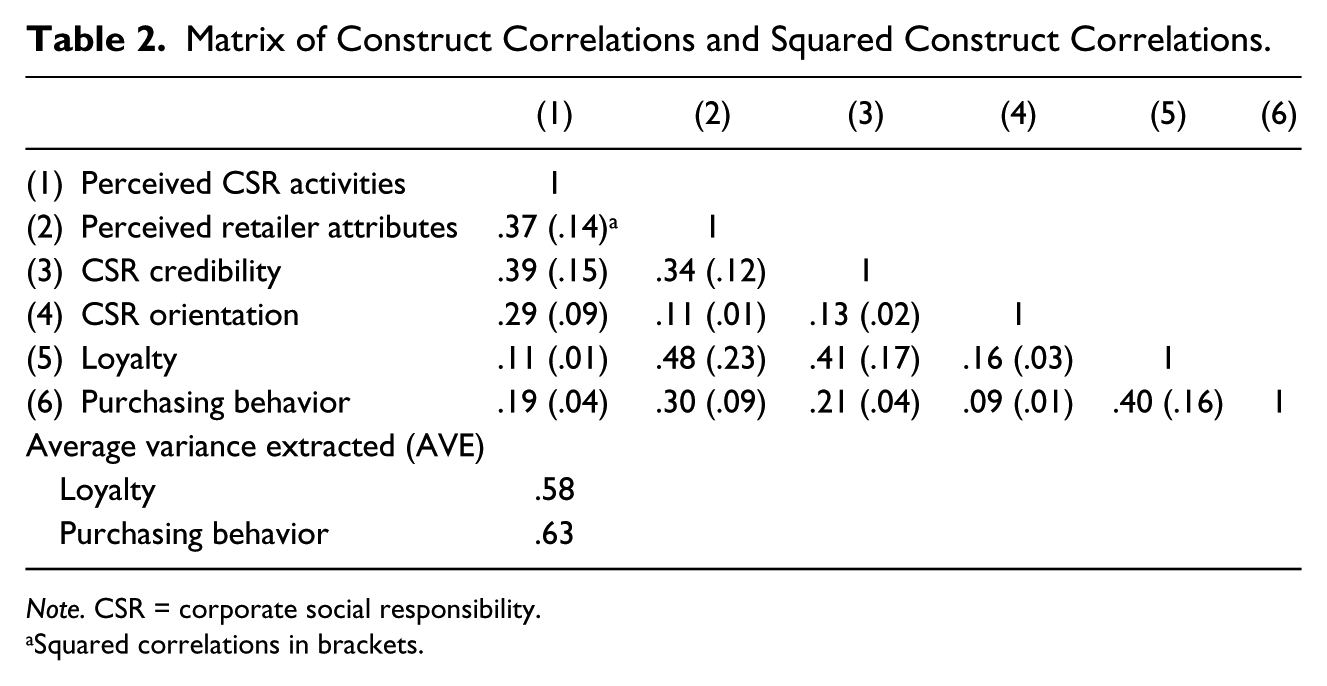
Note. CSR = corporate social responsibility.
Squared correlations in brackets.
Hypothesis Testing and Discussion
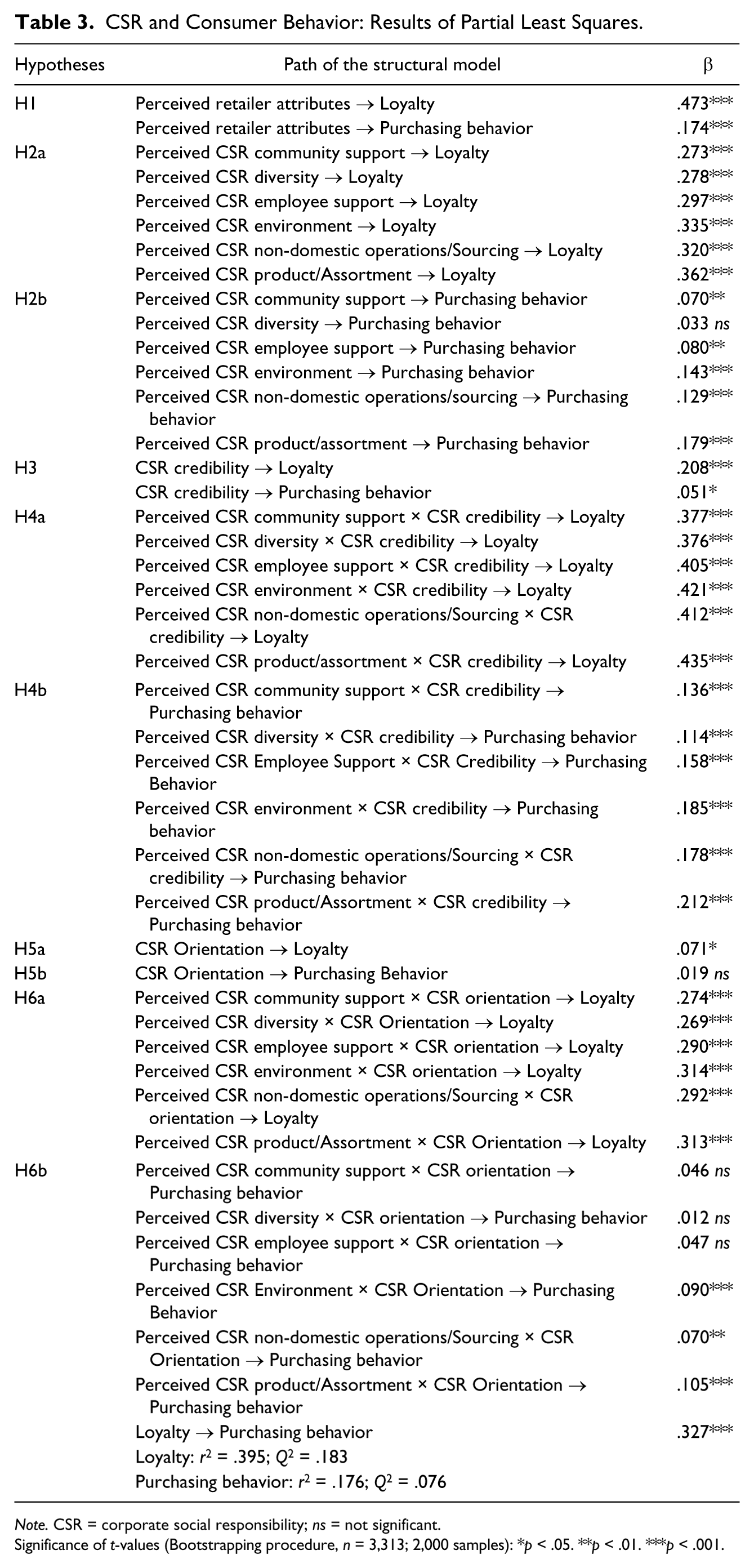
To test the hypotheses, the authors conducted PLS structural equations modeling. The results of the PLS model are presented in Table 3. While it is not possible to report an overall goodness of fit for the model because the objective of PLS is prediction rather than fit (Fornell & Cha, 1994), the r2 values of loyalty (r2 = .395) and purchasing behavior (r2 = .176), as well as the Stone–Geisser criterion, which assesses the predictive quality of the model (loyalty: Q2 = .183; purchasing behavior: Q2 = .076), indicated adequate model specification (Chin, 1998).
CSR and Consumer Behavior: Results of Partial Least Squares.
Note. CSR = corporate social responsibility; ns = not significant.
Significance of t-values (Bootstrapping procedure, n = 3,313; 2,000 samples): *p < .05. **p < .01. ***p < .001.
To analyze the expected moderating effect of CSR credibility in the hypothesized relationship between perceived CSR activities and consumer loyalty and purchasing behavior, given that the strength of the direct relationship between two of the variables (e.g., perceived CSR activities and loyalty) depends on the characteristics of a third variable (CSR credibility), the authors calculated interaction terms by multiplying construct values for the diverse dimensions of perceived CSR activities (formative constructs), which were calculated in a separate, non-moderated path model, and the indicator values of the reflective measurement model of CSR credibility (Baron & Kenny, 1986). Using the same approach, we calculated interaction terms to test the moderating effects of CSR orientation by multiplying the construct values of CSR orientation by perceived CSR activities (all of which were formative constructs). All values were standardized before calculating the product terms (see Chin, Marcolin, & Newsted, 2003, for both procedures for modeling interaction effects; see Henseler & Fassott, 2010, for testing moderating effects with formative and reflective constructs using PLS).
Hypothesis 1 postulated that a positive evaluation of retailer attributes would positively affect consumer loyalty toward the retailer and positively affect purchasing behavior. Overall, our findings show empirical evidence for H1, as both path coefficients are positive and significant. The results showed that the impact of perceived retailer attributes on loyalty is much more important than the direct impact of this construct on purchasing behavior. Those results may indicate that consumers rely more on retailer (or store) attributes to decide on future purchasing intentions, which indirectly affect the present and future purchasing intensity of consumers. Furthermore, the authors expected that perceived CSR activities would yield a positive influence on loyalty (H2a) and on purchasing behavior (H2b). In terms of the influence of CSR activities on loyalty, CSR activities in all of the six dimensions have a significant influence on consumer loyalty toward the retailer, which supports H2a. With regard to H2b, the results indicate a positive impact of perceived CSR activities on consumer purchasing behavior with five out of the six dimensions exerting significant positive effects supporting H2b. The most important CSR dimensions are non-domestic operations/sourcing, employee support, and product and assortment. Regarding the strength of the relationships, the findings show that, overall, the influence of perceived retailer CSR activities on purchasing behavior is nearly of the same importance as the influence of perceived retailer attributes on purchasing behavior. One could assume that the similarity can, in part, be due to the fact that we measured retailer attributes as a “summary construct” by including six different dimensions of retailer attributes likely to have compensatory effects, meaning that the evaluation of one indicator (e.g., price) could be outweighed by an evaluation of another indicator (e.g., assortment or convenience), or a combination of indicators measuring the same construct. To control for such a bias in model estimation and hypothesis testing, we also estimated a model in which the impact of each item used for the different retailer attributes was calculated in isolation. The findings show that no significant compensatory effects occur between the items used.
Considering the expected direct positive effects of CSR credibility on loyalty and purchasing behavior, H3 is also confirmed. Thus, the credibility of retailer CSR activities is important, directly influencing consumer loyalty and purchasing behavior, but CSR credibility has a much stronger positive effect on loyalty compared with the effect on purchasing behavior. However, the moderating effects assumed with H4 seem to be of higher relevance. In general, the findings provided strong support for the moderation of the relationship between the indicators for perceived CSR and loyalty (H4a) with all of the six interactions being significant at the p < .001 level. Furthermore, as expected and supporting H4b, the results also showed that CSR credibility moderates the relationship between perceived CSR and purchasing behavior. Interestingly, concerning the strength of that relationship, we again obtained much stronger effects for customer loyalty compared with purchasing behavior. In H5, the authors postulated that consumer CSR orientation would have a positive impact on loyalty (H5a) and purchasing behavior (H5b). The results show a weak but significant positive effect of consumer CSR orientation on customer loyalty toward a retailer, which supports H5a. Contrary to our assumptions, results provided no support for H5b. Besides these direct effects, Hypothesis 6 proposed that consumer CSR orientation would be a significant moderator of the relationships between perceived CSR and loyalty (H6a) and purchasing behavior (H6b). While findings provided only weak support for H6b with three out of six interactions being significant, we found high and significant moderating effects for consumer CSR orientation on the relationship between perceived CSR and loyalty, which supports H6a. Furthermore, as expected we also obtained a significant positive effect of loyalty on consumers’ purchasing behavior.
In general, the results of this study indicate that retailer CSR activities are less important in terms of influences on purchasing behavior, while influences on attitudinal dimensions, such as loyalty, are more strongly and directly impacted by perceived CSR. Also, consumer CSR orientation is much more important as an influential factor on loyalty, while there is no direct influence on purchasing behavior.
Conclusions, Implications, and Limitations
This study contributes to the knowledge on the impact of CSR on consumer behavior in the retail industry. As the authors comprehensively investigate the impact of the six domains of CSR activities introduced by Sen and Bhattacharya (2001), they extend previous research, which has focused on the relationship between specific CSR activities, such as the introduction of organic food or fair trade products into a retailer’s assortment, and consumer trust towards the retailer as well as purchase intention (Castaldo et al., 2008; Perrini et al., 2010; Pivato, Masani, & Tencati, 2008). This study on CSR’s impact on consumer purchasing behavior follows research that generally suggested a positive influence of ethically and socially responsible corporate behavior on company market performance, especially in terms of affecting customer loyalty and purchasing behavior. We were able to reconfirm these findings for the German retail industry. Even though our findings showed that in retail consumer perceptions and evaluations of several CSR activities are more important as influential factors on consumer loyalty, while consumer purchasing behavior is less influenced, overall our findings confirmed the positive impacts of CSR on consumer behavior. Furthermore, the study results showed that perceived retailer attributes and the perception of a retailer’s CSR activities are more important for consumer loyalty intentions, while these aspects are less important in terms of their direct impact on purchasing behavior. These findings show that CSR activities are of considerable importance for consumer behavior and have to be maintained by retailers to ensure continued impact on long-term consumer purchasing behavior.
Generally, this study on the impact of CSR on consumer behavior also reveals that consumers are not fully aware of all the facets of retailer CSR activities, which was reflected in the differences of the standardized regression coefficients of each dimension of the CSR perception scale. In addition, as the results of our model testing showed, not all domains of CSR are of equal importance. The most important domains of CSR are (non-) domestic sourcing (e.g., not selling products that originate from manufacturers that violate human rights), employee support, and aspects of product assortment (e.g., product safety issues).
The results indicate that (ongoing) communication of CSR activities, highlighting the most important CSR domains, at the point of sale and in the form of general marketing communication, is important for keeping consumers informed about company activities, especially in the period after a scandal that could negatively affect consumer perceptions of the retailer, even when the retailer is not directly responsible for the occurrence of the scandal. Our study revealed that, even though retailers actively communicate their CSR activities, in some cases, these activities go unnoticed by consumers. Also, this study indicates that CSR communication activities are of considerable importance for company success with the results from our survey accentuating that the honesty, sincerity, and credibility of communication activities are of key importance.
As with all research, this study is constrained by certain limitations, thereby implying promising areas for further research. The limitations of this consumer survey are contained mainly in our focus on the impact of positive CSR activities on company performance and consumer behavior. Even though, in the society, usually negative aspects of retailers’ behavior are discussed in public and favorable behavior is less present in the media, and negative behavior of companies which violates social norms is believed to exert higher influence on consumer behavior (Yoon et al., 2006), we did not include aspects of violation of social norms in this study. The authors also did not differentiate diverse forms of socially or ethically irresponsible behavior. These limitations clearly indicate possible areas for future research. Furthermore, we included a limited set of retailer attributes, analyzing them briefly. Therefore, we could not derive detailed information on the trade-offs between perceived CSR activities and specific retail marketing-mix instruments, such as price or convenience, and their influence on consumer behavior. Also, other influential factors, such as further situational variables or additional personal characteristics, should be analyzed. Additional limitations relate to the fact that the authors conducted this empirical study across retail sectors and did not analyze in detail the differences among sectors (mainly because of the limited sample size per sector). Future research should also analyze whether our results are of general relevance and should also determine the differences relating to specific categories in the consumer goods industry. A possible limitation of this study could also be the specific retail context (Germany). As German customers are well known for price-oriented behavior and for a specific consciousness for CSR issues, reactions within other cultural contexts might be different. Thus, the relationships between CSR and consumer behavior should be tested in other sectors and in other countries. Last but not the least, changes in external conditions, especially in economic conditions, might have an impact on the consumers’ perceptions and reactions of different CSR activities of a retailer. This possibility implies a longitudinal study on the impact of external conditions on the perception of CSR activities of a retailer as well as on their credibility and CSR orientation of the consumers as important areas for future research.
Footnotes
Appendix
The article was accepted during the editorship of Duane Windsor.
Declaration of Conflicting Interests
The author(s) declared no potential conflicts of interest with respect to the research, authorship, and/or publication of this article.
Funding
The author(s) received no financial support for the research, authorship, and/or publication of this article.