



Abstract
Does the patron-client connection between local governments and their superiors improve or hurt the local economic development? Although recent research suggests that patron-client connections boost local economic performance, this paper investigates the potential costs and risks of connection-driven economic development. With a difference-in-differences design applied to Chinese prefecture-level cities, I find that politically connected cities were more likely to win their superior’s support to obtain the projects approved by the four-trillion-Yuan stimulus enacted in 2008 and increased the city’s public investment in infrastructure. Meanwhile, these politically connected cities accumulated more public debts than other unconnected cities. Furthermore, those cities that lacked such political connections were more likely to promote private investment by introducing business-friendly policies. These results show that patron-client connections make an economic development model that features government investment and public debts more possible than the one that depends on vibrant entrepreneurship and private investment.
Introduction
Economic development and public goods provision are at the center of comparative political economy research. Local officials are at the frontier of providing public goods and promoting economic development. They raise the funding for public goods and design and carry out programs that facilitate economic development. Meanwhile, recent research shows that sub-national governments that maintain a close connection with higher level governments through partisanship (Brollo & Nannicini, 2012; Callen et al., 2020; Rivera, 2020) or active lobbying (Goldstein & You, 2017; Ji & Ma, 2021; Payson, 2020) receive more fiscal and policy support from superiors. Hence, political connections of local governments with their political superiors will enter into the calculus of regional officials when they formulate plans for local public goods provision and economic development.
Given the importance of intergovernmental relationship in economic development, it is natural to ask whether such close political connections promote or hinder regional economic development. Recent research provides compelling evidence that close intergovernmental connections positively correlate with better economic performance because such close connections enhance the incentives of subordinates to work harder (Jiang, 2018; Toral, 2021) and the protege receives more resources from the patron to implement economic policies (Asher & Novosad, 2017; Jiang & Zhang, 2020; Li & Lei, 2022). Hence, it seems that political resources of a local government “bless” the local economic development.
Building on these findings, the purpose of this paper is to further understand the longer term economic consequences of political patron-client connections between a local government and its superior. My analysis shows that underneath the improved economic performance lies the risks that may undermine the longer term economic development. In other words, while political patron-client connections may boost economic performance as existing research suggests, my research directs to the potential costs and risks of connection-driven economic growth.
The starting point of my analysis is the local government’s choice of how to promote investment. Because a major source of economic development is investment, where investments come from matters. I will argue that a government’s political connections with its superiors profoundly shape local officials’ decision on from whom they solicit the resources for investment projects. More specifically, those local officials who have such close connections with higher-ups are more likely to receive their support (e.g., fiscal transfers and federal projects). Such support and resources from superiors are most important for public investment that often requires various bureaucratic approvals and fiscal budgets. Hence, political resources make public investment in infrastructure or alike more likely.
By contrast, other governments that lack the means to influence their superiors are forced to rely on private investors for investment since their chances of lobbying major public projects are much slimmer than politically connected governments. Consequently, those governments that do not have close connections to their higher-ups have stronger incentives to attract private investment by, for instance, nurturing a more favorable environment for business investment, upholding the rule of law, and cutting bureaucratic red tapes.
Hence, political intergovernmental relations make an economic development model that features higher public investment (and ensuing public debts) more possible than the one that depends on vibrant entrepreneurship and private investment. The divergence of these two economic development strategies will become even more salient if the economy is hit by an economic crisis or other external impacts. To react to such crises, governments often enact stimulus programs that usually contain significant portions of public investment. In particular, those severe economic crises often prompt governments to adopt a larger size stimulus that can profoundly alter a government’s economic development strategies. For instance, to overcome the influence of the Great Depression in the 1930’s, the Franklin D. Roosevelt administration enacted the “New Deal” and introduced many public projects that were, at the time, quite controversial and even unthinkable in the United States.
Turning to the empirical setting of this paper, the Chinese government also announced a stimulus worth of four trillion Yuan (or $586 billion) in the winter of 2008 to boost the declining growth rate due to the global financial crisis in that year. The primary goal of the program was to stimulate economic growth through large-scale infrastructure projects. These opportunities for stimulus-funded public works became a “windfall” that provincial politicians could distribute to their loyal subordinates. Since China adopts a patronage system that allows its provincial leaders to appoint subordinates in prefecture-level cities (“cities” hereafter), my empirical analysis examines whether patron-client connections between city leaders and their primary superior, provincial party secretary, during the 2008 global financial crisis influenced how cities pursue economic development.
Consistent with the discussion above, my analysis shows that cities that had close ties with their provincial superiors in 2008–09, when the stimulus program was implemented, made more public investment in infrastructure than other cities that lacked such political connections. Quantitatively, my analysis shows that patron-client connections boosted city infrastructure investment by more than 50% above the mean. Thanks to the improved infrastructure, the industrial sector of connected cities also grew faster. By contrast, politically unconnected cities accumulated fewer public debts and were more likely to improve the business environment for private investors as they lacked the means to pursue infrastructure development. Moreover, these findings persist even after the crisis is over. This implies that political resources during the 2008 financial crisis set cities on to divergent paths for longer term economic development.
These results help deepen our understanding of the political economy of public goods provision and economic development. Earlier research has studied why politicians in developing countries have the incentives to provide public goods due to intergovernmental relationship and supervision (Ding, 2020; Gulzar & Pasquale, 2017; Malesky et al., 2014), but largely overlooked how governments deliver public goods and promote economic development. In fact, we may still see terrible outcomes if a motivated politician adopts inappropriate strategies. My work demonstrates that intergovernmental relationships affect not only the incentives but also different choices of strategies, of promoting economic development that link to divergent short-term and longer term economic performance.
Before presenting the results, I first review the extant answers for how patronage network influences economic development and develop my theoretical arguments in the next section. As we will see, my theoretical framework differs from these existing perspectives. As well, this theoretical framework also accounts for the conflicting empirical patterns in the literature that patron-client connections sometimes “bless” economic development, while in other cases “curse” the local economy.
Patronage Networks and Economic Development
A popular form of “political resources” that a local government has is its officials’ patron-client connections with political superiors. Political patronage, or the political appointment of lower level officials and bureaucrats, is a common method of selecting local officials around the world. Does the political connection based on the close patron-client relationship promote or hurt local economic development? The literature offers two different views.
On the one hand, some research finds that patron-client connections breed favoritism and corruption at the cost of the government’s fiscal capacity and economic performance (Brierley, 2020; Pan & Chen, 2018; Xu, 2018, 2019). Hence, the replacement of political patronage by a meritocratic system to recruit bureaucrats is associated with better government performance (Rauch & Evans, 2000), higher public spending on infrastructure (Rauch, 1995), less corruption (Oliveros & Schuster, 2018), fewer distributive politics (Bostashvili & Ujhelyi, 2019), and faster economic growth (Cornell et al., 2020; Evans & Rauch, 1999).
On the other hand, some argue that the shared social network between the political patron and client bureaucrats indicates trust between them. This feature of patronage connections reduces the informational asymmetry in the principal-agent relationship between a politician and bureaucrats. As a result, these studies find that political patronage enhances the performance of street-level bureaucrats (Toral, 2021), improves government responsiveness (Jiang & Zeng, 2020), and selects capable bureaucrats (Voth & Xu, 2019).
Moreover, politicians often only appoint the subordinates that s/he trusts to important positions (Hassan, 2017). Hence, many patronage appointments send a signal to the client that s/he is in the “affinity list” or the “winning coalition” of this politician (Bueno de Mesquita et al., 2003). Therefore, clients should expect that their hard work is more likely to be translated into political promotion than other politically unconnected bureaucrats (Jiang, 2018). Consistent with this prediction, earlier research shows that the performance of officials who have established personal connections with their superiors is more likely to be rewarded with promotion (Jia et al., 2015; Toral, 2021). Furthermore, clients often believe that they will lose the current position or policy influence if the patron is replaced. Therefore, clients have stronger incentives to work hard and keep the patron in power (Oliveros, 2020). Indeed, empirical evidence shows that clients have stronger incentives to demonstrate better performance (Jiang, 2018). Political superiors also give more fiscal and policy support to their hard-working and loyal patrons (Jiang & Zhang, 2020; Li & Lei, 2022).
The discussion above shows empirical evidence that patronage connections sometimes hurt economic development, while it benefit the local economy in some other cases. However, the theoretical analysis of political patronage rarely considers these divergent empirical patterns at the same time. Theories often imply a monotonic relationship between patron-client connections and economic development, while the empirical literature contains evidence for both positive and negative relationships.
The theoretical framework proposed here will fill in the gap between monotonic theoretical implications and divergent empirical patterns. The starting point of my analysis is a consensus in the literature: namely, patron-client connections help clients obtain more resources from their patrons. As a result, the client bureaucrat will find it easier to promote economic development by lobbying his/her political patron for fiscal and policy support than other officials who lack such influence over their superiors. Additionally, this lower cost of lobbying superiors means that other options of mobilizing local resources for economic development seem less appealing to officials who can easily receive superiors’ support.
Focusing on investment, the discussion above implies that politically connected officials are more likely to initiate public investment projects, which often require approval, fiscal transfer, or policy support from higher level government, than to attract private investment that entail, for instance, cutting bureaucratic red tapes, upholding the rule of law, and designing special policies to encourage investment. By contrast, those officials who do not have patron-client connections are forced to rely more on private investment, since they do not have the means to obtain favoritism from superiors.
Furthermore, this trade-off between public and private investment becomes even more salient when we recognize that politicians have limited time in office (e.g., term limits), and so, they are forced to prioritize the policies that are most likely to succeed. For instance, Chinese city leaders often have a rather short tenure (e.g., around 3 years) (Lei & Zhou, 2022). Given the short time frame, an official is more likely to prioritize the economic development policies of which s/he has comparative advantage.
However, it does not mean that politically connected officials will always obtain higher (or lower) economic growth, since the effect of public investment on economic growth is not necessarily larger (or smaller) than that of private investment. This explains why the relationship between patronage connections and economic growth can be either positive or negative. By contrast, we can obtain a clear theoretical implication for how governments pursue economic development. In short, patron-client connections make the economic development model that features massive public investment more likely than the one that relies on active private investment.
This divergence of economic development strategies, as I will argue in the next section, should become more pronounced when a country is hit by an economic crisis and its government is forced to enact stimulus program that entails significant portions of public investment. I illustrate this point with the Chinese case, which also serves as the empirical setting, in the next section.
The Chinese Stimulus Program
Economic crisis, or more precisely, governments’ response to the crisis, can amplify the divergence of two economic development strategies discussed in the previous section. Hit by a sudden economic impact or crisis, the central government is often forced to announce a stimulus program that frequently entails significant portions of public investment. Moreover, the allocation of stimulus funding and projects must be decided fairly quickly to boost the declining economic growth. As a result, political resources during this short time frame may profoundly shape the local public investment given the massive size of the stimulus program.
Take the “Four-Trillion-Yuan Stimulus Program” in China as the example. To deal with the 2008 global financial crisis, the Chinese government enacted in 2008 an economic stimulus package totaling four trillion Yuan (or roughly $586 billion) to be budgeted before 2010. Infrastructure development was the primary target of the stimulus package. In particular, 1.5 trillion Yuan was devoted to transportation infrastructure projects such as highways, railways, and airports (Bai et al., 2016).
Cities play a vital role of proposing infrastructure projects. Provincial governments then review these proposals and send them to the National Development and Reform Commission (NDRC), a powerful ministry in the central government, for approval. This formal review procedure is the same as that for other non-stimulus projects proposed before (or after) the crisis. In ordinary times, the most difficult step of obtaining project approval is the NDRC’s permission. 1 Without the permission from the central government, cities cannot start the construction of such major infrastructure projects as subways, airports, highways, railways, among others. This explains why conventional wisdom holds that the connection with central officials (especially in the NDRC), not provincial government, is most important for obtaining project approvals. My analysis also corroborates this view: connections with the province in ordinary times do not increase infrastructure investment (see Appendix Table B12).
However, the NDRC became more flexible at least in 2008 and 2009. Journalistic accounts indicate that the NDRC approved almost all projects sent by provinces in 2008 and 2009 (Wu, 2017, Chapter 1). The director of the NDRC even personally called many provincial leaders and asked them to send more project proposals (Wu, 2017, Chapter 1). This is because the NDRC was assigned with the task of finding enough projects for the stimulus program, but there were not enough proposals when the Premier announced the stimulus.
Nevertheless, it does not mean that all infrastructure projects were approved. As the NDRC rubber-stamped almost all proposals, provinces attained the de facto power of selecting and screening infrastructure projects in 2008–09. Although provincial governments would also like to have more infrastructure projects, they were going to take the financial burden to finance the investment. Roughly 3/4 of the spending authorized by the stimulus program was, in fact, financed by provincial and other local budget usually in the form of bonds and loans rather than by the central government (Bai et al., 2016). In other words, the stimulus program only made the bureaucratic approval for infrastructure projects much easier than other times. The stimulus does not provide much fiscal support for the investment, a problem we will turn to in Section 7.2. Hence, perhaps unwillingly, provincial officials must reject some infrastructure proposals due to budget reasons. This explains why the director of the NDRC had to call provincial leaders and asked them to send more proposals as provinces needed to worry about the budget, while the NDRC only had to approve the proposals.
As a result, the political alignment between city governments and the province became a critical factor that explains which projects were more likely to be approved by the province during the implementation of the stimulus. Following the theoretical arguments in Section 2, we should expect that those cities which had patron-client connections with their provincial superiors during 2008–09 (when China implemented the stimulus program) were more likely to receive the support of provincial governments, and so, had more infrastructure projects compared to other cities that were not connected to their provincial superior. Unfortunately, the Chinese government does not disclose project-level data. Hence, the subsequent empirical analysis focuses on the aggregated amount of public investment at the city level.
Crucially, several aspects of the stimulus program will make the effect of patron-client connections on public investment even more salient and exhibit longer-term persistence. First, a feature of the Chinese stimulus is that most investment projects are long-term, large-scale projects (e.g., railways, highways, airports, subways, etc.). As an example, the average construction cycle of a subway system is 6.6 years in China (Lei & Zhou, 2022). Therefore, many public projects will last beyond the tenure of mayors who initially secured the funding or bureaucratic approvals. Subsequent city leaders still have incentives to complete these public works because they help promote the local economy. Moreover, failed projects often become a public relations crisis for local governments that they will want to avoid. Hence, even though new officials may want to use the city budget in a different way than the predecessors (Williams, 2017), doing so may be economically and politically costly to the new administration.
Moreover, after the initial, massive investment supported by the stimulus, it becomes easier and more reasonable to expand the size of infrastructure due to the economy of scale. A typical example is subways. Although the stimulus program may only sponsor one or two subway line(s) for a city, it is only natural for cities to build additional lines to form a subway system. A similar logic applies to urban roads, highways, and railways. In addition to the economy of scale, bureaucracy also has incentives to maintain (or even increase) the size of its budget. Expanding the size of infrastructure is a good excuse for bureaucrats to realize this goal. Due to these reasons, we should expect that the impact of political resources during the economic crisis will linger on in the longer term.
In short, massive public investment through the stimulus program provides the “initial push” to cities whose leaders aspire economic recovery through systemic investment in infrastructure. Political resources during the crisis make this “initial push” a more possible scenario that, in turn, makes the option of expanding the infrastructure system more attractive in the longer term.
Measurement and Data
Before introducing the research design and reporting results, I discuss how I measure two primary variables, namely, patron-client connections and infrastructure investment. Summary statistics and data sources of other variables are reported in Appendix Section A.
Patron-Client Connections
I focus on prefecture-level cities in China. Cities are managed by provinces, which in turn, answer to the central government. Given this government structure, I analyze the patron-client connections between the provincial party secretary (PPS), who leads the provincial government, and two primary officials of a city, namely the city party secretary (CPS) and the mayor. 2 Both CPS’s and mayors are “prefecture-bureau-level” officials appointed by the provincial government. The difference between these two positions is that a CPS focuses more on political affairs, while the mayor is more responsible for economic policies. However, this division of labor is not institutionalized. For instance, CPS’s can interfere with economic decisions in many cases. 3 Therefore, I study the political patronage network of both CPS’s and mayors. 4
One challenge is to measure the informal patron-client relationship between the PPS and city leaders. Because the Chinese Communist Party is the only governing party, I cannot measure patron-client connections between PPS and city officials by studying their partisan affiliation. In fact, patron-client connections do not necessarily follow the partisan line. It is the personal, informal connections shared between the patron, who makes the political appointment (partisan or not), and clients that matter. Hence, many prior studies use shared work and school experience between political superior and lower level officials to identify such patron-client connections (e.g., Xu, 2018, 2019; Toral, 2021).
However, such a measurement scheme based on shared experience can produce many “false” connections at least in the Chinese setting (Landry et al., 2018). For instance, two officials who used to work in the same organization are probably as likely to be friends as to become enemies. To address this measurement error, I follow Jiang (2018) and identify the patron-client relationship between the PPS and city leaders by finding out whether or not the current PPS appoints this city leader. Because the PPS has an overwhelming influence over the appointment of city officials, it is reasonable to expect that those city leaders who are appointed by the current PPS should have a close informal connection with him (it is usually a “him” in China). By contrast, those city officials appointed by a previous PPS, who continue to serve in the same city under the new PPS, are less likely to have such close bonds with the current PPS.
Following Jiang (2018), I construct a dichotomous variable to measure a city’s patron-client connections with the PPS. I code this variable as one if the CPS or the mayor of city i in year t was first appointed as a city leader (i.e., CPS or mayor) by the current PPS, and as zero if otherwise. I obtain the data on this variable (and other variables of CPS’s and mayors) between 2003 and 2016 from the CCER Official Database (Xi et al., 2018).
Infrastructure Investment
Turning to the outcome variable, I use city government’s annual investment (in Chinese Yuan) in urban roads, highways, and bridges per capita to measure cities’ public investment in infrastructure. I obtain the data on this variable (2003–2016) from China Urban Construction Statistical Yearbooks. I use this measure because the investment in roads, highways, and bridges takes a large share of the four-trillion-Yuan stimulus package (Bai et al., 2016). In addition, building roads, highways, and bridges rarely involves demanding prerequisites (e.g., population size and economic condition of the city) that are required for other more selective infrastructure like subway and airport. Hence, the investment in roads, highways, and bridges is less likely than other special projects (e.g., subways and airports) to pick up the more favorable economic conditions of certain wealthy, large cities.
Moreover, I also employ city governments’ annual reports to identify whether infrastructure investment is the policy priority of the government. City governments are required by law to make annual reports to the City People’s Congress that summarize the work in the previous year and work plans for the next year. These reports often list key public projects that have been (or will soon be) implemented. Hence, the government report should contain a longer discussion on infrastructure if public works—especially such large-scale projects as subways and airports that are not included in the investment in roads, highways, and bridges—are a priority for this city.
Since these annual reports are prepared by the mayor, approved by the city Party leaders, and passed by the city People’s Congress, these reports also reflect the work priorities of city governments. Hence, the data on city annual reports allow me to examine whether city leaders actively seek to change their policy priorities due to patron-client connections. In other words, we should find that patron-client connections in 2008 and 2009 make infrastructure development a more pronounced priority and other developmental policies less appealing.
I obtain the data on the annual reports of city governments (2004–2015) from Jiang et al. (2019). These authors also apply the topic modeling techniques to the data and extract 10 topics from government reports. 5 I further group these topics into four themes. One theme is infrastructure development which contains such key words as “infrastructure” (基础设施), “key projects” (重点项目), “major projects” (重大项目), “highways” (高速公路) among others. 6 I use the share of words for this theme (ranging from 0 to 1) to measure the importance of infrastructure development for a city from 2004 to 2015.
Research Design
I employ the following difference-in-differences (DID) strategy for empirical tests.

In this equation, Y it is the outcome variable. For the main analysis, I use the log-form city government investment in roads, highways and bridges per capita as the outcome variable. Connected08−09,i is a dichotomous variable which is equal to one if either the CPS or the mayor exhibited patron-client connections with the PPS in 2008 or 2009. Note that the stimulus program officially ended in 2010 and stimulus projects were mostly determined in 2008 and 2009 (even though the money may not necessarily be budgeted in these 2 years alone). 7 This is the primary reason why I focus on the patron-client connections in 2008 and 2009.
Then I interact Connected08−09,i with Post t , a dummy variable indicating whether year t is a year after 2007. I also include city fixed effects (θ i ) and province-year fixed effects (γ pt ) to capture city-specific time-invariant confounders and, province- and year-specific shocks, respectively. ϵ it is the error term. The focus of empirical analysis is β1.
Balance Table.
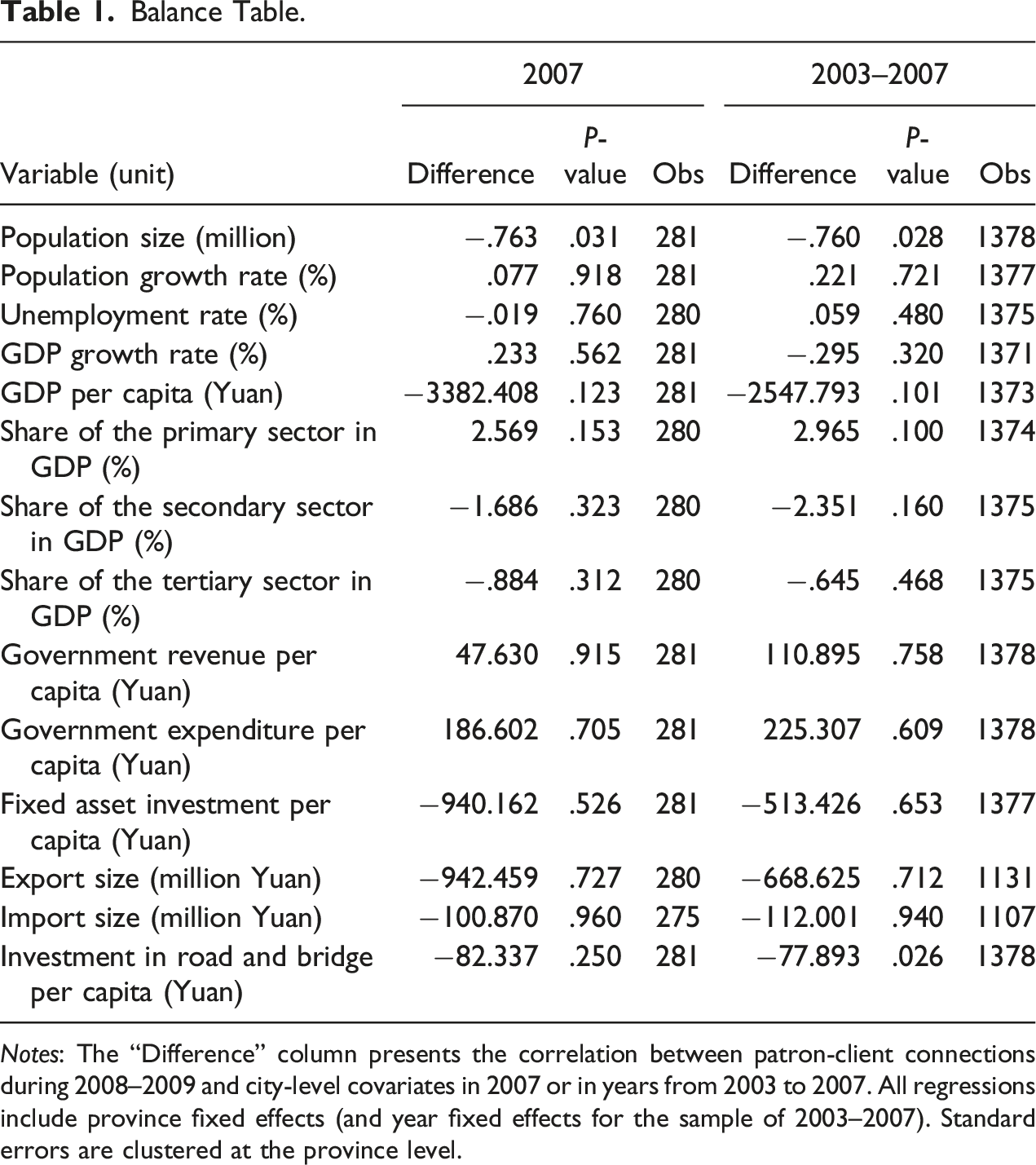
Notes: The “Difference” column presents the correlation between patron-client connections during 2008–2009 and city-level covariates in 2007 or in years from 2003 to 2007. All regressions include province fixed effects (and year fixed effects for the sample of 2003–2007). Standard errors are clustered at the province level.
From Table 1, although we do not see significant imbalances for many variables, a clear pattern does arise: connected cities seem less developed than unconnected cities before the financial crisis. For instance, they have a smaller population size, lower GDP per capita, a larger agricultural sector, a smaller industrial sector, lower fixed asset investment, fewer exports and imports, and less investment in roads, highways, and bridges. These results show that patron-client connections in 2008 and 2009 are not selected into cities that were already richer, more developed, or invested more in infrastructure before 2008. 8 By contrast, less developed cities are more likely to establish patron-client connections during 2008–09.
Moreover, Figure 1 displays the average public investment in roads, highways, and bridges per capita in those cities that were politically connected with the PPS in 2008 or 2009 (blue triangles) and other cities that were not connected during 2008–09 (red dots) from 2003 to 2016. The figure confirms that connected cities had slightly lower levels of investment before the financial crisis than unconnected cities. However, this pattern is quickly reversed since 2008 and connected cities invest more than unconnected cities after 2010. Nevertheless, the figure shows that both connected and unconnected cities substantially increased their infrastructure investment since 2008. Therefore, it is unlikely that unconnected cities, which doubled their infrastructure expenditure after the financial crisis, did not need infrastructure investment. It is more likely that unconnected cities could not obtain the necessary support to push infrastructure investment even further. City infrastructure investment from 2003 to 2016. Notes: “Connected cities” refer to the cities that had patron-client connections in 2008 or 2009. “Unconnected cities” were the cities that did not have patron-client connections in 2008 or 2009.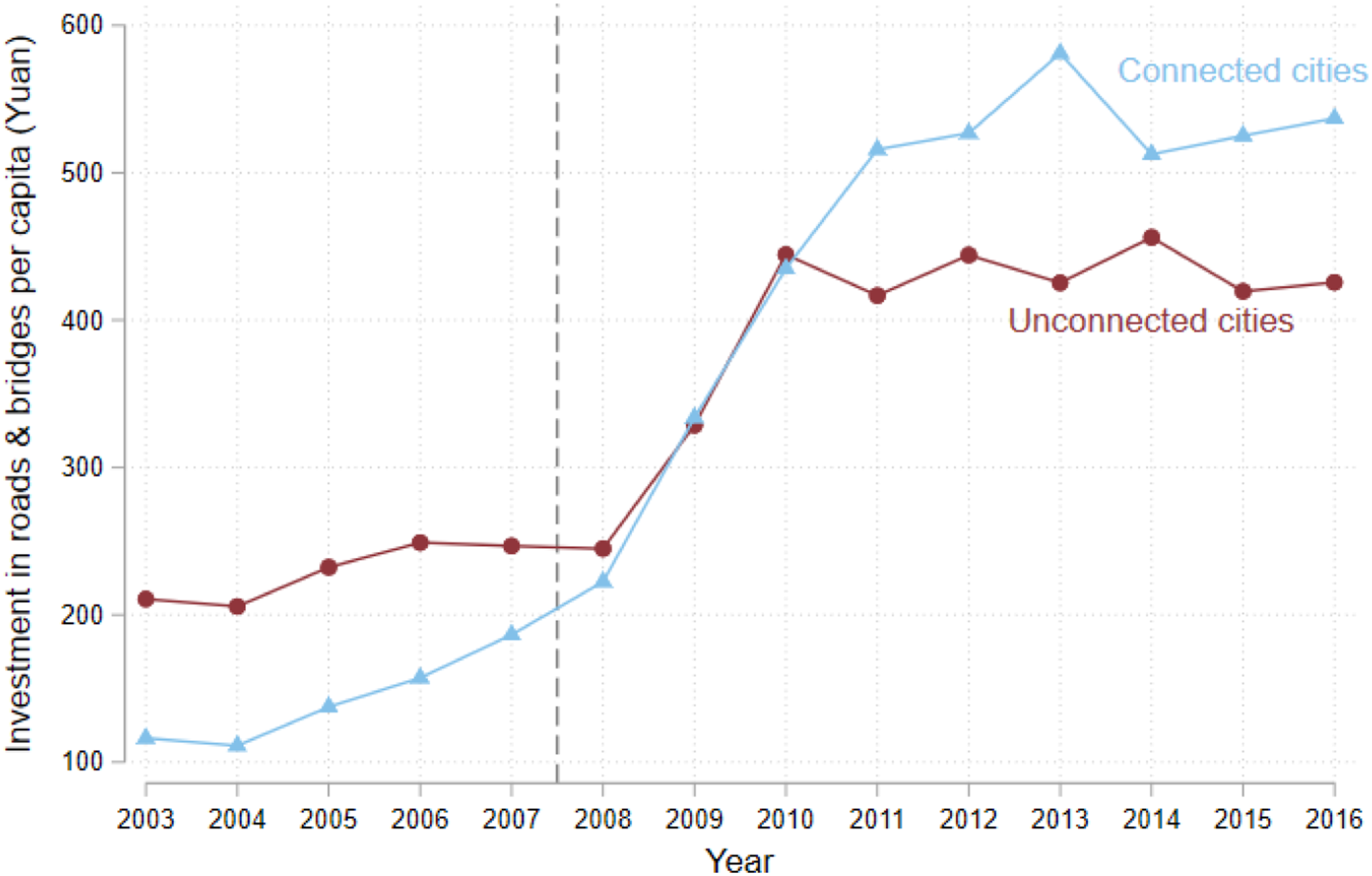
Additionally, the figure also lends support to the parallel tends assumption of the DID design. Although the two groups of cities had different levels of public investment before the financial crisis, this gap remained quite stable before 2008 and only started to change when the Chinese government enacted the stimulus program in 2008. 9
Still, I employ three different specifications to control for differences in the chronological evolution of the outcome variables which may be caused by the differences between connected and unconnected cities before the financial crisis. I do so by adding three forms of control variables into equation (1). In the first form, I use the interaction between pre-treatment variables in the initial year (i.e., 2003) and year trends to adjust for the possible impact of these variables on the “parallel trends assumption” in a DID setup. 10 The second strategy of adding control group is to include the interaction between pre-treatment control variables and Post t to partial out the influence of cities’ initial conditions before and after the financial crisis. Finally, in the third and most stringent form of control strategy, I add interactions between pre-treatment control variables and year dummies which capture the different and year-specific influence of cities’ initial conditions on the outcome variable.
The Benefits of Political Resources
Moving beyond the descriptive patterns contained in the previous section, this section reports the empirical results based on the DID design. Across various modeling strategies, Subsection 6.1 shows that patron-client connections in 2008–09 significantly increase infrastructure investment. Additional placebo tests, robustness checks, and an event study in Subsection 6.2 further strengthen the confidence in this finding. Subsection 6.3 also shows that politically connected cities were more likely to prioritize infrastructure investment in policymaking and downplay the importance of other policy tools to promote economic growth. Thanks to this focus on infrastructure development, Appendix E also reports that the industrial sector is more likely to grow after the financial crisis in cities that had patron-client connections in 2008–09. This is most likely due to the positive effects of infrastructure investment on some privileged industrial firms (Appendix F).
Infrastructure Investment
Patron-Client Connections and Public Investment.
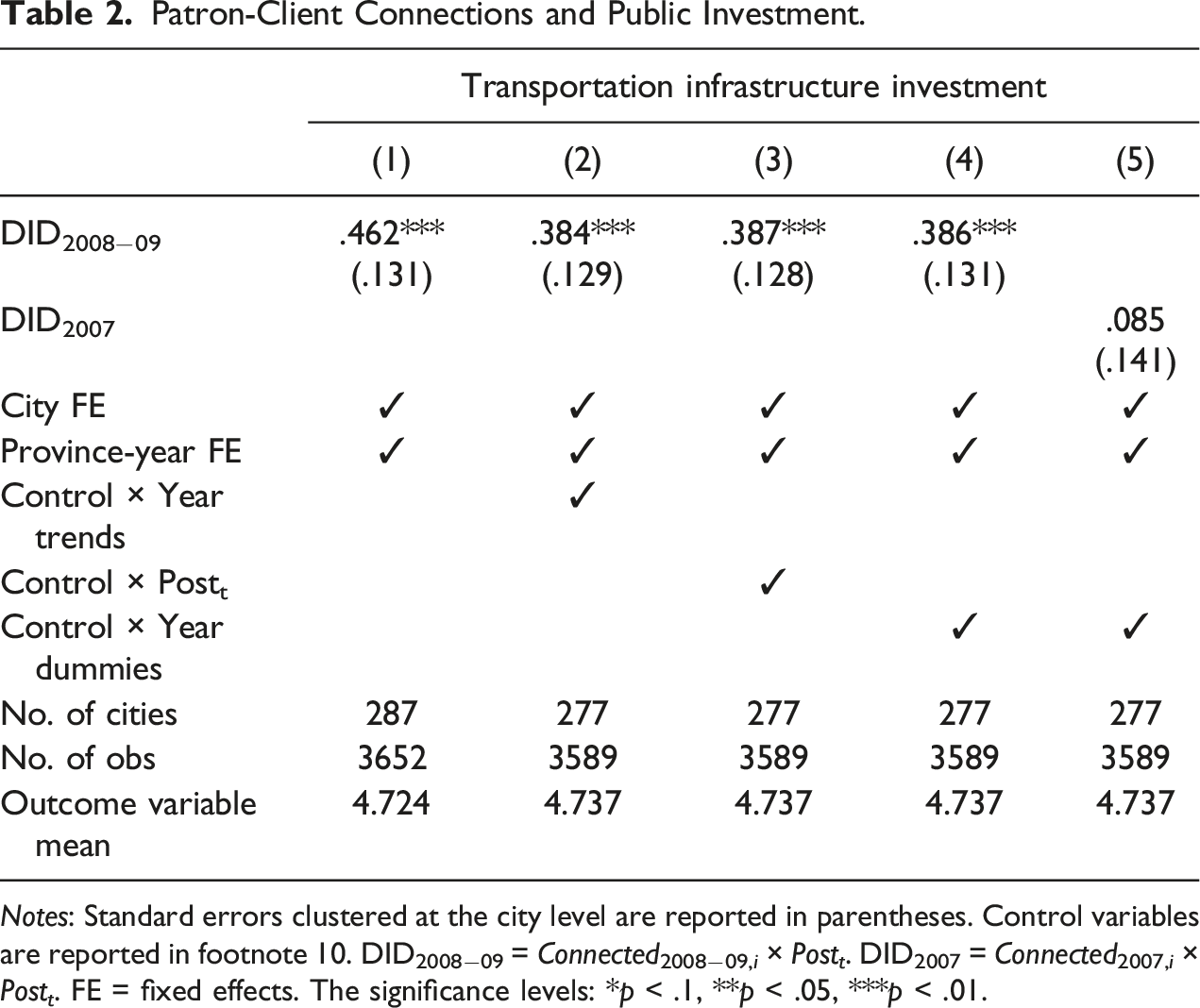
Notes: Standard errors clustered at the city level are reported in parentheses. Control variables are reported in footnote 10. DID2008−09 = Connected2008−09,i × Post t . DID2007 = Connected2007,i × Post t . FE = fixed effects. The significance levels: *p < .1, **p < .05, ***p < .01.
Furthermore, I conduct a placebo test in column (5). I test in this column whether patron-client connections between city leaders and the PPS in 2007—1 year before the introduction of the four-trillion-Yuan stimulus—had any impact on infrastructure investment during and after financial crisis. Although city officials can be replaced at any time, there is a large-scale of position swap or promotion every 5 years during the Communist Party Congress Conferences. In other words, city and provincial officials are likely to be promoted or rotated to another position in these “turnover years.” Hence, the patron-client connections between cities and provinces are more likely to change during the turnover year (even though, again, connection status may also change in other years at a lower frequency).
2007 is such a turnover year (the 17th Party Congress). Since many officials were replaced in 2007, we should expect that the correlation between connections before (i.e., 2007) and after (i.e., 2008) the turnover year is very low. Indeed, the correlation coefficient between the patron-client connections in 2007 and 2008 is only −.023 and is not significant at conventional levels. By contrast, the local leadership is more stable after the turnover year. For instance, the correlation coefficient of connections in 2008 and 2009 is .815. In fact, all the cities that had a connected leader in 2008 continued to be connected in 2009. Hence, the patron-client connections in 2007 should not correlate with higher infrastructure investment (or any other outcome variables) because (1) the connection in 2007 does not help the city benefit from the stimulus program passed in 2008 and (2) connections in 2007 are orthogonal to connections in 2008 or 2009.
Consistent with this expectation, I do not find in column (5) that cities connected in 2007 invest more in transportation infrastructure during or after financial crisis. This result demonstrates that my findings are not driven by connections per se. Instead, patron-client connections will only have effect on public investment if they were established in 2008 or 2009 when the stimulus package was implemented.
I further conduct an event study with the following specification.
By interacting Connected2008−09,i with different year dummies (δ γ ), I can find out the effect of political resources before (i.e., γ < 2008) and after (i.e., γ ≥ 2008) the Chinese government implements the stimulus program. I omit the year 2004 (i.e., δ2004) to avoid multicollinearity. 11 Hence, all coefficients β γ (where γ ≠ 2004) should be interpreted in comparison with the effect of Connected2008−09,i in 2004. The parallel trends assumption for the DID design requires that all β γ are not significantly different from zero before China announces the stimulus program (i.e., γ < 2008).
Figure 2 displays the results of this exercise.
12
Indeed, Figure 2 shows that those cities that will have patron-client connections in 2008–09 did not have significantly higher (or lower) infrastructure investment before 2008 (compared to the baseline year 2004). This result strengthens our confidence in the critical parallel trends assumption of the DID design. Moreover, Figure 2 also shows that those cities that were connected in 2008 or 2009 continue to invest significantly more than other unconnected cities after the stimulus program is concluded in 2010. This finding is consistent with the discussion in Section 3 that public works approved under the 2008 Stimulus were long-term projects and they often paved the path for subsequent investment that would expand the scale of existing infrastructures. Dynamic effects of patron-client connections. Notes: Each dot represents the effect of connection during 2008–09 on infrastructure investment in that given year shown on X-axis. Vertical bars are 90% confidence intervals. Please refer to Appendix Table B1 for regression results that report other significance levels. Year 2004, the first year of the sample used (2004–2016), is omitted and used as the baseline. These results are robust to using 2007, the year just before the financial crisis, as the baseline year (see Appendix Table B2).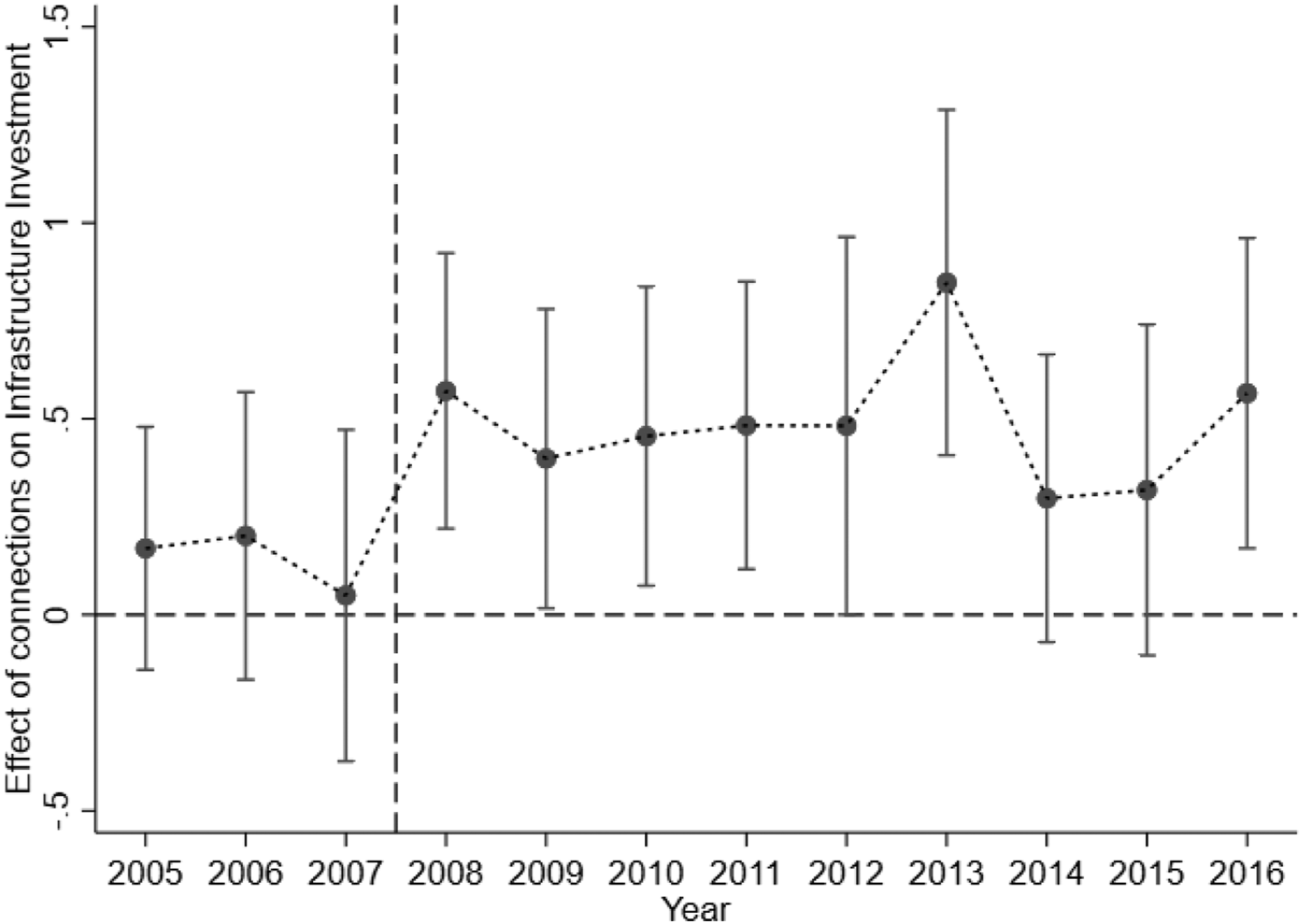
Robustness Checks and Alternative Explanations
I perform several additional tests on the robustness of the results. First, I drop the so-called “deputy-province cities” (副省级城市) and repeat the analysis. Officials in these deputy-province cities enjoy higher bureaucratic status and receive more policy favors from the central government. Additional analysis contained in Appendix Table B3 demonstrates that my results remain almost unchanged after dropping these special cities. Moreover, Appendix Table B4 reports the results based on a more stringent specification that controls for city-year trends. This more demanding model further absorbs the unobserved, unique chronological evolution of the outcome variable for different cities. The results remain robust to this alternative specification.
I also replace the measurement form of the outcome variable with investment per capita (i.e., not taking the log form), log total investment (i.e., not taking the per capita value), and the investment as the share of GDP in Appendix Tables B5 to B7. The results remain both positive and significant across these tests. Moreover, Appendix Table B5 offers an easy and direct interpretation for my results. It shows that the patron-client connections in 2008–09 boosted the infrastructure investment by 184.5 Yuan per resident on average. This is a roughly 50% increase from the mean infrastructure investment.
Next, I consider whether the results in Table 2 are due to the effect of the “turnover year” in 2007. I do so by examining if patron-client connections in another, arguably more important, turnover year in 2012 (the 18th Party Congress) and 2 years after that in Appendix Table B8. I do not find that the patron-client connections in 2012 and two years after 2012 (i.e., 2013 and 2014) significantly increase city infrastructure investment.
I then examine an alternative explanation for my findings. Recall that Section 5 shows that less developed cities were more likely to establish patron-client connections in 2008 or 2009. It was possible that competent officials were appointed to these less developed cities to help promote the infrastructure development. 13 If this is the case, competence (rather than patron-client connections) is driving the results.
Indeed, Appendix C shows that CPS’s and mayors who had patron-client connections with the PPS in 2008 or 2009 were significantly younger and more likely to have college degrees, even though other aspects of their personal characteristics (e.g., gender, race, prior work experience) were similar to unconnected city officials. Hence, I further examine whether my findings are robust to the inclusion of age and education of CPS’s and mayors in Appendix Table C3. This table shows that the coefficient of patron-client connections of city leaders in 2008–09 remain positively and significantly correlated to infrastructure investment after controlling for city leaders’ age and education in 2008–09. Hence, age and education of city officials cannot fully explain my findings.
However, connected mayors and CPS’s may be capable in other aspects that I cannot observe or measure. To reduce this concern of the omitted variable bias, I repeat the analysis by further controlling for mayor and CPS fixed effects in Appendix Table C4. 14 If we consider competence (as well as other unobserved personal traits such as personality) as relatively stable during their roughly 3-year tenure, individual fixed effects should capture a good portion of unobserved competence. 15 Again, the results remain largely robust to this alternative specification.
Furthermore, since those cities connected in 2008–09 are likely to maintain their connections afterward, my findings (and the long-term effects particularly) may not be driven by patron-client connections in 2008 or 2009, but are due to connections after the financial crisis. 16 To rule out this competing interpretation, I further control for patron-client connections for city i in year t and repeat the analysis contained in Table 2. To save space, I report the results in Appendix Table B12. I find that my results are almost unchanged after controlling for this time-variant connection variable. Moreover, the coefficient of patron-client connections is small and not significant, perhaps because the connections with provincial leaders are less important for securing project approvals in normal times when the NDRC does not rubber-stamp project requests.
Still, another concern is that the PPS’s allocated projects to their hometowns, since comparative research finds compelling evidence such hometown biases exist in other countries’ distributive politics (Hodler & Raschky, 2014). This is unlikely to be true in my setting, because only three out of 31 PPS’s were born in the provinces that they served during 2008–2009 when the projects were proposed and approved. Additional analysis further excluding these three provinces whose PPS’s were locally born produces similar results (Appendix Table B13).
Finally, Appendix Section D reports additional results for the (lack of) heterogeneous effect of patron-client connections on infrastructure investment. To summarize these tests, I find that patron-client connections established through both mayors and CPS’s increased infrastructure investment (Appendix Table D1); that connections in both 2008 and 2009 had a positive effect on infrastructure development (even though the effect in 2009 is stronger) (Appendix Table D2); and that patron-client connections of both first-year city leaders and more experienced ones increased infrastructure investment (Appendix Table D3). Hence, my findings are not driven by the position of city leaders, year of connection formation (2008 or 2009), or new city leaders.
Policy Priorities of City Governments
Patron-Client Connections and Policy Priorities.
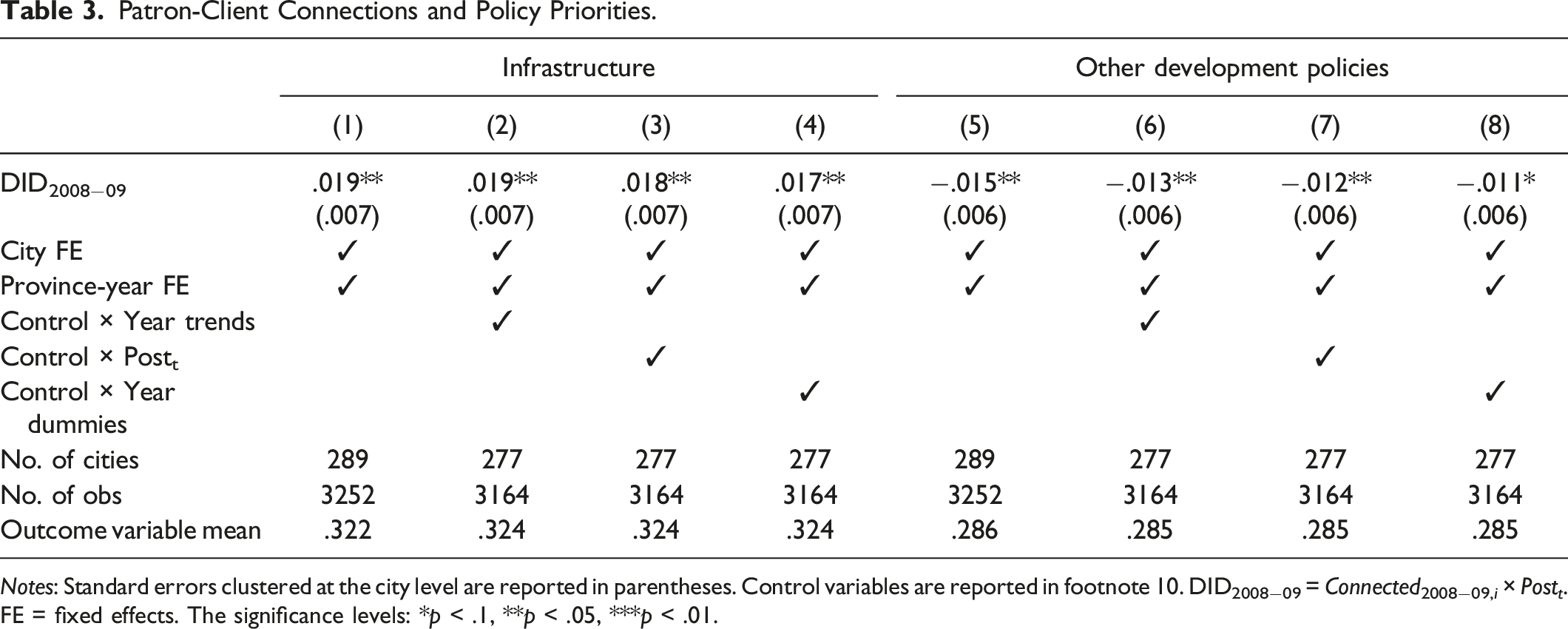
Notes: Standard errors clustered at the city level are reported in parentheses. Control variables are reported in footnote 10. DID2008−09 = Connected2008−09,i × Post t . FE = fixed effects. The significance levels: *p < .1, **p < .05, ***p < .01.
Furthermore, columns (5) to (8) use the portion of words that discuss other economic development topics (e.g., high-value added service industry, agricultural modernization, foreign investment, and market reform, to name a few) in the annual report as the outcome variable. 17 These four columns indicate that these other economic policy tools became less appealing to city governments that had been politically connected to provincial leaders in 2008 or 2009.
I perform two sets of additional tests in Appendix Table B9 to check the validity of these findings. First, I conduct a placebo test to see if the patron-client connections in 2007, one year prior to the announcement of the stimulus program, affected the language used in the annual reports. Moreover, I also perform a falsification test that examines whether the patron-client connections in 2008 and 2009 influenced the portion of words devoted to other non-economic policies in the government report. Neither test yields significant results.
Taken together, this subsection demonstrates that the positive effect of patron-client connections on infrastructure is robust to an alternative measurement choice. Moreover, these results based on city annual reports also indicate that the finding is, at least partly, due to the intentional strategy of city governments. Connected cities proactively prioritize infrastructure development and weaken the importance of other policy tools to promote economic development.
Thanks to this policy priority, I also find that the secondary sector of the city grew faster in politically connected cities than other unconnected cities (Appendix Section E) since transportation infrastructure is found to be most useful for the growth of industrial sectors (Ghani et al., 2016; Li & Li, 2013). Meanwhile, prioritizing infrastructure development may also pose problems for longer term sustainable economic development. I discuss these potential costs of connection-driven growth in the next section, to which we now turn.
The Costs of Political Resources
This section discusses the “costs” of political resources. First, with both firm-level and city-level evidence, I show that patron-client connections correlate with a worse business environment for privately owned firms. Moreover, the second subsection demonstrates that connected cities use bank loans and bonds rather than fiscal transfers to finance infrastructure development. These public debts may undermine the long-term sustainability of economic growth.
A Less Favorable Environment for Private Investment
Does the patron-client connection in 2008 or 2009 reduce a city government’s incentives to improve the pro-business environment and reduce the barriers for privately owned enterprises to invest, since such cities prioritize public investment? A challenge in answering this question is that I cannot analyze private investment directly. This is because public investment naturally “crowds out” private investment as financial resources are diverted to governments and state-owned enterprises (SOEs) (Huang et al., 2020). Instead, the purpose here is to understand governments’ efforts to attract private investment rather than identify the crowding-out effect.
To overcome this challenge, I make use of the Chinese Private Enterprise Survey which samples and surveys owners of privately owned firms from all provinces of China every 2 years. In its 2009 survey, the survey team asked a question directly related to local governments’ support for privately owned firms. The questions is “did your firm receive fewer loans from banks because they reduced loans to privately owned enterprises this year (2009).” 18 The access to loans is a major bottleneck for the development of private firms in China (Song et al., 2011). Moreover, as city governments either own some city banks or can indirectly influence the local branches of national commercial banks, city governments could facilitate the bank loans to privately owned enterprises. Hence, this survey questions is a direct measure for city governments’ resolve to help privately owned enterprises to overcome the financial difficulties during the financial crisis. Nevertheless, a potential problem with this survey question is that firm owners can only provide subjective assessment. Hence, the analysis can only help us understand whether private entrepreneurs believed that they were discriminated in loan applications.
Patronage Connections and the Financial Discrimination Against Private Firms.
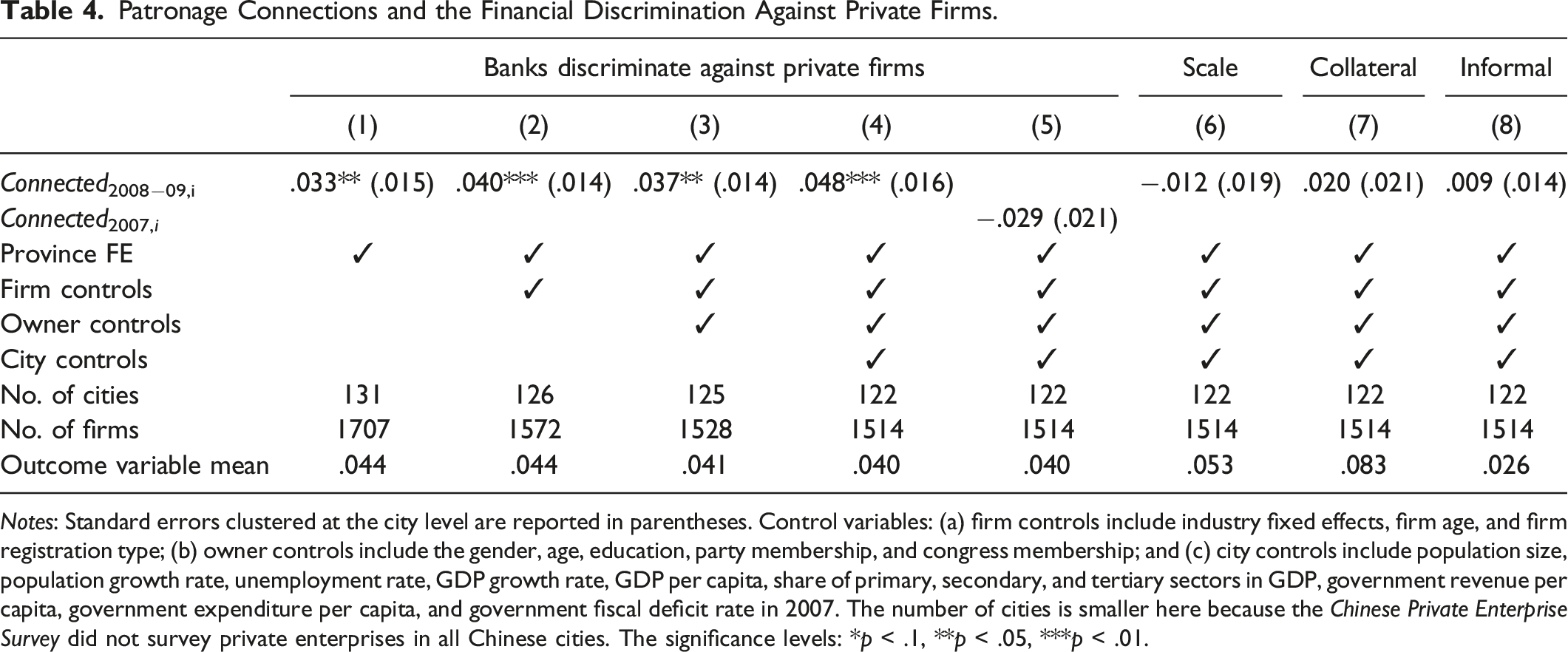
Notes: Standard errors clustered at the city level are reported in parentheses. Control variables: (a) firm controls include industry fixed effects, firm age, and firm registration type; (b) owner controls include the gender, age, education, party membership, and congress membership; and (c) city controls include population size, population growth rate, unemployment rate, GDP growth rate, GDP per capita, share of primary, secondary, and tertiary sectors in GDP, government revenue per capita, government expenditure per capita, and government fiscal deficit rate in 2007. The number of cities is smaller here because the Chinese Private Enterprise Survey did not survey private enterprises in all Chinese cities. The significance levels: *p < .1, **p < .05, ***p < .01.
Column (5) contains the results of a placebo test. This column shows that privately owned firms in cities that were connected in 2007 were not more likely to report financial discrimination against them in 2009. This result demonstrates that only connections at a time when the Chinese government implements the stimulus program changes the incentives of city government. Patronage connections before the financial crisis do not make cities more reliant on public investment than private investment.
Furthermore, I report results for three falsification tests in columns (6) to (8). The outcome variables in these three columns are other reasons that private entrepreneurs reported lower bank loans in 2009, including downsizing the production scale (column (6)), onerous requirements for collateral assets (column (7)), and obtaining loans through informal finance (column (8)). We do not see that private entrepreneurs in cities that had been connected in 2008 or 2009 were more likely to report receiving fewer bank loans due to these other reasons.
Moreover, additional results in Appendix Section G show that private entrepreneurs reported a lower self-assessed score on their social and political status in those connected cities. This finding is consistent with the expectation that cities connected during the financial crisis became more dependent on public investment and SOEs, and so become less supportive for private enterprises. This priority to support government investment and SOEs over private firms was also reflected by private entrepreneurs’ subjective assessment of their social and political status.
Finally, I provide still another piece of empirical evidence that patron-client connections worsen the business environment for private investors. Here, I utilize the city-level “doing business scores (DBS)” published by economists at the Renmin University of China (Nie et al., 2019). The DBS evaluates the following five aspects of city governments’ efforts to improve the environment for business and investment since 2017, including the frequency of city officials visiting firms (10%), public service provision to firms (40%), firms’ tax burden (10%), corruption (10%), and governmental transparency (30%). These scholars then aggregate the scores in these five aspects (with the weights included in the parentheses above) into an index for the general business environment of a city. I use this total score as the outcome variable in my analysis.
Patron-Client Connections and the Pro-Business Environment.
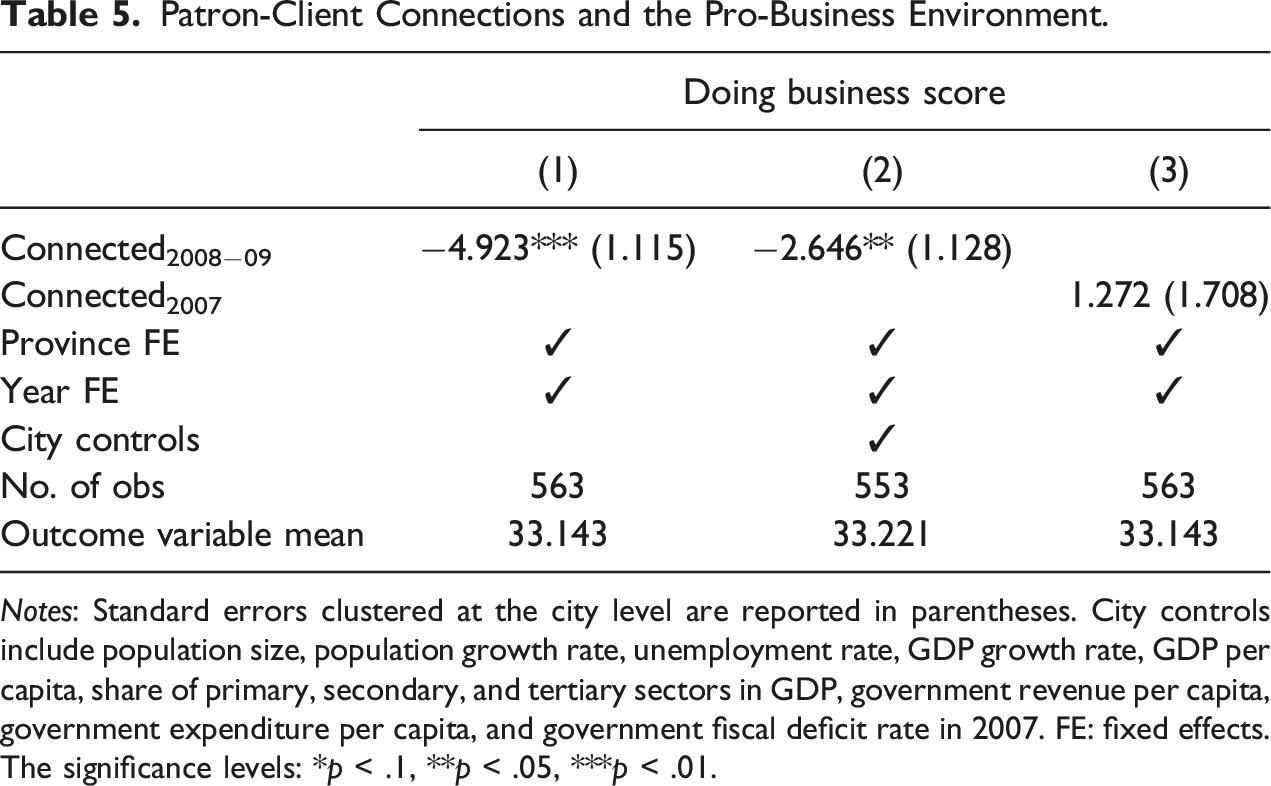
Notes: Standard errors clustered at the city level are reported in parentheses. City controls include population size, population growth rate, unemployment rate, GDP growth rate, GDP per capita, share of primary, secondary, and tertiary sectors in GDP, government revenue per capita, government expenditure per capita, and government fiscal deficit rate in 2007. FE: fixed effects. The significance levels: *p < .1, **p < .05, ***p < .01.
Public Debts
In this subsection, I examines whether patron-client connections increase public debts. I do so by investigating three primary sources of infrastructure finance: namely, fiscal transfers from the central government, budget allocated by local governments (including both provinces and cities), and bank loans. To measure the importance of these funding sources, I use the amount of these sources for infrastructure project finance as the share of the city GDP from 2004 to 2016. I then apply the same DID design to examine connected cities use which financial source(s) to fund their infrastructure development.
Political Patronage and Funding Sources for Infrastructure Projects.

Notes: Standard errors clustered at the city level are reported in parentheses. Control variables are reported in footnote 10. DID2008−09 = Connected2008−09,i × Post t . DID2007 = Connected2007,i × Post t . FE: fixed effects. The significance levels: *p < .1, **p < .05, ***p < .01.
Two policies enacted by the central government made bank loans and city bonds, rather than other budget sources, a popular choice for city governments to finance their proposed projects. First, the central bank of China lowered commercial banks’ reserve requirement ratio four times in a row in 2008. This drastic change of monetary policy injected sufficient liquidity into the banking system and allowed banks to give more loans. Moreover, the central government formally permitted local governments to set up special purpose vehicles (SPVs) in 2009. These SPVs helped cities circumvent the requirement that governments cannot apply for bank loans. Since these SPVs were not governments, they could issue bonds and take bank loans.
Consistent with this policy background, Appendix Section H reports further evidence that connected cities were more likely to accumulate government debts by using two additional datasets. First, drawing on the data on cities’ banking systems, I find that cities that were politically connected in 2008 or 2009 accumulated a larger size of bank loans in this city’s banking system than other cities that were not connected during the financial crisis. A placebo test shows that patron-client connections in 2007 did not have a similar effect. Furthermore, a falsification test confirms that patron-client connections in 2008–09 did not increase the deposits size in the city banking system. Second, with the data on city bonds issued by SPVs (from the WIND Database), I find that connected cities issued more city bonds through SPVs than other cities that were not connected in 2008–09.
Conclusion
Although recent research finds that close political connections between the subordinate and her political superior boost local economic performance, my analysis suggests potential costs of such connection-driven economic growth, including the accumulation of public debts and slowing down market-friendly reforms. These concerns dim the longer term sustainability of economic development, even though patron-client connections boost short-term economic growth as existing research (as well as my analysis) shows.
I offer empirical evidence with the data on Chinese cities from 2003 to 2016. Those cities that were politically connected to their provincial superiors in 2008–09, when the Chinese government implemented the “four-trillion-Yuan stimulus program,” invested more in infrastructure, saw a more rapid growth of the secondary sector, and accumulated more debts. However, politically connected cities were also less likely to attract private investment by building a business-friendly environment and reducing the financial discrimination against private firms.
More broadly, these results also deepen our understanding of how governments react to external economic impacts. First, this paper joins recent work that shows heterogeneous responses of governments to external economic impacts within a country (Tan, 2020). I further demonstrate that these different responses of Chinese cities lay the foundation for different economic development models in the longer term. Moreover, recent work shows that global financial market can influence the fiscal resources available to governments to distribute to their clients (Arias, 2019). My analysis shows another pathway through which global economic shocks activate the influence of the patronage system.
Moreover, my findings indicate that the 2008 stimulus program has a profound impact on the Chinese economy in the longer term. These results echo the recent work that reports pernicious influence of the stimulus program, including crowding out private investment (Huang et al., 2020), reducing the investment in innovation (Zilibotti, 2017), increasing public debts (Chen et al., 2020), and undermining the growth of the private sector (Bai et al., 2016; Cong et al., 2019; Hou & Li, 2021; Lei & Nugent, 2018). My findings demonstrate that patronage connections, a factor under-investigated in these studies, make these pernicious effects only more salient.
The four-trillion-Yuan stimulus in 2008 was not the only stimulus program enacted by the Chinese government. For instance, the Xi Jinping administration called for additional infrastructure projects to boost the staggering economic growth in the first quarter of 2022. 20 It seems that a common feature of these Chinese stimulus programs is that they were enacted quite quickly. As least in the case of the 2008 stimulus analyzed here, we see that the NDRC could not find enough projects for the ambitious anti-crisis program. As a result, the central government temporarily decentralized the de facto approving authority to provinces and rubber-stamped provincial governments’ recommended projects. To the extent that other stimulus programs may also need the provincial officials’ assistance to find enough investment projects in short notice, we may expect that those local governments that maintained a close relationship with the province would receive more approval for their infrastructure projects if we analyze other stimulus programs. Nevertheless, further empirical analysis for other similar stimulus programs is needed to determine whether this theoretical prediction is accurate.
Finally, my analysis is also relevant to cases beyond China. Although I operationalize political connections as city leaders’ patron-client connections with their provincial superiors, close intergovernmental relationship can also be obtained through lobbying, partisanship, personal connections, and alike in other settings. Research shows that these other forms of political connections also help a local government receive fiscal resources or policy support from higher level governments (Brollo & Nannicini, 2012; Callen et al., 2020; Goldstein & You, 2017; Ji & Ma, 2021; Payson, 2020; Rivera, 2020). To the extent that political connections help a local government obtain the necessary resources and support for public investment, we should also expect that political connections make an economic development model that features higher public investment and public debts more possible in other settings. However, further research is needed to examine whether politically induced public investment also reduces governments’ incentives to attract private investment in other countries.
Supplemental Material
Supplemental Material - The Political Resource Blessing or Curse? Patronage Networks, Infrastructure Investment, and Economic Development in China
Supplemental Material for The Political Resource Blessing or Curse? Patronage Networks, Infrastructure Investment, and Economic Development in China by Zhenhuan Lei in Comparative Political Studies
Footnotes
Acknowledgements
This paper is based on chapter three of the author's Ph.D. Dissertation. The author is grateful to his advisors, Bruce Bueno de Mesquita (chair), Dan Mattingly, Julia Payson, and Adam Przeworski, for guidance, advice, and encouragement. The author also thanks Tianyang Xi and Yang Yao for sharing the CCER Elite Database and Junyan Jiang for sharing the data on prefectural governments' annual reports. The Trans-Pacific Junior Faculty Research Group colleagues have provided tremendously constructive and useful comments. The authors also acknowledges the extremely helpful comments of Carlos Felipe Balcazar, Rikhil Bhavnani, Frederick Chen, Yishuang Li, Chuyu Liu, Fengming Lu, Amanda Kennard, Melanie Manion, Xun Pang, Tianyang Xi, Yang Yao, Hye Young You, Congyi Zhou, and Junlong Zhou. Yang Yang has performed excellent research assistance. Earlier versions of the paper have been presented at New York University, Fudan University, the University of Southern California, and the University of Wisconsin-Madison.
Declaration of Conflicting Interests
The author(s) declared no potential conflicts of interest with respect to the research, authorship, and/or publication of this article.
Funding
The author(s) disclosed receipt of the following financial support for the research, authorship, and/or publication of this article: This article was supported by the University of Wisconsin-Madison, Office of the Vice Chancellor for Research and Graduate Education with funding from the Wisconsin Alumni Research Foundation; and Department of Politics and Center on US-China Relations, New York University.

Supplemental Material
Supplemental material for this article is available online.
Notes
Author Biography
References
Supplementary Material
Please find the following supplemental material available below.
For Open Access articles published under a Creative Commons License, all supplemental material carries the same license as the article it is associated with.
For non-Open Access articles published, all supplemental material carries a non-exclusive license, and permission requests for re-use of supplemental material or any part of supplemental material shall be sent directly to the copyright owner as specified in the copyright notice associated with the article.
