



Abstract
When do organizations broadly represent the interests of their economic sectors and when do they narrowly represent the interests of members? This article investigates how agricultural and small-business organizations in Mexico make demands for programmatic policies or patronage benefits. Contrary to explanations based on the class of members, I show that the source of organizational capacity shapes demand-making strategies. Organizations that generate selective benefits internally are able to engage in programmatic policies that shape sectoral competitiveness, whereas organizations that fail to solve membership challenges internally are vulnerable to the patronage trap, a self-reproducing cycle wherein they become specialized in demand making for discretionary private goods. I generate this argument through process tracing of two agricultural organizations in Mexico. Analysis of an original survey of economic interest organizations provides broader evidence that organizational capacity is a better predictor of policy demands than social class.
The Central Campesina Cardenista (CCC) and the Network of Rural Commercializing Firms of Michoacán (RedCCAM) are two large “dissident” peasant organizations in the Mexican state of Michoacán. At their founding in the 1990s, these two organizations shared similar core principles: opposition to the liberalization of agricultural policy, which they viewed as privileging large-scale farmers, and a rejection of the dominant party’s top-down control of rural organizing. Despite these initial similarities, these two organizations’ paths diverged markedly in the early 2000s, when Michoacán experienced party turnover for the first time since the 1910 Mexican Revolution. The CCC downplayed its efforts to effect change in agricultural policy and formed an alliance with the new ruling party—organizing campaign events, endorsing candidates in the media, and posting its own leaders for public office. In return, the CCC receives privileged access to state agricultural subsidies, which the leader allocates discretionarily to reward the most loyal members. In contrast, RedCCAM has eschewed party alignment—and the corresponding handouts—deploying its resources instead to push for state agricultural policies that favor small-scale grain farmers, such as crop insurance programs, investments in storage and shipping infrastructure, and accessible credit programs. Why does one organization narrowly pursue short-term patronage benefits, whereas the other seeks to influence programmatic policies that shape long-term sectoral competitiveness?
In this article, I analyze organizations that were founded to represent two sizable nonelite economic sectors in Mexico—small-scale agriculture and small businesses—to explain variations in these organizations’ demand-making strategies. Within each of these sectors, there are some organizations that fulfill their founding mandates by making programmatic demands that respond to the interests of their sector and others that strive, instead, to maximize patronage benefits for members. I argue that the source of organizational capacity—the ability to recruit, retain, and mobilize members—shapes organizations’ demands. Those organizations that generate this capacity internally—typically by offering services that function as selective benefits—enjoy the autonomy to pursue programmatic policies (e.g., regulatory policy, infrastructure, nondiscretionary subsidies) on behalf of the sectors that they represent. Organizations that do not generate such capacity internally often opt to enter into dependent linkages with state or party actors and limit their demands to bargaining for discretionary distributive benefits.
Scholars of party–voter linkages address a similar puzzle, interrogating when competition between parties is driven by particularistic exchange or by programmatic alignment (Díaz-Cayeros, Estévez, & Magaloni, 2016; Keefer, 2007; Kitschelt, 2000; Shefter, 1977). To explain linkage outcomes, this literature typically turns to regime-level factors that shape the supply side of patronage, such as bureaucratic professionalization, economic shocks, or democratic immaturity. To the extent that scholars address the demand side, they focus on social class, arguing that the poor are vulnerable to clientelist vote buying because they derive a higher marginal utility from particularistic goods than do upper income groups (Calvo & Murillo, 2004, pp. 743-745; Dixit & Londregan, 1996, p. 1144; Stokes, Dunning, Nazareno, & Brusco, 2013, pp. 158-171). However, it is unclear that the same factors that drive individual citizens’ policy demands work equally as well for collective actors—and class-based explanations fail to explain variation in demand-making strategies among organizations that represent the same social groups, as illustrated in the two cases above.
Organizational capacity is the ability of mass-membership interest organizations to solve their most fundamental objective: maintaining an active membership. In the words of Wilson (1995), “(w)hatever else organizations seek, they seek to survive. To survive, they must somehow convince their members that membership is worthwhile” (p. 10). I observe two traits of organizations to detect whether they generate such capacity internally: resource independence and the services that they offer to incentivize participation. Internally generated organizational capacity positions organizations to engage in forms of mobilization suited to influencing programmatic policies: autonomous consultation and lobbying with politicians of all parties and pressure tactics, such as protest and media campaigns. However, organizations that rely on resources extracted through dependent state linkages for recruitment and mobilization are often limited to a narrow range of demand-making strategies, centered on electoral mobilization in exchange for discretionary patronage benefits.
This mode of demand making is self-reproducing through an equilibrium state that I refer to as the patronage trap. Reliance on patronage benefits leads the organization to specialize as an intermediary for state programs. In the extreme case, the organization limits its mobilization to the electoral realm, eschewing pressure politics. The organization leader becomes coopted by the party, assuming the role of clientelist broker. And, as the organization attains a reputation as a source of state handouts, recruitment targets a self-selecting population eager to access such benefits.
The ability of economic interest organizations to represent their sectors broadly, rather than their membership more narrowly, has importance for the quality of representation and political accountability. Scholarship on mature democracies has long been concerned with class-based imbalance in representation in economic policy. An early pluralism scholarship (Dahl, 1961; Truman, 1951), which described the interest arena as a faithful reflection of societal interests, was impugned by influential research showing that disparities in collective-action capacity and political access often cause elite interests to prevail in policy making (Lindblom, 1977; Schattschneider, 1960; Verba, Schlozman, & Brady, 1995). We might expect class distortions in representation to be particularly acute in transitional democracies, which are known for being “hierarchical” and “predatory” (Markus, 2015; Schneider, 2013). And, although scholars of clientelist machines (Auyero, 2000; Gay, 1999) and nonstate welfare provision (Auerbach, 2016; Cammett, 2014; Thachil, 2011) observe that patronage politics often delivers sorely needed public goods and services to vulnerable communities, such informal patronage networks are ill-equipped to represent the interests of squatters, peasants, or other popular-sector populations in important policy battles. In contrast, economic interest organizations—such as those studied here—are founded with the mandate of representing sectoral interests. A narrowing of their demands to patronage benefits causes such interests to be excluded from the venues where structural elements of economic governance are decided.
I build my argument through process tracing of two interest organizations and then test this argument on data from an original survey of interest organizations in Mexico. First, using a “most similar” approach, I compare two peasant organizations with similar founding trajectories, showing how the ability to generate organizational capacity internally sent one down the programmatic path, whereas the failure to do so routed the other into the patronage trap. I then test the argument using data from an original nationwide survey of 99 state and local peasant associations and small-business chambers belonging to four national confederations. These two sectors offer three advantages for testing theories about organizational demand making: (a) They provide a controlled institutional framework, as each sector includes numerous national confederations made up of state and local affiliates. (b) They offer variation on social class between the lower-class peasants and middle-class small-business owners that make up the organizations. (c) Confederations in these two sectors espouse programmatic goals, and prominently engaged in mobilization over core elements of national economic policy during Mexico’s neoliberal transition.
The Mexican context is informative because it presents conditions that are particularly threatening to interest organization autonomy. During the greater part of the 20th century, Mexican politics were dominated by the Institutional Revolutionary Party (PRI), which controlled organizational activity through top-down corporatist ties with labor, business, the peasantry, and other economic sectors (Collier, 1992; Grayson, 1998). The past three decades have witnessed a transition to multiparty competition between the PRI, the right-wing National Action Party (PAN) and the left-wing Party of the Democratic Revolution (PRD). Competition between national parties in Mexico took on greater programmatic content once the PAN assumed the presidency in 2000 and instituted policies to curtail patronage politics (Hagopian, in press). However, this shift has certainly not extirpated the discretionary allocation of state benefits for electoral purposes. Patronage politics remains particularly rampant on the state and municipal levels, which have lagged in adopting rule-based policy-making norms and today control larger budgets due to decentralization (Hernandez-Trillo & Jarillo-Rabling, 2008). Recent literature also documents persistent vote buying in Mexico by all three major parties (Larreguy, Marshall, & Querubin, 2016; Nichter & Palmer-Rubin, 2015). In this context, local organizations face constant temptations to prioritize patronage-based party linkages over programmatic representation of base interests.
Organizational Determinants of Demand Making
Interest organizations sort into two broad categories: those that limit their demands to particularistic benefits for members and those that make demands on behalf of a broader scope of interests, such as producers in an entire economic sector. I argue that these two outcomes are elements of distinct equilibria, which are largely driven by internal organizational traits. Those organizations that generate organizational capacity internally enter into a virtuous cycle featuring autonomous state engagement and programmatic representation of their sector. Organizations that depend on an external actor to generate organizational capacity are routed into a distinct equilibrium, which I dub “the patronage trap,” in which the organization specializes as an intermediary of state programs for members and loses interest or capacity to make demands for sector-wide policy.
Conceptualizing Organizations’ Demands
Classic literatures on labor unions, social movements, and political parties have similarly addressed why these organizations, at times, pursue broad transformative goals and other times narrowly promote the interests of members, or even more narrowly, of leadership. Research on organized labor interrogates why some unions make demands on behalf of unionized workers (business unionism) and others on behalf of the broader working class (social unionism; Iversen, 1999; Mares, 2004). Social movement analysts have been concerned with the displacement of “transformative” goals for demands that further organizational survival—a fate that they attribute to oligarchy and bureaucratization (Piven & Cloward, 1979; Staggenborg, 1988). The distinction between programmatic and clientelistic ties in the party–voter linkage literature turns on whether the voter supports a candidate in exchange for “selective material incentives” or in response to “packages of policies” whose consequences benefit the voter only indirectly (Kitschelt, 2000, pp. 849-850). These studies typically depict linkage strategies from the supply side, for instance, by characterizing how historical trajectories in bureaucratic professionalization and democratization shaped the formation of parties that were oriented to programmatic representation or patronage exchange (Piattoni, 2001; Shefter, 1977).
My approach seeks to explain the demand side of programmatic and patronage politics, focusing on the organizations that are positioned to make policy demands or to broker patronage benefits. Patronage demands are for discretionary material benefits that stand to benefit only the organization itself or its members. For example, an agricultural organization may pursue state grants for agricultural machinery or training in production techniques for members. All nonelite organizations have an interest in such benefits, which can be used to fund organizational activities or incentivize members to join and participate. In fact, all organizations observed in this study actually do pursue discretionary distributive programs to some degree. A subset, however, extends beyond distributive politics to also levy programmatic demands.
Programmatic demands concern public goods, regulations, or other policies that benefit populations that extend beyond the organization. These populations may be quite limited, such as the community within which the organization operates, or quite large, such as all firms in a given sector. Programmatic demands by an agricultural organization might include that the government invest in irrigation infrastructure, regulate genetically modified organisms, or offer subsidized crop insurance. In line with Stokes et al. (2013), I classify demands regarding nondiscretionary distributive programs as programmatic, such as when an organization demands that a larger share of subsidies be allocated to small-scale producers (pp. 6-18).
A greater share of programmatic organizations is favorable for both democracy and economic development. Although patronage-oriented organizations are often revered for bringing much-needed economic benefits to marginal communities, this mode of politics is inevitably inefficient and biased due to its discretionary character. 1 Patronage politics erodes the value of citizenship by holding voters captive to politicians (Fox, 1994; Hunter & Sugiyama, 2014) and favors those with political connections over those who most merit public aid. Furthermore, just as clientelist party linkages eliminate politicians’ incentives to respond to the policy interests of segments of the population who sell their votes (Stokes, 2005), patronage mobilization of interest organizations undermines the policy influence of nonelite groups already at a disadvantage in biased pluralist democracies. However, programmatic interest organizations pressure politicians to respond to nonelite interests and socialize members to support parties and politicians that are most responsive.
We may posit a collective-action problem, where any individual organization prefers to “free ride” on the programmatic efforts of others and focus its own resources on maximizing patronage benefits for members. However, organization members and leaders derive benefits from being programmatic. A programmatic orientation generates prestige and may even position the organization to extract more distributive benefits in the long term as its reputation as a civic-minded representative of its sector facilitates interlocution with a broad spectrum of policy makers. Similarly, members of programmatic organizations are likely to derive long-term economic benefits from belonging to programmatic organizations, in addition to any “purposive” rewards (Clark & Wilson, 1961) derived from furthering collective goals.
Organizational Capacity and Demand Making
To explain variation in demand making, I interrogate the internal logic of organizations. In contrast to elite interests, which wield power through their control of capital or political connections, nonelite organizations wield power in numbers. Organizational capacity—the ability to recruit, retain, and mobilize members—enables mobilization, both in electoral campaigns and protest. Such capacity furthers both the interests of the leader, whose stature increases with membership size, and the base, which derives benefits from the policy clout that a large membership affords. The source of this capacity shapes demand making. When an organization is able to maintain an active membership autonomously—typically by offering services that incentivize participation—it may turn its attention to external goals, such as influencing sectoral policy. However, organizations that are unable to achieve collective action autonomously are prone to prioritize patronage, which the leader can repurpose as selective benefits to induce member participation.
The source of organizational capacity is reflected in two traits: services and resources. I operationalize each of these traits in terms of their diversity, with more diverse services offered to members and more diverse resource flows indicating internally generated organizational capacity. First, organizations achieve collective action by offering “selective benefits,” which provide members with individual incentive to participate (Clark & Wilson, 1961; Olson, 1968). However, not all selective benefits are equivalent. Some organizations rely solely on externally provided selective benefits, commonly discretionary distributive benefits allocated by a state or party patron. Other organizations additionally generate benefits internally, by offering services such as training programs, legal support, and networking opportunities. Second, organizations require financial resources to cover basic expenses, such as hiring staff, renting headquarters, and hosting activities. Although self-financing through member dues is one way that organizations generate capacity internally, this option is often off the table for organizations representing the poor. Alternatively, organizations may secure diverse sources of financial resources—including multiple donors or generating revenue from the sale of services or goods—therein reducing vulnerability to withdrawal of any particular source (Cress & Snow, 2000; McCarthy & Zald, 1977).
The focus on organizational capacity does not suggest that social class, a variable that has been deployed to explain individuals’ programmatic and distributive demands, is irrelevant to organizations’ demands. Class may establish resource and membership conditions that shape an organization’s options for generating capacity. Organizations that represent the poor are vulnerable to budget constraints and demobilization owing to their potential members’ inability to contribute financially and disinclination to civic participation (Holzner, 2010; Kurtz, 2004; Verba et al., 1995). The poor will also be more likely to join an organization in pursuit of handouts than middle-class citizens, who may be drawn to the social networks or prestige that the organization offers (Wilson, 1995, pp. 56-77). However, organizations are not simply passive aggregators of members’ self-interest, and may socialize members to pursue broader goals. Thus, in contrast to the implication in the party-linkage literature that class determines demand type, I argue that class is but one of several traits that shape organizations’ options for generating organizational capacity, which is the key factor that sets them on programmatic or distributive paths. Organizations representing lower-class populations can evade a patronage orientation if they generate organizational capacity internally; and middle-class organizations that fail to do so may cease programmatic demand making.
Figure 1 lays out the causal model leading to organizations’ demand types. First, the source of organizational capacity shapes organizations’ state engagement. When organizations generate organizational capacity internally by offering desirable services and securing diverse resource flows, they are free to engage the state through autonomous mobilization. Because they are not beholden to any particular party or faction, these organizations are positioned to lobby a broad spectrum of political actors and to select mobilization strategies that are appropriate to further their policy goals. Such organizations may combine participation in consultative institutions, direct contact with bureaucrats and politicians of all parties, and pressure tactics such as protest and media campaigns.
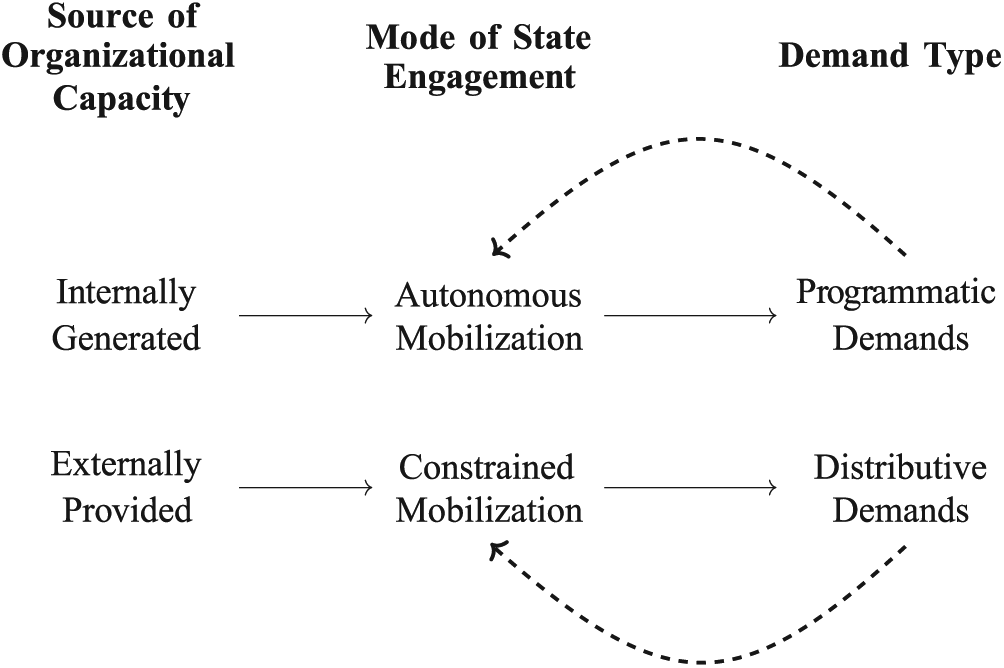
Model of organizational demands.
In contrast, when organizations depend on a state or party actor to generate capacity, they engage the state through constrained mobilization. Patronage benefits can be very effective for achieving collective action, and patronage-based linkages with political parties are likely to be available for organizations that are minimally operational. Party actors, seeking to distribute benefits to groups that demonstrate “coordinating capacity,” are eager to coopt organizations’ networks for electoral mobilization, employing leaders as brokers (Gottlieb & Larreguy, 2018). Over time, this brokerage role spurs a growth in membership and can produce a thriving organization. Dependence on an external actor for resources, however, comes at the price of ceding power to that actor (Emerson, 1962; Pfeffer & Salancik, 2003). It follows that when an organization depends on a political party for financing and selective benefits, the party patron can leverage the threat of withdrawing these benefits to exercise control over the organization’s structure and activities. Thus, when organizational capacity is externally provided, organizations often limit their political engagement to electoral campaigns on behalf of the affiliated party, either at party leaders’ behest or because electoral mobilization displaces other forms of participation.
Second, these modes of state engagement influence the types of policy demands that the organization is able to levy. Autonomous mobilization positions organizations to engage in consultation and demand making at different stages in the policy process, combining insider and outsider strategies and contact with politicians of multiple political parties to secure long-term access to the programmatic policy arena. In contrast, constrained mobilization places limits on organizational demands. Opposition-party politicians are unreceptive to appeals and the allied party often favors the organization in discretionary allocation of distributive benefits rather than granting access to the contested programmatic arena. Thus, as the organization becomes specialized as an electoral vehicle, its demand-making capacity is limited to pressing for a greater share of discretionary distributive rewards.
The arrows looping backward represent the self-reinforcing nature of this process, which occurs through mechanisms of socialization and selection that affect both members and leaders. The lower portion of Figure 1 depicts the patronage trap, in which organizations are “trapped” into an equilibrium state of distributive demand making. 2 This is a trap because the narrow pursuit of distributive demands is self-reinforcing: Once organizations limit their demands to distributive policies, leadership and member recruitment become tailored to patronage politics, making the organization ill-suited for programmatic demand making. First, exclusive party linkages convert leaders into patronage brokers or select for such leaders, generating oligarchic tendencies as leaders manage resources with the goal of retaining their position and expanding their network. Second, as the organization specializes in patronage brokerage, members become socialized to viewing organizational membership through the lens of personal benefit rather than collective interests. In addition, future recruitment is self-selecting for patronage-seeking members.
The upper portion of Figure 1 depicts a parallel equilibrium—a virtuous cycle of programmatic participation—that is perhaps less “sticky” than the patronage trap. This equilibrium is also self-reinforcing through both membership and leadership mechanisms. Through participation in programmatic demand making, organization members become socialized to broader policy issues and perceive broader population groups (e.g., the peasantry or small-business owners) as their “communities of fate” (Levi & Olson, 2000). The organization’s reputation spurs future recruitment of civic-minded members. Furthermore, oligarchic leadership is less likely in programmatic organizations, as these organizations are more likely to attract and produce leaders motivated by the prestige associated with influential activist organizations and rotate leaders more frequently, given less reliance on brokerage.
Alternative Explanations
In addition to class, I consider three rival explanations for organizations’ demand type: leadership, member homogeneity, and electoral context, showing that my argument—based on the source of organizational capacity—more consistently accounts for variation between patronage-oriented and programmatic organizations.
First, leadership practices are better understood as a consequence of an organization’s mode of demand making rather than as the exogenous “luck of the draw.” In line with recent scholarship on endogenous leadership (Ahlquist & Levi, 2011, pp. 14-15), I argue that organizations that focus narrowly on patronage extraction tend to attract and promote leaders that seek monetary rents and are skilled at brokerage. In contrast, organizations with high levels of member solidarity and collective consciousness produce leaders with the skills and motivation to reinforce an orientation to the common good (Andrews, Ganz, Baggetta, Han, & Lim, 2010). In this way, the presence of an oligarchic leader prioritizing rent extraction is an element that reproduces the patronage trap equilibrium rather than an explanatory factor that causes organizations to specialize in patronage demands. Similarly, leaders who rotate frequently and are held accountable to collective goals reinforce the programmatic equilibrium.
Preference homogeneity among members has also been identified as a factor increasing organizations’ ability to mobilize behind collective goals (Moe, 1981; Offe & Wiesenthal, 1980; Olson, 1968). Again, I show that this organizational trait fails to independently account for differences in demand making, for two reasons. First, the membership pool drawn to an organization is shaped by the incentives offered. For instance, an organization offering productive benefits, such as training in crop production methods, attracts a more homogeneous membership of producers of those crops, whereas organizations that mediate state handouts attract a more diverse—and, thus, more difficult to coordinate—membership. Second, once inside an organization, member preferences are induced by organizational norms (Moe, 1981, pp. 537-538). Programmatic organizations generate collective consciousness, and patronage-based organizations reinforce particularism in members.
A third alternative explanation for demand making is the electoral context in which the organization operates. We may expect that the degree of electoral competition or the presence of an ally in government drives demand making. Here, I distinguish between demand making and policy access, asserting that partisanship and party system traits are influential for the latter, as illustrated in the literature on programmatic and clientelist party systems (Hagopian, in press; Kitschelt, 2000; Palmer-Rubin, 2016). The link between political context and organizations’ demands is less certain, however. Examples abound of organizations that levy programmatic demands both in highly adverse circumstances, where politicians have little incentive to respond, and in favorable circumstances, where the presence of electoral allies in office increases the temptation to abandon programmatic goals for patronage.
Case Studies of Interest Organizations in Mexico
Case studies of two organizations in the Mexican state of Michoacán—RedCCAM and CCC—illustrate the causal process through which the source of organizational capacity shapes demand making and rule out alternative explanations. Evidence is drawn from semistructured interviews with organization leaders and nonparticipant observation of routine organization meetings, campaign events, and interactions with state and party figures. Case selection employs “most similar” (Gerring, 2008) criteria to reveal putative causes for different outcomes in cases that are otherwise similar. I compare two peasant organizations facing similar economic pressures, showing how the adoption of a sustainable member-service model by RedCCAM was the key factor that sent it down the programmatic path, whereas the CCC failed to sustain a strategy for generating organizational capacity internally, and was, therefore, routed into the patronage trap.
Within-case process tracing allows me to establish the “causal chain” variables and detect feedback effects pertaining to the programmatic and patronage equilibria (George & Bennett, 2005, pp. 205-232). In particular, I analyze organizational development over time to refute alternative explanations for organizational demands having to do with leadership, member homogeneity, and partisan alignment. Although autonomous organizational capacity can generate from several processes in organizational development; these cases demonstrate that the presence of an enterprising leader or a homogeneous membership base is not sufficient to produce this organizational trait. Rather, oligarchic leadership and a heterogeneous membership base emerged after specializing in patronage brokerage in the case of the CCC. Finally, the presence of an ally in government fails to explain variation in demands, as both RedCCAM and the CCC were ideologically aligned with the PRD, which governed Michoacán from 2002 to 2012, yet display contrasting demand-making models.
Both RedCCAM and the CCC belong to confederations of “dissident” peasant organizations, founded in the late 1980s and 1990s, made up of farmers who had broken off from the dominant party’s rural corporatist structure in rejection of the turn to a market-based development model (de Grammont & Mackinlay, 2009). At their founding, both organizations offered valuable services to members—aiding in land tenure claims in the case of the CCC and commercializing grains in the case of RedCCAM. Both organizations were also active in programmatic demand making, as evidenced by their participation in El Campo no Aguanta Más (The Countryside Can’t Take it Anymore), a 2002 national protest movement pressing for greater state supports for small-scale farmers (Bartra, 2007). 3 When this cycle of protest declined, however, the onus was placed on the individual organizations to devise strategies for sustaining organizational capacity among an economically precarious and atomized population (Kurtz, 2004).
Table 1 summarizes the comparison between these two cases at the time of research. The CCC was founded several years before RedCCAM, at a time when the policy-making environment favored an organization that helped process land claims rather than one that offered productive services. At the time of research, the CCC was much larger and had a much more diverse membership than RedCCAM, having incorporated members from semiurban areas and nonagricultural rural dwellers. As I illustrate below, this growth in membership occurred as a consequence of the change in organizational capacity model, as the CCC moved away from providing services specific to farming and specialized in the brokerage of state programs offering cash or housing benefits. These programs were accessed as a consequence of a formal alliance with a political party, a new strategy for this previously non partisan organization. In contrast, RedCCAM sustained a smaller, yet more homogeneous, membership of small-scale grain farmers as a result of its fidelity to an organizational capacity model based on offering productive services. Representing the programmatic virtuous cycle, RedCCAM refrained from overt partisanship, continued to engage in diverse modes of state engagement, and has consistently levied programmatic demands for rural development policy.
Key Variables for Rural Organization Case Studies.
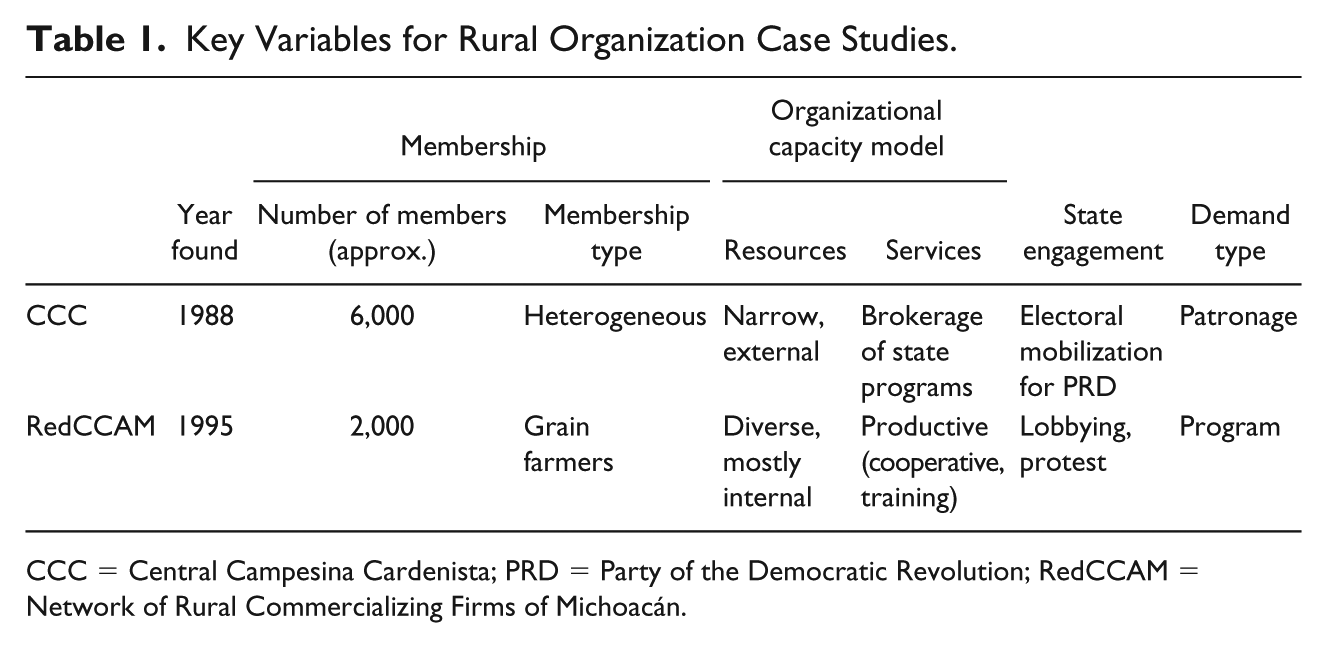
CCC = Central Campesina Cardenista; PRD = Party of the Democratic Revolution; RedCCAM = Network of Rural Commercializing Firms of Michoacán.
CCC-Michoacán: A Patronage-Oriented Rural Organization
As is commonplace for organizations representing the rural poor, the CCC’s policy demands at the time of research were limited almost exclusively to maximizing distributive benefits for its members. The organization leader devotes his energies to gestionar programas (negotiating for government programs) such as subsidies for agricultural inputs, housing, or small-business investments. This leader—Carlos González, secretary general of CCC—monopolizes the gestión process, as well as the discretion to determine which members receive state benefits mediated by the organization. This authority serves as his main tool to recruit and mobilize members, as he makes clear that active participation in organization activities—including electoral rallies for the affiliated party—will be rewarded with such benefits. In interviews, González mentions broader policy concerns on behalf of the rural poor, but these demands are unspecific—“greater redistribution” or “more spending in the countryside”—and the organization rarely mobilizes behind these demands. The CCC is in the patronage trap, but it did not start that way. In its earlier years, this was one of the most vociferous and influential voices pushing for a pro-smallholder rural development policy.
Posttransition decline and organizational revival as patronage machine
The CCC came to narrow its demand making to patronage benefits after the exhaustion of an initially successful period of productive services and programmatic demand making. Although threatening to the sustainability of smallholder agriculture, the 1990s transition to a liberalized rural development model temporarily presented conditions propitious to the CCC’s independent generation of organizational capacity. The organization recruited members by aiding in navigating a federal government program to regularize individual land claims, 4 and mobilized these members in large-scale protests against the withdrawal of state support for small-scale farmers and Mexico’s 1994 entry into the North American Free Trade Agreement (NAFTA).
By the mid-2000s, however, the CCC faced declining organizational capacity as land claims dwindled, as did the willingness of members to sacrifice time and energy in contentious mobilization with uncertain rewards. To revive the organization, González adopted a fund-raising and recruitment strategy oriented around brokering state subsidies, prioritizing numerical growth over autonomy or goal alignment among members. Although CCC bylaws state that voluntary dues should be the only source of revenue, Gonzalez also implemented a policy that the CCC would retain a percentage of each subsidy mediated for members. These commissions represent the organization’s main source of income. 5 González estimated that between one fourth and one third of members apply to some type of government program with the organization’s support each year and proceeds from these subsidies were approximately 12 million pesos (almost one million U.S. dollars) in 2011.
Embracing patronage brokerage as its main mode of generating organizational capacity led to a diversification of the CCC’s membership. The organization has grown by expanding beyond its initial peasant base, incorporating semiurban populations, many of whom are service workers, microentrepreneurs, or wage laborers and, thus, are not united by a concern for rural development policy. An estimated 60% of members were once ejido farmers, but the majority of these lease their land to others or do not produce according to data reported by the organization in 2012. 6 Members find the organization through word of mouth, as others have joined and gained title to land, funding from a rural housing program, or subsidized agricultural inputs. Because these types of benefits are one-off and of broad appeal, the membership is heterogeneous, with new members joining frequently, but many members inactive after extracting the benefit for which they joined the CCC.
Patronage benefits are extremely welcome to CCC members, typically poor or lower middle-class families for whom a windfall valuing several hundred dollars can represent several months’ income. The CCC frequently holds large public events where the benefits delivered from the state—water cisterns, tractors, or building materials such as bricks and cement—are displayed for public viewing. 7 Amid ranchero music and free refreshments, beneficiaries are called up to a stage to claim certificates, shaking the hands of both González and the local representatives of the ministries that distribute these programs.
From nonpartisanship to patronage machine
The CCC’s prioritization of patronage benefits led it to transition from a non partisan advocacy organization to a patronage machine for the PRD. Up through the first few years of PRD rule in Michoacán, neither the administration nor the CCC was eager to reproduce the rural patronage network typical of PRI rule. CCC statutes proclaimed nonpartisanship, while allowing local leaders to run for local elected office under any party banner. However, the interest in accessing subsidies and social programs increasingly drew the CCC to the PRD throughout the early 2000s. In the 2006 national and 2007 gubernatorial elections, the CCC organized campaign events for PRD candidates without officially supporting them in the press. In 2009, the CCC modified its statutes to remove the non partisan mandate and encourage alliances with parties of the left to get CCC leaders into elected office. 8 According to González, this step was taken in response to growing frustration with the difficulty of accessing benefits through outsider strategies alone and after years of overtures by PRD leaders in Michoacán to join up with the party. The PRD alliance eventually transformed into a central organizing principle for CCC’s nationwide network of organizations. At a meeting following Mexico’s 2012 presidential elections, Secretary General Max Correa ordered state-level leaders such as González to expel members who had supported other parties during the campaign declaring that “those who went with the PRI or with the PAN aren’t members any more.” 9
Eventually, the CCC became the largest and most prominent of many rural organizations that operate as patronage machines for the PRD. Leonel Godoy, PRD governor of Michoacán from 2008 to 2012, instituted a practice known as the “carrousel,” where leaders of more than two dozen leftist peasant groups were granted yearly meetings with heads of state ministries that control distributive programs to present lists of member applicants. 10 As the largest of these dissident rural organizations, the CCC commands the most attention from the state government. Thus, González has frequent contact with members of state development ministries that control funding for application-based subsidies for agricultural inputs, economic ventures (proyectos productivos), or social programs. 11
The CCC secures access to these benefits by mobilizing its members in campaigns for PRD candidates. With base organizations in more than a dozen municipalities, the CCC organizes campaign rallies, mobilizing both members and the broader community. Local CCC leaders receive a nomination for mayor in a handful of these municipalities, further aligning electoral incentives between the organization and the party. Through an alliance with the PRD’s 2011 gubernatorial candidate, the CCC was granted the additional inducement of an ultimately unsuccessful candidacy for González for the state legislature.
The patronage-based linkage with the PRD has closed off avenues for other modes of political engagement. Politicians from parties other than the PRD write off the CCC. An interviewed PAN legislator justified this posture: “These organizations belong to a system where social programs exist to feed clients that are beholden to the party in government (the PRD). We are looking for a different type of arrangement.” 12 In choosing to formalize an electoral alliance with the PRD, the CCC ultimately gained access to valuable state benefits, while sacrificing options for mobilizing outside of the alliance.
Reproduction of dependent linkage and patronage demands
The CCC has become increasingly trapped in patronage demand making as the profiles of the leader and members have transformed to specialize in this mode of politics. The CCC modified its own statutes to allow for reelection in 2007, on realizing that González was indispensable, given his strong ties to the party and state government. This rule change solidified González’s power over members through his control of subsidies. And, it was only in 2008 that the CCC in Michoacán pursued a growth strategy based on the recruitment of nonfarming rural and nonrural populations. As an intermediary for a variety of state programs offering funding for housing, small businesses, or family income, the CCC became attractive to a much broader membership base, and bringing these groups into the organization strengthens González’s hand, as they amplify his electoral clout.
Although its role as a patronage intermediary spurred a period of intense growth during the two PRD administrations (2001-2011), it also made the organization vulnerable to a change in government. After PRI governor Fausto Vallejo took office in 2012, the CCC’s access to such benefits declined precipitously. Unlike other patronage-reliant organizations, the CCC remained loyal to the PRD during the 4 years of PRI rule in Michoacán, owing to the national leadership’s ties to this party. As discussed in the next section, other dissident organizations in Michoacán jumped to the PRI in the lead-up to the 2011 elections, as it became clear that this party would win. However, this tactic did not offer a path out of the patronage trap, as these organizations continued to rely on their party ally for distributive payouts to use as selective benefits.
In an interview, Cristóbal Arías, a PRD founder from Michoacán and former state agricultural minister, bemoaned the failure of dissident peasant organizations to sustain demand making on behalf of small-scale farmers: “They preferred to hold onto their little groups, their clienteles and the deals that they were able to make with rural government agencies than form a single larger force, capable of confronting the rural situation.” 13 The case of the CCC demonstrates that it was not so much a lack of initial interest in transforming Mexico’s rural development model as it was the challenge to sustain an active membership base that pushed the organization to prioritize the intermediation of state benefits over programmatic representation of small-scale farmers.
RedCCAM: A Programmatic Rural Organization
RedCCAM represents small- and medium-sized grain farmers and acts both as a cooperative for commercializing these products and an advocate for the interests of its sector in Michoacán. RedCCAM’s leaders and members are certainly not disinterested in accessing distributive programs; one of its main roles is designing projects to apply to state programs that subsidize agricultural inputs and machinery. However, the organization also levies demands for programmatic policies, including investments in rural infrastructure, provision of crop insurance, and transparency in agricultural spending.
An innovative service-oriented model sustains organizational capacity
Since its founding, RedCCAM has sustained organizational capacity autonomously owing to its innovative cooperative model, offering productive services to grain farmers. As RedCCAM’s parent confederation was founded in 1995, several years after the land privatization reforms and immediately following Mexico’s entry into NAFTA, it developed a member recruitment strategy based on aiding small- and medium-sized farmers to remain competitive in newly liberalized agricultural markets. Over two decades later, the organization continues to serve the same central function: operating a cooperative that promises higher prices to participating grain farmers and training to help these farmers increase their production. Farmers typically affiliate to access these economic benefits, but over time, members are socialized to the broader experience of small-scale farmers and associated programmatic demands.
The focus on productive services specific to small-scale grain farming preserves a homogeneous membership base with strong ties to each other and to the goals of the organization. RedCCAM’s recruitment strategy is geared to slow growth, carefully adding members that are committed to grain production, as opposed to a single-minded push to grow the ranks. Recruitment typically operates through word-of-mouth; leaders of local groups of grain farmers approach RedCCAM if they are interested in taking part in the network’s cooperative and other productive activities. 14 Such organizations operate in one or a few municipalities, with anywhere from a dozen to 500 members. 15 At the time of research, 17 base-level associations belonged to RedCCAM, totaling approximately 2,000 members. According to Omar Lando Estañol, general director of RedCCAM, five founding organizations were expelled within the first 5 years because they lacked commitment to the organization’s social mission: “Those five (organizations) were asked to resign because they were uninterested in the productive activities that we were carrying out in the network. They were more interested in their own personal interests—economic and political.”
Commitment to nonpartisanship permits broad state engagement
The autonomy granted by this productive model enables RedCCAM to engage in diverse modes of political engagement. Although dozens of dissident organizations in the state forged linkages with the PRD when it became competitive, RedCCAM carefully guards its partisan neutrality. The choice not to ally with the PRD is not for lack of opportunity. Víctor Suárez, the founder of National Association of Commercializing Firms of Rural Producers (ANEC), the national network to which RedCCAM belongs, has long-standing personal ties to the party, having served in the Federal Congress from 2003 to 2006. Unlike Max Correa, national president of the CCC, Suárez insisted that his ties to the PRD were as an “external candidate” and encouraged RedCCAM and other ANEC affiliates to preserve their nonpartisanship. 16 Resultantly, RedCCAM’s requests for subsidies were not given rubber-stamp approval as were those of the governor’s allies. Instead, according to Lando, RedCCAM has been forced to impress the grant-making authorities with the quality of its projects and the organization’s track record of profitable economic ventures.
RedCCAM’s partisan neutrality was most openly on display when they led the Observatorio Campesino (Peasant Observatory), an effort to monitor rural development spending in Michoacán. Representatives from a Mexico City–based nongovernmental organization specializing in transparency held a training session with dozens of rural organizations in Michoacán. RedCCAM was the only organization that followed through on the training by submitting information requests for data about agricultural subsidies. Interviewed leaders of other organizations reported that they saw little value in using the access-to-information system, viewing it as unnecessarily contentious and preferring informal communications with allied politicians and bureaucrats to access information about government programs.
Abstaining from overt partisanship opens doors for RedCCAM representatives to lobby with politicians from all major parties. During electoral campaigns, the organization invites all candidates to speak to its members and asking each to sign a document signaling their agreement with a list of RedCCAM’s goals for rural development policy. Nonpartisanship does not inhibit its members from pursuing elected office independently: At least five leaders of base-level organizations have run for municipal office since 2004, with each of the three major parties. When the writing was on the wall that the PRD would lose the Michoacán governorship in 2011, most dissident rural organizations—the majority of which had aligned with the PRD—were faced with a choice: Either they would throw their support behind the PRI’s candidate in a bargain to maintain access to benefits or they would remain loyal to the PRD and be locked out of policy making and benefits. Having built a reputation for electoral autonomy with the three major parties, RedCCAM was not faced with the same dilemma. Observations of this organization’s interactions with the PRI administration that entered the state government in 2012 reveal only a minor decrease in the degree of contact.
Reproduction of diverse participation and programmatic demands
Where other organizations devote time and resources to participating in campaign events, nonpartisanship affords RedCCAM the autonomy to focus its resources on productive projects and advocacy. When the PRI reclaimed the governorship in Michoacán in 2012—after two terms under the PRD—RedCCAM approached the newly elected administration to collaborate on projects with long-term consequences for rural development. For example, RedCCAM representatives have negotiated with the PRI administration on improvements to the state’s system of crop insurance for small-scale grain farmers and to earmark a portion of the state agricultural budget for small-producer benefits. 17
Such engagement in programmatic demand making reinforces organizational autonomy through both leadership and membership channels. RedCCAM’s internal governance promotes broad participation—a new president is elected from among its constituent organizations every 3 years. Leaders are chosen on the basis of their commitment to the ideals of the organization and their vision for future projects. 18 Benefits from organization services generate member commitment even in periods when the state government is not forthcoming with subsidies. If these members are initially motivated by particular interests, over time, they become socialized to take a concern in the fate of rural development in the state. Ultimately, RedCCAM has sustained a programmatic orientation because the cooperative model offers a lasting incentive to members to participate and helps a collective consciousness among members. And, this organizational model is what limits RedCCAM’s membership to a homogeneous group of small-scale grain farmers. Because members are socialized to place greater value on the productive services that RedCCAM offers rather than the patronage benefits that it could extract through a party allegiance, internal democracy forestalls the concentration of power in a leader who would monopolize patronage intermediation.
Discussion of case studies
These case studies have illustrated how the ability to generate organizational capacity internally can determine whether organizations become ensnared in the patronage trap or alternatively remain in a programmatic virtuous cycle. The CCC began with internally generated organizational capacity by aiding rural populations in making land claims. When this service became obsolete, the CCC turned to patronage brokerage to recruit, retain, and mobilize members; entered into a partisan alliance to maximize access to discretionary distributive programs; and subsequently lost the ability to effectively levy demands for pro-smallholder reforms to rural development policy. In contrast, RedCCAM adopted an organizational capacity model that remains attractive to small-scale farmers, based on the operation of a grain cooperative and agricultural extension services. Without dependence on patronage benefits to sustain an active membership, this organization remains nonpartisan, and retains the autonomy to make demands for infrastructure investments, market regulations, and support programs for small-scale grain producers.
The durability of RedCCAM’s organizational capacity model and this organization’s commitment to programmatic goals are reinforced by the productive nature of the services that it offers. Just as labor unions in 19th-century industrializing countries generated class consciousness and a commitment to the broader well-being of the working class by organizing laborers grappling with similar conditions (Katznelson & Zolberg, 1986; Korpi, 1983), agricultural cooperatives bring together producers exposed to the same vulnerabilities in a collaborative enterprise where they come to see their individual challenges as representative of the broader plight of small-scale farmers. In contrast, organizations that offer benefits for consumption attract a more heterogeneous membership without a common class condition or mutual undertaking.
What are the antecedent causes of these distinct organizational capacity models? For the CCC and RedCCAM, the luck of timing was key. The CCC was founded at a moment when the most needed productive services for small-scale farmers in a neoliberal economy were not yet apparent or in demand, whereas RedCCAM was founded several years later, when institutions to commercialize grains, training in techniques to increase yields, and access to finance had emerged as needs. In other cases, however, the shift to an externally provided organizational capacity model may be catalyzed by distinct factors, such as the withdrawal of state supports. Business chambers in Mexico, for instance, were thrust into crisis when the Mexican government repealed mandatory chamber membership in 1997 (Palmer-Rubin, 2016; Shadlen, 2004). Some chambers adapted by devising innovative service-delivery models as a strategy to sustain organizational capacity internally and began offering consulting and organizing conventions. Similarly to RedCCAM, these organizations retained the capacity to make programmatic policy demands. Other chambers began to specialize in the extraction of state subsidies for small-business owners, and like the CCC, saw their programmatic demand making erode.
When faced with such threats to their organizational models, decisions made by organization leaders play an important role in directing the organization down one of these two paths. Thus, some degree of enterprising leadership is potentially a necessary condition for organizations to adopt an internal organizational capacity model. However, in line with previous work on rural organizing in Mexico (Fox, 1992), these case studies illustrate that programmatic leaders (or the alternative patronage broker leaders) are not simply the luck of the draw, but are often selected or socialized in line with organizational norms and formal rules. Notably, RedCCAM, like most business chambers in Mexico, enforces strict term limits on organization leaders to prevent any one leader from subverting the organization’s programmatic goals to her own political career. In contrast, the CCC removed term limits on realizing that the organization’s survival had come to rely on a single leader’s acumen in negotiating for patronage benefits from the state.
With these two case studies, I have illustrated the causal pathways that route organizations into the programmatic and patronage equilibria and the feedback effects that sustain these equilibria. Although the causes for distinct organizational capacity models are various, regularity occurs in the causal process that runs from the organizational capacity model to the mode of policy demands. The next section illustrates the generalizability of this relationship across a large sample of interest organizations including small-scale agricultural organizations like the CCC and RedCCAM as well as small-business chambers, a middle-class economic sector.
Survey of Mexican Economic Interest Organizations
In this section, I report findings from an original survey of state-level agricultural and small-business organizations in Mexico. I deploy these data to show that the ability to generate organizational capacity internally is at least as important as a correlate of the organization’s demand type as its class position, the dominant explanation for programmatic and patronage demands in the literature. Further analysis of organizations’ modes of state engagement is consistent with the argument that internally generated organizational capacity shapes demand making by permitting organizations to engage in nonelectoral forms of participation such as lobbying and protest.
The data analyzed here contain responses from 65 business organizations and 34 agricultural organizations, representing all of Mexico’s 31 states (excluding the Federal District). The survey was carried out between September and December 2012 and applied to elected presidents or hired directors of organizations belonging to Mexico’s two largest confederations of business chambers—Chambers of Commerce and Chambers of Industry—and two prominent confederations of “dissident” agricultural organizations—CCC and ANEC. The survey for business organizations was implemented online, and agricultural organizations were surveyed using a printed questionnaire that I distributed to leaders of these organizations at national meetings. 19
Class of Members
The central measure of class—percent micro members—measures within-sector variation. This variable reflects the percent of the organization’s members that belong to the “micro” category for their sector (agricultural producers with less than 10 hectares of land and business owners with fewer than 10 employees). As the size of landholdings and the number of employees are closely associated with income in these two sectors, organizations with higher percentages of smallholder farmers or microentrepreneurs have lower-class memberships. The broader comparison between the lower-class peasant sector and the middle-class small-business sector offers another source of class variation.
Resource Flows
Resource flows and member services are two traits of organizations that are determinative of their ability to generate organizational capacity internally. 20 I operationalize these two dimensions with discrete measures that take the integer values between zero and five.
A first indicator of organizational capacity is the diversity of an organization’s resource flows. To conduct activities or provide services that appeal to members, organizations require financial resources. Although it is difficult to establish an objective amount of funding that is sufficient for an organization, the diversity of an organization’s funding sources is an observable trait that reflects an organization’s financial autonomy. An organization that counts on several funding sources is less vulnerable to the withdrawal of any one. This variable is measured as a count of the number of sources of funds, from a list of five categories: membership fees, donations from the confederation, commissions for mediating subsidies, payments for services, and other lucrative activities.
Member Services
A second indicator of organizational capacity is the diversity of services that organizations offer to their members. Organizations offer selective benefits to recruit, retain, and mobilize members. Whereas some organizations offer the sole service of brokering government benefits, others expand into a variety of internally generated benefits. Thus, organizations that offer numerous member services likely enjoy membership autonomy. This variable is measured as a count of the number of different services offered to members, from a list of five categories: consulting or project design, access to credit, helping access government programs, providing economic or political information, and other services.
Participation and Demand Making
Five indices capture different forms of political participation and demand making for surveyed organizations. The first three indices correspond to different modes of political participation: institutional—contacting bureaucrats or elected officials, electoral—contacting political parties or participating in campaigns, and extra-institutional—organizing protests or media campaigns. The other two indices correspond to types of demands that organizations levy: programmatic—demands that regard infrastructure investments and regulatory policy, the most common types of state policy that generate nonexclusive benefits for farmers and small-business owners; and distributive—demands that regard subsidies and other distributive programs that generate exclusive benefits. The component measures for these indices are presented in Table 2. (Histograms of these indices are presented in Online Appendix C.) By including multiple measures, these indices provide a fuller representation of the different modes of policy participation and demand making than any single indicator would. However, the findings that follow are robust to specifications that isolate individual component measures within the indices, as shown in Online Appendix D.
Participation and Demand-Making Indices.
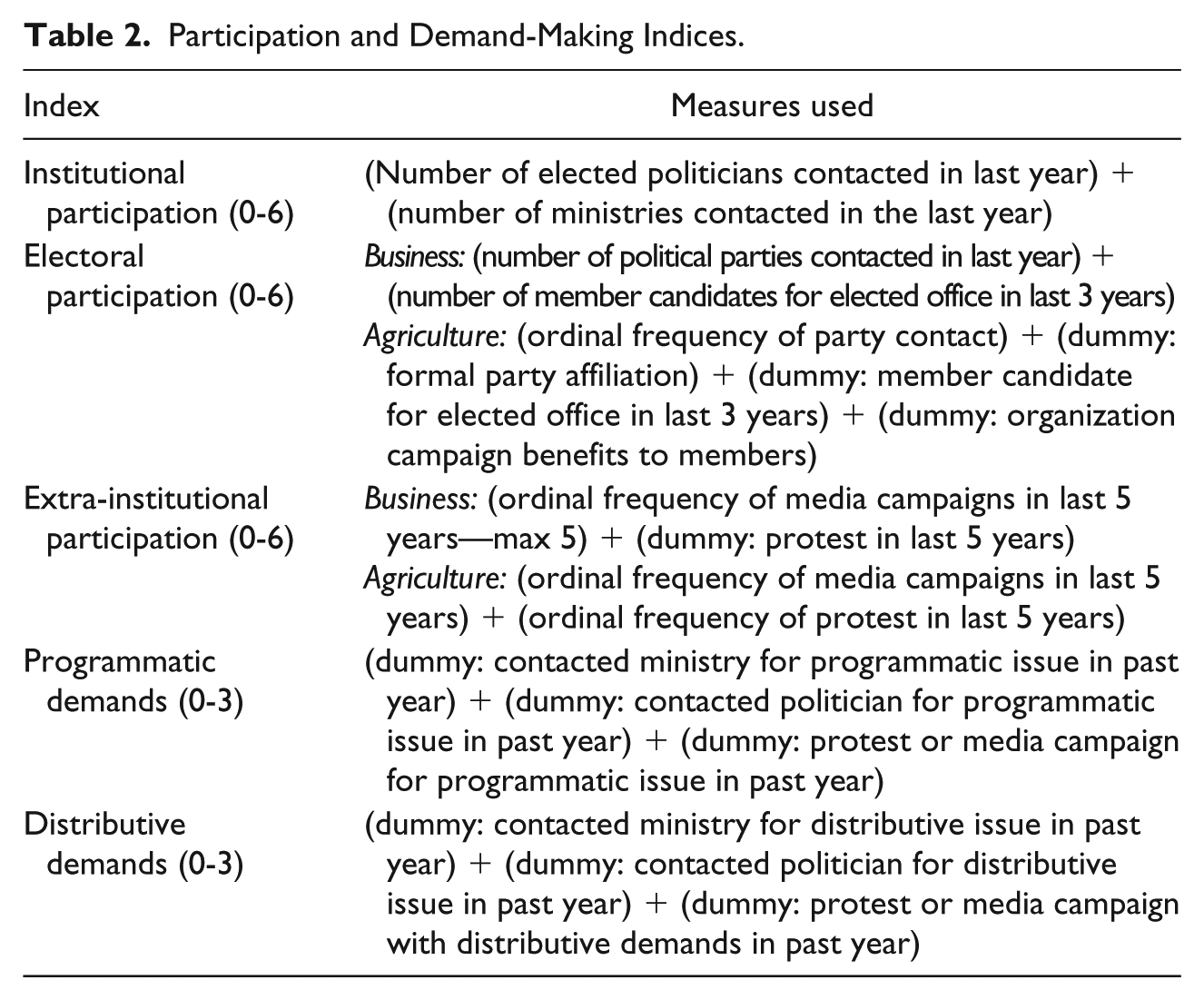
The central outcome of this study is reflected in the programmatic demands index and distributive demands index. If an organization is in the patronage trap, I expect it have a high score on the distributive demands index—reflecting frequent participation in demand making for government handouts—and a low score on the programmatic demands index. An organization that has evaded the patronage trap scores highly on the programmatic demands index, and may or may not engage in frequent distributive demand making. Regarding state engagement, I expect an organization in the patronage trap to have high scores on electoral participation and low scores on institutional and extra-institutional participation, as such an organization is forced to forgo direct contact with politicians, protest, and media campaigns in favor of campaign mobilization. Finally, programmatic demands should be associated with nonelectoral forms of participation—institutional and extra-institutional participation indices—as I have argued that internally generated organizational capacity leads to programmatic demand making by enabling broader (and nonelectoral) forms of state engagement.
Figure 2 shows the average scores and standard deviations of organizations surveyed in the agricultural and small-business sectors for each of these indices. Mean scores for agricultural organizations are higher than those for small-business organizations across all indices except extra-institutional participation, but the high degree of dispersion demonstrates that within-sector variation is more substantial than across-sector variation, most notably in the programmatic demands index. The largest cross-sectoral differences occur for the electoral participation and distributive demands indices, where the mean difference is greater than 1 point on the 6-point scales. Notably, electoral participation and distributive demand making are most closely associated with party dependence, suggesting that rural organizations are more vulnerable to the patronage trap than small-business organizations.
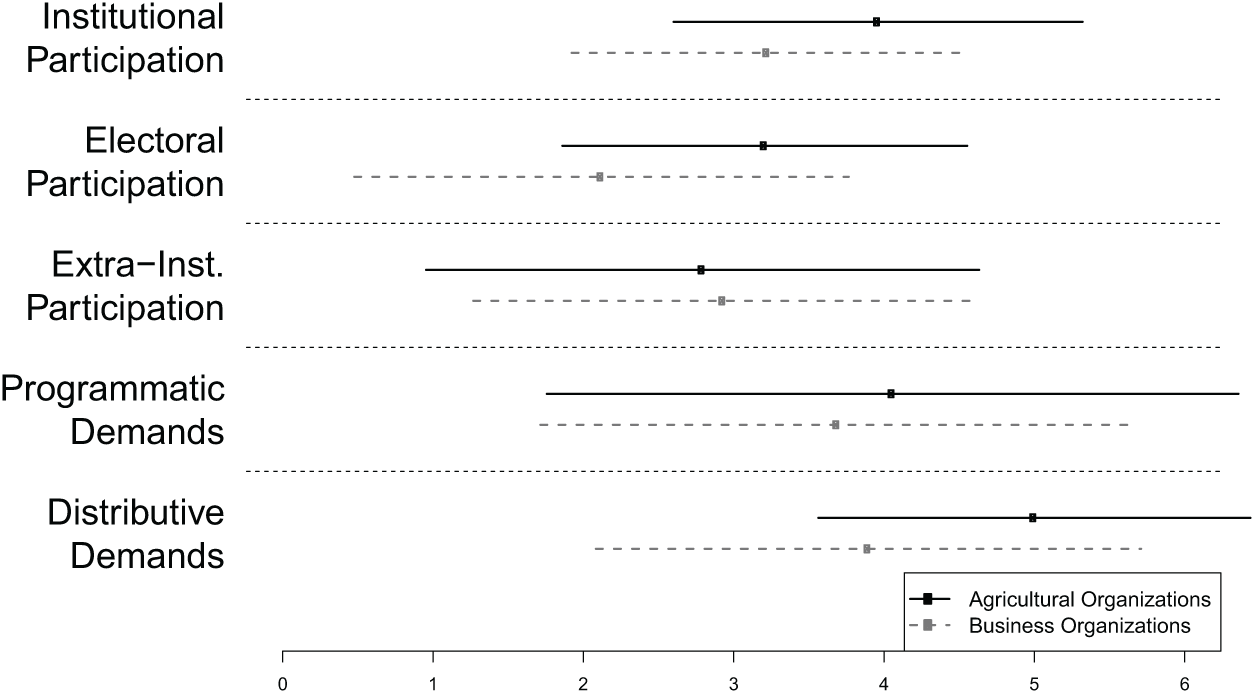
Cross-sector comparison of participation and demand-making indices (N = 93).
I proceed by conducting multivariate regression analyses (ordinary least squares), focusing on the relationships between the above-described indices and three organizational traits: class composition, resource flows, and member services. Multivariate models also include logged organization membership size as a control, a dummy variable to differentiate between agricultural and business organizations, and indicators of state-level electoral competition—ruling party and vote margin in the most recent gubernatorial election. An interaction effect between sector and members services reflects potential heterogeneity of these statistical associations between the agricultural and small-business sectors.
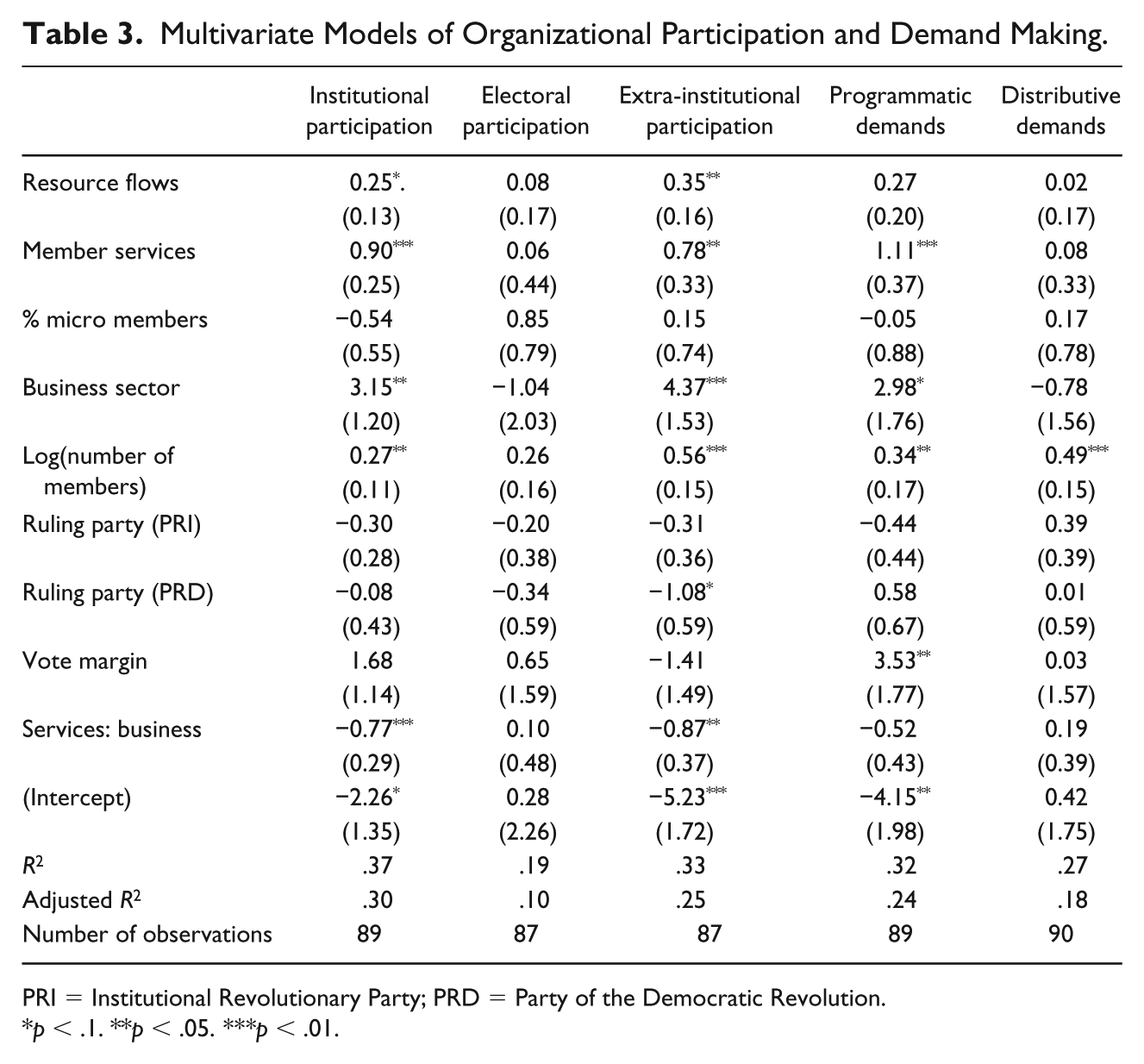
The findings in Table 3 support the assertion that internally generated organizational capacity lends itself to broader forms of political participation and programmatic demand making. Recall that institutional participation (direct contact with politicians and bureaucrats) and extra-institutional participation (protest or media campaigns) are the forms of participation predicted to be conducive to programmatic demand making. The variables associated with organizational capacity—resource flows and member services—are positively associated with these two forms of participation. More crucially, both indicators of organizational capacity are also positively associated with programmatic demand making. 21 Taken together, these findings are consistent with the argument that the ability of organizations to generate organizational capacity internally permits them to engage in policy-making processes that extend beyond patronage exchanges in the electoral arena. 22
Multivariate Models of Organizational Participation and Demand Making.
PRI = Institutional Revolutionary Party; PRD = Party of the Democratic Revolution.
p < .1. **p < .05. ***p < .01.
Indicators of organizational capacity do not have statistically significant relationships with electoral participation or distributive demand making, the variables associated with patronage-based linkages with political parties. This suggests that membership autonomy does not lead organizations to withdraw from electoral politics or distributive demand making as much as it enables them to engage in broader forms of political participation and programmatic demand making. The one covariate that is significantly associated with distributive demands is the size of the organization’s membership. Unsurprisingly, larger organizations more frequently lobby the state for handouts. Findings for sector suggest that small-business organizations are less vulnerable to the patronage trap than agricultural organizations as the former engage to a greater degree in nonelectoral modes of participation and programmatic demand making. However, an interaction between sector and member services is negatively associated with institutional and extra-institutional participation. These self-generated selective benefits appear to be more important for enabling diverse political participation in the more precarious agricultural sector, yet predict programmatic demand making in both sectors.
Percent micro members—a measure of class composition that varies among organizations in each sector—is not significantly associated with any of the indices. This lack of a finding for class holds up in a sensitivity analysis where institutional participation and programmatic demands indices are regressed on percent micro members in the absence of other organizational traits (Online Appendix D).
Models also include measures of state-level electoral competition, including ruling party and vote margin in the most recent gubernatorial election, a measure of electoral competition. The ruling party appears to have little effect on organizational participation and demands, although organizations use extra-institutional tactics less often in states governed by the leftist PRD. Intriguingly, vote margin is positively associated with programmatic demand making, suggesting organizations make these demands to a lesser degree in states with higher levels of electoral competition. Perhaps where elections are more closely contested, ruling politicians offer more tempting packages of patronage benefits to recruit organizations for electoral campaigns.
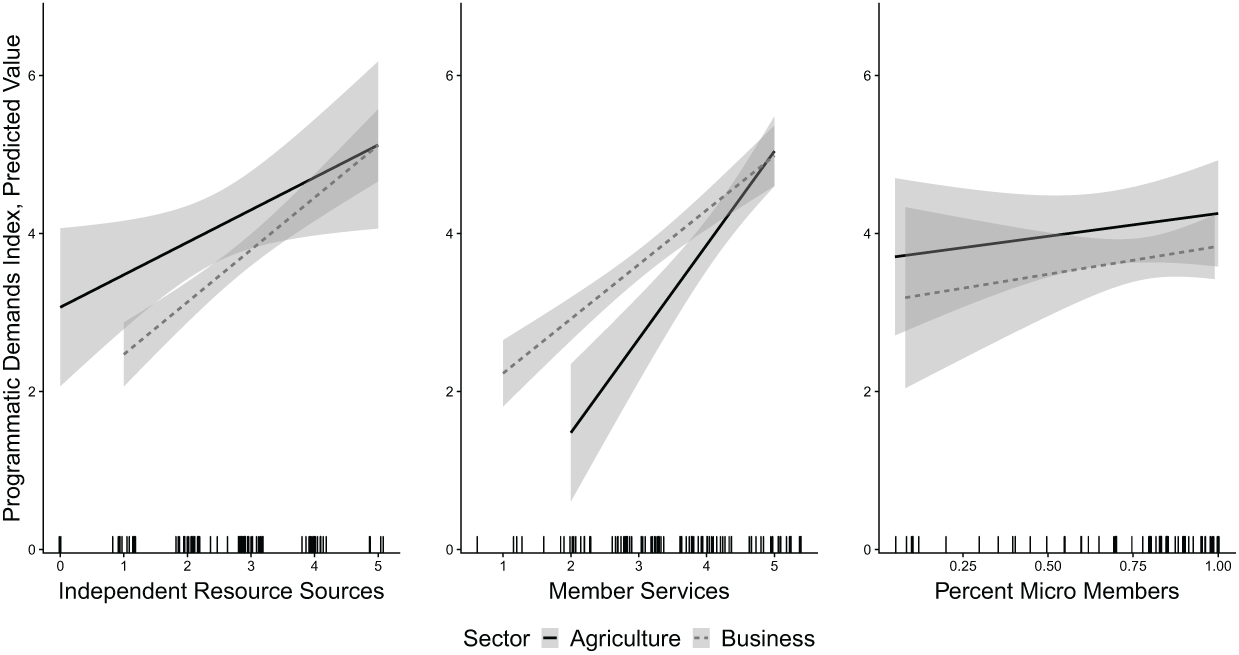
The graphs in Figure 3 plot each of the three organizational traits against predicted values for the programmatic demand-making index, derived from the fourth regression model displayed in Table 3. These graphs are visual representations of the relationships between each trait and programmatic demand making for each of the two sectors, controlling for the other variables included in the model. As displayed in Panel 3, organizations’ class composition appears to have no significant relationship with programmatic demand making. If anything, organizations with lower-class memberships make more programmatic demands. This finding suggests that the common argument in the party-linkage literature that lower-classes are more likely to favor patronage (i.e., distributive benefits) over programmatic benefits does not extend to economic interest organizations in Mexico.
Organizational traits and programmatic demand making, predicted values (N = 89).
In contrast, Panels 1 and 2 provide evidence that organizations in both sectors with more diverse resource flows and member services make more programmatic demands. Findings are consistent across the two sectors—agricultural organizations that have diverse resource flows and that offer multiple member services are predicted to participate just as much in programmatic demand making as small-business organizations with similar organizational traits. Consistent with the findings for the interaction effect between sector and member services in Table 3, these services appear to be particularly important for facilitating programmatic demand making for agricultural organizations. For each additional service that these organizations offer, they are predicted to increase about 1 point on the programmatic demands index. Given the trenchant obstacles to collective action in the countryside, these self-generated selective benefits are a crucial tool to sustain engagement in the policy areas that shape sectoral competitiveness.
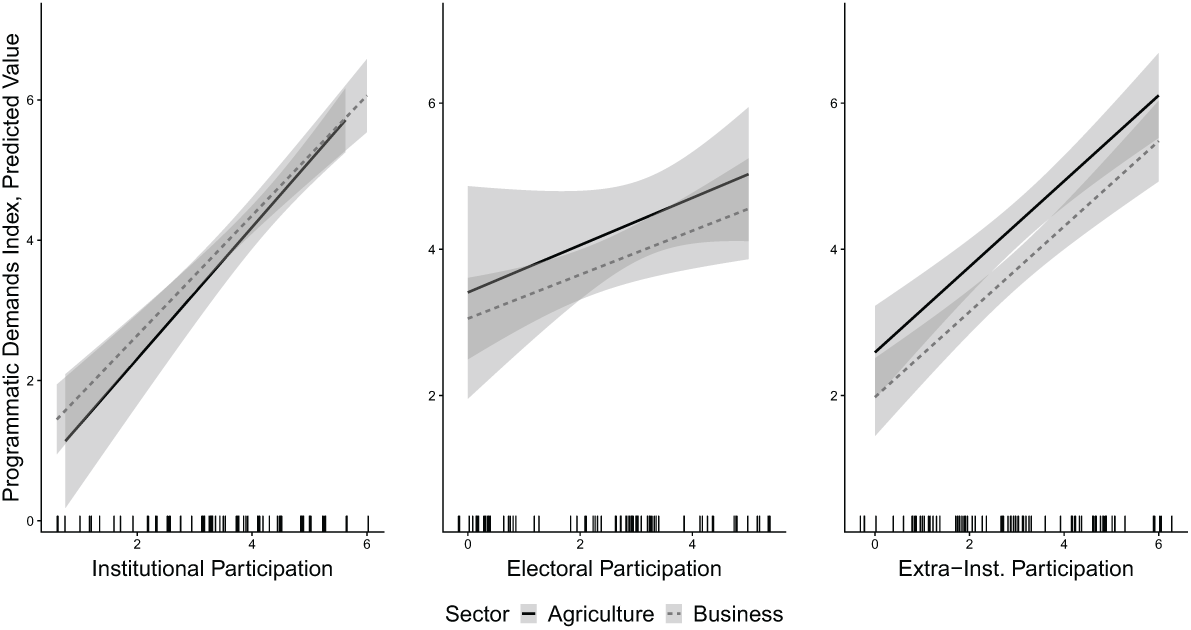
Recall that the patronage trap model argues that internally generated organizational capacity influences demand type through the mechanism of modes of state engagement. From Table 3, we have seen that diverse resource flows and member services are positively associated with nonelectoral modes of state engagement (the institutional and extra-institutional participation indices). Graphs in Figure 4 illustrate that organizations that engage to a greater degree in these modes of participation make more programmatic demands. 23 These associations reinforce the findings from case studies that RedCCAM’s broader modes of state engagement—including lobbying and protest—facilitated ongoing programmatic demand making. In contrast, as shown in the middle panel of Figure 4, participating in electoral politics is neither positively nor negatively associated with programmatic demands. Both organizations in the patronage trap and those in the programmatic virtuous cycle may participate in electoral politics; reduction in programmatic demands occurs for organizations such as the CCC whose dependence on a party ally causes them to withdraw from nonelectoral modes of participation.
Modes of state engagement and programmatic demand making, predicted values (N = 89).
We must interpret these models with caution, as multivariate regression on cross-sectional data is not sufficient to prove causal relationships, much less to identify causal mechanisms. However, these results support the patronage trap model and hypotheses generated in case studies above. The ability of organizations to generate organizational capacity internally by offering services and securing diverse resource flows is a more consistent explanation for patterns of state engagement and, consequently, for programmatic demand making, than the class of the organization’s members.
Conclusion
In this article, I ask why economic interest organizations sometimes make demands on behalf their sectors and other times focus their efforts on extracting patronage benefits that only accrue to the organization and its members. Similar questions, having to do with a social actor’s scope of interests, have been asked in the context of party–voters linkages, labor unions, and social movements. However, until now, we have lacked a theory to explain the types of demands levied by interest organizations.
I construct such a theory, providing a new explanation for observed differences in demand making based on the ways that organizations generate organizational capacity. In the patronage trap equilibrium, failure to recruit and retain members through autonomously generated benefits causes organizations to focus their efforts on the extraction of state benefits—often by entering into patronage-based linkages with political parties. This decision locks them into a self-reproducing cycle in which they prioritize access to distributive benefits over sectoral policy influence. I then illustrated the causal steps in this model and the parallel virtuous cycle of programmatic demand making with case studies of two small-scale agricultural organizations in Mexico. Finally, I fostered evidence from an original survey of economic interest organizations, showing that resource flows and member benefits—indicators of organizations’ ability to generate organizational capacity internally—are associated with broader participation strategies and programmatic demand making.
Social class, the predominant explanation for patronage and programmatic demands in the party–voter linkage literature, only tells part of the story when it comes to interest organizations. On one hand, lower-class interest organizations are certainly more vulnerable to patronage pressures than middle-class organizations, both because these organizations suffer from resource and membership deficiencies and because their members demand government handouts. On the other hand, I have shown that we must turn our attention to the internal traits of organizations themselves to understand how organizations representing the lower-classes can resist pressures to abandon programmatic interests in favor of patronage ties. Furthermore, I showed that other factors often hypothesized to affect organizations’ strategies—including leader entrenchment, interest divergence among members, and the presence of allies in government—do not independently explain demand outcomes. These variables either are not strongly associated with demand-making outcomes or emerge along the causal path only after an organization has adopted an autonomous or dependent mode of generating organizational capacity.
Future research may evaluate how the relationship between organizational capacity and demand making travels to other types of organizations. The dynamics of the causal process outlined in the present analysis suggest that the source of organizational capacity is centrally important for mass-membership organizations that, at some point, have been involved in programmatic demand making, thus excluding either elite interests for whom membership is less of a concern or special-interest organizations that have no pretense of representing broad sectoral interests. With these limitations in mind, many cases qualify; scholars have found that service provision for group maintenance is a precondition for effective mobilization in cases as broad as violent insurgencies (Weinstein, 2006) to unemployed workers’ movements (Garay, 2007).
Extensions may also assess generalizability outside of Mexico, a country that is notable for its strong political parties and history of corporatist interest representation. Undoubtedly, the problem of state dependence for nonelite organizations is not unique to Mexico. Wherever states control discretionary resources that can be used to generate dependence from organizations, I would expect the patronage trap to be a looming risk. However, as Holland and Palmer-Rubin (2015) show in a broader analysis of organizational clientelism in Latin America, countries with weak parties or volatile party systems are less amenable to organization-mediated patronage politics. Thus, I would expect to find the patronage trap taking hold in democracies where scholars have described strong parties engaging in patronage politics, such as Brazil, India, or Zambia (Baldwin, 2013; Gay, 1999; Thachil, 2011).
Finally, although my goal here was to understand how organizations filter their members’ interests into policy demands, a separate analysis is required to address the natural follow-up question: How are these demands translated into influence in the policymaking process? To address this question, scholars must extend beyond the organization itself to analyze the political context within which it operates. Regardless of the way in which the organization positions itself, state actors have their own preferences regarding the types of policy processes to which they are willing to grant interest organizations access and the specific groups that they prefer to incorporate, preferences likely shaped by the electoral motives of ruling politicians. However, if organizations are not capable of nor interested in pursuing demands for programmatic policies that stand to benefit their sectors, the question of whether politicians are amenable to programmatic appeals is moot.
Supplemental Material
Patronage_Trap,_online_appendix – Supplemental material for Evading the Patronage Trap: Organizational Capacity and Demand Making in Mexico
Supplemental material, Patronage_Trap,_online_appendix for Evading the Patronage Trap: Organizational Capacity and Demand Making in Mexico by Brian Palmer-Rubin in Comparative Political Studies
Footnotes
Acknowledgements
For useful comments and discussion, the author wishes to thank Benjamin Allen, Christopher Chambers-Ju, Ruth Berins Collier, Maria Lorena Cook, Candelaria Garay, Yanilda González, Sean Gray, Alisha Holland, Kyle Jaros, Anirudh Krishna, Chappell Lawson, Daniel Mattingly, Akasemi Newsome, Simeon Nichter, Paul Pierson, Benjamin Read, Ben Ross Schneider, Suzanne Scoggins, Jason Wittenberg, Deborah Yashar; and the participants in workshops at UC Berkeley, UC San Diego, Center for Economic Research and Teaching (CIDE), MIT, Notre Dame; and Harvard as well as three anonymous reviewers.
Declaration of Conflicting Interests
The author declared no potential conflicts of interest with respect to the research, authorship, and/or publication of this article.
Funding
The author disclosed receipt of the following financial support for the research, authorship, and/or publication of this article: This research was made possible by financial support from the Inter-American Foundation (Grant G141200S1), the Social Science Research Council, and the UCSD Center for U.S.–Mexican Studies.

Notes
Author Biography
References
Supplementary Material
Please find the following supplemental material available below.
For Open Access articles published under a Creative Commons License, all supplemental material carries the same license as the article it is associated with.
For non-Open Access articles published, all supplemental material carries a non-exclusive license, and permission requests for re-use of supplemental material or any part of supplemental material shall be sent directly to the copyright owner as specified in the copyright notice associated with the article.
