



Abstract
Under what conditions do states uphold their formal trade commitments? While recent work focuses on the formation and design of trade agreements, we know comparatively little about the durability of agreements over time. We argue that government turnover undermines states’ commitments to liberalization, even if they have already signed an international agreement meant to constrain their behavior. We test this argument using data on realized trade in the presence of around 300 preferential trade agreements (PTAs) since 1970. Even in the presence of an international agreement, ideological turnover is associated with increased political barriers to trade, especially when the shift is toward left-wing leaders. These findings have important implications for our understanding of international cooperation: If new leaders do not adhere to their predecessors’ commitments, international agreements may not have lasting economic consequences.
Introduction
How well do international agreements hold up in the presence of government turnover? Do leaders abide by the formal commitments made by their predecessors? The literature on trade agreements typically assumes that the answer is yes. Like agreements in many areas, trade agreements are designed so that their rules and regulations apply regardless of who is in office. In this way, international trade law is thought to tie leaders’ hands, preventing future governments from failing to live up to their commitments by erecting new barriers to market access.
This “hands-tying” assumption underpins many studies of trade institutions, but it is rarely tested directly. This article explores whether preferential trade agreements (PTAs) prevent leadership turnover from interrupting economic relations among member states. PTAs, defined as interstate contracts that grant reciprocal market access between members, are one the most prominent modes of formal interstate economic cooperation. Countries at all levels of development and in all regions of the world have entered into these agreements. However, the extent to which PTAs actually constrain the behavior of their member states over time is not well understood. 1
We argue that, after a PTA is signed, states are less likely to abide by their liberalizing commitments when turnover brings about a shift in the ideological leanings of a country’s chief executive. Trade agreements reflect distributional bargains that favor certain domestic constituents over others. However, these bargains may not satisfy new leaders who come to office representing a different winning coalition, with different constellations of preferences (Grieco, Gelpi, & Warren, 2009; Mattes, Leeds, & Matsumura, 2016). Incoming leaders have incentives to protect their constituents’ interests, even if it means contravening existing commitments (Milner & Rosendorff, 2001; Rosendorff, 2005). If new leaders inherit foreign policies that are not favorable for their constituents, they may set agreements aside or actively impede the policy reform process. In either case, a shift in chief executive ideology will be associated with greater political barriers to trade.
By “political barriers to trade,” we refer to the wide variety of strategies states can use to protect domestic producers. These can include traditional tariff barriers, but more commonly involve a set of more sophisticated policies such as technical barriers to trade and licensing rules (Kono, 2006). In addition, even if governments do not erect new entry barriers, they may shirk their obligations by simply ignoring their commitments or delaying implementation of the liberalization schedule of the agreement. We count all of these strategies among the political barriers that can result from leadership turnover.
These barriers can be difficult to detect and even harder to quantify. However, a useful feature of studying PTAs is that they have an observable implication: trade between members. 2 Following recent work in economics, we measure political barriers to trade using the residuals from a standard gravity model (Carrere & De Melo, 2011). Controlling for other factors that affect economic relations, observed trade levels that fall short of the gravity model’s prediction are an indication of political barriers to trade, or policy adjustments governments have made to renege on their formal commitments to liberalize (Rose, 2002).
Our analysis examines the consequences of ideological turnover on barriers to trade, even in the presence of an international agreement. We show that for countries in a PTA, political barriers to trade increase when new leaders’ ideological leanings differ from their predecessors. This relationship is driven primarily by right-to-left shifts. Right-leaning ideologies are traditionally associated with greater support for free trade, whereas left-leaning ideologies tend to support more protectionism. These diverging preferences stem from disagreements over the appropriate level of government intervention in markets and from the different segments of the economy that right- and left-leaning leaders represent (Dutt & Mitra, 2005; Milner & Tingley, 2011; Nollen & Quinn, 1994). We find that when left-wing politicians replace right-wing ones, they tend to be associated with higher political barriers to trade.
The analysis pays particular attention to agreement design, which may affect states’ incentives to pursue (or maintain) freer trade. We look specifically at the impacts of agreement depth and rigidity. Our estimates show that rigid agreements—PTAs that heavily limit use of trade-related flexibility provisions—can backfire. Rather than tying leaders’ hands, new leaders are more likely to shirk their trade contracts when those contracts are more rigid. This is again more pronounced when left-leaning parties replace right-leaning ones.
Our evidence aligns with recent skepticism about the durability of international agreements (Dai, 2006; Jensen, 2007; Sanchez & Urpelainen, 2014; Tallberg, 2002). Existing work observes imperfect, inconsistent records of implementation and compliance in areas such as human rights (Conrad & Ritter, 2013; Lupu, 2013), financial regulation (Walter, 2008), and the environment (Bechtel & Tosun, 2009). We identify the domestic political conditions that undermine PTAs’ abilities to liberalize trade among member states.
More generally, the analysis identifies important limits to international law. It shows that agreements do not fully constrain the behavior of future politicians. Once ideological turnover is taken into account, the dynamics of international economic cooperation shift toward noncompliance, as others argue for economic sanctions (McGillivray & Stam, 2005) and sovereign debt repayment (Dhillon & Sjostrom, 2009). Political barriers may be a less dramatic form of defection than outright abrogation. 3 However, much of the research on international economic cooperation still assumes that international agreements represent credible commitments to liberalization. Our findings cast doubt on this assumption and point the way toward future research on the links between domestic political institutions and international cooperation.
Domestic Politics and International Economic Agreements
Much of the literature on international organizations (IOs) argues that agreements commit member countries to cooperation (Martin, 2000; Moravcsik, 2000; Simmons, 2001). International agreements are meant to tie politicians’ hands, limiting the policy options available to member states (Keohane, 1984; North, 1990). By assumption, these constraints extend beyond an agreement’s original signatories. Formal agreements are designed to lock in cooperative behavior among future governments, not just the particular governments that sign on to them.
Scholars frequently apply this logic to economic cooperation (Baccini & Urpelainen, 2014; Hicks & Kim, 2012; Hollyer & Rosendorff, 2012; Johns, 2012). In the context of trade, PTAs help resolve the cooperation problems inherent in mutual liberalization, preventing domestic interest groups from lobbying effectively for protection (Grossman & Helpman, 1995). 4 For example, Mansfield and Reinhardt (2008) argue that the policy-stabilizing benefits of formalized commitments reduce volatility. 5 Others show that defection from economic agreements risks incurring reputational costs (Simmons, 2000) and trade retaliation (K. Anderson, 2002). For these reasons, PTAs should help maintain liberal trade policies.
Yet new research provides good reason to relax the assumption that agreements tie hands. Many economic agreements have a highly varied record of compliance (Eicher & Henn, 2008). Haftel (2012) finds a significant “implementation gap” among nearly all of the economic organizations that he surveys. Peinhardt and Allee (2012) find that PTAs do not have the investment effects that one would presume from the provisions in those agreements. This broader gap has been the subject of speculation in the studies of IOs and compliance (Simmons, 2000) more generally. 6 With that variation in mind, we offer an account of the domestic political conditions that shape the likelihood that members continue to uphold their commitments as domestic political conditions change over time.
How Ideological Turnover Affects Liberalization
Once the leader who initially joins a PTA leaves office, agreements may be actively flouted or passively ignored (Smith, 2009). The principal reason is that new governments may not share the same priorities as their immediate predecessors.
Every trade agreement represents a distributional bargain between politicians and their winning coalitions. These coalitions can include industry associations, labor organizations, and a variety of other interest groups. 7 At their core, PTAs not only ask members to liberalize trade but also tend to include provisions designed to offset the economic losses endured by these groups (Hafner-Burton, 2009). During the bargaining phase, leaders must strike a balance between the competing interests of the domestic winners and losers from trade (Grossman & Helpman, 1995). However, even successful bargaining does not guarantee future compliance, especially as domestic preferences shift over time. Economic deals, like agreements in many other areas, are vulnerable to time inconsistency problems. The terms that benefited a government (and its constituents) today might not be favorable to subsequent ones.
Changing leadership tends to be associated with a shift in the winning coalition’s preferences (Gartzke & Gleditsch, 2004; Mattes et al., 2016). This is especially true when turnover results in a change in ideology. Ideology informs leaders’ preferences in several trade-related areas. It speaks to leaders’ views about the role of government in the marketplace, their commitments to free markets, and their taste for redistribution and regulation.
Importantly, ideological shifts come as a result of a change in the composition, and the preferences, of the winning coalition. New leaders have incentives to distance their government from the previous one and to appease the coalitions that brought them into office (Leeds, Mattes, & Vogel, 2009). Given new policy goals and new constituents, the terms of the international agreements leaders inherit may no longer be favorable under the terms struck by their predecessors. The implication for trade is that new governments have less incentive to remove political barriers to trade. In fact, the reverse may be true—new leaders may introduce higher barriers.
These barriers can take a variety of forms, and it is important to recognize that members’ commitments can vary widely across agreements (Frieden & Rogowski, 1996). PTAs ask for differing levels of trade liberalization and often specify unique provisions under which liberalization will take place. However, at a minimum, they involve pledge to grant reciprocal market access, endeavoring to eliminate new political barriers to trade. Governments can impede this process of trade liberalization in a number of ways, including delaying the progress of liberalization, ignoring their obligations to liberalize, or by introducing formal trade barriers. Political barriers to trade encompass myriad ways in which governments prevent (or roll back) additional liberalization (Johnson, Smith, & Souva, 2013; Souva, Smith, & Rowan, 2008).
To give one example, the U.S. Trade Representative under George W. Bush negotiated PTAs with Colombia, South Korea, and Panama in Bush’s second term. Once Barack Obama took office in 2008, representing a significant shift in the ideological leanings of the executive office, those agreements remained mired in Congress for several years before they were eventually ratified even though the legislatures in the partner countries had already pushed the agreements through. 8
Even after agreements have already been ratified by their members, political turnover may result in new governments simply ignoring PTA commitments already in place or delaying liberalization timelines. To illustrate, new leaders with varying ideologies have caused frequent trouble for Mercosur, a proposed customs union among Brazil, Argentina, Paraguay, and Uruguay. First conceived in 1985 by President Jose Sarney of Brazil, the bloc first hit trouble when the subsequent Brazilian president, Fernando Collor de Mello, became embroiled in charges of corruption that later led to his impeachment. Although de Mello was a committed free trader, his competing domestic troubles stalled the implementation of Mercosur although the other countries in the agreement continued to push the agenda. For example, one study noted that the negotiations on investment between Mercosur member states had been signed in 1994, they were not transposed into domestic law, and that Brazil was “the chief problem in negotiating this issue” (Rios, 2004). In the meantime, the agreed timeline for liberalization stalled in several sectors—most notably in sugar, automobiles, and competition policies (Gmez-Mera, 2013). The liberalization of other sectors was also under debate, with Argentina claiming that Brazil had not upheld its Mercosur commitments. 9
Trade picked up among the countries after de Mello stepped down, but in 2001, the Argentine financial crisis led to the election or appointment of several different presidents in quick succession, all of whom claimed to reject the neoliberal policies of the previous administrations. During that time period, trade within the bloc contracted and never regained ground, particularly after the election in Argentina of the Kirchner family, who pursued statist policies. “The queen of all presidents, Cristina Kirchner herself, is to blame and her husband [Nestor] before her,” said one Buenos Aires transport consultant. “Together they turned Argentina inwards on itself and away from the international trading arenas and we have all suffered so much because of this” (“Mercosur Expected to Gain,” 2016). In Brazil, the election of Luiz Lula da Silva brought with it a trade policy that looked more toward opportunities outside, rather than within, the region. Mercosur was not disbanded, but Lula focused more on exercising leadership at World Trade Organization (WTO) negotiation rounds and forming new PTAs than he did on dealing with implementation difficulties in Mercosur (Mahrenbach, 2013). 10 Thus, even though the agreement itself remained unchanged, member leaders’ varying preferences had significant consequences for the extent to which governments pursued a course toward liberalization.
Similarly, the Uruguayan president in 1992 said of Mercosur, “The integration process is happening between nations, not between political regimes or administrations. This process will continue when I am no longer president and will continue when governments change” (“Brazil Crisis No Block,” 1992). Yet in 2004, Paraguay’s president announced that he wanted to “revise” the Mercosur agreement because it was “inherently imbalanced” against Uruguay and Paraguay (“Paraguay Plunged,” 1999).
Turnover can also stall liberalization if the agreement becomes a subject of debate in subsequent elections. For example, the United States and several Central American countries negotiated a PTA (known as Dominican Republic–Central America Free Trade Agreement [CAFTA-DR]) in 2003. The agreement was signed by Costa Rican officials in 2004 (Urbatsch, 2013) and introduced for ratification into the Costa Rican legislature in 2005. However, it became a controversial issue in the 2006 presidential campaign. Subsequent elections resulted in a narrow victory for Oscar Arias of the left-leaning National Liberation Party (PLN), which previously had supported the agreement—but the election was sufficiently close that the opposition party pushed for a referendum in 2007, which only barely went through in favor of the agreement (Hicks, Milner, & Tingley, 2014). In this instance, the revelation of the voting power of different constituents forced a reconsideration of the agreement altogether.
Leaders might also promote trade to different parts of the world that better match their own priorities than the trading partners delimited by previously existing PTAs. For example, in 2004, Mikhail Saakashvili took the office of the president of the Republic of Georgia. He replaced Eduard Shevardnadze, a former Soviet minister who had maintained close ties with Russia even after the breakup of the Soviet Union. Sheverdnadze previously signed a free trade agreement with Russia in 1994. However, even though Saakashvili had a far more promarket ideology than did his predecessor—he liberalized nearly every sector and launched an aggressive campaign for foreign direct investment (FDI)—trade with Russia flagged, partially because Saakashvili encouraged firms to establish economic ties with the West rather than the East. Thus, even though Saakashvili had a more right-wing ideology than the former president, upholding the free trade agreement (FTA) with Russia did not take place because of his attempts to distance himself from the policies of the former regime.
These examples highlight various ways in which existing PTAs failed to constrain leaders who entered office after agreement formation, resulting in a lack of commitment to liberalization. This phenomenon generates a testable prediction 11 :
This hypothesis assumes that ideological shifts represent a change in leaders’ priorities, creating disincentives to liberalize. However, the direction of the ideological shift likely matters. Leaders’ ideologies generate specific expectations regarding their policy positions (Bergman, Muller, Strom, & Blomgren, 2003; Budge & Hofferbert, 1990; Schmidt, 1996). In the context of trade, ideology helps predict whether a leader supports liberalization or protection (Milner & Tingley, 2011; Nollen & Quinn, 1994). Parties on the right typically hold preferences for laissez-faire economics, limiting the role of government in the marketplace. By extension, conservatives often hold a broad commitment to free trade. Furthermore, multinational firms that would benefit from global markets tend to support right-wing parties, favoring the creation of PTAs and the liberalization that they offer. Conversely, politicians on the left typically support policies designed to correct for distributional asymmetries, emphasizing the role governments play in redistribution. Workers who might lose out from competition from the global economy tend to oppose FTAs and to side with left-wing parties, which tend to favor more protectionist policies as a result. Thus, the mere occurrence of shifts in ideology may not matter as much as the direction of the shift. Therefore, we also test the possibility that moves toward the right (left) result in reduced (increased) trade barriers.
Additional Considerations
Several factors might mitigate the relationship that we propose. For example, work on rational design argues that international agreements foster high levels of cooperation. For one thing, countries would not bargain to produce a deal that asked for commitments that exceeded their capabilities (Koremenos, Lipson, & Snidal, 2001). If states did not plan to abide by an agreement, according to these theories, we would not observe its existence.
A core contribution of the design literature is the flexibility hypothesis, which states that permitting escape increases agreement durability (Kucik & Reinhardt, 2008; Milner & Rosendorff, 2001; Rosendorff, 2005). Providing legal opportunities to escape from the contract increases the probability of compliance because leaders are able to appease domestic constituents in the short term without defecting from the agreement altogether. PTAs provide evidence for this claim (Dür, Baccini, & Elsig, 2014), where access to escape mechanisms such as antidumping and safeguards appear to promote trade cooperation. If the flexibility hypothesis is correct, then new leaders need not roll back their commitments. Instead, they can serve the winning coalition’s interests by taking advantage of targeted protection afforded by flexibility provisions. 12 However, there is also a competing prediction. It may be true that more rigid agreements—those that heavily regulate, or entirely prohibit, the use of flexibility provisions—better tie leaders’ hands (Milner & Rosendorff, 2001). If so, then commitment levels should remain constant, even when ideological turnover occurs. We test these competing views in the analysis below.
We also examine how features of the domestic political landscape affect the relationship suggested by our core hypothesis. For example, legislatures can play a significant role in trade policy, both in ratification as well as other aspects of PTA compliance. Thus, a member state’s political system—parliamentary or presidential, as well as the strength of democracy—might condition the relationship that we posit. Furthermore, the number of checks and balances affect any leader’s ability to deviate from the status quo. Even if a leader preferred not to abide by a previous PTA, the number of veto players can constrain their ability to raise new barriers to trade. We consider these factors, among others, in our robustness checks below and in our online appendix.
Data and Variables
To test our argument, we gathered data on leadership turnover, trade flows, and PTA membership for countries from the years 1970 to 2010. Our principal sources include the Archigos data for leaders, the Database of Political Institutions (DPIs) for ideology, and the author’s own data on PTAs. The data cover roughly 300 agreements formed over this period, involving 800 leaders across 160 countries. 13
The data contain one row per PTA-country-year. Our question is whether ideological turnover affects member behavior. Therefore, we focus on the variation between PTA members, specifically among members with and without shifts in chief executive ideology. The most appropriate data structure for this question is a monadic analysis of PTA members, which we use in our core models. This allows us to isolate how turnover shapes governments’ commitments to liberalize under a PTA. 14
Dependent Variables
To measure political barriers, we start from the assumption that PTAs are formed to boost trade (Foster, Poeschl, & Stehrer, 2011). While the trade effects vary widely across agreements (Gray & Slapin, 2011), some PTAs increase intramember trade by as much as 50% (Baier, Bergstrand, & Feng, 2013). 15 As a result, one possible measure of political barriers is simply to look at trade among PTA members (an option we utilize in the robustness checks).
However, trade levels alone do not offer a full picture. To begin with, trade is undertaken by firms, and it is difficult to identify the components of economic exchange that are in the realm of political control. Most economists acknowledge that aside from geography, trade is impeded primarily by policy obstacles, including nontariff barriers. 16 Thus, we need a measure of the persistence of political impediments to trade that would be within the authority of politicians to adjust (Mansfield & Busch, 1995). 17 Unfortunately, those policies are difficult to measure directly. 18 By their very nature, many trade barriers are hard to identify, particularly among the countries who have developed ways to obscure their protectionist policies (Kono, 2006). 19
Work in economics relies on the residuals from a standard gravity model of trade to operationalize political impediments to trade. Residuals measure the distance between observed and predicted trade levels. They tell us whether a country pair is trading at, above, or below expectations given its economic and geographic fundamentals. Economists show that these residuals indicate political barriers to trade (Deardorff & Stern, 1997; Rose, 2002). Residuals have been deployed usefully in areas related to our research question. For example, Disdier, Fontagne, and Mimouni (2008) use a gravity equation to estimate whether sanitary and phytosanitary (SPS) measures or technical barriers to trade (TBTs) impact trade. Saxonhouse and Stern (1989) use a similar technique to compare protection across the United States, Europe, and Japan. In several analyses of the WTO’s impact on trade among its members, Rose (2004) relies on residuals from the gravity model to estimate the effect of that institution’s record of liberalization among members. Previous work supports the assumption that the gap between observed and expected trade captures the impact of PTAs on government policy choices. We provide a further description of this measure in the online appendix. 20
We generate our residuals using a standard gravity model (see Table 1 in the online empirical appendix). Our specification includes both dyad and year fixed effects. These fixed effects help reduce the chance that residuals are shaped by unobserved influences. This is important for our analysis because the gap between observed and predicted trade might be driven by factors that are not built into a standard gravity model. For example, we cannot observe the decisions that firms make in the presence of political risk, or economic shocks of various types. Using fixed effects helps control for these potential sources of noise in the estimates. 21
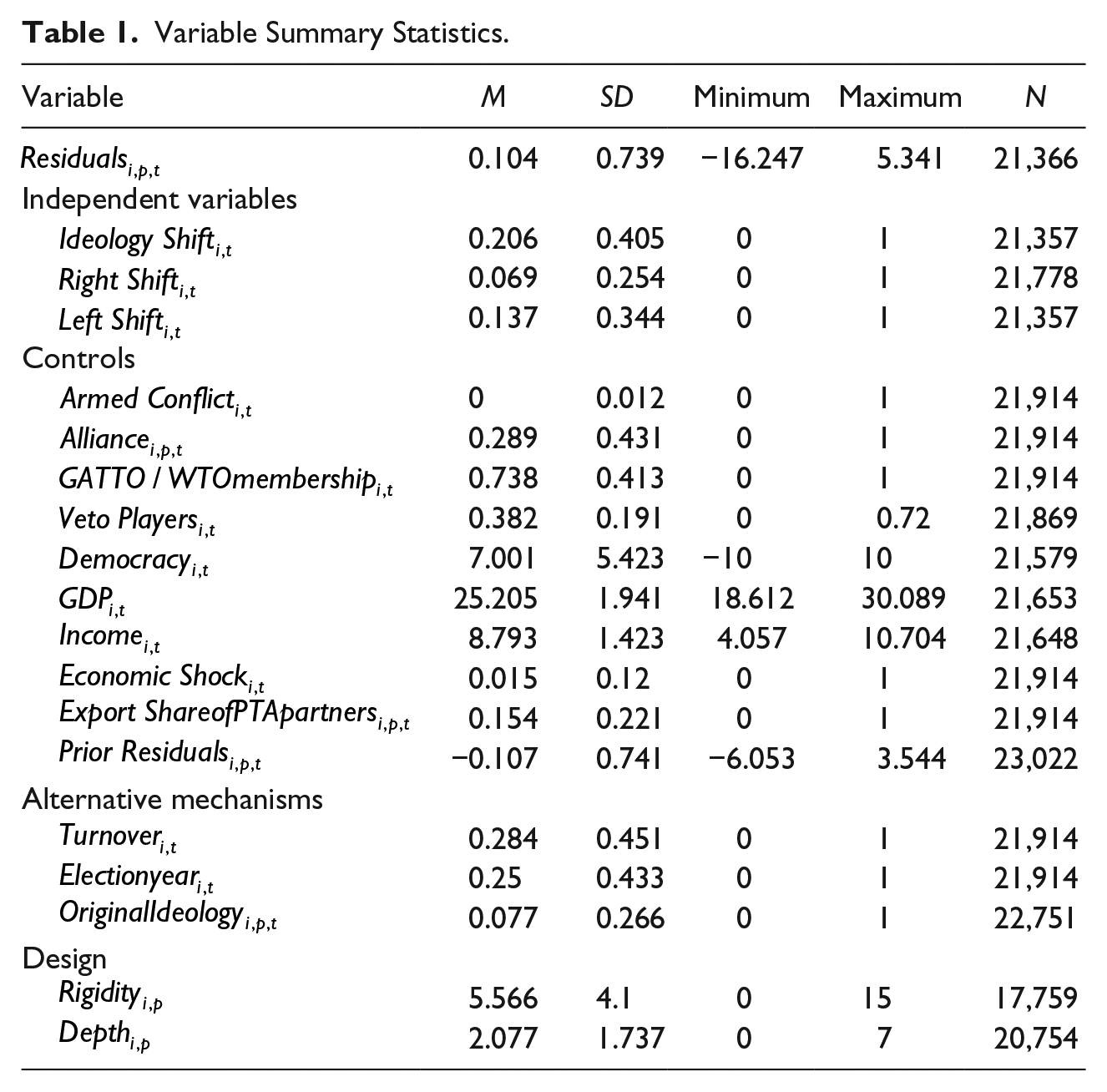
Variable Summary Statistics.
The residuals are the difference between the observed trade flow
The gravity model produces expectations for imports between dyads—that is, each pair of countries i, j. However, as our core analysis is monadic, we take the mean of each country
Lower residuals represent higher political barriers to trade. Note that the gravity model does not include an indicator of PTA membership. Instead, we run a standard model to get a baseline prediction. This means that the residuals ought to be positive for PTA members, on average. If PTAs promote trade, then observed import levels should be higher than predicted. Therefore, positive residuals provide a clear sign of at least some adherence to the agreement. On the contrary, relatively lower (or negative) residuals suggest poor compliance.
We do not anticipate that our main independent variables produce year-on-year changes in political barriers. Therefore, differencing the values is not appropriate for our hypothesis. However, our core models include fixed effects to differentiate actual imports in a given year from the baseline of the panel mean. We include either PTA-country or country fixed effects, as appropriate to the model. We also include a variable that measures the gap between observed and expected trade in the year before the PTA was enacted. Including a measure of pre-PTA residuals or imports provides a reference point for the barriers we observe in year
Independent Variables
We hypothesize that changes in the ideology of the chief executives alter their compliance with PTAs. Measuring political ideology is not straightforward (Dinas & Gemenis, 2010; Lo, Slapin, & Proksch, 2014). Applying a left-to-right spectrum across all countries is difficult because the meanings of “left” and “right” vary across states (Benoit & Laver, 2006). However, we are interested in changes from the status quo within—not across—countries, from a leader at
The most comprehensive data on ideology can be found in the DPIs. DPI offers a three-value coding, where a value of 1 represents right-wing ideology and a value of 3 represents left-wing. Our core variable of interest is not a leader’s ideology but whether this has varied from one leader to the next. We code our variable
In robustness checks, we include several alternate operationalizations of ideological shift to ensure that the mechanism we describe is driving the result. These include measures accounting for the presence of an
To test the conditioning effects of PTA design on the degree to which that agreement is upheld, we employ two additional measures. Our prediction is that agreement flexibility/rigidity shapes new leaders’ incentives to abide by predecessors’ PTAs. We use data on the degree to which PTAs limit use of the three escape clauses most frequently included in PTAs—antidumping, safeguards, and countervailing duties. This 16-point (0-15, inclusive) index measure
Control Variables
Failing to control for other influences on political barriers to trade may confound our inferences. We include several variables that operationalize the considerations described earlier (see Table 1 for descriptive statistics and sources). Our models include measures of the national security issues known to shape trade flows—namely, whether the PTA signatories are engaged in an
Our models account for features of the domestic political landscape. We include a measure of regime type (
Several economic factors may also shape whether new leaders uphold the agreements they inherit. Beyond controlling for
Finally, it is necessary as well to account for how much trade we would expect a given agreement to produce, so that we can scale our expectations for political barriers accordingly. In models using only country fixed effects, we include a measure for residuals levels prior to the PTA being enacted (
Analysis and Results
This section tests the validity of our predictions. Our tests proceed in four steps. First, we present our baseline estimations, demonstrating the negative relationship between ideological turnover and political barriers to trade. Second, we examine the direction of the ideological shift. We find that shifts to the right have no significant effect on barriers. Instead, the core dynamics are driven principally by moves to more left-leaning chief executives. Third, we explore whether PTA design conditions our result. These tests provide modest support for the flexibility hypothesis, showing that barriers increase in the presence of agreement rigidity. Fourth, we describe the additional analyses provided in the empirical appendix. This supplemental analysis includes additional tests of baseline specifications as well as a parallel analysis using import levels rather than residuals. Across all tests, our estimates point to the same core relationship: For countries already in a PTA, ideological turnover, particularly to the left, is associated with a significant increase in political barriers to trade.
Main Estimations: Residuals as Outcome of Interest
For this first set of tests, we conduct a monadic analysis, where the unit of observation is country-PTA-year. This allows us to examine a specific leader’s behaviors within the context of a particular agreement. The outcome of interest is deviations from expected imports—that is, gravity model residuals—among PTA members. We are interested primarily in the conditions under which PTA members uphold their commitments. As such, the analysis compares the residuals of PTA members with and without ideological turnover. This is the most direct way to think about whether PTA effectively ties future leaders’ hands. 26
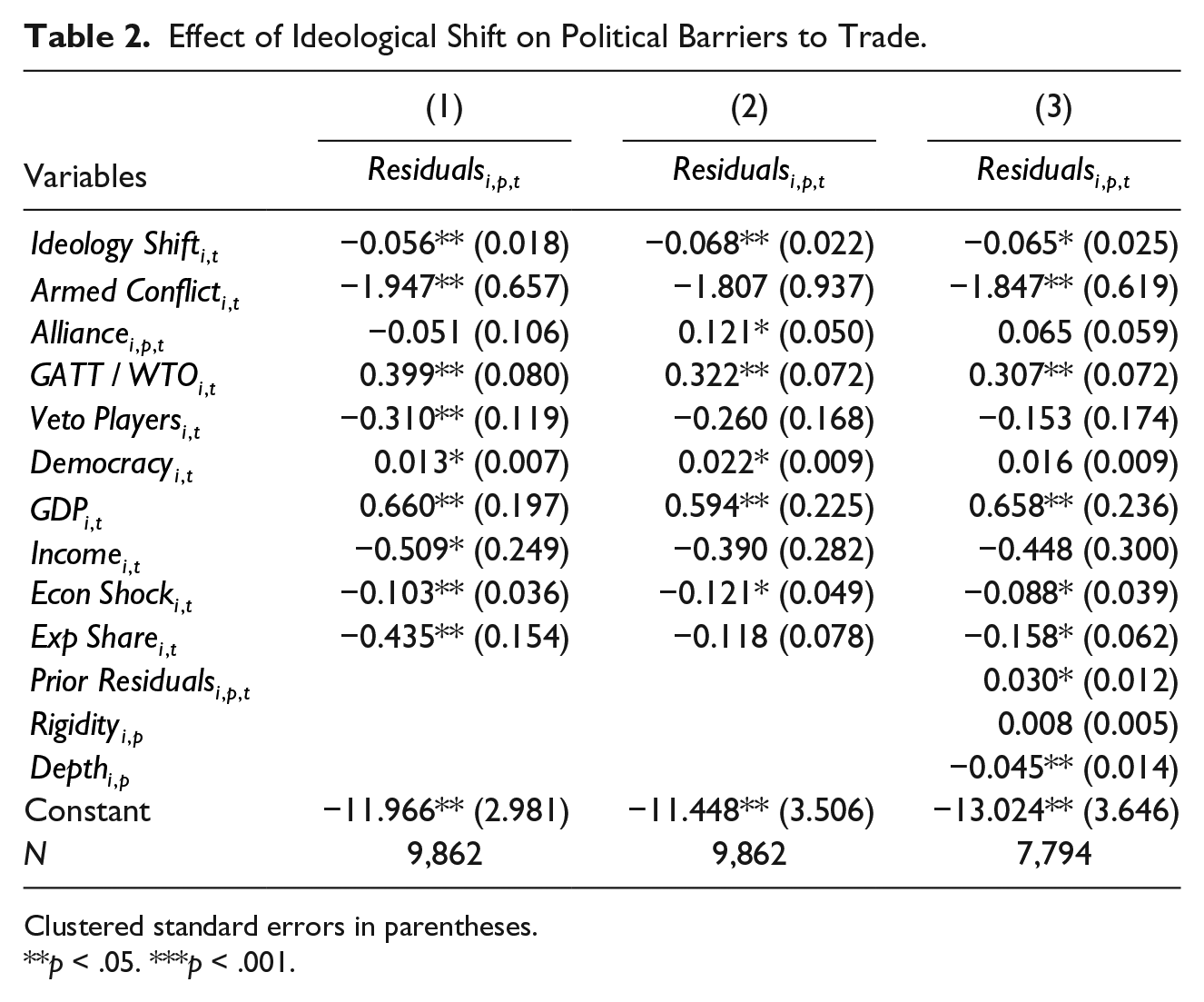
Models 1, 2, and 3 (Table 2) present the baseline results, estimated in two ways: first, with country-PTA fixed effects (Model 1) and, second, with country fixed effects (Models 2 and 3). The country-PTA fixed effects in Model 1 control for time-invariant features of PTAs, such as agreement design. The country fixed effects in Models 2 to 3 allow us to model time-invariant features of member states explicitly. The standard errors are clustered according to which fixed effects are used.
Effect of Ideological Shift on Political Barriers to Trade.
Clustered standard errors in parentheses.
p < .05. ***p < .001.
The controls generally follow expectations. War and economic crises are both associated with a drop in residuals. Larger markets, more democratic policies, alliances between PTA partners, and General Agreement on Tariffs and Trade [GATT]/WTO commitments are all associated with higher residuals. Countries with deeper ties to the international system are less likely to impose barriers to trade in the presence of trade agreements.
Our explanatory variable,
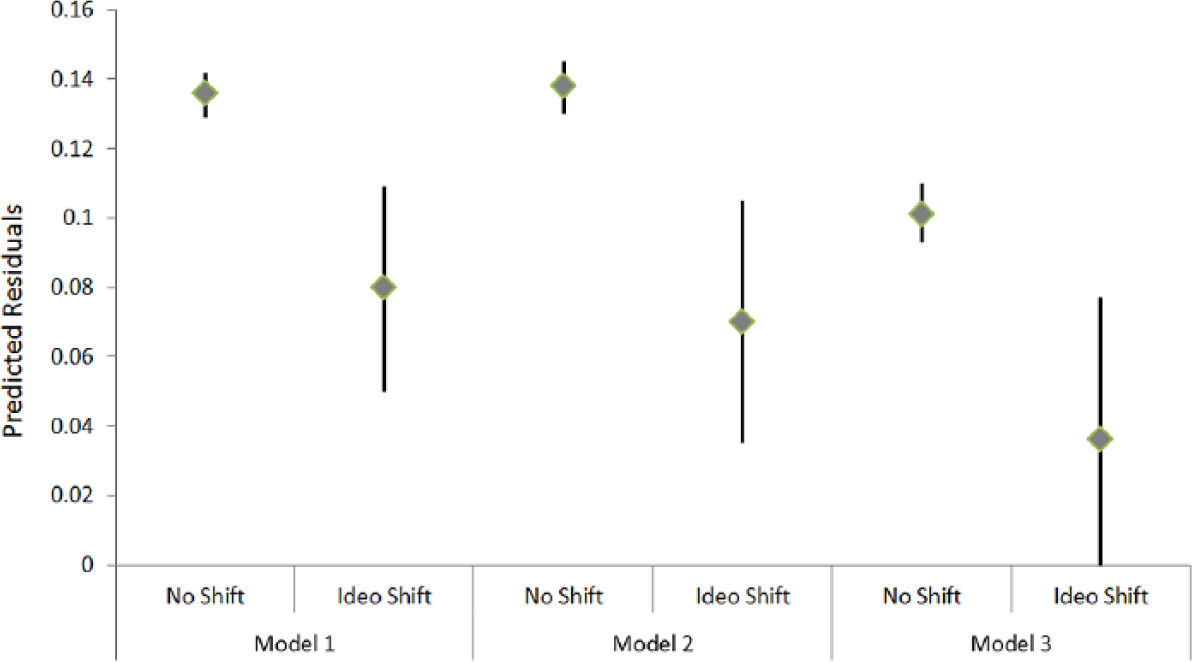
Substantive effects for baseline models (1-3).
Models 2 and 3 use country fixed effects. The substantive effect is slightly larger in Model 2, where ideological turnover results in a 50% drop in the residuals. Model 3 adds several additional controls (otherwise dropped by Model 1’s country-PTA fixed effects). It includes our two measures of PTA design, and a measure of pre-PTA trade residuals. The latter helps us account for trade levels before the PTA was put in place. The Model 3 estimates are consistent with the previous results. Ideological turnover is associated with a predicted decrease in the residuals from 0.102 [0.093, 0.110] to 0.037 [−0.004, 0.078]. 29
Direction of the Ideological Shift
To the extent shifting ideology represents a change in chief executive priorities, any change in ideology has the potential to affect a state’s commitment to freer trade. However, there are reasons to expect that the direction of this shift matters. Right-wing parties generally favor trade, while left-wing parties tend to oppose them, so a shift to either of those parties might condition the effects of turnover generally.
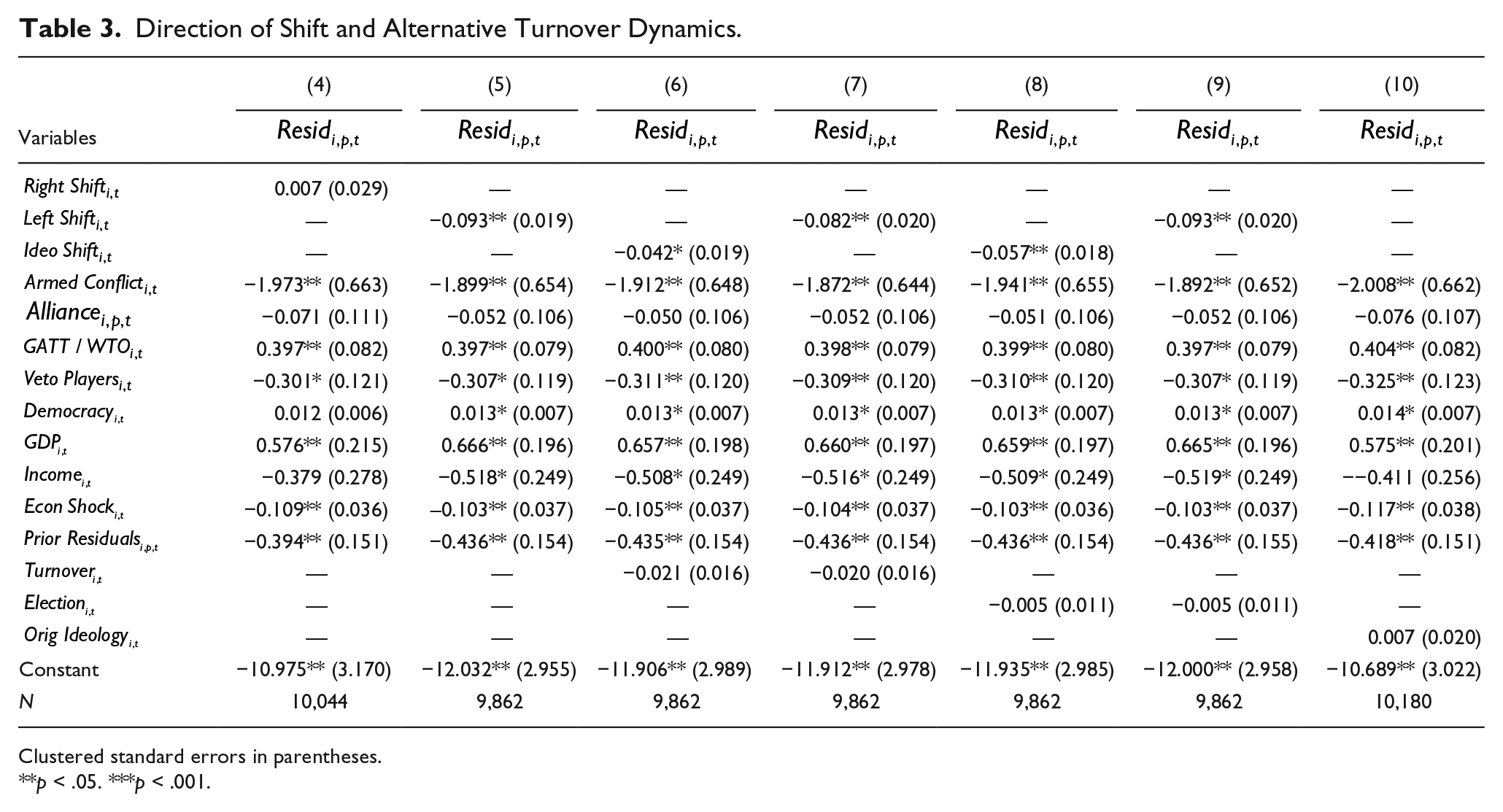
We rerun our baseline specification using a measure of whether ideological turnover results in a shift to the right (
Direction of Shift and Alternative Turnover Dynamics.
Clustered standard errors in parentheses.
p < .05. ***p < .001.
The mixed results raise an interesting puzzle. Why do shifts to the left have a significant effect whereas shifts to the right do not? Several factors are likely at play. To begin with, it may be the case that left-leaning politicians are more susceptible to demands for trade barriers. Protectionist interests, traditionally represented more by the left, might better overcome collective action problems and lobby successfully for protection. If protectionist interests are politically powerful, then even newly elected, right-leaning chief executives may have difficulty rolling back existing trade barriers.
30
At the same time, the existence of a PTA already represents a previous government’s efforts to liberalize, or else there would be no agreement. Therefore, even right-leaning chief executives may not have an additional incentive to liberalize beyond the status quo. In light of this finding, we present subsequent tests separately for both
To further distinguish the importance of shifting ideology, we look at several of the related, but distinct, explanations of how turnover affects political barriers (Table 3). It might be the case that uncertainty around the entrance of a new leader causes firms to respond to the uncertainty by cutting back their exports to that country in favor of trade with countries that have more stable outlooks, and thus turnover would cause trade to decline. In Models 6 and 7, we include a dichotomous indicator of whether there was leadership turnover of any type. This control helps isolate the independent effect that shifting ideology (Model 6) or shifts to the left (Model 7) might have, as distinct from turnover generally. Another way of approaching this issue is including an indicator of whether an election was held in Year
Finally, the ideological shifts we observe in Year
Across each of these models, we find results consistent with the baseline estimates. Ideological turnover is associated with a significant decrease in residuals even when a trade agreement is in place, implying that trade is being interrupted by unobserved political barriers, not simply by uncertainty in the marketplace. The relationship stems primarily from a shift toward left-leaning chief executives. This corresponds with existing work on the left’s greater representation of protectionist interests, with the added insight that international agreements do not seem to constrain those tendencies.
Design Features of the Agreement
Our next set of tests looks at agreement design. Design outcomes—particularly the levels of flexibility and depth built into agreements—likely shape leaders’ incentives to maintain open markets. However, as discussed above, there are competing views on the direction of this relationship. One view is that flexible agreements, through the inclusion of escape clauses, lower the costs of PTA membership and reduce leaders’ incentives to shirk the agreement. An alternative point of view is that more rigid agreements effectively constrain leaders, tying their hands to liberalization regardless of any given leader’s preferences. Similarly, the depth of the liberalization may make abiding by a PTA particularly onerous, and states may be more likely to defect from deep agreements. Others argue that deep commitments act as a tighter constraint, such that defection from the agreement is actually less likely.
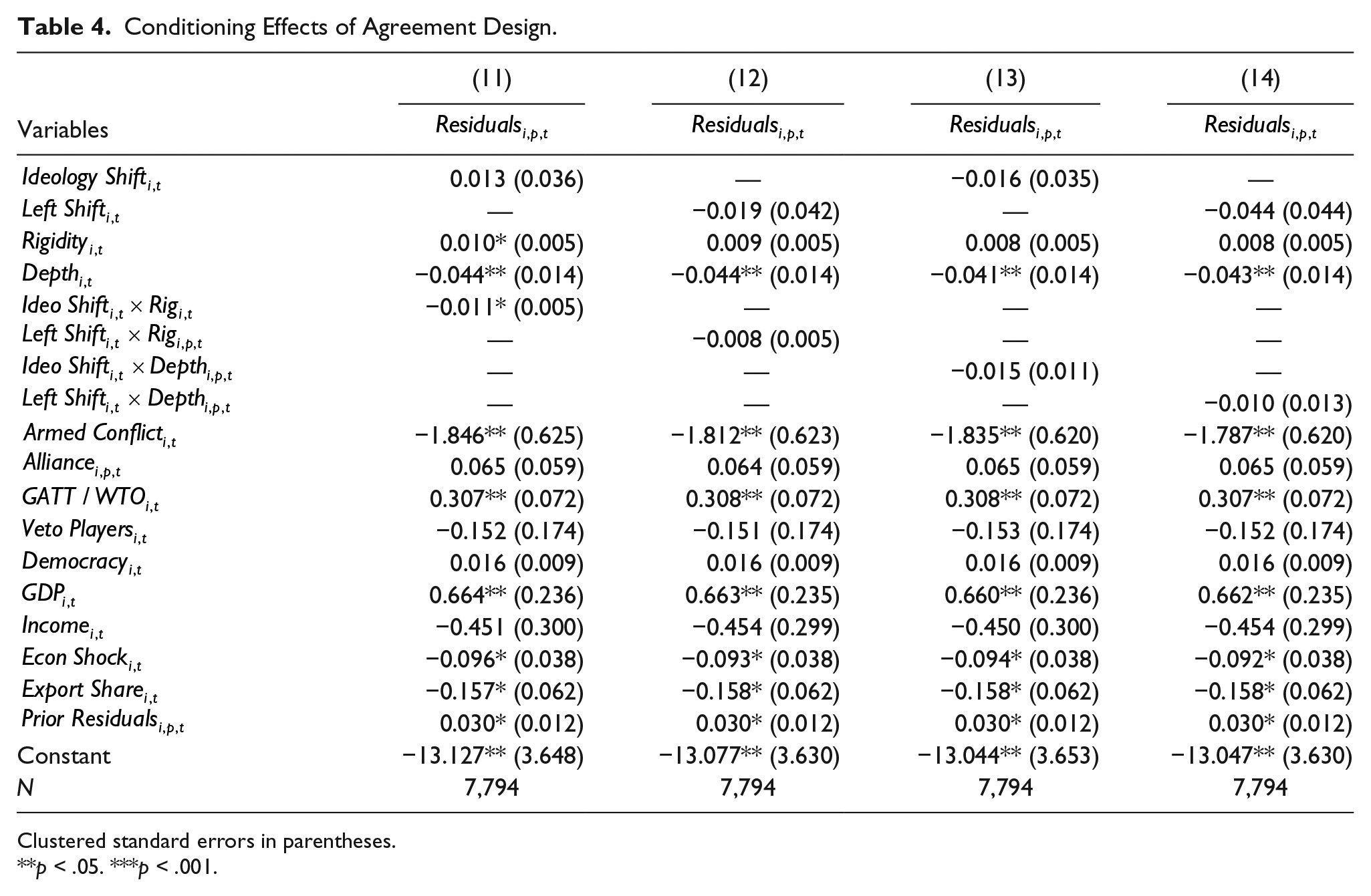
Table 4 shows the estimations of our baseline model, adding interactions of leadership turnover with the design features of the agreement. Model 11 includes the interaction of
Conditioning Effects of Agreement Design.
Clustered standard errors in parentheses.
p < .05. ***p < .001.
To interpret Model 11, we look at the effect that ideological turnover has on political barriers to trade at different levels of
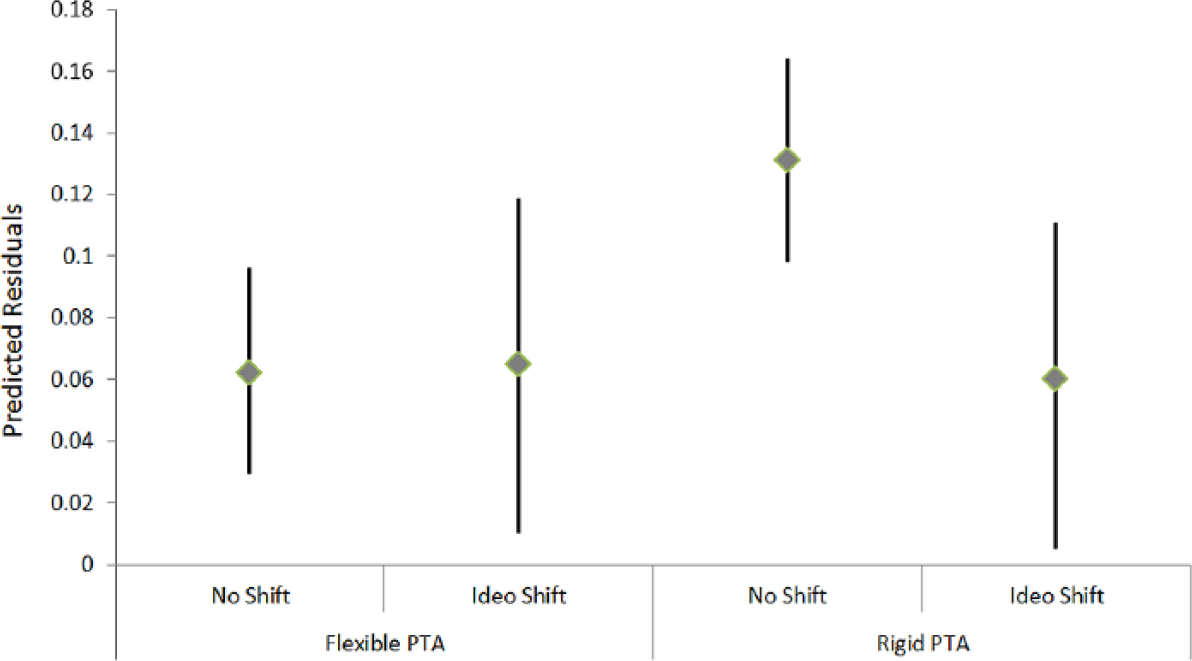
Substantive effects for Model 11.
We infer several things from these results. First, rigid agreements may be more likely to be abandoned when ideological turnover occurs. Flexible agreements, conversely, could provide leaders with enough room to manage their commitments to their constituents within the system for escape. In this way, our estimates lend preliminary support for the flexibility hypothesis. The results also show that rigid international agreements fail to tie members’ hands. It appears as though the opposite is true. 31 However, the modest results prevent us from drawing more definitive conclusions.
Additional Robustness Checks in the Online Appendix
Our online appendix includes a variety of additional tests. To begin with, we look how ideological turnover shapes barriers over time. We consider the age of a PTA, which might determine how entrenched liberalizing commitments are in domestic policy. We also look at the frequency of ideological turnover. This accounts for whether greater instability over time has a more dramatic effect on barriers.
The online appendix also includes tests of domestic political institutions, which might limit the chief executive’s authority to shift trade policy. In addition, we correct for nonrandom entry into leadership turnover. Our argument assumes that leaders change as a result of an underlying shift in the identity or preferences of constituents. This implies that turnover is nonrandom. We model this process in the online appendix.
Finally, we want to ensure that our core estimates are not an artifact of our dependent variable construction. Therefore, we use annual imports as an alternative indicator. While imports are an imperfect measure of political barriers, for the reasons that we described in the main text, they are the most directly observable outcome of PTA membership. We rerun our analysis using this dependent variable and find consistent results. One advantage of looking at imports is that it allows us to rerun a fuller gravity model specification on directed dyads. This affords greater confidence in our estimations and central findings (see online appendix).
Conclusion
International agreements act as contracts between countries, not leaders. Many scholars argue that interstate contracts transcend the politicians who form them. In practice, the idea that agreements extend beyond the tenure of the current leader is precisely why states may want to formalize the rules of interstate relations. However, we have demonstrated that these assumptions merit reconsideration. Shifts in the ideological leanings of the chief executive result in new political barriers to trade. As new governments come into power, their differing priorities and constituents make them likely to direct their energies toward policy aims that are distinct from their predecessors. In this regard, PTAs appear not to tie the hands of member countries effectively.
Our evidence offers a more complete picture of the notion on international agreements as credible commitments. Our focus on domestic politics helps explain how, although very few agreements are formally discarded, leaders do not always enact those agreements. Previous investigations of the effects of IOs on cooperation focus mainly on factors in the international system or on features of the contract itself. Our argument emphasizes the importance of domestic politics in understanding the cooperative effects over time of international agreements. It shows that the force of international law cannot be divorced from an understanding of the domestic political shifts that could shape members’ behavior under agreements. While we do not deny the importance of institutional design or interstate politics, we focus chiefly on member governments as agents of agreement effectiveness.
Our finding has broad implications for the study of international cooperation. Many studies laud the proliferation of international agreements as an indicator that states are increasingly willing to adopt and comply with international rules. However, we show that subsequent leaders are able to let those agreements slide, even if they do not exit from them formally. This finding casts doubt on the claims about the constraining nature of international agreements over time. It also highlights the fundamental importance of domestic politics in studying questions of international relations. The performance of international agreements must be understood in light of domestic political processes that states undergo. We have offered one cut at that story here, showing that turnover in leaders’ preferences leads to increased political barriers to trade. Future research on this topic might explore the implication for other types of international agreements. Although other IOs have different outputs, and thus their compliance rates would have to be measured on their own terms, the general principle that an ideological shift brings with it a shift in the demands of the new ruling coalition would likely hold in different settings.
These findings also give rise to other questions about PTAs that have yet to be explored. If new leaders are less likely to abide by existing agreements, we might expect potential PTA partners to be reluctant to forge agreements in the run-up to elections. Other work, however, has argued that PTAs improve leaders’ electoral prospects (Hollyer & Rosendorff, 2012; Mansfield & Milner, 2012), which would then lead to an expectation that leaders under threat might favor signing more PTAs. This proposition would need to be thoroughly investigated in future work. Further research should examine more closely how states can create more durable agreements. Many have focused on the design of the agreements as critical in ensuring cooperation over time. It is worth investigating the conditions under which the terms of international agreements endure, irrespective of who is in office. Moreover, a closer look at governments’ preferences, and how those preferences change with domestic political turnover, provides a more thorough understanding of the interaction between domestic politics and international commitments.
Footnotes
Acknowledgements
We wish to thank Sarah Bush, Stephen Chaudoin, Jennifer Dixon, Avery Goldstein, Guy Grossman, Raymond Hicks, Andrew Kerner, Edward Mansfield, Michele Margolis, Marc Meredith, Peter Rosendorff, Alastair Smith, Jessica Stanton, Yuhua Wang, Alex Weisiger, and participants at the 2014 annual meeting of the International Political Economy Society for their thoughtful comments.
Authors’ Note
All remaining errors are our own. Full replication materials are available on Harvard’s Dataverse.
Declaration of Conflicting Interests
The authors declared no potential conflicts of interest with respect to the research, authorship, and/or publication of this article.
Funding
The authors received no financial support for the research, authorship, and/or publication of this article.
Notes
Author Biographies
References
Supplementary Material
Please find the following supplemental material available below.
For Open Access articles published under a Creative Commons License, all supplemental material carries the same license as the article it is associated with.
For non-Open Access articles published, all supplemental material carries a non-exclusive license, and permission requests for re-use of supplemental material or any part of supplemental material shall be sent directly to the copyright owner as specified in the copyright notice associated with the article.
