




Abstract
Media reports can have a significant and lasting impact on public perceptions about crime and criminals. Jonathan, Jarrod, and Jamie Bacon gained notoriety in Vancouver through substantial media coverage for their involvement in gang-related shootings and criminal activity. The present study examines how the media have portrayed the Bacon brothers and their importance in the region’s gang scene. We examine all articles published in the area’s largest newspaper, the Vancouver Sun, mentioning the Bacon family between 2008 and 2015 (N = 401). Specifically, we explore the media’s depiction of the Bacons through developing a thematic content analysis, with themes tested in a keyword analysis using a corpora comparison with a set of reference articles. We argue that the Bacon brothers’ family relationship, tumultuous gang alliances, and alleged involvement in Vancouver’s worst gang-related shooting led to the media overreporting and sensationalizing their criminal activity and prominence in the local gang landscape. In addition, we contend that the popular theme of crime families provided the media with a narrative that proved useful in a context where the police and the courts were simultaneously trying to adapt to the emerging reality of violent gang conflict.
Mass media has a significant and long-lasting effect on public perceptions and beliefs about crime and criminals (Dowler, 2003). As opposed to official police or court records, the media is often the primary source of crime knowledge for the general public (Chermak, 1995; Sheley & Ashkins, 1981). The public’s use of media representations of current issues as their primary source of information becomes problematic when criminal justice policy and subsequent action is influenced by these representations (Surette, 2007; Thompson, Young, & Burns, 2000). Thus, when public opinion is influenced by inaccurate media representations, policy may not accurately reflect the issue, but rather the public’s misinformed opinion of an issue.
This study examines the portrayal of the notorious gangsters Jarrod, Jonathan, and Jamie Bacon by news media in Metro Vancouver—a regional district in British Columbia, Canada, that encompasses the City of Vancouver and other surrounding urban and suburban areas. The present study looks at how the media have portrayed the Bacons and their importance in the region’s gang scene. We argue that the Bacon brothers became the face of gang violence in Metro Vancouver, not necessarily because they were important players in the gang scene, but rather because they provided the media with a familiar anchor point from which to explain the origins of gang violence to an audience suddenly exposed to the reality of street gangs. The popular theme of crime families provided the media with a narrative that proved useful in a context where the police and the court—the media’s usual sources of information—were also trying to adapt to the emerging reality of violent gang conflict. In this article, we examine the language used in articles depicting the Bacons, the process by which the brothers became household names, and the legacy associated with the elevation of the Bacon brothers to the status of notorious, familiar gangsters.
The Social Construction of Crime
Two frameworks are commonly used when examining the portrayal of crime or other phenomena in the media: production theory and audience theory. The latter centers on how an audience reacts to what the media presents and how they interact with the messages conveyed (Ross, 2014). One audience theorem especially relevant to the present study is cultivation theory, which proposes that the media does not have an immediate effect on the audience (Gerbner, 1969). Instead, the media produces gradual and indirect effects that compound over time due to an issue being framed and presented consistently and repetitively (Roskos-Ewoldsen & Monahan, 2007). This may lead the audience to adapt their opinions or perceptions to fit what the media portrays. For example, portraying gangs as an out-of-control problem may lead the public to perceive their city’s gang problem as such (e.g., McCorkle & Miethe, 2002).
Production theory focuses on the processes that define information as newsworthy (Ross, 2014). One such process is social constructionism, which recognizes the critical role of the media in the social construction of knowledge. This framework views knowledge as socially created by all members of society (Surette, 2007; Weinberg, 2014), and heavily comprised of shared meanings—the ideas, interpretations, and knowledge that people hold in common. These shared meanings are not dependent on objective, empirical reality, but rather on shifting cultural trends. Therefore, constructed reality evolves with social change in a society and results from a combination of personal experiences, social interactions, and symbolic and experienced realities.
According to Surette (2007), there are four primary sources of knowledge: personal experiences, other people, other social groups and institutions, and the media. The social knowledge gained from these four sources make up our experienced and symbolic realities. Experienced reality is constructed through direct day-to-day experiences (Surette, 2007) and can be limited in contexts such as crime because many people will never personally experience criminal victimization. In this circumstance, symbolic reality is particularly influential. Symbolic reality is constructed through vicarious experience; it is based on the knowledge gained from exposure to others (e.g., peers, friends, family), and to institutions such as schools, government agencies, and the media (Surette, 2007). As a primary source of knowledge, the media provides much of the shared social knowledge in society and plays an important role in the formation of symbolic reality, especially as it relates to crime.
Surette (2007) proposes that social constructions are developed from experienced and symbolic realities through four stages. In the first stage, the media is presented with facts/events to be reported. The second stage involves the emergence of competing constructions of social conditions that have been identified as problems (e.g., gangs). During the third stage the media filters out competing constructions by favoring constructions from powerful groups or those that support preestablished themes (Surette, 2007). This process gives some constructions more credibility, making it difficult for others to be seen as legitimate. In the fourth stage, the dominant construction emerges. What the media determines to be the dominant construction directs public opinion, which in turn directs public policy, which eventually feeds into the social construction process (Surette, 2007; Thompson et al., 2000). In this cyclical process, criminal justice policies and community responses to a given problem are influenced by public opinion, which itself is influenced by the media’s portrayal of the problem (Thompson et al., 2000).
Forces That Shape Dominant Constructs
If It Bleeds, It Leads: Violence, Street Gangs, and Peculiar Crimes
While many studies have shown that “crime sells,” it is important to note some caveats about this statement. News organizations make decisions about crime stories based on their perception of the public interest a story is likely to generate. Many studies have shown that the media tends to favor violent crimes over property crimes (Dowler, Fleming, & Muzzatti, 2006; Sheley & Ashkins, 1981). For example, Chermak (1994) found that nearly half of the crimes reported in newspapers were violent, compared with 10% for misdemeanors and property offenses. Unusual crimes also tend to make the news, compared with the more mundane but much more prevalent street crimes (Katz, 1987). In addition, crimes that involve spectacle, graphic imagery, or significant planning are likely to be depicted by the media (Jewkes, 2004). In some cases, the overrepresentation of relatively unusual crimes can lead to moral panics (Cohen, 1972) and a disproportionate response to an event by the general public, the media, and the criminal justice system (Goode & Ben-Yehuda, 1994).
Gangs are often portrayed in ways that make them especially popular topics. The media frequently present gangs as highly organized and hierarchical structures with well-established leaders (Esbensen & Tusinski, 2007), a description that goes against most academic research on gangs (e.g., Decker, Melde, & Pyrooz, 2013; Klein & Maxson, 2006). Further, gangs are often described as highly violent and involved in sophisticated drug trade (Esbensen & Tusinski, 2007; Klein, 1995). While most research confirms that gang members are more likely to be involved in violence than non-gang members (e.g., Melde & Esbensen, 2013; Thornberry, Kroh, Lizzote, Smith, & Tobin, 2003), many studies have shown that the media severely overstates gang violence (Esbensen & Tusinski, 2007; McCorkle & Miethe, 1998). As for their involvement in sophisticated drug trade, most research has shown that while individual or subgroups of gang members may decide to become involved in drug dealing, gangs are rarely organized specifically for that purpose (e.g., Decker & Van Winkle, 1996; Fagan, 1989). Moreover, most research on the subject has demonstrated that gangs lack the organizational structure to control the behavior of their members as it relates to their involvement in the drug trade, the money they make, and the areas in which they sell (Decker & Van Winkle, 1996; Klein, 1995).
According to Esbensen and Tusinski (2007), one of the main reasons for the stereotypical depiction of gangs in the media is the lack of concern for definitions. The authors note that journalists almost never define what is meant by use of the word “gang,” leaving the definition open to the imagination of readers. Naturally, when journalists emphasize stereotypical elements of gangs—organization, violence, drug trade—it is likely that readers will make associations with cultural references from books, movies, television shows, and video games. As pop culture has plenty of examples of notorious gangsters, ruthless gangs, and organized crime groups, soon the fictional images of crime become blurred with reality. According to Dowler et al. (2006), “the portrayal of crime and justice is blurred, especially within news content, in which the most serious and violent crimes are given an entertaining angle and presented as ‘hard’ news, even though the facts are often distorted or misrepresented” (p. 839).
Sources of Information
Ericson (1991) states, Law is among the dominant institutions entwined with the mass media. [ . . . ] They collectively constitute justice by turning accounts of what is into stories of what ought to be, fusing facts with normative commitments, values, beliefs, and myths. (p. 223)
Without the collaboration of different actors in the criminal justice system, the face of crime news would be very different. Courts and government agencies play important roles in providing news agencies with information about crime. Entire agencies are devoted to the diffusion of information about crime and public safety in the United States, Canada, and most other democracies around the world. Governments can also inhibit access to information in important ways. For instance, many legal systems allow judges to impose publication bans designed to protect certain populations (e.g., children) and the integrity of justice (e.g., rights of the accused to a fair trial). But of all the actors involved in exchanges between law and the media, the police play perhaps the most important role. Sheley and Ashkins (1981) report that the media’s main source for information regarding crime events is the police wire service, which provides information on crimes such as those in which the police or reporters have expressed an interest.
The police have been found to sometimes frame the narrative about crime, especially as it relates to gangs, to serve their own interests. For example, by shifting focus onto gangs, the police have been able to draw attention away from media focus on their own misconduct (McCorkle & Miethe, 1998). Generally, law enforcement act as gatekeepers of information for crime reporters and therefore have significant control over what, when, how, and to whom information about crime is made accessible (Mawby, 2010). That said, an important function of the media is to keep public officials—including police organizations—accountable to citizens. Therefore, police departments have historically walked a fine line between providing the media with information that ensures they are trusted and viewed positively by the public, while attempting to control their public image (Chermak & Weiss, 2005). As the media has generally been the main channel through which they can inform the public, police departments have incentives to maintain good relationships with members of the media. In recent years, however, police departments have increasingly attempted to gain a better control on their public image through the use of media units (e.g., Chermak & Weiss, 2005). Such units directly shape the news related to crime and police activity. In some cases, police media units specifically generate media reports that end up verbatim in newspapers (e.g., McGovern & Lee, 2010).
Gangs of Vancouver: The United Nations (UN), Red Scorpions (RS), and the Bacon Brothers
To situate the current research, it is useful to understand the emergence of two rival gangs that received significant attention in the media during the period of study (2004-2015 1 ): the UN and the RS. Both gangs were formed in the late 1990s (Langton, 2013). Although they have often been described in the media as having a sophisticated leadership structure, Totten (2012) argues that these gangs in fact have a relatively weak structure and minimal organization. The UN garnered much attention when one of its leaders, Clayton Roueche, was deported to the United States to serve a sentence for involvement in a drug smuggling scheme across the Canada/U.S. border (The Combined Forces Special Enforcement Unit British Columbia [CFSEU], 2015; Totten, 2012).
The RS are associated with one of the deadliest mass shootings in British Columbia’s history—the event occurred in 2007 and is commonly referred to as the Surrey Six Shooting (S6S). According to Langton (2013), Quang Vinh “Michael” Le and Eddie Narong, who were the RS’s leaders at the time, had a falling out with other members of the gang and formed their own gang in the early 2000s. Their alliance was short-lived as Le was arrested in relation to the S6S, in which RS members killed Narong. The S6S had six victims—four gang members and two innocent bystanders—and six individuals were arrested and charged in connection to these deaths. Of those arrested, Jamie Bacon received disproportionate media attention.
Before Jamie’s involvement in the S6S, he and his two brothers—Jonathan and Jarrod—were largely unknown in Vancouver media. The Bacon brothers sold drugs supplied by the UN up until the late 2000s, although they were never official members of the gang (Langton, 2013). Their alliance with the UN began to fall apart when the Bacons began forging ties with the RS, eventually leading the Bacons to join the RS and amplifying a long-standing rivalry between the two gangs (Langton, 2013; Totten, 2012).
Although Jamie’s involvement in the S6S certainly served as the major catalyst for the brothers’ rise to prominence in Vancouver media, we argue that the sustained media attention the brothers received is better explained by the appeal of framing the gang problem as a family affair. The S6S itself was a turning point in terms of the media’s attention to gangs and the establishment of specialized responses to gang violence in British Columbia (Gravel, Wong, & Simpson, in press). Overnight, the Bacon brothers became the face of gang violence in the media. News stories escalated following the May 2008 murder of Jonathan Barber after being mistaken for a Bacon brother, and the subsequent police-issued public warning about the risks of associating with the brothers given death threats from other gangs. Despite Jonathan’s death in a gang-related homicide in 2011, and the fact that Jarrod has been incarcerated since 2012 and Jamie has been in prison since 2009 awaiting trial for involvement in the S6S (set to begin in 2018), the Bacon brothers continue to occasionally make headlines to this day.
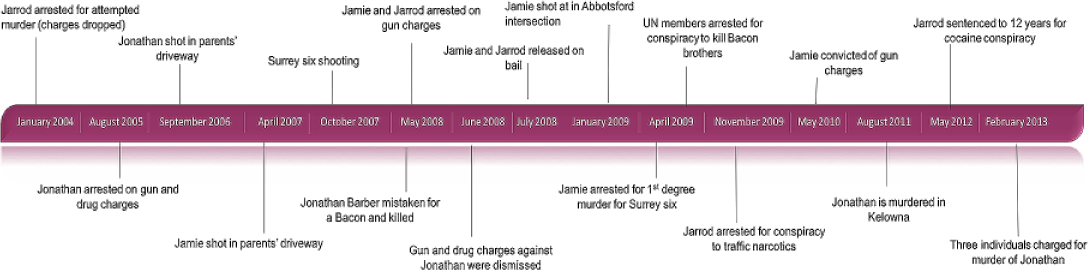
Figure 1 contains a timeline of key events involving the Bacon brothers, based on available literature, newspaper articles, and publicly available provincial court records. This timeline was created to provide information regarding Jarrod, Jonathan, and Jamie’s activities and criminal involvement so as to contextualize the media coverage surrounding the brothers.
Timeline of key events.
Method
Data Collection
We analyzed articles published in the Vancouver Sun between January 1, 2004 and December 31, 2015. The Vancouver Sun is Metro Vancouver’s largest newsroom and is published six times a week (Post Media, n.d.). While the search included the years 2004-2015, the sample primarily included articles from 2008-2015 as only two articles were found published between 2004 and 2007. The search terms included (“Bacon brothers” OR (“Bacon gang”) OR (“Jamie Bacon” OR “Jarrod Bacon” OR “Jonathan Bacon” OR “Bacon family”)) AND (“The Vancouver Sun”) NOT (“Kevin Bacon”). The sample included any articles that mentioned any of the three Bacon brothers. After removal of duplicates and irrelevant articles, a total of 401 articles were identified as relevant and published in the Vancouver Sun between 2004 and 2015.
Analytic Approach
Our primary analysis involves developing rich descriptions in a thematic content analysis of the data used in the 401 Bacon brothers articles (e.g., see Braun & Clarke, 2006). Using an inductive approach, codes and categories were developed based on patterns identified in half of the articles in our sample (n = 200), selected purposively from within each year of the data set. These codes and categories were then used to develop key themes from within the news articles. After the rich themes were developed, the entire sample (N = 401) was coded for presence of each of the themes. To help describe the themes in our presentation of results, we identified illustrative quotes in articles from within each theme.
To test the validity of the themes, we conducted a keyword analysis using a corpora comparison in which the frequency of words between two sets of articles are compared. The goal was to determine emerging themes unique to coverage of the Bacon brothers, in comparison with a reference set of words from all articles on homicide published in the Vancouver Sun from 2004 to 2007, prior to the S6S. 2 Although this comparison set might overestimate violent crimes, using articles on gang- and non-gang-related homicides prior to the Bacon brothers’ emergence helps to determine if there is anything special about the way the Bacons’ crimes are reported. Names of organizations, individuals, and places were removed as these are likely to be more prevalent in one or the other data set. We used lemmatizing, which identifies words with different forms and simplifies them (e.g., charge = charge, charges, charged), and we removed all stopwords such as “a,” “the,” “not,” “and,” and so on. This analysis was done using the Natural Language Processing Tool Kit (NLTK) package in the programming language Python.
After identification of the most frequent words (n = 500) in each set, we calculated expected counts of each word in each corpus. Given the Bacon corpus b and the reference corpus r, the expected count of word i in corpus b is as follows:

where is the total number of words of in Bacon corpus,

Given that this approach is equivalent to a chi-square test with 1 degree of freedom, any
Results
Thematic Analysis
Four key themes surrounding the Bacon brothers emerged from our thematic analysis of the 401 articles in the data set.
The Bacon brothers are a family, not individuals
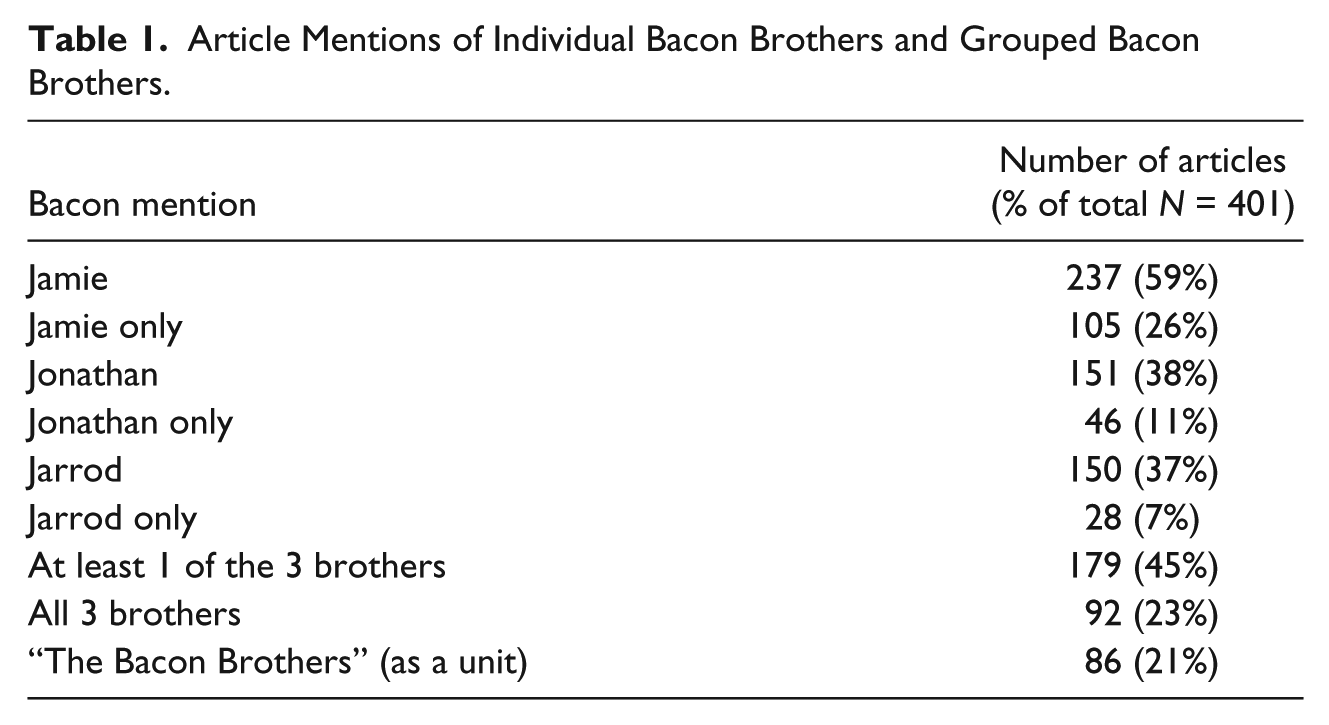
The first theme surrounds the media’s presentation of the Bacon brothers as a whole, rather than as three individuals. A significant proportion of the articles in the data set (33%, n = 131) referred to the single unit of the “Bacon brothers,” regardless of whether the article was about one brother, all three, or none specifically, thus reducing their individual identities into one unit. Additionally, media reports rarely spoke only of Jonathan or Jarrod Bacon in isolation; the media often referred to the family or the other brothers when speaking about the crimes of one of them (typically Jamie). For example, Table 1 shows that while 38% of the articles mention Jonathan (n = 151), only 11% mention Jonathan without also mentioning one or both of his brothers (n = 46). Similarly, while 150 articles mention Jarrod Bacon (37%), only 28 articles reference Jarrod alone (7%). Conversely, nearly one quarter of the articles mention all three brothers (23%), while 21% refer to “the Bacon brothers” as a unit. These findings indicate that even in instances in which journalists referred to only one brother, they commonly referenced the other two, emphasizing the theme of family. This is true even when such references had little to do with the current story. For example, in an article discussing Dennis Karbovanec’s guilty plea for his involvement in the S6S:
Article Mentions of Individual Bacon Brothers and Grouped Bacon Brothers.
As a result of Karbovanec’s singing, Jamie Bacon, 23, the youngest of the three notorious brothers, is charged with the first-degree murder of Corey Lal and one count of conspiracy to murder. (Mulgrew, 2009, p. A3)
The theme of “the family” is made salient in articles about the Bacons when journalists combined information about unrelated cases involving different brothers in the same article, and by description of events emphasizing family support. An article mainly devoted to the description of a bail hearing wherein Jamie and Jarrod faced multiple weapons charges provides an illuminating example of when both aspects are present. The article begins by describing an appeal filed by federal prosecutors regarding the dismissal of Jonathan’s gun and drug charges in a different case heard a month prior. Immediately after quoting the crown prosecutor saying the appeal was filed, the journalist transitions into a description of the bail hearing: [Jonathan] Bacon sat in the public gallery in Surrey provincial court Tuesday during a bail hearing for his two younger brothers, Jarrod and Jamie. [ . . . ] Jonathan was not the only family member in court supporting his brothers. Jamie and Jarrod’s girlfriends, two grandmothers and parents, David and Susan all attended, chatting with defence lawyers Ken Westlake and Michael Bolton at the break. David Bacon chatted with police about the Vancouver Canucks’ prospects, while his mother complained that Crown prosecutor Teresa Mitchell-Banks was taking too long. “She is just droning on and the judge is yawning,” she said, as grandson Jonathan laughed. (Bolan, 2008c, p. B4)
The 448-word article not only combines information about two completely separate cases, but also mentions the police’s public warning not to associate with the brothers, and concludes by implicating the brothers—by virtue of their association with the RS—in a “dial-a-dope” crack cocaine ring and the S6S. 3 The combination of crimes committed by different brothers contributes to solidifying the image of the Bacons as a unit. Further, the quote above juxtaposes the seriousness of the criminal world in which the brothers are embroiled with a description of the Bacon family’s casual, carefree demeanor. Their father “chatted” about the local hockey team with police officers, their grandmother complained about the Crown prosecutor being boring, and her “grandson Jonathan laughed.” Describing the Bacon family as, on the one hand, being involved in sophisticated and violent crimes, and, on the other hand, having business-as-usual attitudes about the court proceedings, reinforces the image of the Bacons as a Sopranos-like crime family.
The Bacon brothers are a public safety risk
The second emerging theme was that the Bacon brothers posed a safety risk to the public. This theme was present in 49% (n = 195) of the articles. The Bacon brothers were presented both as a risk to bystanders due to the public nature of attacks by rival gangsters, as well as a risk to those associating with them. For example, Being close to Abbotsford’s notorious Bacon brothers has proven very deadly in recent months. Since the Integrated Gang Task Force warned those associated with Jon, Jarrod and Jamie Bacon to steer clear of the trio or be potentially marked for death, eight associates have been murdered. Several others have been shot, beaten or targeted in drive-bys, including Jamie, who was uninjured in a shooting last January. (Bolan, 2009a, p. A4)
Keeping the Bacon brothers and the threat to public safety that accompanies them in the public eye helped the media to construct the Bacons as dangerous gangsters. Although the criminal charges against each of the brothers stemmed from only a few incidents, the media portrayed them as being very active and dangerous criminals, prepared and willing to kill or be killed.
It is important to note that the Bacon brothers themselves were not necessarily the ones described as threatening in the Vancouver Sun articles. Rather, the threat is described as coming from the abundant ruthless, violent, and dangerous enemies of the Bacon family. As opposed to warning the public against the potential actions of the brothers themselves, many of the warnings were directed at associates of the Bacons due to attacks and “hits” out on one or more of the brothers. For example, the following quote presents the fear of violence as exhibited by the employer of one of the Bacons’ parents: The patriarch of the Bacon clan works with students in the Abbotsford school district, which contacted police this week after the unusual warning about death threats to the Bacon brothers and the potential risk to anyone surrounding them . . . Sgt. Shinder Kirk, of the B.C. Integrated Gang Task Force . . . said the concern mostly relates to one of the sons or associates showing up at their parents’ workplace and someone attempting a targeted hit that endangers everyone in the vicinity. (Bolan, 2008b, p. A1)
The media’s focus on the public nature of the attacks on the Bacons helps present the Bacon brothers as a concrete threat. Had Jamie, Jarrod, and Jonathan only been presented as a threat to other gang members or those involved in criminal activity, their situation would not have been as newsworthy. This is illustrated by the reported opinions of the family’s neighbors: Neighbours in the upscale Abbotsford neighbourhood where the Bacons moved in 2001 are so concerned about security that none wanted to be quoted by name in the newspaper. However, everyone interviewed by The Sun said they are well aware of the tense situation involving the Bacons and are nervous about getting caught in the middle. In September 2006, Jonathan was shot several times in his parents’ driveway, but survived. An earlier shooting in 2002 of a car parked at the house occurred just after children playing in the otherwise quiet cul de sac had gone in for the evening. (Bolan, 2008b, p. A1)
The spotlight on the neighbors in this 2008 article (which was prior to Jamie’s arrest for his alleged S6S involvement) provides an example of risk the general public can relate (and react) to. If people are at risk at their own homes and in their own “quiet cul de sac[s]” due to the presence of the Bacons, anywhere any of the brothers live, work, drive, or play can be seen as dangerous. The article also highlights several other murders and incidents of violence linked to the brothers, which, presented along with the Abbotsford school district’s concern quoted above, suggests that danger and risk follow the brothers wherever they go.
The Bacon brothers are unfairly treated by the criminal justice system
The third theme that emerged was that the Bacon brothers were unfairly treated by members of the criminal justice system. This theme was demonstrated in 18% (n = 73) of the articles in the data set. During the time that the Bacon brothers were at the forefront of the gang scene, they experienced several instances of mistreatment. Throughout the articles, journalists repeatedly quoted lawyers’ statements and described several instances in which the Bacon brothers were mistreated by the criminal justice system. For example, Jamie Bacon asserted that while at a pretrial services center, he was not only held in solitary confinement (with deplorable conditions) for months on end, but that his right to lawyer–client confidentiality was violated when phone calls between himself and his lawyer were recorded for a period of eight months. Although some articles suggest that the public had a cavalier attitude toward Jamie’s complaints, for example, “Accused killer and swaggering gangster Jamie Bacon gets treated badly in prison on remand and it’s understandable nobody really cares a lot” (Mulgrew, 2012, p. A10), many articles focused on Jamie’s mistreatment by the justice system constituting an extreme violation of basic legal rights and that the seriousness of these violations should not be obscured by his criminal notoriety. This can be seen in the following excerpt in which Justice McEwan is heavily quoted: “The breaches of solicitor-client privilege in the present case occurred against a background of other breaches of Mr. Bacon’s constitutional rights, mostly intended to isolate him from all contact with the outside world, in a manner that I found to be hazardous to his psychological health and integrity,” McEwan said in Wednesday’s ruling. “I have described . . . the wholly inadequate conditions under which solicitor-client contact takes place in the Surrey Pre-Trial Centre, and the remarkable disregard . . . for its purposes as a Remand Centre—that is, as a place where persons presumed to be innocent are to be held safe, on the direction of the court, until they can be brought back for trial.” (Bolan, 2012, p. A9)
Still, other articles in the data set presented the issue of unfair treatment from an alternate viewpoint, that of one of the S6S victim’s mothers: Eileen Mohan, whose son Chris was a bystander gunned down in the slaughter, scribbled notes throughout the morning. She said it was hard to take Bacon’s complaints about his incarceration. “I am finding it very hard to digest,” Mohan said. “I find these proceedings really ridiculous.” She said she and her family are struggling to cope day to day with their immeasurable loss, while the Bacons make demands on the justice system. “You can’t expect to have a vacation in the jail,” she said. (Bolan, 2009b, p. A1)
By using statements made by Eileen Mohan, the journalist highlighted the general public’s lack of recognition of Jamie Bacon’s complaints as serious rights violations because of the media-created image of him as an unsympathetic gangster and merciless killer. This dilemma for journalists presents a juxtaposition between the image of the Bacon brothers that the media developed and the associated contempt among the public and the reality that newsworthy rights violations—which might typically result in sustained media attention—took place.
The Bacon brothers are sophisticated, powerful gang members
The media often implied that the Bacon brothers were sophisticated criminals, which emerged as the final theme in our analysis. Just over one fifth (21%, n = 86) of the articles presented this theme. Based on the media’s portrayal, the Bacon brothers led and organized very sophisticated criminal operations. For example, Jarrod’s involvement in the drug trade was portrayed as a complex conspiracy, in which it was reported he had a prominent role alongside his former father-in-law: “The B.C. Court of Appeal has added two years to the cocaine conspiracy sentence of notorious gangster Jarrod Bacon . . . the operation was sizable, well developed and reasonably sophisticated,” Chiasson said of the drug conspiracy in which Bacon was involved. (Bolan, 2013a, p. A6)
This theme is further illustrated by the media’s focus on the number of resources that were spent monitoring the Bacon brothers. Eleven percent (n = 45) of the articles in the data set included discussion about the heightened security and monitoring that law enforcement put in place for the brothers, including during court proceedings. Reportedly, additional checkpoints were implemented and an unprecedented number of officers were put in place in part to protect others from the Bacon brothers, but also to protect the Bacons from their enemies.
There was unprecedented security at the courthouse with extra sheriffs, two checkpoints and at least two dozen police, both uniformed and plainclothes, for the appearance of James Kyle Bacon, 22, and his brother Jarrod Wayne Bacon, 25. The heavy security was in response to credible death threats the BC Integrated Gang Task Force said it had received targeting the pair, other family members and associates. (Bolan, 2008a, p. A1)
The discussion surrounding the “heavy security” and numerous resources needed added to the media’s construction that the Bacon brothers were high-level, sophisticated gangsters, with high-level, sophisticated enemies. Further, the media consistently reported on the amount of resources used by law enforcement to monitor the brothers’ daily activities, providing the impression that the brothers were such notable criminals that they required constant surveillance. For example, one article discussed the tracking of Jamie Bacon the day of the S6S murders: Nine officers from the Integrated Gang Task Force were following accused killer Jamie Bacon on the day of the Surrey Six murders “to gather intelligence” on the notorious gangster. The cops started that morning outside the Port Moody highrise where Bacon lived and watched as he and a man who can only be identified as Person Y due to a publication ban drove to World Gym in Port Coquitlam. The Crown has alleged that Bacon held a meeting at the gym that morning, during which he ordered the murder of rival drug dealer Corey Lal—one of six men shot to death later that day in suite 1505 of Surrey’s Balmoral Tower. (Bolan, 2013b, p. A6)
This article’s focus on the surveillance of Jamie on the day of the S6S murders is of particular interest given the journalist’s inclusion of Crown allegations as well as police activities. The beginning of the article states that nine police officers—which seems excessive for monitoring a single individual—were following Jamie Bacon that day. The rest of the article goes on to describe the activities and whereabouts of Jamie and others he interacted with prior to the murders. The discussion of the details of Jamie’s day and the emphasis on the high level of surveillance implies that if nine officers were gathering intelligence on Jamie, perhaps they should have been able to determine that he was conspiring to murder Corey Lal.
Keywords Analysis: Corpora Comparison
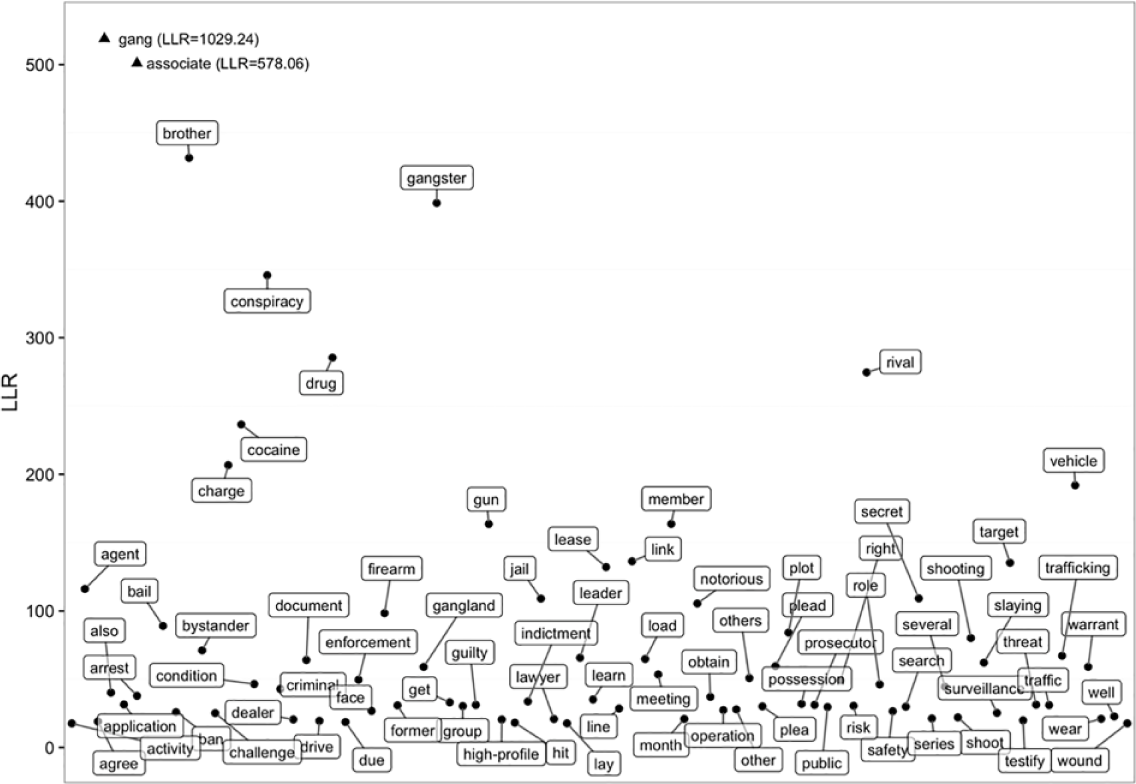
To test whether our thematic analysis resulted in the discovery of a set of reliable and consistent themes, we conducted a corpora comparison of the words used in the 401 articles on the Bacons to a reference set of articles in the Vancouver Sun. Figure 2 presents the words statistically more likely (p < .01) to be found in the Bacon corpus. We restricted our analyses to words that occurred at least 100 times across all articles.
Log-likelihood for words significantly more likely to be found in Bacon articles (p < .01).
The words in Figure 2 are statistically more likely to be present in stories about the Bacon brothers compared with stories about other homicides. These keywords for the most part appear consistent with three of the four themes identified in the thematic analysis:
Public safety risk: Keywords: target, firearm, load, bystander, safety, threat, public, risk, slaying, shoot
Sophisticated criminals: Keywords: gangster, drug, cocaine, associates, vehicle, rival, notorious, gangland, lease, conspiracy, trafficking, secret, plot, leader, dealer, series
Unfair treatment of the brothers: Keywords: guilty, criminal, challenge, conditions
Other than the fact that the word “brother” is among the most discriminant words between the two sets of articles, the keyword analysis did not necessarily point to the “family” theme. This is likely because the identification of this theme is more a matter of interpretation of journalists’ descriptions of the article, rather than due to any specific language used. Conversely, the keyword analyses reveal convincing evidence of the relative emphasis on the danger to the public posed by the Bacon brothers as well as their portrayal as sophisticated criminals. Although the theme of unfair treatment of the Bacons is not as well represented, these results suggest the Bacon brothers are described as “criminal” and “guilty” significantly more often than are offenders mentioned in most other homicide stories. Further, the keywords “challenge” and “conditions” refer specifically to complaints by Jamie Bacon about the poor conditions he faced in jail and discussion about constitutional challenges of his treatment.
Although not identified as a theme in the content analysis, the keywords analysis suggests that unlike other articles on homicide, articles about the Bacon brothers involved significantly more discussion about the criminal justice system, with words such as jail, bail, enforcement, document, warrant, indictment, surveillance, arrest. This is telling of the sustained media interest the Bacons generated. It appears to be uncharacteristic of journalists to follow homicide cases from the identification of suspects, arrest, pretrial proceedings, all the way to sentencing.
Discussion
Based on our analyses of 401 articles discussing gangsters Jonathan, Jarrod, and Jamie Bacon, our main thesis is that portraying the Bacon brothers as a unit allowed the media to organize the rapidly evolving gang conflicts in Metro Vancouver around the popular theme of crime families. This focus was timely as the police and courts—the media’s main sources of information—were also adapting at the time to new challenges associated with ongoing gang violence (Gravel et al., in press). We contend that the Bacon brothers’ role in the British Columbia gang landscape was overstated in the media due to their family relationship. The thematic analysis suggests that the media described the Bacons as a sophisticated, dangerous crime family who posed a serious safety risk to the public. These same themes were echoed in the keywords analysis. With no alternative information source available to support or disconfirm just how active and/or dangerous the Bacon brothers were in the Vancouver gang scene, the media’s presentation of the brothers became the dominant social construction.
Although there are only a few key events that resulted in criminal charges against any of the Bacons, the brothers are covered in over 400 articles, with approximately 36% published in 2009 alone. Recall that prior to 2008, only two articles made mention of any of the Bacon brothers. This is surprising considering that all of Jonathan’s and nearly all of Jarrod’s criminal charges occurred prior to 2008, and suggests that factors aside from the brothers’ criminality contributed to their media spotlight. In 2009, the year in which Jamie was arrested for his role in the S6S, the Bacons became the media’s focus despite the fact that Jamie appears to have had a small role in the incident compared with others who were involved—that is, evidence to date suggests that Jamie was involved in the planning but was not physically present at the murder scene.
The Bacons were consistently referred to as a single unit and the family aspect was frequently included (33% of the articles in our data set referred to the Bacon family in this way). Even when irrelevant to the focus of the article, the reporter would often tie in other brothers or other family members such as their parents, even going so far as to suggest the whole family was involved in the criminal activity. The Bacons were essentially portrayed as Vancouver’s home-grown crime family. It certainly contributed to the mystique surrounding the Bacons that the brothers came from a White, middle-class, and seemingly supportive family. Until the S6S, the gang landscape was described in the media as consisting mainly of youths from minority groups in the Vancouver area, and the gang “problem” was often constructed as relating to the specific conditions of these ethnic communities. The fact that on paper (or at least given the information available to and/or shared by the media) the Bacon brothers did not come from a marginal community or a dysfunctional family, yet nonetheless became violent gangsters, perhaps contributed to generate public curiosity as to how a “normal” family could go so wrong.
Given that much social knowledge is constructed using information from the media, the presentation and focus on the Bacon brothers by a prominent Vancouver newspaper is likely to have had a considerable influence on the public’s perception of gang violence in BC. During the years the Bacons were actively covered by the media, gang violence was a hot topic in the news and the constant coverage of the Bacons deemed them as leaders in the violence and gang turf wars. This is in line with the social construction process defined by Surette (2007). The media determined gang violence and the Bacon brothers as newsworthy, which then defined the brothers and the violence in which they were involved as social problems. The media favored and portrayed the construction of the Bacons as sophisticated and dangerous gangsters who were leading an upswing in gang violence, putting the public at heightened risk.
It is interesting to note that many articles mentioning the Bacon brothers were about events in which they were not involved; however, the media found a way to make some form of a connection to the brothers (e.g., to being Facebook friends with a relative of an associate of the Bacons). This peripheral addition of the Bacons to articles about irrelevant events not only kept the Bacon name in the news, but may have contributed to generalize the media’s construction of the Bacons as sophisticated and dangerous criminals to such a construction of gang members in general. Although it is certainly possible that the media correctly portrayed Vancouver’s gang scene, we are more inclined to relate our findings to those of Esbensen and Tusinski (2007) who found that the media has a tendency to overstate the organization and violent nature of gangs.
The fascination by the media may well have influenced the responses by the police and the public, which in turn influenced the story to be reported in a cyclical process. For example, the media may have overplayed the risk the Bacons posed to the public. The response to this recurring focus was public fear and the police reacting by issuing warnings regarding potential danger to those associating with the Bacons, as well as to bystanders who happened to be in their vicinity. This public safety risk then became an essential part of the story about the Bacons, which contributed to the public fear of gang violence and further sensationalized the story.
Limitations
There are several limitations to this study. The first is the subjective nature of our thematic analysis, which is inherently influenced by our own knowledge and biases. Others analyzing the same data could potentially develop themes distinct from those identified in this article. A second limitation is that we know little about the police–media relationship in Vancouver. We studied the portrayal of the Bacon brothers from the perspective of the reader. There are many different factors regarding, for instance, the production process of news stories or the investigative considerations of police departments that may have shaped how the Bacon brothers were portrayed.
The third limitation is that our data set was limited to a single newspaper. Crime reporting is often conducted by only a few journalists, as was certainly the case for the articles in our study. Some of these journalists even won awards for their coverage of gangs in Vancouver. When the entire coverage of a region’s crime is limited to only a few individuals, it is difficult to know whether this coverage is a reflection of the Media’s—with a capital M—perspective or the particular journalist’s approach to covering crime. One way to circumvent this limitation would have been to collect data from other sources (e.g., newspapers, television). Notwithstanding the fact that only one other major regional newspaper was available to us (The Province), and this paper is owned by the same company as the Vancouver Sun, we would argue that spending the necessary resources to coding of multiple hundreds more articles would not have been worthwhile. Given that The Province also has only a handful of crime reporters, collecting and coding additional articles would not have allowed us to convincingly rule out the hypothesis that the particular inclination of a given news outlet or crime reporter was biasing the results.
We do not believe that the portrayal of the Bacon brothers was much different in the Vancouver Sun compared to The Province—or another media source for that matter. If anything, the Sun tends to be regarded as a more traditional newspaper in its presentation, whereas The Province tends to be geared toward attention-grabbing headlines, which would be more conducive to the publication of sensationalist crime stories. As to other media sources, it is certainly a limitation that we focused on newspapers, rather than on more modern sources of news such as the Internet, social media, or television. Although future studies should consider these alternative sources, we believe that our chosen source of our data actually works against our main hypotheses rather than increases our chances of finding support for them. The real-time and multimedia nature of more modern news sources are much more conducive to the kind of fascination with and depiction of the Bacon brothers we describe in this article.
Conclusion
Given that symbolic realities are in part constructed using information from the media, the media’s representation of gangs and gang members is a key part of the public’s perception and knowledge. Combining the stories of Jonathan, Jarrod, and Jamie Bacon, and occasionally that of their parents and extended family, enabled the media to organize the elements of an ongoing gang war. This proved especially useful when the courts started issuing publication bans surrounding the S6S, as it allowed the media to piece together elements of a story that involved betrayal, revenge, guns, money, and drugs that led to the province’s deadliest shooting. To this day, the S6S shooting and much of the gang violence that followed is in one way or another traced back to the Bacon brothers’ decision to join the RS and the ensuing rift between the RS and the UN gangs. The Bacon brothers are ingrained in the media’s understanding of the gang landscape, and their relevance is still highlighted today even though Jonathan was killed in 2011, and Jamie and Jarrod have been in prison since 2009 and 2012, respectively. Jamie’s recent court appearance in September 2016, in which his trial date was further postponed, had spectator and media lineups out the courtroom door.
Were the Bacon brothers as important players in Vancouver’s gang landscape as the media portrayed them to be? We may never know for sure. What our research indicates is that the brothers were extremely important in helping the media make sense of the complex social problem of gang violence by anchoring it to the familiar notion of the sophisticated crime family. One reason we may never know the real importance of the Bacon brothers is that in the absence of any serious academic research on gangs in Vancouver, the police and the courts are the only source of information available. We have shown that in some cases—as in the police’s unusual public warning against associating with the brothers—actors of the criminal justice system played a direct role in reinforcing the image created by the media of the Bacons as glamorous, powerful players in Vancouver’s gang landscape. To be clear, we are in no way suggesting that the police or the courts misrepresented or purposefully misdirected the public and the media. However, we do contend that the image of the downfall of a crime family doubles as a cautionary tale that the glamorous lifestyle youths may see in gangs will never save gangsters from their inevitable demise—if not by death, certainly at the hand of the law. This image is both a satisfying parable for the public as well as a useful example for police to call on whenever additional resources are deemed necessary to contend with gangs. The police and the courts have little incentive to dispel the powerful images the media evoke by bringing up the doomed fate of familiar gangsters.
Footnotes
Declaration of Conflicting Interests
The author(s) declared no potential conflicts of interest with respect to the research, authorship, and/or publication of this article.
Funding
The author(s) received no financial support for the research, authorship, and/or publication of this article.