




Abstract
This yearlong ethnographic case study investigated higher and lower track adolescents’ experiences with core content-area (social studies, science, and math) writing in one urban working-class district. Teacher, student, and administrator interviews; field notes; and students’ written work comprised the data set. The findings from this study, framed by sociocultural theory and Bourdieu’s theory of practice, suggest that higher and lower track students experienced disciplinary writing in distinct ways in terms of the expectations for the kinds and complexity of writing and the importance placed on writing in content learning. These contrasting experiences affected the quality of students’ preparation to engage in advanced disciplinary discourse as they progressed through secondary school. The findings from this study are discussed in light of the increasing emphasis on disciplinary writing at the secondary level.
Prelude
She [the teacher] started out with a metaphor about how her 11th grade regular [lower track] students have trouble writing. She’s trying to get them to build a hut. All she wants is a roof, walls, and maybe a door. And then she showed a huge big mansion thing she got off the Internet and she said, “This is what I want you to write.” (10th-grade higher track student interview)
In this excerpt from an interview with Sarah (a higher track 10th-grade student in an urban working-class school district), differences in expectations for writing depending on which track a student was placed is made clear. The focus of the current research is on how teachers conceptualize the value of writing in their disciplines, how messages about what is important in writing are translated into instruction in higher and lower track content classrooms, and the effect on adolescents’ preparation to engage in advanced disciplinary discourse as they proceed through secondary school.
Introduction
Over the past few decades, adolescents’ writing performance has been identified as an area of particular concern (Graham & Perin, 2007; Salahu-Din, Persky, & Miller, 2008). The results from the most recent administration of the National Assessment of Educational Progress (NAEP; National Center for Education Statistics, 2011) writing test indicate that with regard to persuasive, explanatory, and narrative writing (those genres required on the exam), only 24% of 12th-grade students scored at the proficient level (described as the ability to accomplish the communicative purpose of writing). These results suggest that the majority of high school graduates do not exhibit the ability to accomplish the communicative purpose of their writing in these genres by the time they are close to graduation from high school. While these results are discouraging, even more problematic are the persistent gaps in writing performance among certain subgroups of students. While gaps have narrowed between some subgroups at the 12th-grade level (e.g., between males and females) since the last NAEP writing assessment in 2007, students from lower income homes (indicated by eligibility for free or reduced-price lunch) and some ethnic and linguistic minority groups (e.g., African American, Hispanic, English learners) continue to score significantly lower than native English-speaking Whites and students from higher income homes. Such patterns have been found to relate to narrowed and what some might characterize as impoverished instruction in lower track classrooms that are dominated in many urban schools by high percentages of low-income and ethnic and linguistic minority students (Wilcox, 2011; Callahan, 2005; Darling-Hammond, 2010).
These achievement gaps are important because in recent years, writing has been recognized as an important component of preparing middle and high school students to engage in the more advanced discipline-specific discourse required in and beyond high school (Brown & Conley, 2007; D’Agostino & Bonner, 2009). Meta-analyses have underscored the importance of writing for content learning, noting that “about 75% of the writing-to-learn studies analyzed had positive effects” (Graham & Perin, 2007, p. 20). In addition, positive relationships between writing and reading performance, and writing and content learning, were also found in recent meta-analyses (Bangert-Drowns, Hurley, & Wilkinson, 2004; Graham & Hebert, 2010). Furthermore, research has indicated that developing students’ abilities to successfully perform these tasks during adolescence can have a considerable impact on their academic trajectories (Applebee & Langer, 2009, 2011; Author, 2011; Graham & Hebert, 2010; Graham & Perin, 2007; MacArthur, Graham, & Fitzgerald, 2006). In light of these findings, the Common Core State Standards (Council of Chief State School Officers & National Governors Association, 2010) outline an ambitious agenda for writing in the core disciplines of social studies, mathematics, and science. These standards, among other things, emphasize developing students’ abilities to support claims, examine and convey complex ideas clearly and accurately, produce writing appropriate to different purposes and audiences, and draw evidence from literary or informational texts to support analyses.
Related Research
Beyond Basic Skills: Writing Instruction for Differently Tracked Adolescents
How writing instruction is approached among content teachers working with different populations of students has been found to be related to perceptions of what the purpose of writing instruction should be (Ackerman, 1993; Bangert-Drowns et al., 2004; Boscolo, 2001; Close, Hull, & Langer, 2005; Newell, 1984; Williams, 1977). For some teachers, the purpose may be to develop writing skill to communicate ideas clearly and according to the norms of the language in terms of syntax, mechanics, and so forth (learning to write); for others, it may be to use writing as a tool for learning content and ways of thinking about content (writing to learn). What we know from studies of skill-based approaches intended to enhance lower achieving students’ writing quality is that such approaches are insufficient in developing advanced disciplinary writing aptitudes and dispositions that require adaptation and negotiation of rules to suit complex situations (Graham & Perin, 2007; Langer, 2001; MacArthur et al., 2006).
A number of studies have indicated that students’ achievement track is related to whether a skill-based approach is used and also to the kinds of writing tasks assigned. Oakes (1985) and Page (1991), for example, found that in English and social studies higher tracked classrooms students were evaluated on more expository writing tasks and given more homework requiring some writing than their peers in the lower tracks. In addition, these studies showed that lessons incorporating writing in the lower track classrooms were planned based on simple texts and required only basic understandings of text structure in terms of argument, while those in the higher track classrooms emphasized “critical thinking, problem solving, drawing conclusions, making generalizations, evaluations or synthesizing knowledge” (Oakes, 1985, p. 76).
Watanabe (2008) extended Oakes’s (1985) research by analyzing English teachers’ instructional patterns across tracks in the context of high-stakes assessment in her ethnographic case study of urban middle school classrooms. She found that students in the lower track English classes had fewer opportunities to perform cognitively demanding tasks in writing such as explaining, justifying, generalizing, analyzing, and synthesizing. Instead, they were limited to writing essays of only a few paragraphs for their assessments. She also found that lower track students were taught a narrower range of composing skills such as those focused on organization and using appropriate conventions seen as crucial to higher scores on high-stakes tests.
Much of the previous research on the explicit teaching of disciplinary genres has found positive impacts on lower and higher achieving students’ writing, the learning of content, and the development of complex higher order thinking about content (Applebee & Langer, 2006; Davis, Clarke, & Rhodes, 1994). Yet few studies have closely examined the relationships between track placement and adolescents’ content-area writing development that might inform implications for practice intended to improve lower achieving students’ writing. With the increased emphasis on writing in the content areas embedded in the national movement toward the Common Core State Standards (2010) in U.S. classrooms, it is important to ask what the conditions for disciplinary writing are for adolescents and where opportunities for improving instruction for those students who are in lower academic tracks might exist.
Beyond Huts: The Role of Writing in Disciplinary Learning
While there is a substantial body of literature regarding the teaching and learning of writing in general, a growing number of researchers have focused their investigations on what is unique to the teaching and learning of writing within the core disciplines of social studies, science, and math. These studies explore what ways of thinking about content are embedded in disciplinary genres and explore instructional strategies that might scaffold these ways of thinking for adolescent learners. For example, researchers interested in writing in the social studies have focused on the ways historical thinking as interpretation of events rather than explanation of “truths” might be supported through source-based writing tasks (Wineburg, 1991; Wineburg & Martin, 2009). This approach, discussed in a study by Wineburg, Martin, and Monte-Sano (2011), is based on the idea that advanced historical thinking (e.g., the ability to contextualize past events to avoid presentism) can be prompted by writing activities that encourage students to contextualize their understandings through the analysis of multiple historical texts. A recent study of the effects of different prompts on students’ social studies writing suggested that when students are given source-based tasks that require corroboration of evidence and causal analysis, students’ essays are superior in terms of showing complex (i.e., contextualized) thinking about history (Monte-Sano & De La Paz, 2012). This line of inquiry provides some insight into the relationships of writing prompts and task structures and the kinds of advanced thinking about historical content they might promote.
Some studies have also suggested that certain kinds of writing tasks can have positive impacts on the qualities of adolescents’ thinking about science content (Hand & Prain, 2002; Metz, 2006; Porter et al., 2010). A particular genre, the laboratory report, has been of interest to some researchers as it is a common type of writing teachers require of secondary-level students. In one study of eighth-grade students’ experiences with writing lab reports, Keys (2000) revealed that although students generated hypotheses, examined patterns in data, and made general knowledge claims in response to the task of a lab report as they were explicitly instructed to do, the fixed structure of the task also constrained students’ deep thinking into scientific problems. This is problematic because, as discussed in a report commissioned by the National Academy of the Sciences and the National Science Foundation, one of the purposes of the laboratory experiment is to promote an understanding of the complexity and ambiguity of scientific knowledge (National Research Council: Division of Behavioral and Social Sciences and Education, 2005). In alignment with this recommendation, Hand, Wallace, and Yang (2007) in another study sought to identify the outcomes of infusing seventh-grade science laboratory instruction with science writing heuristics (prompting students to ask such questions as, “What are my questions?” “What did I do?” “What did I see?” “What can I claim?”). The results of their analysis of students’ retrospective accounts of writing in response to these questions as part of their laboratory report task suggest that such an approach positively affected students’ understandings of the rhetorical features of a scientific claim and argument and that such writing enhanced their learning of the science content. This research draws attention to the potential of scaffolding writing tasks through the use of heuristics to encourage both better writing and deeper thinking about scientific inquiry.
As in social studies and science, there has been increasing acknowledgment of the value of writing in the field of mathematics education. Morgan (1998), decades ago, argued that learning mathematics is about investigation and that writing should be applied in math class to elicit such investigation. Studies of the types of writing done in math classes suggest that it is a useful tool for learning for both higher and lower achieving students (Baxter, Woodward, & Olson, 2005; Gibson & Thomas, 2005). Furthermore, one recent study (Steele, 2005) suggested that the incorporation of writing into mathematics lessons is correlated with more advanced conceptual knowledge and, in a mixed-method dissertation study, Reilly (2007) found that students generally had positive attitudes toward writing in math class and that this was particularly true for lower achieving students.
These studies suggest that writing can be used to do much more than evoke “huts”—skeletal and basic structures of understandings of disciplinary content, but rather can afford students’ entrées into ways of thinking in complex and discipline-specific ways and pathways for participation in advanced disciplinary discourse.
Theoretical Orientation
The study was informed by sociocultural theory and also drew on Bourdieu’s (1991) theory of practice in that the focus of attention was on how opportunities to engage in academic writing might be understood as an affordance for adolescents to develop linguistic capital—competence to use language in ways that are legitimated and valued in the marketplace of society. The works of socioculturalists such as Vygotsky (1962, 1978) highlight the ways domains of knowledge offer tools, practices, motivations, and epistemologies by and through which individuals engage in different aspects of social life. In this view, learning to participate in disciplinary discourse, including disciplinary writing, is part of becoming a member of a discourse community. In research on writing, this perspective translates into a view that opportunities to write in certain ways and for different purposes go beyond meeting an immediate need to exhibit competency of a discrete skill or show understanding of content knowledge but extends to opening up opportunities to actively engage in knowledge transformation within and possibly across disciplinary communities (Chuy, Scardamalia, & Bereiter, 2012). Extending this vision, and through a Bourdieusian lens (Bourdieu, 1993), teaching students to produce writing in a content classroom would not simply be seen as the transmission of procedures, but rather would frame writing as a reflexive process of positioning and repositioning oneself in a larger social and cultural tradition in which disciplinary writing and its corollary, disciplinary thinking, affords the opportunity to accumulate social capital of which linguistic capital is part. Sociocultural theory, complemented by a Bourdieusian lens, focuses this inquiry on how the context for writing instruction in tracked classrooms has the potential to reflect and also construct societal inequities by affording some students more opportunity than others to develop the legitimated and valued linguistic capital of advanced disciplinary discourses.
In light of this important distinction, the overarching goal of this study was to identify contrasts that might exist between the writing experiences of adolescents in higher and those in lower track content classrooms and in so doing reveal any potential constraints, real or perceived, that might be related to the pervasive problem of poor adolescent writing performance. This study was guided by the following questions: (a) What kinds of writing are valued in content-area-tracked classrooms? (b) What kinds of writing do adolescents in different content-area-tracked classrooms do? (c) What are the qualities of writing instruction offered in different content-area-tracked classrooms?
Method
This case study was embedded in the National Study of Writing Instruction (NSWI), which examined the ways writing is being incorporated into the core academic disciplines in a variety of school contexts. The broader study sought to characterize how the writing experiences of students from different socioeconomic, cultural, and linguistic backgrounds might differ and included a phase in which 3-yearlong case studies of schools in different contexts (urban, suburban, and rural) were studied. Case study was chosen because it facilitates the thick description of the ways individuals engage in day-to-day activities situated within sociocultural contexts (Grenfell et al., 2012; LeCompte & Preissle, 2003).
Setting
This present study was conducted in Grades 8, 10, and 12 in a middle and a high school urban working-class district categorized by the state as “high need” indicating 50% or more of the student population qualified for free or reduced-price lunch. The schools in this district, referred to here as “Skansen Middle School” and “Skansen High School” (pseudonyms) were chosen as the sites for this research because the patterns of subgroup achievement and dropout are typical of other urban schools with similar demographic characteristics (National Center for Education Statistics, 2011).
Participants
At the beginning of the year of data collection, I worked with the English department chair/team leader to gather nominations for focal students at each grade level. Four focal students at each of the target grades in each school were chosen, in consultation with the English department leader, to represent higher and lower achievement according to school norms. Affirmative consent and assent for participation were obtained from parents and focal students, and anonymity was ensured through the use of pseudonyms. Table 1 summarizes the student participant sample.
Student Participant Characteristics and Track Placement.
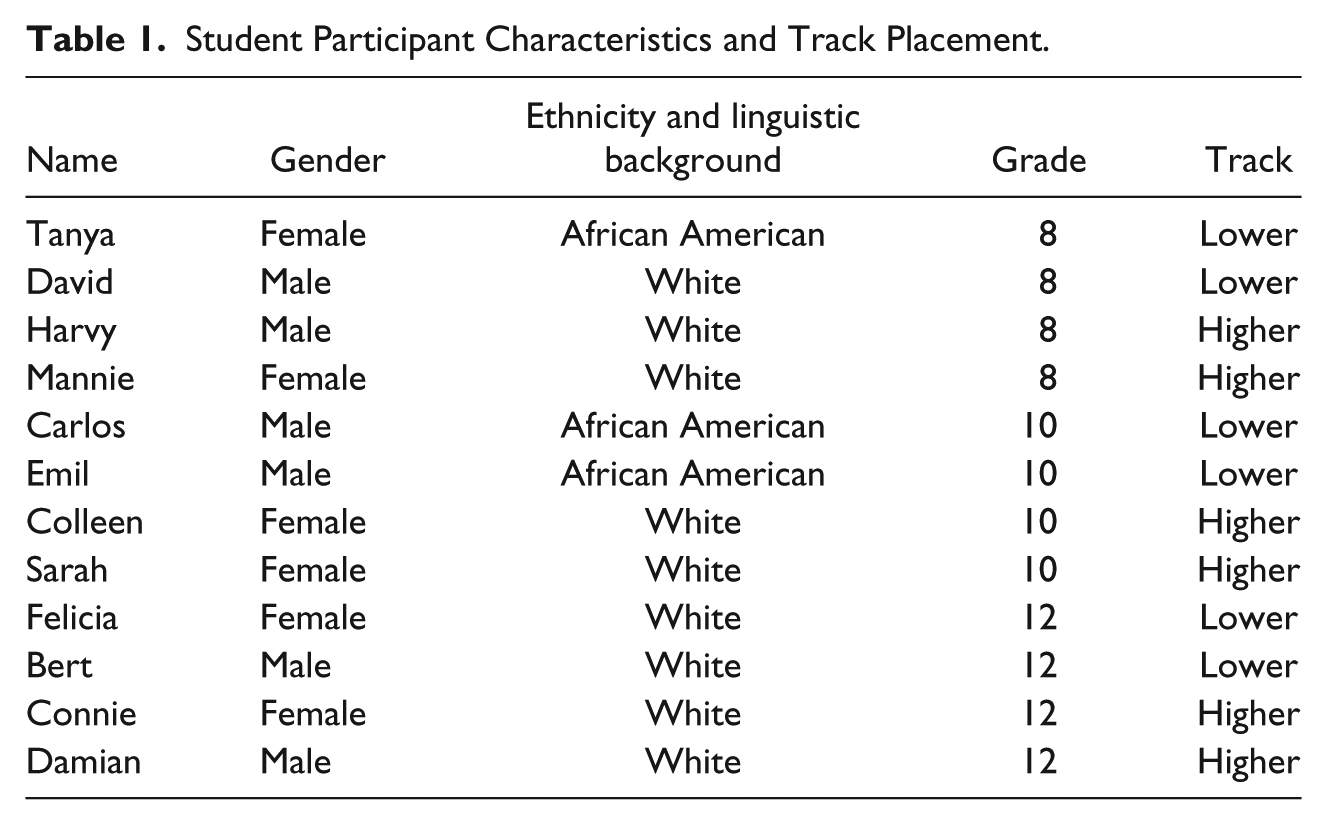
In collaboration with the site coordinator, I also scheduled observations and interviews with administrators and with selected teachers at each of the targeted grade levels in each of the core academic subject areas of social studies, science, and mathematics. Teachers who volunteered for interviews and observations tended to be ones who felt that writing was of some importance within their subject area. Administrators selected for interviews were those in leadership roles (e.g., assistant superintendent, district curriculum coordinators, school principals, school curriculum coordinators). Interviews with students were scheduled at the end of each term (~December and June), and teacher and administrator interviews as well as classroom observations were scheduled throughout the school year.
Data Sources
Interviews
As this study sought to characterize educator and student experiences with content-area writing, a series of semistructured interviews were used to gather data on a variety of aspects of curriculum, instruction, and the general context for writing and writing instruction. Each section of each interview consisted of a general question to begin the conversation and a series of more specific questions that could be used if needed for follow-up. Questions in the administrator interview focused on school and district perspectives on the importance of writing across academic subjects, initiatives to support writing instruction, the extent to which there is a school- or district-level sense of what high-quality writing looks like, modifications in scheduling or tracking that might affect writing instruction, changes over time in school or district support for writing, and perceptions of student performance. Questions in the teacher interview focused on each teacher’s perspectives on the importance of writing in their subject, school or department initiatives to support writing instruction, the types of writing that are important in the subject area, the amount of writing students do, the teacher’s approaches to writing instruction, attention to the writing process, the role of technology, quality of and response to student work, the effects of school-level factors (scheduling, tracking, special services) on writing instruction, and changes over time in student writing and writing instruction. The student interviews were built around the portfolios of work that had been collected from each student throughout the semester. Specific questions focused on self-perceptions as a writer, the kinds of writing for different classes, the completeness of the collection of work in each subject, favorite and least-favorite assignments during the semester, steps in completing writing assignments for each subject area, preparation for state or national exams, uses of technology in each subject area, criteria for “good” writing in each subject area, and subject-specific instruction in different types of writing. A total of 16 individuals with administrative and/or teaching responsibilities were interviewed. In addition, 12 students participated in interviews twice during the school year resulting in a total of 24 student interviews collected for this study.
Observations
Classroom observations occurred at least twice a week in the period from September to June. During these visits, I gathered field notes utilizing a laptop to record instances of writing and writing instruction in content classrooms. An open-ended protocol was used to focus the notes on rich description of any activities and discussions that involved writing. After each observation, a teacher debrief was conducted, which focused on the purposes of the lesson, the role of writing, planned versus actual activities, levels of student engagement perceived, things that in hindsight might have been done differently, and what would come next for this class. Observational field notes of 18 classes in different content areas were collected.
Documentary evidence
In addition to classroom assignments, tests, and quizzes, I also collected students’ written work from all their core subject classes on a weekly basis. These pieces of written work (n = 1,336) were stripped of identifiers and categorized by content area and length.
Data Analysis
Field notes and interview data were coded using NVivo qualitative research software (Researchware, n.d.) using the constant comparative method (Miles & Huberman, 1994). The coding began with the following a priori categories: broad goals for writing, conceptualizations of writing and the discipline, district/school context (e.g., initiatives), approaches toward instruction (e.g., explicit teaching), kinds of writing in the content area (e.g., lab report), uses of writing (e.g., informational), and student and teacher perspectives on writing. In addition, each piece of written work was coded by content area, type of writing (e.g., short answer, essay, report), and length of writing. After the initial coding of field notes, interview data, and written work was completed, axial coding was used to further organize the data by content-area categories (i.e., math, science, social studies) and by categories of higher and lower track to capture any contrasts in the nature of instruction and the kinds of writing tasks in which students in different tracks engaged.
To ensure the credibility of the findings, throughout the study, I kept memos of developing interpretations of the data and shared them with the study team on a monthly basis. In the final analysis, these memos and data in the forms of observation field notes, interviews, and student work were triangulated to facilitate what Yin (2005), on case study method, refers to as “convergence of evidence” (p. 105). The entire case study was shared with the research team and also member-checked with educators in the schools studied.
Findings
While the analysis of students’ written work did not reveal any significant differences in the quantities of writing students in different tracks produced (see appendix), their work, interviews, and the classroom field notes highlighted differences in the qualities of writing emphasized in instruction in the higher and lower track classrooms. These differences were most pronounced in social studies classrooms and to a lesser extent in science and mathematics classrooms where there was little demand for writing requiring composing of more than a paragraph in both higher and lower track classes. In the next section, I describe the kinds of writing students experienced in each content area and draw attention to notable contrasts in writing instruction in higher and lower track classrooms.
Writing in Social Studies Classrooms
In social studies you’ve got to have content knowledge. It’s got to be there, but they [students] have to be able to understand the genre they’re writing in and then what makes the genres different. Constructed Response: What does it mean to be concise and accurate in a Constructed Response? How many details are enough? All kids have trouble giving enough supporting details, but you don’t have to teach them to identify supporting details. We need to teach them to pick up the details and put it in the writing. Nine out of ten of the teachers would hammer identifying supporting details. That’s not the root cause of the problem: The teachers of social studies would say they [students] didn’t know the facts, but in fact students didn’t have the skills to incorporate them. (District administrator interview)
The district administrator interview excerpt above captures a few of the important themes brought out in previous research investigating what is unique to social studies writing in terms of its emphasis on providing corroboration of evidence around historical content and the importance placed on incorporating supporting detail in the analysis (Monte-Sano & De La Paz, 2012). This excerpt also points to some of the challenges Skansen social studies teachers faced in helping lower achieving students go beyond identifying details around content or essentially transmitting knowledge (Berieter & Scardamalia, 1987) to composing extended essays and reports that required analysis and synthesis, making claims and supporting claims with evidence in well-organized prose.
One of the major foci of instruction in both higher and lower track social studies classrooms observed in this study was on providing assistance to students in writing document-based questions (DBQs) and constructed response questions (CRQs). These tasks require students to glean evidence for an argument from more than one historical text and, in the case of CRQs, to draw on their own background knowledge. Teachers scaffolded these tasks by breaking them down into multiple steps with specific procedures for using charts (like the “doc box”—a kind of graphic organizer noted in Figure 1) to facilitate composing. Explicit directions were given to students as seen in higher track eighth-grade student Mannie’s notebook.
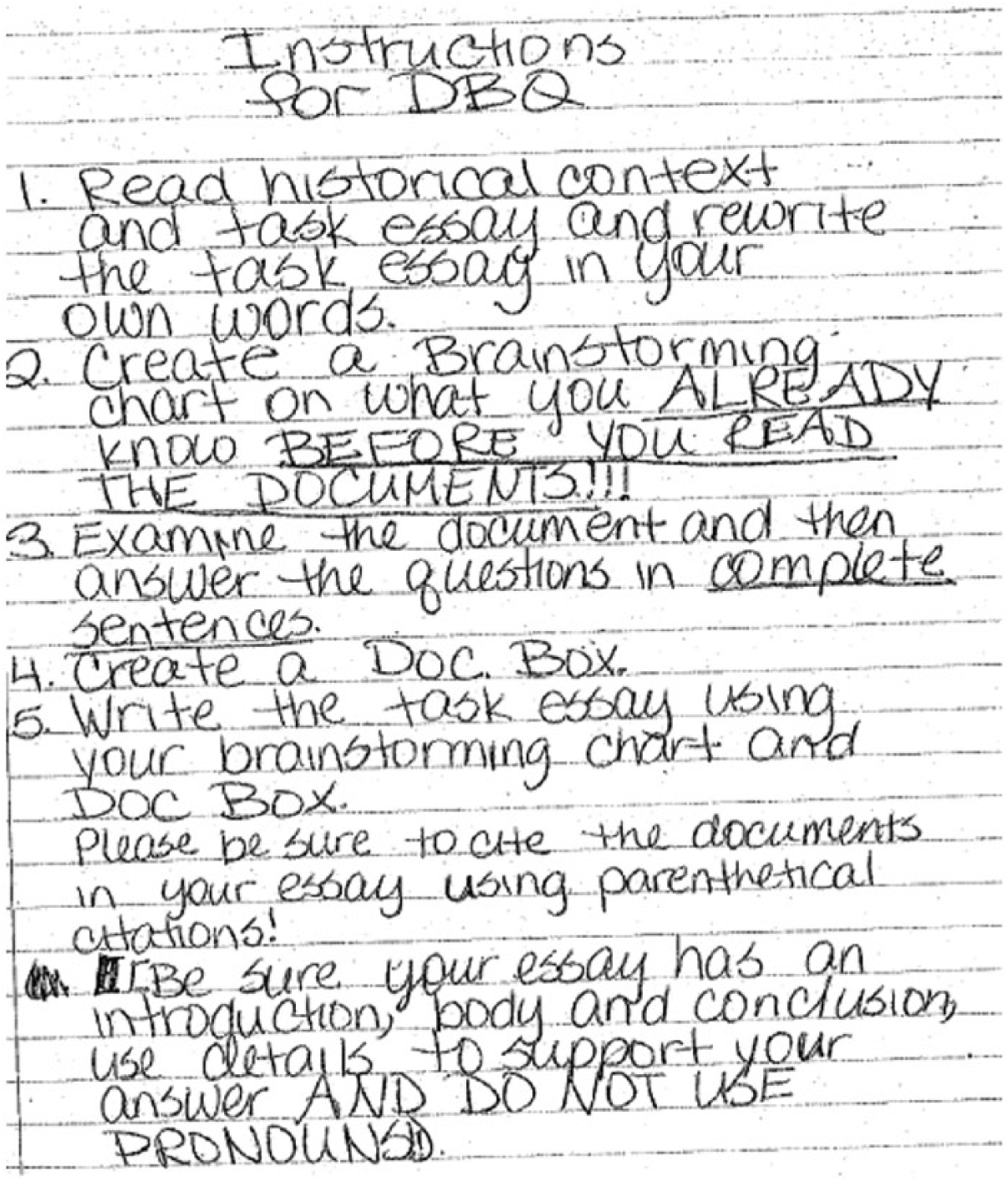
Mannie’s social studies notes (eighth-grade higher track).
As this example illustrates, students were given directions to do “analysis” and identify “point of view” when writing a DBQ and CRQ. However, students were also asked to go beyond “discussing” the content and show their “reasoning” and “make an argument.” In addition, middle school students were expected to construct complete sentences, cite documents, and write an introduction, body, and conclusion. They were also instructed to pay close attention to details including names of places and people as these were considered important evidence of content knowledge. At the high school level, students in both higher and lower tracks continued to be tasked with writing DBQs and CRQs in preparation for the state’s high-stakes exam. A DBQ question at the 10th-grade level (see Figure 2) differed from 8th-grade DBQs in terms of both the organization and complexity of thinking expected.
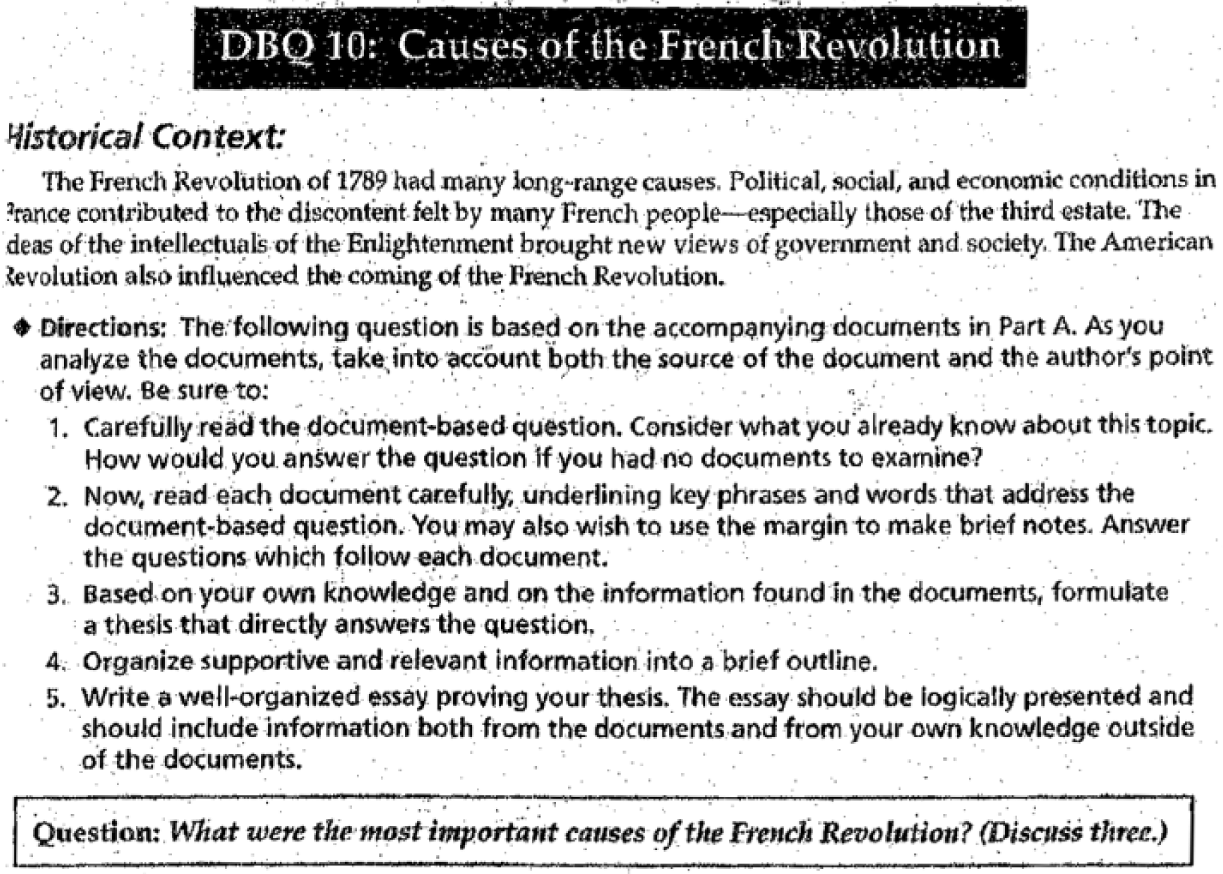
10th-grade document-based question.
Like in 8th-grade DBQ assignments, 10th-grade students were tasked with analyzing historical documents taking into account the “point of view.” However, rather than being directed to provide an introduction, body, and conclusion as in 8th grade, the task is framed as requiring a “logical presentation.” The 10th-grade DBQ also extended beyond what was asked of 8th graders by encouraging students to use their “own knowledge” and formulate a “thesis.”
Contrasts in Higher and Lower Track Writing Instruction in Social Studies
Although the requirements to produce DBQs and CRQs held for all students in all tracks from middle through high school, the instruction that surrounded this writing and the kinds and qualities of the writing receiving the most emphasis differed in the higher and lower track classrooms. At the 8th-grade level, teachers reported that excellent writing for social studies starts to look “analytical” and how analytical a student’s writing was related to his or her track placement. As one teacher explained, “students who show analysis in their writing will be able to be tracked into Honors social studies in 9th grade.” When asked about their challenges in teaching writing in social studies, middle school social studies teachers saw the major challenge of instruction with lower achieving students lying in finding ways to help them “make the leap from the concrete and basic facts to synthesizing and analyzing rather than showing rote content” (social studies teacher interview). These challenges continued through high school and informed different emphases in instruction as explained by one 10th-grade teacher in the following excerpt.
I would give them an essay. For example, we just finished the Renaissance. I will have them make a grid and fill in the information. For the Regents class [lower track], I would have them do the grid. I would look at it and give it back to them. I would look at their notes and talk about note-taking: not writing full sentences and brainstorming. I would then give this back to them and have them write it [an essay]. In Honors [higher track], I don’t have to do all that. They will do it on their own. (10th-grade teacher interview)
Social studies teachers generally held an expectation that the higher track students at the high school level would have internalized many of the steps in the writing process and have a firm grasp of essay organization, leaving more time for feedback on the content of their writing. In contrast, lower track students were given more class time for prewriting and more support through the stages of composing essays and less emphasis on the content of their writing in feedback. Students such as Bert, a lower track 12th-grade student, attested to the relatively low importance placed on the thinking about content he showed in social studies writing. He explained that his social studies teacher’s emphasis of instruction and feedback on his writing was focused on “vocabulary and if you answered the question, spelling and grammar.” Felicia, another 12th lower track student explained that she did little extended writing in her social studies classes other than the required test preparation for DBQs and CRQs leading up to the 11th-grade high-stakes exam and that writing assignments in class usually required no more than a paragraph.
Writing in Science Classrooms
Although there was little evidence of extended writing of a page or more in any science class, science teachers in higher tracks did show evidence of placing importance on writing to evaluate, persuade, summarize, synthesize, and analyze. They also placed importance on the use of science-specific vocabulary. Echoing previous research on science writing, this study revealed tensions in teachers’ desire to use writing to encourage deep thinking about science while still ensuring that all students were able to express correct science content on assignments, quizzes, and exams.
Contrasts in Higher and Lower Track Writing Instruction in Science
We have done around 15 portfolio pieces. Most of them we have to read and then do a worksheet on some of them. We have to write complete sentences to answer questions. When the lower class had a worksheet, we had an essay. We do more work, extra assignments, and different portfolios. (Eighth-grade higher track student interview)
As expressed in the excerpt above from an interview with Harvy, an eighth-grade honors student, he and his classmates were generally given more writing assignments than their peers in the lower track class with the expectation of “complete sentences.” These assignments were in the form of “portfolios.” One example of a portfolio assignment Harvy did for his honors science class was the following:
Read the article from the October 26, 1998 issue of U.S. News and World Report entitled “The Battle was Lost in a Zone of Silence” by Brendan I. Koerner. (1) Explain the main thesis (the main idea) of the article. (2) Do you think that this is a plausible theory? (3) What do you think about the author’s investigations and how science and history have been combined here? You should have a minimum of three paragraphs. (Eighth-grade higher track student interview)
This assignment called for higher track students to draw on their understandings of the rhetorical patterns of an informative piece of writing, including what a thesis is and how a thesis is supported in a coherent three-paragraph essay. Students also needed to show they understood content-specific ways of communicating knowledge including identifying a theory and evaluating that theory. To do this task, Harvy and his classmates needed to be able to analyze the article to locate the thesis, identify and use examples from the article to support their justifications of whether they thought the theory was plausible or not, and evaluate the relationships between the investigation and historical events. Harvy received an A on this assignment displayed in Figure 3.
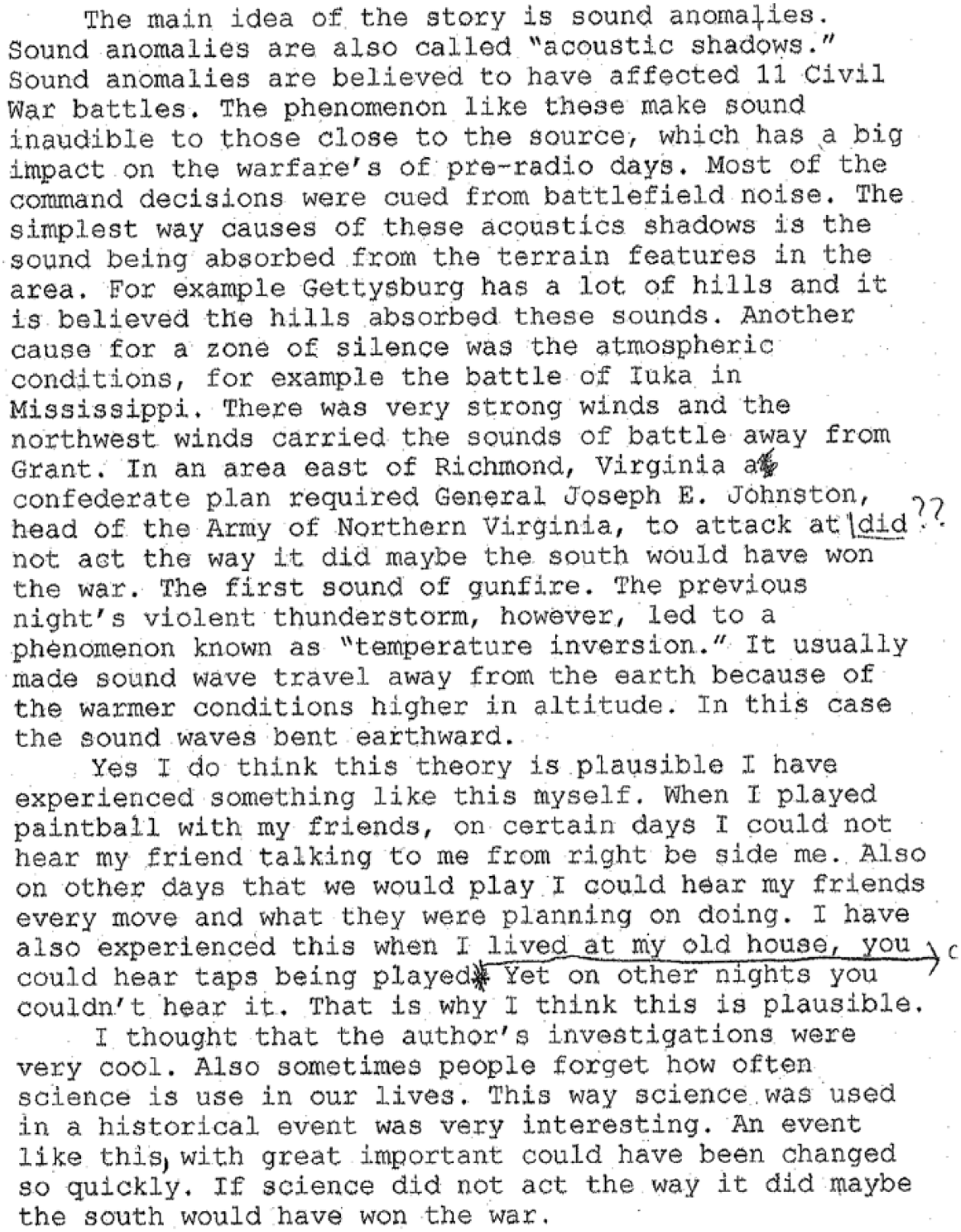
Harvy’s science portfolio assignment (eighth-grade higher track).
In completing this task, Harvy identified the thesis in the first sentence and then explained the scientific concept central to the piece. He integrated information from his own experience to relate the ideas in the reading (“I do think this theory is plausible I have experienced something like this myself”) and to evaluate the plausibility of the author’s thesis. He also showed his knowledge of paragraph structure by using a thesis statement, providing support, restating (as in “That is why I think this is plausible”), and providing a closing (“If science did not act the way it did maybe the south would have won the war”). Honors students, like Harvy, saw “putting it together” or synthesizing science concepts and adding in their own evaluations of what something meant as very important in their writing and factors that affected their grades.
In contrast, one of the greatest emphases of instruction teachers pointed to, in working with lower track science students, was using science-specific vocabulary in writing. At the middle school level, it was typical for science teachers to make explicit attempts to broaden lower track students’ science vocabulary. As one science teacher explained, “I ask them about word derivations. Where does this word come from? Converge and diverge for example. I’ll read a poem to increase vocabulary. Their [lower-tracked students’] vocabulary is lousy.” As was evident in the writing collected, much of the writing lower track students did in science was in the form of note taking of science vocabulary. When asked to describe the kinds of writing she was asked to do in her science class, lower track eighth-grade student Tanya explained,
We just usually write notes. He [the teacher] has the overhead projector sheets that he puts up on the thing and we copy it. We have quick reviews; they are work sheets about the same thing as social studies—it’s on the chapter and there are multiple choice, fill in and short answer questions.
The majority of science writing examples from Tanya were in the form of notes or short answers. The one portfolio assignment (seen in Figure 4) Tanya completed was like higher track Harvy’s in that it was based on a prompt from a reading, but that is where the similarities end.
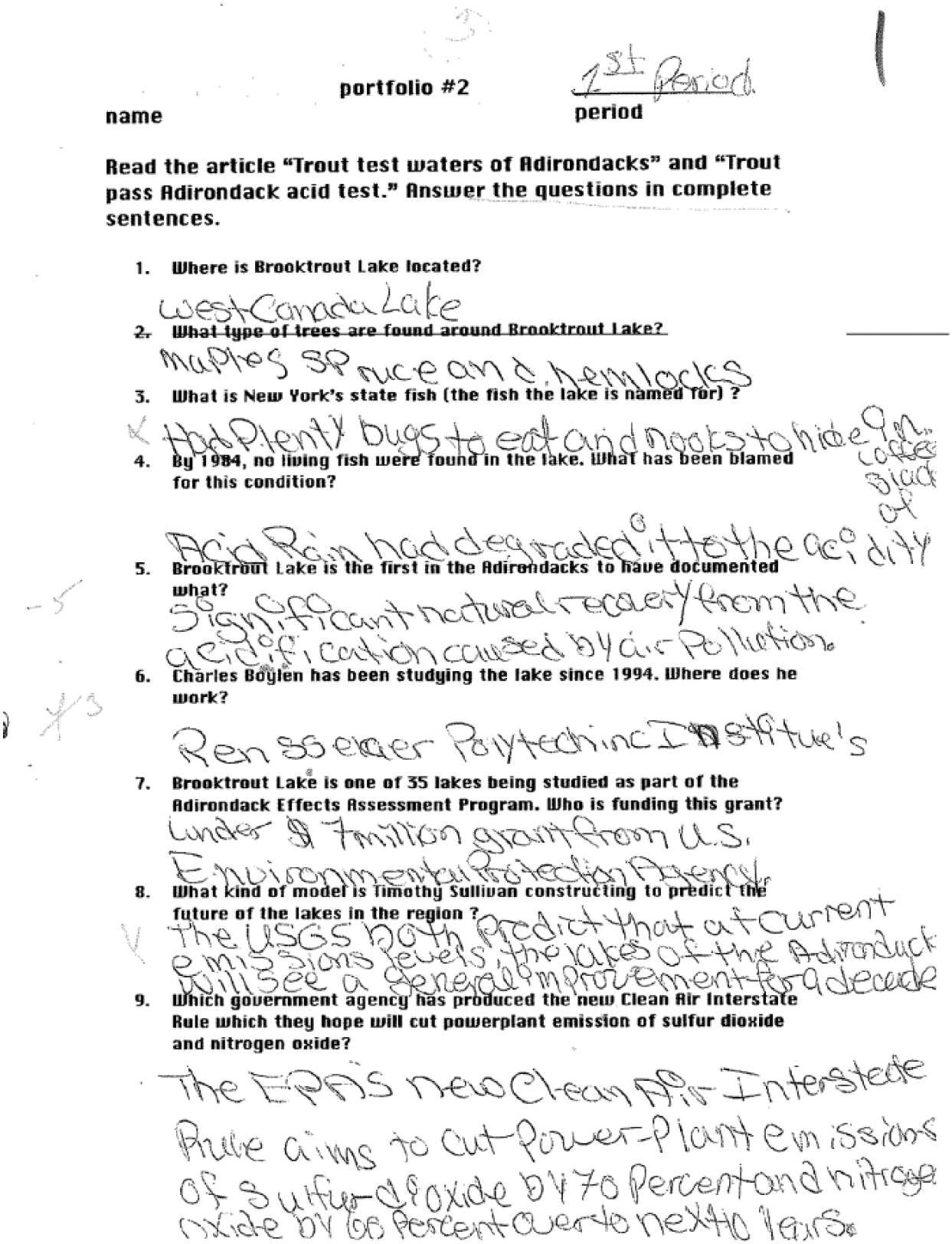
Tanya’s science portfolio assignment (eighth-grade lower track).
Tanya explained that what was important in this assignment was “getting the answer right,” not on how she expressed her understandings in writing.
Writing Instruction in Math Classrooms
While the research literature indicates that to advance math understandings, students should be encouraged to approach math as investigation, and writing about one’s thinking through that investigation can be helpful (Baxter et al., 2005; Gibson & Thomas, 2005), there was little evidence of this approach in Skansen. For instance, in the high school, most writing in eighth-grade math was done in the form of copying notes word for word for much of the class period. In math class, teachers typically worked out problems on the blackboard or overhead and students followed along taking notes on what the teachers were saying and writing. However, it is important to note that some writing around problem solving that required composing of a paragraph or more was incorporated into instruction in both higher and lower track classrooms. This was in direct response to the requirement for explanations of problem solving on the state’s high-stakes exam (see an excerpt from Harvy’s notebook in Figure 5).

Harvy’s math notebook (eighth-grade higher track).
36. I did. It can’t be negative so the squared number needs to be bigger then 35 then I guessed and checked. 32. I was guessing and checking. I just got it and it works. Wrong—go into factoring to get the answer.
In the Figure 5 example, Harvy, a higher track eighth-grade student, explained that he used his understanding of positives and negatives, squaring, and factoring to guess and check his answers. In this way, he articulates his understanding of core concepts in math and the steps he takes in using this concept to solve problems. This required him to interpret what operations the problem requires, make estimates based on his knowledge of how numbers behave (e.g., negative and positive), and confirm his answers through analyzing the results. This kind of writing was brief and infrequent in both middle and high school math classes and in both the higher and lower tracks. In general, other than copying notes and occasional explanations of problem solving in notebooks, teachers expressed that they required very little writing in math, some because it was not strongly emphasized on the high-stakes exam and therefore was not a priority, and others because they did not feel they knew how to teach writing in math well.
Contrasts in higher and lower track writing instruction in math
A notable difference between the instruction in lower and higher track math classrooms was in the emphasis on reading word problems and justifying an answer. In Carlos’s lower track Algebra class, for example, the teacher spent more time on reading word problems and expressing problem solving in writing than in the higher track classes because she believed that the lower track students needed more support in this area. She explained,
They [students] need to read the word problems, solve them, check answers . . . write a short statement—like, “the milk shake costs . . .” but when we review for the final there are a lot of problems when they have to justify. (10th-grade teacher interview)
The relationships of reading and writing skills and math problem solving become quite evident in the mathematics data analyzed in this study in that Skansen students who struggled interpreting math problems and justifying their answers in written text tended to be placed in the lower track classrooms in 8th grade. From there, they tended to advance more slowly in math, oftentimes not meeting the state’s algebra requirement until 10th or 11th grade in contrast with their higher track peers meeting this requirement in 8th or 9th grade.
Discussion
Based on the most recent findings from the larger national study in which this study was embedded, secondary students in U.S. schools are doing more writing in their content-area classrooms and spending more time writing drafts of their work than students did three decades ago (Applebee & Langer, 2009, 2011). However, as this and other research indicates, the qualities expected in adolescents’ writing vary considerably depending on whether a student is placed in a higher or lower track content classroom (Wilcox, 2011; Callahan, 2005).
Findings with regard to the emphasis of instruction in social studies suggest that teachers focused students’ attention on showing understanding of historical events through analysis and synthesis of documents and also encouraged students to state a point of view and make an argument. While both higher and lower track students were required to produce some extended writing of a page or more, the lower track students encountered lower expectations for writing requiring summarization, persuasion, evaluation, analysis, and synthesis than students in higher track social studies classrooms. In addition, teachers in the lower track classrooms, especially at the higher grades, placed more value on filling in facts on mechanical tasks and on vocabulary, spelling, and grammar than in higher track classrooms. Furthermore, social studies teachers offered more scaffolding of extended writing tasks and used more worksheets including fill-ins or short answers in lower track classrooms leaving less time for substantive feedback on the quality of thinking around content as articulated in writing .
In science, teachers expressed valuing synthesizing information into coherent explanations of specific processes and explaining relationships of those processes with others—sometimes in short answers and other times in essays. This study revealed that students in lower track science classrooms tended to be offered fewer opportunities to engage in writing tasks requiring description and explanation than in higher track classrooms. In addition, students in lower track science classrooms engaged in less writing that required summarization, evaluation, analysis, and synthesis than in higher track classrooms. Teachers in lower track science classrooms placed more emphasis on using appropriate vocabulary and taking copious notes (i.e., transcribing).
While there was little evidence of writing in mathematics classes, mathematics teachers did show evidence of teaching students how to explain their problem solving in writing. The primary contrast between the instruction offered in higher and lower tracks was in the greater emphasis on explicit instruction around comprehension of word problems and constructing explanations of problem-solving strategies in lower track classrooms.
Conclusion
“Huts and mansions,” as 10th-grade honors student Sarah explained in the interview excerpt presented at the beginning of this article, are metaphors that symbolize very different expectations for the writing of lower and higher track adolescents in the urban working-class middle and high school investigated in this study. These different expectations informed the approaches teachers used toward writing and were related to what teachers envisioned as the practical need to ready students with different achievement histories for high-stakes assessments and different academic paths.
However, if we view adolescents’ writing experiences through a Bourdieusian lens, we see that the contrasts in instruction offered to students in higher and lower tracks evidenced in this study encourage a different set of aptitudes for and dispositions toward writing and thinking, ranging from rigid templates that evoke the most basic transmission of knowledge to flexible resources that offer entrées into the discourses of disciplinary communities. The distinctions in writing instruction observed in differently tracked classrooms as discussed in this article are not trivial; they relate to qualitatively different opportunities for developing adolescents’ disciplinary ways of knowing and being in relationship to larger social and cultural traditions.
In large, diverse urban school districts such as the one highlighted in this study, providing students with widely varying achievement histories, the appropriate level of scaffolding to be successful in social studies, science, and mathematics proved challenging due to a variety of factors. In Skansen, institutional constraints (e.g., scheduling) and content teachers’ paucity of writing pedagogy knowledge were particularly salient contributors to the contrasts in the kinds of writing experiences higher and lower track students had. As in this urban district, not unlike many others in the United States, the lower track classrooms were dominated by non-White and lower income students, these students, who could gain the most from affordances to develop strong disciplinary writing, suffered the most.
Besides reconsidering how and why adolescents are situated in tracked classrooms, this study holds several other implications for practice, especially as educators in U.S. settings attempt to address the Common Core State Standards for writing in the disciplines of social studies, science, and mathematics. As many of the lower track students in the urban school district discussed here showed evidence of very limited writing competencies as they entered high school, one recommendation is for educators to revisit the curriculum at the elementary level and integrate writing tasks that would prepare these students for what is expected at the high school level. As students engage in increasingly complex disciplinary writing tasks, they will not need to be relegated to framing simple “huts” in their writing but rather will have the foundational skills and sufficient understandings of disciplinary genres to learn to write in ever-more complex ways and use writing to support increasingly complex understandings of content. To offer this kind of instruction, this study suggests that a great deal of support needs to be offered to both elementary teachers and secondary content teachers in developing their understandings of how writing functions in learning in different disciplines and how to engage in the teaching of writing in content-specific ways. It is here that collaboration between language specialists (e.g., English language arts and English second language) and content teachers on how to make explicit the ways genres in the disciplines vary and also how to scaffold writing tasks at the service of content learning might be done.
Footnotes
Appendix
Students’ Written Work Over One School Year
| Content area | Student a | Grade | Track | Mechanical writing (e.g., fill in) | Extended writing (one page or more) | Percentage of total extended writing |
|---|---|---|---|---|---|---|
| Social studies | Harvy | 8 | Higher | 52 | 98 | 65 |
| Mannie | 8 | Higher | 84 | 100 | 54 | |
| Tanya | 8 | Lower | 30 | 40 | 57 | |
| David | 8 | Lower | 62 | 83 | 57 | |
| Sarah | 10 | Higher | 27 | 29 | 52 | |
| Carlos | 10 | Lower | 39 | 35 | 47 | |
| Emil | 10 | Lower | 4 | 7 | 64 | |
| Felicia | 12 | Lower | 62 | 61 | 50 | |
| Science | Harvy | 8 | Higher | 127 | 131 | 51 |
| Mannie | 8 | Higher | 25 | 25 | 50 | |
| Tanya | 8 | Lower | 27 | 26 | 49 | |
| David | 8 | Lower | 73 | 73 | 50 | |
| Colleen | 10 | Higher | 1 | 1 | 50 | |
| Sarah | 10 | Higher | 9 | 9 | 50 | |
| Carlos | 10 | Lower | 46 | 38 | 45 | |
| Connie | 12 | Higher | 22 | 25 | 53 | |
| Damian | 12 | Higher | 13 | 12 | 48 | |
| Bert | 12 | Lower | 9 | 10 | 53 | |
| Math | Harvy | 8 | Higher | 219 | 214 | 49 |
| Mannie | 8 | Higher | 54 | 52 | 49 | |
| Tanya | 8 | Lower | 24 | 22 | 48 | |
| David | 8 | Lower | 61 | 61 | 50 | |
| Carlos | 10 | Lower | 59 | 52 | 47 | |
| Colleen | 10 | Higher | 12 | 12 | 50 | |
| Sarah | 10 | Higher | 48 | 23 | 32 |
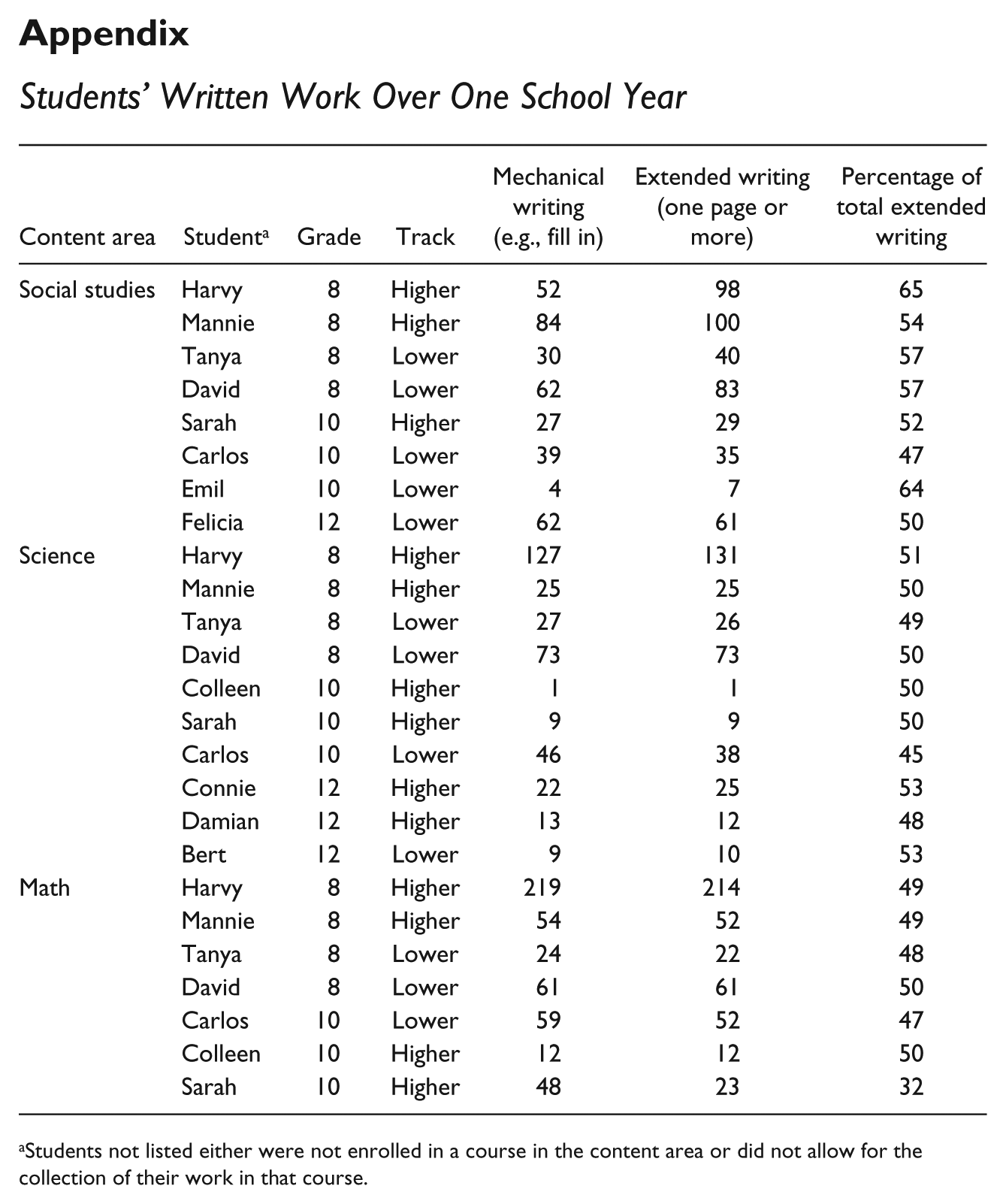
Students not listed either were not enrolled in a course in the content area or did not allow for the collection of their work in that course.
Acknowledgements
I would like to acknowledge Arthur Applebee and Judith Langer for their guidance and support during the data collection and analysis that eventually led to this article.
Declaration of Conflicting Interests
The author(s) declared no potential conflicts of interest with respect to the research, authorship, and/or publication of this article.
Funding
The author(s) received no financial support for the research, authorship, and/or publication of this article.