



Abstract
This study explored the perceptions of 430 P-12 urban teachers regarding the instruction of diverse students and their own ability to effectively implement culturally responsive teaching (CRT). Employing qualitative methodology, four open-ended sentence stems were used to capture teachers’ thoughts, beliefs, and experiences. Results reveal teachers’ strong commitment to CRT, an understanding of behaviors which constitute CRT, a strong sense of efficacy in teaching diverse students, and anticipation of positive outcomes through proactively addressing diverse students’ needs. This research provides valuable information for school districts and schools of education as they develop culturally responsive teachers for today’s diverse classrooms.
Students in U.S. classrooms today are dramatically different than they were in the past. This difference is particularly evident in substantial increases in the racial, cultural, linguistic, and economic diversity of public school students over the past few decades (National Center for Education Statistics, 2008; Ross & Bell, 2014). Serving such diverse students has created a need for changes at all levels of education, particularly in the classroom. Yet, not all educators have effectively responded to the changes in ways that support the academic and social needs of diverse students and ensure they receive a high quality and equitable education (Bennett, 2012; Brown, 2007; Phuntsog, 1999).
School leaders have a moral imperative to guarantee that all students are successfully educated regardless of their backgrounds. Accomplishing this goal requires the presence of teachers who have the knowledge, skills, and dispositions to support the diverse students in their classrooms (Boutte, 2012; Gay, 2010; Ladson-Billings, 1995, 2009). School districts need to assess teachers’ beliefs about and abilities to educate diverse students to inform decisions regarding the selection of new instructors as well as professional development for current teachers. This study (a) explores the perceptions of teachers in urban Southern California P-12 public schools regarding diverse students and culturally responsive teaching (CRT) and (b) compares their responses with the elements of CRT found in the literature. These teachers are challenged with educating learners in schools representing some of the poorest communities in the United States and where the majority are students of color.
Changing Demographics
The United States is more diverse today than it has been since the last wave of immigrants in the early 1900s. Approximately 1 million immigrants come to live in the United States each year (Martin & Midgley, 2006), with 9,105,162 newcomers arriving from 1997 to 2006. Most of these newcomers were from Mexico; nations in Asia, Latin America, and Central America; or islands of the Caribbean (U.S. Department of Homeland Security, 2007). In addition, it is estimated that there are over 12 million illegal immigrants in the United States (“Immigration Sabotage,” 2007). Most of these immigrant families send their children with diverse languages, cultures, and educational backgrounds to public schools.
Students of color in U.S. public schools in the fall of 2014, for the first time, collectively represented the majority (Ross & Bell, 2014). Non-White students already exceeded the number of White students in six states by 2004: California, Hawaii, Louisiana, Mississippi, New Mexico, and Texas (National Center for Education Statistics, 2008). The number of K-12 students of color in California public schools reached its highest in 2013 at 71% (California Department of Education Educational Demographics Unit, 2013). Many of these students of color are also socioeconomically disadvantaged and lack the resources necessary to support them in school (Veney, 2014).
A study by the Southern Education Foundation in 2011 revealed that almost half (48%) of all public school students are now designated as low income based on federal guidelines for receiving a free or reduced-price school lunch. This percentage was a substantial increase from 38% a decade earlier. Seventeen states have at least half of all public school students coming from low-income families, up from just four in 2000. California has 53.8% of its students designated as low income, and Mississippi has the highest number at 70.6% (Southern Education Foundation, 2013).
The Need for Culturally Responsive Teachers
Despite the high numbers of students from diverse ethnic, linguistic, and economic groups, over 83% of the teachers in P-12 public schools represent middle-class and White backgrounds that do not reflect the lives of today’s diverse student body (National Collaborative on Diversity in the Teaching Force, 2004; U.S. Department of Education, National Center for Education Statistics, 2007-2008). Many of these teachers lack the cultural knowledge, skills, dispositions, and experiences necessary to provide a quality education for students who represent differing levels of knowledge and skills and often come from ethnically, linguistically, ideologically, historically, politically, and economically different perspectives from their own (Bennett, 2012; Harriott & Martin, 2004; Trumbell & Pacheco, 2006; Warren, 2002). They often have preconceptions and misconceptions about their students, hold low expectations for their students’ academic abilities, and possess negative attitudes about their students and their families (Banks, 2006; Delpit, 2003). This is often attributed to a lack of preparation to teach culturally and linguistically diverse populations (Boutte, 2012).
New and veteran teachers admit that effectively educating non-White students is a key challenge in today’s schools. Sixty-three percent of new P-12 teachers, in a nationally represented sample (N = 641), indicated that they need more information on how to teach diverse students (National Comprehensive Center for Teacher Quality and Public Agenda, 2008). Many educators attribute the vast disparities that continue to exist between the academic achievement of students of color and their White and more affluent peers to this lack in teachers’ cultural competency (Boutte, 2012; Kozol, 2005; Ladson-Billings, 1995, 2009). Nationwide, more than one in four students of color do not graduate on time (Veney, 2014). The graduation statistics for California’s English learners is even more dismal with 38% (29% of the total student population) failing to complete their senior year (Leff, 2014). Nevertheless, research also indicates that, regardless of students’ race, socioeconomic status, or location, effective teachers can increase student academic performance (Darling-Hammond, 2000; Zeichner, 1996).
The dispositions or beliefs of educators as well as their ability to use effective pedagogical practices can greatly affect their teaching, particularly with diverse students. Culturally sensitive teachers understand the larger systemic influences that have affected disenfranchised groups over time and have prevented them from receiving a just and equitable education. This is the foundation for culturally responsive, culturally relevant, or culturally proficient teaching (Banks & Banks, 2009; Freire, 2002; Gay, 2010; hooks, 1994; Murrell, 1998; Nieto & Bode, 2007). Ladson-Billings (2001) suggests that cultural competence is present in classrooms where . . . the teacher understands culture and its role in education, the teacher takes responsibility for learning about students’ culture and community, the teacher uses students’ culture as a basis for learning, and the teacher promotes a flexible use of students’ local and global culture. (p. 98)
The goal of CRT is to ensure diverse students achieve through support such as respect for their cultural backgrounds, meaningful connections to the curriculum, appropriate communication, and effective instructional strategies (Irvine & Armento, 2001). However, as long as the population of students of color and socioeconomically disadvantaged students increases, without CRT schools will continue to marginalize these learners (Bennett, 2012; Kozol, 2005).
CRT
CRT evolved from a growing body of research that originated in the 1970s and 1980s (Boykin, 1986; Edmonds, 1986; Ramirez & Castaneda, 1974) and was further developed beginning in the 1990s by cultural difference theorists (Au, 1993; Delpit, 2006; Irvine, 2003; Ladson-Billings, 1995; Moll & Gonzalez, 2004; Nieto, 2010). Cultural difference ideology critiques and offers an alternative to the cultural deficit paradigm that depicts the cultural capital in the homes and communities of minority and low-income students as limited and the major factor causing their low achievement in school. Little consideration is given in the deficit model to the impact of the structures within schools or the political economy of the greater society on the achievement of low achieving, diverse students. Instead, the victims are blamed for their dreadful educational status and structural exclusion (Banks, 2010). This viewpoint has continued to affect America’s schools and is still held by many educators, resulting in uninspiring teaching and teachers’ low expectations for students, particularly in inner-city classrooms with high populations of socioeconomically disadvantaged African American and Latino students (Greene, 2009).
Cultural difference theory, in contrast, focuses on the strengths and resilience of the cultures, families, and communities of students from diverse ethnic, racial, and linguistic backgrounds (Wang & Gordon, 1994). Theorists with this ideology believe that the discontinuities between the home and community cultures of students of color as well as socioeconomically disadvantaged students and the school culture greatly contribute to low academic achievement. Therefore, these students will be more academically successful if educators and schools respect and utilize their language and cultural strengths. This is the essence of CRT (Banks, 2010).
Culturally responsive teachers understand the powerful role of culture in the educational system and place culture at the center as they analyze techniques for improving the performance of underachieving students of color. They largely believe that patterns in academic achievement among groups of students in the United States are not a result of individual limitations but rather due to the impact of institutional assumptions, structures, procedures, and operational styles of schools, classrooms, and the greater society (Gay, 2010). Teachers who are culturally competent purposefully incorporate the experiences and cultural orientations of students from diverse racial, ethnic, and economic backgrounds into their teaching strategies. These educators honor their students and their families and seek to develop the talent potential of underachieving diverse students, placing them at promise instead of at risk (Boykin, 2002).
Several scholars have introduced frameworks for CRT (Gay, 2002, 2010; Ladson-Billings, 2001; Phuntsog, 2001; Villegas & Lucas, 2002) outlining the essential elements. For the purposes of this research, Gay’s (2010) framework will be used. At the heart of Gay’s model of CRT are four dynamic components that are interwoven: caring, communication, curriculum, and instruction.
Culturally responsive caring, the ideological grounding of CRT, refers to how teachers relate to their students. The classroom interactions between teachers and students and among students often determine whether learning will be a success or failure for diverse students. Teachers’ attitudes and expectations (academic, personal, social, and ethical dimensions) as well as their pedagogical skills determine the tone, structure, and quality of instruction. “Caring teachers expect (highly), relate (genuinely), and facilitate (relentlessly)” (Gay, 2010, p. 47). They place their students at the center of the learning process with their strengths and personal interests used as opportunities for academic success. Culturally competent educators acquire a knowledge base about ethnic and cultural diversity as it relates to education and are continually culturally self-aware and conscious about what they do in the classroom as well as the effects of the educational system on their diverse students. They grow to view CRT as a moral mandate for teaching culturally and linguistically diverse students (Gay, 2010).
Effective communication, the tool of CRT, is also essential for quality instruction in the classroom yet many teachers carry with them misconceptions and confusions about their diverse students that cause them to struggle in communicating. While complex and challenging, educators who practice CRT incorporate elements of different cultural communication styles into classroom instruction. They analyze their own preferred discourse modes and compare them with those of their students to better understand how well their students negotiate the teaching. Using this information, culturally competent teachers seek ways to better communicate with their culturally and linguistically diverse students (Gay, 2010).
Curriculum that is culturally diverse and accessible to students is additionally critical for their success. Effective teaching and learning for diverse students must allow all students access to knowledge that is regarded as high quality and prestigious with a guarantee that they become literate in the core subjects. Curriculum, the resource of CRT, should be multicultural and accurately recognize the worth of the knowledge various ethnic groups have contributed. Culturally competent teachers ensure that the curriculum is meaningful and relevant to students’ lives and that they are included in curriculum decision-making (Gay, 2010).
Finally, CRT acknowledges the importance of incorporating aspects of the cultural systems of diverse groups into instruction. Instruction, the praxis of CRT, addresses the dialectic discourse, interaction, and engagement of students and teachers throughout the teaching and learning processes. Academic achievement improves when the processes of teaching correspond with the learning styles (participation, thinking, mental schemata), work habits, and experiences that diverse students bring to the classroom. Culturally competent teachers ensure that instructional processes are congruent with the learning styles, cultural orientations, and experiences of their marginalized students and create learning spaces for this to occur (Gay, 2010).
Method
The study employed mixed methodology to address the following research question:
This article emphasizes the qualitative portion of the study. Through qualitative inquiry, the researchers explored possible patterns and themes that emerged from teachers’ responses to four open-ended sentence stems developed for this study and compared their responses with the elements of culturally relevant teaching found in the literature (Gay, 2010). The four questions were attached to a longer quantitative online survey that was used for similar purposes. Thus, the findings from the quantitative questionnaire that were relevant to the qualitative findings are also briefly presented.
The Teachers
In total, 430 teachers from three Southern California urban school districts (242 elementary, 83 middle, and 105 high school) voluntarily participated in the study. Of the 430 completing the survey, 423 (98%) completed one or more of the sentence stems, and 416 (96%) completed all four sentence stems. The sample was comprised of 268 White, 26 African American, 105 Hispanic, and 31 Asian teachers. Of the 430 participants, 353 (82%) were female. The total teacher population in the three districts was 2,475 White, 420 African American, 1,327 Hispanic, and 140 Asian.
Participants in the study were teachers from three large urban districts. Each district had an enrollment of over 20,000 students who were ethnically and socioeconomically diverse. Over 80% of the P-12 students in these districts were of Hispanic/Latino or African American backgrounds, and over 80% were socioeconomically disadvantaged based on state demographic data from DataQuest (http://www.cde.ca.gov).
Instruments
All P-12 teachers in the three urban districts were emailed an invitation to participate in an online survey by their district office. The quantitative survey was comprised of items from the CRT questionnaire developed by Phuntsog (2001), the Culturally Responsive Teaching Self-Efficacy (CRTSE) scale developed by Siwatu (2007), and the Culturally Responsive Teaching Outcome Expectancy (CRTOE) scale developed by Siwatu (2009). All 104 survey questions used a 6-point scale from “strongly disagree” to “strongly agree.”
The four open-ended sentence stems used for this study were attached to the online quantitative survey: (a) “I would describe my attitudes and feelings toward diverse student populations (or multicultural issues) as follows . . .”; (b) “Culturally responsive teaching or instruction that recognizes and affirms the culture, history, and language of diverse students would include the following teaching behaviors . . .”; (c) “My capacity/ability for effectively teaching culturally diverse students is . . .”; and (d) “I believe that instruction that meets the academic needs of culturally diverse students will produce the following outcomes/results . . .” These four sentence stems produced the qualitative data.
Quantitative Component Preliminary Findings
Results from the preliminary analysis of the questionnaire (Jiang, Bonner, & Warren, 2013), specifically using Principal Components Analysis (PCA) with varimax rotation of CRTSE (Siwatu, 2007), produced factors related to integrating students’ culture into instruction, enhancing teachers’ CRT self-efficacy, enhancing positive home–school–teacher–student communication and relationships, implementing strategies to make learning meaningful, identifying biased assessments, use of culturally relevant instructional materials, establishing connectedness to English-language learners, being knowledgeable about students’ home life, and developing teacher–student relationships. The qualitative results consistently supported these identified factors from the CRTSE.
PCA with varimax rotation of CRTOE (Siwatu, 2007) revealed factors related to increased academic self-identity, image, ability, and achievement motivation; instructional strategies associated with deep learning, home, school, and parental relations; student–teacher communication and mutual understanding; and fair assessment and instructional sensitivity to English-language learners. The qualitative results also related to these identified factors from the CRTOE.
Qualitative Findings
The electronic written responses to the four sentence stems by 423 of the 430 teachers produced a massive amount of qualitative data, a total of 127 single-spaced pages and 53,423 words. As a result, the responses were entered into NVivo software and analyzed through the process of coding by creating nodes and subnodes. Reading and rereading the responses and subdividing nodes into subnodes produced a total of 34 categories and subcategories. All of these data (152 pages) were printed, read, reread, and analyzed into initial codes as depicted in Table 1, which should be read from the bottom up and which is based on Anfara, Brown, and Mangione’s (2002) recommendations for documenting and reporting qualitative research in a manner that substantiates and makes public the analysis of the findings. Following the comprehensive organization of the major classifications, further analysis and review produced patterns depicted in the second iteration of Table 1. Finally, these patterns were condensed and summarized into comprehensive themes that responded directly to the four sentence stems which explored teacher perceptions regarding their attitudes and feelings toward CRT, teaching behaviors appropriate to CRT, the effectiveness of CRT, and potential outcomes of CRT.
Code Mapping: Three Iterations of Analysis.
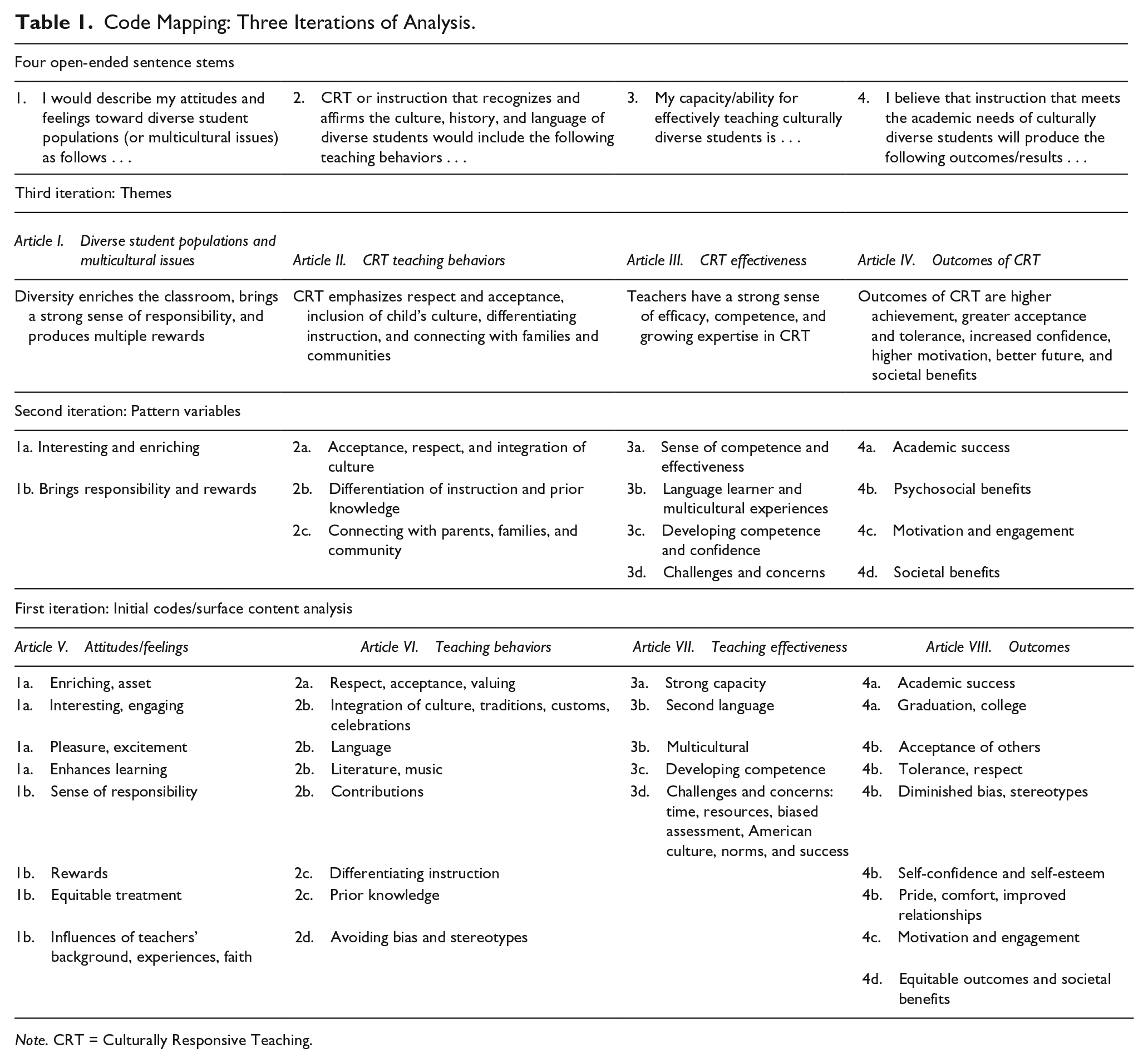
Note. CRT = Culturally Responsive Teaching.
Theme 1: Diversity Enriches the Classroom, Brings a Strong Sense of Responsibility, and Produces Multiple Rewards
Theme 1a: Enrichment of classroom environment
Teachers’ responses reflected a strong appreciation for the value of cultural diversity within the classroom. They most frequently used words such as enrich, rich, richness, asset, and wealth when speaking of the value of diversity in their classrooms: Diverse student populations add a richness to the classroom, and these populations often expand the shared knowledge of the student body. We should value the diversity of students we have, because they all bring different experiences and backgrounds to the table that can help us grow in our understanding of who we are in the world. Diverse student populations are an asset. While the language barriers can be difficult, the various cultures, languages, and beliefs enhance the classroom discussions and learning. I learn much from my culturally diverse students. Their lives and stories have enriched my teaching and my attitudes toward all cultures.
Teachers also believed that student diversity not only strengthened learning but also made it more interesting and engaging: Diversity makes life more colorful, and learning more vivid . . . it makes a classroom climate burn with vigor and enthusiasm. Not only do I consider myself someone who respects diverse populations, but I embrace them, am interested in learning about them, and I enjoy being a part of them. Diversity just makes life and my classroom more fun and interesting. Every student is a beautiful ingredient in a recipe for learning. Some are more spicy than others, but it would be bland if we were all the same.
They spoke of pleasure, gratitude, and excitement in encountering diverse populations every day in their classrooms: I am so grateful to work and live in a state that offers such vast diversity in the classroom. Every year I feel that I learn more about the world and others and myself as I interact with the beautifully varied faces of my students. To be honest I find it quite exciting when I get my class roster and I get to see the different cultures I will be learning about for the school year. I think it is just great. We are just one piece in this puzzle we call earth, and it is a small piece at that!
In addition, teachers expressed the conviction that they and their students learn more as a result of diverse student populations and that a variety of cultures, backgrounds, and languages, enhances each student’s academic understanding and learning: Every year I feel that I learn more about the world and others and myself as I interact with the beautifully varied faces of my students. Diversity in the classroom is what makes all students and myself learn the most. I think different backgrounds enhance the learning environment for all students. We try to develop open-mindedness and empathy at our site.
Theme 1b: Diversity accompanied by strong sense of responsibility, rich rewards, convictions, and challenges
Teachers described their sense of the substantial responsibility of teaching a heterogeneous student population: We live in a diverse community. To ignore the differences in culture is a disservice to our students. When they grow up and begin to interact with the community, their differences will be noted. They may even experience biases and discrimination because of their differences. As educators, we have to prepare them, mainly by building them up to stand their ground and know who they are as a people. They have to know the greatness of their culture to help build their self-esteem and confidence in their ability to be a contributing member of this society. My attitudes and feelings towards diverse student populations is the responsibility to ensure that students learn to respect one another. I feel that it is my responsibility as a teacher to be able to differentiate instruction, as well as classroom management, to include every student in my classroom. I feel that every student has the ability to learn in a safe and comfortable environment, and I need to be able to find ways to make diverse students feel welcome in the classroom in order for them to be able to learn.
Although teachers recognized the inherent challenges in teaching diverse student populations, they noted the balance of rewards: Teaching diverse student populations is challenging but makes me excited since I can understand multicultural issues and help students get along with the environment they live in. It is a blessing and huge responsibility to work with diverse student populations. Although it is more challenging, it is also more rewarding. Although extremely challenging to meet the unique needs of the various populations, it is the most rewarding.
They also expressed firm convictions and principles regarding the rights of students to equitable treatment, respect, and high expectations in the classroom: I believe that all students have the same rights and deserve the best quality of education regardless of their ethnicity or culture. I believe that all students’ cultural backgrounds should be equally respected and represented within the classroom. Tolerance should be a main focus in the classroom and no tolerance for racism, prejudice, and gender bias-ism in the classroom. All students deserve my attention and not one specific group will be favored over the other. I believe that all students from all ethnicities and cultures and abilities deserve the right to have the highest academic program that I can provide.
Theme 1c. Teachers’ influences of cultural backgrounds, life experiences, and religious faith
Teachers described the influence of their own culture, life experiences, and religious beliefs on their attitudes and beliefs related to diversity in the classroom: As a person of color I welcome a classroom of diverse student populations. I enjoy the challenge of designing lessons to meet the needs of all my students. I myself am a student that came to this country and had to learn the language and adapt to the American culture. I am grateful to the teachers that took their time to learn about my background and made me feel important. I believe that celebrating our differences makes a big difference and encourages students to work together. As I am bilingual/bicultural I have not only empathy but also challenge students to try harder in all areas; and I expect all students to treat each other with respect and kindness. I am also very accepting of students who are gay, lesbian, and/or transgender because I have close relatives who belong to this “group.” I believe that all people/students, regardless of culture, can make valuable contributions to our world. God made us all in His image and He calls on all of us to do work in His kingdom.
Theme 2: CRT Emphasizes Respect and Acceptance, Inclusion of Child’s Culture, Differentiating Instruction, and Connecting With Families and Communities
Theme 2a: Respect, acceptance, and valuing of child, culture, family, and community
Teachers repeatedly avowed the need to demonstrate acceptance, respect, and sensitivity for each child and his or her culture, language, and other differences: It is incredibly important in increasingly diverse classrooms that we learn to not only incorporate other cultures into our lessons, but that we strive to appreciate what they bring to the table. Each student is different but those differences should be celebrated not suppressed or ignored. There is a beautiful mosaic of humanity in our classrooms, and I hope and pray that as an educator I can do what I can to recognize and meet the needs of that mosaic. You respect each child and treat each child like they are valuable contributors to your classroom. This means you incorporate their everyday experiences into your curriculum. Responding to various cultures in the classroom with deep respect and using language that affirms their culture, without being exclusive or stereotypical. Helping students become proud and aware of their culture, history, and language and sharing that same pride with the rest of the class.
Teachers recognized the connection between valuing culture and involving parents, family, and community in the classroom: Enlisting parent and student discussions about their culture and integrating that information into the curriculum. Sharing of special talents, interests that may be unique to a particular culture. Parents and community members are sometimes invited to present and share. I also try to involve all parents as volunteers in whichever ways they feel comfortable. We want families to know that all are welcome to contribute to the school community. Experiences and help from parents and community members from various backgrounds.
Theme 2b. Intentional inclusion of students’ culture such as language, literature, traditions, contributions, customs, music into daily life of classroom
Teachers were specific in terms of the types of cultural components that could be integrated into the daily life of the classroom, such as language, literature, traditions, contributions, history, and customs: Including literature that is inclusive of all the cultures of my students, celebrating contributions of people from different cultures, celebrating holidays from my students with the entire class, inviting family members to share things about their cultures, learn words from the different languages of my students. Culturally responsive teaching allows the students to fully participate in the shared academic environment by bringing their unique traditions and cultural norms to school. My students are allowed to share any relevant (and appropriate) stories or events from their cultures that may be new to the other students. It would teach cultural admiration for all cultures. It is not hard to do considering the wonders of each and every cultural group. I emphasize and praise cultural groups by bringing in photos, artifacts, film clips that demonstrate the achievement of the world around us. A globe is my best friend as I always show the children who is where and who they are.
Theme 2c. Differentiating instruction and connecting prior knowledge with learning
Teachers also recognized the necessity of differentiating instruction as well as assessment to address various learning needs, including cultural background and language: Differentiating instruction so that I am using teaching techniques that work for the different learning types, including examples from all the different cultures in my class so that the material is made real for all students, patience when learning and language barriers exist, and finally recognizing and celebrating that there is a cultural difference in the classroom. Formative assessment is ongoing and diagnostic to understand how to make instruction more responsive to learner need. Multi-option assignments are frequently used. Time is used flexibly to address student need. Multiple perspectives on ideas and events are routinely sought. It includes diverse literature, varying teaching strategies, multiple choices for learning activities, and opportunities for students to learn from each other.
Teachers understood the relationship between valuing students’ culture and connecting prior knowledge with new learning: A teacher should consciously make an effort to tap into the prior knowledge of students when designing the lesson. Use students’ prior knowledge about topics they are going to discuss in class to help them make connections between what they already know and what they are going to learn. Able to relate concepts and ideas to their culture, history, and language. Talk about prior knowledge and build upon it when teaching concepts, skills, and ideas.
Theme 2d. Cautions regarding possible biases and identifying and avoiding one’s biases, prejudices, and stereotypes
Teachers were aware of the potential for bias and stereotypes and cautioned the need for self-reflection and examination: A teacher has to check her attitudes to make sure she is not overlooking someone because of their cultural background. We all come with prejudices or preconceived ideas. It’s natural. But we have to be better than that, and as reflective practitioners, make sure we are not unconsciously neglecting a student or not putting the same amount of effort into teaching them. I believe to truly do this is difficult. It means being constantly vigilant. Addressing perspective—Evaluating self-bias—Evaluating others’ biases—Asking questions—Allowing for many possibilities—Avoiding stereotypes—Reserving judgment.
Teachers’ responses regarding their capacity to effectively teach culturally diverse students primarily reflected a strong sense of competence balanced with a recognition of the need to continue to improve. There was a strong orientation toward learning, growing, and developing increasing competence. Having experiences similar to culturally diverse students strengthened teachers’ sense of efficacy.
Theme 3. Teachers Have a Strong Sense of Efficacy, Competence, and Growing Expertise in CRT
Theme 3a. Strong capacity to teach culturally diverse students
The most prevalent, recurring response from teachers was that their capacity for teaching culturally diverse students was strong, excellent, high, good, or above average. Common responses were as follows: . . . believe I have great capacity to effectively teach culturally diverse students. I understand their needs and have a great relationship with parents. . . . only limited by my willingness to immerse myself in the diversity in my classroom. Positive and great . . . Especially being a person who is from a different culture, I feel that I can truly relate to these children and that I can understand them on a deeper level.
Theme 3b. Teaching efficacy strengthened by second language and/or culturally different learner experiences
Some teachers recognized that their own multicultural and language-learning experiences contributed to their effectiveness with culturally diverse student populations: Due to the fact that I myself belong to a minority culture. This allows me to teach through this context and to help students appreciate differences. . . . being an English Language Learner myself, I am able to share my stories, misunderstandings, and my struggles in learning English in America. My ESLs are able to relate to my stories and love to share their own.
Theme 3c. Developing and growing in competence
Teachers who did not feel as confident nor strong in their capacity to provide culturally responsive instruction indicated a motivation to continue to learn and develop competence: Growing. I am learning new things and have to be intentional about implementing best practice. Still progressing. I am new to this concept; however, with my main goal for my classroom being for every student to succeed, I will do anything for those students that come from different cultural backgrounds to make them feel comfortable and succeed. Average—I’d love to receive more training in this area.
Theme 3d. Challenges and concerns
Even with a prevailing enthusiasm for classroom diversity and an overall sense of strong expertise, some teachers expressed frustration with the challenges inherent in addressing a multitude of cultures and languages in daily classroom instruction. Constraints included lack of time, scope of the need, educational emphasis on high-stakes and biased assessment, and standardized curriculum: I wish I knew some language from each linguistically diverse group represented at our school but there are 96 languages represented. I sometimes have 10 to 15 different ethnic cultures. It sometimes feels overwhelming simply looking up the information . . . difficult to incorporate so many different cultures. I can speak Spanish so the Spanish speakers connect with me easily. It isn’t so easy with the children of other countries. I am limited in knowledge about their culture, and of course, the language . . . I can’t honestly say that I give equal support and attention to the non-Spanish-speaking students. It is very difficult to be equally knowledgeable in so many different cultures! My capacity for effectively teaching culturally diverse students is hindered by the focus on standards and teaching to the test. Limited by the time that it takes to develop a culturally diverse knowledge base and gathering the appropriate resources. Handicapped, as the current direction of teaching and learning requires a narrowing of focus to prepare students for high stakes standardized tests that are biased and not culturally diverse.
There were isolated critiques of the concept of culturally guided instruction relating to a potential negative effect and the need to promote “American culture” in order that students can be prepared to succeed in the dominant culture: I also believe it is our responsibility to educate ALL our students to be productive members of the United States, including our cultural norms, our commonly used language (English), our patriotism, etc. I do believe that any person, young or old, should make progress toward acclimating themselves to our culture. I believe one can do this without abandoning his or her own culture. At the same time, it is also my job to help students understand what is expected of them in American education and the American workplace. I want my students to be good in both worlds! Understanding cultural differences is important to understand the children and their needs. However, there are “norms” in our culture that bring us together that identify us as American. These are norms that culturally diverse students NEED to learn in order to be successful in America. These are important to teach.
Theme 4: Outcomes of Higher Achievement, Greater Acceptance and Tolerance, Increased Self-Confidence and Self-Esteem, Higher Motivation, Better Future, as well as Societal Benefits
Theme 4a. Higher achievement and graduation rates as well as increased college attendance
Teachers envisioned broad, constructive outcomes from instruction that meets the needs of culturally diverse students. They consistently projected higher achievement and greater academic success: Higher test scores. Higher number of graduates. Higher number of students attending college. Pride. Higher levels of understanding. Life application skills. The achievement gap will start to close and there will be less culturally biased testing done in our schools. This means that students from diverse backgrounds will have opportunities beyond what they have had in the past. It means that students first in their families to graduate high school will go on to further graduate from college and receive the skills necessary to give back and empower others. Teaching students and really meeting their needs allows them to be successful and thrive.
Theme 4b. Acceptance, tolerance, and respect for others
They also projected students having a greater acceptance of their own culture and other cultures as well as increased tolerance and harmony and reduced bias and stereotypes: Will produce students that feel proud of their own cultures . . . [They] will also respect, admire, and promote diversity in their future lives . . . it will make this world a better place to live. I believe it is crucial to celebrate cultural diversity with my students. It validates who they are as a person and helps educate others about the diversity in our world. It helps build tolerance for people of different cultures. I believe in learning about different cultures and comparing how they are similar and different. This shows we are all people with the same wants and needs, but the way we interpret the world may differ in some ways. Allowing students to learn about diversity is very important to the classroom culture because it broadens their perspective and hopefully diminishes bias. An appreciation for diversity among students, decreased prejudice among students, increased awareness of the different cultures, compassion, and acceptance of other people.
Theme 4c. Increased self-confidence and self-esteem
A large number of respondents mentioned one or more of the following as student outcomes from culturally responsive instruction: self-esteem, self-worth, confidence, improved self-image, self-respect, and pride.
Confidence in their abilities, higher test scores, higher self-esteem; students will become positive contributors to society. Students develop greater confidence and self-esteem. A sense of pride, higher self-esteem, and a sense of self-worth on their part and their parents’ part. Hopefully produce lifelong learners. Learners that have a positive self-esteem and a good feeling about their schooling.
Theme 4d. Enhanced motivation and engagement
Finally, as a bolster to academic learning and achievement, teachers believed that recognition and inclusion of culture would make learning more meaningful and relevant, thus inspiring higher motivation and greater engagement in learning. They projected that
Student motivation increases when students can relate to the lessons taught. Learning will become more meaningful to all students. Therefore they will be more engaged in the learning which leads to enhanced learning and better outcomes. Students will be more motivated to continue learning. The attendance of students will be higher because they will feel a level of trust and respect from their teacher and classmates. It will also make the content more relevant and applicable to the students and therefore keep them more engaged than if the information was completely disconnected to their daily lives. More motivated students who have self-esteem and are motivated to continue their education.
Theme 4e. Better future and societal benefits
In addition to favorable classroom and learning outcomes, respondents predicted a better future for students and broad societal benefits, with statements such as the following: It will produce competent individuals who are contributing members of our society who have confidence in their abilities and who interact with others successfully. Meeting the academic needs of culturally diverse students will broaden our country’s perspectives. We live in a global economy where employers will need people who are able to work with many kinds of people. The student will have the capability to work in the real business world. This means the student will be able to relate to problems from different cultures in order to solve problems that meet the needs of customers and fellow employees. Global citizens and culturally sensitive humans.
Connections With the Quantitative Survey Results
The qualitative data and analysis expand and elaborate on the quantitative results, which triangulate and support the qualitative results, indicating teachers’ strong commitment to CRT and understanding of behaviors which constitute CRT, a strong sense of efficacy in teaching diverse students, as well as anticipation of robust, positive outcomes from proactively addressing the needs of these students.
Specifically, in the qualitative data, teachers indicated that their understanding of effective CRT behaviors included integrating children’s culture, such as traditions, customs, language, music, and literature, into the curriculum and teaching. This correlates with the quantitative survey results factor related to integrating students’ culture into instruction as well as the need to employ culturally relevant instructional materials and examples. Likewise, in Theme 2, teachers considered that connecting with parents and families was a part of culturally responsive pedagogy, and this related to the factors of home, school, and parental relations as well as the need to enhance positive home–school–teacher–student communication and relationships. Theme 3 which reflects teachers’ strong perceived teaching self-efficacy and a growing sense of expertise in CRT is consistent with the component of meeting students’ needs to enhance teachers’ CRT self-efficacy. In terms of the outcomes of CRT, teachers perceived that increased motivation and engagement would be a result. This was also indicated in the CRTOE factor of the relationship of achievement motivation with CRT. Thus, there are numerous substantiating connections between the varimax rotation analysis of CRTOE (Siwatu, 2007) and CRTSE (Siwatu, 2009) and the themes developed from the extensive qualitative data of the sentence stems completion.
Connections With the Literature on CRT
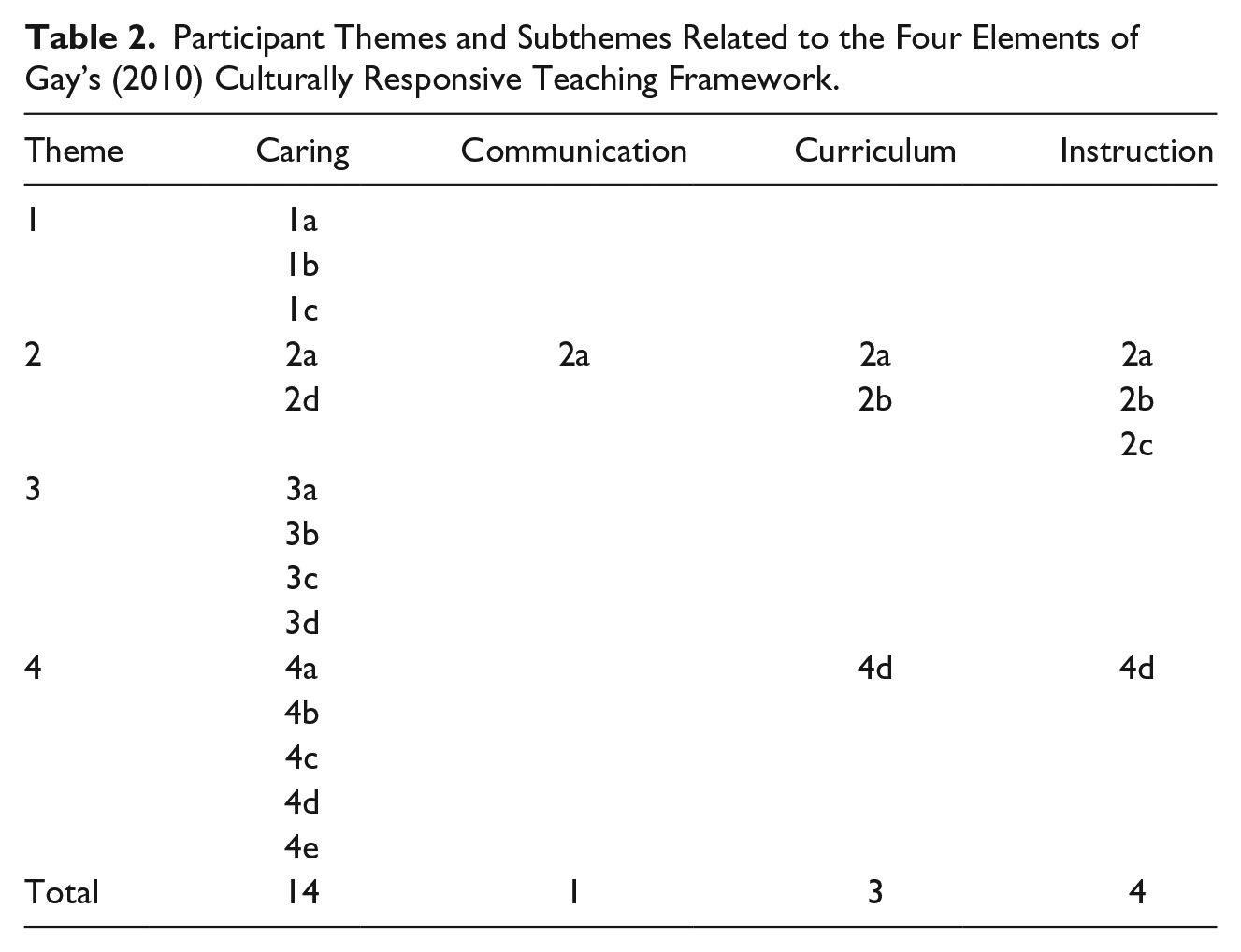
As mentioned in the review of the literature, the themes from the teacher participants in this study were compared with the four elements of CRT outlined in Gay’s (2010) framework: caring, communication, curriculum, and instruction. Table 2 indicates the subthemes relating to each of the CRT elements. Fourteen of the subthemes were related to caring, one to communication, three to curriculum, and four to instruction. One subtheme, 2a, was related to all four elements; one subtheme, 4d, was connected to three elements; and one subtheme, 2b, was in two elements.
Participant Themes and Subthemes Related to the Four Elements of Gay’s (2010) Culturally Responsive Teaching Framework.
Summary
The responses of 423 elementary, middle, and high school teachers in this study provided strong evidence that Southern California urban teachers of culturally diverse student populations have overwhelmingly positive attitudes toward culturally diverse student populations and responsive pedagogy. They also report perceived high efficacy and competence in teaching diverse students, accompanied by a motivation to continue to learn and develop expertise. Their understanding of culturally responsive pedagogy is broadly encompassing of fostering attitudes of acceptance and respect, inclusion of varied aspects of culture, and connection with families and communities. They envision impressive outcomes, not only for P-12 learners in terms of achievement, high school graduation, and college attendance but also for society as a whole with a wholesome integration of diverse individuals in the workplace and communities.
Discussion
The voluminous results of the 423 elementary, middle, and high school teachers’ responses to four sentence stems facilitate insight into their attitudes and beliefs as well as their understanding and commitment to CRT. The fact that 98% of the teachers who responded to the survey also responded to one or more of the four sentence stems and that 96% responded to all four of the sentence stems with enthusiastic, lengthy, colorful, rich language indicates their passion for and commitment to meeting the needs of culturally diverse students. In general, teachers reported a strong appreciation for diversity in the classroom and the many ways it enriches and informs classroom learning. They also seemed to accept and own the inherent responsibilities brought by this diversity, and they embraced the rewards. These responses reflect the caring, consciousness, and sense of responsibility to culturally and linguistically diverse students that is referred to in the literature as the ideological grounding of CRT (Gay, 2010; Ladson-Billings, 2001; Villegas & Lucas, 2002).
Teachers believed that CRT behaviors encompassed the inclusion and acceptance of and respect for differences in students’ culture, language, and history, including human contributions. Learning to communicate with diverse students and their families is considered the essential tool of CRT. Ensuring that the curriculum is multicultural and includes the contributions of all cultural groups is the fundamental resource of CRT (Gay, 2010). The teachers in this study also recognized the appropriateness of, and necessity for, differentiating instruction and utilizing prior knowledge as an integral part of CRT as well as fundamental effective instruction. They believed that the inclusion of students’ culture, family, background, and interests would produce more meaningful learning, higher engagement, and motivation. Effective instruction, or the praxis of CRT, combines the other three components and sets them into action to expedite learning (Brown, 2007; Gay, 2010).
Teachers reported an unexpected strong sense of efficacy and competence in CRT and were generally strongly motivated to continue to grow and develop in expertise. It may be that because the teachers were serving students in highly diverse communities and schools, they had been more fully prepared in the area of culturally responsive pedagogy than teachers in less diverse schools and communities. Thus, they may not only have perceived a greater degree of expertise in serving the varied students but were also more aware of the concomitant benefits and positive outcomes that effective culturally responsive pedagogy can generate. The ideological foundation of CRT, caring, is a combination of commitment, concern, compassion, responsibility, and action. Culturally responsive teachers continually reflect and engage in cultural self-awareness and consciousness-raising. They view CRT as a moral mandate and lifelong process as they strive to grow personally and professionally (Gay, 2010; Milner, 2006, 2011).
The teachers’ lofty expectations for the outcomes of CRT were as also unanticipated and gratifying. They perceived benefits for students not only for the present in terms of higher achievement and enhanced learning but also for the future in terms of higher graduation rates and university attendance as well as greater success in the world of work and in life. In addition, they envisioned even broader and longer range positive outcomes in their sense that society and life in America would benefit from its citizens learning to accept, respect, and understand each other regardless of background and culture. These educators viewed their commitment to CRT as helping the students transform both inside and outside of classrooms and schools. According to Gay (2010), this caring-based form of education “has academic, civic, social, personal, cultural, political, moral, and transformative learning goals and behavioral dimensions” (p. 51). The teachers in the current study expressed this through their impressive vision for their students and beliefs about the benefits of CRT.
The findings from the study suggest that some teacher preparation programs as well as school district professional development efforts may include a strong component of preparing teachers to effectively serve diverse student populations.
Conclusions and Implications
The ideological foundation of CRT is caring which begins with educators’ personal and professional self-awareness. Teachers must continuously reflect on their own beliefs and biases to become more culturally conscious and committed to supporting marginalized, diverse students. Subsequently, they will commit to gaining the necessary skills to become culturally competent and responsive (Gay, 2010; Milner, 2011). While the urban teachers in this study shared perceptions aligned with the tenets of CRT, particularly in regard to caring about students, this does not represent all teachers (Brown, 2007; Delpit, 2006; Kozol, 2005). It does, however, indicate that within three large, urban school districts with a majority of students who are culturally and linguistically diverse and socioeconomically disadvantaged, there is a substantial group of teachers who perceive themselves to be culturally competent. This can be a starting point for any urban school or district.
Teachers need opportunities to not only reflect on their expectations and interactions with cultural diversity in the classroom but to dialogue with colleagues who can help them make sense of their behaviors and improve them (Gay, 2010; Senge, 2006). Building cultural competence is a journey that requires support and guidance. Spindler and Spindler (1993) suggest cultural therapy, a process for working with teachers to build cultural competence that combines personal awareness with professional analysis as well as cultural knowledge with instructional action. Teachers, such as the participants in this study, who identify as culturally competent could become mentors or coaches for their colleagues at the beginning of the journey as well as partners with those further along. An investment of time and training could result in educators who are committed, responsive, and competent to teach culturally and linguistically diverse students who have been historically underserved. The outcome of more culturally responsive classrooms could be substantial achievement gains for the urban students who are often disenfranchised and left to fail (Bennett, 2012; Eisenhart & Cutts-Dougherty, 1991; Erickson, 2010; Gay, 2010; Ladson-Billings, 2009).
Recommendations
The findings from the study suggest that some teacher preparation programs as well as school district professional development efforts may include a strong component of preparing teachers to effectively serve diverse student populations. Consideration of other necessary supports such as time and resources for adequately preparing culturally responsive curriculum and instruction is also indicated by the study.
The results indicate the importance of investigating the relationship among teachers’ perceptions of characteristics of CRT, their ability to execute specific CRT practices, and their beliefs that engaging in CRT practices will have strongly positive classroom and student outcomes. This research can provide valuable information for school districts and universities as they prepare teachers to be more culturally responsive in today’s diverse K-12 classrooms.
As the teachers in the study were from Southern California urban, highly diverse schools, it would be helpful to conduct the study with teachers of other types of student populations, such as rural schools, suburban schools, and less diverse student groups but whose students still need the kind of instruction that speaks to and addressees their unique cultural backgrounds. In a subsequent study, it might be helpful and of interest to match teachers’ culture and/or ethnicity to their responses to ascertain more specifically the possible influences on their perceptions and beliefs regarding culturally responsive pedagogy as well as toward culturally different student populations. Follow-up interviews with the current study participants or teachers with like experiences could also provide more detail and specificity regarding the types of professional development and supports that would continue to strengthen the education of students who must cope with being culturally different while struggling to learn and achieve in a classroom setting which reflects a different culture and often language as well.
Transforming schools so that the educational experiences for all students are equitable and excellent will require educators at all levels who are committed to the vision. School leaders must promote and implement education policies reflecting diversity as a strength, provide professional development on effective practices for teaching culturally and linguistically diverse students, and offer teachers ongoing opportunities to work together exploring best practices as they grow in their abilities to create culturally responsive classrooms (Brown, 2007). Based on this study, school districts should begin this work by assessing the knowledge, skills, and dispositions of teachers regarding diversity and CRT. Identifying a cadre of culturally competent teachers who could serve as mentors or coaches could benefit a professional development plan for all teachers’ growth in CRT. “When people truly share a vision they are connected, bound together by a common aspiration” (Senge, 2006, p. 198). A vision for equity in education should result in teaching, classrooms, and schools that are more responsive to the students they serve.
Footnotes
Declaration of Conflicting Interests
The author(s) declared no potential conflicts of interest with respect to the research, authorship, and/or publication of this article.
Funding
The author(s) received no financial support for the research, authorship, and/or publication of this article.